








Candy Rush Wilds Slot Review
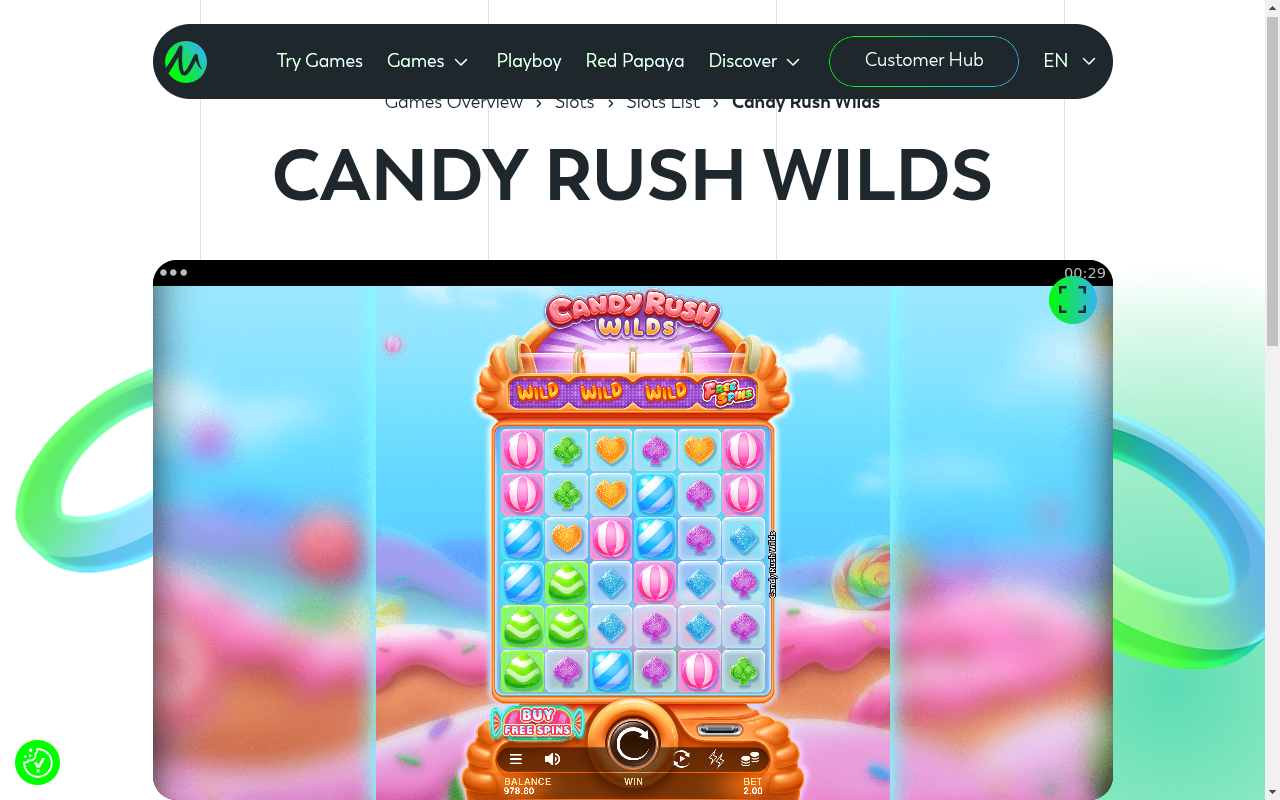
Frosted candy hills roll away under a pale blue sky, the reel frame piped with icing curls like a confectioner’s showpiece, a swirled lollipop leaning in from the right edge. It’s a lot of sugar for a game this plain, and that’s the interesting thing about it: Candy Rush Wilds is one of the most stripped-back cluster grids you’ll come across, with one mechanic and no paylines, and it leans on that single idea harder than most of its sweeter-tempered rivals dare.
The studio behind the sugar is Games Global, and the build is a 6×5 grid running the ClusterChase™ system at 96.75% RTP and medium volatility, with Free Spins and a Buy Feature on top. It later gained a sequel, Candy Rush Wilds 2, which turned the volatility up to high and rebuilt the progression around a filling meter. Next to Sweet Jar Combo, this original is the gentler sweet tooth’s pick.
The ClusterChase™ System
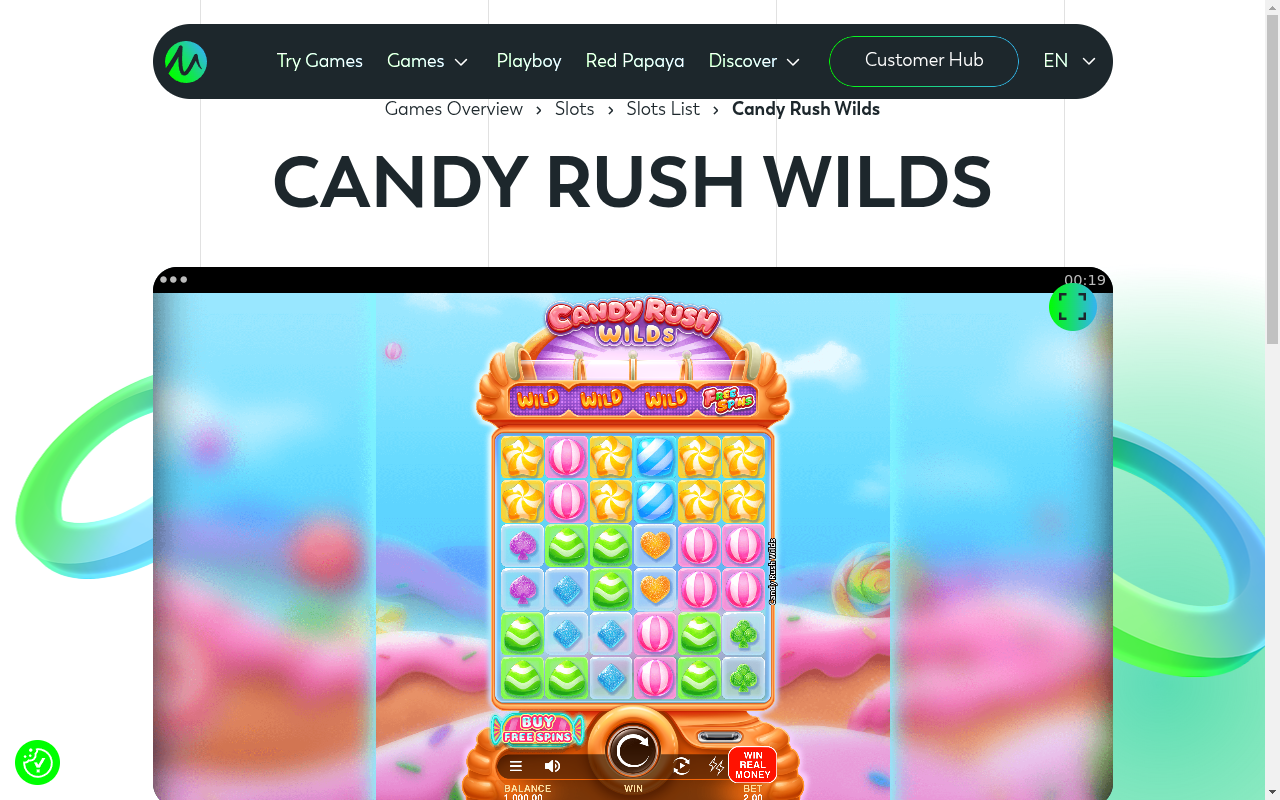
A ClusterChase™ is a group of symbols sitting next to each other, horizontally or vertically, anywhere on the 6×5 grid. Five or more matching symbols makes it a winner. Where a payline game needs things lined up left to right, here a blob of gobstoppers in the middle of the board pays just as well as one tucked into a corner.
The rules of a cluster, in full:
- A ClusterChase™ is a group of symbols adjacent horizontally and/or vertically
- A winning ClusterChase™ consists of 5 or more matching symbols
- A ClusterChase™ can form anywhere on the reels
- A ClusterChase™ can award multiple consecutive wins
- Only the highest winning combination is awarded per ClusterChase™
- Winning symbols are removed to make way for new symbols
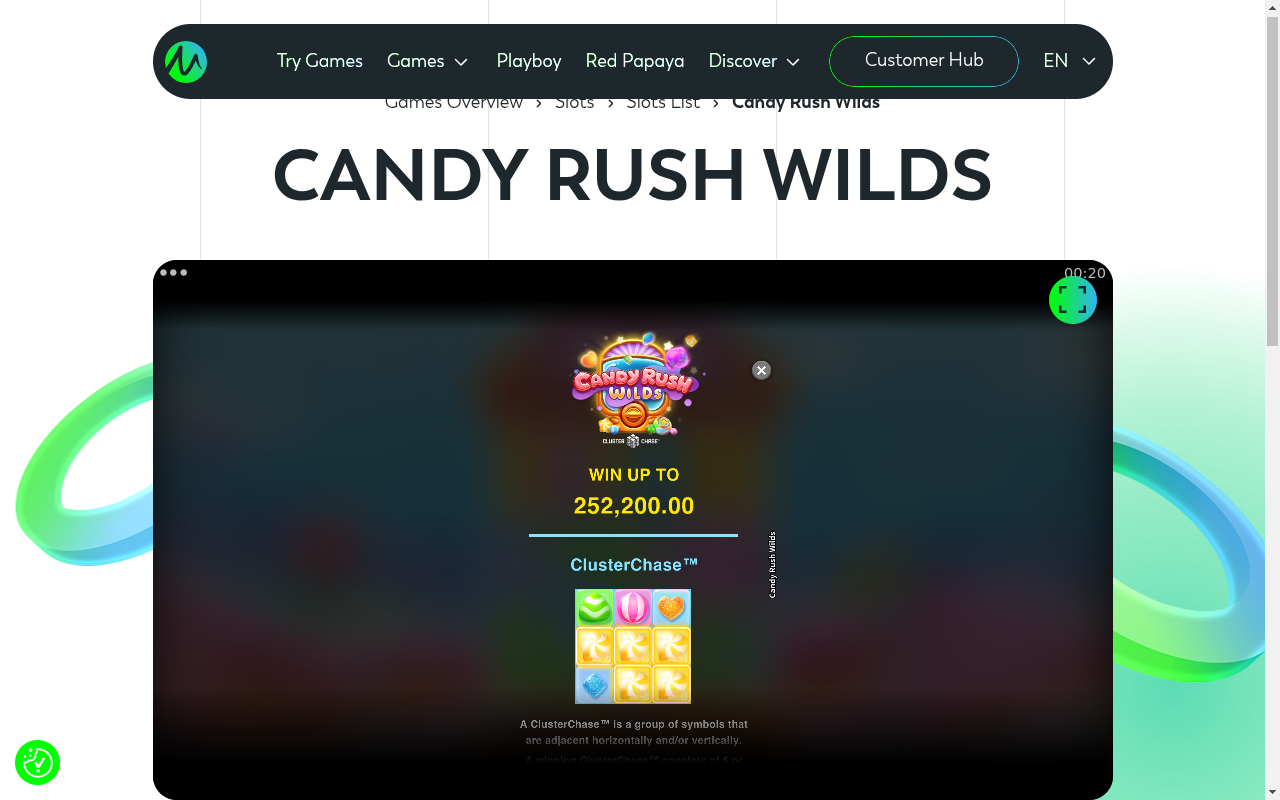
That last rule is where the game’s motion comes from. Winning symbols vanish, new ones drop into the gaps, and any fresh cluster of five or more sets the removal off again. A single spin can therefore chain several wins together, one after another, until a drop leaves no winning group behind.
The size of the first group is only half the story, because a cluster is never really finished when it pays. Every removal reshapes the board, and what cascades into the vacated positions decides whether the chain continues or stalls. Two spins that begin with identical-looking clusters can end completely differently depending on the symbols that arrive to replace them.
How Clusters Pay
Each cluster pays only its highest combination, so there’s no double-dipping when two overlapping groups share symbols. If two winning groups form in the same cascade, each settles on its own best result. The removal and refill then run their course regardless, which is what keeps a good drop alive.
The one gap in what’s documented is the per-symbol values: no paytable of individual symbol pays exists for this game, so a cluster’s worth comes down to how many symbols it holds and what cascades in behind it rather than a fixed ladder of multiples. There’s no maximum win multiplier either, and the advertised top prize is a cash amount rather than a multiple of stake.
The grid itself is the whole engine. Symbols clearing between wins keeps the board in constant motion whenever a cluster lands, and the chain only stops when no new group of five or more forms. For a game with a single mechanic, that mechanic gets a lot of mileage out of a simple idea.
Symbols and the Wild
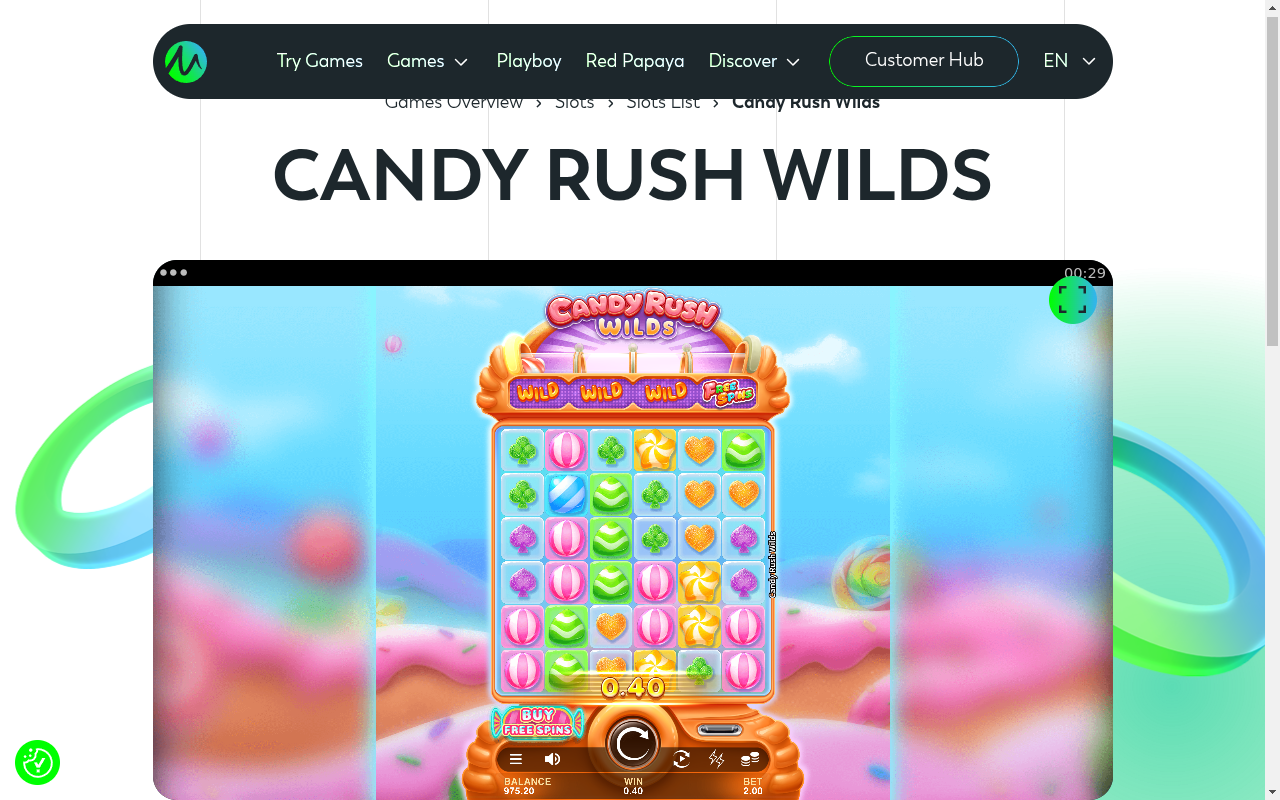
The reels carry the candy selection the scenery promises, with WILD and FREE SPINS banners both appearing in play. The wild stands in as a helping symbol for the clusters; there’s no fuller substitution rule than that, so its job is best read as completing groups rather than carrying a mechanic of its own.
In practice that makes the wild the most valuable single symbol on the board. A wild landing next to four matching sweets can turn a near-miss into a paying cluster, and because the removal system clears winners immediately, that cluster then feeds whatever drops in above it. The wild’s value compounds with the cascade rather than sitting apart from it.
Free Spins and the Buy Feature
Free Spins
Candy Rush Wilds sells itself as a candy machine with infinite sweet delights behind its button, and the free spins round is where that promise gets tested. The marketing copy is unapologetically sugared, but it points at the right thing: the round is the destination, and the base game is the walk to it.
The round is built on the same cluster foundations as the base game, with the wilds doing the work that plain cascades can’t. The essentials:
- Free Spins is the game’s bonus round, triggered from the base game
- Cluster rules in the feature follow the base game’s five-symbol minimum
- Clusters can still form anywhere and still chain consecutive wins
Buy Free Spins
A Buy Free Spins button sits in the interface during base game play. Pressing it skips the wait for a natural trigger and drops you straight into the bonus round at a cost set by the buy menu, so it’s worth checking that price at your casino before committing.
On a medium volatility game the round doesn’t demand the bankroll patience a high-variance buy would, but it’s still a direct stake against a single feature. The natural route has its own appeal here: because the cluster system keeps the base game moving, the wait for the trigger isn’t dead time in the way it can be on a slower five-reel game. The buy is there for the impatient.
Our Honest Verdict
Overall Rating: 7.1/10
Playing this one is like standing at a candy machine that only sells one thing, but sells it well: you push the button, clusters form, winners clear, the board refills, and the whole thing repeats at a relaxed, medium-volatility pace that never feels like it’s punishing you for showing up. That steady loop is the reason to pick it.
Its best quality is that the cascade keeps every spin alive for longer than a payline game would manage; a cluster that pays is really three or four clusters in disguise. Its worst is that there’s nothing to discover after the first hour. One mechanic, one bonus round, no symbol values to study, and the sequel’s meter and progression ladder exist precisely because this game ran out of new things to show.
That makes it a fit for cluster fans who want the format without the harsh edges, and for anyone who finds their pleasure in watching a board empty and refill. Players who need a spread of features to stay interested will run out of sweets early. For the rest, the sugar is simple, and it holds its shape.
Candy Rush Wilds FAQs
-
What is the RTP of Candy Rush Wilds?
96.75%. That’s the total expected return, and it sits comfortably above the typical online slot average. -
Is Candy Rush Wilds high volatility?
No, it’s a medium volatility slot. Wins are sized and spaced more evenly than in a high-variance game, and its sequel, Candy Rush Wilds 2, is the harsher of the two. -
What is the grid size of Candy Rush Wilds?
It plays on a 6×5 grid. There are no paylines; wins come from clusters of matching symbols instead. -
How does the ClusterChase system work?
A ClusterChase is a group of symbols adjacent to each other horizontally or vertically. Five or more matching symbols form a winning cluster, and clusters can appear anywhere on the reels. -
Can winning clusters chain into more wins?
Yes. Winning symbols are removed and new symbols drop in, so one spin can deliver multiple consecutive wins. Only the highest winning combination is paid per cluster. -
Where can clusters form on the grid?
Anywhere. Unlike payline slots, there’s no left-to-right requirement, so a cluster in the middle of the board pays exactly the same as one at the edge. -
Can you buy the bonus on Candy Rush Wilds?
Yes. A Buy Free Spins button is part of the interface during base game play, letting you go straight into the free spins round without waiting for a natural trigger. -
When is Candy Rush Wilds released?
Candy Rush Wilds’s release date is 27 February 2023.