















Jewel Rush Slot Review
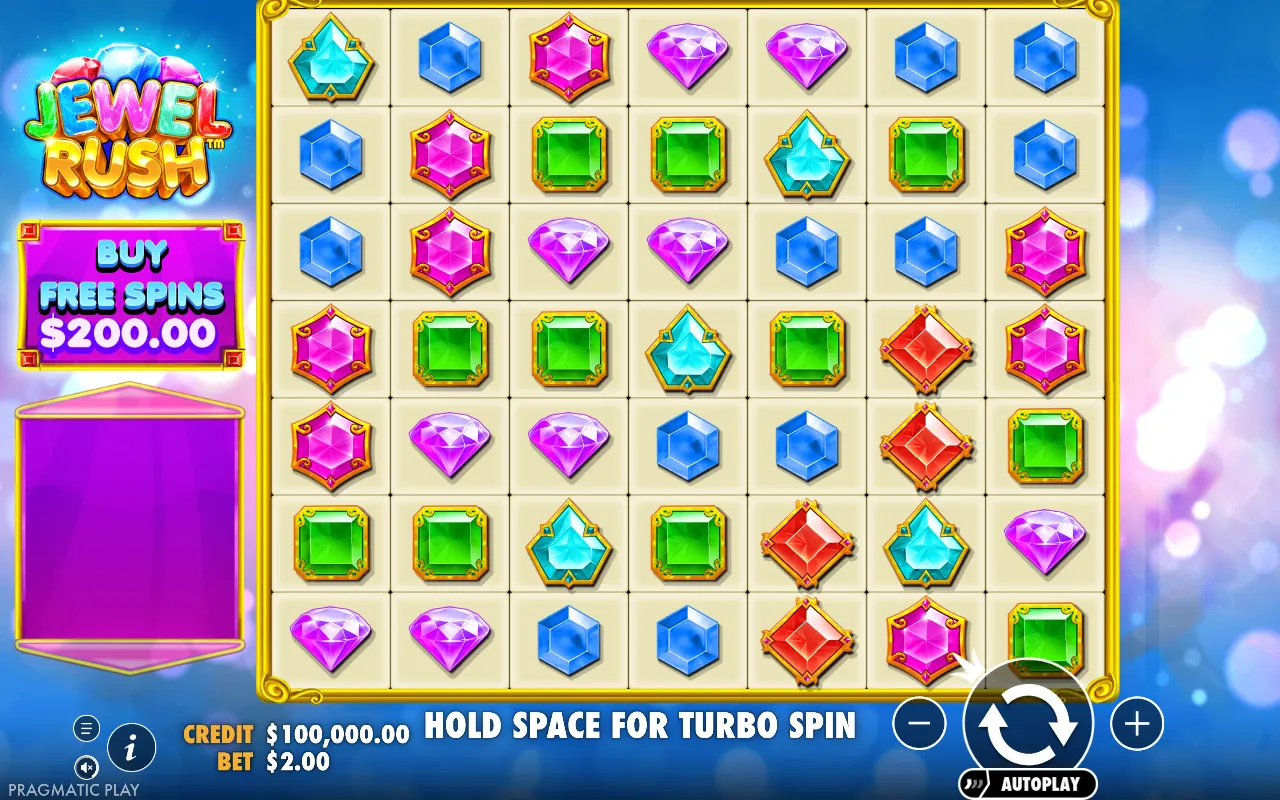
The reels sit in a heavy gold frame over a deep blue blur of drifting bokeh lights, a fat cluster of cartoon gemstones propped on the logo like a crown. Jewel Rush is built so that the most important symbol on the grid is whichever one you happen to be looking at: there’s no headline special to wait for, and the game insists every gem is worth watching. That’s a rarer design choice than it sounds, and it’s the reason a grid this plain can still surprise you.
Pragmatic Play have built this one on a 7×7 grid where symbols pay in connected blocks, with a single idea doing the heavy lifting: multipliers riding on the gems themselves. It runs at 96.47% RTP with high volatility, stakes from 0.20 to 240.00, and wins capped at 5,000x the bet. It’s a leaner machine than cluster siblings like Gems Bonanza or Gates of Olympus, and it wears that plainness well, closer in spirit to Sweet Bonanza than to anything with a story attached.
Base Game & Features
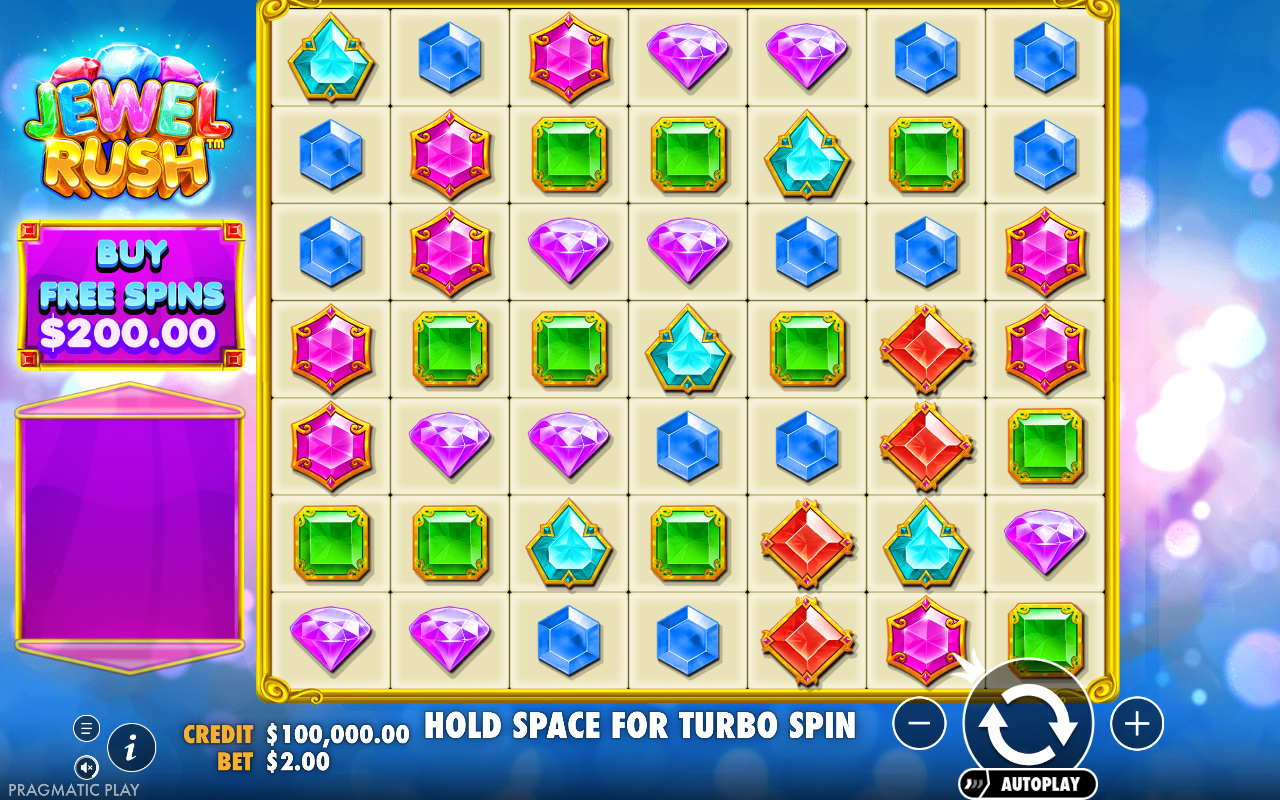
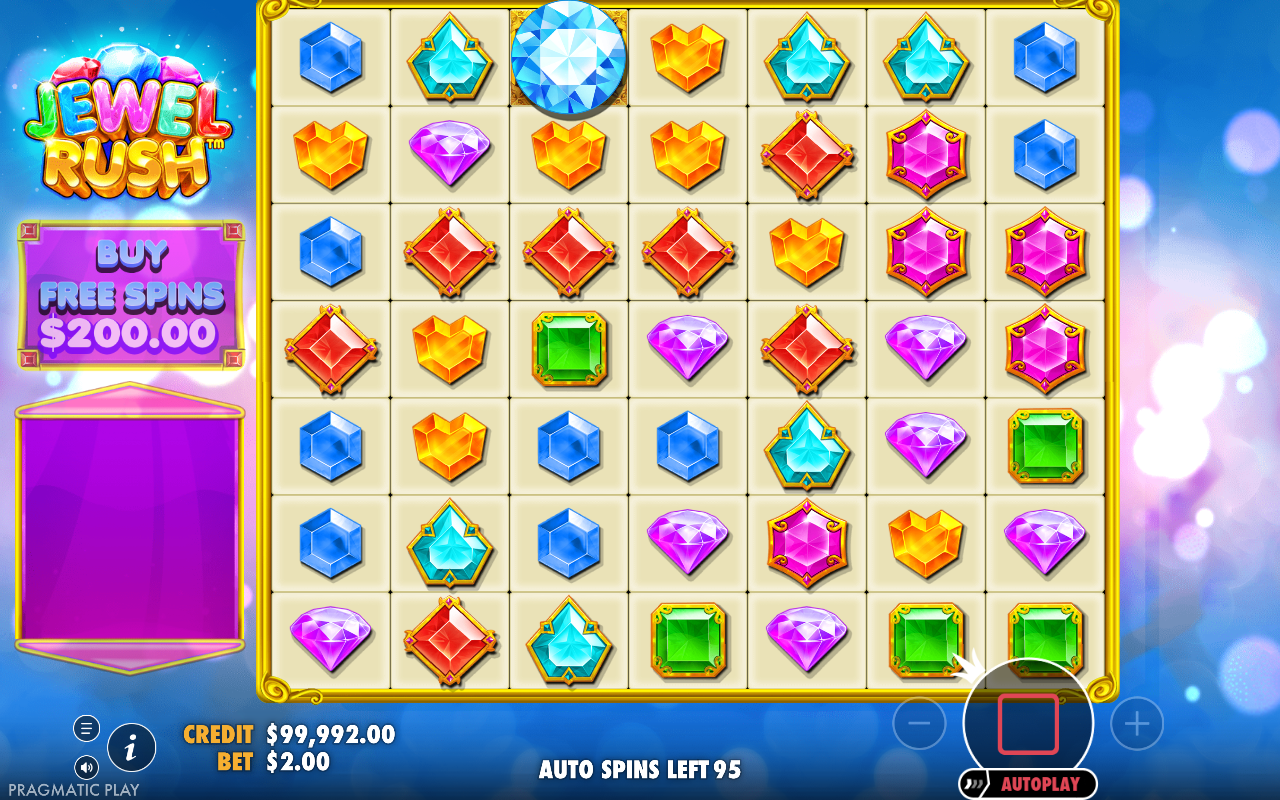
Every symbol pays in blocks of five or more, connected horizontally or vertically anywhere on the 7×7 grid. Position doesn’t matter beyond the connection: a cluster snaking across three rows pays the same as a neat square. There’s no wild symbol in this game.
The scatter appears on all reels, but it doesn’t form winning blocks of its own. It’s the only special symbol on the grid, which tells you how much of this game’s character lives in the gems and their multipliers rather than in symbol tricks.
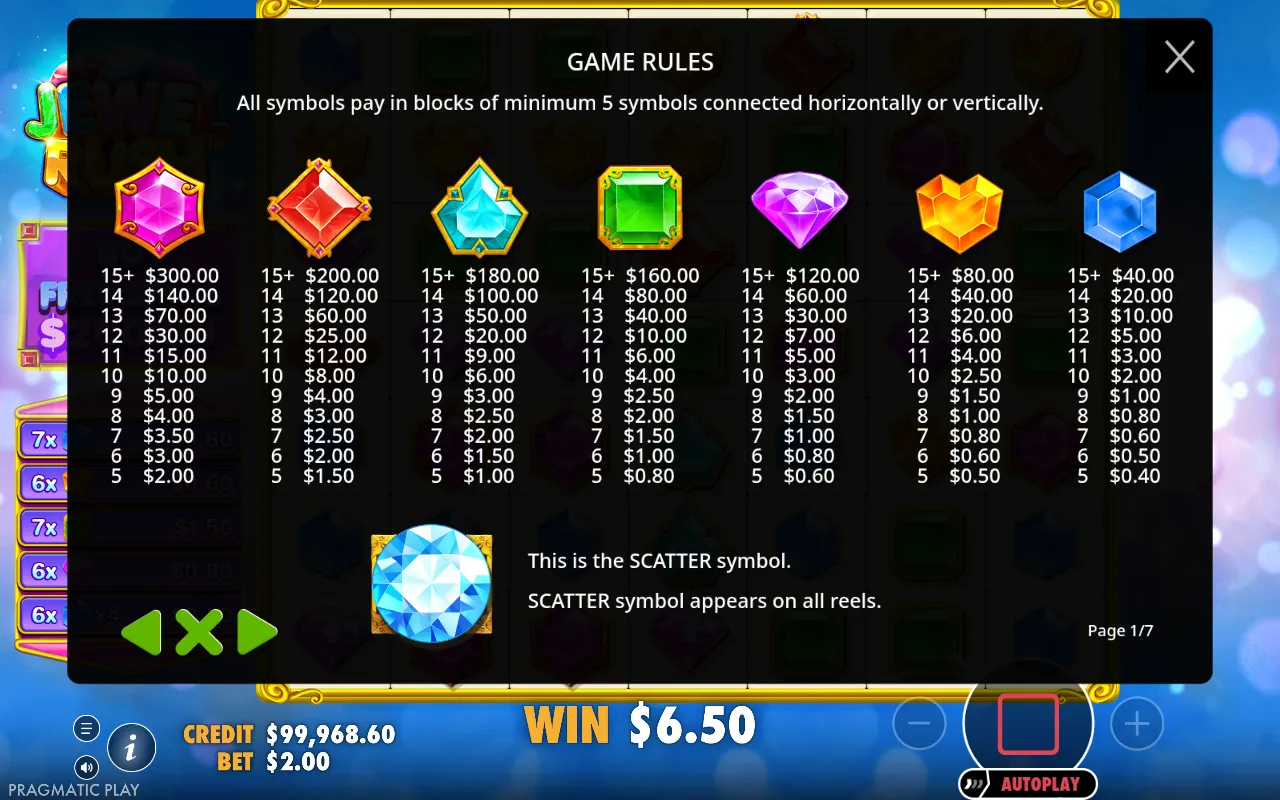
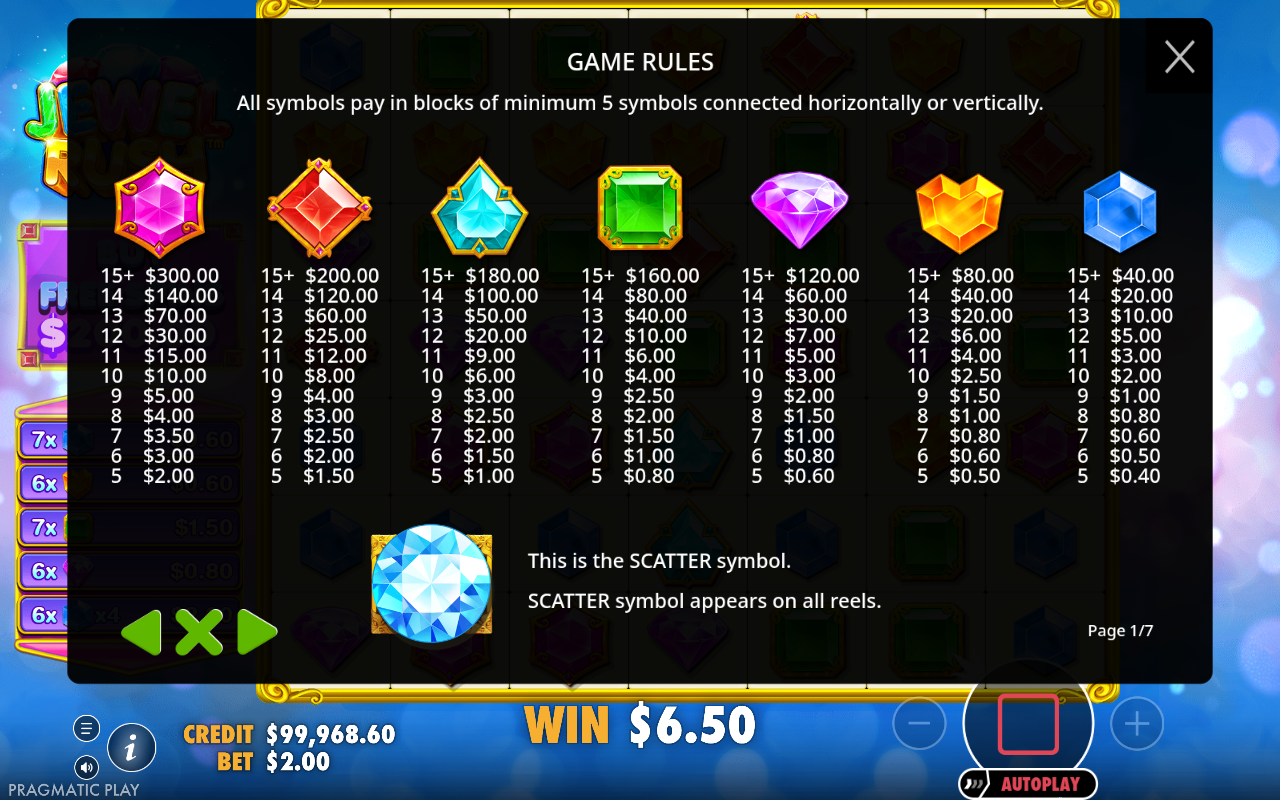
Seven gem symbols make up the entire paytable, from the pink and purple premium down to the humble blue. Values below are the wins at the minimum 0.20 stake, with the block size beside each.
- Pink/purple gem: 2.00 for five, 3.00 for six, 4.00 for eight, 10.00 for ten, 15.00 for eleven, 30.00 for twelve, 70.00 for thirteen, 140.00 for fourteen, 300.00 for fifteen or more
- Red gem: 1.50 for five, 2.00 for six, 3.00 for eight, 8.00 for ten, 12.00 for eleven, 25.00 for twelve, 60.00 for thirteen, 120.00 for fourteen, 200.00 for fifteen or more
- Teal shield gem: 1.00 for five, 1.50 for six, 2.50 for eight, 6.00 for ten, 9.00 for eleven, 20.00 for twelve, 50.00 for thirteen, 100.00 for fourteen, 180.00 for fifteen or more
- Green gem: 0.80 for five, 1.00 for six, 2.00 for eight, 4.00 for ten, 6.00 for eleven, 10.00 for twelve, 40.00 for thirteen, 80.00 for fourteen, 160.00 for fifteen or more
- Purple diamond: 0.60 for five, 0.80 for six, 1.50 for eight, 3.00 for ten, 5.00 for eleven, 7.00 for twelve, 30.00 for thirteen, 60.00 for fourteen, 120.00 for fifteen or more
- Orange/amber gem: 0.50 for five, 0.60 for six, 1.00 for eight, 2.50 for ten, 4.00 for eleven, 6.00 for twelve, 20.00 for thirteen, 40.00 for fourteen, 80.00 for fifteen or more
- Blue gem: 0.40 for five, 0.50 for six, 0.80 for eight, 2.00 for ten, 3.00 for eleven, 5.00 for twelve, 10.00 for thirteen, 20.00 for fourteen, 40.00 for fifteen or more
The step from twelve symbols to fifteen is where the paytable gets steep. The top gem jumps from 30.00 to 300.00 across those three extra symbols, and the bottom-tier blue multiplies its twelve-symbol pay tenfold. Below twelve, the curve is almost flat: a five-symbol block of pink gems returns exactly what the stake cost, and everything smaller pays pocket change. Big blocks are the whole point of a 7×7 grid, and the paytable rewards them accordingly.
Tumble Feature
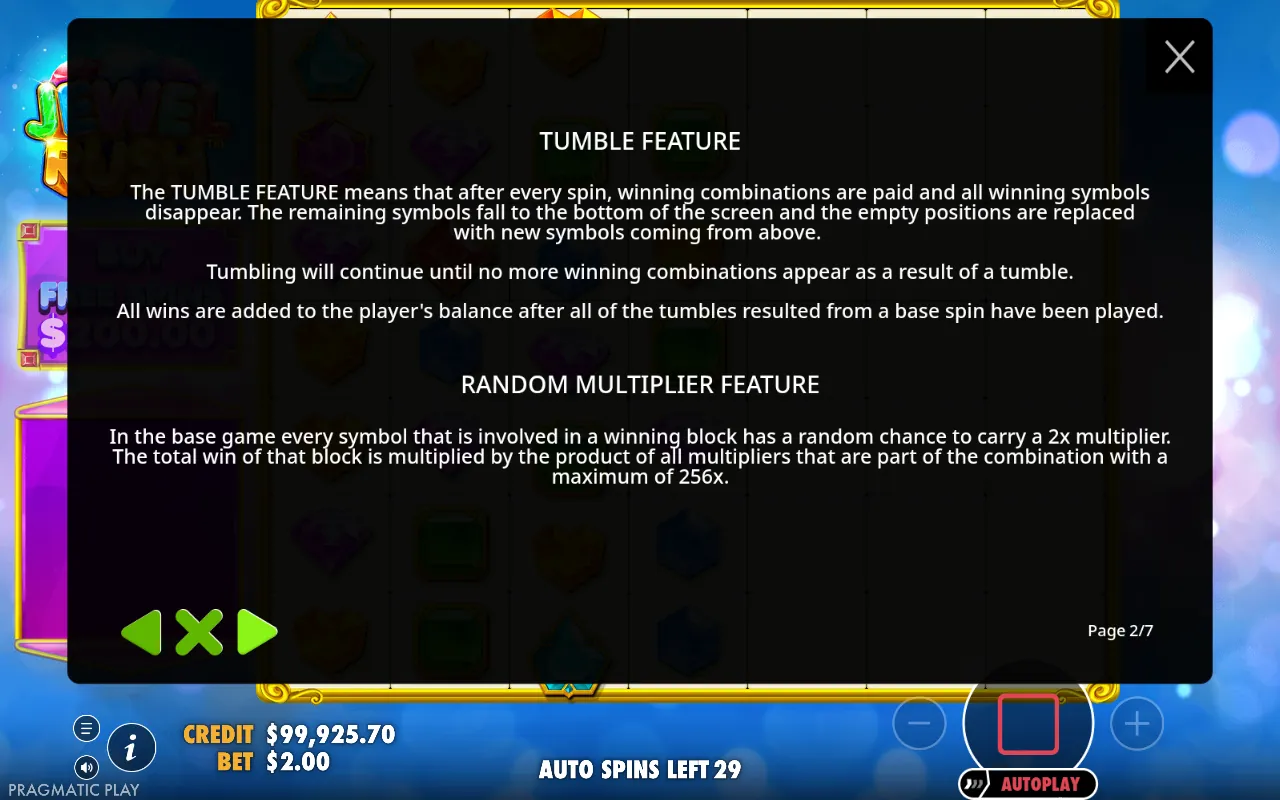
After every spin, winning combinations are paid and all winning symbols disappear. The remaining symbols fall to the bottom of the screen, and empty positions refill with new symbols from above.
Tumbling continues until no new winning combinations appear. That means one spin can chain several paid blocks together, each one reshuffling the grid into a fresh arrangement.
All wins from a base spin are added to the balance only after every resulting tumble has played out, so the counter keeps climbing while the chain runs. Autoplay is on hand for the long stretches between features, with a skip option that jumps past the introduction and end screens after a short delay.
Random Multiplier Feature
Here’s the idea the whole game hangs on. In the base game, every symbol involved in a winning block has a random chance to carry a 2x multiplier. The total win of that block is multiplied by the product of all multipliers in the combination, up to a maximum of 256x.
That ceiling matters. Eight 2x tags stacked into a single block is already the full 256x, and the multipliers ride on ordinary gems rather than on special symbols, so any win can quietly turn into a big one. The tags attach at the moment the block forms, not before, which is what keeps every cluster worth watching.
The interplay with the tumble is where it compounds. A tagged block pays, disappears, and the refill can form a fresh cluster that picks up its own multipliers, so a single spin can stack boosted wins back to back. The 5,000x round cap is the only brake on it.
Free Spins & Bonus Buys in Jewel Rush
The game offers a Buy Free Spins option from the base game screen. It’s the only purchase available, priced at 200.00, which works out at 1,000x the minimum stake.
The button sits beside the spin controls rather than behind a menu, so it’s always in reach. The price is steep relative to the stake range’s lower end, and the 5,000x cap applies to bought rounds just as it does to organic ones.
- Buy Free Spins: 200.00 (1,000x the minimum stake)
Our Honest Verdict
Overall Rating: 7/10
This is a game of watching gems, not chasing symbols. Jewel Rush plays as one long chain: clusters form, pay, vanish and refill, and because the boost is attached to ordinary gems rather than saved up behind a special, the tension never gathers in one place. It’s spread thin across every spin, which is exactly why somebody would pick it over a flashier cluster slot.
The stacking multipliers are its best work. Two or three tags in one block turns a nothing win into something, and the maths escalates honestly to the cap. The weakness is everything around that idea: there’s one mechanic, one purchase, and a backdrop you’d struggle to describe ten minutes after closing the tab. Between the gems, there just isn’t much game.
It’s for cluster players who care about the maths and nothing else, the sort who’d happily watch a blank grid as long as the multipliers multiply. Anyone who wants a bonus round with its own build, or a theme to sink into, should look elsewhere. For the rest, the gems here really do rush.
Jewel Rush FAQs
-
How does the Tumble Feature work in Jewel Rush?
After every spin, winning symbols are paid and removed, the remaining symbols drop to the bottom of the grid, and new symbols refill the empty positions from above. Tumbling continues until no new winning combinations appear, and all wins from the spin are credited once the chain finishes. -
How do the random multipliers work in Jewel Rush?
Any gem that forms part of a winning cluster can randomly arrive tagged with a 2x multiplier. The tags multiply together rather than adding, so a handful of them in one block escalates the payout fast, and the combined boost tops out at 256x. -
Is there a wild symbol in Jewel Rush?
No. There’s no wild and no substitution rule in this game. The scatter is the only special symbol, appearing on all reels without forming winning blocks of its own. -
How do symbols pay in Jewel Rush?
Wins need clusters of at least five matching gems, linked side to side or top to bottom anywhere on the grid. Bigger blocks pay substantially more, with the top gem jumping from 30.00 at twelve symbols to 300.00 at fifteen or more, at the minimum 0.20 stake. -
What is the RTP of Jewel Rush?
Jewel Rush runs at 96.47% RTP. -
What is the maximum win on Jewel Rush?
The maximum win is 5,000x the bet. If a round’s total win reaches that cap, the round ends immediately, the win is awarded up to the cap and any remaining features are forfeited. -
Can you buy the bonus on Jewel Rush?
Yes. A Buy Free Spins option is available from the base game, priced at 200.00, which is 1,000x the minimum stake. -
Does Jewel Rush have autoplay?
Yes. Autoplay runs a chosen number of automatic spins, and a skip option auto-jumps past the feature introduction and end screens after a short delay. The settings menu also toggles the intro screen, ambient sound and sound effects, and opens the game history page.