










Knife Drop Slot Review
A dark wood-grain board, warm light bleeding in at the edges, and a target waiting in the middle of it. The most important thing in Knife Drop isn’t the knife at all; it’s the apple. Galaxsys has built a throwing game where the throws themselves are almost arithmetic, and the entire reason to keep playing is a piece of fruit that shows up now and then and remembers you hit it.
That progress bar is what stands in for a paytable. The game runs at an RTP of 96.79-97.32%, takes bets from 10 to 45.000, and caps winnings at 4,500,000, which works out to 100x the top stake. It’s a cousin of Tower Rush 2 and Wingo from the same studio, and sits somewhere near Aviabom in spirit: one decision, one outcome.
Throwing Knives for Wins
A round starts with a bet and a tap on the target. The target can be a barrel, a snowman, an orange or a watermelon, and each throw returns a random set of odds. Whatever the multiplier lands on, that’s the round settled.
There’s a spectacle threshold built in. Any winning odds of x5 or higher tear the target apart, and the game puts a big-win message across the screen to mark it. Below that, the target stays standing and the throw pays quietly.
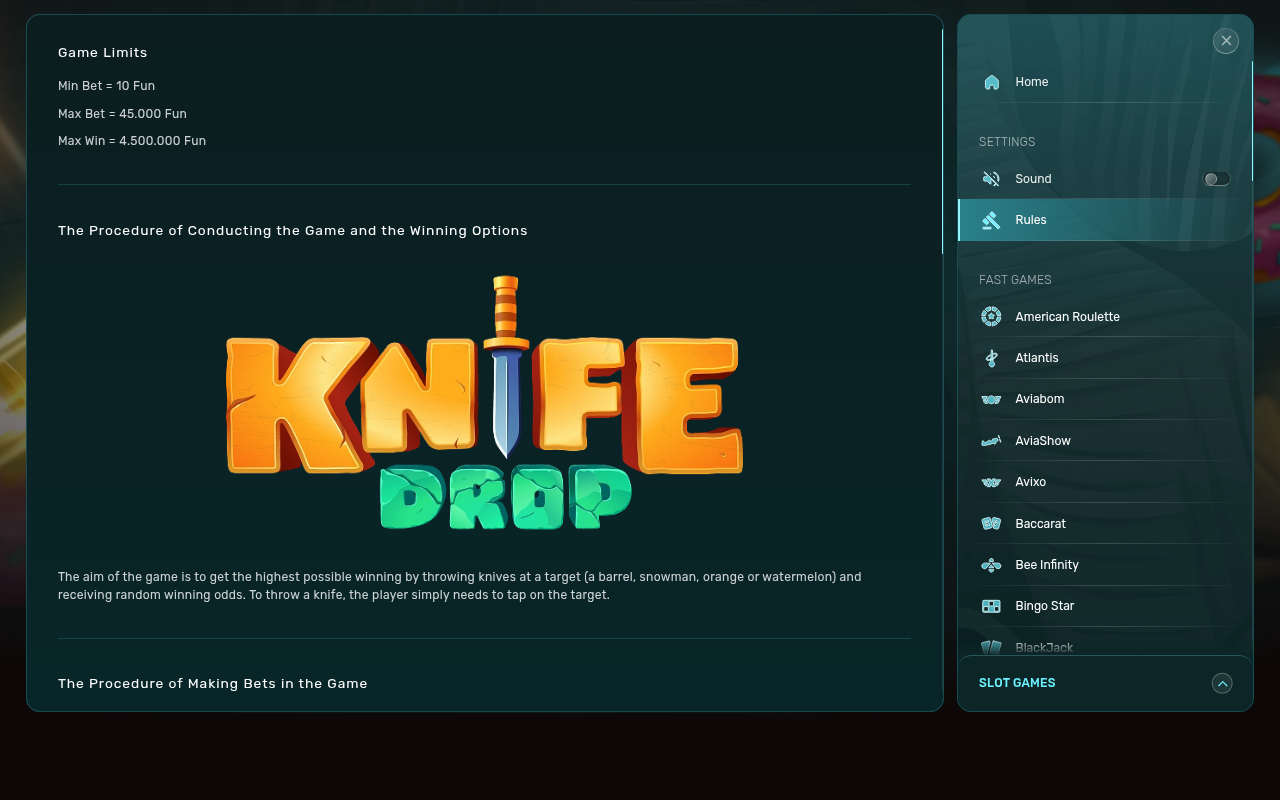
The limits frame everything. Bets run from 10 at the bottom to 45.000 at the top, and the overall winnings cap sits at 4,500,000. A single throw’s ceiling is therefore bounded by the stake you’ve chosen rather than by any symbol combination.
There’s no paytable to study because there’s nothing to line up; the odds on each throw are the whole economy. Apples appear as an occasional alternative target, and they matter for one reason only: hitting them fills the progress bar that leads to the bonus game.
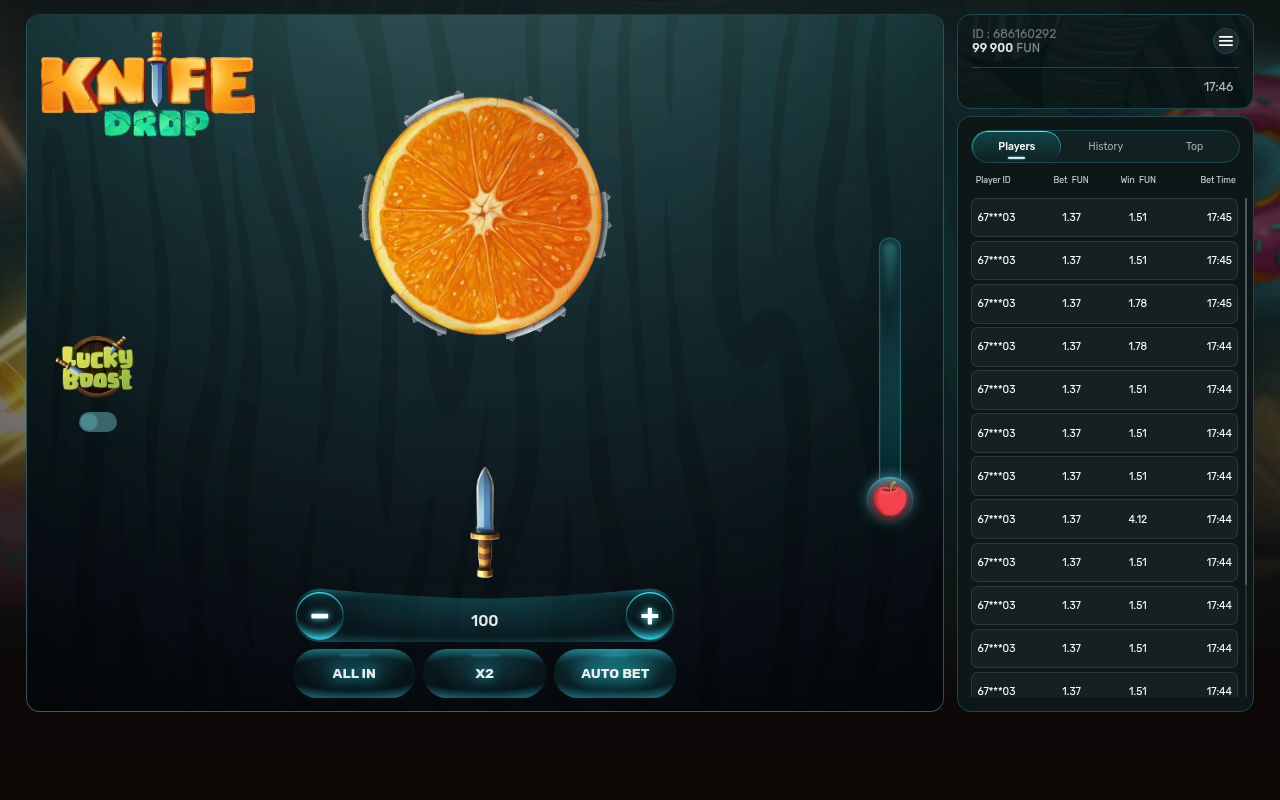
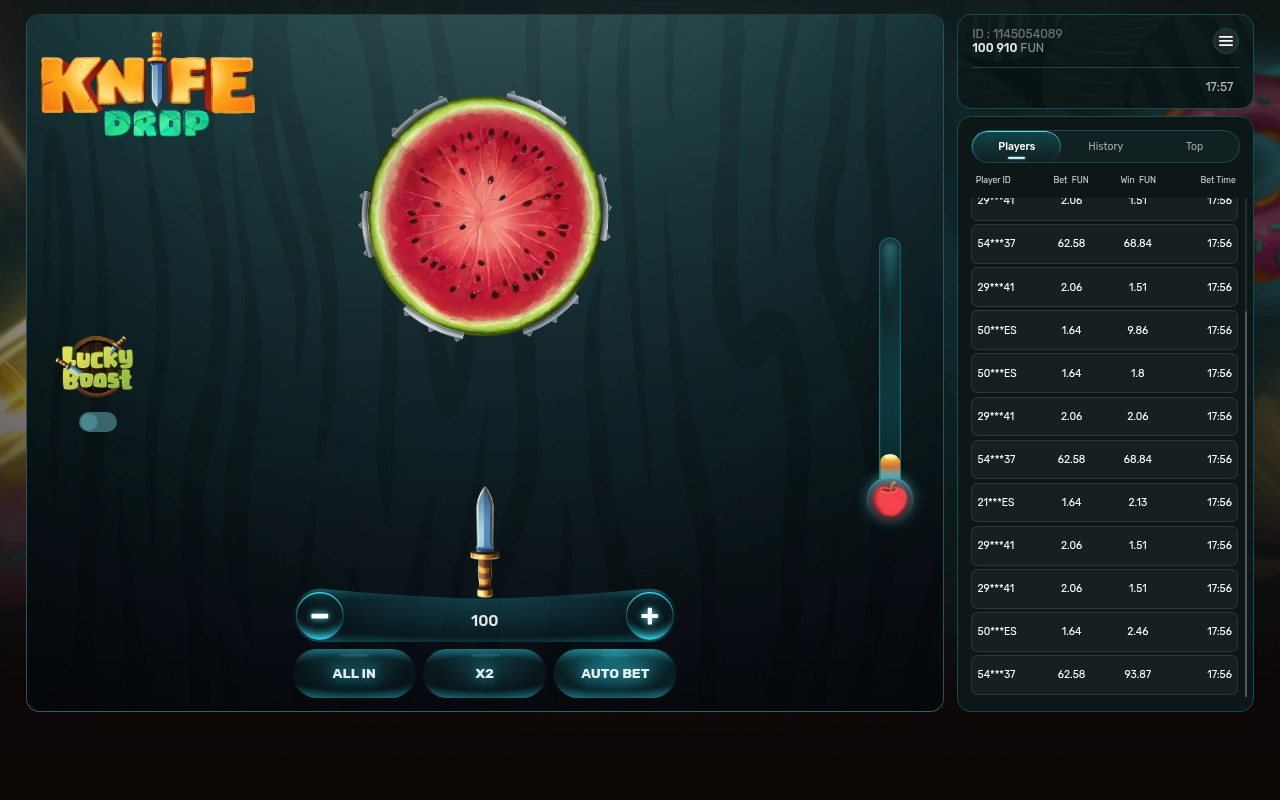
The table you’re actually sitting at looks like this: a watermelon half-cut by a knife, an apple icon near the progress meter, and a players’ panel down the side listing other bets and results.
The stake controls sit alongside it. As well as typing a bet into the field, there’s an X2 shortcut for doubling up and an ALL IN option that puts the whole balance on a single throw.
Auto Bet opens up the pacing. Combined with it, the game can be played at anything from one careful knife at a time to a flat-out sequence of rounds.
If the connection drops after a bet has been placed, the round still plays out on the server and any win is transferred to the balance automatically. A lost signal doesn’t cost a settled throw.
The Progress Bar and Bonus Wheel
The bonus game is earned, not bought. Apples show up at random as targets during normal play, and every successful throw at one fills a segment of the progress bar. Thirty apple hits, taken at any pace across any number of rounds, fill the bar completely and start the bonus game.
What opens is a wheel with eight sections. Five of them carry multipliers and three carry free bets:
- x2
- x3
- x10
- x35
- x100
- 2 free bets
- 5 free bets
- 25 free bets
One spin, one result. A press of the Spin button sets the wheel turning, and it stops at a random section. If it lands on a multiplier, the bet amount is multiplied by that figure and the win goes straight to the balance.
If it lands on free bets, the round converts into that number of free throws instead. Those throws have their own stake logic. The amount is calculated from the average of the recent bets, so a bonus earned during higher-stakes play carries more weight than one earned at the minimum.
It’s a small detail, but it means the bonus remembers how you were playing when you earned it. A 25-free-bet result means twenty-five throws at the averaged stake, with results settling to the balance like any other round.
Wins during those throws follow the same odds and the same x5 tear-apart rule as normal play, so a big multiplier can still land while the free rounds run.
Auto Bet and Lucky Boost
Auto Bet
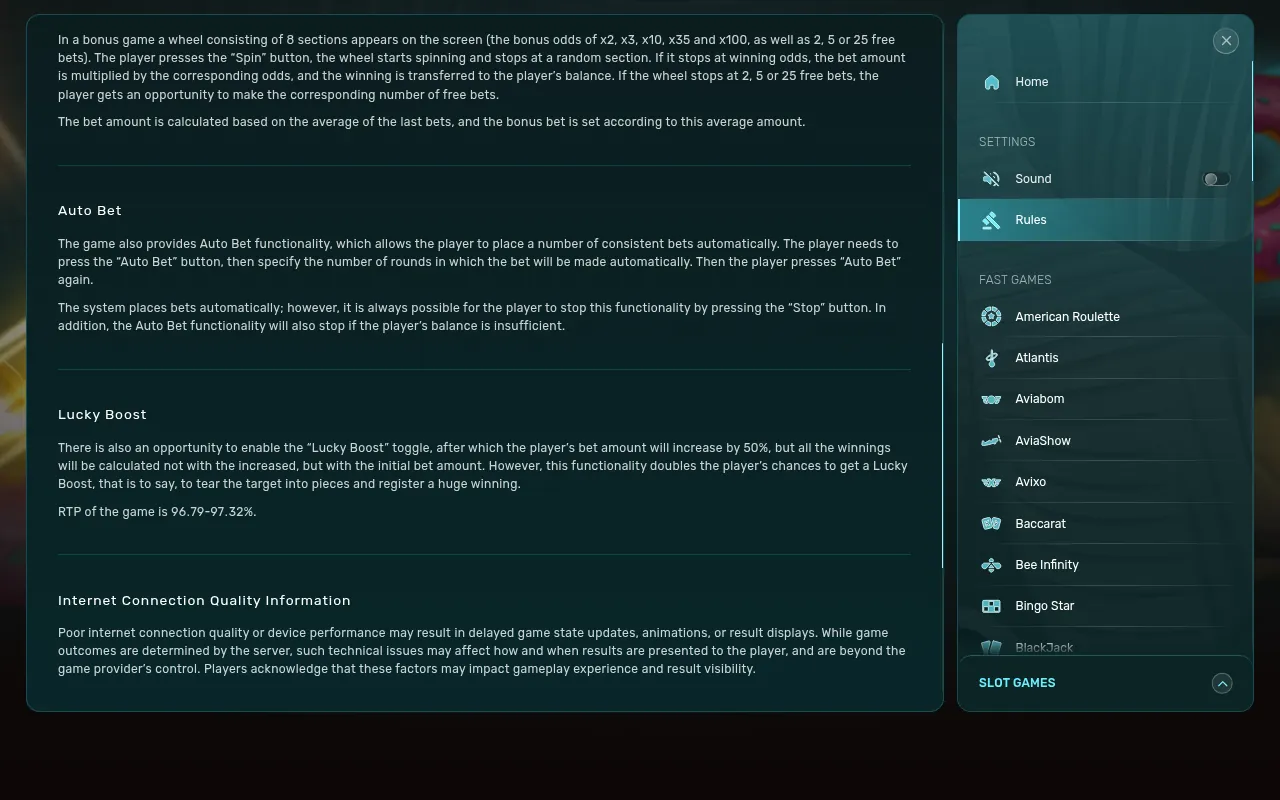
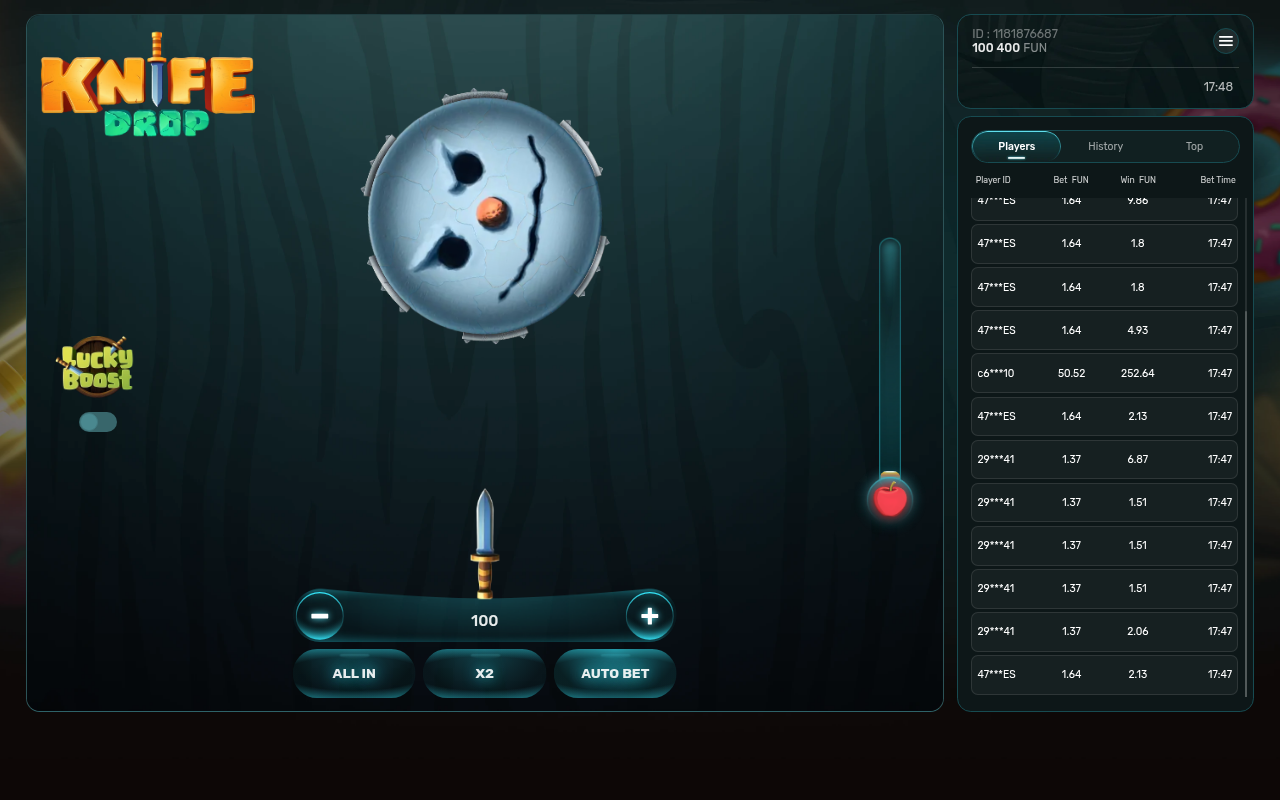
Auto Bet does what the name says. Choose a number of rounds, press the button again, and the system places consistent bets automatically until the count runs out. It can be stopped at any time with the Stop button, and it also stops on its own if the balance runs dry.
Because the bet stays fixed for the whole run, Auto Bet pairs naturally with a set budget: pick a stake, pick a round count, and the total outlay is known before the first knife flies. It doesn’t change anything about the odds, it just removes the tapping.
Lucky Boost
Lucky Boost is the game’s optional side wager, and its terms are worth reading twice. Enabling it increases the bet amount by 50%, but all winnings are still calculated on the original, lower stake. What the extra half-stake buys is a doubled chance of the Lucky Boost outcome: the target torn into pieces and the huge win that goes with it.
So the boost doesn’t change what a win pays. Every multiplier still settles against the original stake, and the boost price is gone from the balance either way.
What it changes is how often the game’s biggest moment can happen, which makes it a bet on the tear-apart itself rather than on the ordinary odds.
Bonuses from the wheel sit alongside operator free bets and free amounts, and the two systems share a wallet with restrictions. An active bonus has to be deactivated before playing with real money, and a bonus balance smaller than the bet throws an error rather than a partial wager.
A free-bet award of 10×100, for example, means ten free throws at 100 each, drawn from that bonus balance rather than from cash.
Our Honest Verdict
Overall Rating: 7/10
Knife Drop is mostly watching a progress meter while a knife thuds into fruit. That’s not a criticism so much as the product: rounds take two seconds, there’s nothing to learn, and one tap settles everything. The apple really is the star. Thirty hits is a proper campaign, and the wheel waiting at the end of it, with x100 sitting at the top, gives the whole grind a shape most instant games never bother with.
The weakness is everything between apples. A throw on its own is a coin toss with animation, and Lucky Boost’s 50% premium buys more tear-aparts, not bigger ones, which is a poor spend unless the spectacle itself is what you came for.
It suits players who like instant games with a long tail, one stake decision and a finish line worth reaching. Reels, symbols and a choice to make each round won’t be found here. If a slow count towards a wheel spin sounds like a good evening, the board is warm and the apples are waiting.
Knife Drop FAQs
-
What is the RTP of Knife Drop?
Knife Drop runs at an RTP of 96.79-97.32%, with the exact figure within that range depending on configuration. -
How do you trigger the bonus game in Knife Drop?
Apples randomly appear as targets during play. Each successful knife hit on an apple fills the progress bar, and thirty apple hits in total fill it completely and launch the bonus game. -
What does the bonus wheel in Knife Drop offer?
The wheel has eight sections: multipliers of x2, x3, x10, x35 and x100, plus 2, 5 or 25 free bets. It spins once and stops at a random section. -
What is Lucky Boost in Knife Drop?
Lucky Boost is an optional toggle that increases your bet by 50% while winnings are still calculated on the original stake. The extra cost buys a doubled chance of the tear-apart big win. -
How are free bets valued in Knife Drop?
Free bets won on the bonus wheel are set from the average of your recent bets, so the stake reflects how you were playing when you triggered the bonus. -
What is the minimum and maximum bet on Knife Drop?
Bets run from 10 at the minimum up to 45.000 at the maximum, and Auto Bet is available for placing consistent rounds automatically. -
What is the maximum win on Knife Drop?
Overall winnings are capped at 4,500,000, which is 100x the maximum bet of 45.000. -
Who makes Knife Drop?
Knife Drop is made by Galaxsys. Its release date is 14 May 2025.