








Mine Mine Quest Slot Review
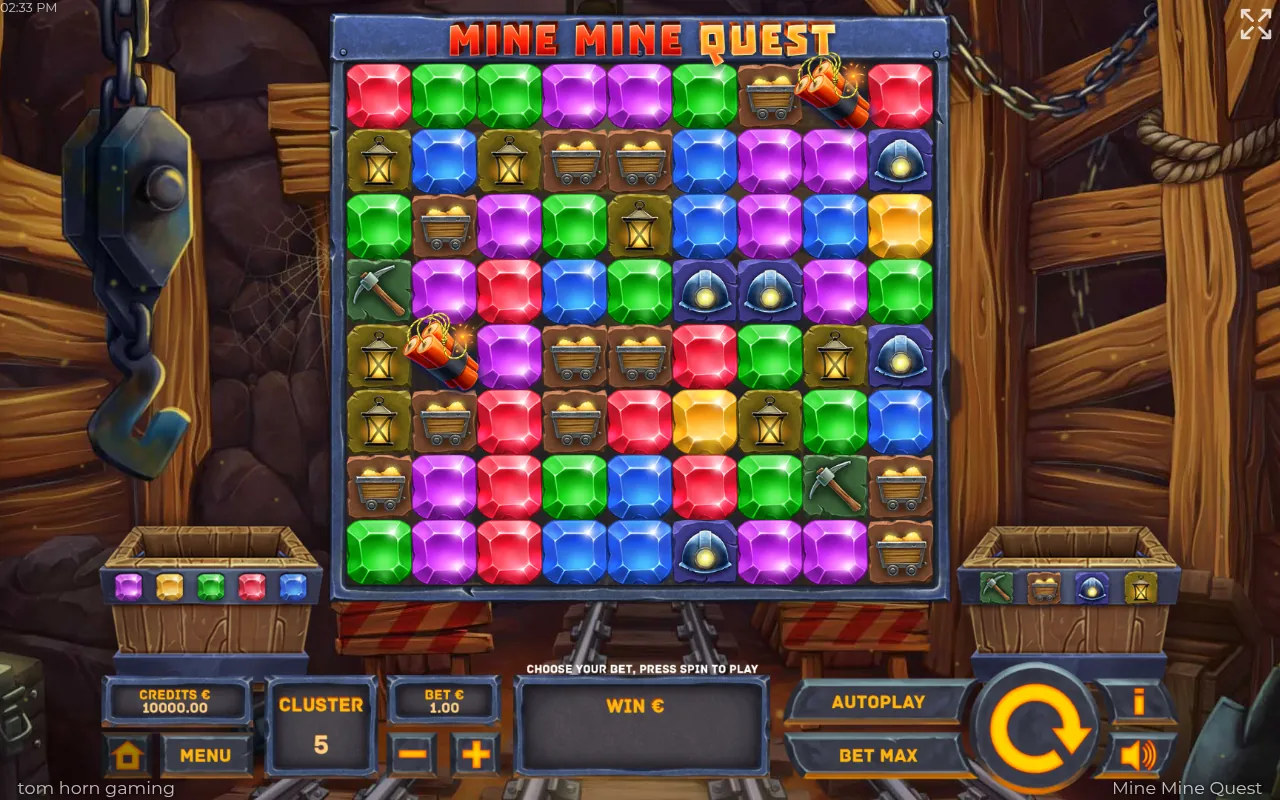
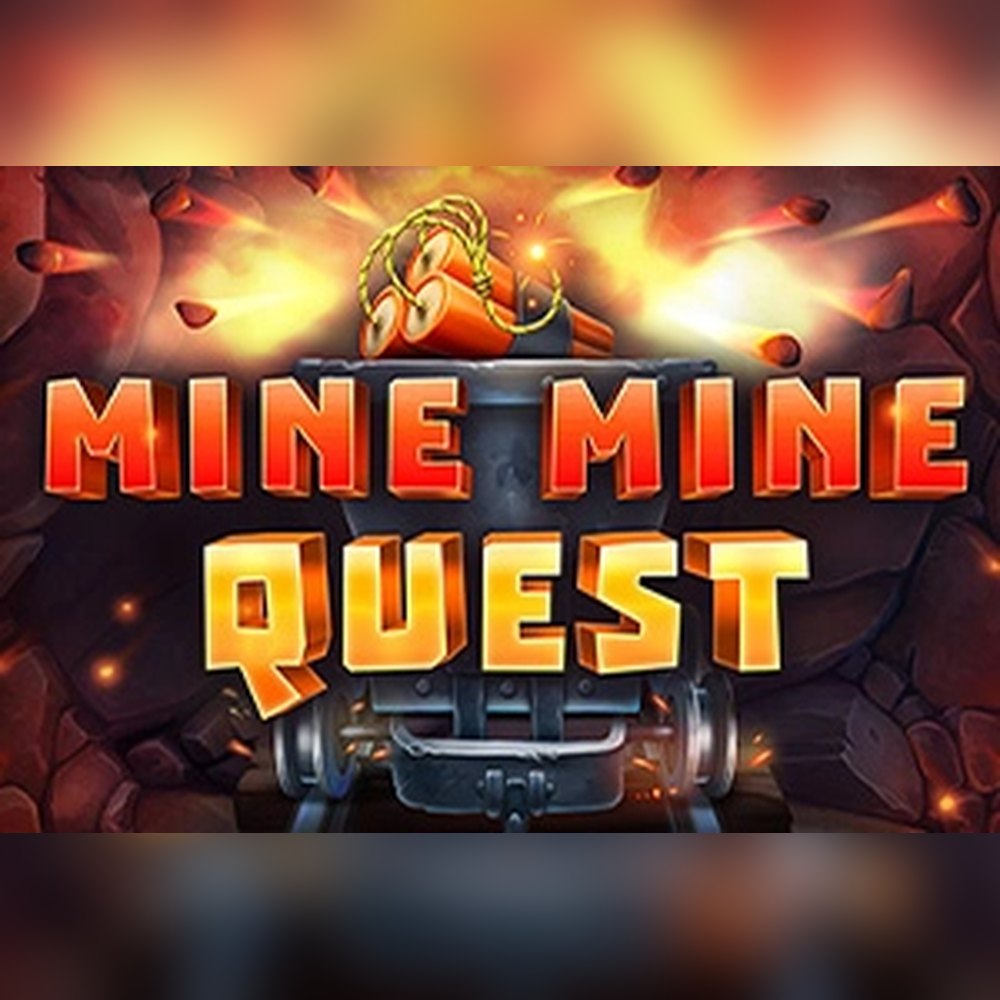
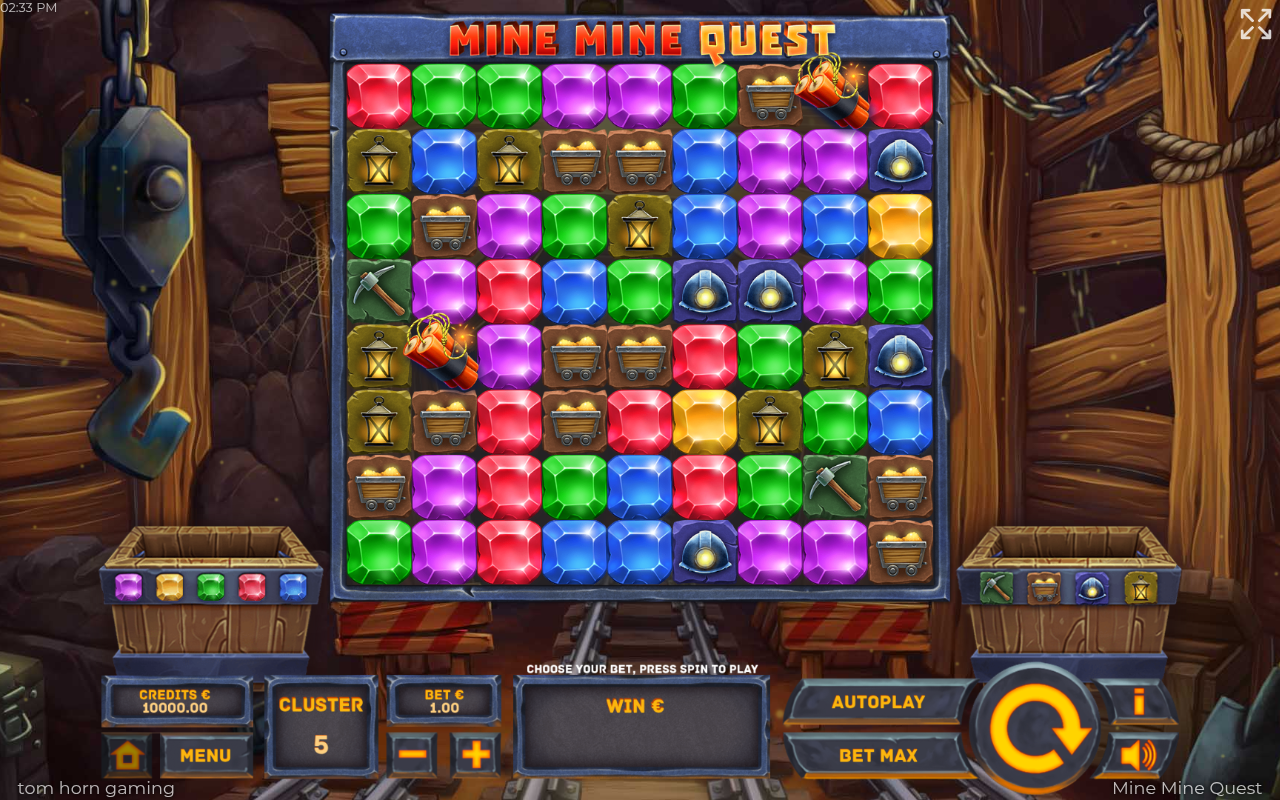
A cobweb in the corner, a coil of rope on the timber frame, a rail track running between striped barricades: this is a mine shaft that’s been worked for years, and Tom Horn Gaming puts you at the bottom of it with Mine Mine Quest. The slot never really stops spinning. A win here isn’t the end of anything, because every payout starts a chain that collects symbols towards something bigger, and the game only settles when the board runs dry. Dead spins don’t even stay dead, since the screen can shake itself into a win. There’s no bonus round waiting behind a scatter – the shaft itself is the whole attraction.
The game runs on a 9×8 grid with cluster pays and no bet lines at all, at an RTP of 95.41%. Volatility isn’t stated. It’s a different shape of slot to the studio’s Book of Cleo or Frutopia, and closer in spirit to the cluster mechanics of 3 Mermaids. Down here, the ore you gather is the whole game.
Cluster Pays on the 9×8 Grid
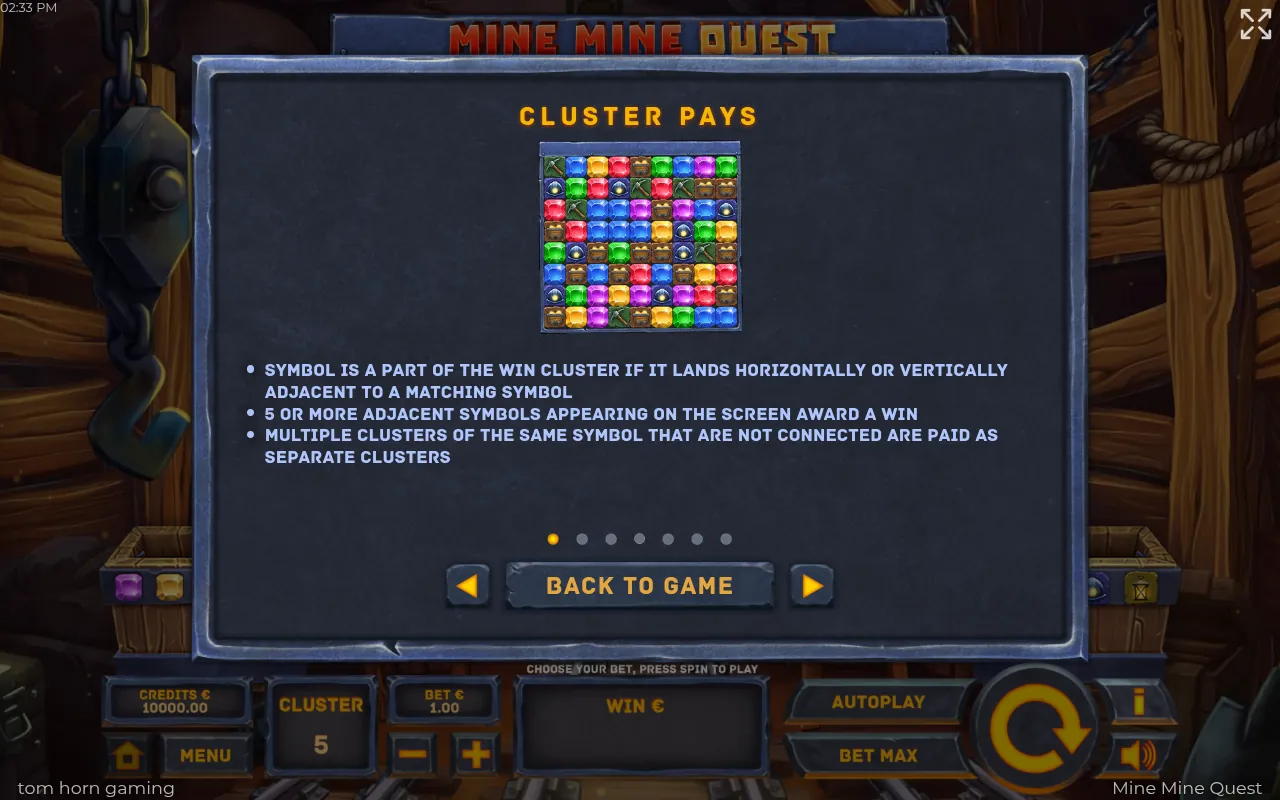
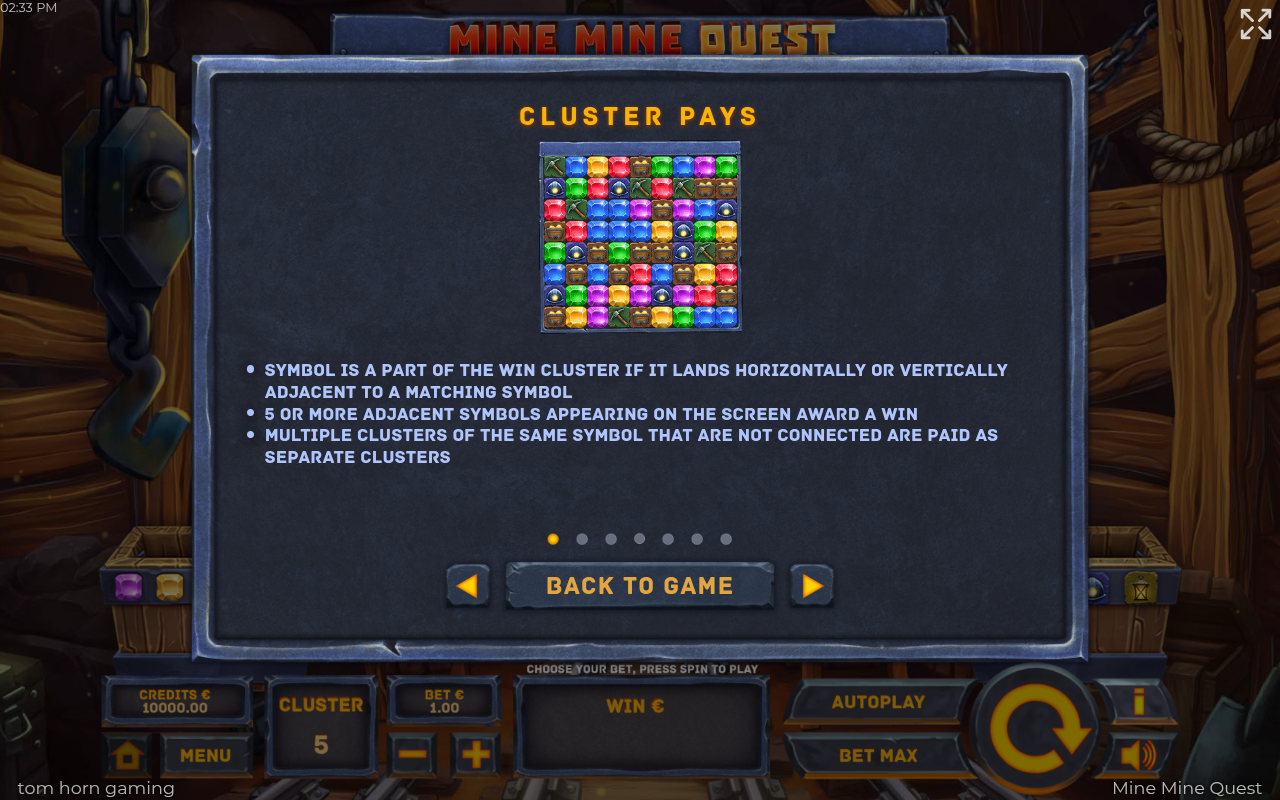
There are eleven symbols in the game and no bet lines anywhere. Wins come from groups instead, and the rules for them are simple:
- A symbol is part of a win cluster if it lands horizontally or vertically adjacent to a matching symbol
- Five or more adjacent symbols appearing on the screen award a win
- Multiple clusters of the same symbol that aren’t connected are paid as separate clusters
Diagonals don’t connect anything. That vertical-and-horizontal-only rule matters more here than it would on a five-by-five board, because a 9×8 grid gives clusters room to sprawl in both directions before they touch.
The separate-cluster payment is the quiet gift of the big grid. A single screen can hold two or three disconnected groups of the same symbol at once, and each one pays on its own, cluster by cluster.
Winning symbols are then removed and new symbols fill the empty spaces, with the game continuing until no new winning combinations form. That chain is the spine of everything else this game does. No wild symbol is defined in the base game, though wilds do arrive through the Wild String feature covered below.
Shatter Mode and the Collection Trays
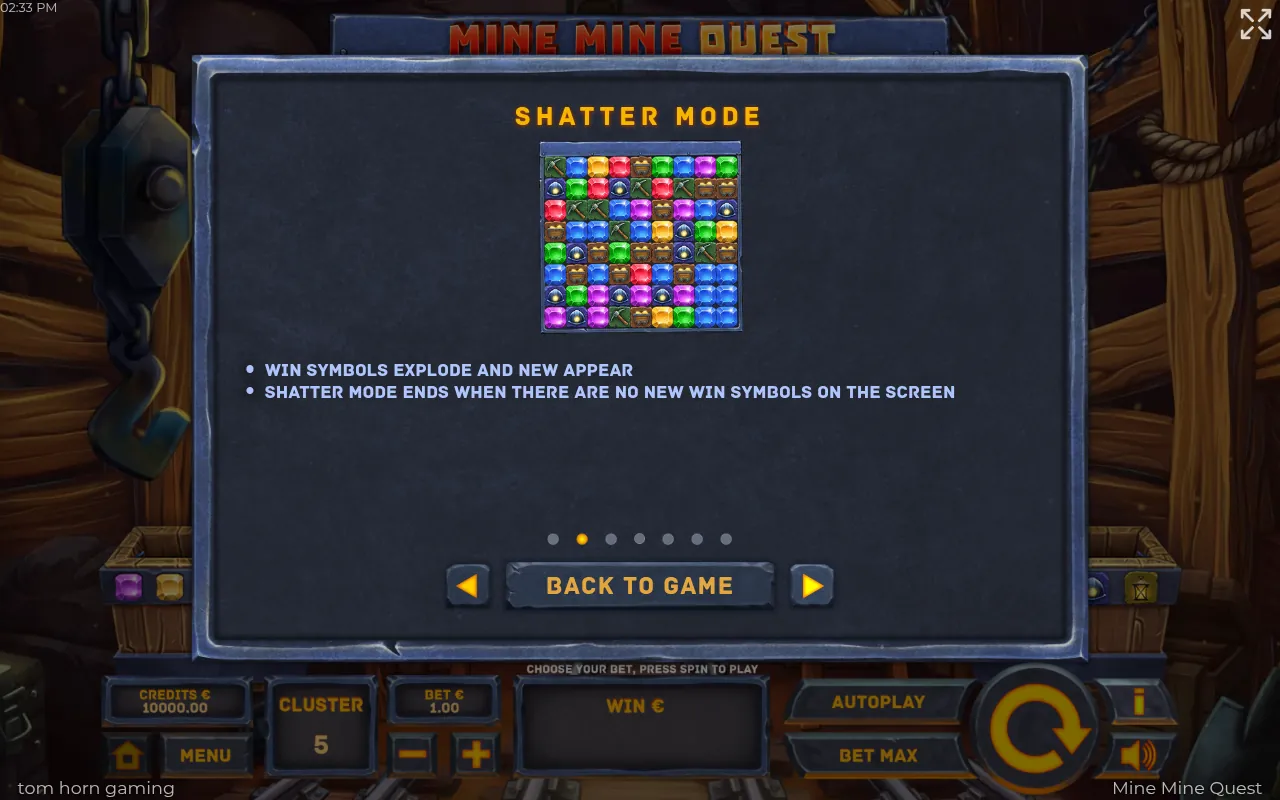
Shatter Mode is the game’s name for its reaction chain. When a cluster pays, the winning symbols explode and fresh ones drop into the gaps. The mode keeps running for as long as new wins keep forming, and one spin can therefore work through several waves of payouts before it settles.
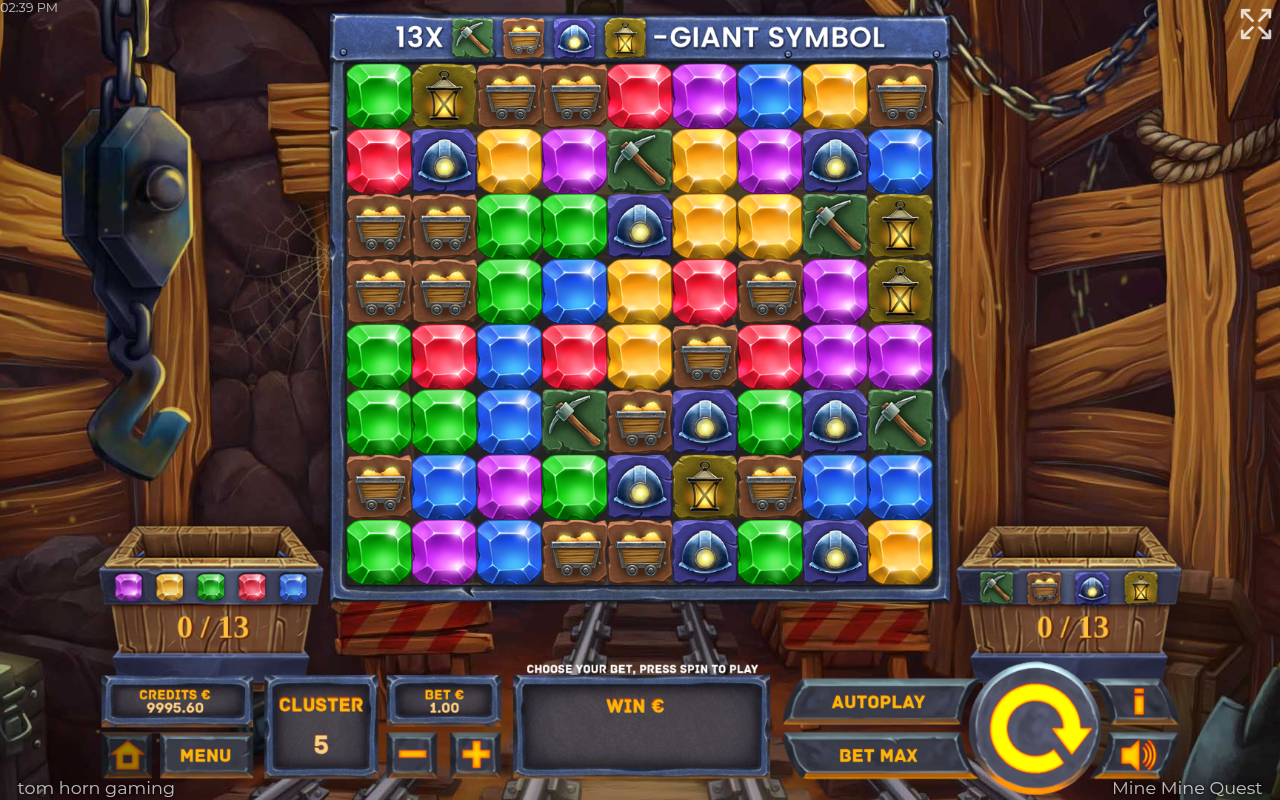
While the shattering continues, the game counts the symbols it’s collecting. High symbols feed one tray and low symbols feed another, and both fill towards thirteen. Reach the threshold on either and a feature fires:
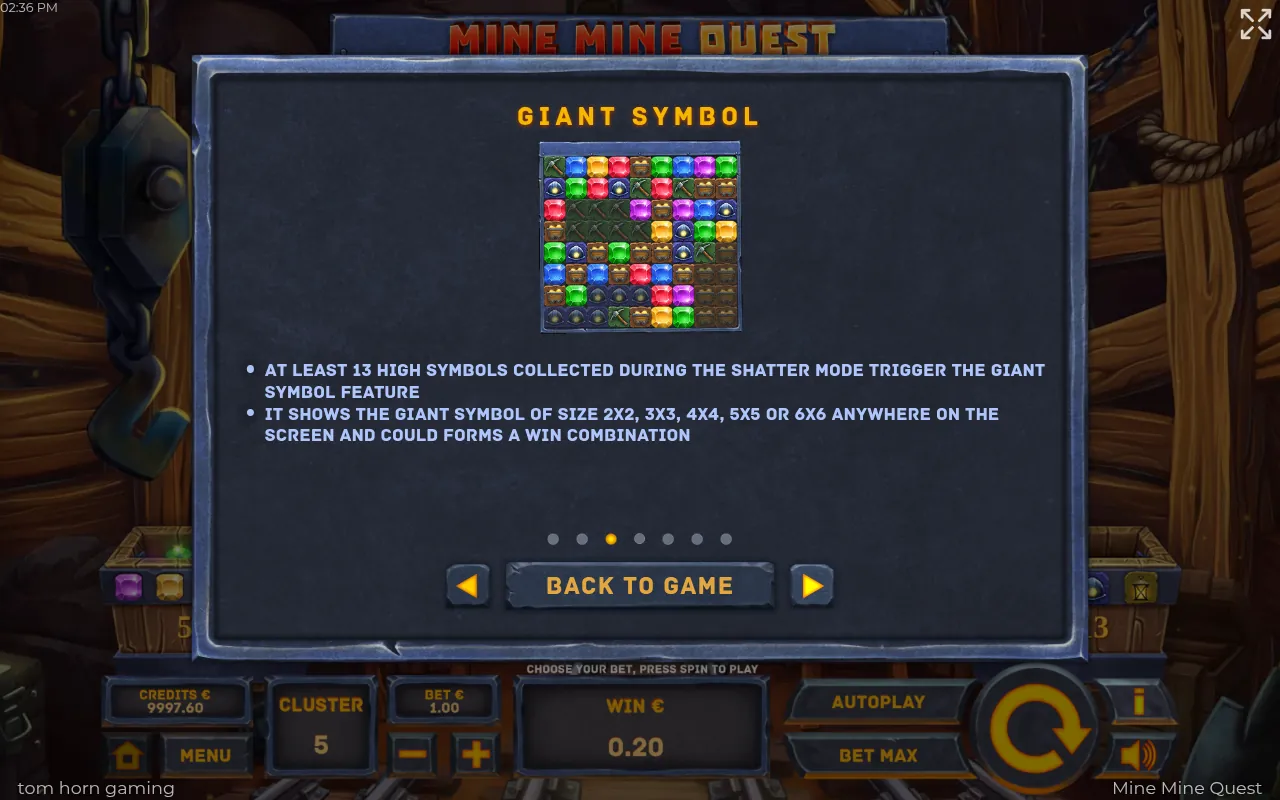
- Giant Symbol – at least 13 high symbols collected during Shatter Mode
- Wild String – at least 13 low symbols collected during Shatter Mode
The collection counters sit alongside the grid, so you can watch the tally climb with each explosion that clears the board. A prize ladder runs beside the play area too, stepping through the cluster sizes and their values. The bigger the cluster you assemble, the further up the ladder the payout climbs.
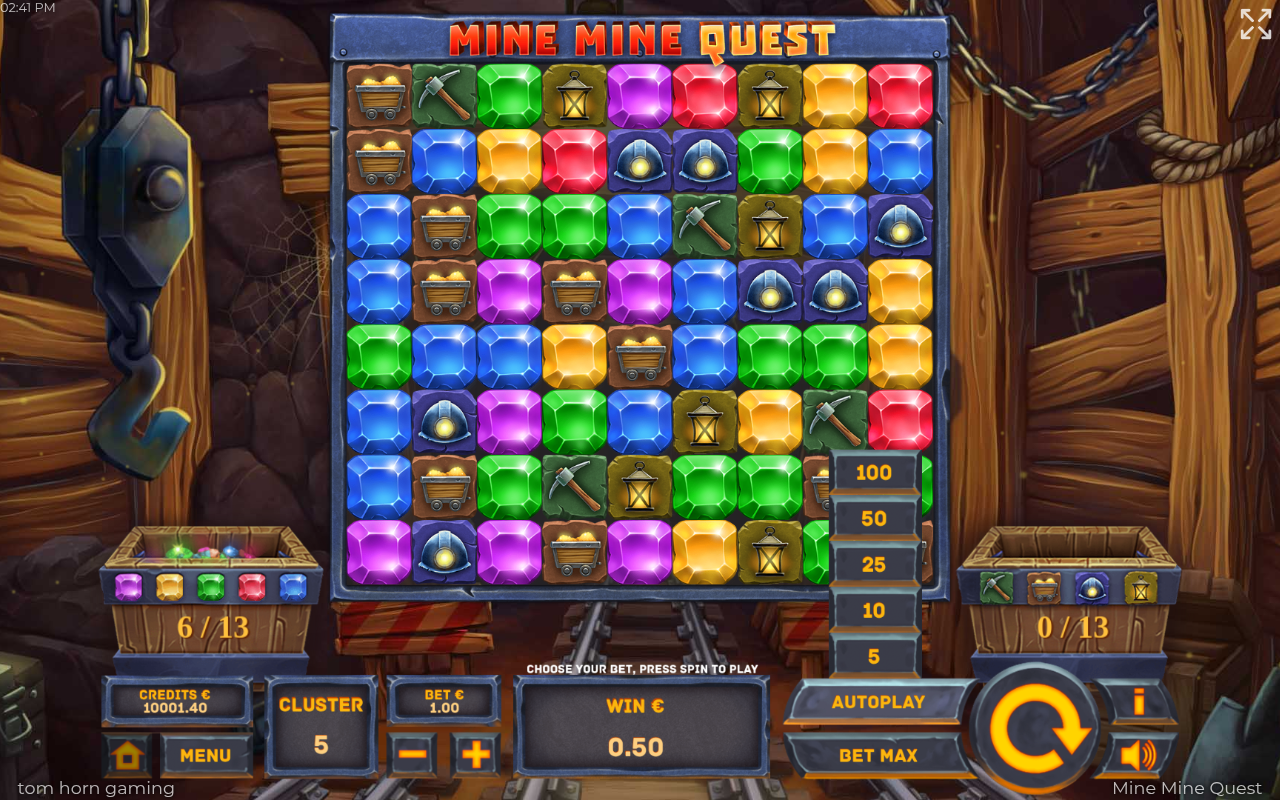
Giant Symbol
Fill the high-symbol tray and a single oversized symbol appears, anywhere on the screen, in one of five sizes:
- 2×2
- 3×3
- 4×4
- 5×5
- 6×6
Whichever size lands, the block can form a win combination on its own. A 6×6 giant covers 36 grid positions on a 9×8 board – exactly half the screen at once. Even the 2×2 version gives the next cascade a dense core of matching symbols to build around.
Both trays reset to zero after the feature fires, so the build starts again from scratch. A long shatter chain is the fastest route back to thirteen, which is where the two systems feed each other.
Wild String
The low-symbol equivalent is the Wild String. Fill the low tray and a run of up to 10 wild symbols is placed on the grid, which could award a win.
Ten connected wilds on a cluster grid can bridge groups that would otherwise pay separately, so the string is at its most useful when the board around it is already busy. Like the Giant Symbol, it resets the trays and the build starts over from zero.
Shake Up
When a spin produces no win combination at all, there’s a chance the Shake Up kicks in. The whole screen shakes and rearranges itself to deliver a win. It’s the game’s way of refusing a dead spin, and on a 9×8 grid a rearrangement has plenty of room to work with.
It simply gives a spin that had nothing a second chance, and the result is then evaluated like any other screen, clusters and all.
Stakes and Session Controls
Choosing a bet is a matter of the minus and plus buttons, and the spin button does what you’d expect. The other controls are worth knowing:
- Bet max – sets the maximum bet the game allows in one press
- Autoplay – spins automatically for the selected number of rounds and stops when you hit stop (found in the options menu on mobiles)
On desktop there’s a full set of keyboard shortcuts as well, covering everything from the spin and bet controls to the paytable and autoplay.
The RTP is 95.41%. How far a chain can climb is a question the prize ladder answers through your cluster sizes, step by step, rather than through one big number at the top.
Our Honest Verdict
Overall Rating: 7.1/10
Playing Mine Mine Quest is more like panning than digging: you’re rarely waiting for one big strike, you’re watching two trays fill, spill over and start again. That rhythm is the reason to choose it. The screen rarely goes still, and even a losing spin can shake itself into a payout, so the base game never feels like a corridor you walk down to reach the good part.
The strength is that everything compounds. A long chain fills the trays, the feature it fires can start another chain, and a single spin can snowball through several payouts. The weakness is that the payoff ceiling is unmarked: there’s no max win figure to aim at, and the 95.41% RTP sits below what most modern cluster slots offer, so the ore thins out sooner than the visuals suggest.
This is one for players who like the build-and-release loop of Frutopia and don’t need a free spins round to feel rewarded. If you play slots for the bonus round reveal, this shaft has nothing behind the door. For anyone who finds that counter-filling loop quietly gripping, though, there’s plenty still down here worth digging for.
Mine Mine Quest FAQs
-
What is the RTP of Mine Mine Quest?
The RTP is 95.41%. -
How do wins work in Mine Mine Quest if there are no paylines?
There are no bet lines at all. Matching symbols appearing in a cluster award a win, and a symbol counts towards a cluster if it sits horizontally or vertically next to the same symbol. Five or more adjacent symbols pay, and unconnected clusters of the same symbol are paid separately. -
What is Shatter Mode in Mine Mine Quest?
It’s the game’s reaction chain. Winning symbols explode and new ones drop in, and the chain keeps going until a screen produces no new win symbols. One spin can therefore run through several waves of payouts. -
How do you trigger the Giant Symbol feature?
Fill the high-symbol tray by collecting at least 13 high symbols during Shatter Mode. A single oversized symbol of size 2×2, 3×3, 4×4, 5×5 or 6×6 then appears anywhere on the screen and can form a win combination. -
What is the Wild String feature?
It’s the low-symbol counterpart to the Giant Symbol. Once the low tray reaches 13 symbols, the game drops a chain of as many as ten wilds onto the grid, and that chain can pay. -
What does Shake Up do?
After a spin with no win combination, there’s a chance the whole screen shakes up to deliver a win. It only fires on losing spins, so it never interrupts a shatter chain. -
What is the grid size of Mine Mine Quest?
Mine Mine Quest is played on a 9×8 grid, which gives the cluster pays mechanic plenty of room. Unusually, the grid is wider than it is tall. -
Who makes Mine Mine Quest?
Mine Mine Quest is made by Tom Horn Gaming. Its release date is 2 November 2021.