









Pocket Ace Slot Review
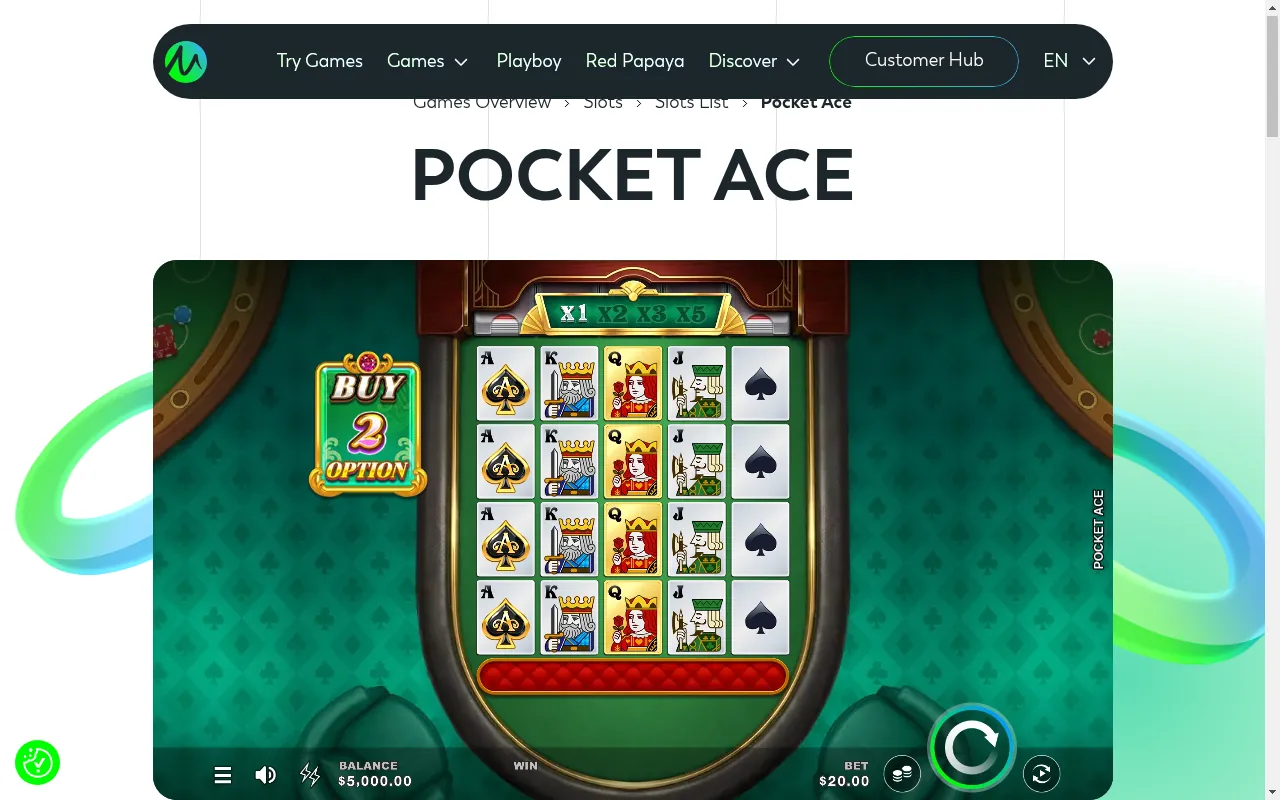
A horseshoe card table, a padded mahogany rail, green baize and wallpaper stamped with card suits: the setting is drawn with real care, right down to the chips stacked in the corners. But the room isn’t the point of Pocket Ace – what makes it worth a look is that it shows you exactly where you stand, at all times, on a multiplier climb that tops out at 10x. That’s rarer than it should be, and it changes how the whole game feels to play.
Games Global built this one around a 96% RTP, mid volatility and a 5×4 grid. It sits in the same catalogue as Thunderstruck II, Immortal Romance and Mega Moolah, though it’s a quieter, more mechanical proposition than any of those: a game about reading a board rather than waiting for a jackpot.
How the Base Game Pays
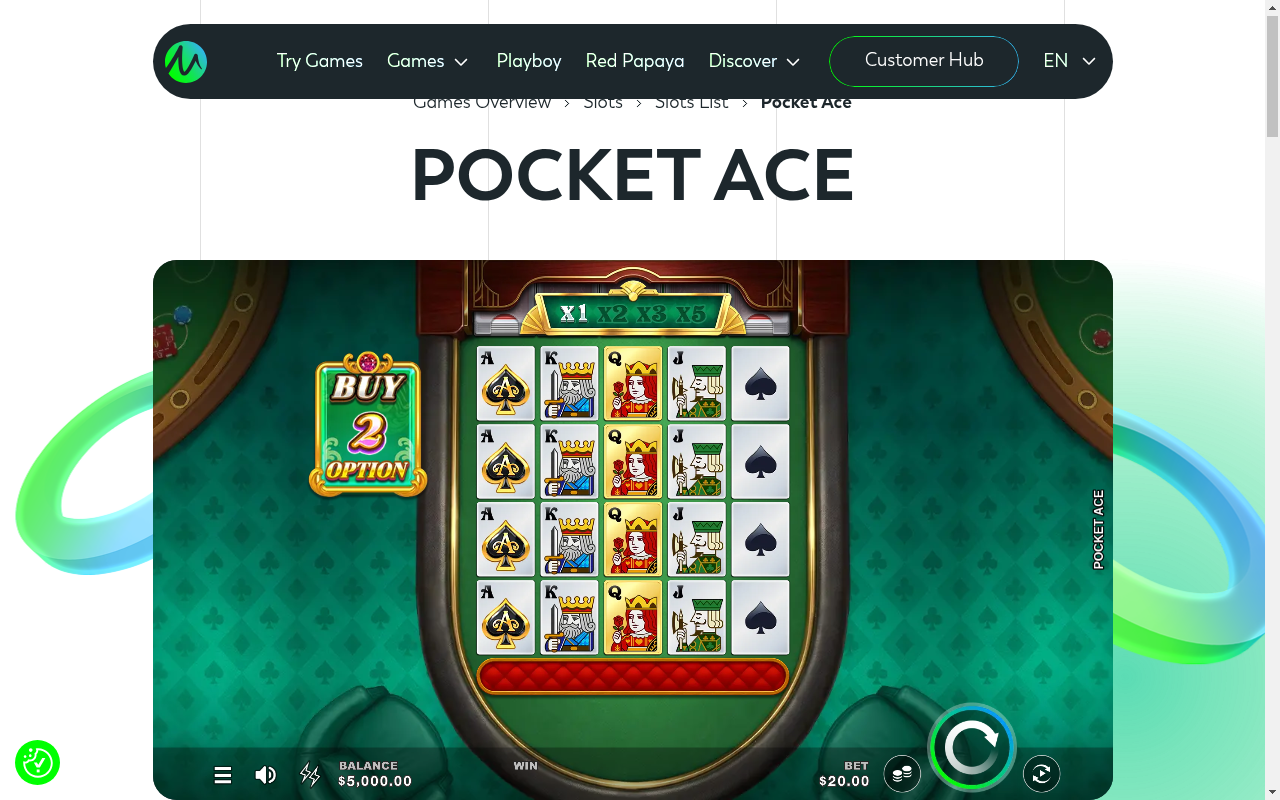
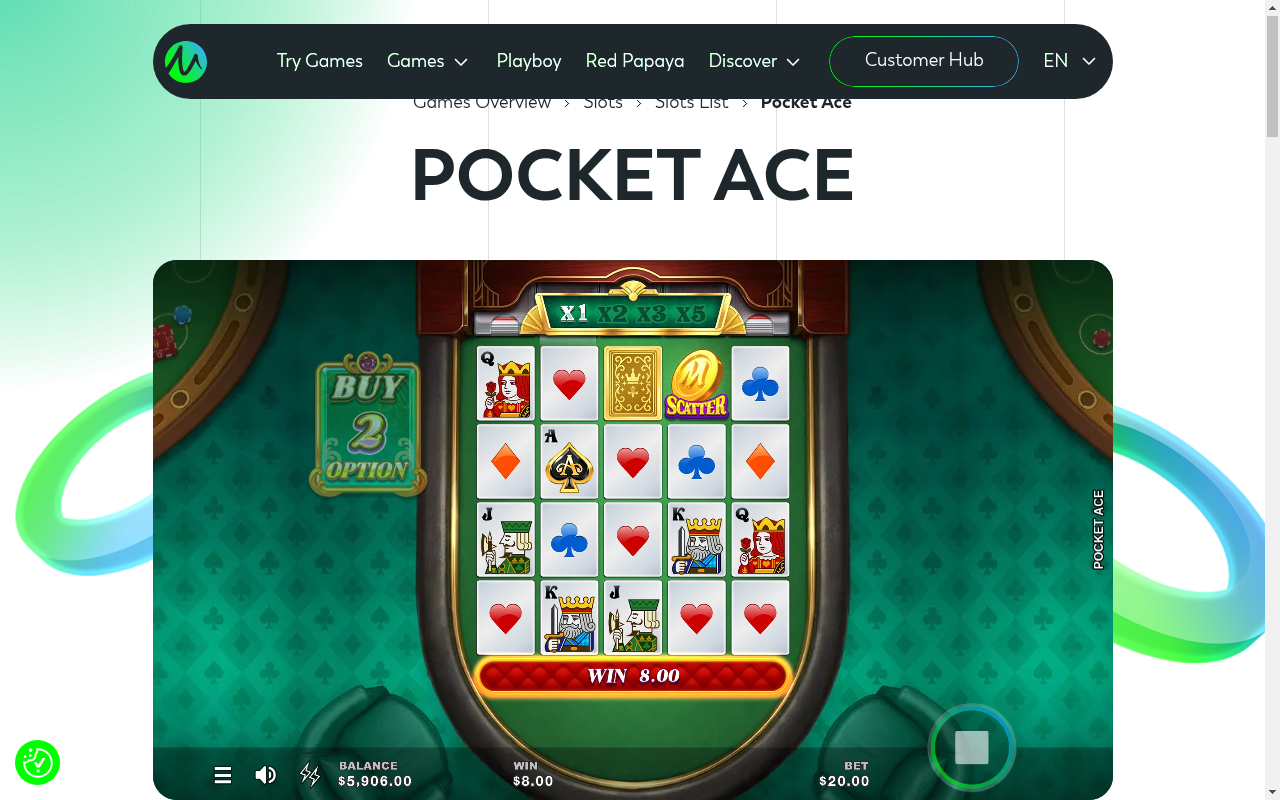
Pocket Ace runs on a 5×4 grid: five reels, four rows of symbols, more room for combinations than the usual three-row layout. The frame is the table itself, the rail curving round the bottom of the playfield, with chip stacks filling the corners above and below the reels. Beyond the game’s edges the page glows with soft green and blue ribbon loops.
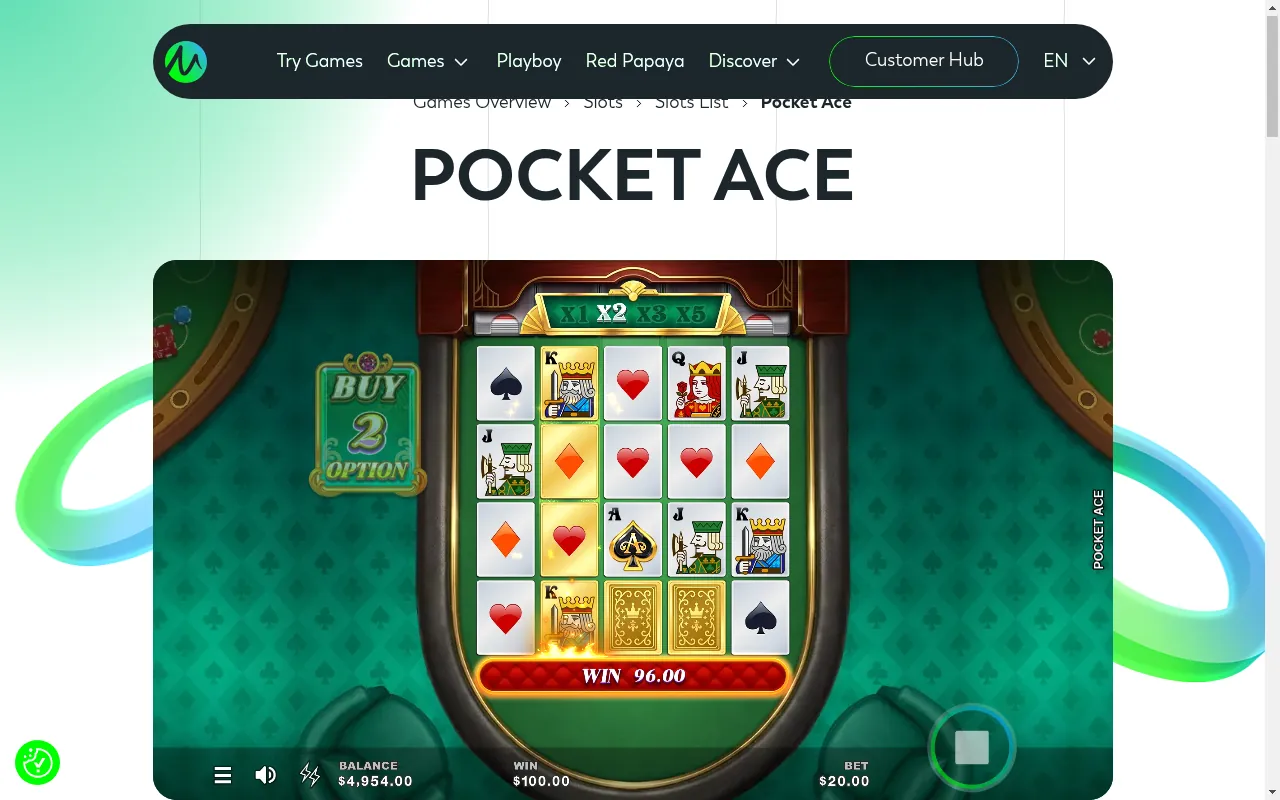
Wins arrive with a label attached. A paying combination lands tagged as a COMBO hit, numbered by its position in a sequence, rather than as a plain line win. The number isn’t decoration: the combo count is what the meter above the reels is tracking, so every tagged win tells you something about where you stand on the climb.
The labelling runs both ways. The win banner that spells the sequence out as it lands also counts the consecutive spins feeding the challenge, so the same readout covers what you just won and how far along you are. The ladder tops out at 10x, so the challenge the banner counts towards has a fixed destination.
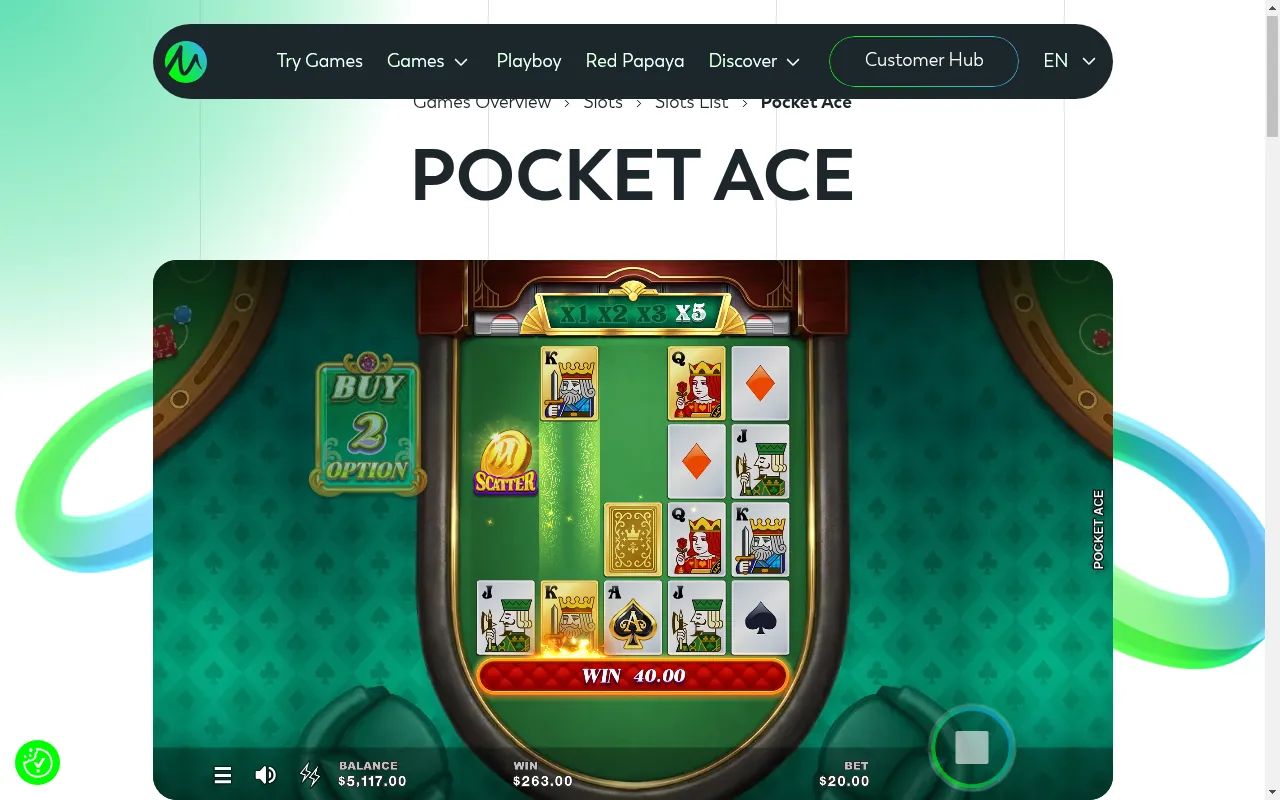
There’s a coin-shaped scatter carrying the SCATTER label on the grid, and it’s the one symbol doing anything out of the ordinary in the base game. No wild is depicted or described, so the scatter carries the only special-symbol duties. No symbol pays are part of what the game shares, so there’s no paytable walkthrough to give here.
What the base game does share, plainly:
- 5×4 grid, with the curved rail of the card table as its frame
- Wins labelled by combo number as they land
- A win banner counting consecutive spins towards the challenge
- A coin-shaped SCATTER symbol on the reels
- No wild symbol
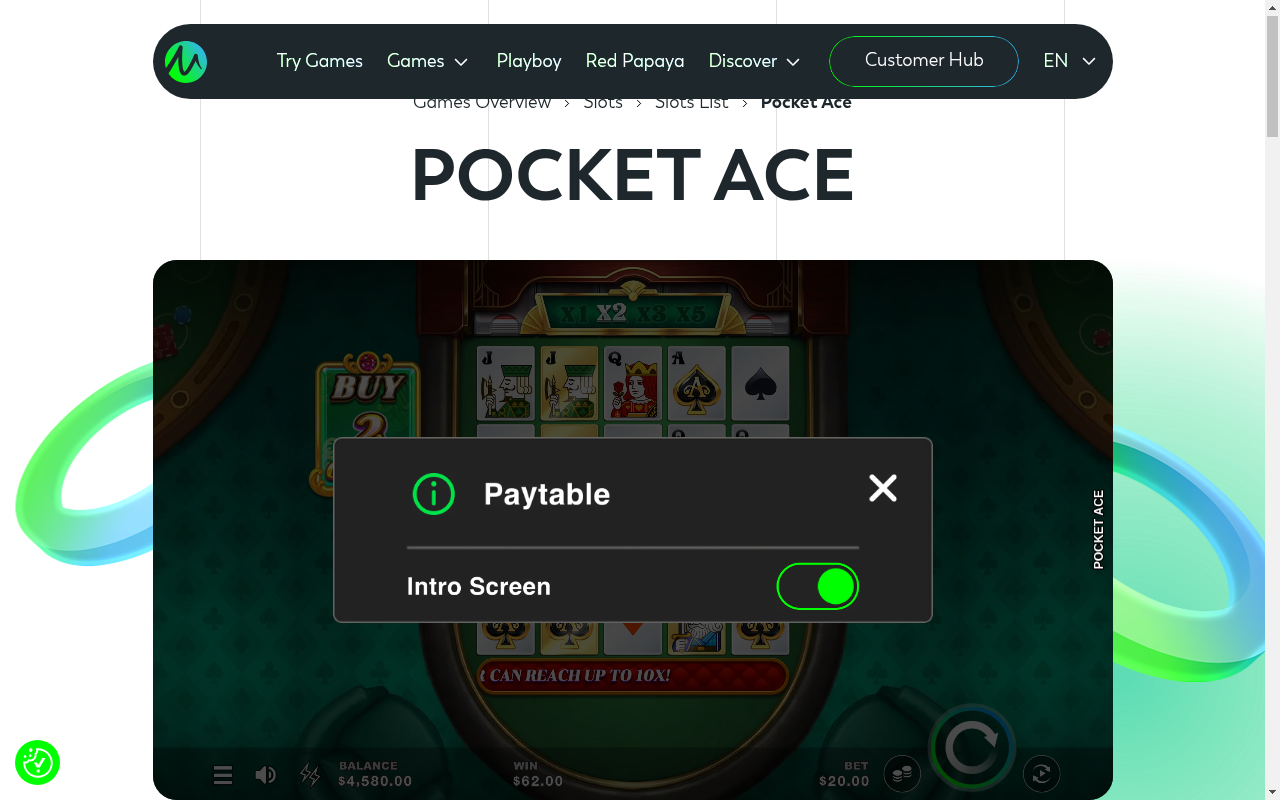
- An intro screen that can be toggled off from the paytable popup
That last one deserves its own word. The intro screen that plays on load can be switched off, which spares anyone grinding the ladder from watching the same opening every session. It’s a settings toggle rather than a feature, but it’s the right kind.
The Multiplier Ladder
The centrepiece is the meter sitting above the reels. It reads, in sequence:
- X1 – the starting rung
- X2 – the second rung
- X3 – the third rung
- X6 – the top rung on the meter
The game highlights the current rung in its own frame, so at any moment the active multiplier is visible without hunting for it. X1 and X2 sit in different frames from the rest, which marks the lower half of the climb as its own stretch of the game. It’s a simple read: climb the rungs, and whatever the grid pays gets multiplied by where you stand.
The ladder doesn’t stop at six. The multiplier can reach up to 10x, which puts a clear ceiling on the climb: double the top rung on the meter, no more.
For a mid-volatility game that’s a sensible shape of prize, sized to reward a good run of combos without promising a jackpot-scale hit. It pairs the two numbers a grinder cares about: a ceiling you can name, and a pace of progress you can watch.
Replication
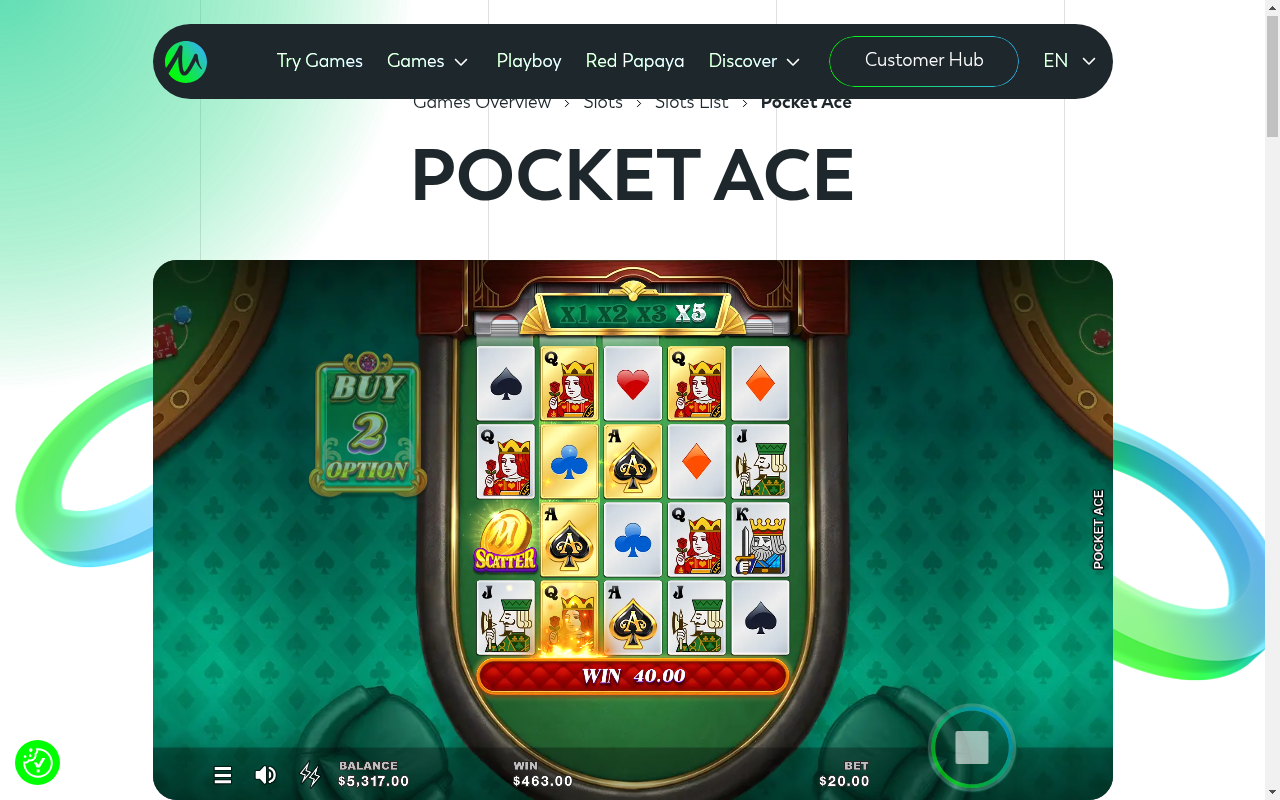
One mechanic sits behind the bigger wins. When the triggering symbol appears, it replicates into multiples across the grid, filling several positions at once.
That replication is how a single combo turns into a large win: more matching positions, a longer sequence, a higher rung. A tagged COMBO 2 hit can clear a comfortable multiple of the bet on its own, with the highlighted symbols showing exactly which positions contributed.
The two mechanics feed each other. Replication builds the matching positions that make a combo worth counting; the ladder turns that count into a multiplier you can see coming. Neither works alone, and the game is honest about that: neither meter nor mechanic pretends to be the whole story.
What the ladder gives the base game is a reason to keep watching between wins. A combination that feeds the meter still moves you somewhere, and the meter’s visibility makes each step legible rather than announced.
The poker-room dressing fits that loop. This is a game about reading a board and waiting for the hand to complete, and the meter gives the waiting something to measure.
Bonus Buy
For anyone who’d rather skip the climb, the left panel carries a BUY 2 OPTION button. Beyond its name, the game doesn’t say what the buy actually grants.
What it offers, plainly:
- Named BUY 2 OPTION, in the base game’s left-hand panel
- One click from the reels, not buried behind a menu
Our Honest Verdict
Overall Rating: 7/10
Playing Pocket Ace feels like sitting down at a table where the dealer keeps the running count face up. The reason to choose it over louder games is that you always know where you stand: the meter is on screen, the rung is highlighted, the wins are labelled. Nothing about your progress is guesswork, and for a mid-volatility game that pace of visible increments is genuinely satisfying.
The strength is the honesty of that build. The weakness is everything around it. The game never tells you what its symbols are worth, the scatter’s job goes unexplained, and the buy button sits there without a price, so you work the edges out by feel rather than by reading them.
This is a game for players who enjoy watching a number climb and don’t need a four-figure ceiling dangling over the reels. The patient sort will settle in happily: the seat is comfortable, the room is handsome, and the count is always face up. Anyone chasing a headline payday should fold early.
Pocket Ace FAQs
-
What is the RTP of Pocket Ace?
Pocket Ace runs at an RTP of 96%, which sits right at the industry’s customary benchmark. -
Is Pocket Ace high volatility?
No. Pocket Ace is a mid-volatility game, so wins and ladder progress should arrive at a steadier pace than a high-variance title. -
What is the grid size of Pocket Ace?
Pocket Ace uses a 5×4 grid: five reels with four rows of symbols. -
Can you buy the bonus on Pocket Ace?
Yes. A BUY 2 OPTION button sits in the left-hand panel of the base game, offering a purchased entry without the need to climb the ladder organically. -
When is Pocket Ace released?
Pocket Ace’s release date is 11 March 2026. -
Who makes Pocket Ace?
Pocket Ace is made by Games Global, the studio behind titles like Thunderstruck II, Immortal Romance and Mega Moolah. -
How high does the multiplier go in Pocket Ace?
The meter above the reels steps through X1, X2, X3 and X6, and the multiplier can reach up to 10x in total. -
Can you turn off the intro screen in Pocket Ace?
Yes. The intro screen that plays when the game loads can be toggled on or off from the paytable popup, so repeat sessions can skip straight to the reels.