






Reactoonz Slot Review
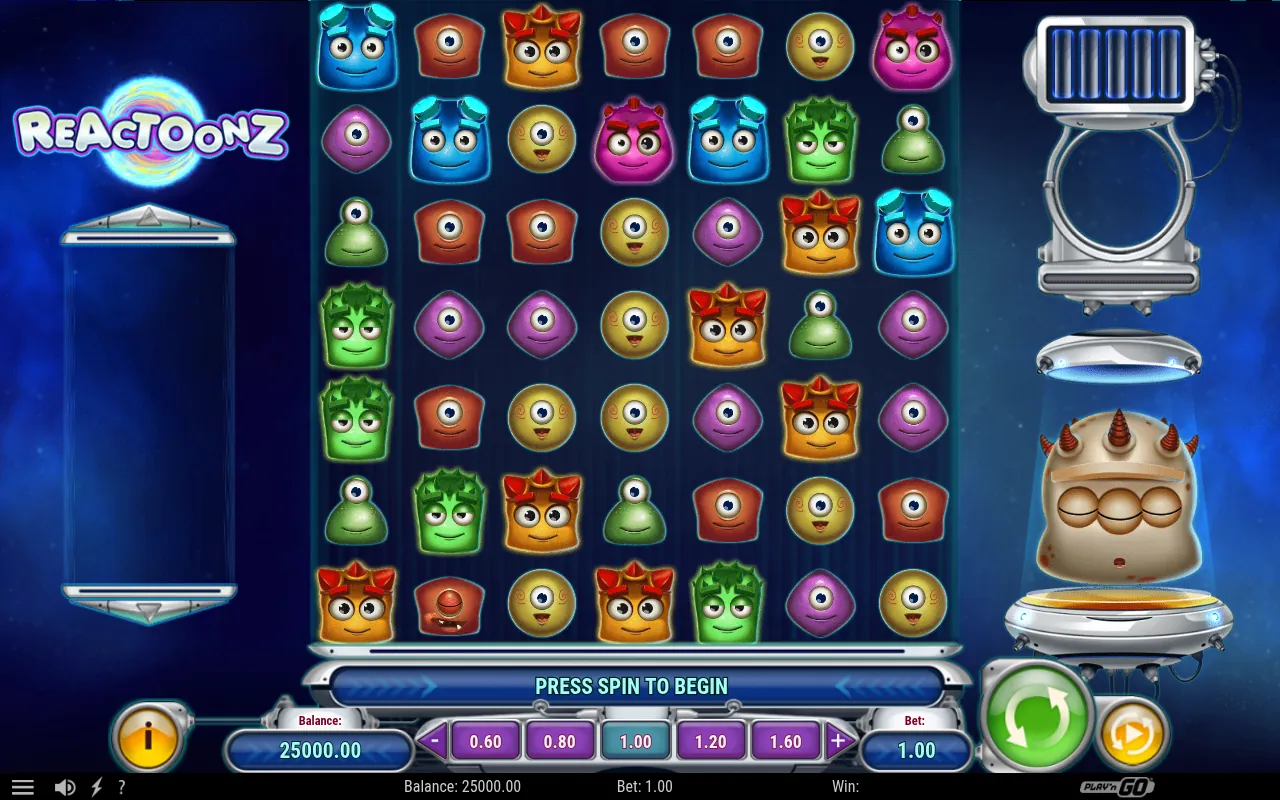
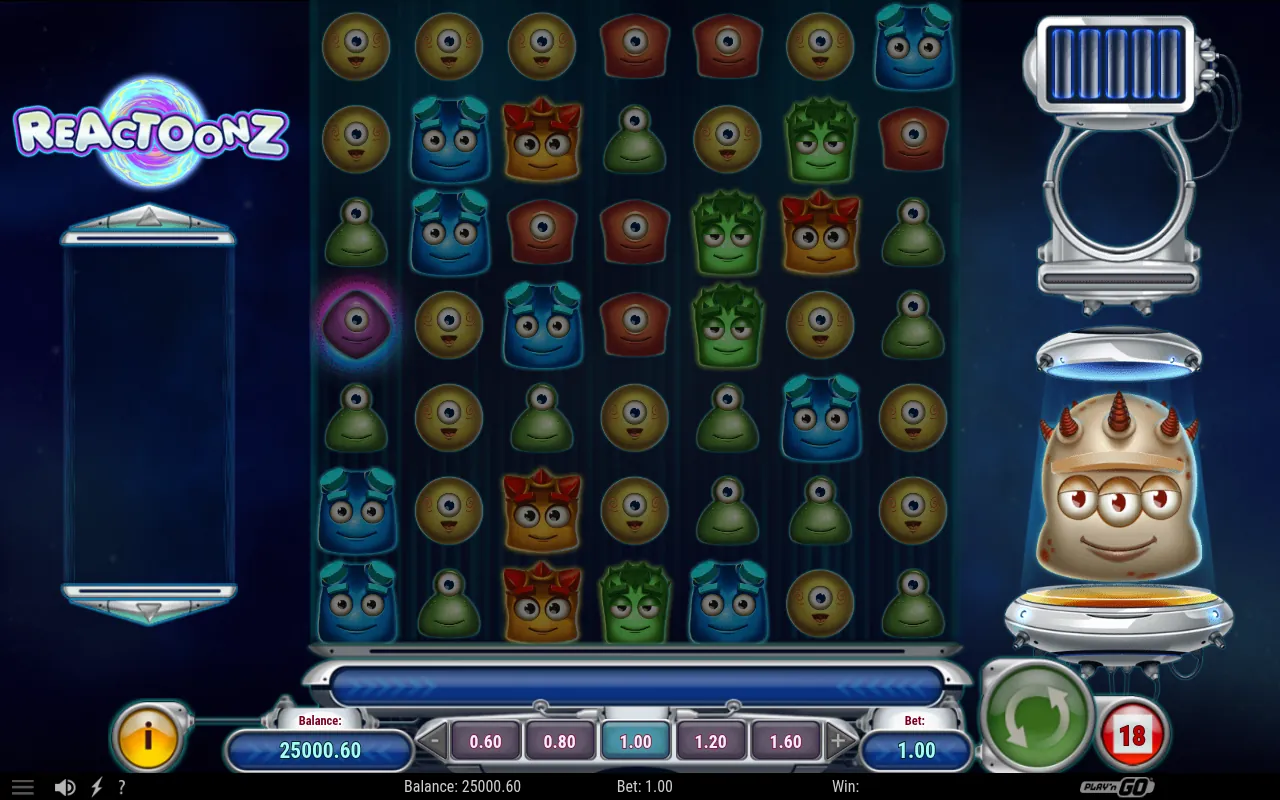
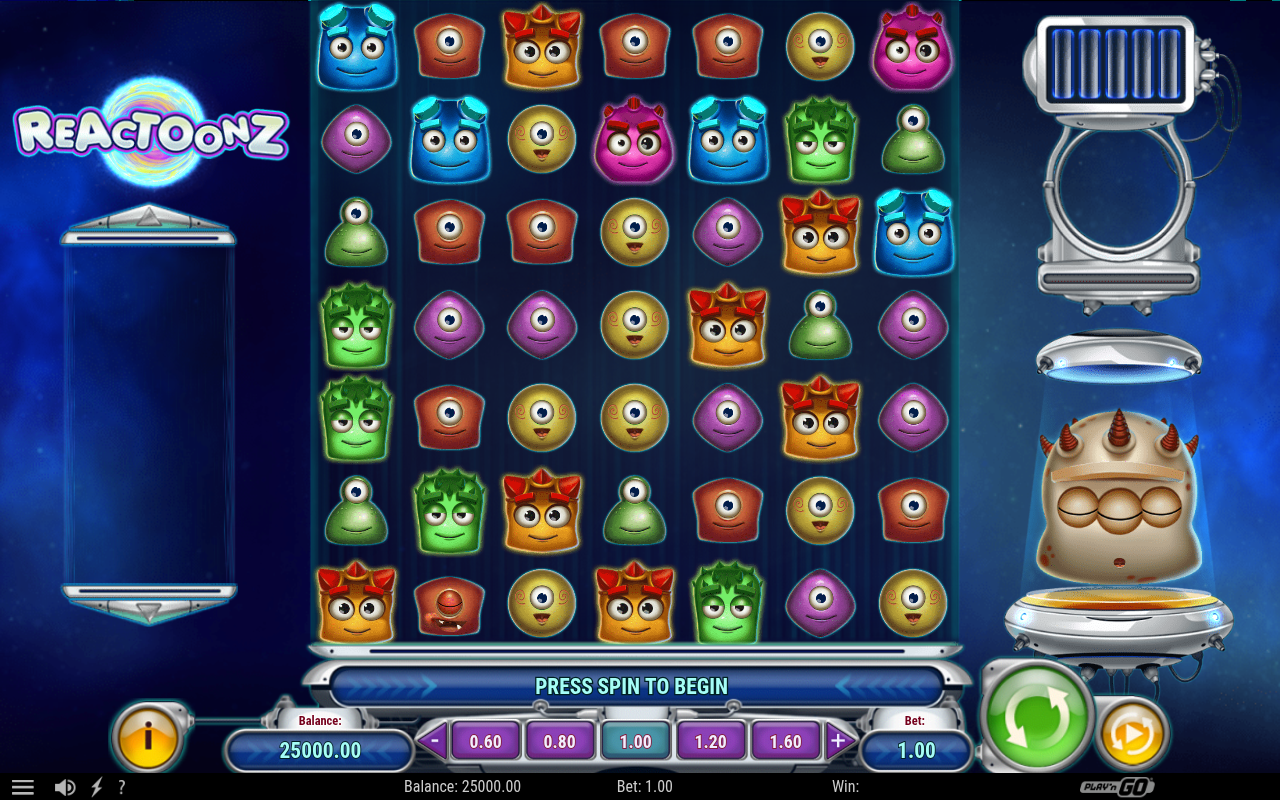
In a deep-space laboratory, a chrome rig beams pale light down onto a horned, three-mouthed blob waiting on a landing pad, while pastel aliens swirl through a wormhole behind the logo. Reactoonz takes place in that lab, and its argument is a bold one: a slot doesn’t need free spins at all. There’s no bonus round anywhere in it, and eight years of imitators suggests dropping it was the right call.
It plays out on a 7×7 grid with Cluster Pays, a 96.51% RTP and high volatility, with a maximum win of 4,750x the bet. Play’n GO built the format, and it has aged well enough to spawn a family of successors, including Reactoonz 2 and Gargantoonz. None of them has quite replaced this one, and the reasons are worth unpicking.
How Reactoonz Pays
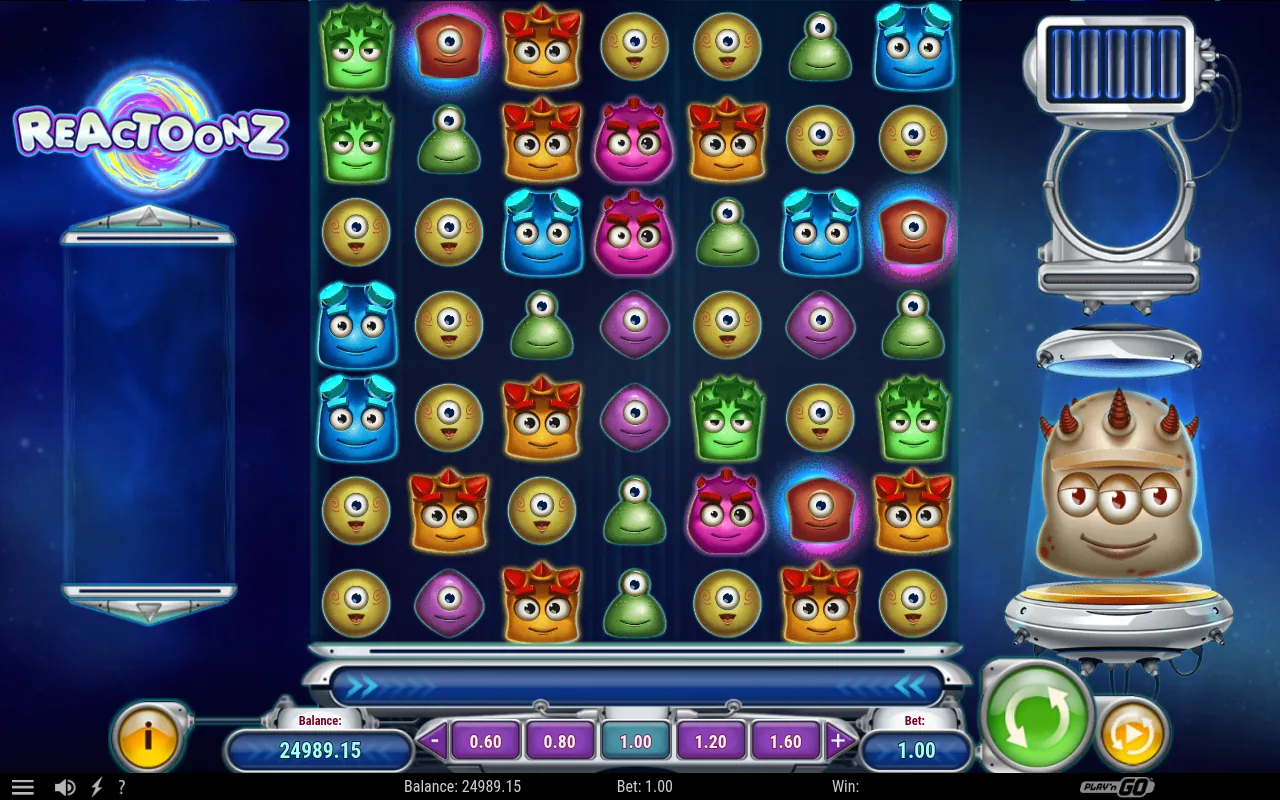
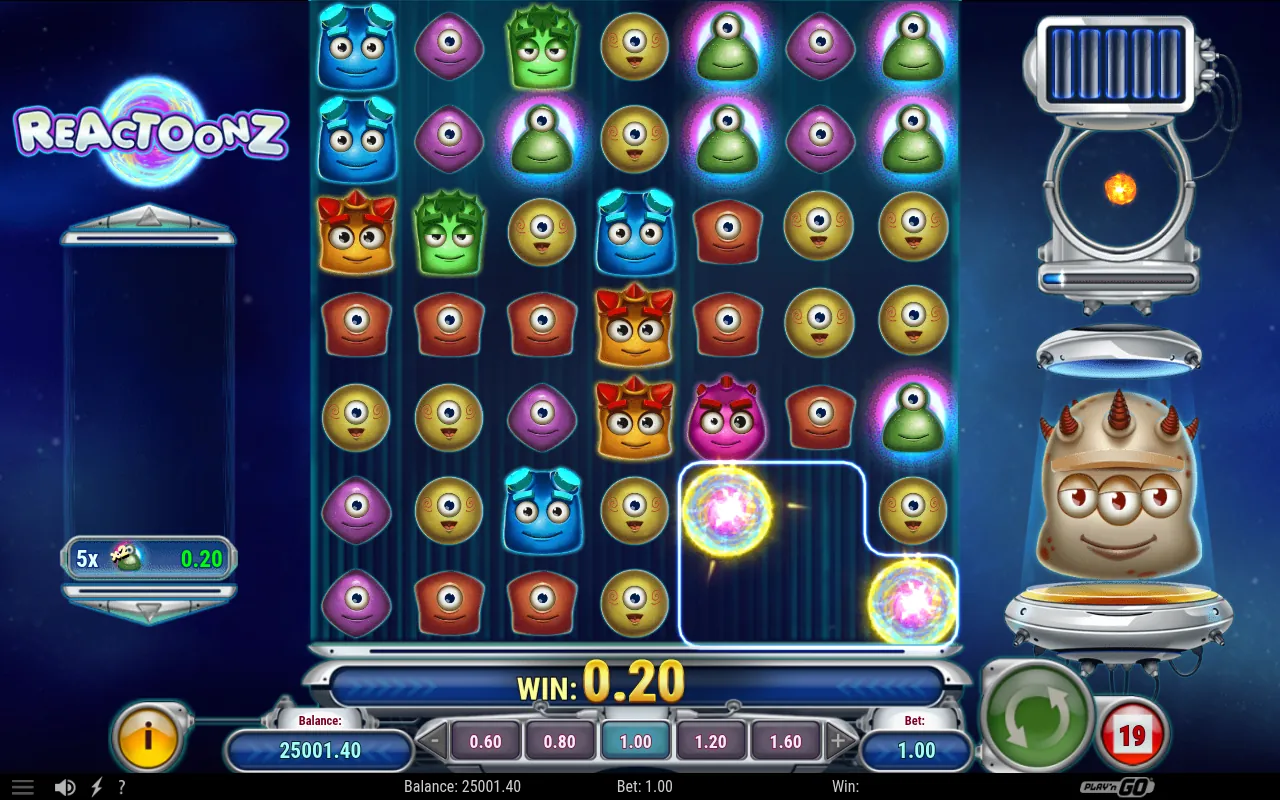
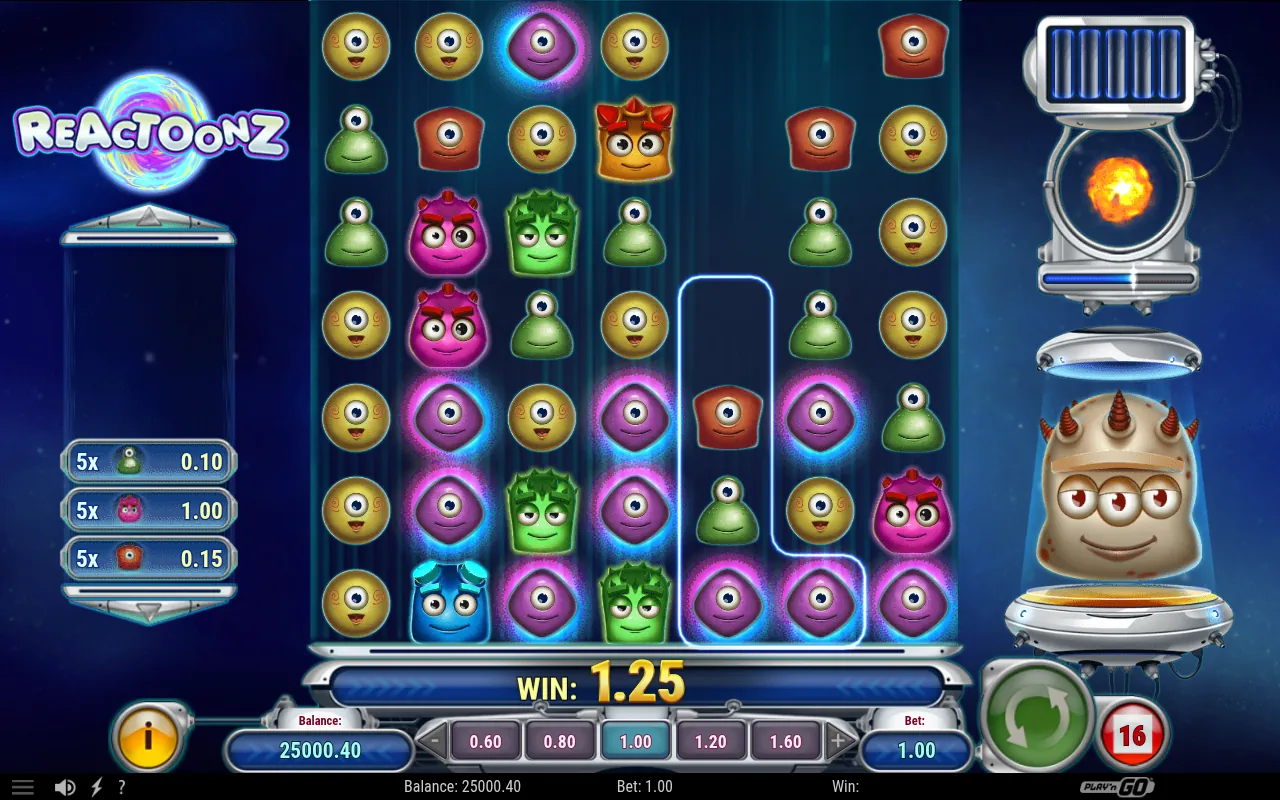
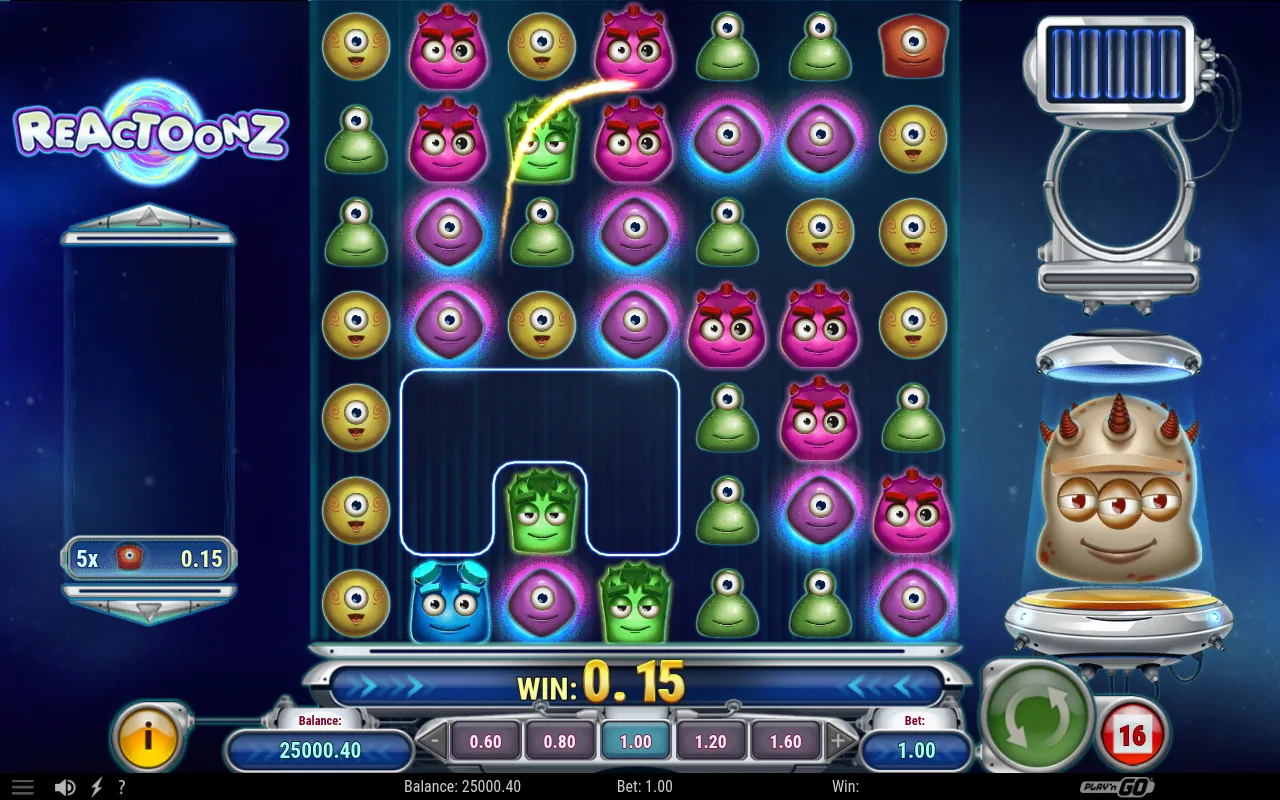
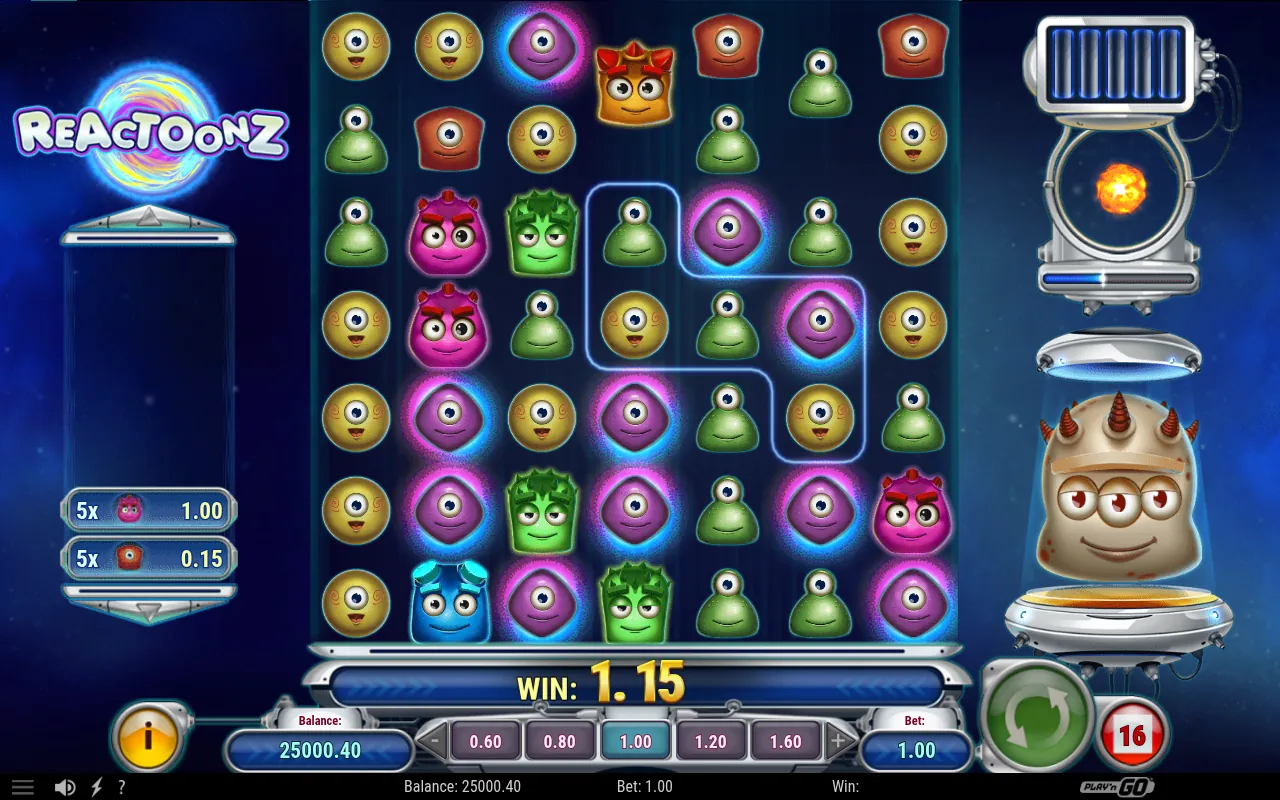
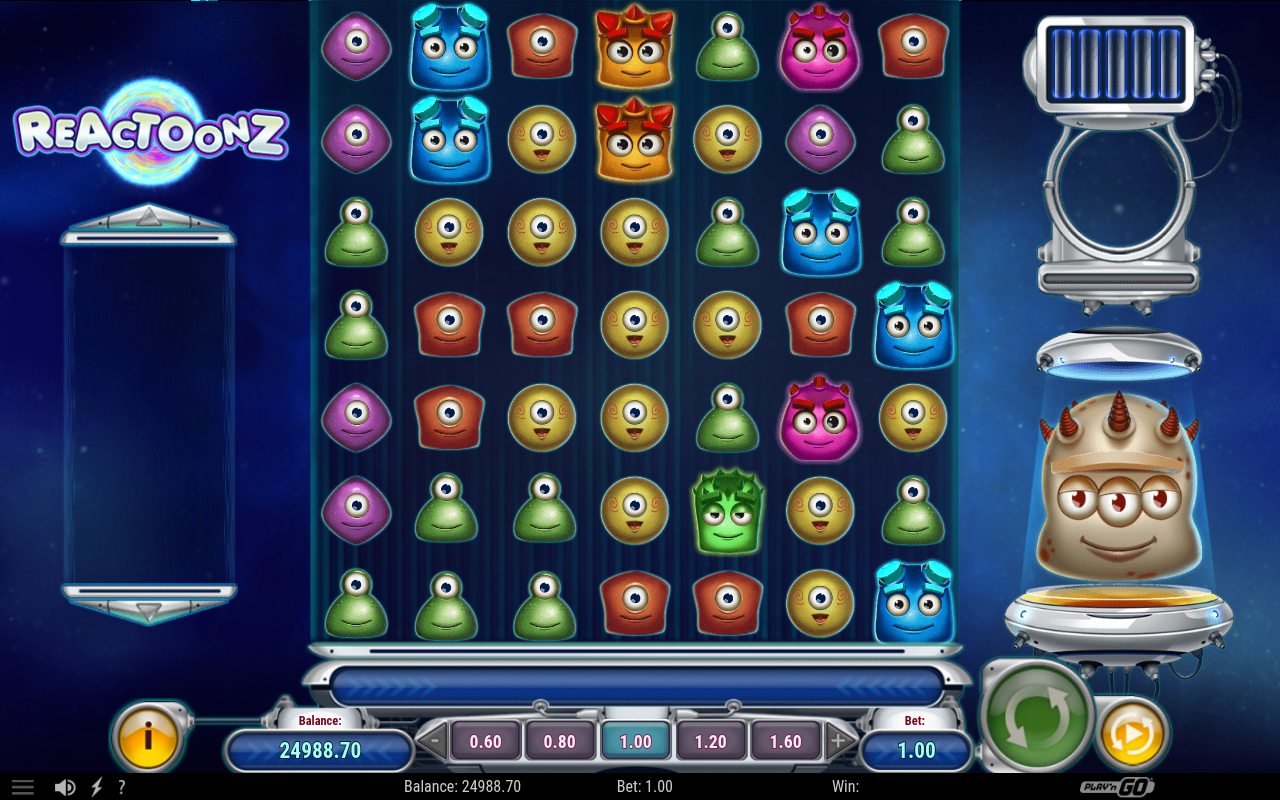
There are no paylines. Wins form when five or more matching aliens land in a connected cluster, horizontally or vertically, anywhere on the 7×7 grid. Winning clusters vanish, and new symbols cascade down into the gaps, so a single spin can produce several wins in a row.
A round unfolds in a fixed sequence, and every step feeds the next one:
- The initial symbols drop onto the 49-position grid
- Any cluster of five or more matching symbols pays and is removed
- New symbols cascade down from above into the empty positions
- Fresh clusters formed by the cascade pay as well, and the chain repeats
- When no more wins are present, any queued Quantum features trigger
- The round ends once the queue is empty and no winning combinations remain
Cascades matter here more than in most games, because every symbol removed in a win feeds the charge meter beside the reels. A grid that keeps clearing is a grid that keeps building towards the features.
Each step of that sequence has its own role. The cluster check is what pays, the cascade is what refreshes the grid, and the queue is what the whole round is building towards. Stakes run from 0.20 to 100 per spin, which covers casual budgets and serious ones alike.
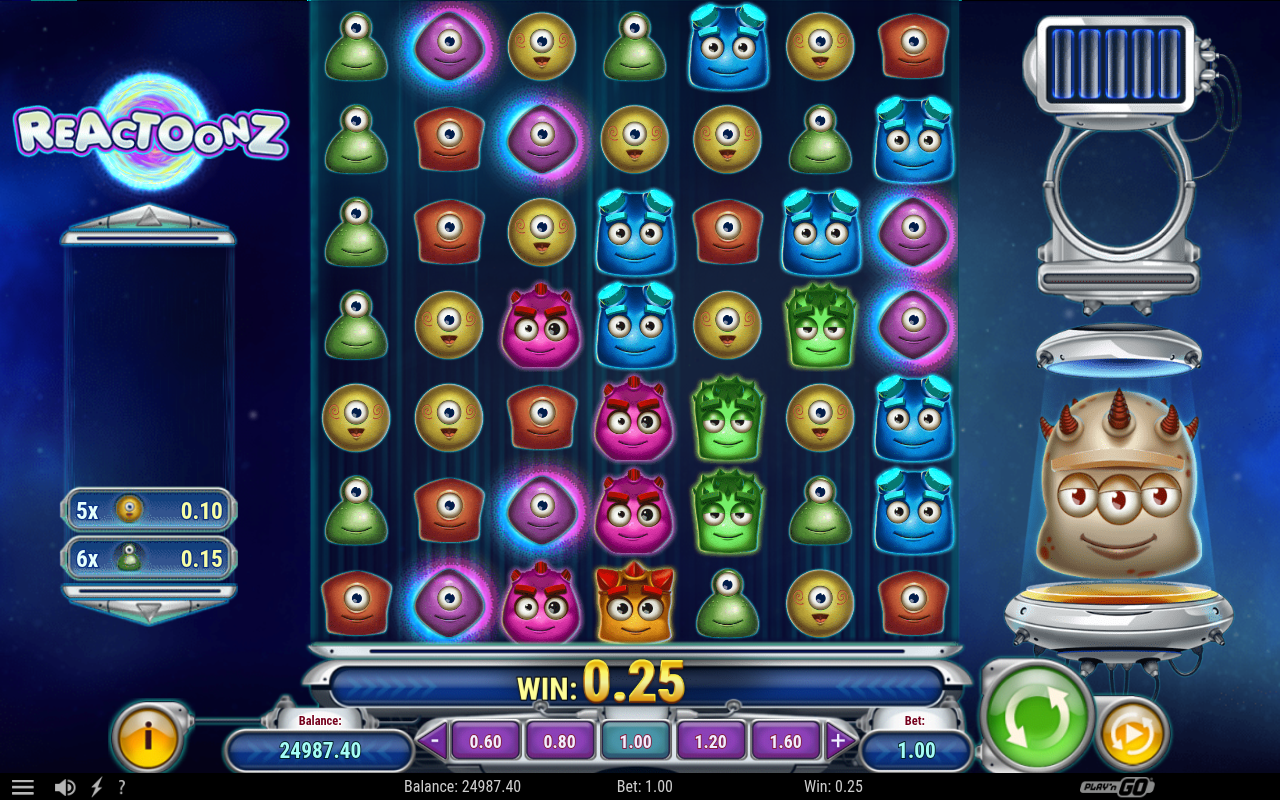
The wild substitutes for every symbol. It never lands as an ordinary reel symbol: wilds only ever arrive through the special mechanics, dropped by the Gargantoon or created by the Quantum features.
Wilds are also left untouched by the Quantum features themselves, so a wild created by Implosion survives whatever the next queued modifier does to the symbols around it. In a game where the modifiers arrive in sequence, that persistence is what makes stacked features dangerous.
The Quantum Leap
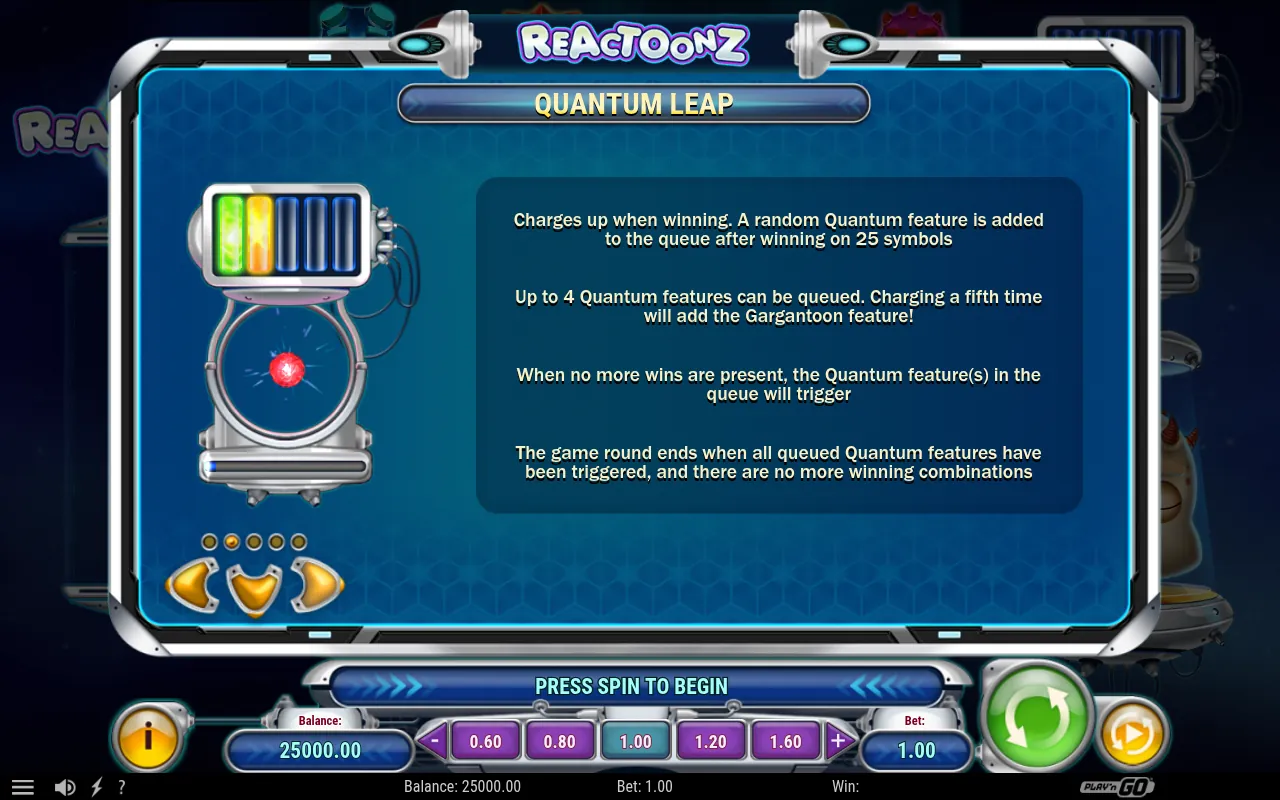
The Quantum Leap meter is the engine the rest of the game hangs off. The rules of the charge are simple:
- Charging – the meter fills from winning symbols only, so a spin that pays nothing on its first drop doesn’t advance it
- 25 symbols – every 25 winning symbols adds one random Quantum feature to the queue
- Four slots – up to four Quantum features can be queued at once while the cascades keep running
- The fifth charge – doesn’t add another feature; it queues the Gargantoon itself
- Triggering – queued features wait until no more wins are present, then fire one after another
Because the meter only counts winning symbols, a long cascade chain can add several charges in a single spin. That’s the compounding effect the game is built around: wins create the very modifiers that create more wins.
The queue doesn’t reset between rounds in the way a free-spins counter does. Once a feature is queued, it stays there until it fires, so progress made on one spin carries the potential to pay off several spins later.
Quantum Features
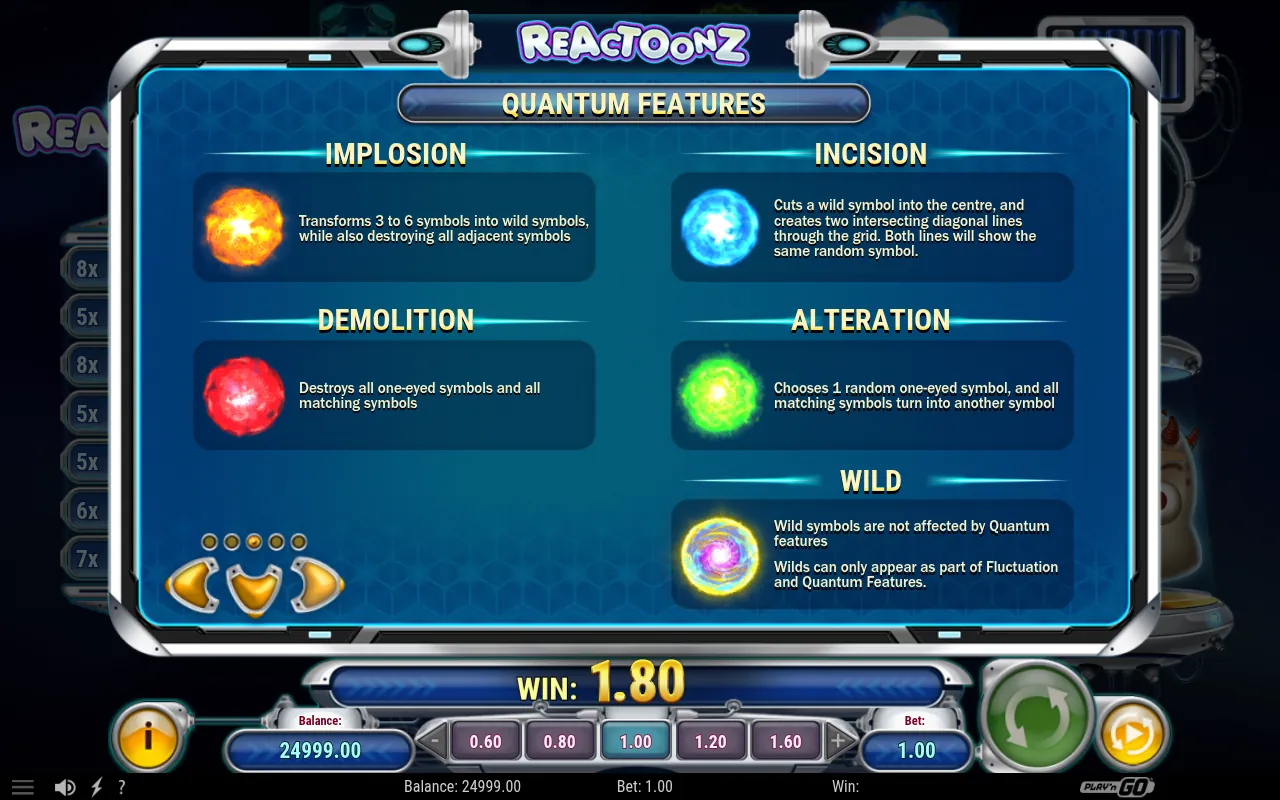
Four modifiers can enter the queue, and each one changes the grid in its own way:
- Implosion – transforms 3 to 6 symbols into wilds and destroys all adjacent symbols
- Incision – cuts a wild into the centre and draws two intersecting diagonal lines showing the same random symbol
- Demolition – destroys all one-eyed symbols and all matching symbols
- Alteration – picks one random one-eyed symbol and turns every matching symbol into another symbol
Implosion is the one that most often turns a dead grid live, since its wilds can bridge clusters that were one symbol short. Incision is the most dramatic to watch: two diagonals of identical symbols appearing at once, meeting at a central wild.
Demolition and Alteration both work through the one-eyed aliens, clearing or converting them wholesale. None of the four is a win on its own. What they do is reshape the grid after the paying stops, then let the cascade check run again.
A feature that produces a new cluster can start the whole chain over: the new win pays, its symbols feed the meter, and the meter edges closer to the next charge. That loop – feature, win, charge, feature – is the shape of every good round the game produces.
Instability and the Gargantoon
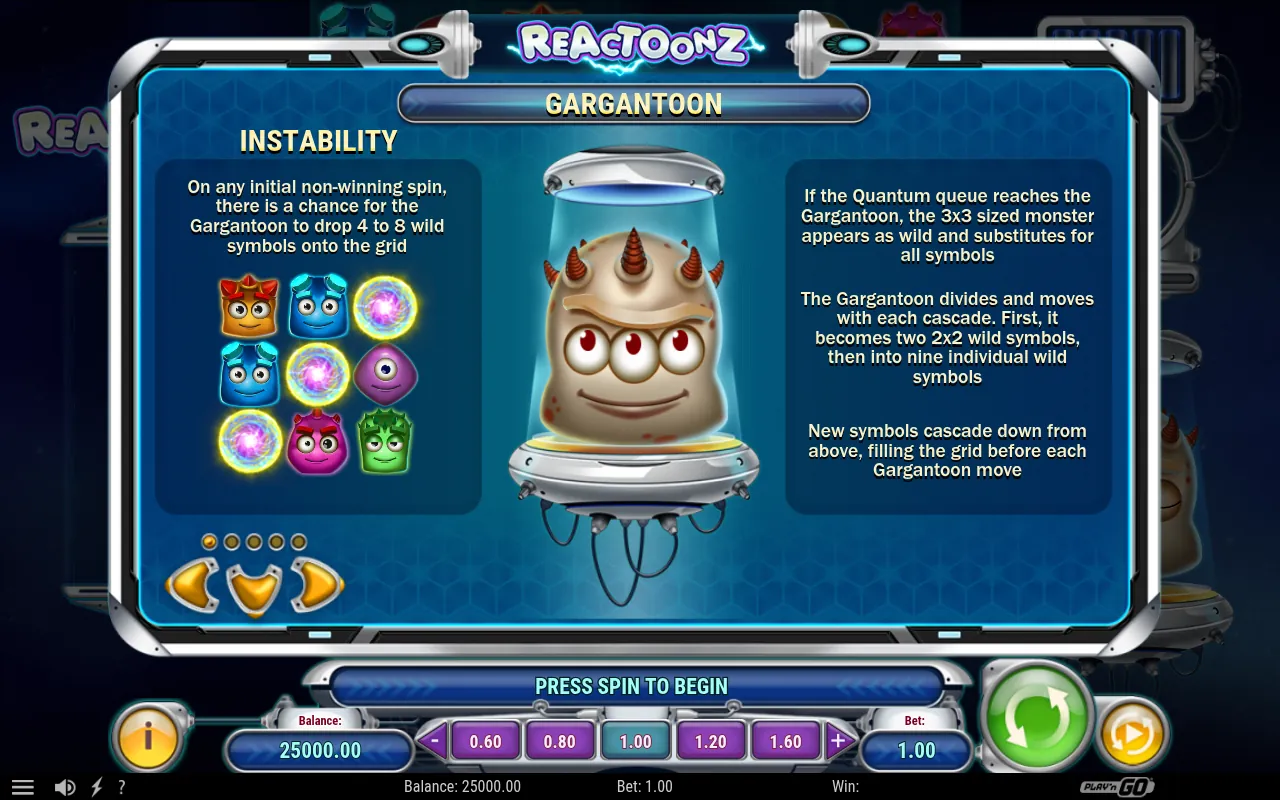
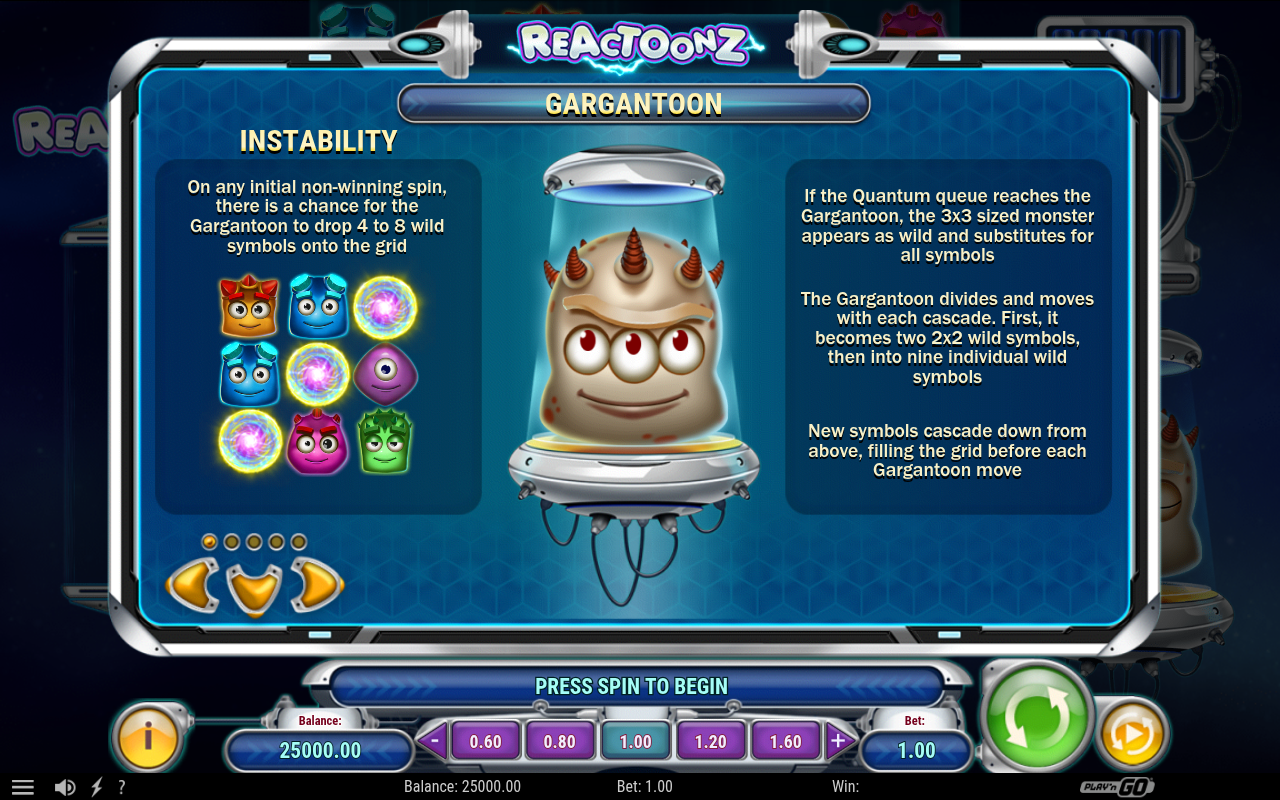
Instability covers the spins where nothing lands. On any initial non-winning spin, there’s a chance the Gargantoon drops 4 to 8 wild symbols straight onto the grid, rescuing a spin that looked finished. It’s the only thing that happens on a losing first drop, and it’s what stops the base game from being purely a waiting exercise.
The Gargantoon itself is the payoff for a fully charged meter. When the queue reaches it, the 3×3 monster lands as one giant wild substituting for all symbols. From there it divides and moves with each cascade:
- First form – a single 3×3 wild covering nine grid positions
- After the first cascade – splits into two 2×2 wilds
- After the next – nine individual wilds scattered across the grid
New symbols cascade down and fill the grid before each Gargantoon move, so every split lands on a freshly stocked board. A 3×3 wild that divides twice across cascades is the closest the game comes to a set-piece moment, and it’s the only route to the biggest clusters the grid can hold.
Our Honest Verdict
Overall Rating: 9/10
This is a slot you play to watch a machine run. Rounds start small, gather pace as the meter fills, and occasionally end with a three-by-three monster tearing the grid apart, which is exactly the moment all those little experiments in the lab were building towards. When a round chains properly, nothing in the format beats it.
The strength is that the queue never wastes a win. Every paying symbol pulls the next feature closer, so even modest spins feel like progress rather than filler. The weakness is the ceiling: 4,750x is small for a high-volatility cluster game, and the long stretches of quiet spins in between can bite.
It’s for players who enjoy the build more than the destination, and it isn’t for anyone who wants a free-spins round to break up the grind. The lab’s oldest experiment also remains its most satisfying one: smaller prizes than its sequels, but a game that earns every cascade.
Reactoonz FAQs
-
What is the RTP of Reactoonz?
The RTP is 96.51%, which sits just above the typical average for an online slot. -
Is Reactoonz high volatility?
Yes. Reactoonz is a high volatility slot, so wins can be spaced out and the balance can swing noticeably in both directions. -
How many paylines does Reactoonz have?
It doesn’t use paylines at all. Wins are formed by Cluster Pays, with five or more matching symbols connecting horizontally or vertically on the grid. -
What is the grid size of Reactoonz?
Reactoonz plays on a 7×7 grid, giving it 49 symbol positions and plenty of room for large clusters to form. -
How does the Quantum Leap work in Reactoonz?
Every 25 winning symbols adds a random Quantum feature to a queue that can hold four, and a fifth charge queues the Gargantoon. Queued features trigger once the cascades stop producing wins. -
What is the Gargantoon in Reactoonz?
The Gargantoon is a 3×3 wild that appears when the Quantum queue is fully charged. It substitutes for all symbols, then splits into two 2×2 wilds and finally nine individual wilds as cascades continue. -
What is Instability in Reactoonz?
Instability is a random consolation mechanic. On any initial non-winning spin, there’s a chance the Gargantoon drops 4 to 8 wild symbols onto the grid, potentially creating a winning cluster where none had formed. -
What is the minimum and maximum bet on Reactoonz?
Stakes run from 0.20 to 100 per spin, which covers most bankrolls from casual play upwards. -
Who makes Reactoonz?
Reactoonz is made by Play’n GO. -
What is the maximum win on Reactoonz?
The maximum win is 4,750x the bet.