









Skybound Bail2Win Slot Review
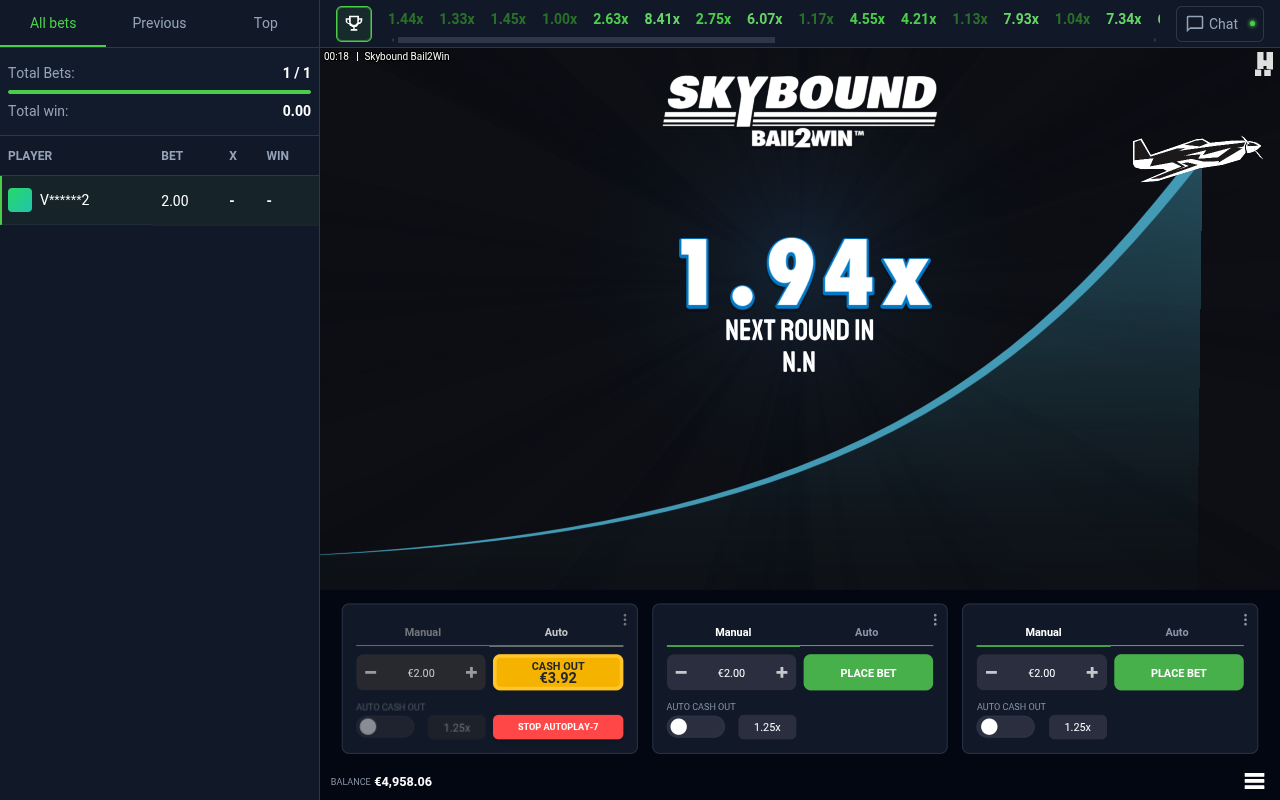
A silver jet noses up through near-black sky, a teal trail sweeping away beneath it, and nothing on screen is going to help you. That’s the argument of Skybound Bail2Win: every round hands you a multiplier climbing in plain sight and asks one thing, how long you’ll hold on before the plane drops. The nerve is the game. There are no symbols to read and no features to trigger, just a counter, a button and your own greed working against your own fear.
Hacksaw Gaming built it, and it runs at 97% RTP with a 10,000x ceiling on a single bet, numbers that put it among the more generous crash titles on the market. Hacksaw are better known for reel slots like Wanted Dead or a Wild and Chaos Crew 2, and their crash sibling Moneyplane Bail2win covers similar ground. This one keeps the presentation lean: one plane, one multiplier, three bet panels and a decision that repeats every round until you stop making it.
Rounds, Bets and Cash Outs
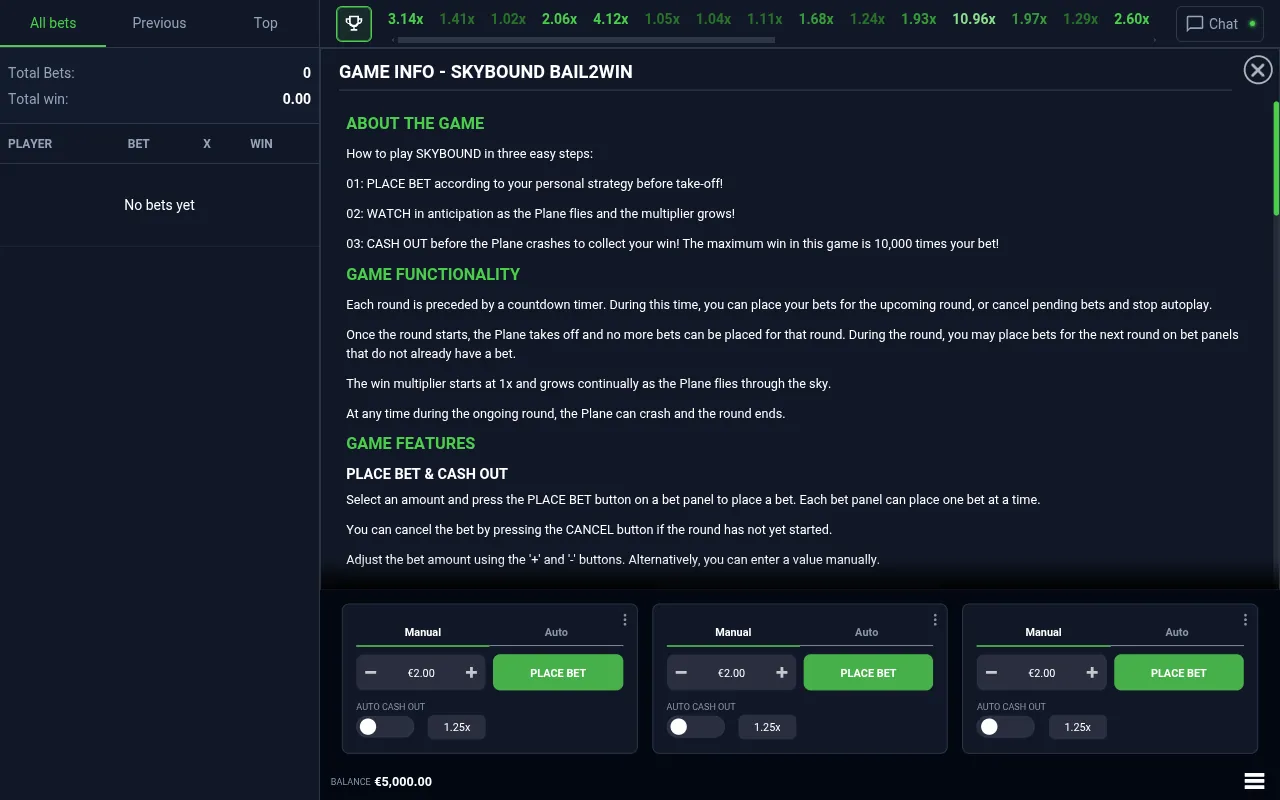
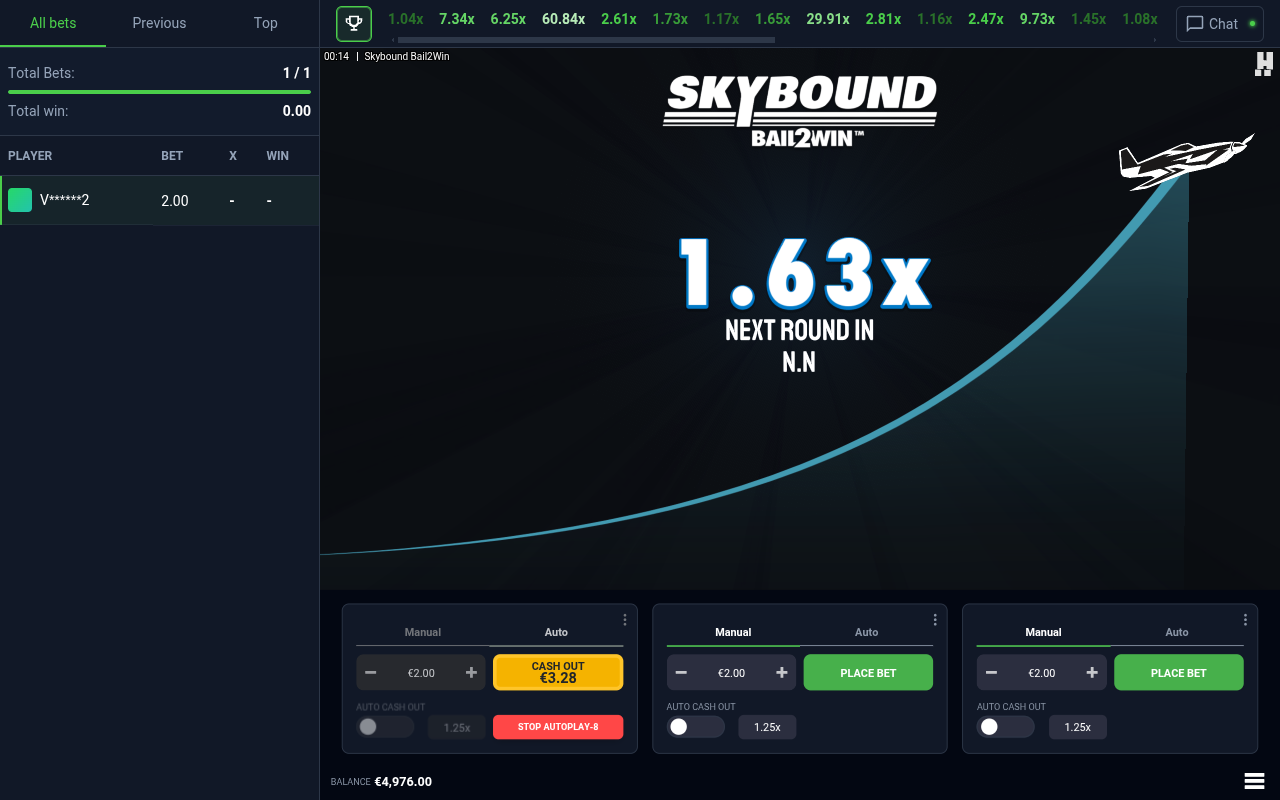
Each round begins with a countdown, and during that window you place your bets for the flight ahead. You can also cancel pending bets or stop autoplay while the countdown runs. Once the round starts, the plane lifts off and no further bets are taken for that flight, though you can queue bets on free panels for the next one.
The whole game plays out in three moves:
- Place your bet on one or more panels before take-off
- Watch the multiplier climb from 1x as the plane flies
- Cash out before the plane crashes to collect your win
The multiplier grows continuously while the plane is airborne. At any moment it can crash, and when it does the round ends instantly. Any bet still aboard is lost.
Your win, if you take one, is your bet multiplied by whatever the counter read when you pressed cash out, rounded to two decimal places. The cash out button sits on the panel itself, and the panel shows the live win amount updating as the multiplier climbs. That number is the whole game: the gap between pressing and watching is measured in fractions of a second.
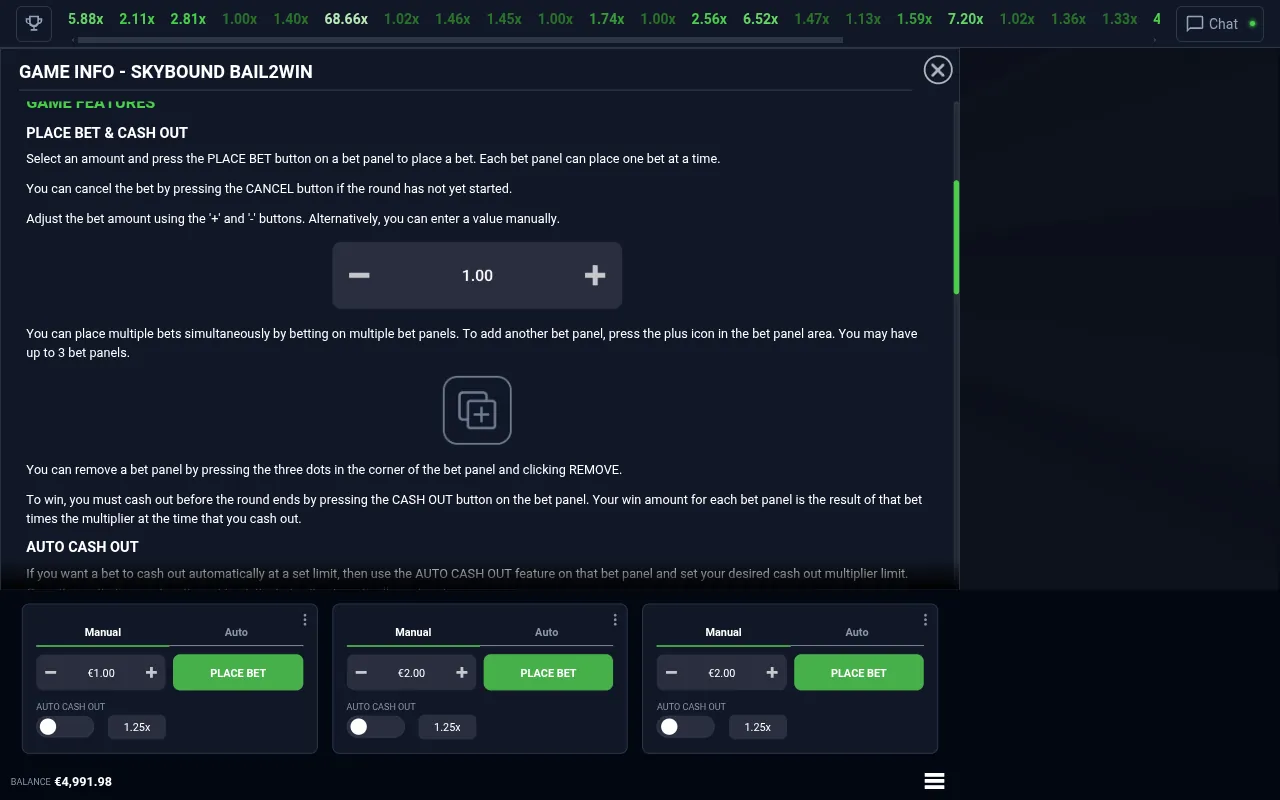
Betting works through panels rather than a single stake, and each panel runs independently:
- Each panel holds one bet at a time
- You can run up to three panels at once
- Add a panel with the plus icon in the panel area
- Remove one via the three dots in its corner
- Adjust stakes with plus and minus buttons, or type a value in directly
- Pending bets can be cancelled any time before take-off
A few things sit around the game view worth knowing:
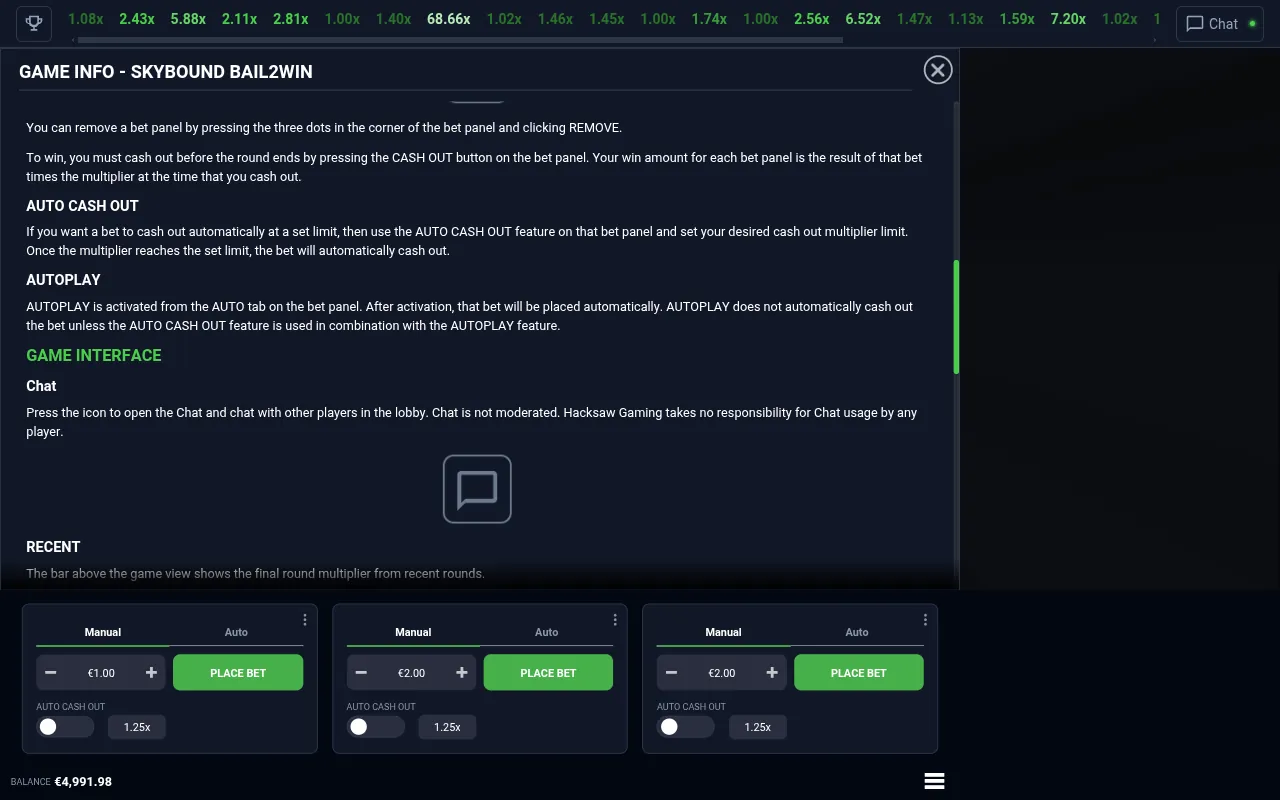
- A bar above the game shows the final multiplier from recent rounds
- All Bets lists every bet and outcome in your lobby for the current round
- Previous does the same for the round before
- Top shows the highest winning multipliers from the last 25 rounds in your lobby
- A chat window lets lobby players talk to each other, unmoderated by the provider
The recent-rounds bar is the closest thing this game has to a history chart. The bar doesn’t tell you anything about the next flight, but it does give a feel for the shape of a session.
Autoplay and Auto Cash Out
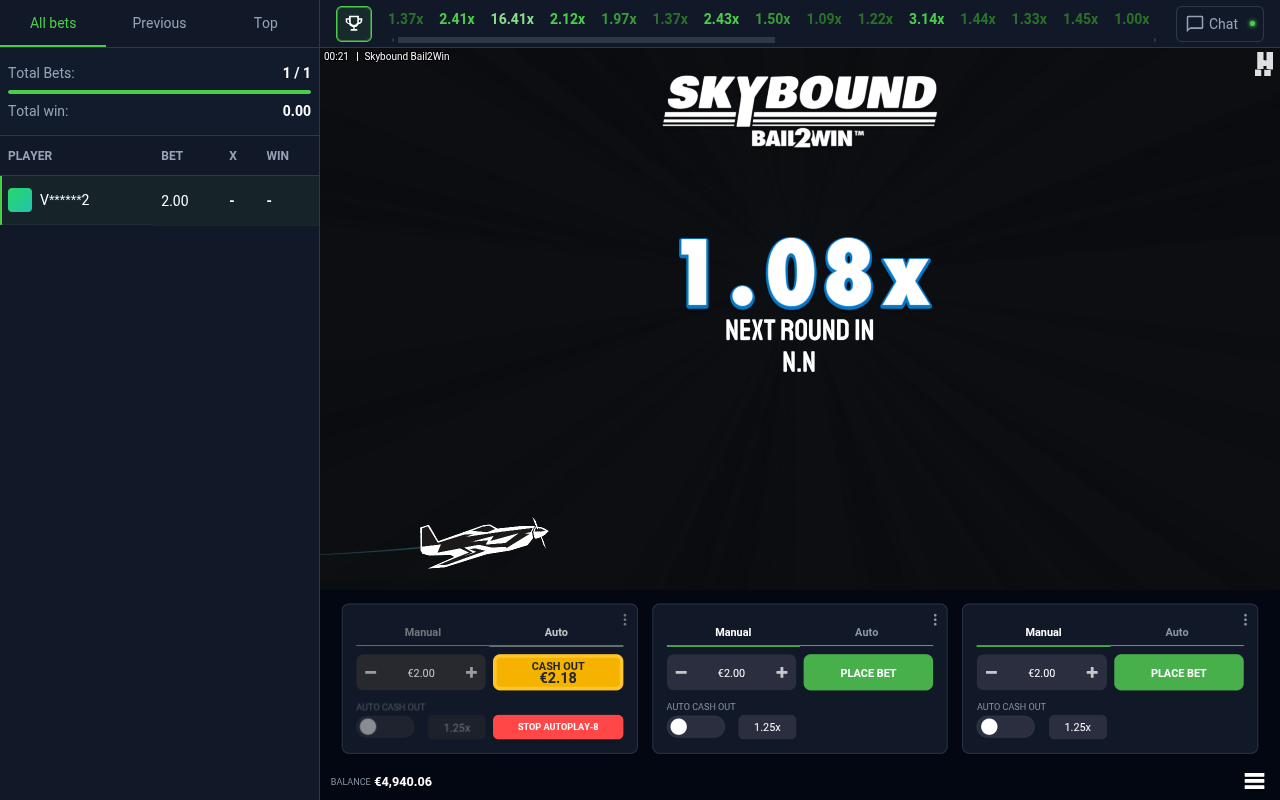
Two modifiers automate the round-to-round work, and they do different jobs. Autoplay is switched on from the AUTO tab on a bet panel. Once it’s active, that panel places its bet automatically every round, with a stop counter and an active label shown on the panel itself.
Autoplay on its own never cashes out. It keeps placing bets round after round, and if the plane goes down while a bet is riding, that bet is gone. Anyone wanting a hands-off session needs to pair it with the second modifier.
Auto Cash Out is a toggle on each bet panel with a multiplier limit you set yourself, with 1.25x shown as the default. When the live multiplier reaches your limit, the bet cashes out automatically, no button press required.
Running the two together gives you a fully automated strategy: a fixed bet, placed every round, banked at a fixed multiple. Set them differently across the three panels and you can run a cautious 1.25x grind on one and a speculative hold on another, all in the same round.
Each panel keeps its own settings, so the automation is per-bet rather than global. Stopping autoplay on one panel leaves the other two running, which makes staged sessions straightforward: start everything automated, then take manual control of a single panel when you want to.
The Maths Behind the Flight
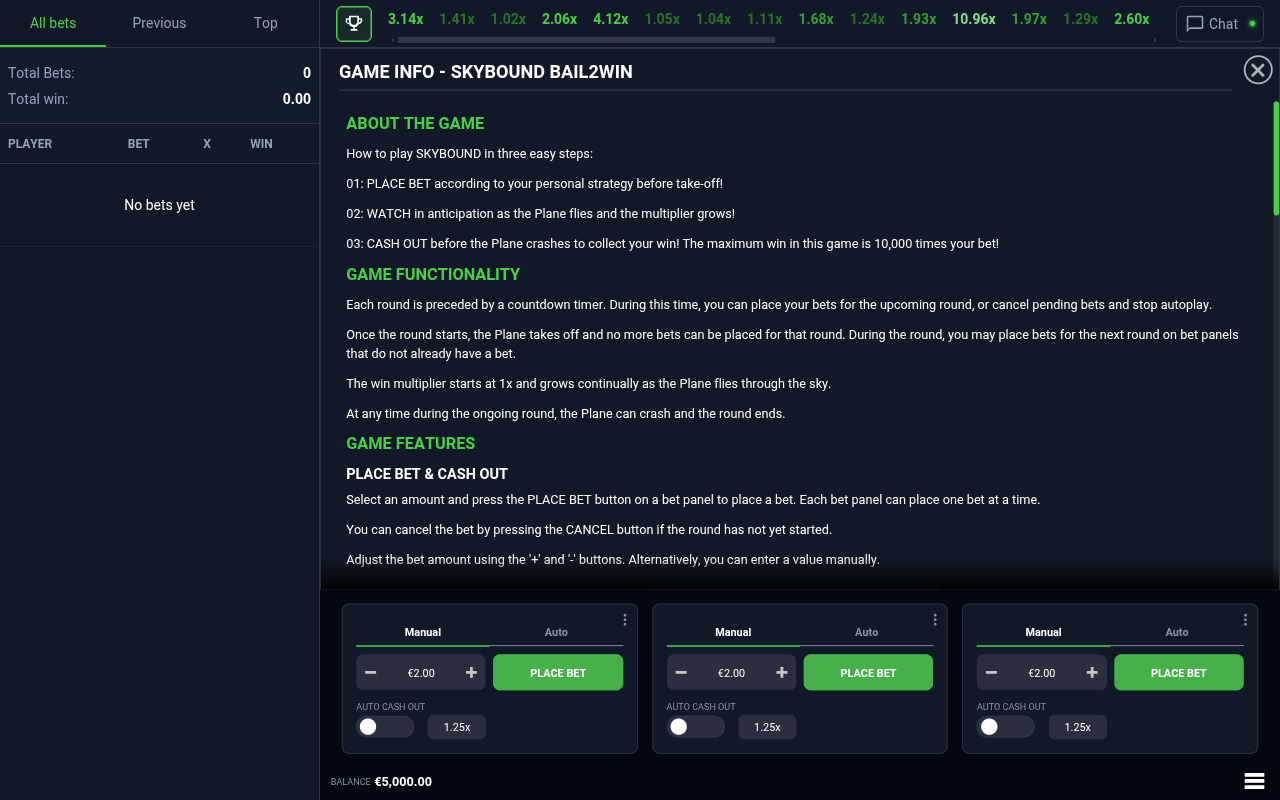
The 97% return is a total figure, calculated deterministically from a theoretical probability model and verified across ten billion simulated rounds. Because your payout depends entirely on when you cash out, the effective return shifts slightly with your bet level and your chosen multiplier.
That last point matters more here than in a reel slot. The same game returns steady small amounts to a player banking at 1.25x and hands long losing runs to one holding out for double digits. The house edge doesn’t change; where you sit on it does.
There’s no volatility label because you supply the volatility yourself. A 1.25x limit plays like a grind: frequent small returns, occasional losses. Holding for double digits is a different game entirely, with the 10,000x top end reserved for a plane that somehow stays airborne long past what anyone would sensibly wait.
Our Honest Verdict
Overall Rating: 7.7/10
There’s a plane in the sky and a number going up, and the whole game is the distance between the two. Playing Skybound Bail2Win is the same decision made over and over, slightly faster each time, and that repetition is exactly why somebody chooses it over a slot: the outcome is yours to lose in a way no reel spin ever is.
The three bet panels are the best thing here. Running a banked 1.25x bet alongside a long-shot hold in the same round gives the game a strategy layer most crash titles never attempt, and it does it without cluttering that quiet teal sky.
The flip side is that the game supplies none of its own variety. When the plane drops early three rounds running, there’s nothing to switch to, chase or unlock, and 97% feels a long way off in the middle of that. It suits gamblers who want one decision under a clock with nothing extra around it; anyone who plays slots for features and discovery will find the sky up here thin. For the rest, this is the genre distilled, and Hacksaw have distilled it well.
Skybound Bail2Win FAQs
-
What is the RTP of Skybound Bail2Win?
The RTP is 97%. It’s calculated from a theoretical probability model and was verified across ten billion simulated rounds. Your effective return can vary slightly depending on your bet level and the multiplier you cash out at. -
When is Skybound Bail2Win released?
Skybound Bail2Win’s release date is 1 December 2026. -
Who makes Skybound Bail2Win?
Hacksaw Gaming make Skybound Bail2Win. They’re also behind Moneyplane Bail2win, an earlier crash title with the same cash-out core. -
What is the maximum win on Skybound Bail2Win?
The maximum win is 10,000 times your bet. It’s the ceiling on a single round, reached only if the plane keeps flying long enough for the multiplier to climb that high before you cash out. -
How do you win in Skybound Bail2Win?
Place a bet before take-off, then press CASH OUT before the plane crashes. Your win is your bet multiplied by the multiplier at the moment you cash out. If the plane crashes first, the bet is lost. -
Does Autoplay cash out for you in Skybound Bail2Win?
No. Autoplay places your bet automatically each round, but it never cashes out on its own. You need to enable Auto Cash Out on the same bet panel and set a multiplier limit for bets to be banked automatically. -
How many bets can you place at once in Skybound Bail2Win?
You can place up to three simultaneous bets, one per bet panel. Panels can be added from the panel area and removed at any time, and each one can run its own Autoplay and Auto Cash Out settings. -
Can you place a bet while a round is in progress?
No. Once the round starts, no more bets can be placed for that flight. You can, however, place bets for the next round on any bet panel that doesn’t already have a bet queued.