







Stargate Scratch Slot Review
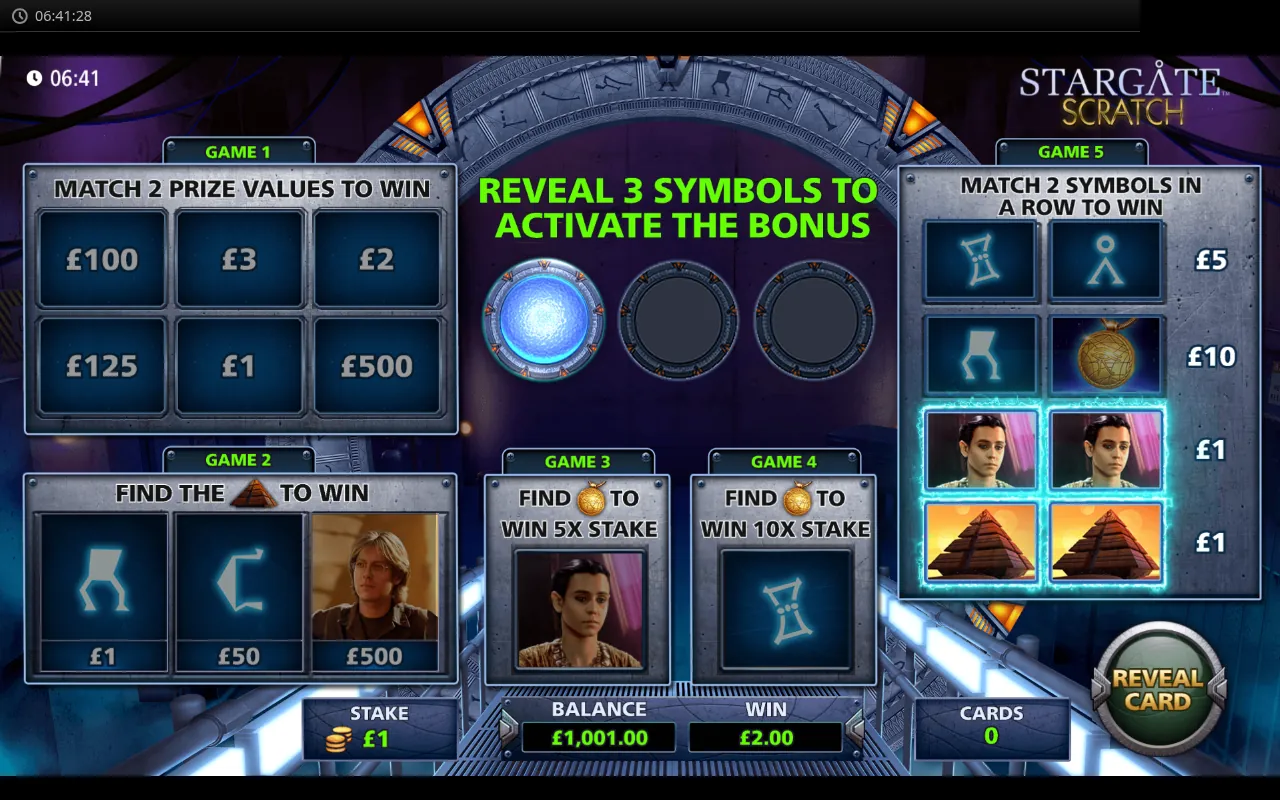
A stone ring carved with angular glyphs sits at the centre of a gateroom washed in neon-blue light and a violet haze, cables trailing across the walls like the place has been wired in a hurry. It’s the Stargate, and Stargate Scratch from Light & Wonder uses it to frame something unusual: a genuine scratchcard that thinks it’s a slot. Five game panels share a single card, 12 chances to win per purchase, and a pick-style bonus on top – the structure of a shop scratchcard with the production values of a reel game.
The RTP sits at 87%, which is well below what a video slot returns, and that gap is the first thing to weigh before you buy a card. The top prize on a single panel is 1,000x stake. It’s a very different animal from Stargate Megaways or Rainbow Riches Megaways, closer in spirit to the shop scratchcard it imitates than to anything the studio builds for reel players.
How the Scratchcard Works
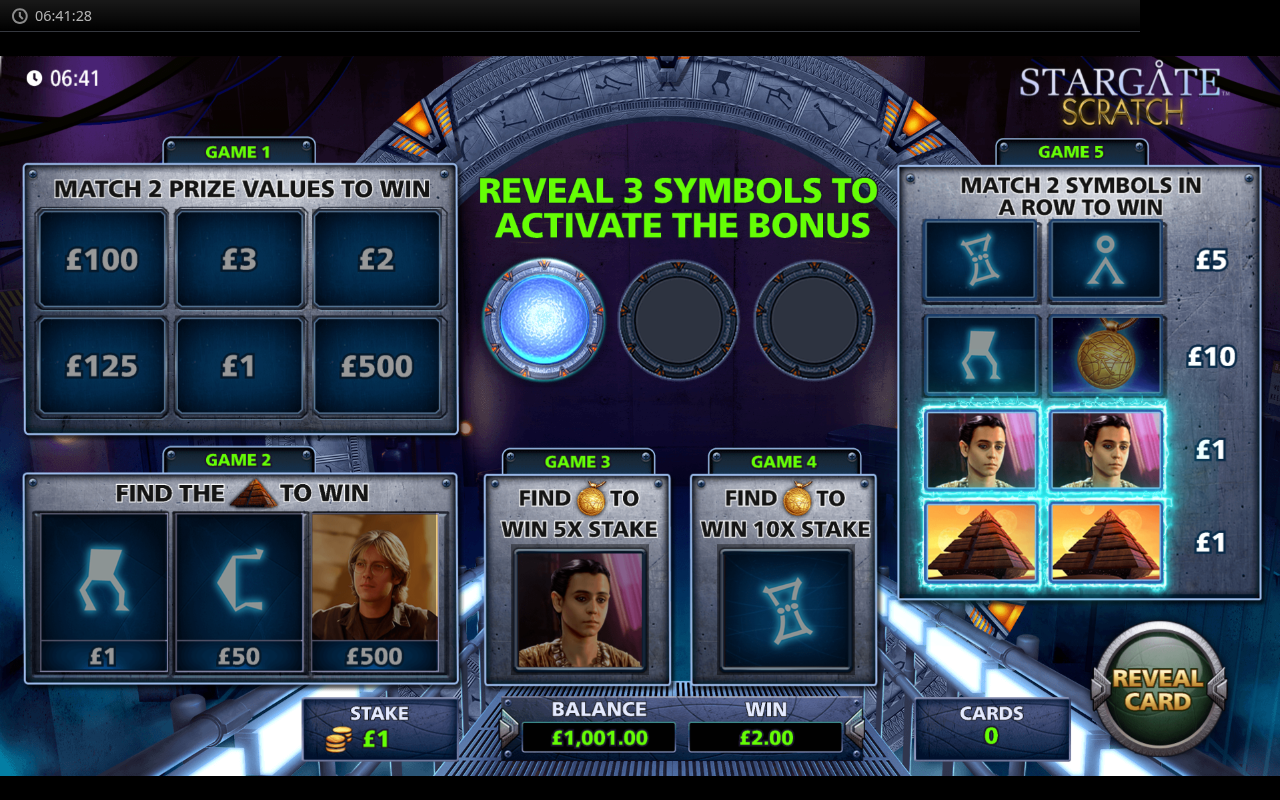
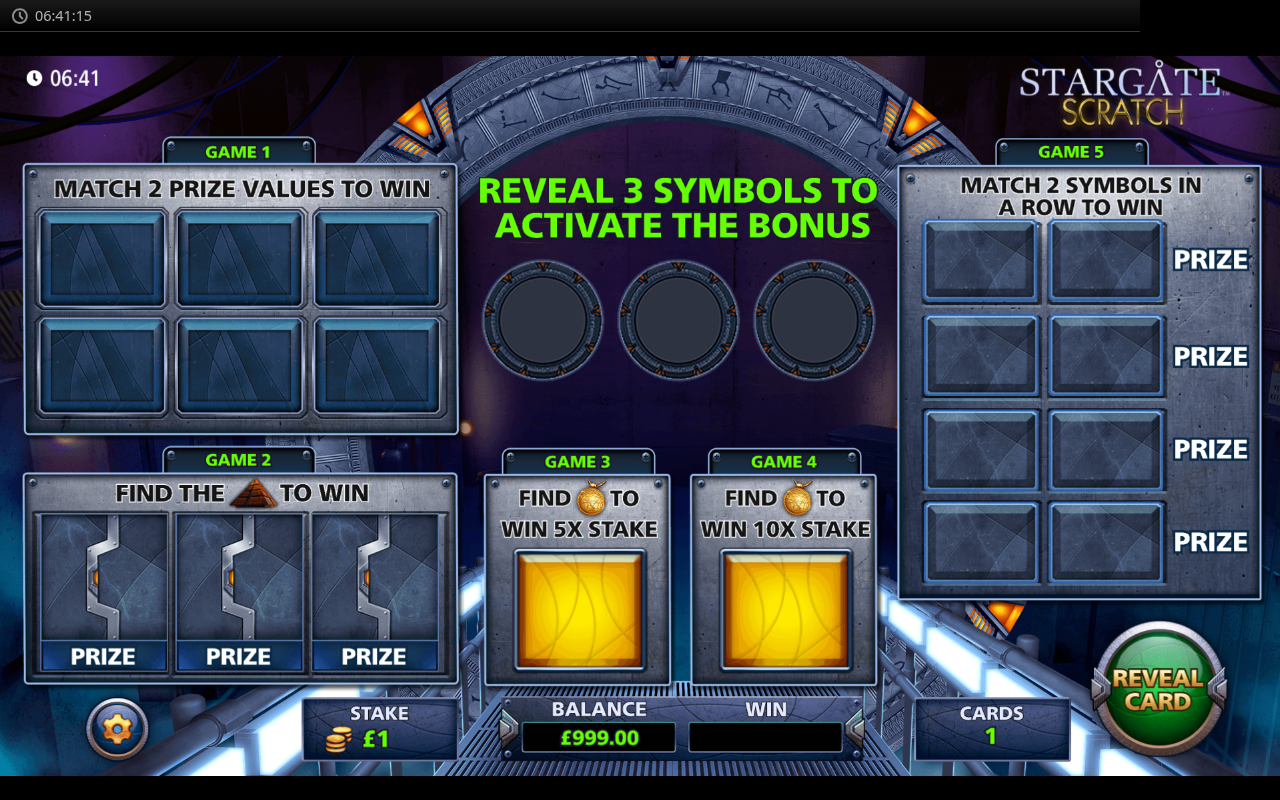
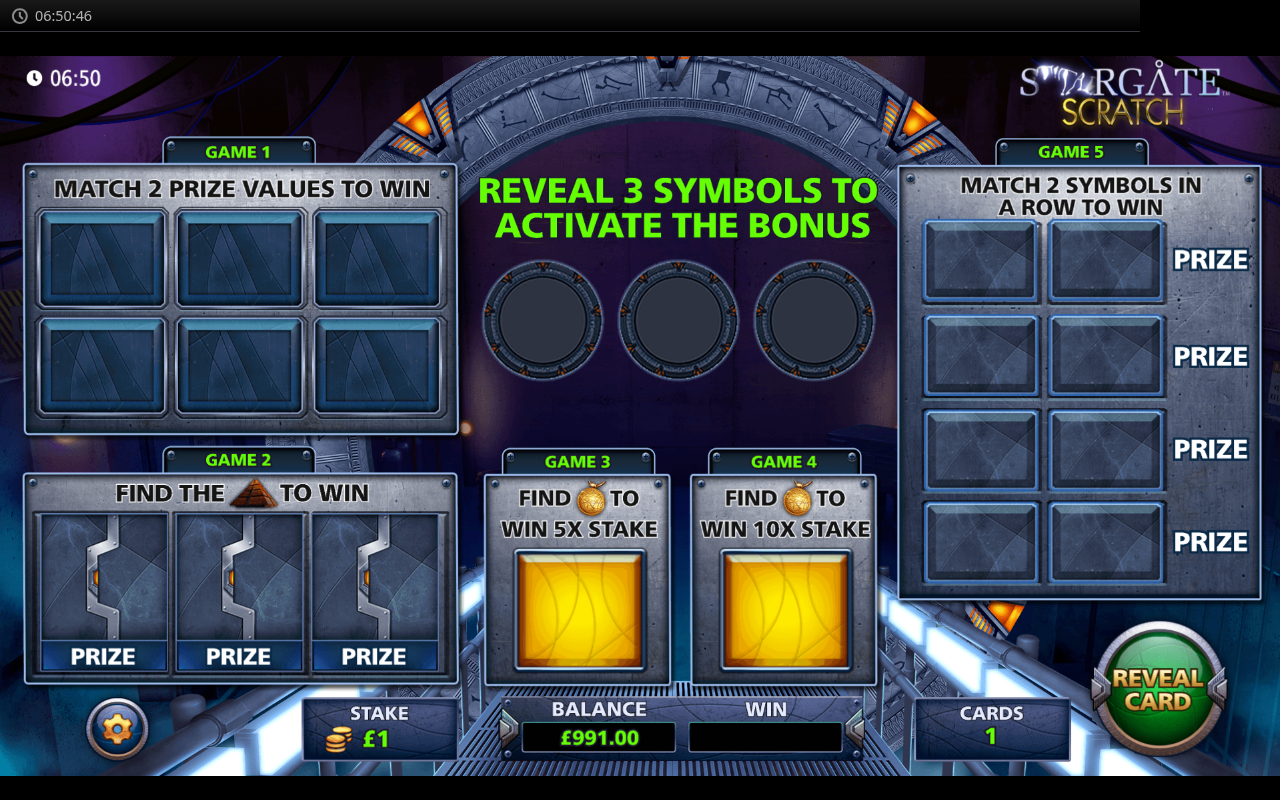
Each card is a scratchcard with five individual game panels, and you can scratch them in any order you like. If you’d rather not do it by hand, a REVEAL CARD button uncovers every panel automatically. The CARD panel keeps count of how many cards remain in your purchase, which matters more than it sounds: cards come in batches as well as singly.
Prizes are attached to the panels themselves rather than to symbol combinations in the slot sense. There’s no reel grid, no paylines and no wild. What there is instead is a set of five mini-games, each with its own win condition, and each of the twelve chances on a card belongs to one of them.
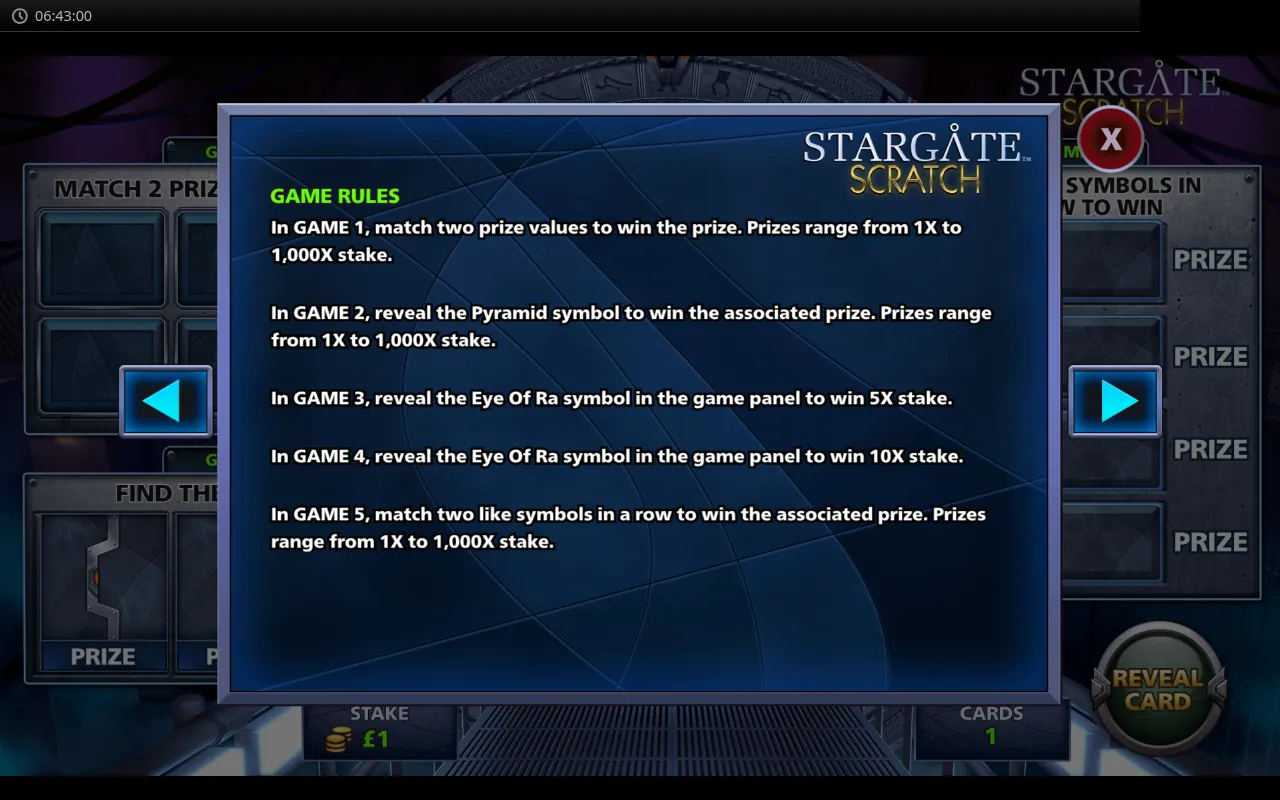
- Game 1: match two prize values to win that prize, between 1x and 1,000x stake.
- Game 2: reveal the Pyramid symbol to win the prize attached to it, between 1x and 1,000x stake.
- Game 3: reveal the Eye Of Ra symbol in the panel to win 5x stake.
- Game 4: reveal the Eye Of Ra symbol in the panel to win 10x stake.
- Game 5: match two like symbols in a row to win the associated prize, between 1x and 1,000x stake.
The two Eye Of Ra panels are the small-change end of the card, quick fixed hits that keep the reveal moving. Everything else scales all the way to four figures on a lucky panel. One card, twelve chances, and the whole thing resolves in under a minute if you let the reveal button do the work.
Because more than one panel can win on the same card, a good card pays more than once. That’s the structural difference from a single-line shop scratchcard: five games share one stake, and a bad panel doesn’t kill the card.
The presentation holds up its end too. The panels sit inside metal plating with rivets and cool blue light strips along the floor, and the arch looms over the top of the layout rather than sitting behind it as wallpaper. It reads as a gateroom you’re scratching around in, not a card with a logo.
It also means the reveal order is cosmetic rather than strategic, whatever order you scratch in. The only real choice on a single card is how fast you get through it, and the reveal button answers that for you.
The Bonus Game
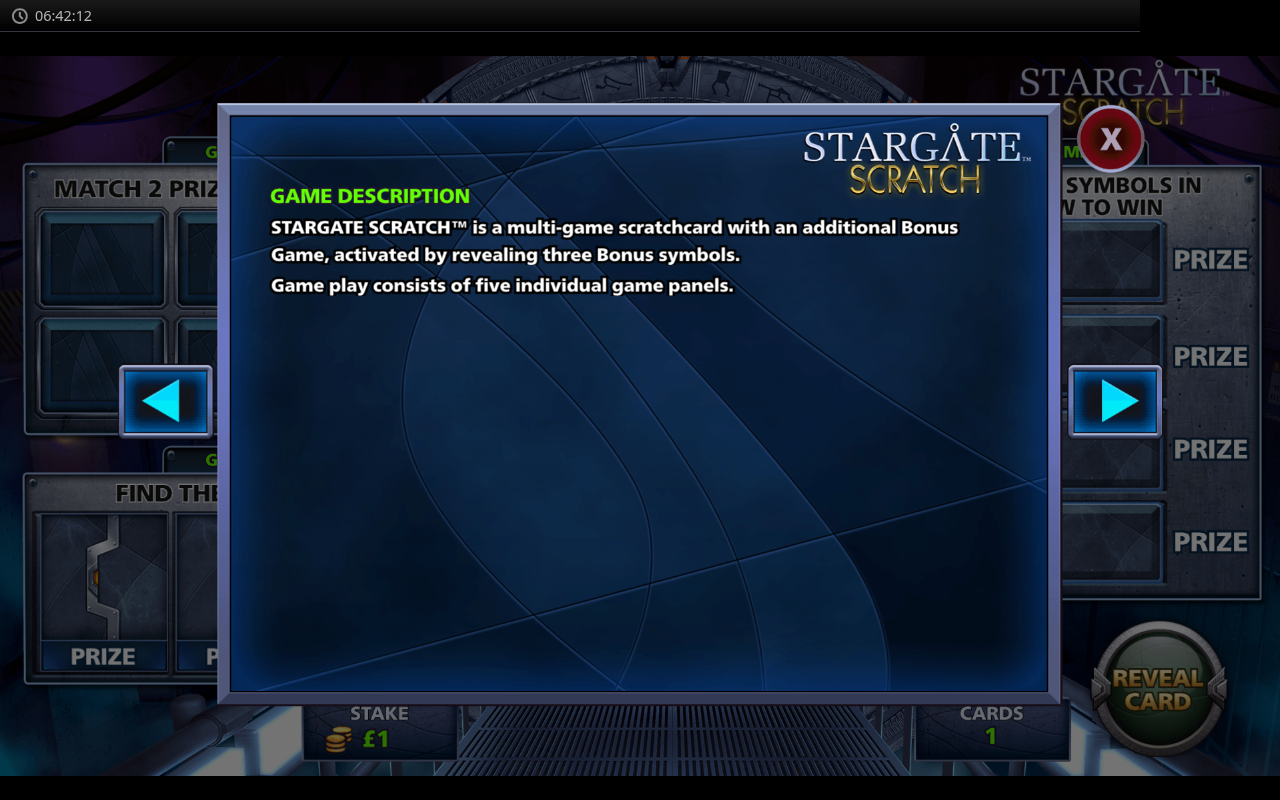
The bonus is where Stargate Scratch breaks out of scratchcard format. Reveal three Bonus symbols across the five panels and the Bonus Game activates. If you’ve bought a batch of 5 or 10 cards, Bonus symbols accumulate between cards, so a symbol found on card one still counts towards a trigger on card four.
That accumulation rule is the one genuinely strategic decision in the purchase. A single card needs all three symbols on its own panels, which is a tall order. A ten-card batch gives the symbols ten cards to turn up in, which is why the multi-card purchase exists at all.
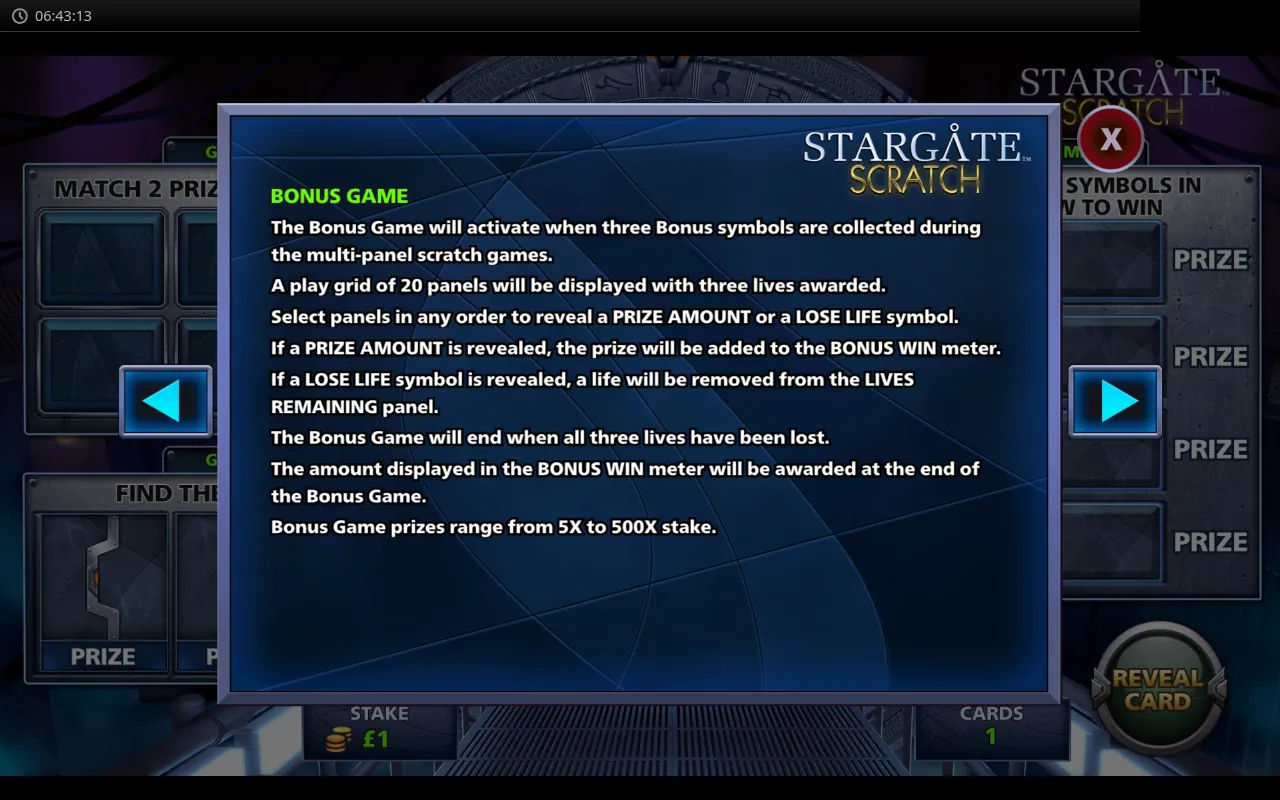
The round itself is a pick game. A grid of 20 panels appears with three lives attached. You select panels in any order, and each one hides either a PRIZE AMOUNT or a LOSE LIFE symbol.
- Reveal a PRIZE AMOUNT and it’s added to the BONUS WIN meter.
- Reveal a LOSE LIFE symbol and one life comes off the LIVES REMAINING panel.
- The round ends when all three lives are gone, and whatever sits in the BONUS WIN meter is paid out.
- Bonus Game prizes run from 5x to 500x stake.
It’s a push-your-luck structure in miniature. Every prize you bank stays banked, but each selection risks a life, and three wrong picks end the round with nothing added after the last life goes.
The odds sit inside those 20 panels, and you control nothing except the order you open them. Since every prize is banked the moment it appears, there’s no decision about whether to stop or push on – you keep picking until the lives run out and take what the meter holds. The 500x top prize is the ceiling here, half of what the card panels can pay.
Stakes, RTP and What It Doesn’t Tell You
The RTP is 87%. That’s the number that decides whether this game is for you: over the long run it returns noticeably less than a typical reel slot. Scratchcards generally run lower RTPs than slots, and this one doesn’t buck that pattern.
There’s no volatility rating attached to it anywhere, which fits a game where outcomes are fixed per card rather than spun. There’s no overall maximum win figure either – the biggest single number the game puts on anything is the 1,000x panel prize, with the bonus capped at 500x.
Bet limits aren’t fixed either, so what you pay per card comes down to where you play it. What you get for that stake is fixed: five panels, twelve chances, and one bonus that carries across a batch.
Our Honest Verdict
Overall Rating: 6.4/10
Playing Stargate Scratch feels like a coffee-break game that’s been given a film budget. You buy a card, the gateroom hums around it, and a minute later you know where you stand. The reason to choose it over the shelf of generic scratchcards is that bonus: 20 panels, three lives, prizes that bank as you pick. It’s a proper round, not a coin flip with extra steps.
The best thing about the card itself is that five panels share one stake, so a good card pays several times over and one dead panel doesn’t sink it. The worst thing is that 87% RTP – noticeably below slot territory, and it shows over any session longer than a few cards. The Eye Of Ra panels rarely soften the blow either.
This is one for scratchcard players who want the format done with some care, and for Stargate fans who’ll enjoy scratching around a gateroom that’s actually been built rather than pasted on. Anyone chasing slot returns should stay with the reels.
Stargate Scratch FAQs
-
What is the RTP of Stargate Scratch?
The RTP is 87%, which is well below the typical video slot and in line with what online scratchcards generally return. -
Who makes Stargate Scratch?
Stargate Scratch is made by Light & Wonder, the studio behind titles including Stargate Megaways and the Rainbow Riches series. -
When is Stargate Scratch released?
Stargate Scratch’s release date is 21 April 2022. -
How do you win on Stargate Scratch?
Each card has five game panels offering 12 chances to win. You win by matching two prize values, revealing the Pyramid symbol, revealing the Eye Of Ra symbol (5x or 10x stake), or matching two like symbols in a row, depending on the panel. -
How do you trigger the Bonus Game in Stargate Scratch?
Reveal three Bonus symbols across the card’s five game panels. If you buy a batch of 5 or 10 cards, Bonus symbols accumulate between cards, so they carry over from one card to the next. -
How does the Stargate Scratch Bonus Game work?
You face a grid of 20 panels with three lives. Each pick reveals either a prize amount, which banks into the Bonus Win meter, or a Lose Life symbol. The round ends when all three lives are lost and the meter is paid out. Prizes range from 5x to 500x stake. -
What is the maximum win on Stargate Scratch?
There’s no overall maximum win figure. The biggest single prize is 1,000x stake on a card panel, the Bonus Game tops out at 500x stake, and because five panels share one card, several of them can win together. -
Can you play the panels in any order in Stargate Scratch?
Yes. You can scratch the five game panels in any order, or use the Reveal Card button to uncover every panel automatically.