




Thunder Reckoning Slot Review
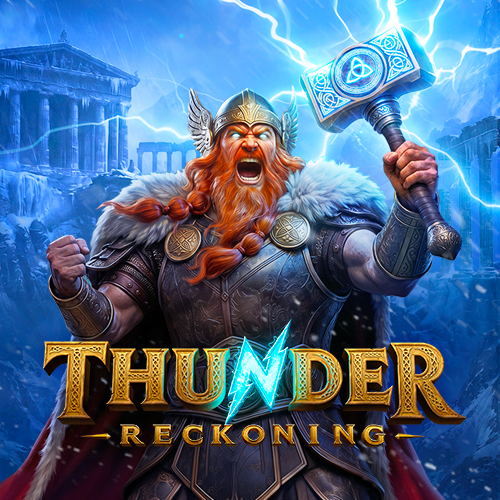
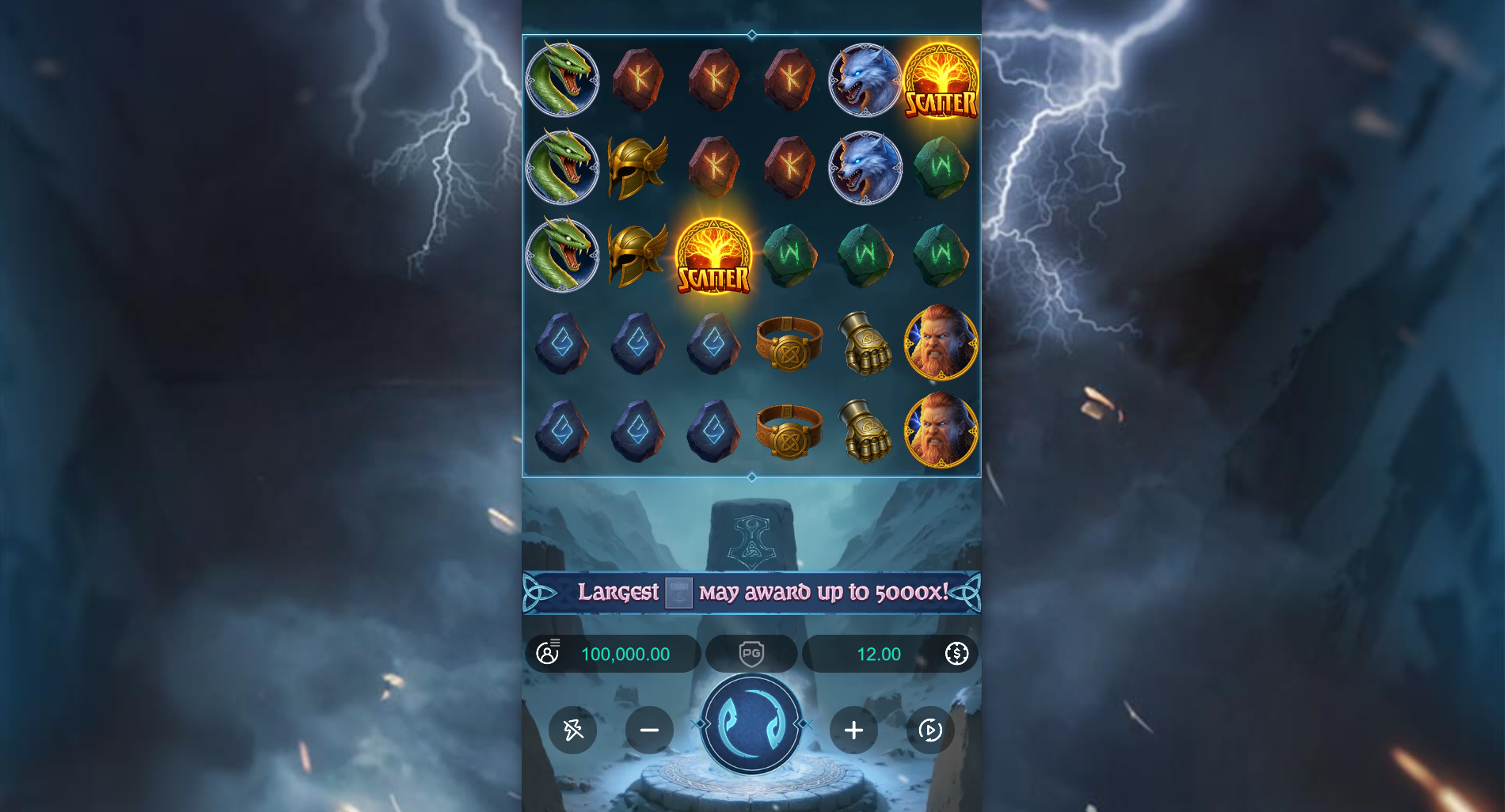
A rune-carved monolith stands half-buried in snow beneath a forked night sky, lightning cracking down both sides of the frame. Thunder Reckoning is the rare cascade slot where the board, not the payout, is the reason to keep spinning: nearly every spin leaves something behind, and the game you’re playing three spins from now is visibly bigger than the one you started with.
PG Soft have kept this one simple on purpose. It’s a scatter pays game on a 6×5 grid, running at 96.76% RTP with medium volatility, a 5,000x maximum win, and stakes from 0.20 to 100 per spin. The whole game rests on a single idea, positions on the grid that activate and grow, and it’s a better game for the focus.
The presentation doesn’t get in the way of that idea. The backdrop stays simple yet intense, the soundtrack builds rather than loops, and the towering rune stone beneath the grid anchors the layout without crowding it. Everything on screen is in keeping with the storm theme, and it stays that way through a long session.
Scatter Pays and Collapsing Reels
There are no paylines here. Any eight or more matching symbols anywhere on the grid form a win, and winning symbols then explode and collapse, dropping new symbols in for another chance in the same round. Chain a couple of combinations together in one cascade sequence and you can clear a large chunk of the grid in a single spin.
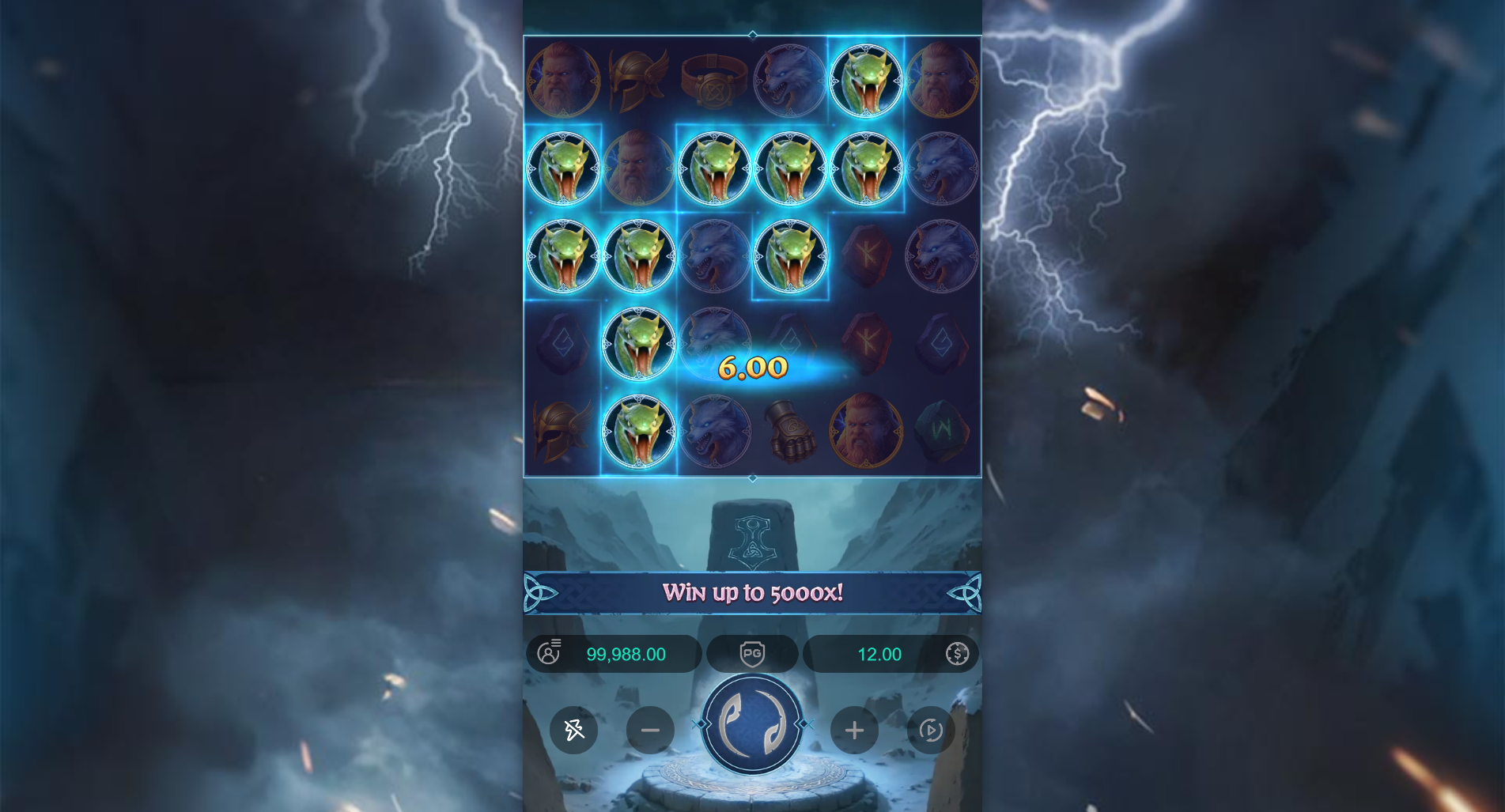
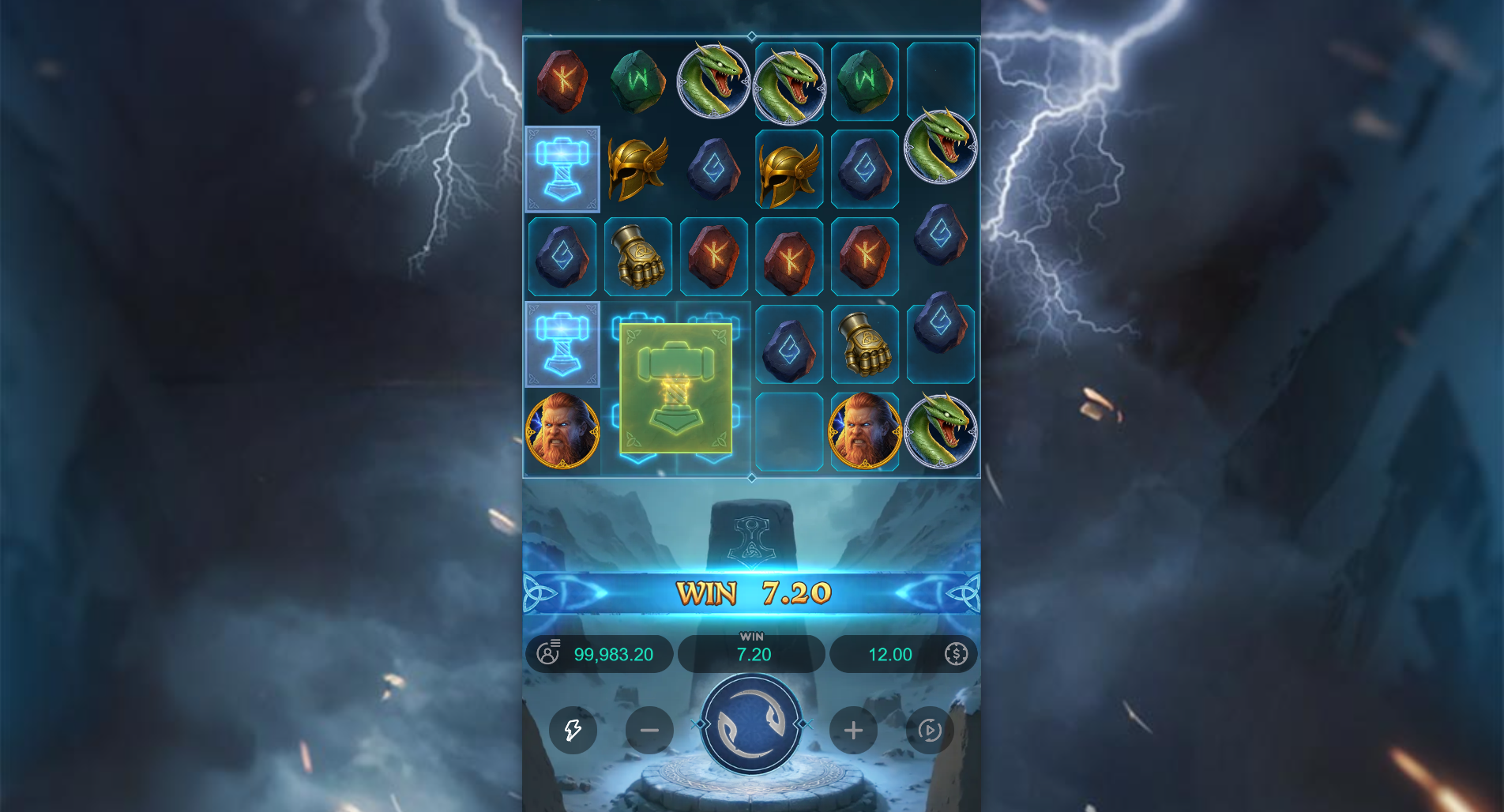
The twist is what winning leaves behind. Every position a winning symbol occupied becomes activated, and one visit is all it takes to understand the ladder:
- A position hit once by a win becomes partially activated
- A position hit twice becomes fully activated
- Adjacent fully activated positions merge into blocks of 2×2, 3×3, 4×4 or 5×5
- At the limit, the entire 5×6 grid becomes a single block
It reads clearly at a glance. Partially activated cells take a highlight, full activation changes the border, and merged zones are obvious as they expand. In practice the base game mostly produces singles and the occasional 2×2, with dry spells of five or six spins where nothing connects. The bigger blocks are the carrot: rare in the base game, but always visible on the board.
The rhythm between features is dynamic rather than flat. Because the scatter pays threshold is eight symbols, a couple of combinations in one cascade sequence can take out a large share of the grid at once, which leaves plenty of partially activated positions behind. The following cascades then hinge on fully activating those zones and building them out, so one good spin feeds directly into the next.
Prize Symbols
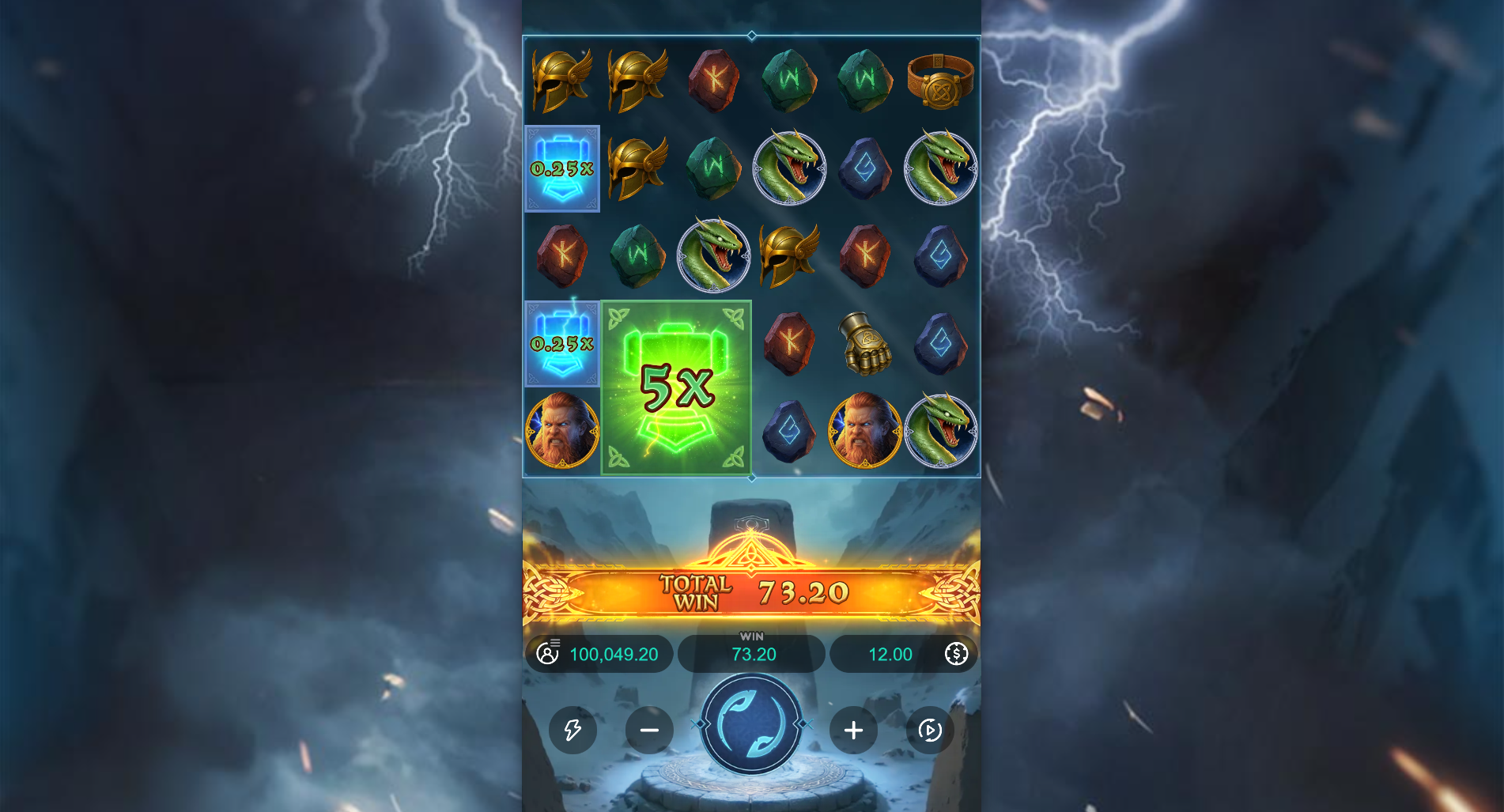
When a spin runs out of winning combinations and one or more fully activated positions remain, the round stops being a cascade game and becomes a reveal. Every fully activated block transforms into a Prize symbol sized to match the block, and the payout scales steeply with that size:
- Single Prize symbols pay 0.25x to 1x the bet
- 2×2 blocks pay 5x to 10x the bet
- 3×3 blocks pay 20x to 200x the bet
- 4×4 blocks pay 50x to 500x the bet
- 5×5 blocks pay 200x to 1,000x the bet
- A full 5×6 grid pays 1,000x to 5,000x the bet
You know early how a spin is going to resolve. A board of single cells tops out at 1x, so there’s no suspense in it. A 2×2 or better carries real weight, and a forming 3×3 is where the anticipation starts.
Free Spins
Landing three or more Scatter symbols anywhere starts the round, and the awards step up with each extra Scatter:
- Three Scatters award 10 free spins
- Each additional Scatter beyond the third adds two more spins
- The round can be retriggered the same way once it’s running
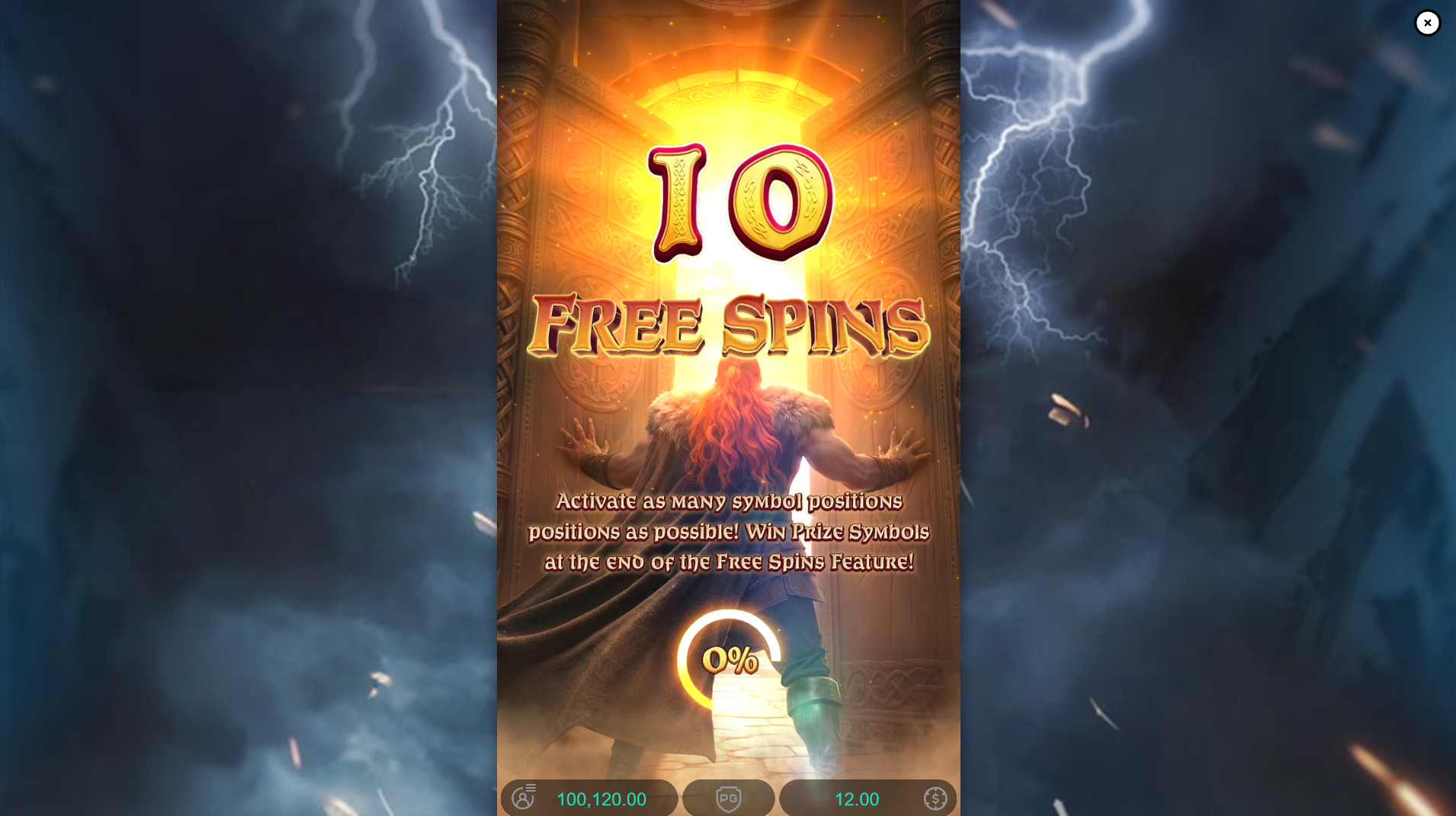
The setup is generous from the first spin. Every position starts partially activated, so you’re on the front foot immediately, and activation progress carries over between spins rather than resetting. It’s a sharp contrast with the base game, where you build from nothing each time.
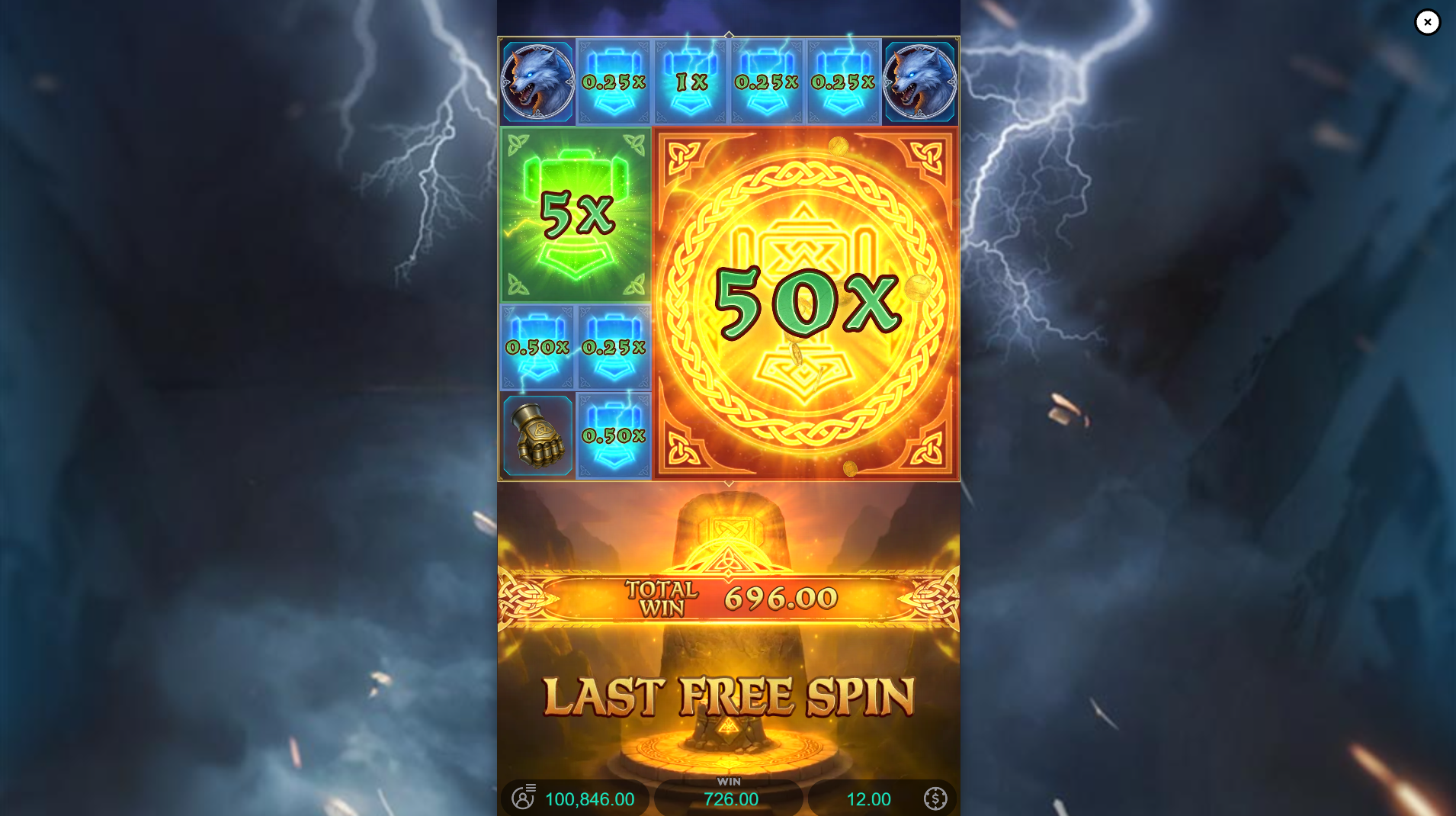
Across ten spins the board visibly builds, and the closing spins carry real tension when decent-sized zones are already in place and one more hit could grow them further. When the round ends, the Prize Symbols Feature resolves everything the board has built, which means a strong round pays out on the full accumulated grid rather than spin by spin.
Feature Buy
The Feature Buy menu offers a direct route into the Free Spins Feature for a displayed price, paid at your current bet size and bet level. It’s a straightforward purchase with a single outcome: the round starts immediately, with the same partial activation across every position and the same carry-over progression as a natural trigger.
Natural triggers can be slow to arrive, as they often are in PG Soft games, so the buy is there for players who’d rather skip the wait. The base game gives you enough combination opportunities in the meantime that the wait doesn’t feel empty.
Our Honest Verdict
This is a slot you play for the build. Every spin feeds a board that grows in front of you, and by the end of a session the free spins round feels earned rather than dropped on you, the storm finally breaking over everything you’ve stacked up.
The carry-over activation in the bonus is the best thing here, because it turns ten spins into one continuous board with a single payoff at the end. The base game doesn’t pull its weight the same way: most spins resolve as singles paying under 1x, and the big merged blocks stay a sight you’re shown rather than one you’re paid on.
It’s for players who enjoy scatter pays and a long progressive build, and it isn’t for anyone who wants reels, paylines and a stack of separate features. Sit through the quiet stretches and the rune stone rewards the patience.
Thunder Reckoning FAQs
-
What is the RTP of Thunder Reckoning?
Thunder Reckoning runs at 96.76% RTP, which sits above the typical online slot average. -
What is the maximum win in Thunder Reckoning?
The maximum win is 5,000x your bet, awarded when the entire 5×6 grid becomes one fully activated Prize symbol block. -
How do wins form in Thunder Reckoning?
It’s a scatter pays game on a 6×5 grid. Any eight or more matching symbols anywhere on the reels form a win, with no paylines involved. -
How does the activation mechanic work?
A position hit once by a win becomes partially activated, and a second hit makes it fully activated. Neighbouring fully activated positions then merge into larger blocks, all the way up to a single 5×6 grid block. -
How much do Prize symbols pay in Thunder Reckoning?
Single Prize symbols pay 0.25x to 1x the bet, 2×2 blocks pay 5x to 10x, 3×3 blocks pay 20x to 200x, 4×4 blocks pay 50x to 500x, 5×5 blocks pay 200x to 1,000x, and a full 5×6 block pays 1,000x to 5,000x. -
How do you trigger free spins in Thunder Reckoning?
Three or more Scatter symbols anywhere on the grid start the round with 10 free spins, and each additional Scatter adds two more. The round can also be retriggered the same way once it’s running. -
When does the Prize Symbols Feature trigger?
At the end of a main game spin, once there are no more winning combinations and at least one fully activated position remains on the board. In free spins, it resolves at the end of the whole round instead. -
Is there a bonus buy in Thunder Reckoning?
Yes. The Feature Buy menu lets you pay a displayed price to start the Free Spins Feature directly at your current bet size and bet level. -
Is Thunder Reckoning volatile?
It’s a medium volatility slot with a hit frequency of 28.01%, so wins arrive reasonably often and the swings suit a medium model. -
What are the betting limits in Thunder Reckoning?
Stakes run from 0.20 to 100 per spin, covering both casual sessions and bigger bankrolls. -
What happens to activated positions during free spins in Thunder Reckoning?
Every position starts the round partially activated, and activation progress carries over from spin to spin until the feature ends. When the round finishes, the Prize Symbols Feature resolves all fully activated positions on the board. -
Who makes Thunder Reckoning?
PG Soft, a studio whose back catalogue leans heavily on compact, single-mechanic designs. Thunder Reckoning fits that approach: one core activation system rather than a stack of unrelated features.