










Twenty One Slot Review
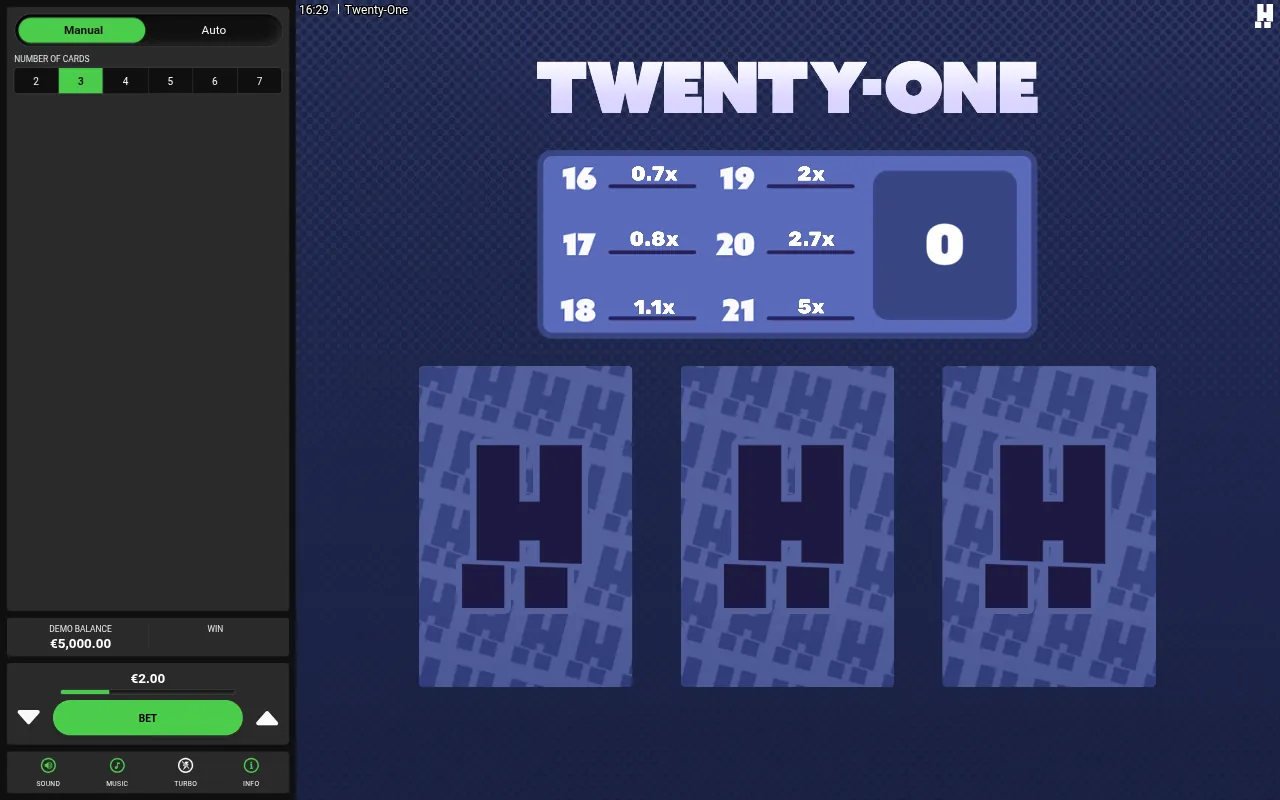
A dark navy backdrop, a fine diagonal-checker texture, and the word TWENTY-ONE glowing in thick lavender-white letters across the top of the screen. Below it, face-down cards wait on a lighter blue tile surface. It’s blackjack reduced to a single decision: how many cards do you want, and will they add up.
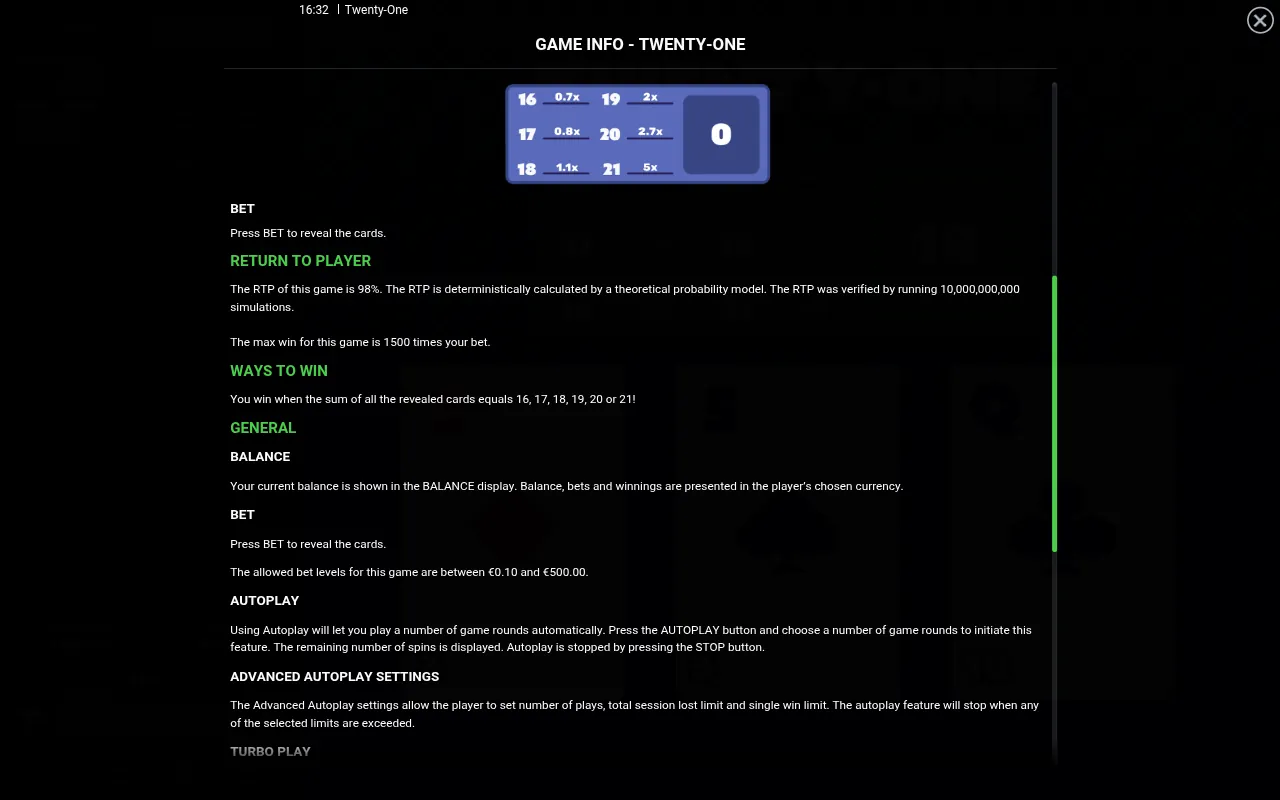
What’s interesting about Twenty One is how much of the card game it keeps. There’s no dealer, no hit or stand, no strategy beyond one choice before the reveal. Hacksaw Gaming have taken the most familiar total in gambling and turned it into a high volatility game with a 98% RTP, a 1,500x maximum win, and bets running from 0.10 to 500 per round.
It sits closer to their instant-win output than to Wanted Dead or a Wild or Chaos Crew in spirit. The question is whether one reveal can carry a game on its own.
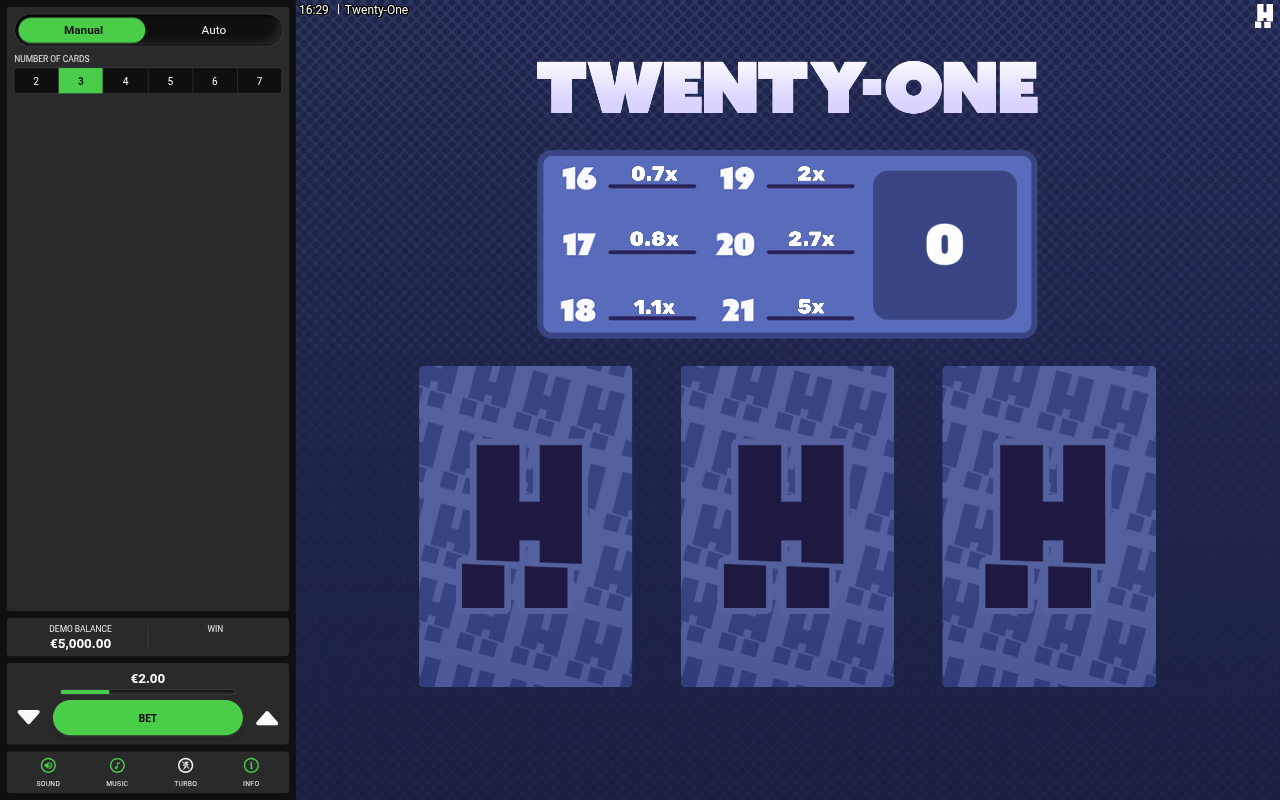
How Twenty One Plays
Each round runs through the same three steps. Nothing else happens in between, and there’s no second decision once the cards start turning:
- Choose the number of cards to play with
- Press BET to reveal the cards, drawn at random from a standard deck of 52
- The revealed values are added together to form the final result
Every round uses a new deck and newly drawn cards, so no carry-over exists between hands. Clicking in the game window during the reveal skips the animation and shows every card at once, which matters when the rounds are this quick.
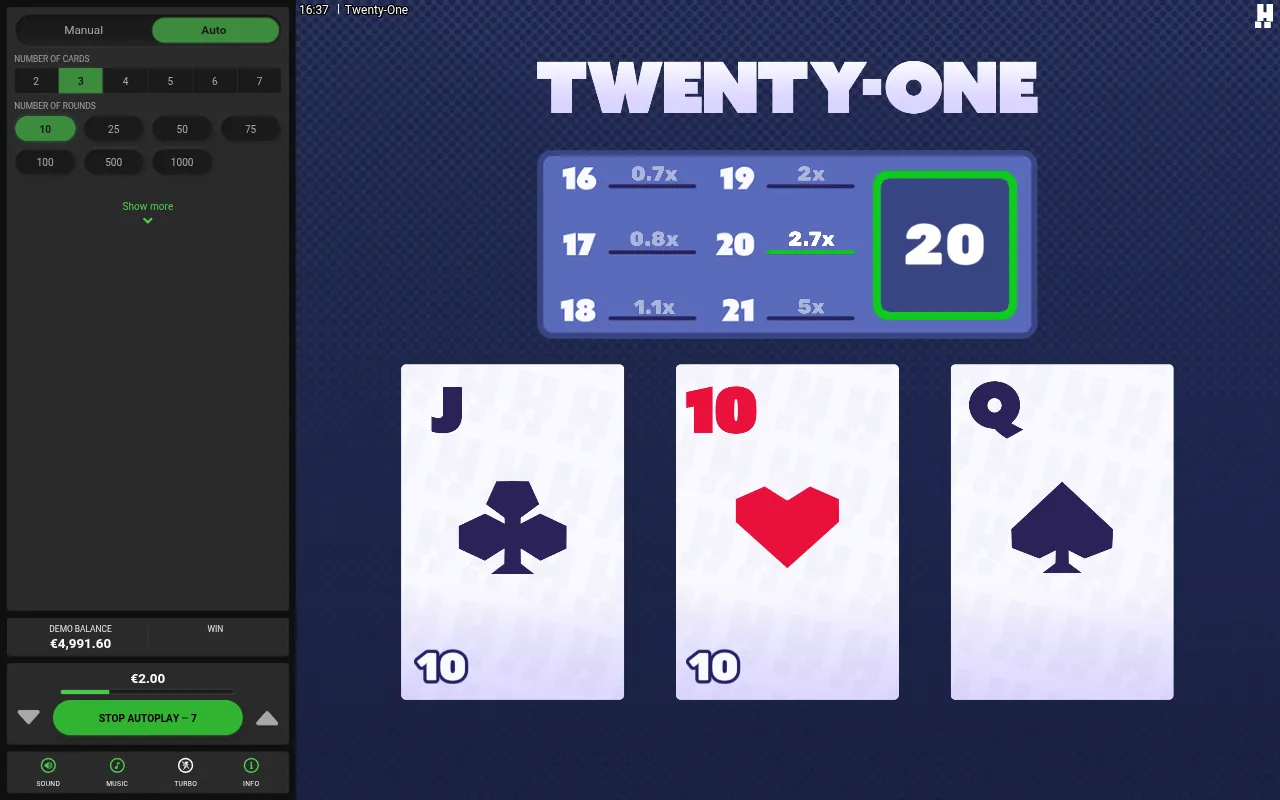
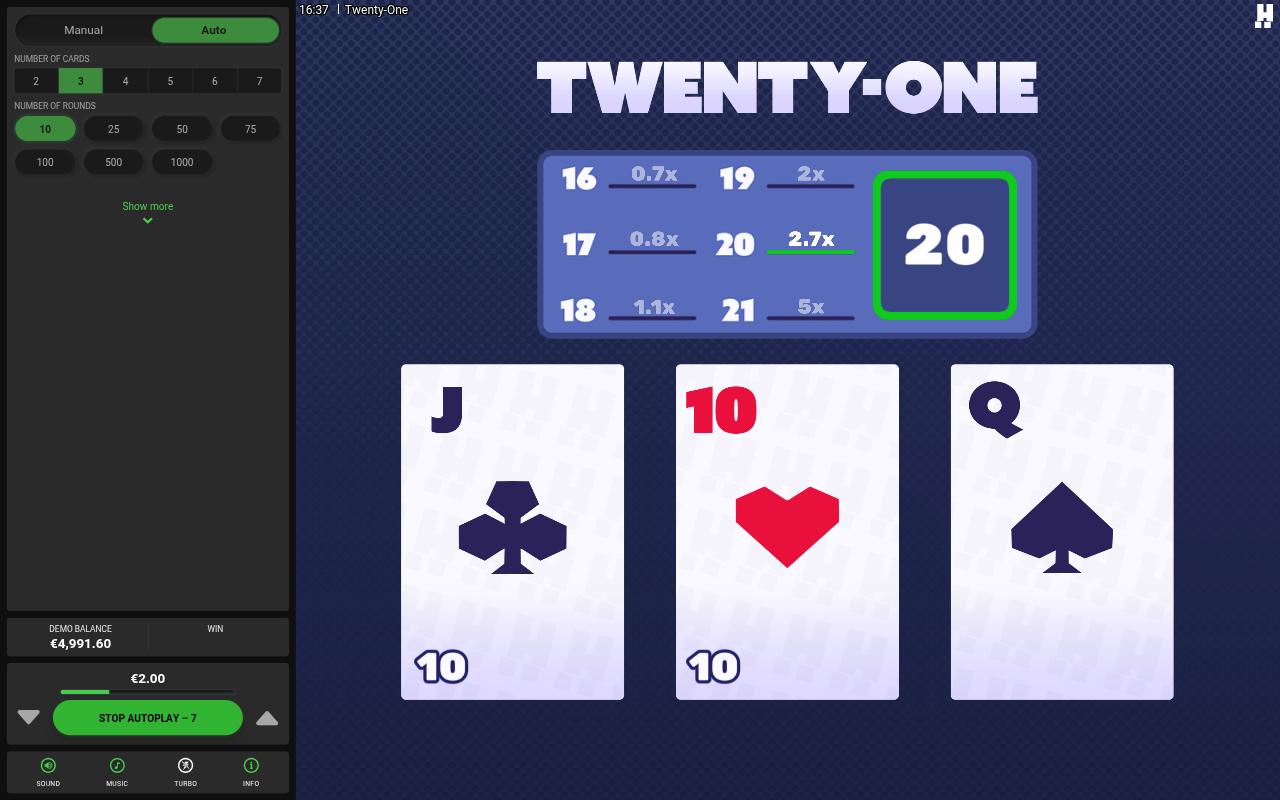
The reveal itself has a small theatre to it. Cards flip into place one at a time, so a hand sitting on 19 with two cards still turning keeps its suspense until the last one lands. The result box then shows the total, and a win lights the matching multiplier with a green border.
Six totals win, and anything below them loses:
- 16
- 17
- 18
- 19
- 20
- 21
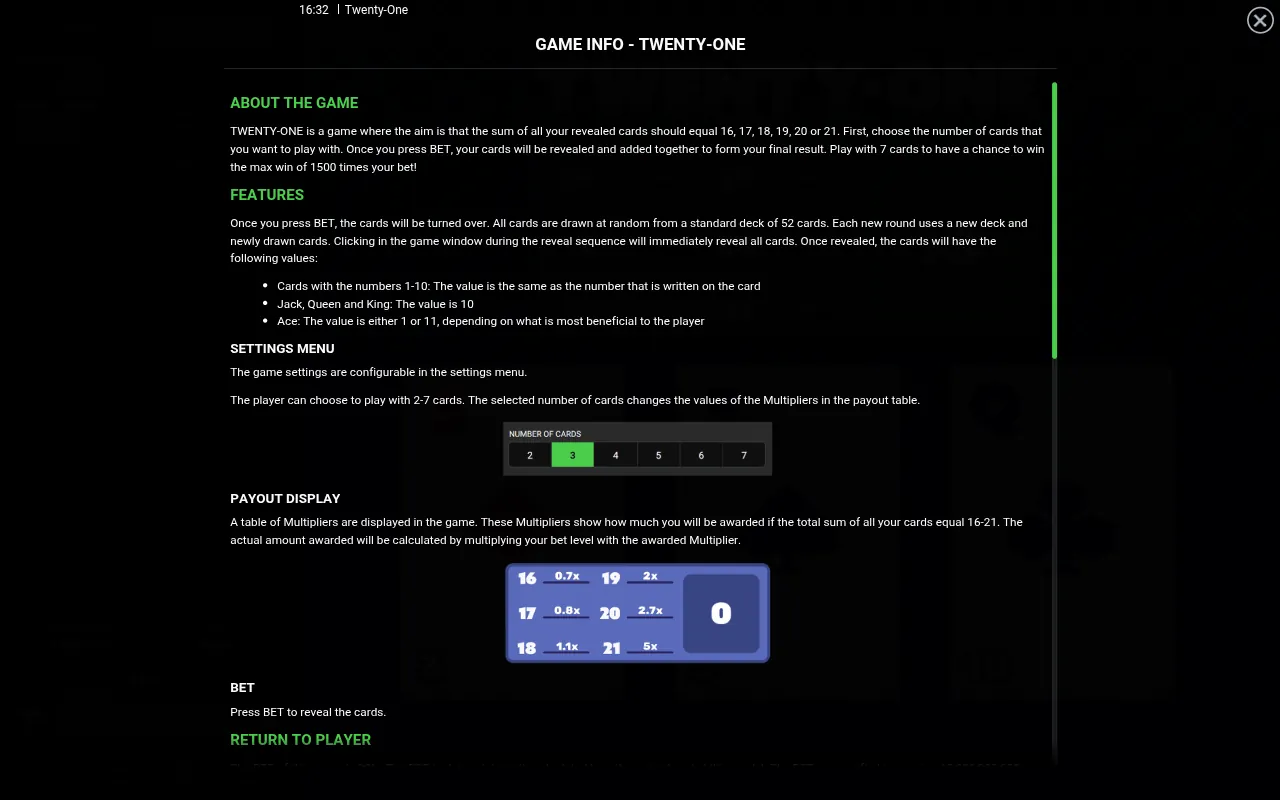
Card values follow the conventions of the table game:
- Cards numbered 1 to 10 count as the number printed on them
- Jack, Queen and King count as 10
- Ace counts as 1 or 11, whichever is better for the total
There are no paylines, no reels and no symbols in the slot sense. The paytable is a table of multipliers, one row per winning total, and the payout is the bet multiplied by whichever multiplier the final sum lands on.
With three cards in play, a total of 20 carries a 2.7x multiplier and a total of 18 carries 1.1x. A hand of Jack, 10 and Queen lands the first; a hand of 4, 10 and 4 lands the second. Both figures shift the moment the card count changes.
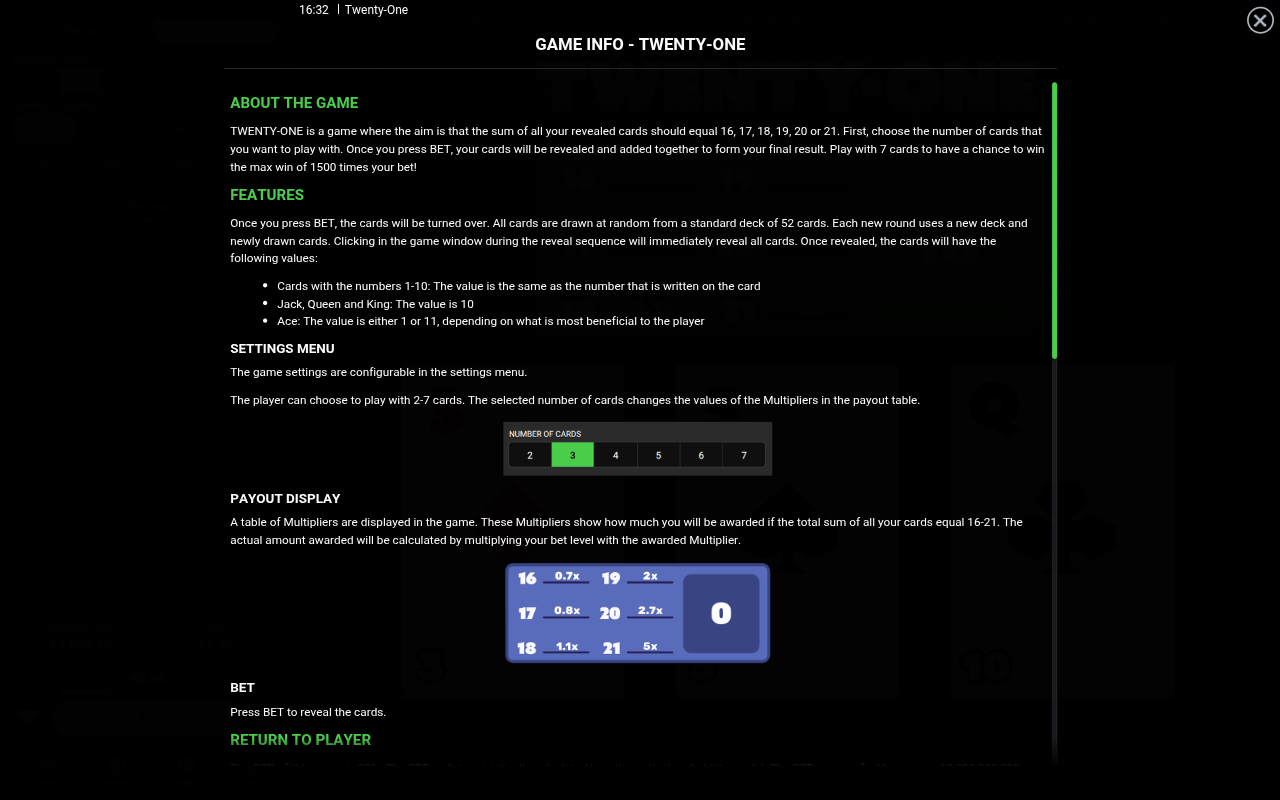
The Number of Cards Setting
The card count is the only real decision in the game, and it does more than change the odds. Playing with 2 to 7 cards changes the multiplier values across the whole payout table, so the same total pays differently depending on how many cards produced it.
Fewer cards make the higher totals harder to reach. More cards make the low sums easier and the precise 16-to-21 window trickier to land inside. Either way, the setting reshapes the paytable rather than just nudging a probability.
Seven cards is the ceiling in every sense. The 1,500x maximum win is only available when playing with all seven, so the biggest multiplier on the table is locked behind the widest possible spread of draws. Anyone chasing the top of the payout table has to take the least controlled route to get there.
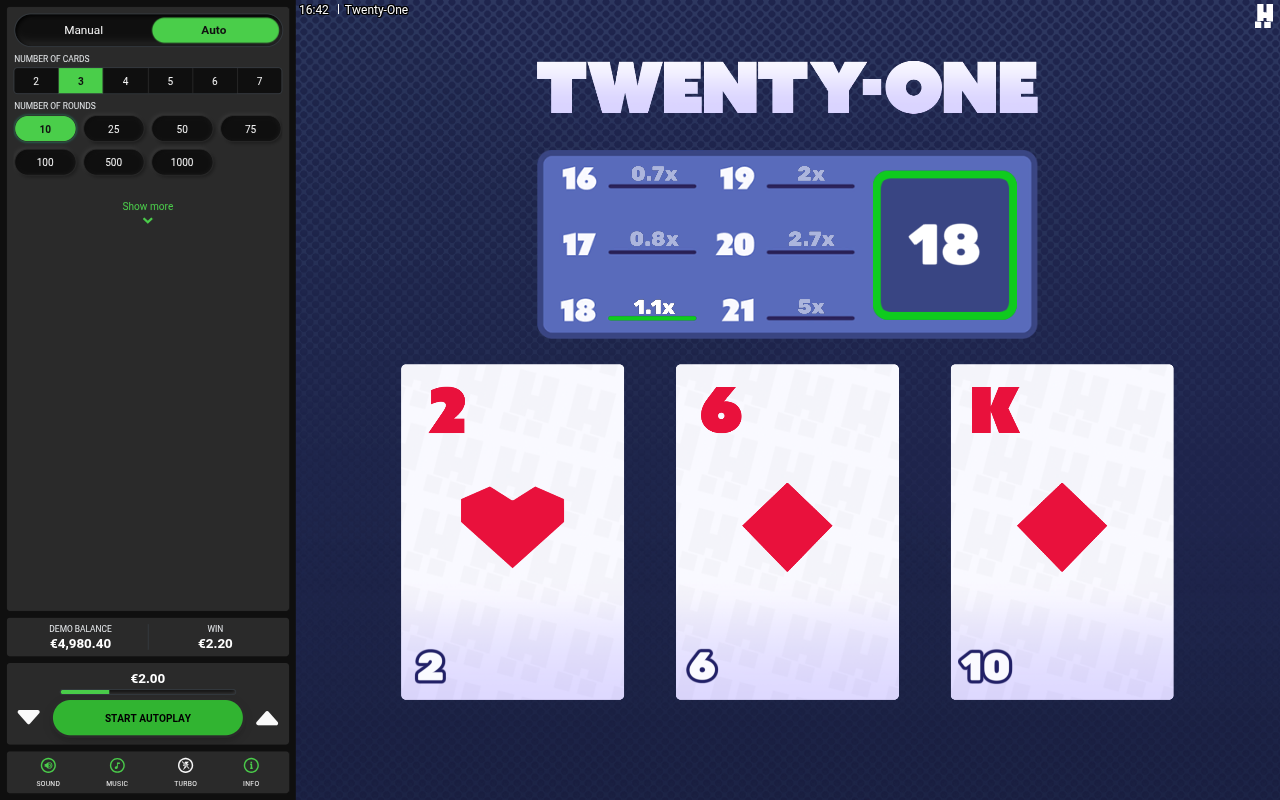
Autoplay, Turbo and Session Controls
Autoplay runs a chosen number of rounds automatically, with a remaining-count display and a STOP button to break out at any point. The advanced settings add two limits, and autoplay stops the moment either is exceeded:
- Total session lost limit – stops autoplay once cumulative losses pass the figure you set
- Single win limit – stops autoplay after any one round pays beyond the threshold
Turbo Play forces the fastest possible round and is activated from the menu. It isn’t available on every site or in every jurisdiction.
The bottom bar keeps the running totals visible throughout: current balance, the amount staked on the current proposition, and the amount paid on a win. Completed rounds appear in the history view. Unfinished games don’t.
There’s a full set of keyboard shortcuts for desktop play, which a rapid single-decision game makes better use of than most:
- SHIFT + Arrow UP/DOWN – change bet amount
- SHIFT + T – toggle Turbo mode
- SHIFT + S / M – toggle sound or music
- SHIFT + I or G – show or hide the game information
- ESC or BACKSPACE – close fullscreen windows
None of this changes how the game pays. But a game built on rapid single reveals leans on these controls more than a five-reeler does, and the loss limit in particular is worth setting before a long run of hands.
Our Honest Verdict
Overall Rating: 7.1/10
Twenty One is a game of one decision and one reveal. Choose your card count, press BET, and watch the total arrive. That’s the whole experience, and the honest answer is that it holds attention in short bursts: the reveal has genuine tension because the multipliers are steep at the top and worthless below 16.
The strength is the maths. A 98% RTP on a high volatility game is generous by any measure, and the card count reshuffles the pays in a way that rewards thinking about the choice rather than ignoring it. The weakness is the ceiling. 1,500x is a modest top end, and it’s reserved for the seven-card setting, where the draw is at its least controllable.
For players who like fast, single-decision games and value return over spectacle, it’s a purer test of nerve than any feature slot. Anyone wanting bonus rounds, narrative or a five-figure ceiling will find more of that elsewhere in the studio’s catalogue. As a hand of blackjack you don’t have to play well, it stands on its own two cards.
Twenty One FAQs
-
What is the RTP of Twenty One?
The RTP is 98%, which is well above the typical slot average. The figure comes from a theoretical probability model verified across ten billion simulated rounds. -
Is Twenty One high volatility?
Yes. Twenty One is a high volatility game, so payouts tend to be less frequent and the winning totals carry multipliers that scale steeply towards 21. -
How do you win on Twenty One?
You win when the sum of all your revealed cards equals 16, 17, 18, 19, 20 or 21. Your payout is your bet multiplied by the multiplier shown for that total, which depends on how many cards you chose to play with. -
What does the Ace count as in Twenty One?
An Ace counts as either 1 or 11, whichever total is most beneficial. Numbered cards count as their face value, and Jacks, Queens and Kings all count as 10. -
How many cards can you play with in Twenty One?
You can choose to play with between 2 and 7 cards. The number of cards changes the multiplier values in the payout table, and the 1,500x maximum win is only available when playing with 7 cards. -
What is the maximum win on Twenty One?
The maximum win is 1,500 times your bet, and it can only be achieved when playing with seven cards. -
What are the minimum and maximum bets on Twenty One?
Bets run from 0.10 to 500.00 per round, with the payout calculated as your bet multiplied by the multiplier awarded for your card total. -
Are the cards drawn from a fresh deck each round in Twenty One?
Yes. Every round draws its cards at random from a standard deck of 52, with a new deck and newly drawn cards each time, so no result influences the next.