











Well of wonders Slot Review
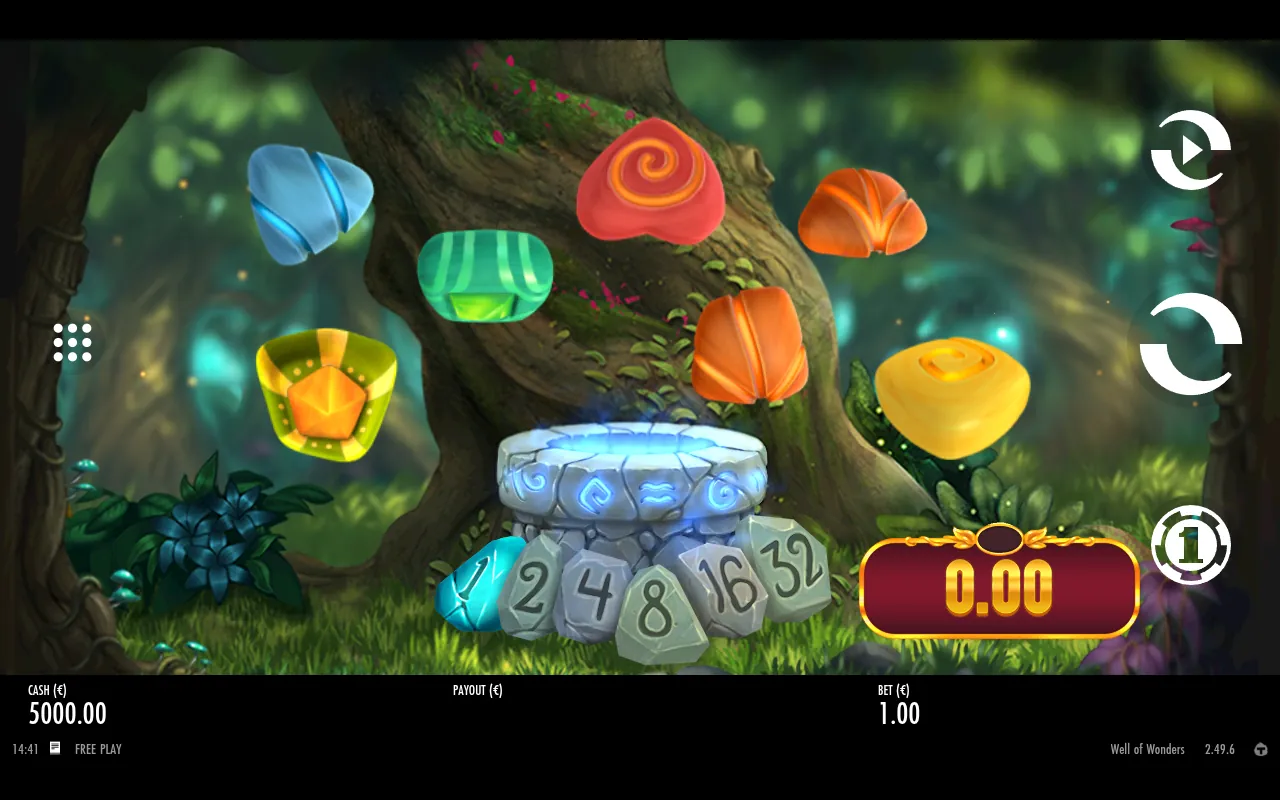
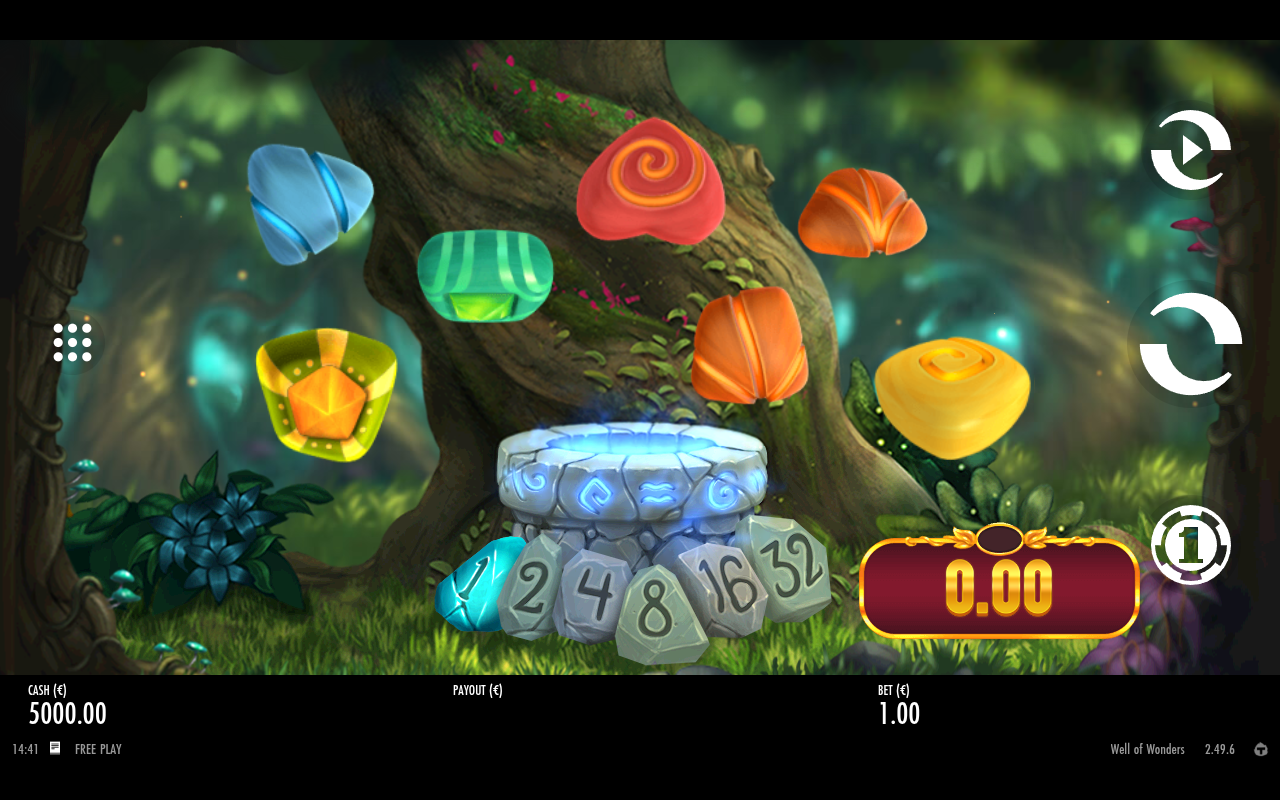
A gnarled old tree fills the middle of a forest glade, its bark patched with moss and tiny pink flowers, and beneath it sits a stone well with runes glowing blue around the rim. That’s Well of wonders, and it’s one of the strangest ideas Thunderkick has shipped: a slot with no paylines at all, where wins pay by how often a symbol shows up rather than where it lands.
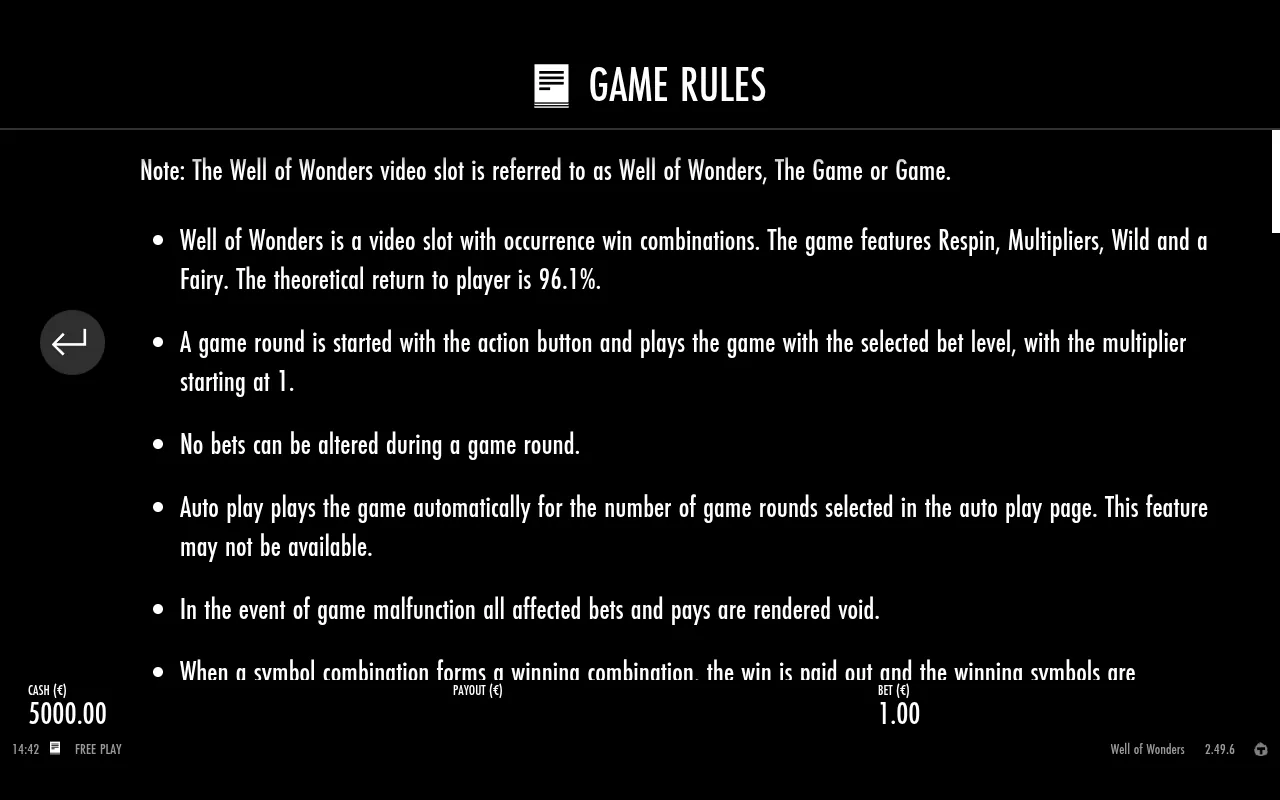
It runs at 96.1% RTP on low volatility, and its whole personality comes from a respin chain that doubles the payout every time it continues, up to 32x. It shares its occurrence-pays DNA with Fruit Warp and the Esqueleto Explosivo series, both also from the Stockholm studio. Whether a payout engine this stripped-back still holds up is the real question.
Winning by Occurrence
Well of wonders doesn’t use reels in the conventional sense. Symbols appear on screen, and a winning combination forms when the same symbol shows up often enough in a single draw. There are no paylines to trace and no adjacent reels to worry about. Position simply doesn’t matter; only the count does.
It’s a structure that changes how you read the screen. On a payline slot you scan left to right and watch the reels stop one at a time; here every symbol drawn is part of one shared pool, and the question each round asks is whether enough of a kind turned up. A draw with seven matching symbols scattered anywhere on the board is worth more than the same seven clumped in a corner would be on a payline game, because the corner doesn’t exist.
Each round starts with the multiplier at 1, played at the bet level you selected before pressing the action button. Bets can’t be altered mid-round, so what you set before the draw is what the whole chain plays at. On desktop the space bar also starts a round, and autoplay runs the game automatically for the number of rounds chosen in the autoplay menu, though that feature may not be available everywhere.
A single round plays out as a fixed sequence:
- Symbols are drawn on screen
- Matching symbols forming a combination pay out, multiplied by the current multiplier
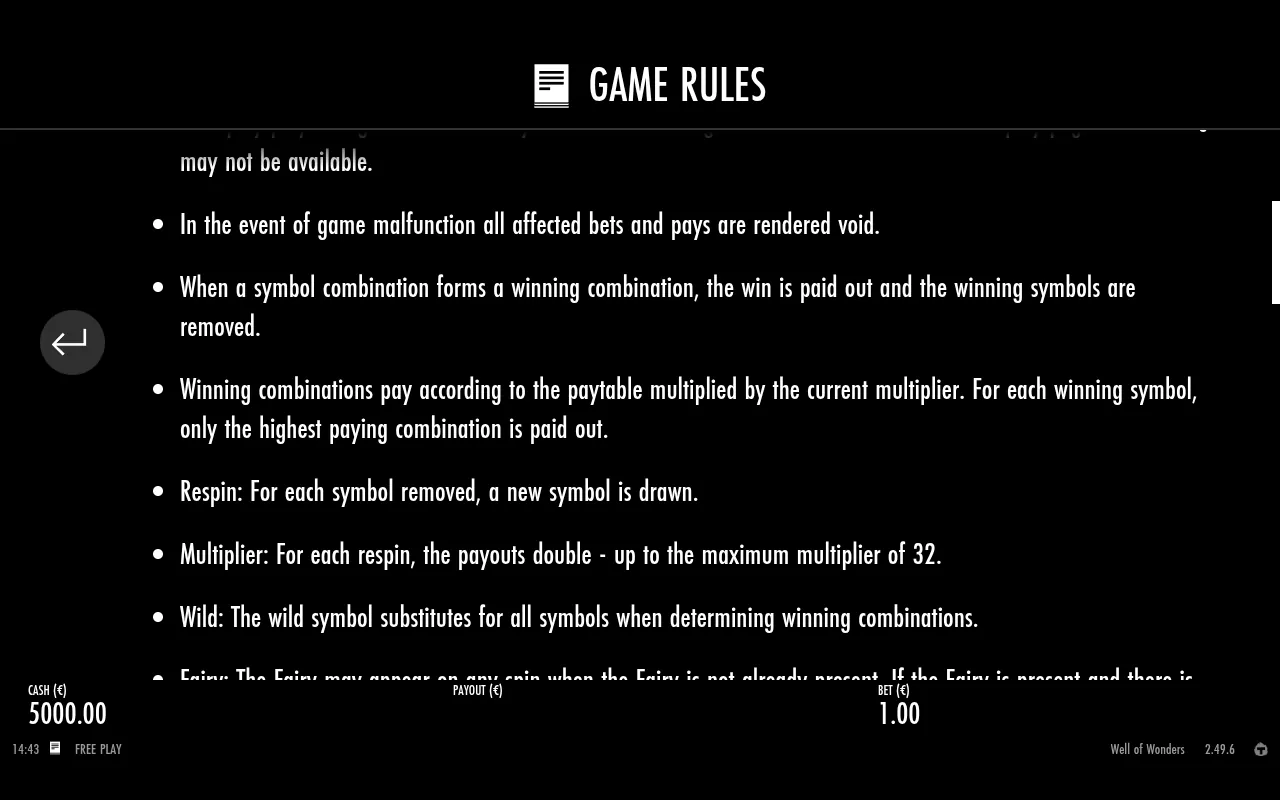
- Only the highest paying combination counts for each winning symbol
- The winning symbols are removed from the display
- New symbols are drawn in their place, and any new combination pays again
- The cycle continues until a draw produces no win and the round ends
It’s a simple loop, and the whole game lives inside it. The wild substitutes for all symbols when determining winning combinations, which makes it the most useful tile on the screen whenever it appears. Because wins are counted rather than lined up, a single wild contributes to every symbol type it can stand in for, so its value scales with whatever else the draw produced.
Visually, the loop is spelled out as it happens. Winning tiles fall away from the board, fresh symbols drop in to replace them, and the payout display ticks up with each link in the chain. The painterly glade sits behind all of it, soft-edged and glowing, but the business of the game is always this one repeating rhythm: draw, pay, clear, draw again.
Respin Chain and the Multiplier Ladder
The respin is the engine. For each symbol removed after a win, a new symbol is drawn to take its place. If those new symbols form another winning combination, they pay out, get removed, and the cycle repeats. There’s no separate bonus round to wait for; the respin chain is the feature, and it runs off the base game’s own wins.
That’s where the multiplier comes in. A round opens at 1x, and for each respin in the chain the payouts double, holding at the maximum once the ladder tops out:
- Opening draw: 1x
- First respin: 2x
- Second respin: 4x
- Each further respin keeps doubling the payouts
- The ladder caps at 32x, the game’s maximum multiplier
What makes the ladder interesting is what it does to early wins. A small combination on the opening draw is worth face value and nothing more, but that same small combination arriving four respins deep is worth several times more, purely because of when it landed. The game rewards chains, not symbols.
That gives every respin two jobs at once. The new symbols have to connect, or the chain dies and the multiplier resets to 1x for the next round. So a mid-chain draw carries a tension a flat payline spin doesn’t have: the win in front of you is real, but the win it might unlock next draw is always worth more.
The Fairy
The Fairy is the game’s only real character feature. She may appear on any spin when she isn’t already present, drifting in over the glade. Her role is a rescue mechanic rather than a jackpot.
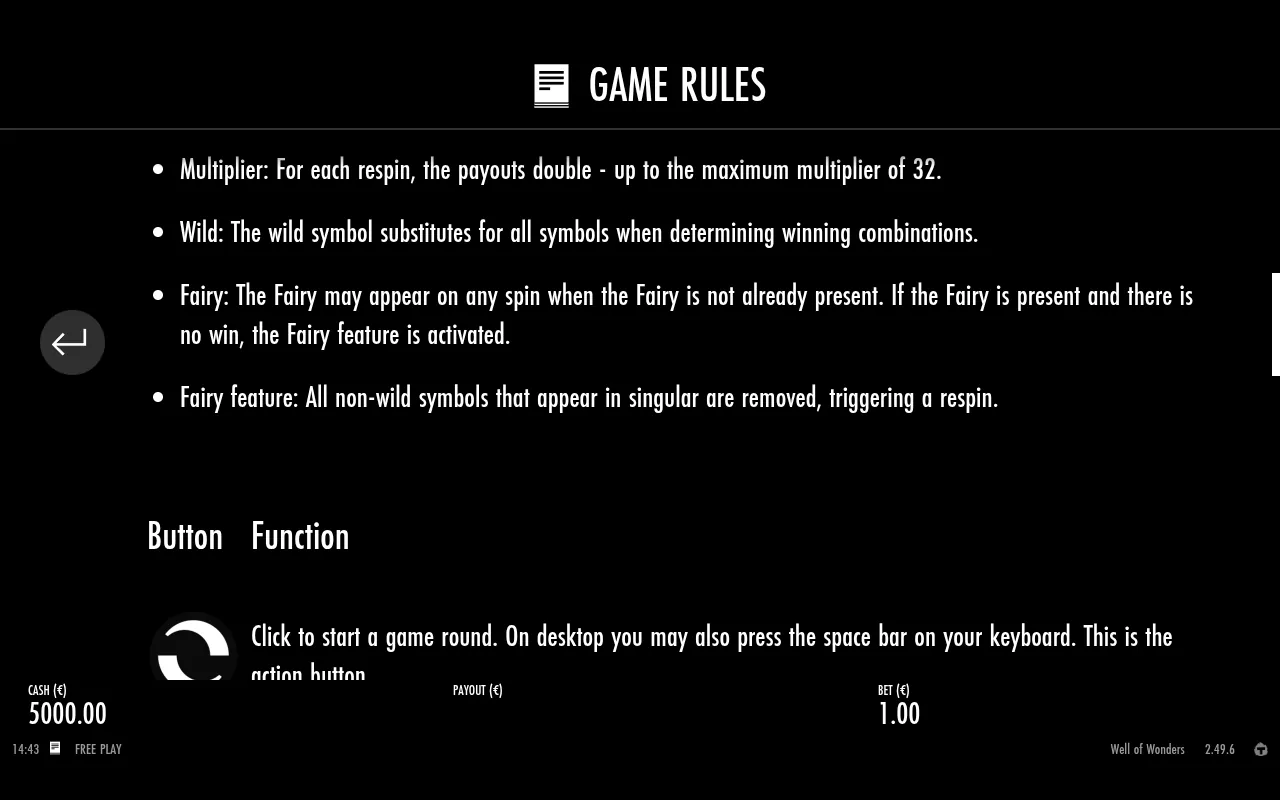
If the Fairy is on screen and the draw produces no win, the Fairy feature activates: all non-wild symbols that appear are removed, which triggers a respin. In effect, she clears the board and forces the chain to keep breathing. Because the multiplier holds across that respin, a Fairy save can carry a stalled ladder forward instead of letting the round die at 1x.
There’s a second consequence worth spelling out. Because the cleared board fills with entirely new symbols, a Fairy save gives a dead draw a full fresh set to work with, and any combination those new symbols form pays at the multiplier the round had already built. The wild is untouched by her clear, so it stays where it landed and keeps helping whatever comes next.
Notice the timing of her appearance, too. She shows up on spins when she isn’t already present, but she only acts when a draw produces no win. A winning draw doesn’t need her and doesn’t set her off, so her feature is spent precisely where the round is weakest: at the exact moment the chain would otherwise end.
Our Honest Verdict
Overall Rating: 7.7/10
Sitting by this well is a patient sort of pleasure: the same soft glade every round, symbols drifting onto the tree, and the quiet arithmetic of whether enough of a kind turned up. The one reason to choose it over a conventional slot is that every draw is live to the last moment, because a chain worth 32x can start from the smallest win in the world.
The Fairy is the best thing here. A board-clear that only fires when a round is about to die is an elegant piece of design, and it turns what would be a flat loss into one more draw. The weakness is just as clear: there’s nothing else. No free spins, no bonus round, no second mode waiting behind the multiplier ladder, so the loop has to hold you on its own.
For players who like one mechanic done properly, it does hold. Anyone who needs a feature round to break up a session will find the glade quiet in a way they didn’t bargain for, but low volatility and a rescue mechanic this neat make it an easy game to settle into.
Well of wonders FAQs
-
What is the RTP of Well of wonders?
96.1% -
Is Well of wonders high volatility?
No. Well of wonders is a low volatility game, so wins tend to be smaller and more regular than in high variance slots. -
How do wins form in Well of wonders?
Well of wonders uses occurrence wins rather than paylines. When the same symbol appears often enough in a draw, it forms a winning combination, pays out, and the winning symbols are removed. -
How does the multiplier in Well of wonders work?
Each round starts with the multiplier at 1. For every respin in a chain, the payouts double, up to a maximum multiplier of 32x. The multiplier drops back to 1x once the chain ends. -
What does the Fairy do in Well of wonders?
The Fairy can appear on any spin when she is not already on screen. If she is present and the draw produces no win, all non-wild symbols are removed, triggering a respin that keeps the round’s multiplier going. -
What does the wild symbol do in Well of wonders?
The wild substitutes for all other symbols when determining winning combinations, making it the strongest tile in any draw it appears in. It is also the only symbol the Fairy feature leaves untouched. -
When is Well of wonders released?
Well of wonders’ release date is 15 March 2017. -
Who makes Well of wonders?
Well of wonders is made by Thunderkick, the Swedish studio also behind Fruit Warp and the Esqueleto Explosivo series.