


I’ve been in this industry for over twenty years.
I’ve built FruitySlots.com from scratch, doing things properly recommending regulated operators, keeping every T&C current, staying on the right side of UKGC affiliate guidelines even when it costs money and time I don’t have. I believe in a gambling industry that is honest, compliant, and genuinely tries to protect its customers.
Which is why what I’m about to show you makes me so angry I can barely write this calmly.
This is what’s ranking on Google right now
Search “best casino sites” on Google in the UK today. This is what you get:
- Site 1: new.ukcasinonogam.ink – “Non GamStop Casinos 2026 – Best Online Casinos in the UK” (Google Featured Snippet)
- Site 2: casino.sitesnongamstop.uk – “UK’s Best Online Casinos Not on GamStop in 2026”
- Site 3: onlinecasinogb.us.com – “Non Gamstop Casinos UK – Best Casinos Not on Gamstop 2026”
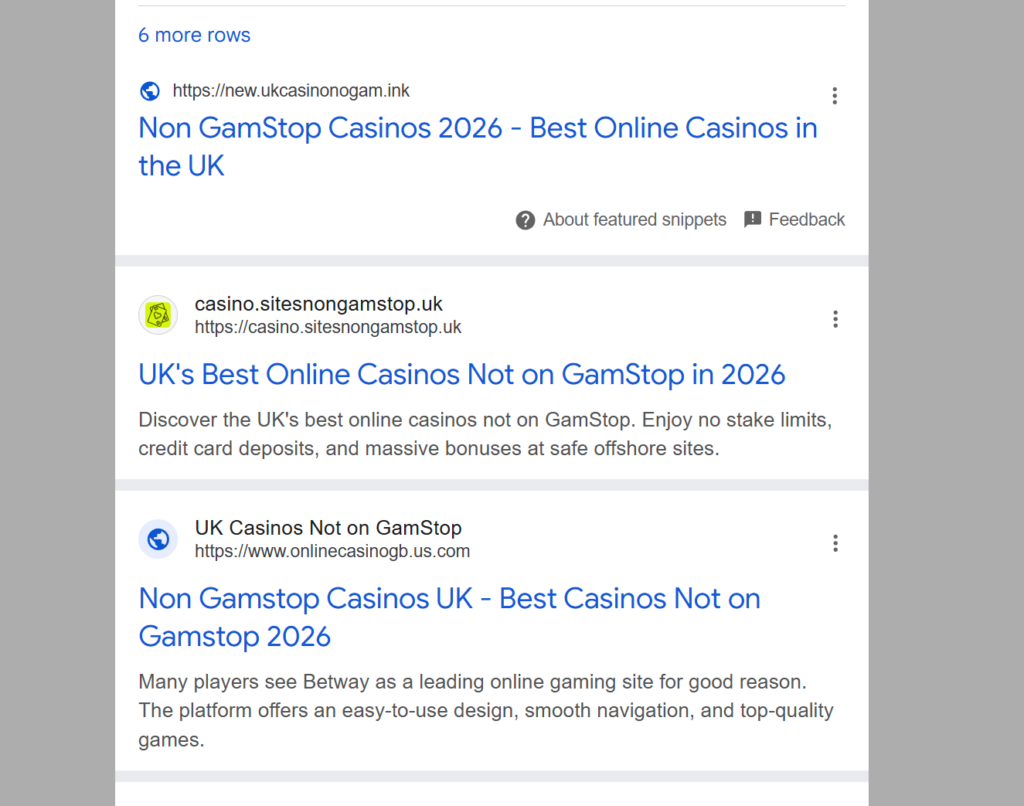
None of these domains hold a UKGC licence. All actively market to UK self-excluded gamblers.
The first result holds a Google Featured Snippet – meaning Google has algorithmically elevated it as the most authoritative answer to the query.
Read that again. A site with a .ink domain – not even a .com or a .co.uk – explicitly marketing “non GamStop” casinos to UK users, is sitting in Google’s Featured Snippet position for one of the most valuable gambling keywords in the country.
Google has algorithmically decided that is the single most helpful answer it can give someone searching for the best casino sites in the UK.
That person could be anyone. They could be someone who joined GAMSTOP last week.
“Google awarded its Featured Snippet – its gold star of authority – to a site explicitly designed to help self-excluded UK gamblers bypass their own protections.“
It’s not just bad SEO. It’s coordinated black-hat abuse
Here’s what a lot of people outside the SEO industry don’t understand: many of these sites aren’t just dodgy affiliates who got lucky.
They are using highly sophisticated, deliberately abusive tactics to exploit Google’s algorithm – and Google is either unable or unwilling to stop it.
Over the past year, we have seen an explosion of what’s known as ‘parasite SEO‘ in the gambling space.
This is where operators and shady affiliate networks inject gambling content – sometimes thousands of pages – onto completely unrelated, high-authority domains.
We’re not talking about vaguely adjacent sites. We are talking about cancer charities. Hospital websites. Children’s education portals. Greeting card companies.
Sites that have spent years building legitimate domain authority, which has then been compromised – sometimes through hacked subdomains, sometimes through expired domain purchases – and used to push illegal gambling content up Google’s rankings.
Think about what that means. A self-excluded problem gambler searches for casino recommendations. Google serves them a result that appears to come from a trusted, authoritative source. Behind it is an illegal operator with no player protections, no stake limits, no GAMSTOP checks, and no intention of paying out when things go wrong.
What “parasite SEO” looks like in practice:
- Operators and affiliate networks acquire expired high-authority domains – charities, hospitals, media outlets – or exploit subdomains on hacked legitimate sites.
- They publish hundreds of SEO-optimised gambling pages on these domains, inheriting years of trust signals Google has assigned them.
- The gambling content ranks almost immediately.
- The real owners often don’t know it’s happening.
- Google continues to serve the results.
This has been documented repeatedly. It is not a secret.
Google’s own quality raters would flag this as a clear violation of their guidelines. And yet the results persist, month after month, for the most commercially valuable keywords in the industry.
I‘ve watched this happen to someone I know
This isn’t just me venting my professional frustration. This is personal.
I have a close friend who had a serious problem with gambling. They made the right call. They joined GAMSTOP – excluded themselves from regulated UK casinos, including some I had recommended on this very site. That’s exactly what GAMSTOP is for. That’s the system working in practice.
Except it didn’t work. Because within weeks, they had found offshore casinos through Google. Sites that don’t check GAMSTOP. Sites with no deposit limits, no reality checks, no cooling-off periods. Sites that will take every pound you put in – and when you finally win something, hide behind “verification holds” that drag on for weeks, or simply never pay out at all.
In their own words:
“I always look for big bonuses and this was a deposit match offer of over a grand, which I’ve not seen in ages, so as any gambler would think, I’ve beat the system. I thought if Google was showing them, they must be okay. I won over £12,000 and never saw a penny of it. The hold just never ended.”
This person isn’t naive or weak-willed. They tried to protect themselves using a government-backed scheme. Google handed them straight to the wolves anyway.
The compliance trap that only catches the honest
While all of this is happening, I’m spending real time and real money keeping FruitySlots.com compliant.
This means that bonus terms must be crystal clear, responsible gambling messaging must be current and prominent, promotional claims must be accurate to the letter – one slip and years of affiliate relationships can unravel overnight. The UKGC’s affiliate advertising standards are detailed, enforced, and carry real consequences.
I accept all of that. I think it’s right.
But the system is fundamentally broken when the rules only ever catch the people already trying to follow them.
Regulated affiliates operate under constant threat of losing everything over a single outdated disclaimer.
Meanwhile, sites built on hijacked cancer charity domains rank above us on Google for the same keywords, face zero platform consequences, and freely target the most vulnerable gambling consumers in the country.
“Compliance is only meaningful if it applies to everyone. Right now it applies to us – and to nobody who is actually causing harm.“
Google’s Featured Snippet is not a neutral act
I want to dwell on that Featured Snippet for a moment, because I think it matters more than people realise.
When Google awards a Featured Snippet, it’s not passively indexing the web. It’s making an active editorial choice.
It’s telling every user who sees it: this is the most authoritative, most helpful answer to your question. It’s the closest thing Google has to an explicit endorsement.
Google chose to award that to a site called ukcasinonogam.ink – a domain that exists entirely to help UK gamblers bypass their own self-exclusion. That isn’t an algorithm failing silently in the background. That’s Google’s systems, at their most deliberate, pointing vulnerable people toward harm.
Google has the technical resources to cross-reference domains against the UKGC’s public register of licensed operators.
It isn’t a hard problem. It’s a choice not to solve it. And with the Online Safety Act now in force, I think it’s a choice that will become increasingly difficult to defend legally.
What needs to happen and FAST
I’m not writing this as a list of polite suggestions. I’m writing this as someone who has spent twenty years in this industry and is watching it being used to cause real, measurable harm to real people – while regulators and platforms treat it as someone else’s problem.
Google must verify the UKGC licensing status of any gambling domain appearing in UK organic or paid results.
Not as a pilot. Not as a working group recommendation. As a baseline requirement, enforced algorithmically. If a domain is not on the UKGC register, it does not rank for UK gambling queries – it’s really that simple.
The UKGC must engage Google directly and publicly on this issue and must be willing to use the Online Safety Act as leverage.
The Act creates new obligations for platforms around harmful content. Directing self-excluded problem gamblers to illegal offshore casinos via Featured Snippets is not a grey area.
And the wider industry – the legitimate operators, the licensed affiliates, the trade bodies – needs to stop pretending this is just an SEO curiosity and start treating it as the public health issue it is. Because that is what it is.
I’m still here. Just angrier
I still believe in a properly regulated gambling industry. I believe it can be entertaining, honest, and safe. I’ve spent my career trying to contribute to that version of it.
But I can’t keep defending this industry’s legitimacy while Google hands its highest-authority search result – a Featured Snippet – to a .ink domain that exists to circumvent self-exclusion. I can’t keep telling people the system works when my friend played on an illegal casino Google recommended, won £12,000, and never saw a penny of it.
The UKGC, Google, and the industry all need to stop waiting for someone else to act.
I’m a small affiliate. I have no power here except a website, a voice, and twenty years of watching this up close.
So I’m using it.
—
Jamie Rosen
Owner, FruitySlots.com · Gambler and industry observer for 20+ years
This is an opinion piece reflecting the personal views of the author. FruitySlots.com operates as a UK affiliate under UKGC advertising guidelines. The screenshot referenced was captured from Google UK search results in April 2026.

Jamie Rosen
CEO & Co-Founder