










Bugs Party Slot Review
Puffy clouds drift over a saturated blue sky, reeds grow thick along a sunny pond bank, and two cartoon bugs have set up their party on the bamboo frames that hold the bingo cards. Bugs Party is at its best when it’s asking you to decide rather than watch: the ball draw is gentle, but the priced question of whether one more ball is worth buying is where the game sharpens up.
It’s a video bingo title from Play’n GO: up to four cards of 15 numbers, 30 balls drawn from a pool of 60, and 14 patterns to complete, running at mid-to-low volatility with no RTP figure published. It sits in the same video bingo family as Rainforest Magic Bingo and Sweet Alchemy Bingo.
Four Cards, Sixty Balls, Fourteen Patterns
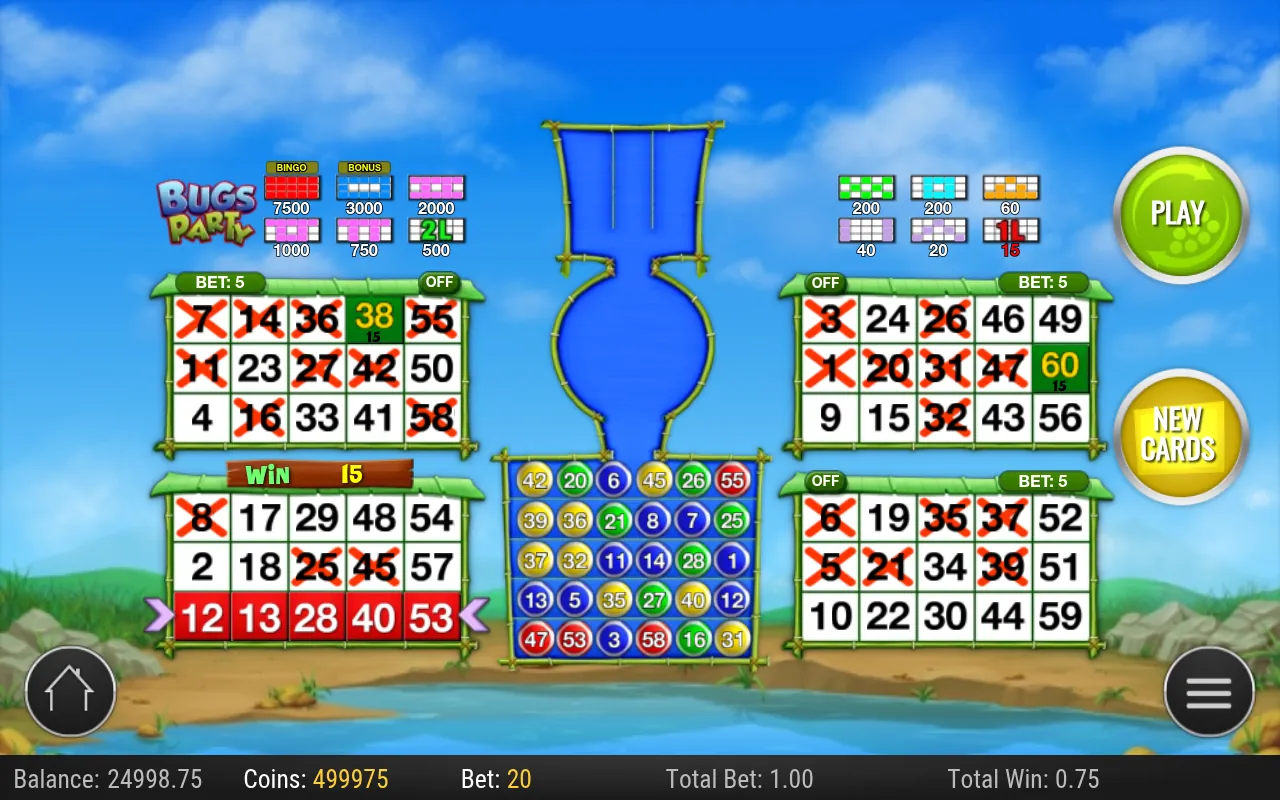
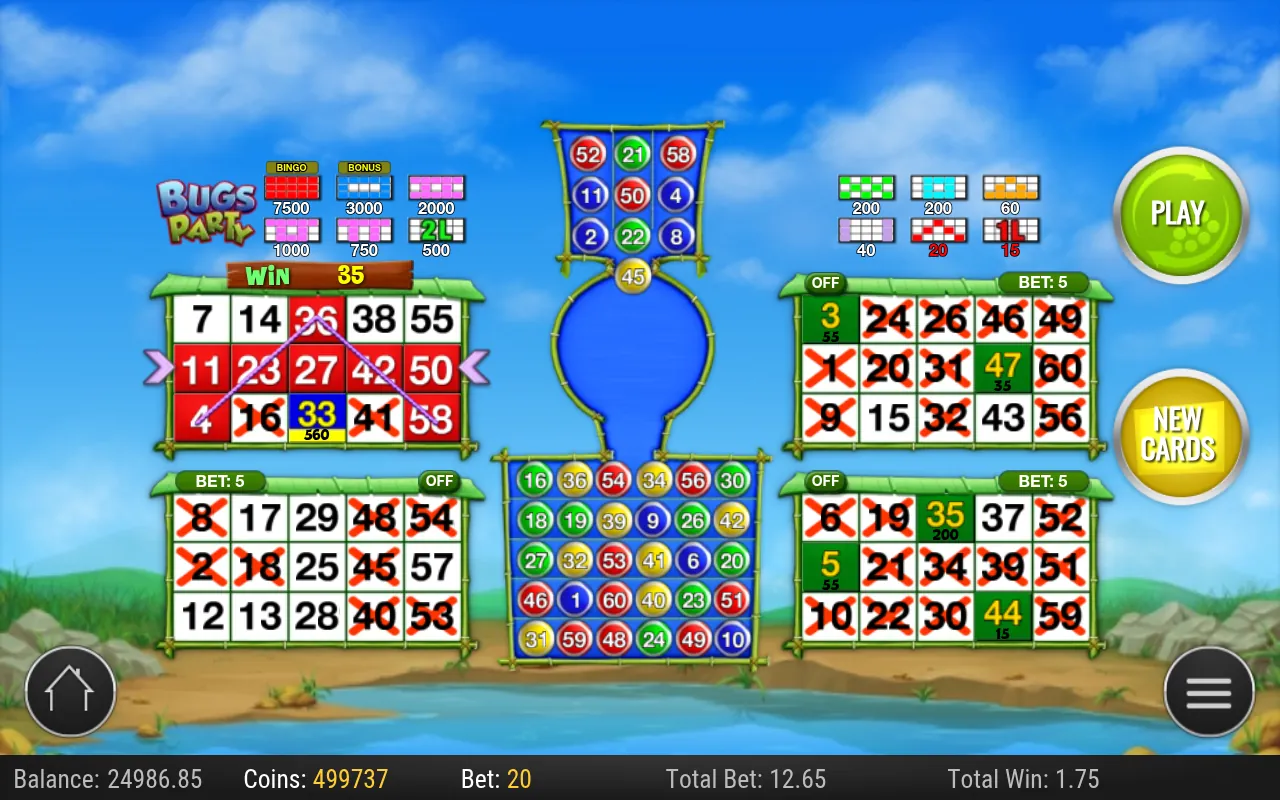
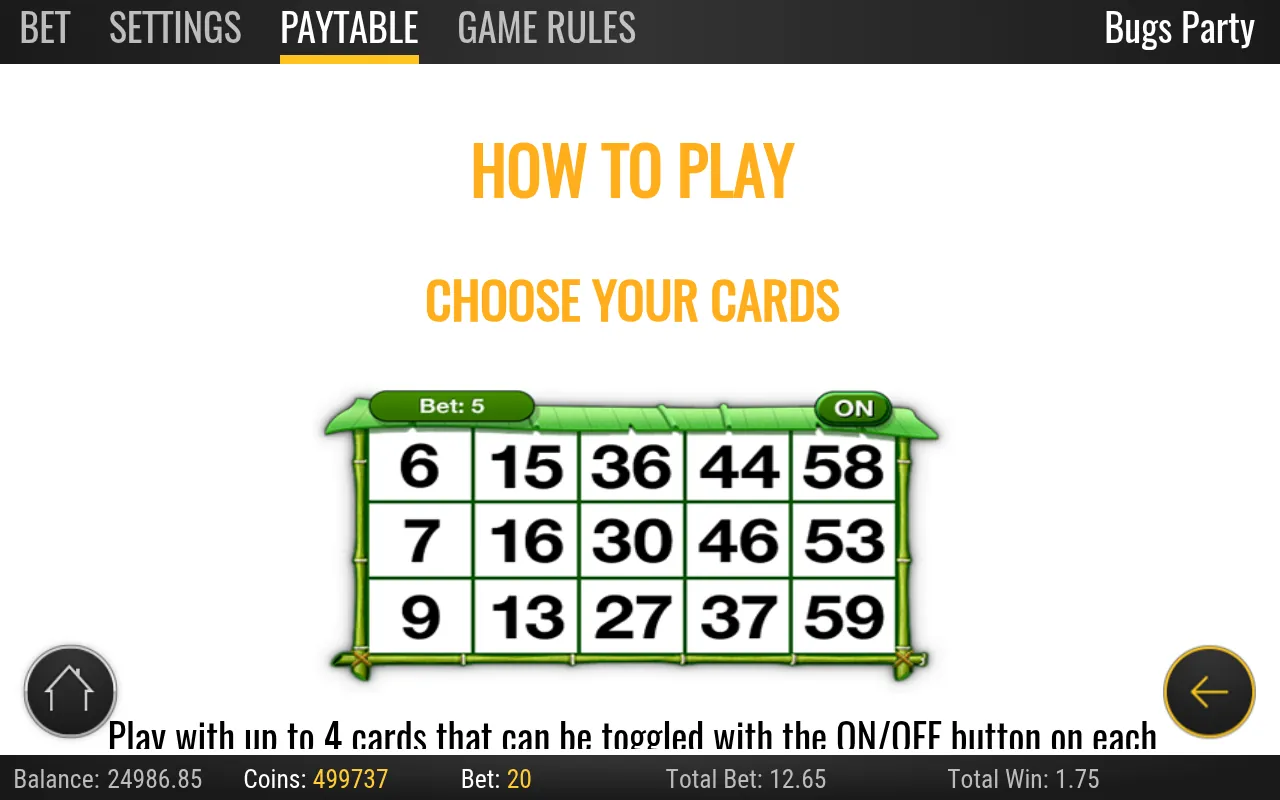
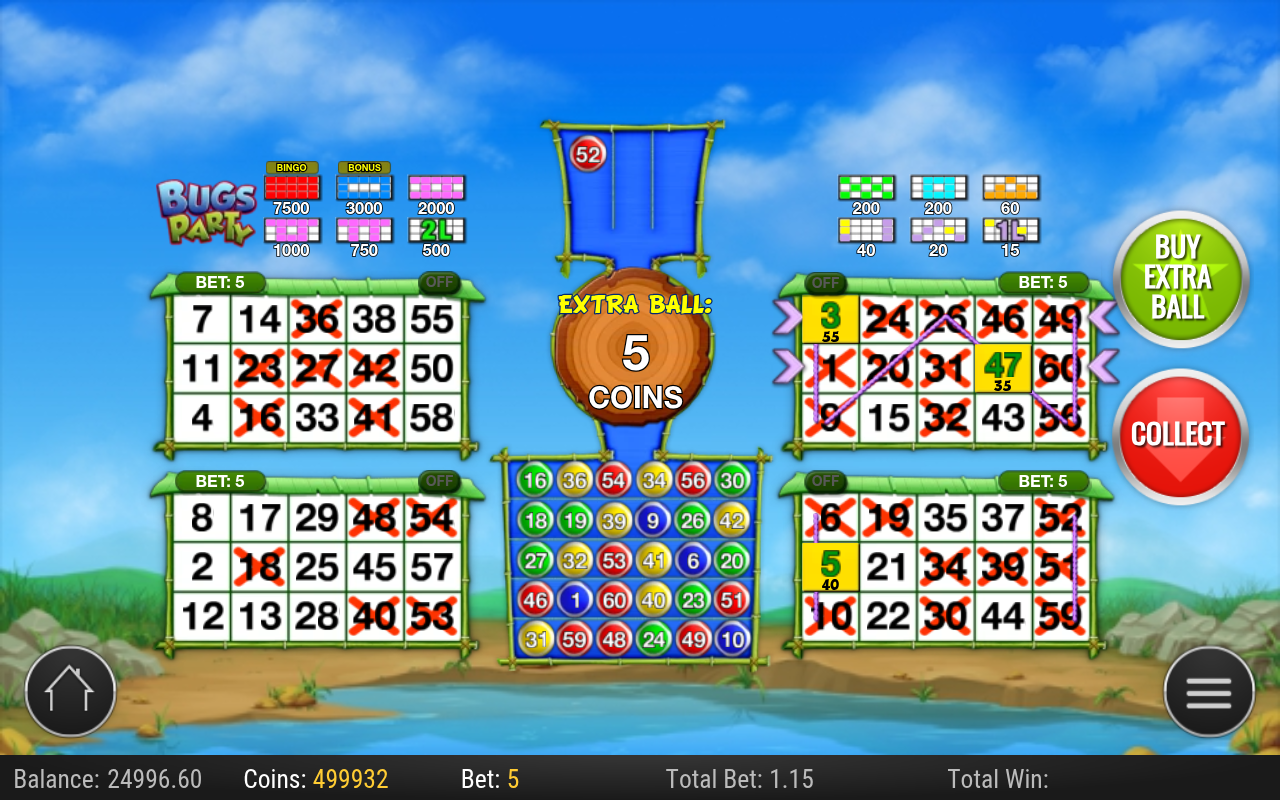
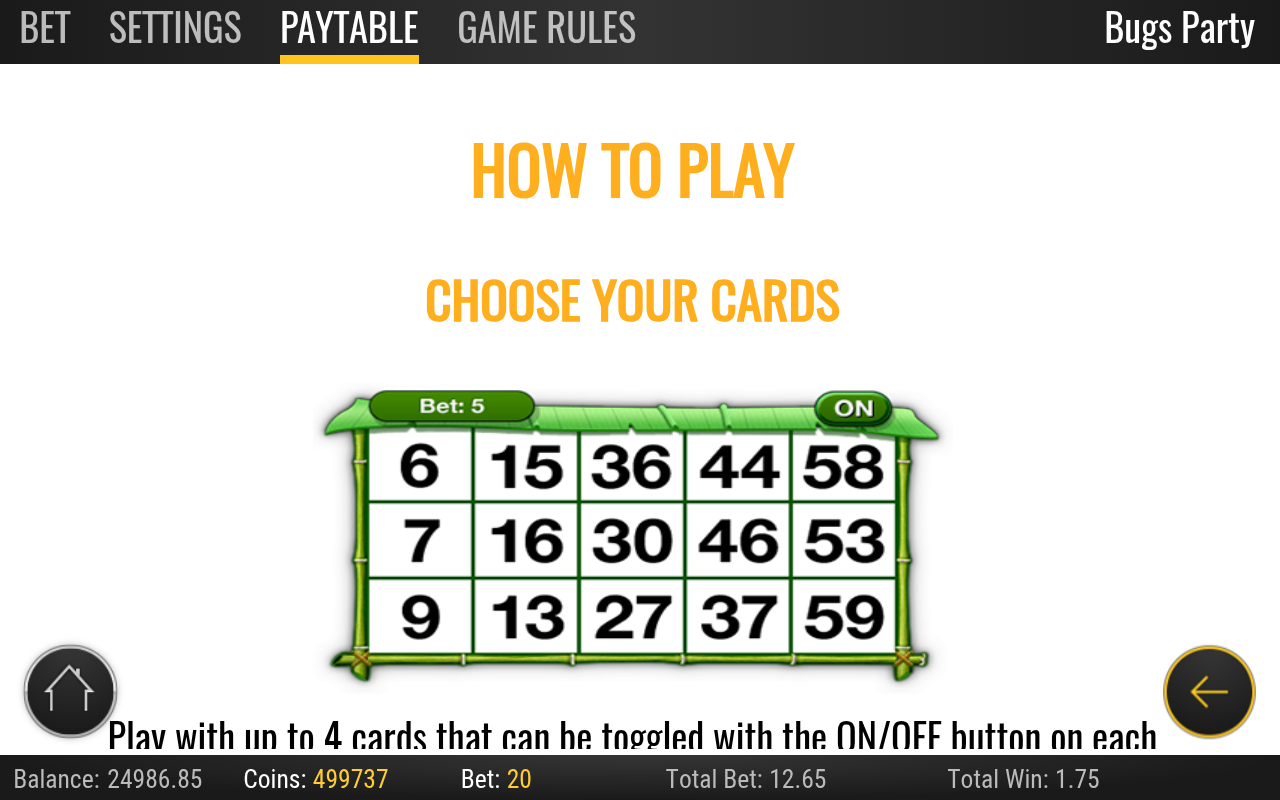
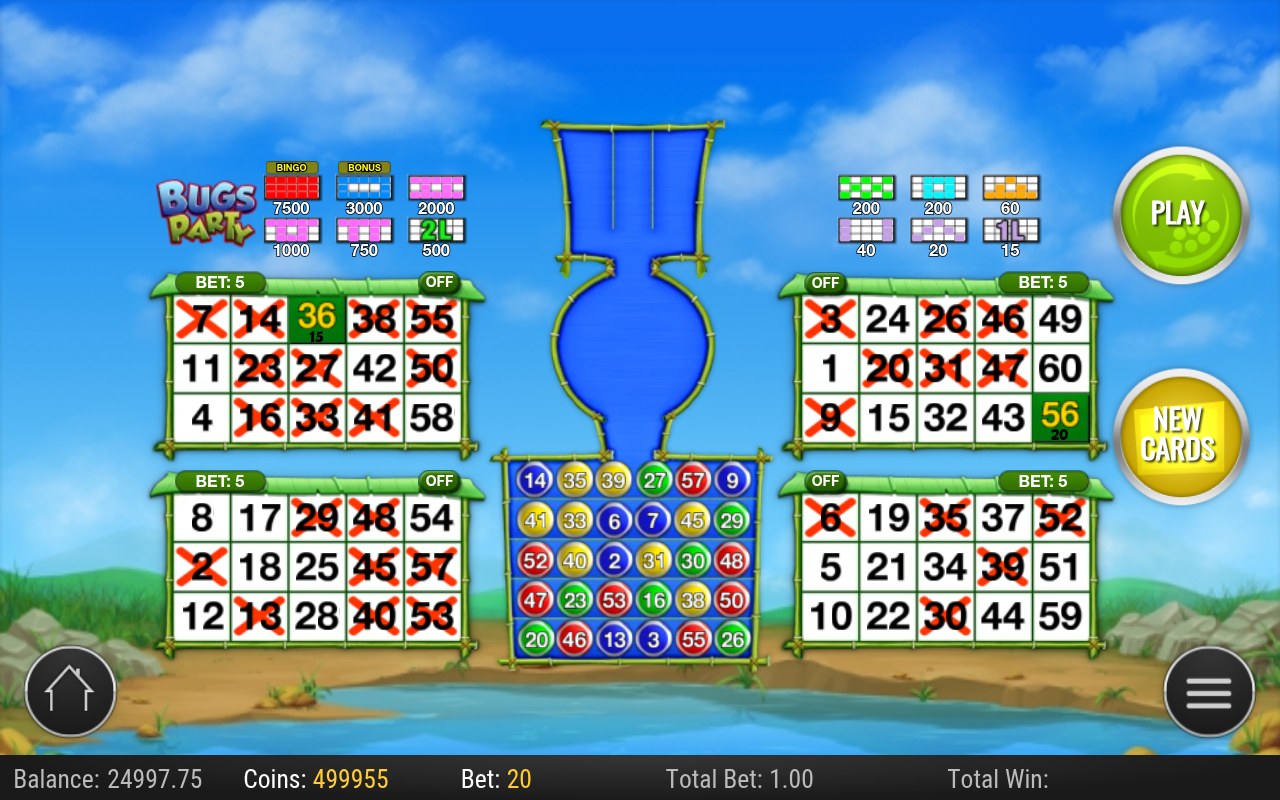
Each round starts with up to four bingo cards, toggled on or off individually before play. Every active card carries 15 numbers in a five-by-three layout, so a full four-card round puts 60 numbers in play at once. Pressing NEW CARDS resets the numbers on all active cards, and pressing PLAY draws 30 balls from the 60-ball pool.
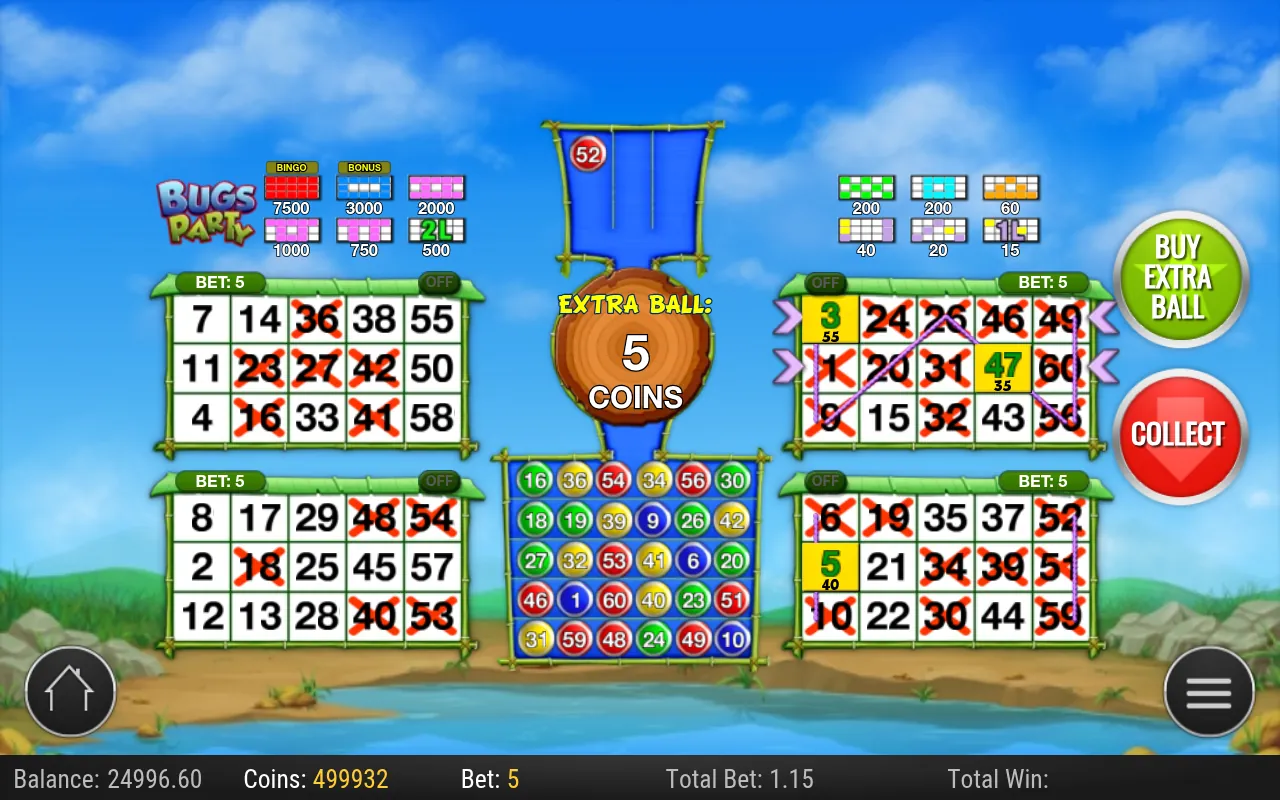
Wins don’t come from paylines. Matching numbers have to complete one of 14 patterns on an active card, and each pattern carries its own prize. The pattern set sits at the top of the screen with its prizes printed beneath it, so the whole ladder is visible while the balls land.
The prize ladder is quoted in coins at the bet in play, and it steps down through the full pattern set:
- BINGO, the top pattern, worth 7,500 coins
- BONUS, which opens the jam jar round, at 3,000 coins
- A 2,000-coin pattern just below it
- 1,000, 750 and 500 coins across the next three patterns
- 200, 200, 60, 40, 20 and 15 coins across the smaller shapes
If more than one pattern completes on the same card, each completed pattern pays. There’s one restriction: when a pattern is fully covered by a higher-paying pattern, only the highest prize is given. So a full card pays the BINGO prize once, not the BINGO prize plus everything beneath it.
That single rule shapes the whole ladder. The smaller patterns are worth chasing because they land often, but a card filling in towards BINGO gradually loses its smaller claims as the big pattern swallows them.
The middle of the ladder, from 1,000 coins down to 200, is where most of the round-to-round money actually sits.
The Extra Ball Round
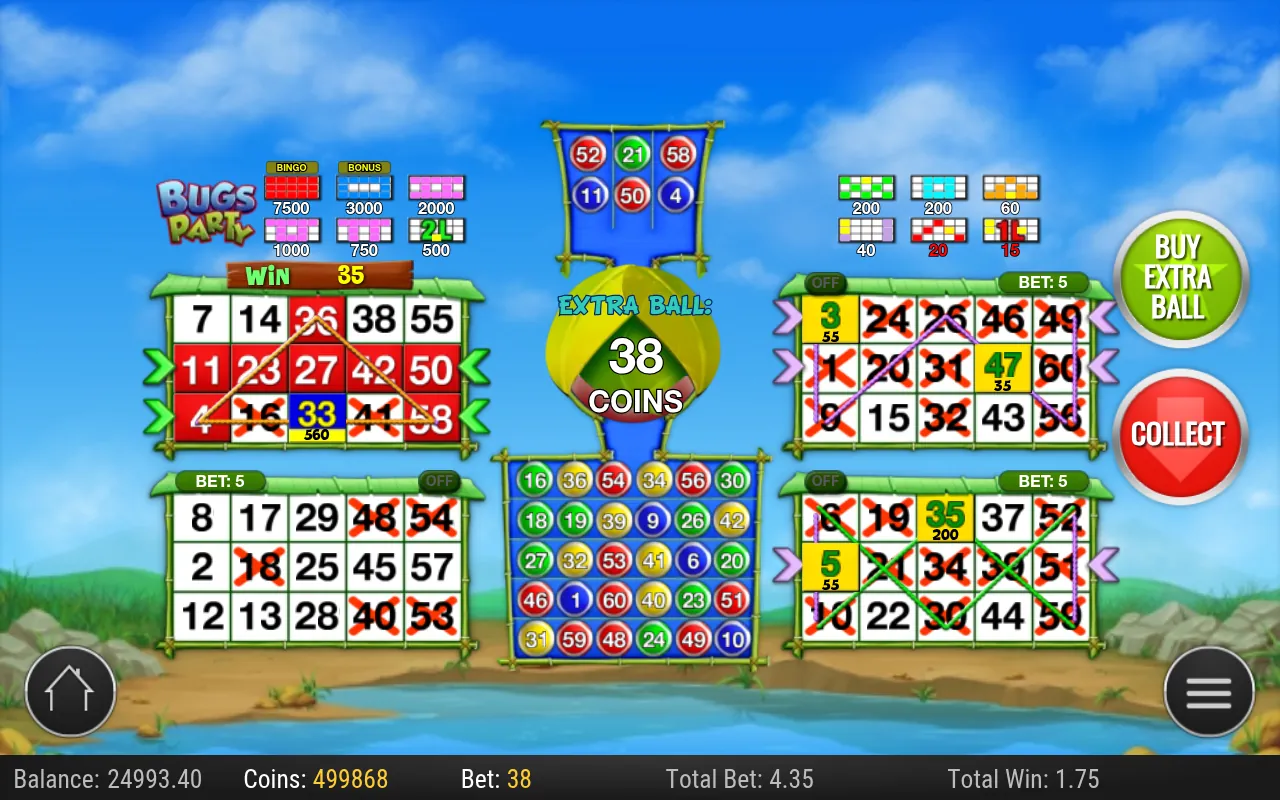
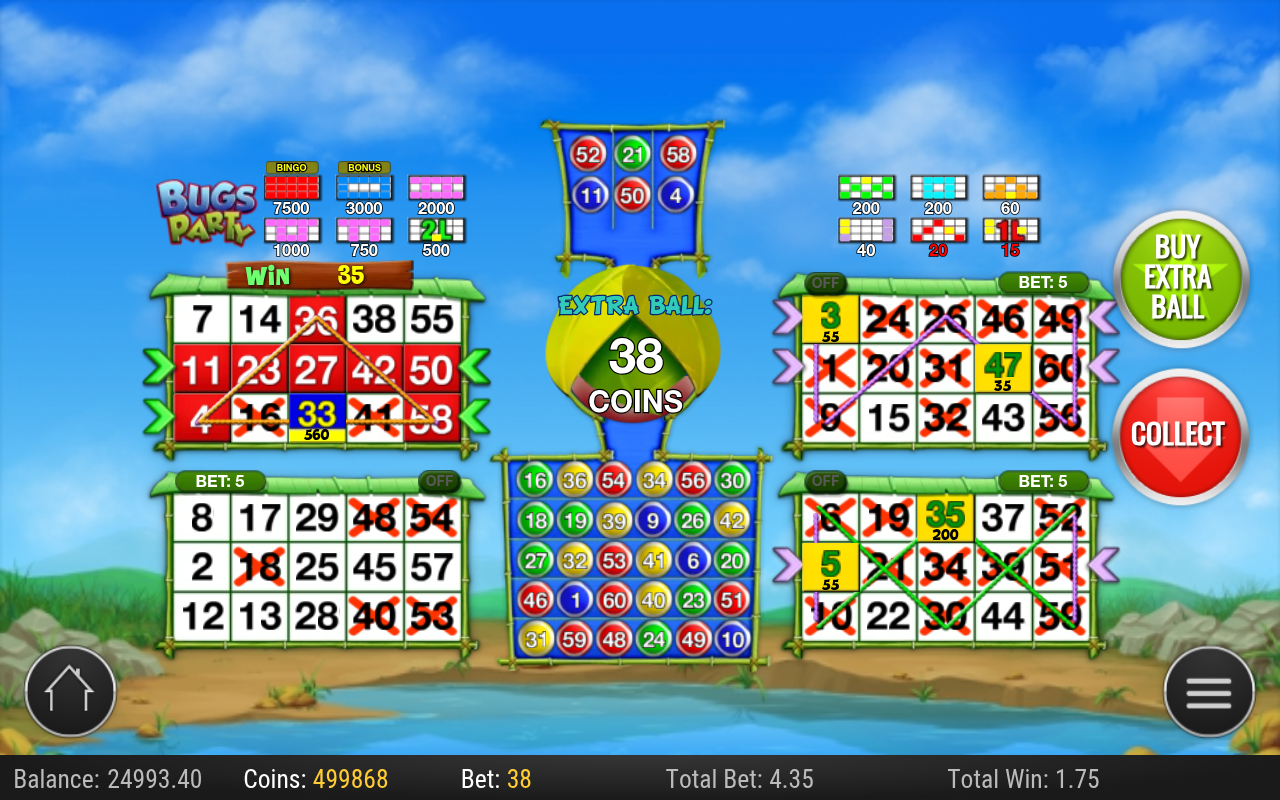
When a card finishes a round one number short of a prize worth x8 or more, the Extra Ball feature opens. Up to 10 extra balls can then be purchased, one at a time, each drawn from the remaining pool.
The cost of each ball is calculated from the probability that it completes the prize, so the price moves as the situation changes. The panel prices each ball individually in coins, and the figures move sharply: a ball can cost 5 coins in one position and 43 in another as the potential prize and the remaining pool change.
That pricing is the whole game within the game. Buying a cheap ball on a long shot is one decision; paying a heavy price for a near-certain BINGO completion is another. Because the feature only fires at x8 or above, every purchase sits in front of a prize worth arguing about.
The one-number-short trigger keeps the feature honest, too. It doesn’t open on every near miss, only on the ones within reach of the ladder’s upper half, which means the expensive decisions are at least attached to prizes that can pay for them.
The Jam Jar Bonus Game
Completing the square pattern shown on screen doesn’t pay a flat prize, it opens the bonus round. Here the party moves to a shelf of colourful jam jars, and the picking begins: each jar hides either a prize or a modifier.
- Prize jars, which award their amount on the spot
- X3 and X5 multiplier jars, which multiply the next prize picked
- Two consecutive multipliers combine to x15, applied to the next prize
- The hungry frog, which ends the round if picked
- The angry pest control officer, which also ends the round
- The instrument symbol, which keeps the round going when picked
The round runs on these picks until one of the two party-poopers shuts it down. Chaining multipliers ahead of a big prize jar is where the round’s better results come from, and the x15 combination is the strongest multiplier available. The instrument pick is the round’s lifeline, extending the run for another choice.
Order matters more than luck here. A multiplier only boosts the next prize, so picking one late in the run, with the frog still lurking, does far less work than picking one early with several jars still unopened.
Play Settings
Three settings shape the pace. Auto Play runs consecutive rounds automatically at the current bet and switches itself off if the balance runs too low. Fast Play speeds the ball draws up considerably for anyone who finds 30 balls a round too slow a wait.
Auto adjust bet reduces the total bet when a new round would otherwise exceed the balance, picking the highest bet that still fits. It only ever decreases, and it doesn’t climb back after a win, so a session that dips stays at the lower level.
A disrupted round isn’t lost, either. All game information and placed bets are stored, and the round resumes from the point of interruption on reopening, which matters more in a game where an Extra Ball decision can sit mid-purchase.
Our Honest Verdict
Overall Rating: 7.1/10
Four cards fill in, 30 balls fall, and the small patterns pay often enough to keep the pond-side round ticking over at a pace that suits the format. The rhythm is the draw, plus the moments where a card closes on a big pattern and the price of one more ball has to be weighed.
The Extra Ball counter is the best thing here. Because each ball is priced by the probability of completing the prize, every purchase is a real decision rather than a reflex, and the expensive ones carry genuine tension. The jam jar round is a decent second act, though it’s the ball counter you’ll remember.
The ladder itself is the weakness: a big pattern swallows every smaller one it covers, so a card filling towards BINGO quietly gives up its lesser prizes, and at mid-to-low volatility the top rungs stay a distant prospect. For bingo-format players and anyone after a gentler session with the odd priced decision, it fits; multiplier-chasers will find the jam jars thin. The pond, at least, stays sunny.
Bugs Party FAQs
-
Is Bugs Party high volatility?
No. Bugs Party runs at mid to low volatility, so smaller pattern prizes land fairly regularly while the top BINGO prize remains a rare result. -
How many paylines does Bugs Party have?
None. Wins are formed by matching numbers completing one of 14 bingo patterns on an active card. Each pattern must be fully completed to award its prize. -
How does the Extra Ball feature work in Bugs Party?
It triggers when you finish a round one number away from a prize worth x8 or more. You can then buy up to 10 extra balls, each priced according to the probability of completing the prize. -
How do you trigger the bonus game in Bugs Party?
Complete the square pattern shown on screen on an active card. That opens the jam jar picking round, where jars hide prizes, X3 and X5 multipliers, and two characters that end the round. -
Can you buy the bonus on Bugs Party?
There is no bonus buy in the usual sense. The closest thing is the Extra Ball purchase, offered when a card is one number from a prize of x8 or more. -
What happens when two multiplier jars are picked in a row?
Their values multiply together to give x15, which is then applied to the next prize jar you pick. It’s the strongest multiplier available in the bonus round. -
Do all completed patterns pay on the same card?
Yes, as long as they aren’t overlapping in a specific way. If more than one pattern is completed on the same card, each one pays, but when a pattern is fully covered by a higher-paying pattern, only the highest prize is given. -
Who makes Bugs Party?
Play’n GO, the Swedish studio behind titles including Book of Dead and the Reactoonz series. Bugs Party is one of their video bingo releases.