














Candy Drops Slot Review
A vending machine glows against a purple midnight sky, its teal-and-white awning lit like a sweet shop that never closes, a red-orange moon parked over the roof. Candy Drops, from ESA Gaming, bets everything on that storefront glow, because the machine behind it is a lean one: a 6×6 grid, mid volatility and a 96% RTP, with no bonus round anywhere on the cabinet.
What holds it together is the drop-and-clear loop and the candy-cane multiplier column beside the reels, which turns every win into a small story of escalation. One meter and a handsome night sky make for a thin machine on paper. In practice, the loop does more work than its parts suggest.
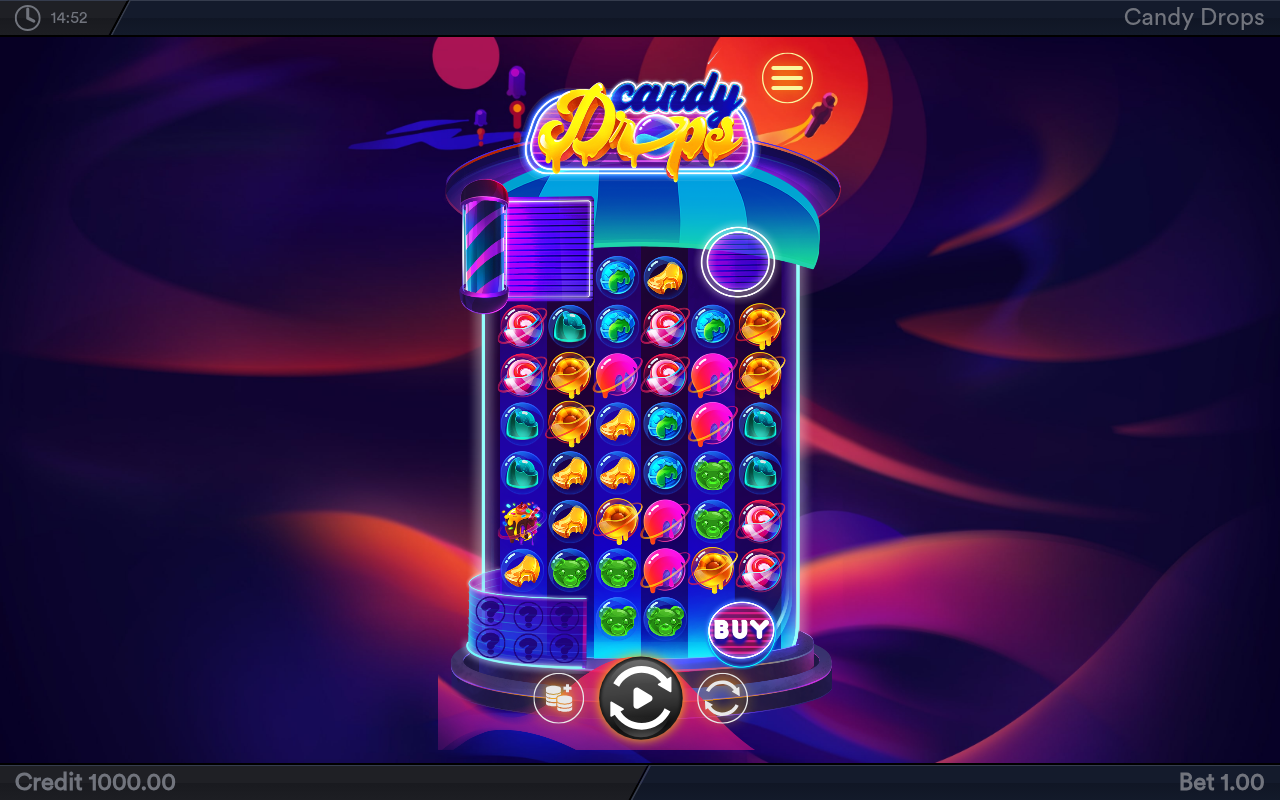
The 6×6 Grid and How a Win Forms
Candy Drops doesn’t use conventional reels. Candies drop onto a 6×6 board, and matching candies in sufficient numbers form the wins. It’s a match-and-clear format: the board fills, formations land, and winning candies leave the grid.
When a win forms, the sequence runs the same way every time:
- The matching candies are highlighted on the grid
- A WIN banner states the amount, and three matching green candies in a column make one such winning formation
- The cleared candies drop away from the board
- New candies fall in to refill the gaps
- The board settles, and the next drop begins
The same banner value can arrive from different boards. A WIN 0.60 result appears against one settled spread of candies and again, at the same figure, against an entirely different arrangement. It’s the formation that pays, not the particular board, so every refill is a genuinely fresh draw rather than a reshuffle of the last one.
The refill is where the follow-up chances live. A single candy appearing on an otherwise cleared board, with a fresh spread settling around it, is how the sequence continues after a win. One drop can therefore pay more than once if the refill lands new matches in the gaps the last win left behind.
That chain of events is the whole rhythm of the game. Wins are confirmed by the banner, cleared from the board, and replaced in a single continuous motion. Nothing interrupts it, and nothing else happens between drops.
Beyond that, the cabinet is honest about what’s on offer. There’s no pick-me game, no wheel, no separate free-spins round. Match candies, clear them, let the board refill: that’s the entire engine.
The Multiplier Meter Beside the Reels
The most distinctive element sits to the side of the grid: a candy-cane striped column that tracks multipliers alongside running values. It’s the closest thing Candy Drops has to a headline attraction, and it’s on display during every spin, styled as part of the machine rather than bolted on beside it.
The meter shows escalating pairings of multiplier and amount, in the shape:
- x6 at 0.20
- x5 at 0.10
- x6 at 0.30
- An associated WIN figure when matching candies light up on the board
Read together, those pairings show multipliers attached to running amounts, with higher multipliers sitting alongside higher running totals, so the meter gives the matching a sense of progression the grid alone wouldn’t supply.
What pushes the meter from one tier to the next isn’t spelled out anywhere, so the logic has to be read from what the column displays. The values escalate, the win amounts track alongside them, and the meter resets between rounds like the board does. Watching the candy-cane column tell you where a spin stands is a small ritual the game builds for itself.
It’s also the only place Candy Drops signals anything about its own arithmetic. The grid shows you what you won; the meter shows you what the win was worth relative to the climb. Between the two, a spin reads as a story of escalation rather than a flat result, which is a neat trick for a game with one feature.
The interplay is worth spelling out, because it’s the reason the base game doesn’t read as bare. A winning formation lights up, the banner confirms it, and the meter’s figures sit there beside the win as a running commentary on the climb. When the refill lands nothing, the meter’s position still tells you what the next win would have been working towards.
The board itself does the quiet work of keeping score. Credits tick down and back up as spins resolve, wins land and losses pass, and the WIN banner sits at the top of the frame like a till receipt. Every state of the game, mid-drop or settled, is readable at a glance.
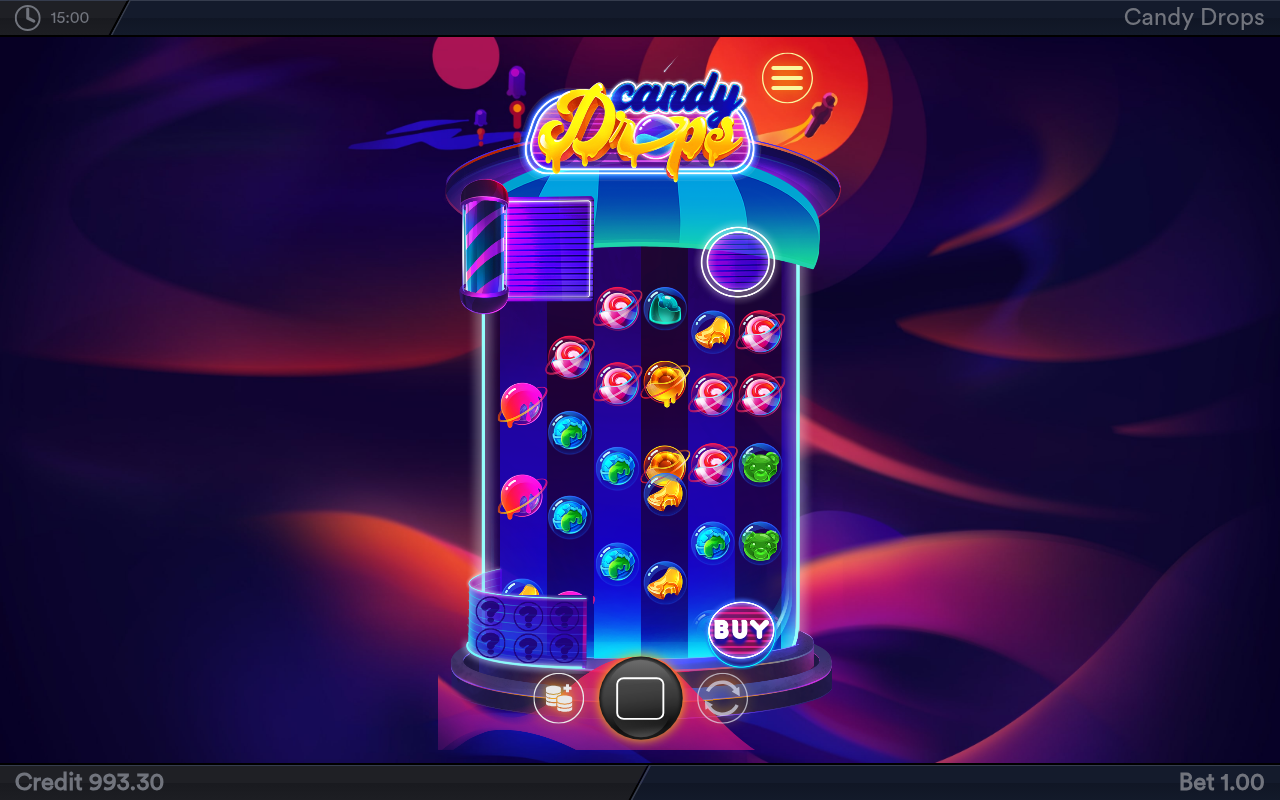
The Buy Button and the Betting Cabinet
A circular BUY button sits in the lower-right of the cabinet, and it’s there throughout play rather than appearing situationally. No purchase prices or tier list come with it, so what a purchase costs and what it buys are left to the casino you’re playing in. Treat it as an option that exists rather than one with a published menu.
The betting side is similarly quiet. No stake range is set out for this one, so the lobby you’re playing in is the authority on stakes.
What the cabinet does communicate clearly is the running state of play. Credits, win amounts and the meter all update as the board turns over, and the WIN banner confirms each formation before the refill sweeps it away. It’s a clean loop to follow, even when it’s a modest one.
The setting holds up throughout. The tall candy-striped pillar at the machine’s shoulder, the glowing slatted panel beside it and the neon-blue rim around the plinth all stay put while the board churns above them. Thin silhouetted figures and lamp-like posts line the top edge against the swirling sky, and ribbons of orange and violet light curl across the background as if the whole street were dissolving into night. Even a spin that pays nothing gets that backdrop for company.
Our Honest Verdict
Overall Rating: 6.2/10
Playing Candy Drops is like standing at the nicest sweet shop window in town with a modest purse. You drop in, the board turns over, the candies clear and refill, and the whole thing is wrapped in that midnight-purple glow. The one reason to pick it is that glow: it’s a genuinely pretty machine, and the presentation never sags.
The strength is the loop’s clarity. Every win is confirmed, cleared and refilled in one motion, and the candy-cane meter gives each result a shape instead of a flat number, which most single-feature games never manage. The weakness is that there’s nothing behind the curtain: no bonus round, a BUY button with no published price, and a meter whose logic the game never explains.
It’s for players who enjoy the spin itself and don’t need a destination at the end of it. Anyone hunting free-spins rounds and layered mechanics will find the shelves here lightly stocked. But for an undemanding, good-looking session after dark, the shop is open.
Candy Drops FAQs
-
What is the RTP of Candy Drops?
Candy Drops runs at an RTP of 96%, which sits right on the industry benchmark. -
Is Candy Drops high volatility?
No. Candy Drops is a mid-volatility game, so the swings should be moderate rather than extreme. -
What is the grid size of Candy Drops?
The game uses a 6×6 grid. Candies drop onto the board, matching formations create wins, and the cleared candies refill from above. -
Can you buy the bonus on Candy Drops?
A BUY button is present on the cabinet throughout play, but no purchase prices or tiers come with it. Any cost and content of a purchase would depend on where you’re playing. -
When is Candy Drops released?
Candy Drops’ release date is 28 February 2024. -
Who makes Candy Drops?
Candy Drops is made by ESA Gaming. -
What does the multiplier meter do in Candy Drops?
It’s a candy-cane striped column beside the grid that displays escalating pairings of multiplier and running amount, such as x6 at 0.20 and x5 at 0.10, alongside a WIN figure when matching candies light up. Higher multipliers attach to higher running totals as the meter climbs. -
Does Candy Drops have a bonus round?
No separate bonus round sits on top of the base game. The drop-and-clear loop with its multiplier meter is the whole offering, along with a BUY button whose contents vary by casino.