













Claw Machine Slot Review
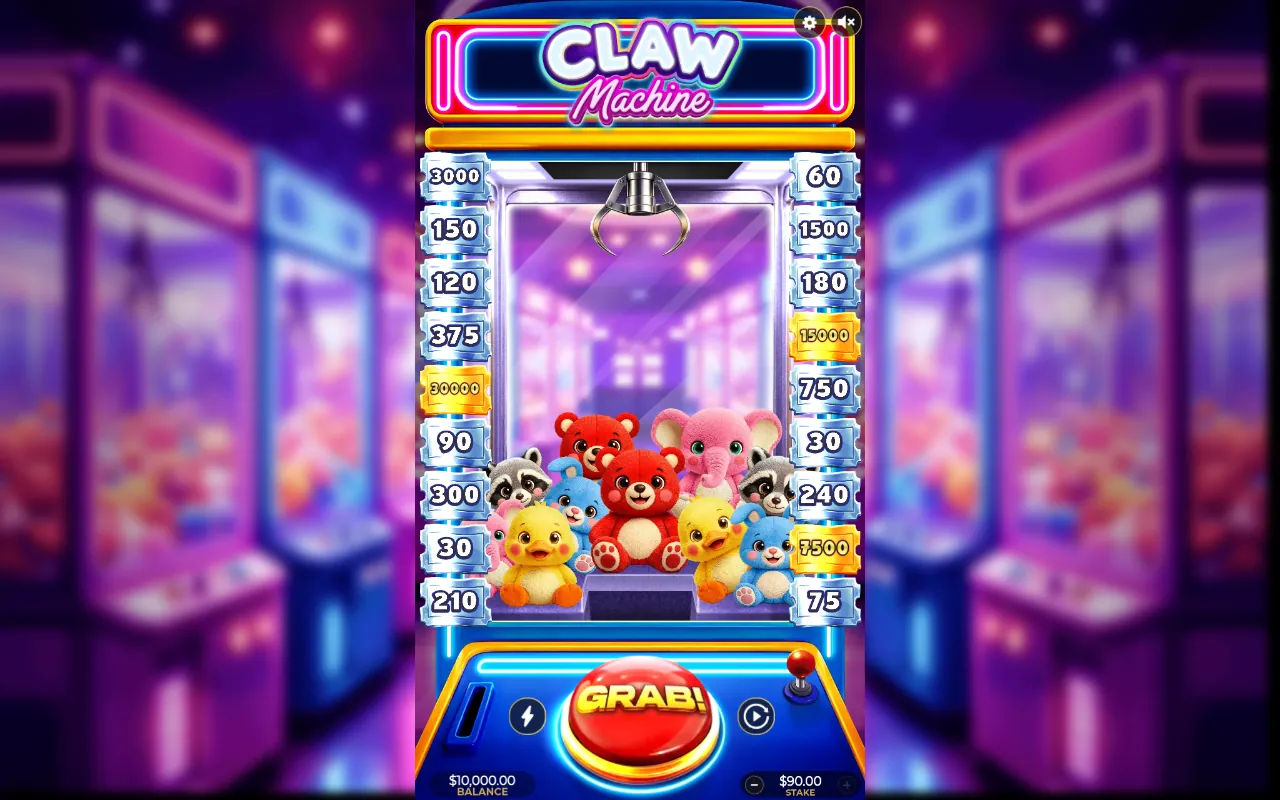
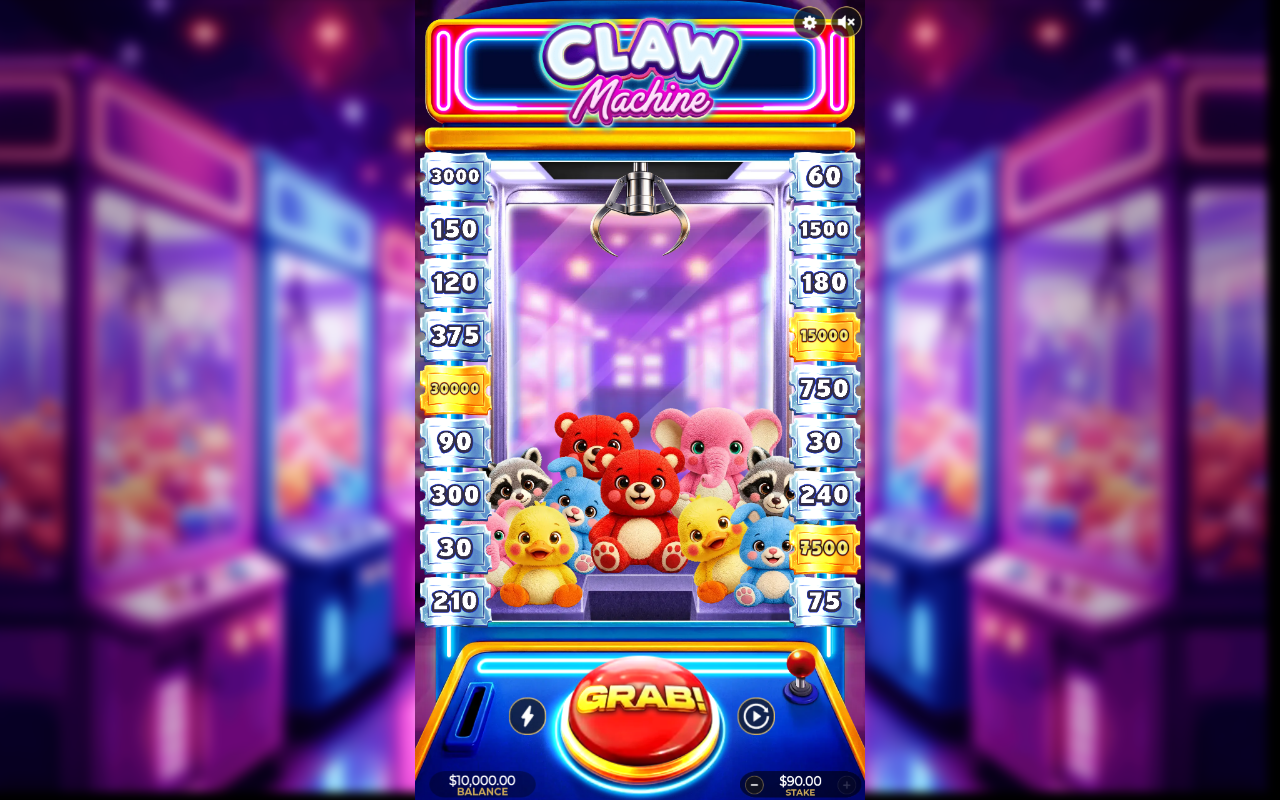
A claw-crane cabinet glows at the centre of a dark arcade hall, pink and blue neon washing over the blurred prize machines ranged either side of it. Dragon Gaming‘s Claw Machine bets everything on that single claw drop: no reels, no symbols, no base game, just one grab and whatever it manages to grip. Stripping a gambling game down to one press of a button is a bold call, and it’s the kind of design that either feels refreshingly direct or leaves you wondering where the rest of the game went.
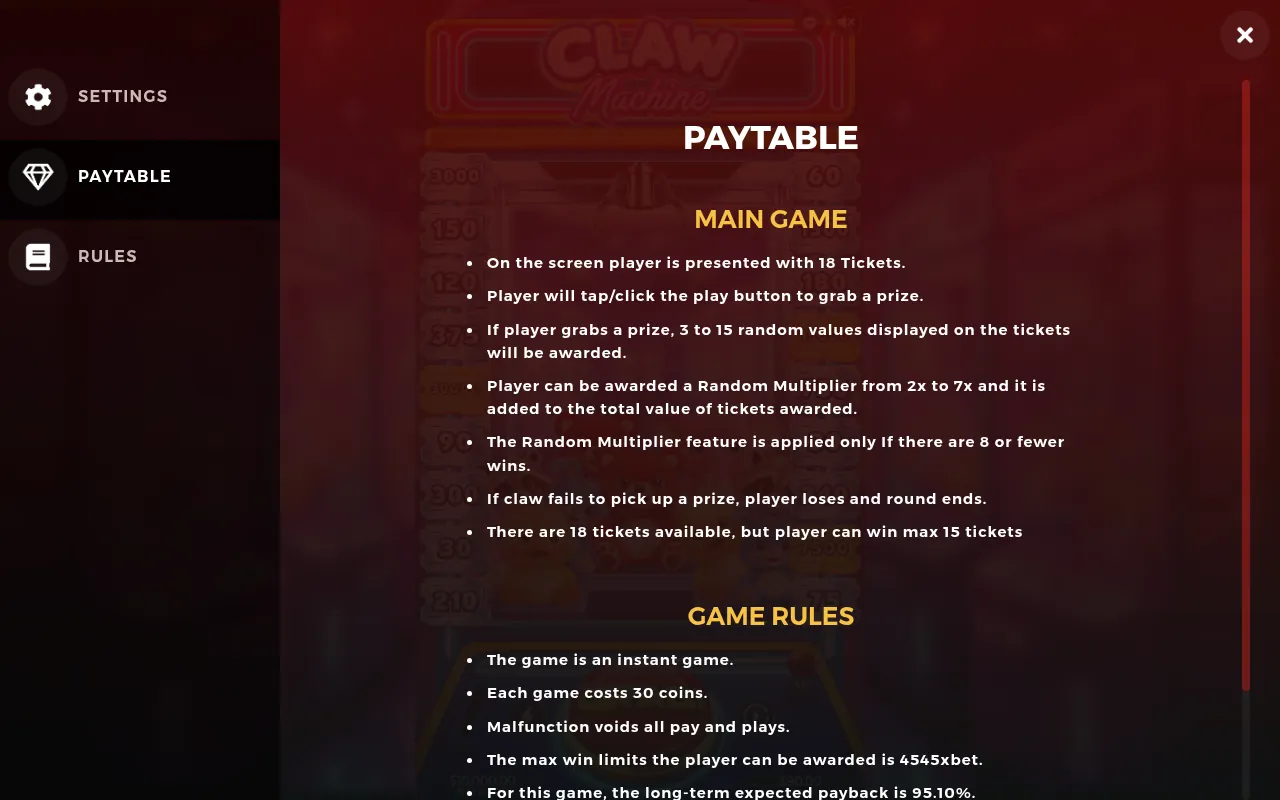
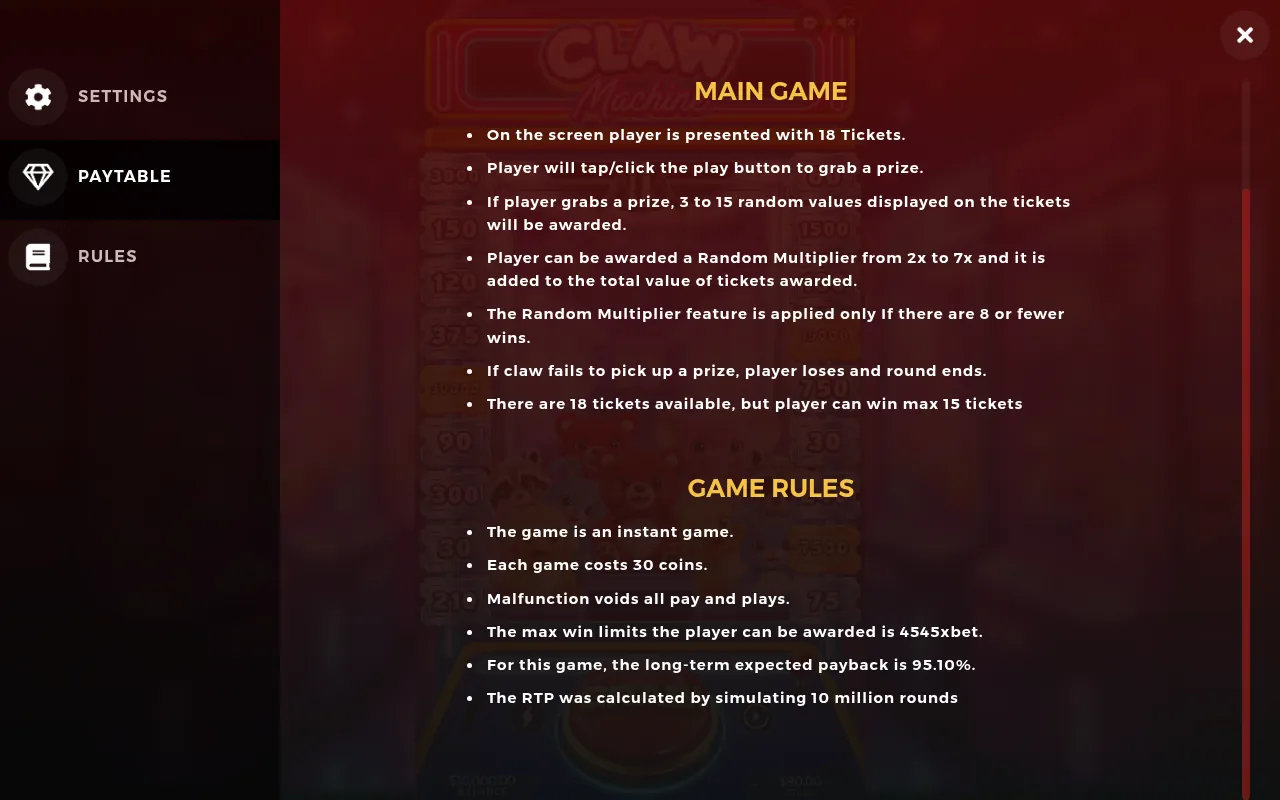
Each game costs 30 coins, the long-term payback is 95.10%, and the most that can be awarded in a single round is capped at 4,545x the bet. The studio’s other titles on these pages include Piggy Wheel Bonanza and Plundering Pirates Hold And Win, both of which take a similarly sideways view of what a slot can be. Whether a single claw drop can carry a whole game is the question here.
How a Round Works
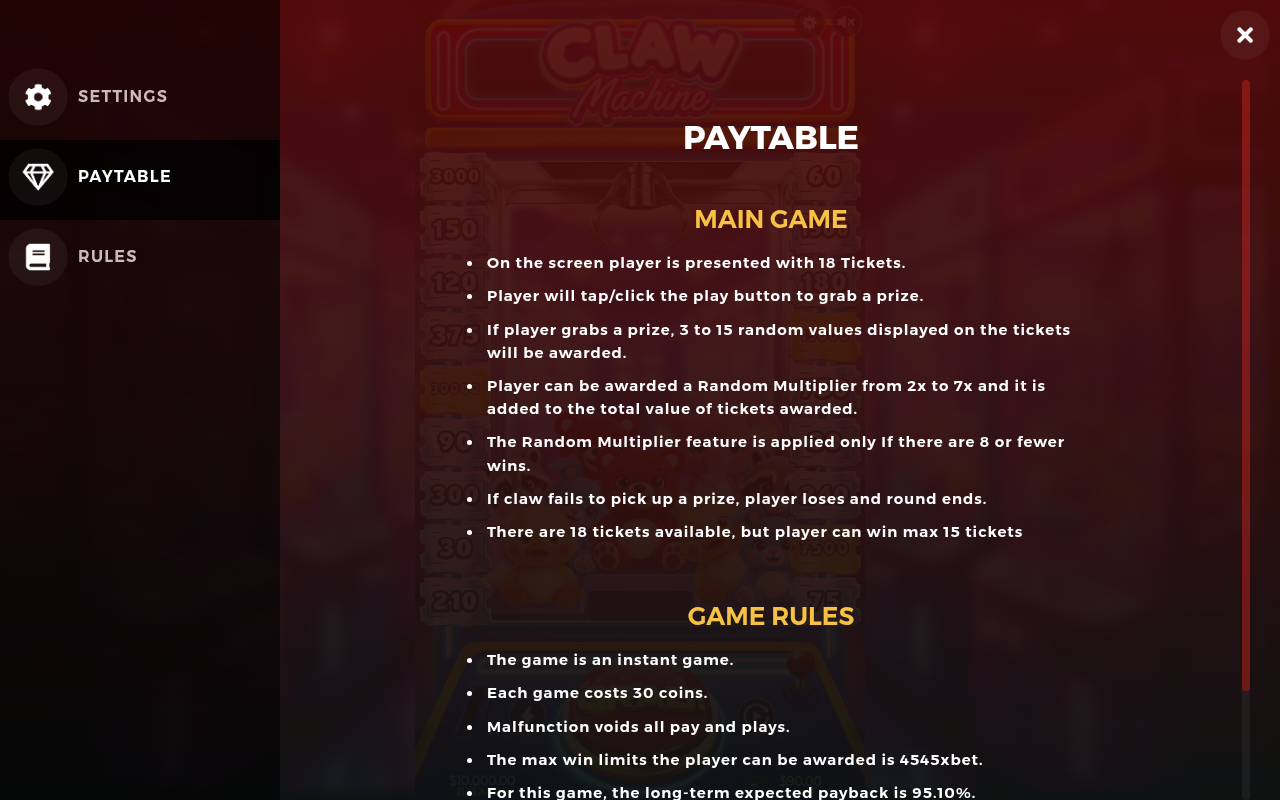
Eighteen tickets are presented on the screen, stacked either side of the cabinet the way the prize card sits on a real crane machine. You tap or click the play button, the claw drops, and everything hangs on whether it grips a prize. That’s the entire round: one press, one grab, one outcome.
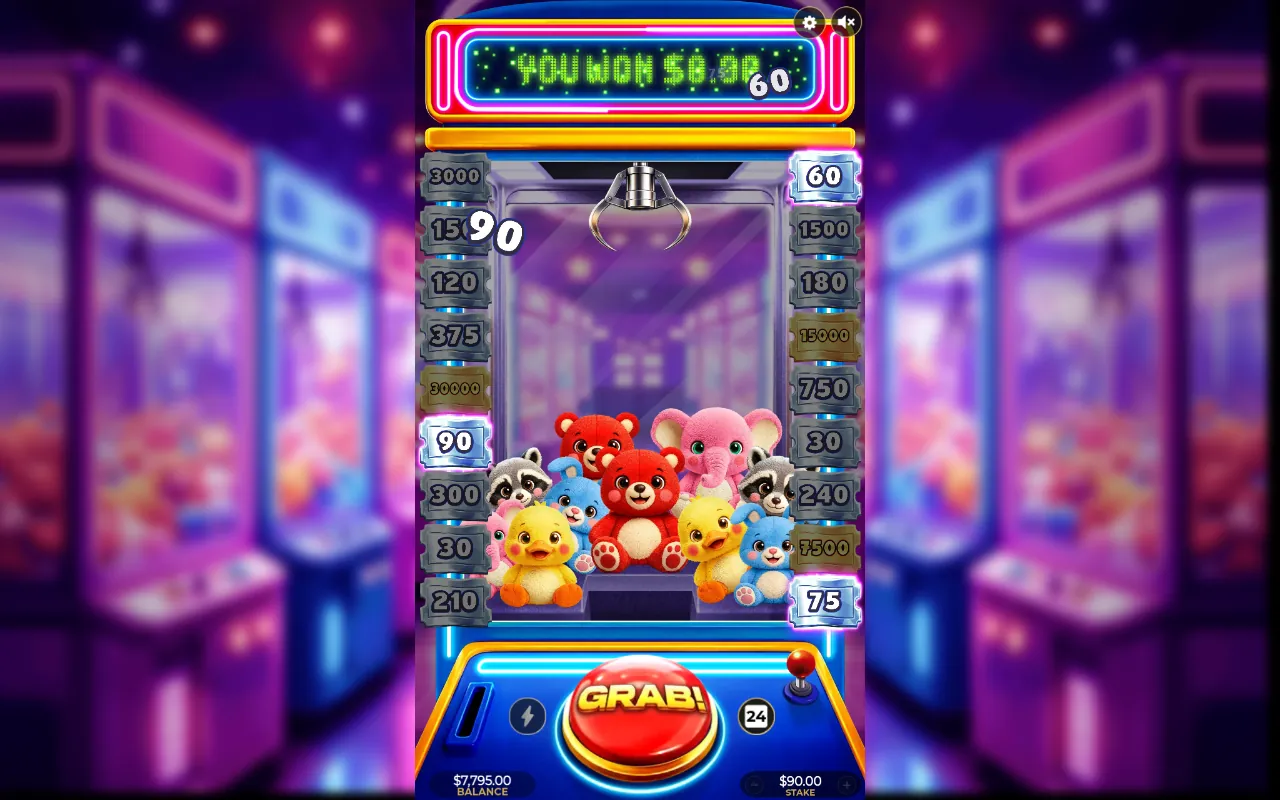
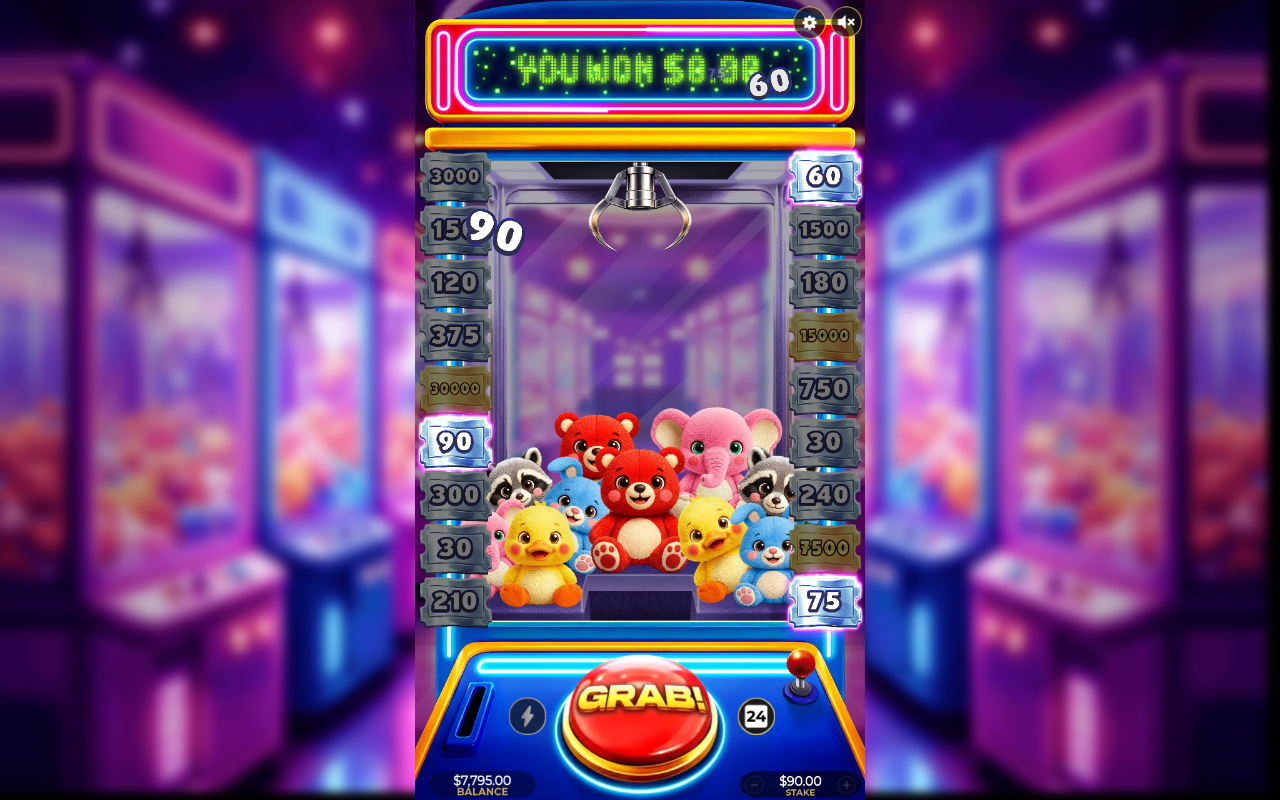
A successful grab awards between three and fifteen of the random values shown on the tickets. There are 18 tickets on screen, but a round can pay out on no more than 15 of them, so even the best grab leaves at least three values on the glass. If the claw fails to pick anything up, the round ends and nothing is awarded.
There’s nothing to configure beyond the stake. No paylines to choose, no bet levels to weigh against each other, no autoplay strategy to think about – the decision the game asks for is a single tap, and the claw does the rest. Each game costs a flat 30 coins regardless of how the round goes.
Tickets, Values and the Prize Ladder
The tickets carry the prize values, and the ladder is what a round is really playing for. The values aren’t fixed prizes – they’re tied to the stake, so the whole ladder scales up and down with what you’re betting. Quoted at a stake of 90, the ticket values are:
- 30,000
- 15,000
- 7,500
- 3,000
- 1,500
- 750
- 375
- 300
- 240
- 210
- 180
- 150
- 120
- 90
- 75
- 60
- 30
The spread is wide. The bottom of the ladder sits at a third of the stake, the top ticket is worth roughly 333 times it, and most of the values in between cluster low enough that a grab of small tickets often returns less than the round cost.
That’s the shape of the game: plenty of the ladder pays pocket change, and the big money is concentrated in the handful of tickets at the top. Only two tickets in the full set break four figures at this stake, and only five break three. The rest are small change by design, padding out the grabs that don’t land anything serious.
Because a winning grab takes three to fifteen of these values at once, the totals build quickly when the claw picks well. A grab that snags the top ticket alongside a cluster of mid-range values can clear hundreds of times the stake in a single motion. It’s those grabs, with a multiplier attached, that the 4,545x cap exists to limit.
The Random Multiplier
How It’s Awarded
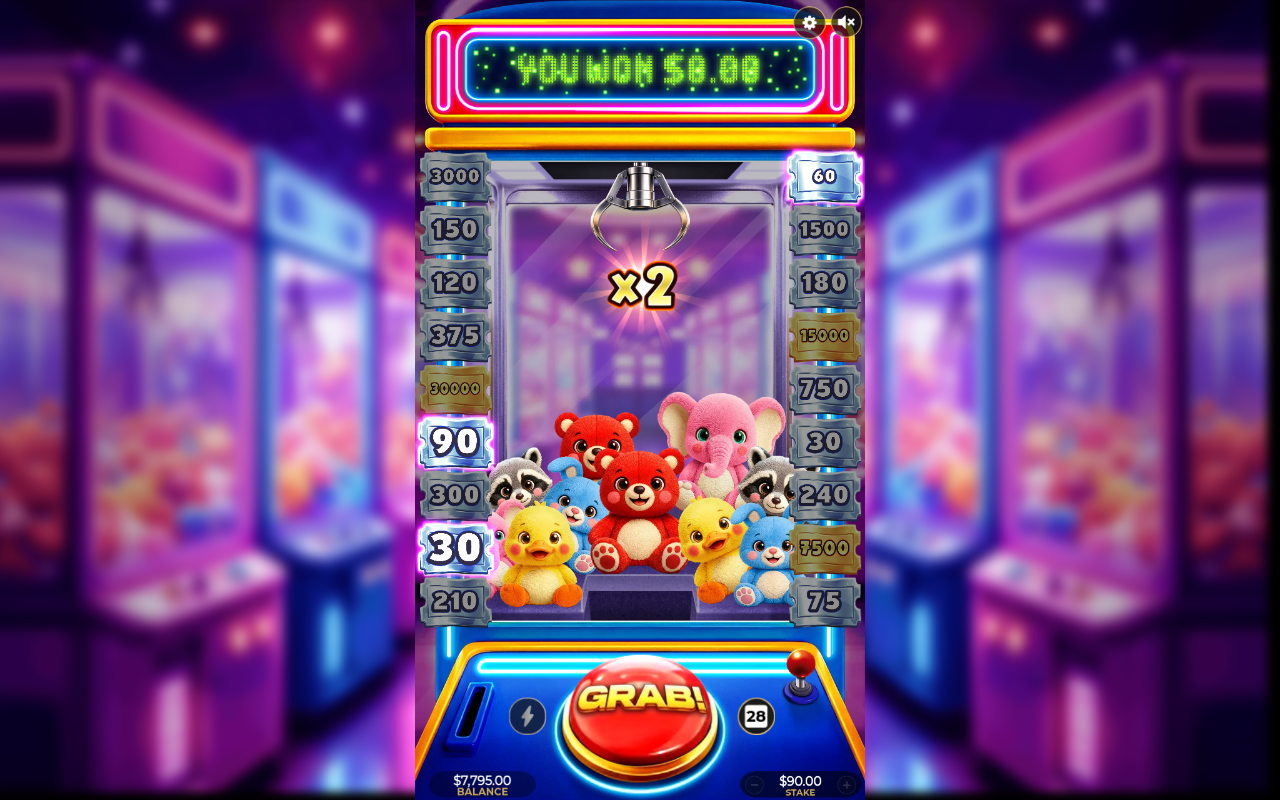
A successful grab can also land a Random Multiplier of between 2x and 7x. The multiplier is added to the total value of all the tickets awarded in that round, so it doesn’t boost individual tickets – it boosts the finished total, whatever the claw managed to collect.
At the bottom of the multiplier range that’s a modest lift. At the top it’s the difference between a decent grab and a serious one, and a full fifteen-ticket grab with a 7x attached is the sequence the cap exists for. The multiplier can’t be triggered separately and can’t be declined; it arrives with the grab or it doesn’t arrive at all.
The Eight-Win Limit
There’s one condition: the Random Multiplier only applies when there are eight or fewer wins. Beyond that threshold the tickets pay their face value and the multiplier stays out of it, which puts a hard shape on the payout curve – modest grabs can be boosted, big ones can’t.
The effect is deliberate. Without the limit, every large grab would come with a multiplier riding on top, and the biggest rounds would routinely push towards the cap. With it, the multiplier does its work on the small and mid-sized grabs, where it turns a marginal return into a real one, while the biggest rounds pay exactly what the tickets say.
Format, Cost and Payback
Claw Machine is an instant game, not a slot, and that distinction runs deeper than the lack of reels. There’s no volatility profile in the usual sense – no spin-by-spin variance between feature hits – because every round is the feature. One grab is the whole engine, and the outcome space runs from nothing at all to the cap.
The payback of 95.10% was settled by simulating 10 million rounds, so the figure carries some weight. Instant games have always run their own arithmetic, and this one has to cover a single decision rather than a base game feeding a bonus. The RTP also can’t be adjusted between rounds or bet modes; one figure governs every grab.
Each game costs 30 coins, flat. There’s no bonus buy, no side bet, no optional extra that changes the price of a round – what’s on the cabinet is what you get, and the stake you set is the only variable in play before the claw drops.
Our Honest Verdict
Overall Rating: 7/10
Playing this is exactly like feeding coins into the cabinet at the end of the pier: press, watch the claw, feel it either grip or slip. That’s the whole appeal, and it’s a real one – the arcade squander of two coins at a time, with a serious ticket sitting behind the glass if the claw behaves. You’d choose it for that feeling, and for rounds that take seconds rather than sessions.
The honesty of it is the strength. Every prize is on screen before you commit, so there’s no mystique about what’s on offer, and the multiplier can genuinely rescue a thin grab. The weakness is that a missed claw gives you nothing and then asks for another 30 coins, with nothing in between to keep you company.
If you want the arcade’s brand of luck, quick rounds and a prize wall you can read at a glance, this is a faithful little cabinet. If you want reels, build-ups and a game that fills the time between wins, it isn’t that. For the right mood on the right evening, the neon still draws you in.
Claw Machine FAQs
-
What is the RTP of Claw Machine?
The long-term expected payback is 95.10%, a figure calculated by simulating 10 million rounds. -
When is Claw Machine released?
Claw Machine’s release date is 15 December 2026. -
Who makes Claw Machine?
Claw Machine is made by Dragon Gaming. -
What is the maximum win on Claw Machine?
The maximum win is capped at 4,545x the bet in a single round. -
How does the grab feature work?
You tap or click the play button to send the claw down. If it grabs a prize, between three and fifteen of the random ticket values on screen are awarded. If the claw fails to pick up a prize, the round ends with nothing. -
What does the Random Multiplier do?
A successful grab can award a Random Multiplier of between 2x and 7x, which is added to the total value of the tickets won. It only applies when there are eight or fewer wins. -
How many tickets can you win in a round?
There are 18 tickets presented on screen, but a round can award a maximum of 15 of them. -
How much does a game of Claw Machine cost?
Each game costs 30 coins, and it’s an instant game: one grab settles the round. There’s no bonus buy or side bet.