













Deck of Divinity Slot Review
Print Studios has a particular way with card-themed slots. Deck of Scurra, the studio’s pirate-flavoured predecessor, established the Prize Card model as something genuinely worth returning to; Deck of Divinity trades the ye olde and mysterious setting for a cosmic, astral world and refines the system further. The theming is striking from the first spin: an ornate playing table, 25 Prize Cards arranged across five divine energies, and a deep-space backdrop that gives the whole grid an otherworldly quality. It’s a high-volatility offering rated 9 out of 10 on the volatility scale, built around a max win ceiling of 20,000x and a Prize Chase system that rewards patience as the bonus develops. Players who appreciate deliberate, layered mechanics over flash-and-scatter simplicity should find plenty to engage with here.
Base Game & Features
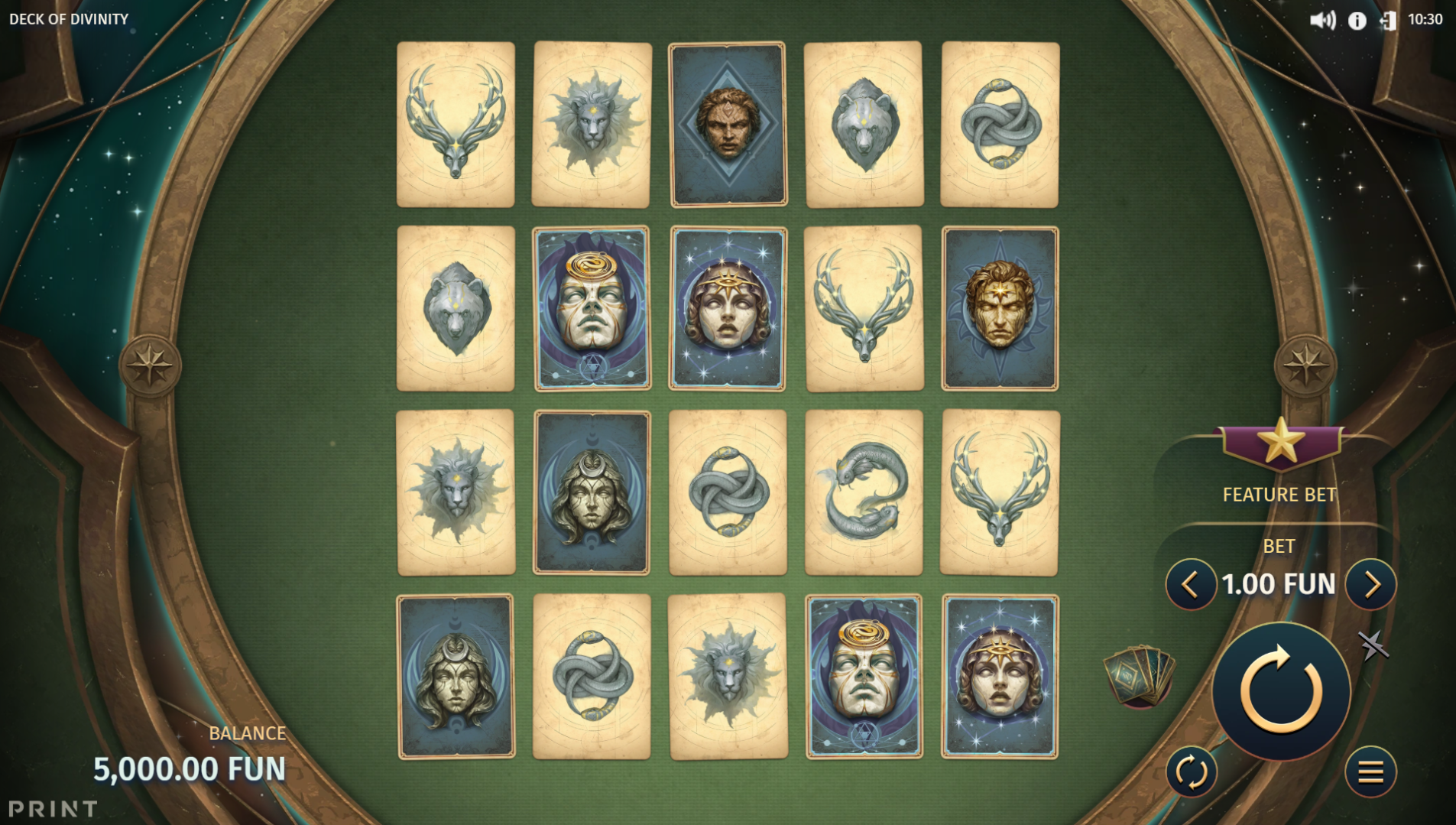
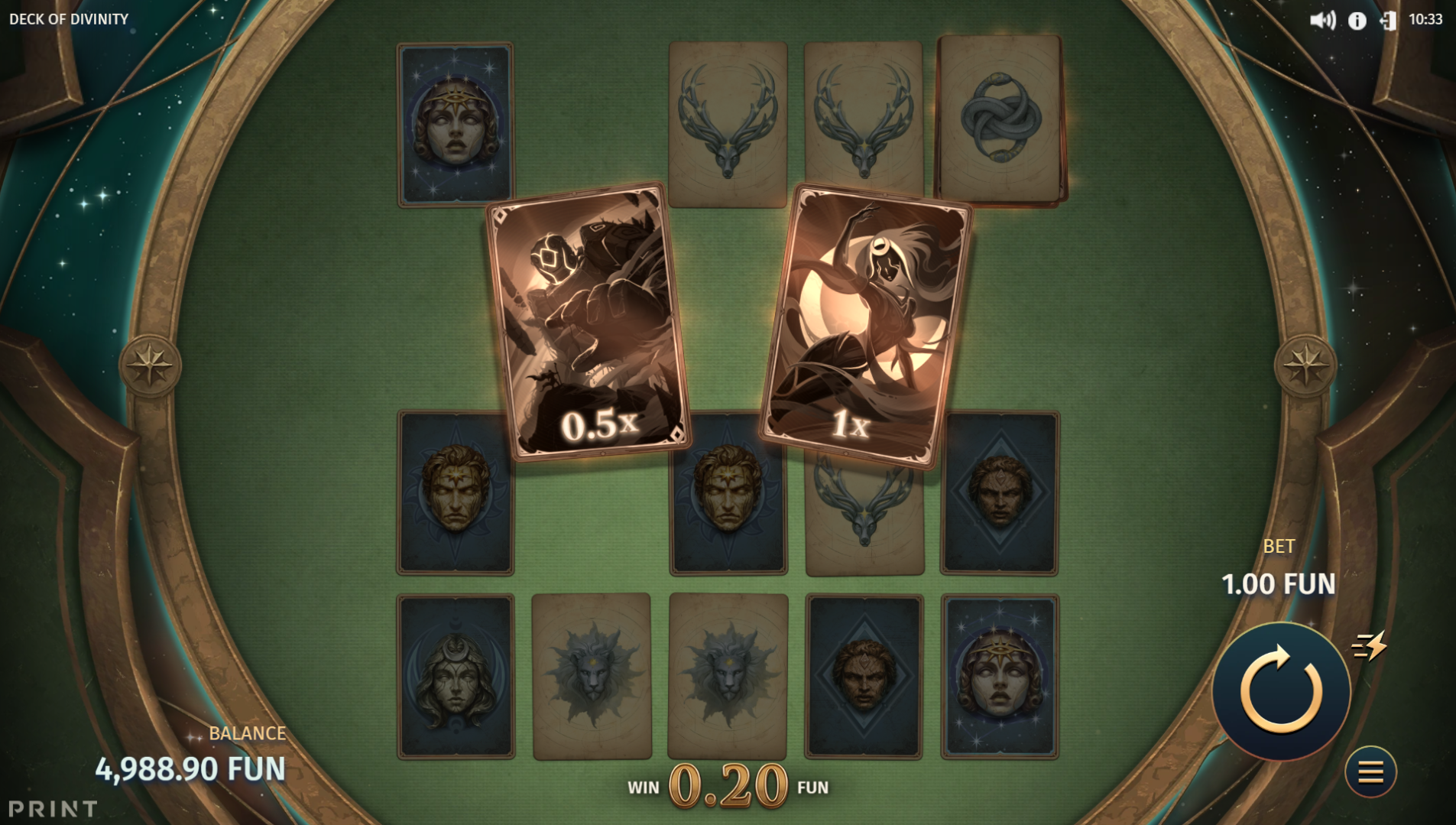
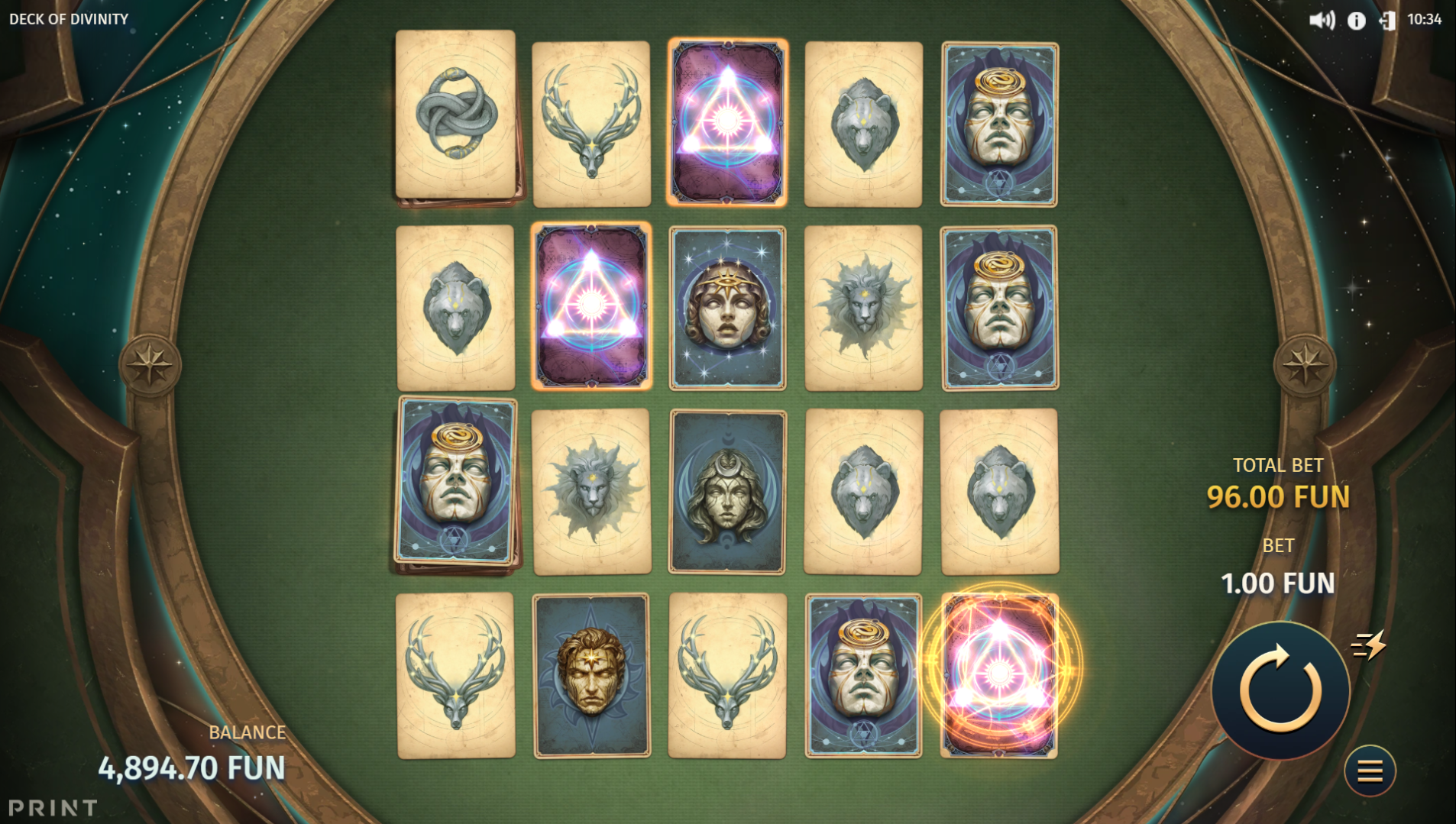
Deck of Divinity runs on a 5×4 grid with Cosmic Scatter Pays as its core win mechanic. There are no traditional paylines: land 5 or more matching Symbol Cards anywhere on the board and a win is triggered. Winning cards are swept away and new cards fall into place, allowing cascades to continue within the same spin. It’s a clean, familiar structure for players used to scatter-pays titles, though the grid dimensions feel slightly more contained than some of the wider cluster setups popular elsewhere.
The Prize Chase
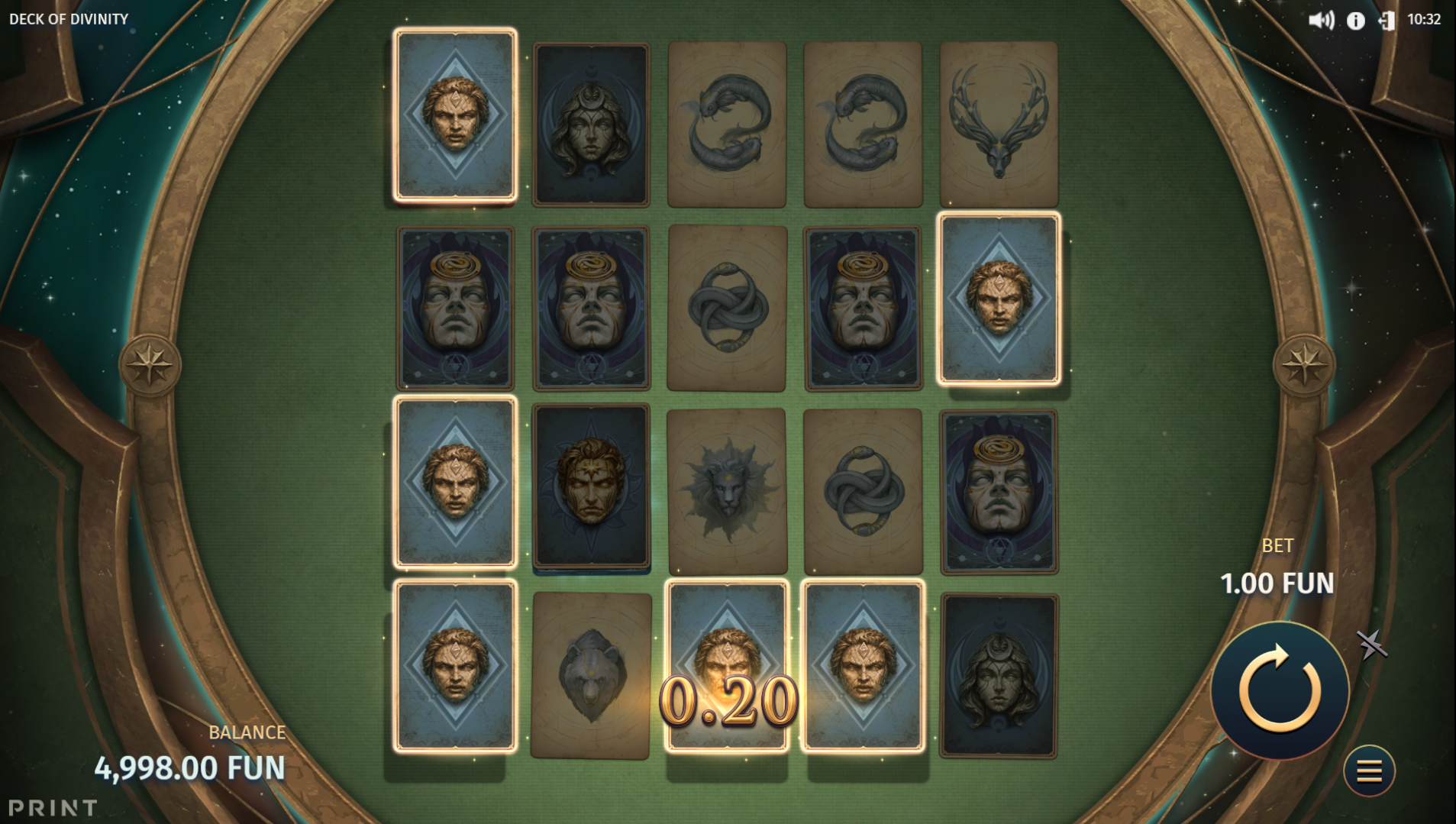
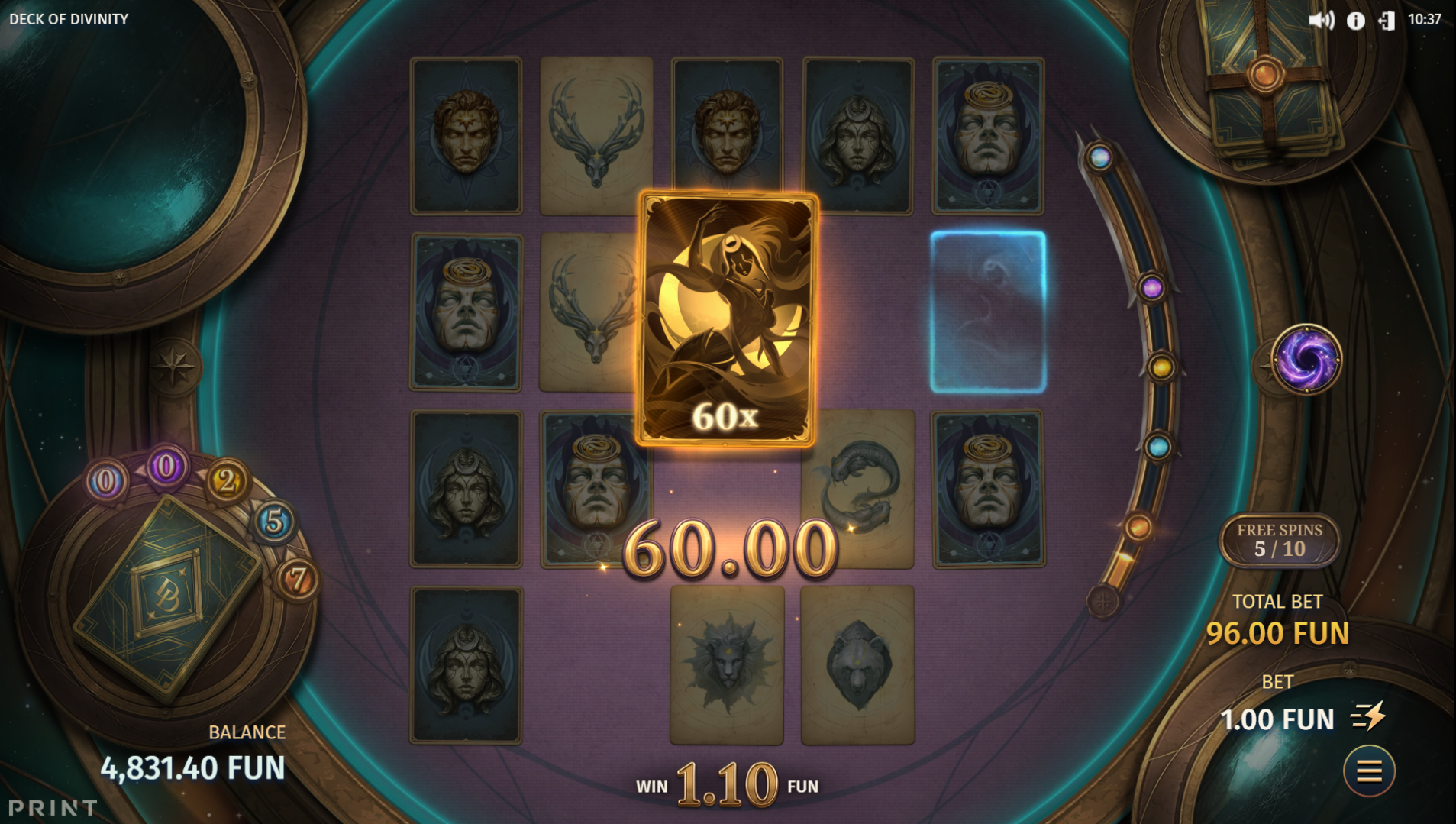
The defining layer of the base game is The Prize Chase. The 25 Prize Cards are divided across five divine energies – Earth, Moon, Sun, Stars, and Aether – and five value tiers. Each Prize Card displays its value upfront, so there’s transparency in what you’re chasing at any given moment. When Symbol Cards land on Prize Cards, those Prize Cards are uncovered and their values awarded immediately. Crucially, Prize Cards can stack up to three deep beneath a Symbol Card, creating layered reward opportunities across the grid. The tier colour-coding makes it immediately clear which level of card you’re dealing with: lower Earth and Moon cards appear frequently in the base game, while the higher Sun, Stars, and Aether tiers build anticipation as you push further into the bonus.
Cosmic Scatter Pays Mechanic
The scatter-pays model does require a short acclimatisation period, particularly if you’re new to the Prize Card concept. The system isn’t difficult to follow, but the interaction between Symbol Cards, Prize Cards, and the five energy tiers means there’s genuine information to absorb before each spin feels intuitive.
Deck of Divinity Free Spins & Bonus Features
The Divine Deck Bonus is where Deck of Divinity’s depth becomes most apparent. Landing 3 or more Bonus Cards triggers the feature, awarding up to 10 free spins from the outset. The bonus frequency sits at approximately 1 in 254 spins organically, reflecting the high-volatility profile. What follows is a progressive bonus round built around three interlocking systems.
Build Your Deck
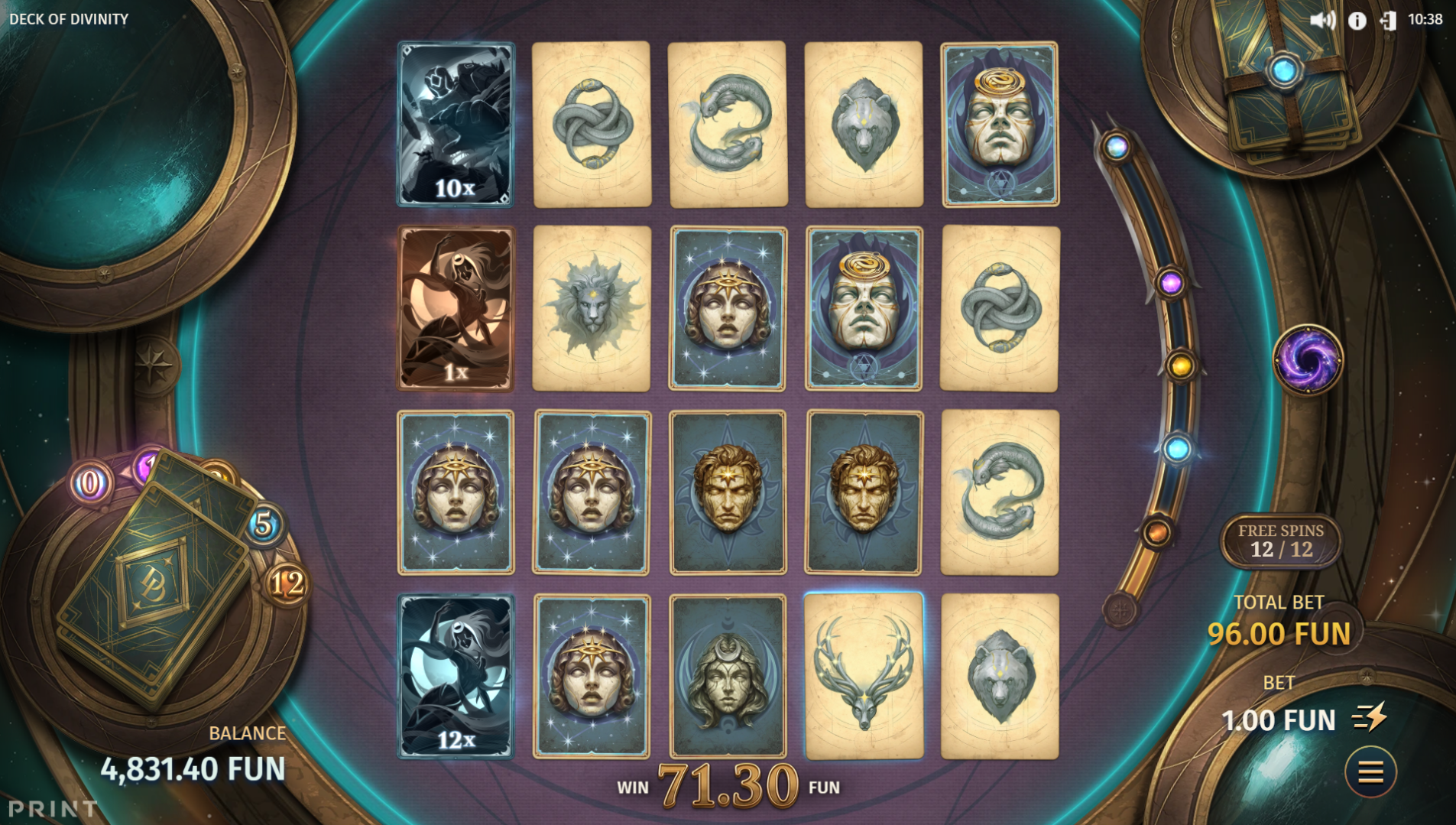
Prize Cards are retained in the deck for the entire bonus, not just for a single spin. When a Prize Card is won, it doesn’t simply disappear: it upgrades to the next tier before returning to the deck. This means each bonus session starts with a baseline deck and progressively improves it. Early bonus spins might reveal mostly Earth and Moon cards; later spins, once the deck has been refined through repeated reveals, will see Sun, Stars, and Aether cards appearing with greater regularity. The trajectory is visible in real time through the tier counter.
Card Packs
Every winning Symbol Card fills a progress meter. Reaching a new level on that meter unlocks a Card Pack, which adds Prize Cards of higher value to the deck and awards additional free spins. Lower-tier Card Packs unlock at a relatively accessible rate; pushing toward Stars and Aether levels is rarer and significantly more lucrative. When you get close to those upper tiers, the anticipation is genuinely palpable – each winning Symbol Card carries tangible weight in terms of where the deck is heading.
Hidden Prize Cards
Before each spin during the bonus, Hidden Prize Cards are placed beneath Symbol Cards. These aren’t immediately obvious – look for the highlighted spaces on the grid before each spin drops. Once revealed, they become permanent additions to the deck. The most significant escalation comes within the 5 scatter bonus round: this fills the entire grid with Hidden Prize Cards on every subsequent spin, dramatically expanding the deck’s prize potential and creating the conditions for the game’s biggest returns.
Bonus Buy & SuperSlider
Two separate options exist for players who want more control over bonus access. The direct bonus buy costs 96x your base stake and delivers immediate access to the Divine Deck Bonus. The SuperSlider is a distinct ante-bet feature that operates differently: it lets you dial up your probability of triggering the bonus at various cost levels between 1.5x and 96x stake. These are not the same mechanism – the bonus buy skips the waiting; the SuperSlider simply shifts the odds while you continue spinning naturally.
- Direct Bonus Buy: 96x stake – immediate access to the Divine Deck Bonus
- SuperSlider ante-bet: 1.5x to 96x stake – increased probability of natural trigger; RTP adjusts to 96.17% on bonus buy
Our Honest Verdict
Print Studios has spent much of the last year refining what a card-collecting slot can look and feel like. Deck of Divinity is the clearest articulation of that work yet – a high-volatility title that earns its complexity through a genuinely layered prize progression rather than layered complexity for its own sake. The base game functions well enough as a scatter-pays setup, though it’s the Divine Deck Bonus that carries the weight of the experience. The three-part bonus structure – Prize Card upgrades, Card Pack unlocks, and Hidden Prize Card placement – works together cohesively, and the visual feedback (tier colours, progress meters, highlighted grid spaces) makes the system readable even as the deck evolves late into a bonus.
Fans of Deck of Scurra’s Prize Card foundation will recognise the DNA immediately; those new to Print Studios‘ card-collect model may need a few spins to get their bearings, but the learning curve is short. The RTP sits at 96.22% in its standard configuration, dropping marginally to 96.17% via the bonus buy – both figures are above the market average. The average bonus return of 93.55x won’t move the needle for players chasing five-figure payouts; the real value is in the escalating bonus sessions that build toward something rather than delivering it in a single swing. This is a slot for players who enjoy watching a system develop – not one suited to quick-hit sessions or those content with base-game grinding.
Deck of Divinity FAQs
-
What is the RTP of Deck of Divinity?
Deck of Divinity has an RTP of 96.22%, which sits above the industry average of 96%. When using the bonus buy feature, the RTP adjusts slightly to 96.17%. -
What is the maximum win on Deck of Divinity?
The maximum win on Deck of Divinity is 20,000x your stake. Achieving this ceiling requires triggering the five-Bonus-Card condition during the Divine Deck Bonus, which fills every grid position with Hidden Prize Cards on every spin. -
Is Deck of Divinity high volatility?
Yes, Deck of Divinity is rated high volatility, scoring 9 out of 10 on the in-game volatility scale. The bonus triggers roughly once every 254 spins on average, so the game rewards patience and a comfortable bankroll. -
What is the bet range for Deck of Divinity?
Deck of Divinity accepts stakes from £0.10 to £50 per spin. The default bet is £2.00, giving players a sensible starting point before adjusting to their preferred stake level. -
Does Deck of Divinity have free spins?
Yes. Landing 3 or more Bonus Cards triggers the Divine Deck Bonus, awarding up to 10 free spins. Additional spins are earned during the bonus by unlocking Card Packs via the progress meter. -
Does Deck of Divinity have a bonus buy feature?
Yes. The direct bonus buy costs 96x your base stake and gives immediate access to the Divine Deck Bonus. There is also a separate SuperSlider ante-bet feature that increases your probability of triggering the bonus naturally, at adjustable cost levels between 1.5x and 96x stake. -
Is Deck of Divinity a sequel?
Yes. Deck of Divinity is the second game in Print Studios’ Deck series, following Deck of Scurra. It uses the same Prize Card foundation as its predecessor but applies it to a cosmic, astral theme with five divine energy tiers replacing the pirate-themed card system. -
Who developed Deck of Divinity?
Deck of Divinity is developed by Print Studios, an independent slot developer known for premium mechanics and distinctive visual design. The game is the studio’s follow-up to Deck of Scurra in the Deck series.