













Diamond Chance Slot Review
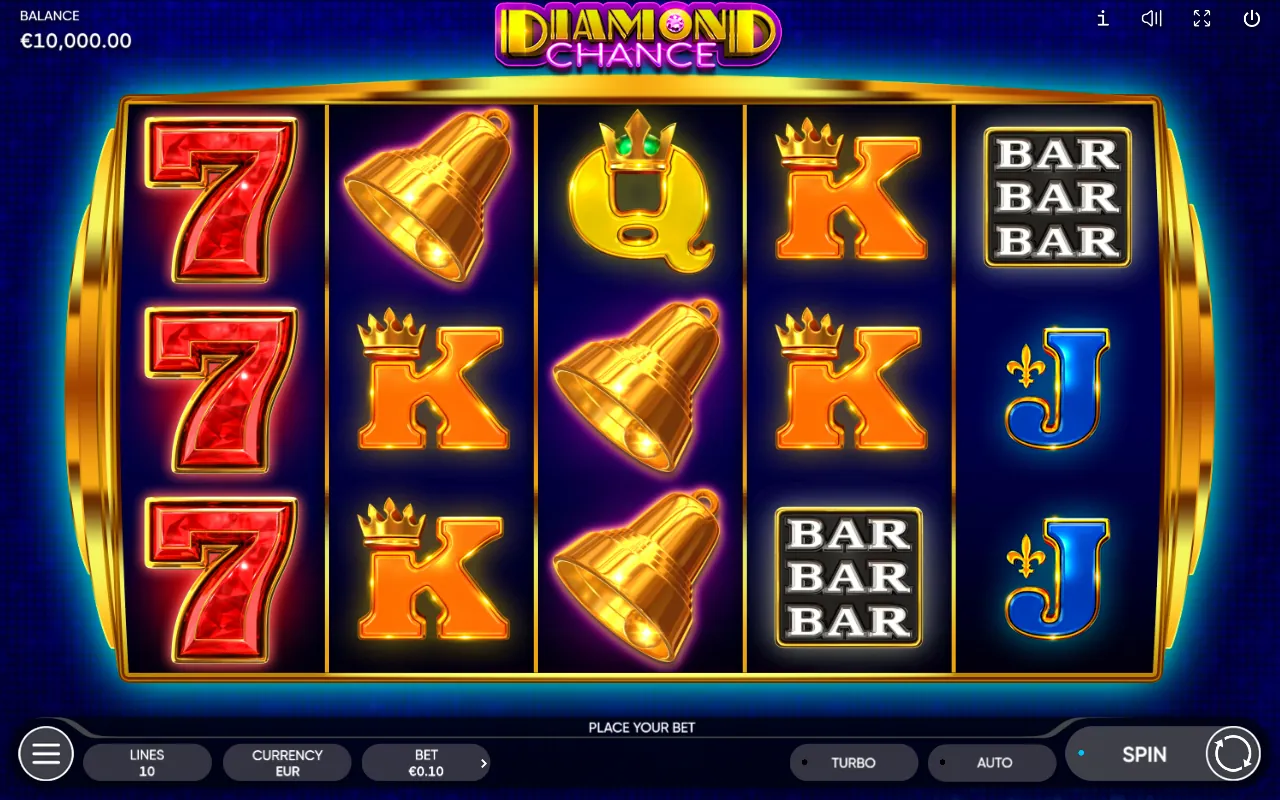
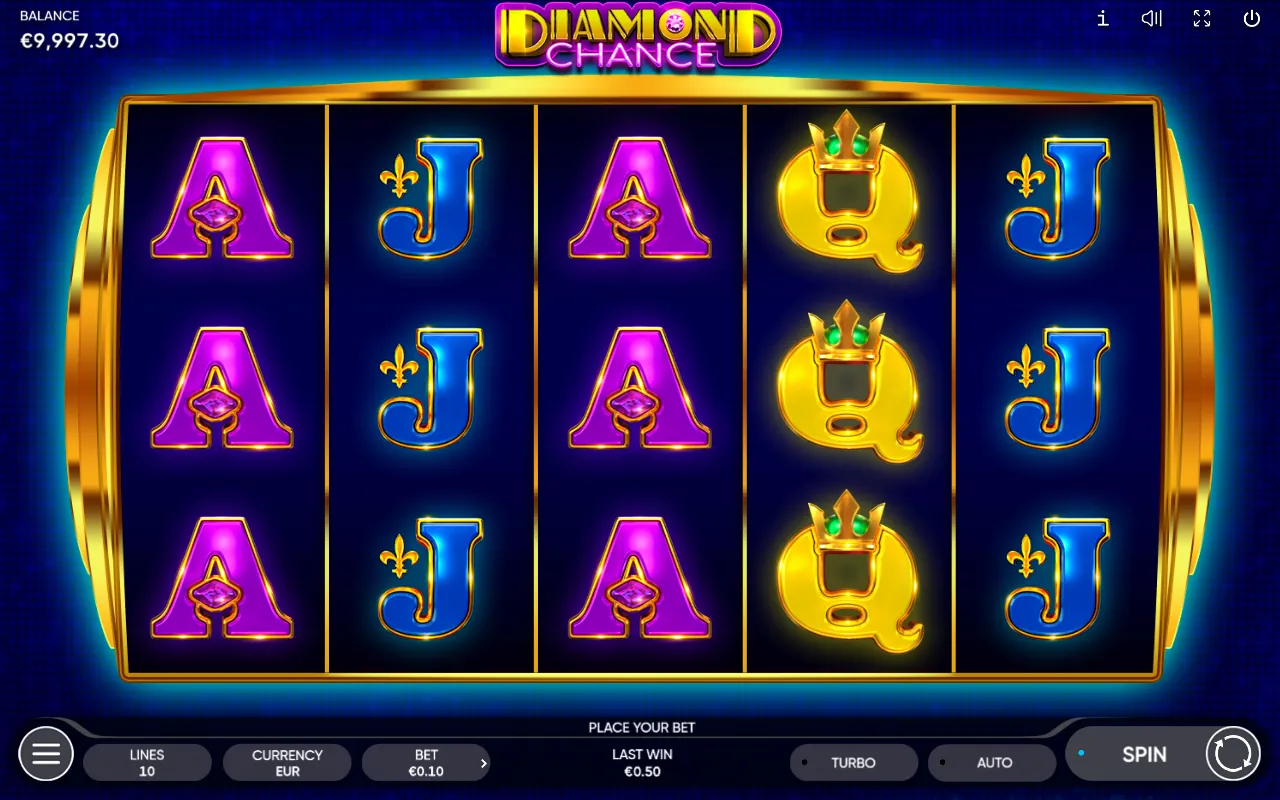
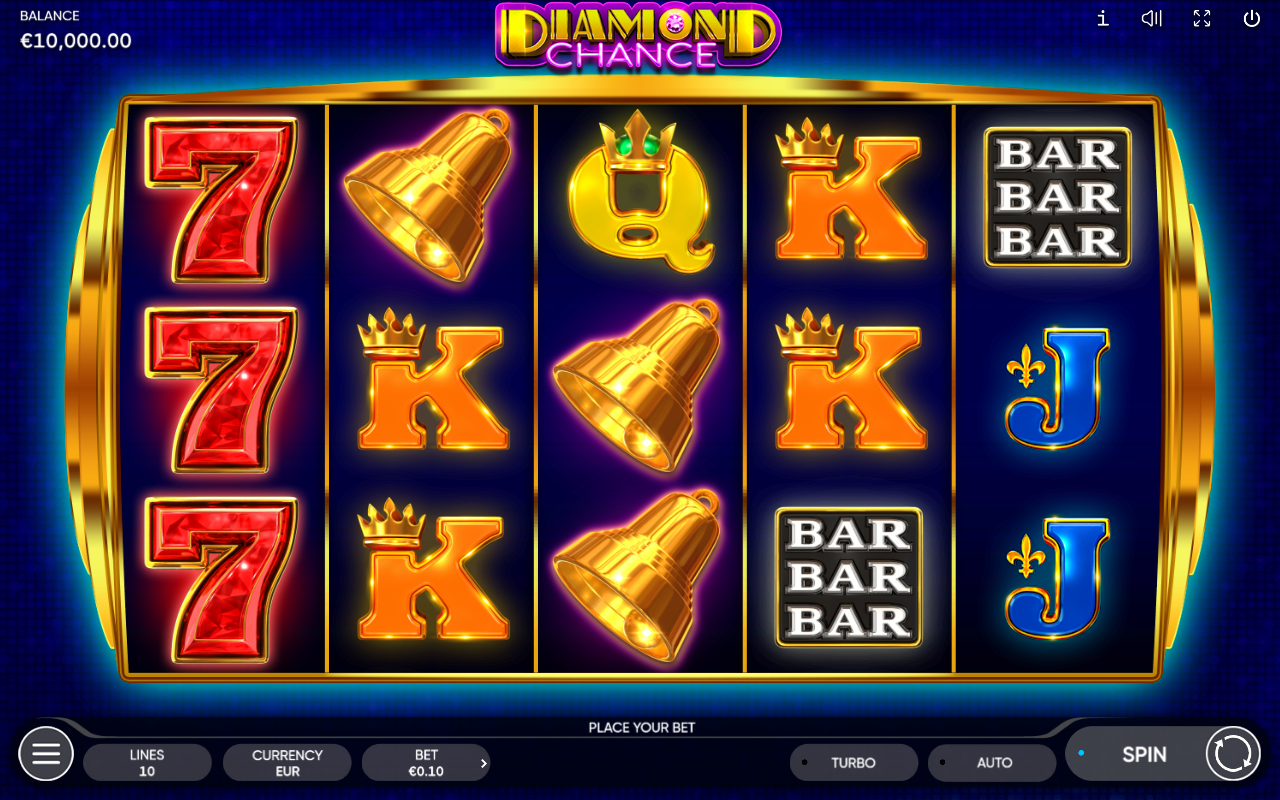
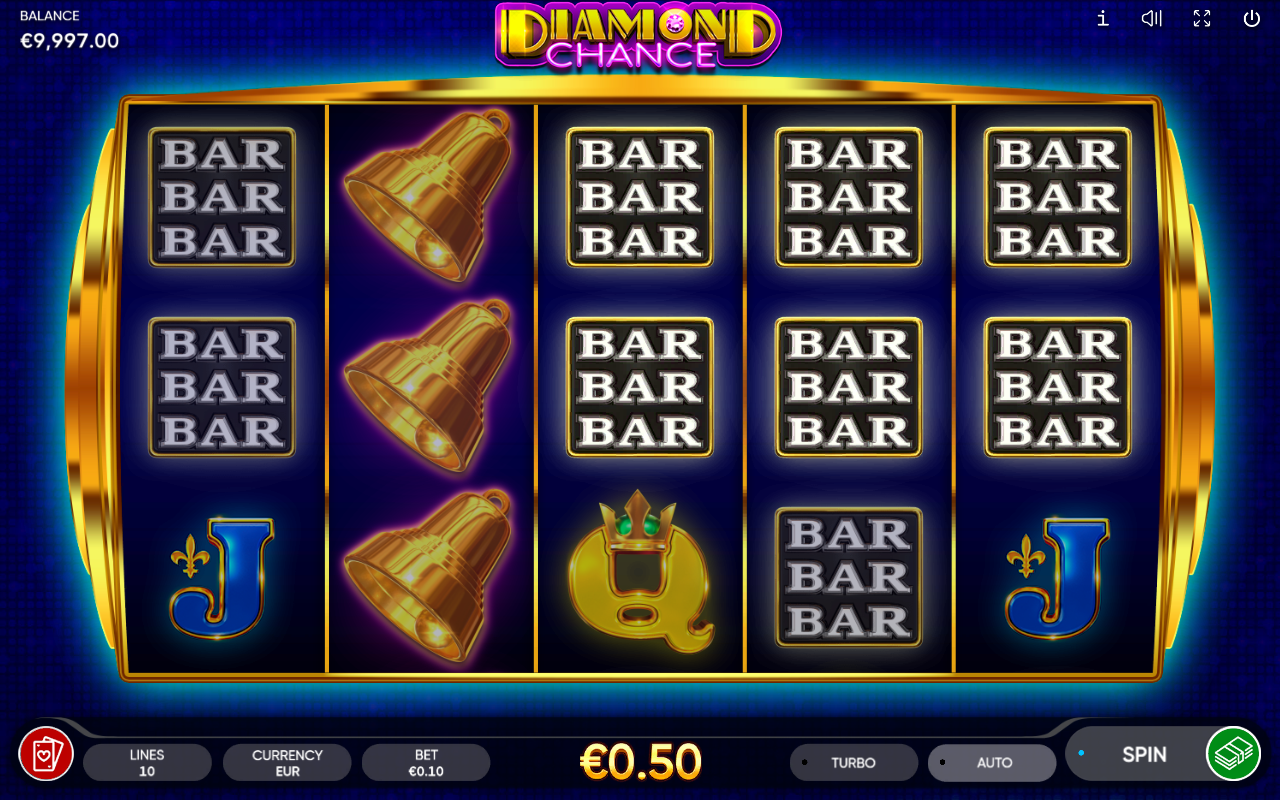
A gold cabinet curves out of a dark blue void, its rounded side panels catching a soft glow like an old-style machine switched on in an empty club. Diamond Chance, from Endorphina, wants you to believe the dressing, and you should: this is one of the fairest classic reels you’ll ever spin, running at 98.03% to 98.08% RTP before the gamble even enters the picture.
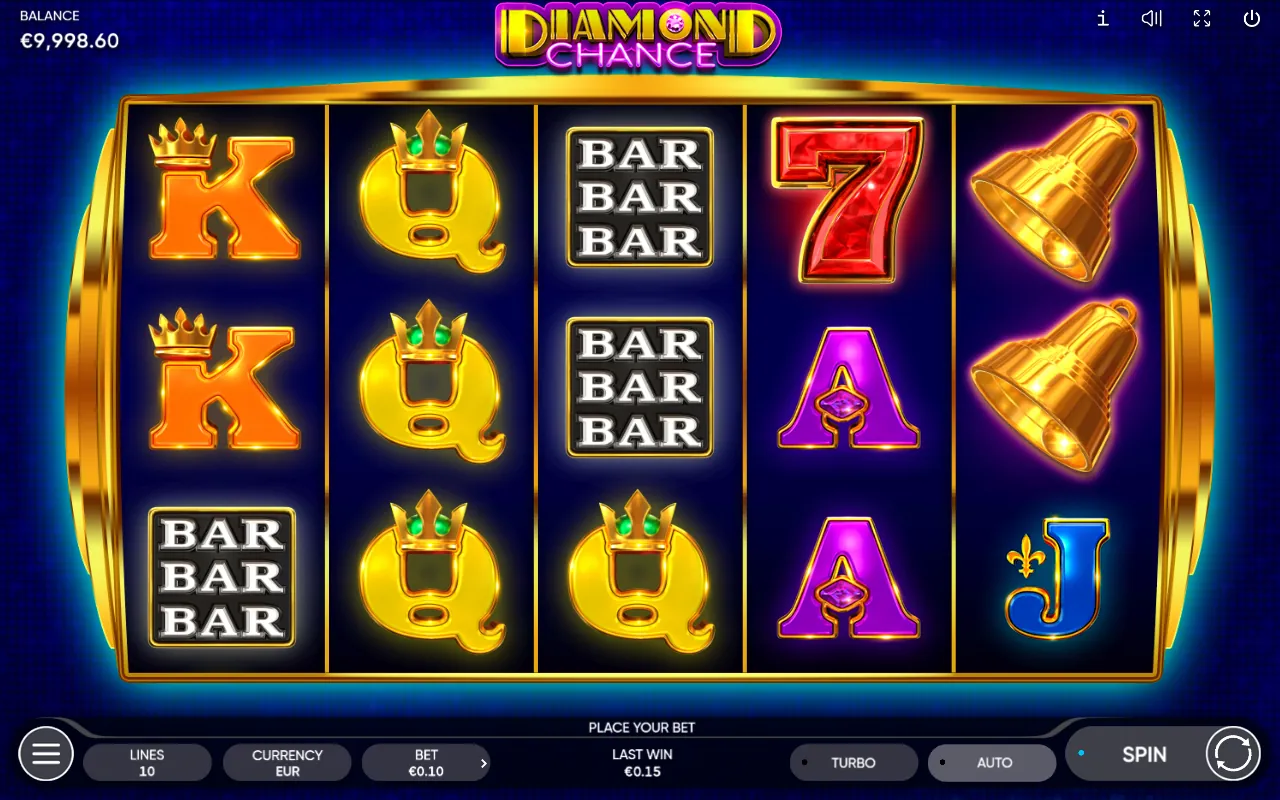
It’s a 5×3 grid with 10 paylines, stakes from 0.10 to 200.00, sevens and Bells on the reels, and very little else besides. Endorphina’s back catalogue runs to games like Fruletta, Chance Machine 5 Dice and Multistar Fruits, and this sits firmly on that classic-fruit side of the studio’s work. For a game with one special symbol and one side game, that return figure does a lot of talking.
Ten Lines, a Spreading Wild and a Lot of Gold
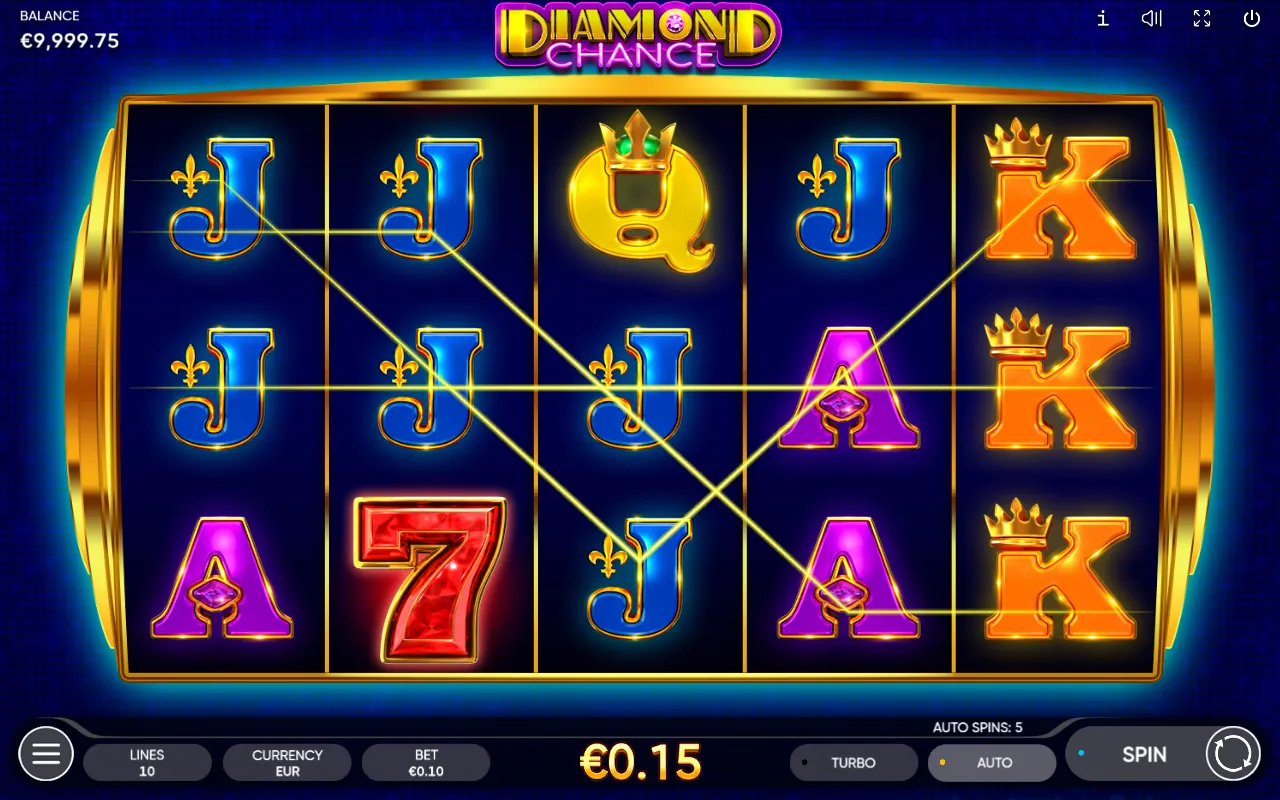
The mechanics are about as direct as the format gets. Matching symbols need to land on enabled paylines and adjacent reels, and combinations can start from the leftmost reel, the rightmost reel, or the middle of the grid.
That middle-start option is unusual for a classic layout. A ten-line game normally pays left to right and stops there; here, a combination anchored in the centre of the reels counts just as much as one built from either edge. It gives the 10 lines more routes to a payout than the count alone suggests.
Two further rules settle how prizes are counted. On each enabled payline, only the highest win is paid, so a line can’t stack two combinations at once.
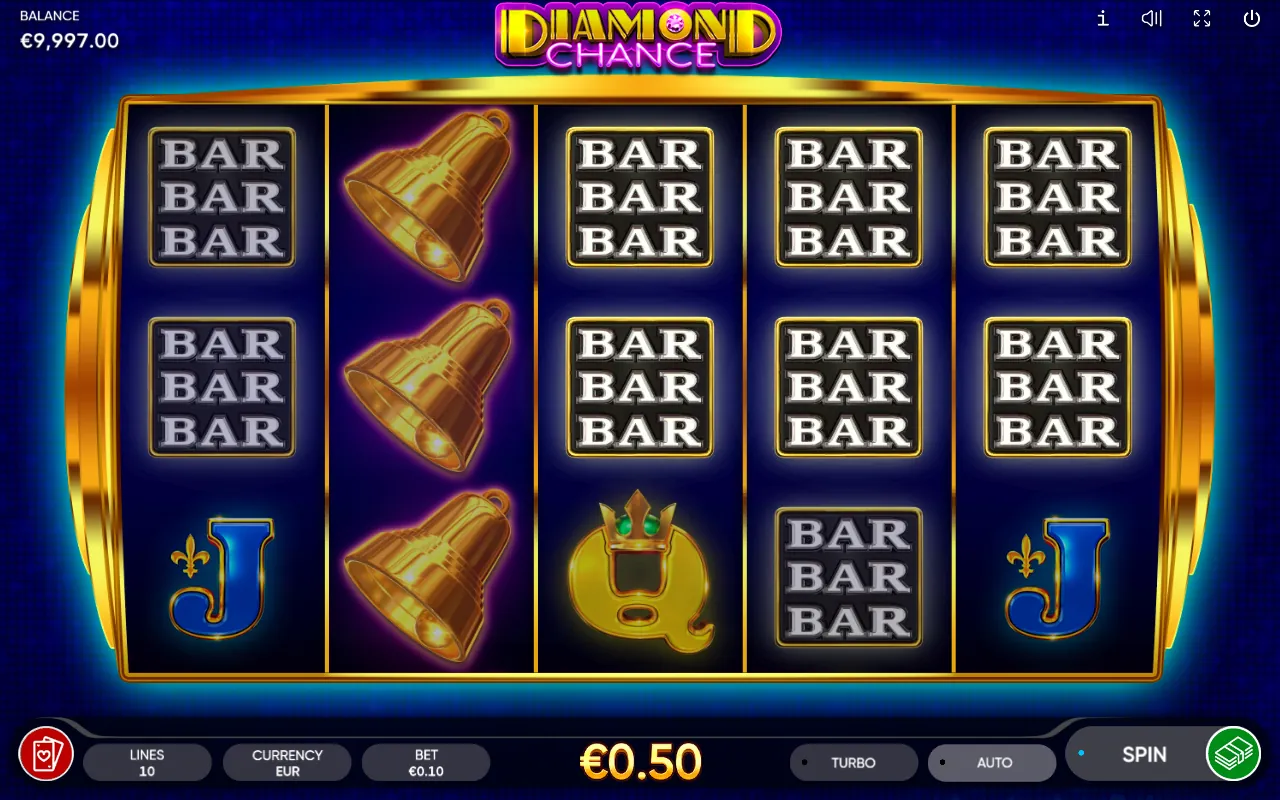
Wins on different paylines are added together. That’s where the bigger base-game results come from: several modest lines landing on the same spin.
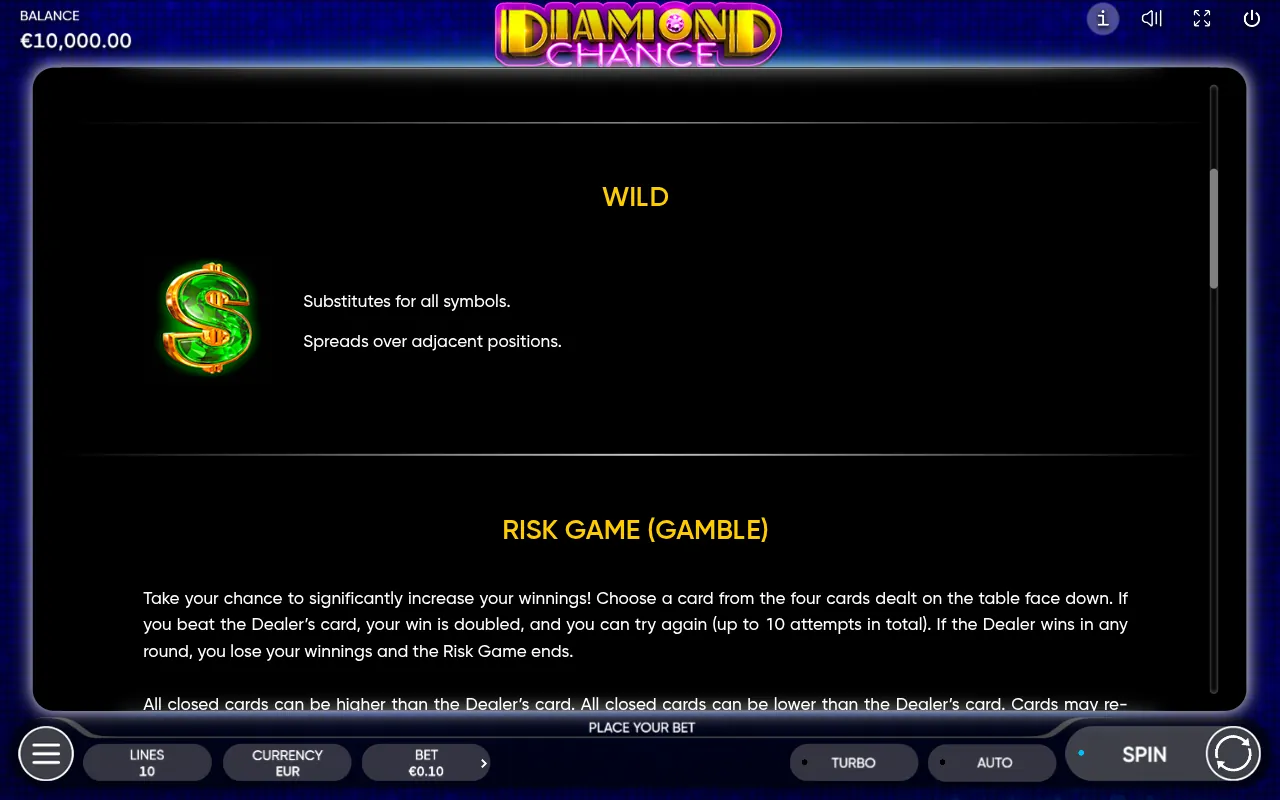
One symbol does the interesting work. The Wild, a green and gold Dollar sign, substitutes for every symbol and spreads over adjacent positions, so a single appearance can cover more ground than it first seems to.
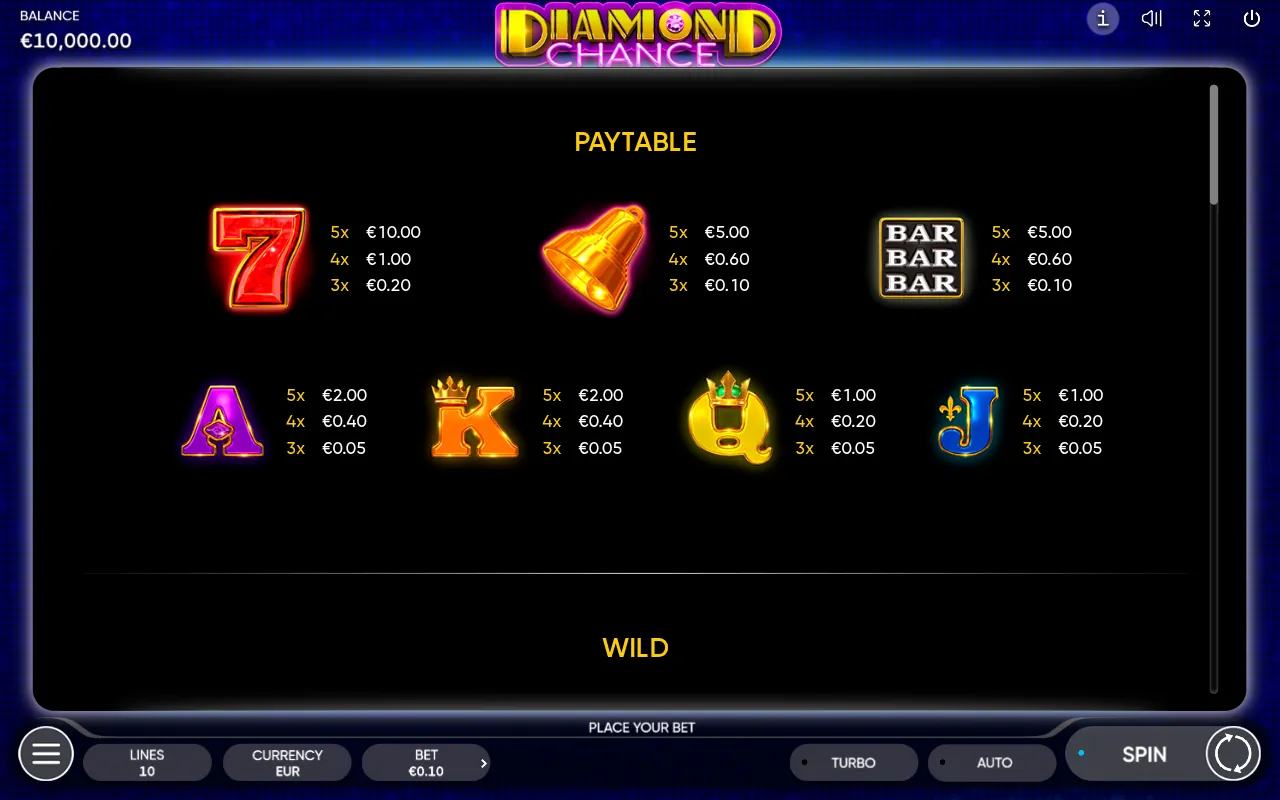
The rest is the classic ladder. Sevens lead, Bells and BARs follow, and the card royals fill out the bottom of the table. Every value below is a multiple of the total bet, not the line bet:
- 7: three pay 2x the total bet, four pay 10x, and a full line of five returns 100x
- Bell / BAR: the mid-tier pair, worth 1x for three, 6x for four and 50x for a complete line
- A / K: the stronger royals, paying 0.5x, 4x and 20x from three through to five
- Q / J: the bottom of the ladder at 0.5x, 2x and 10x
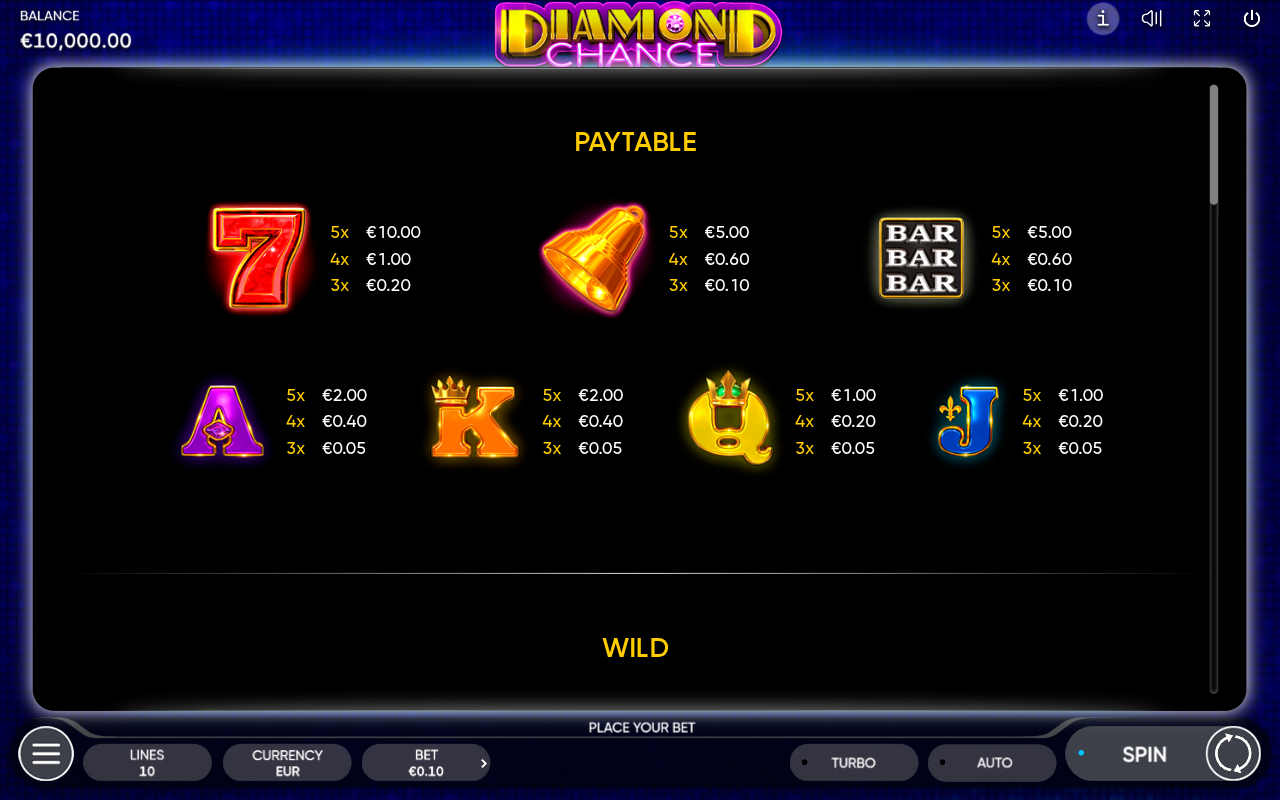
Because everything is measured against the total bet, the arithmetic stays honest at any stake. A line of five sevens across a 1.00 stake simply returns 100.00, and the same proportion holds whether you’re spinning at the 0.10 floor or the 200.00 ceiling. It’s a paytable built for straightforward math rather than spectacle.
There’s no jackpot tier to climb towards, either. The top of the table is that 100x line of sevens, with everything below it stepping down from there.
For a game whose whole identity is generosity, the prizes themselves are modest. The return comes from how often the maths pays out, not from one towering combination.
The Risk Game
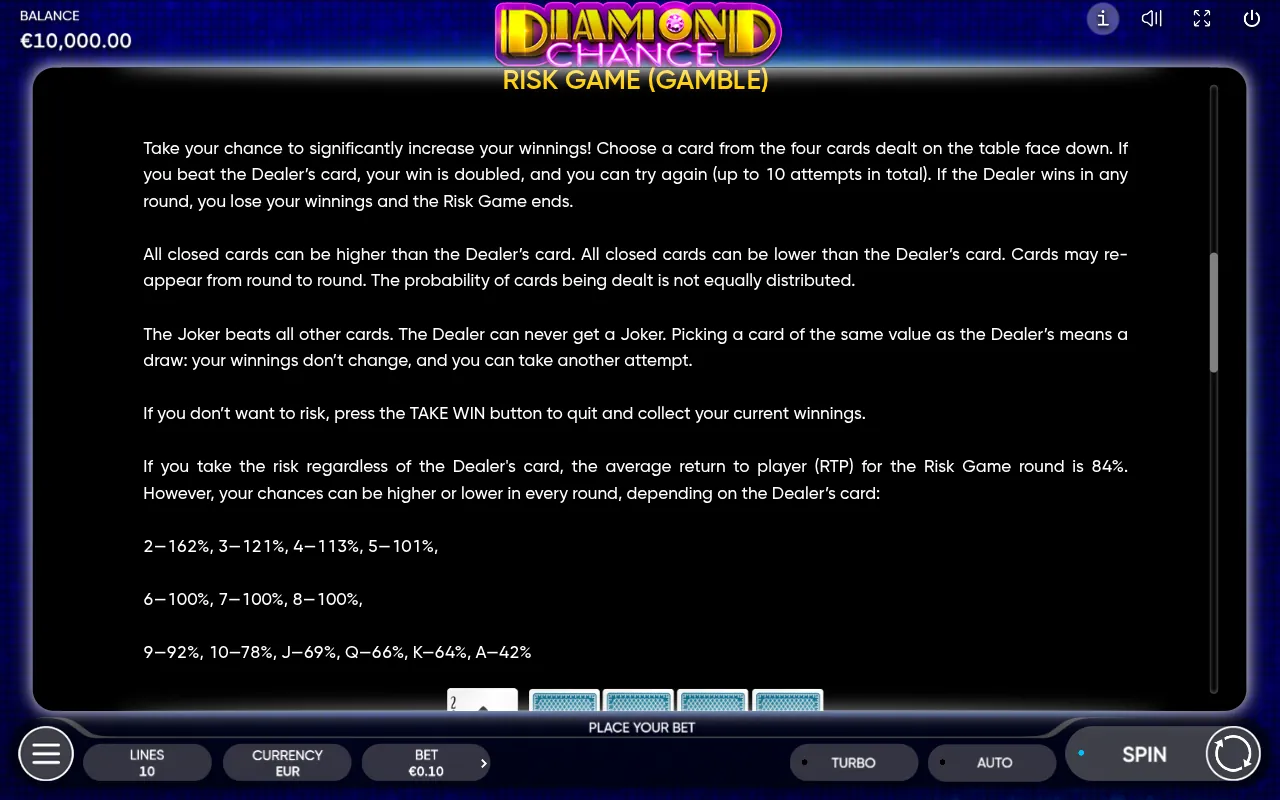
After any win, the Risk Game offers to double it. Four cards lie face down on the table; pick one, and if it beats the Dealer’s card your win doubles and you can go again, up to 10 attempts in total. If the Dealer’s card is higher, the winnings are gone and the round ends on the spot.
The round has details that reward knowing them. The Joker beats every other card, and the Dealer can never draw one, so the Joker is always a safe pick when it’s available to you.
Matching the Dealer’s value is a draw: the win stays as it is and you get another attempt. Cards can reappear from round to round, and the deal isn’t equally distributed, so counting cards won’t help you.
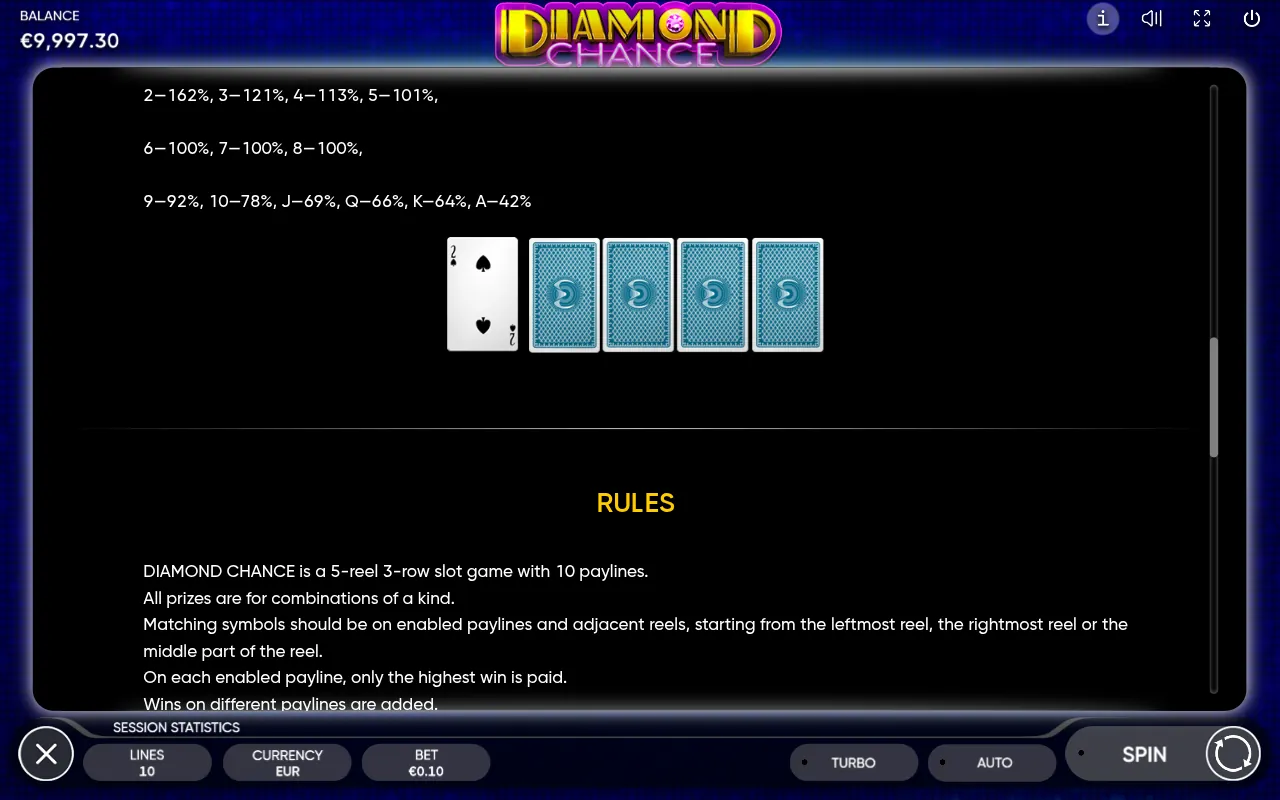
Each Dealer card carries its own odds, and the differences are wide. The average return on a Risk Game round is 84% if you take the risk regardless of what the Dealer is showing, so picking your moments is where the value sits:
- Dealer shows 2: 162%
- Dealer shows 3: 121%
- Dealer shows 4: 113%
- Dealer shows 5: 101%
- Dealer shows 6, 7 or 8: 100%
- Dealer shows 9: 92%
- Dealer shows 10: 78%
- Dealer shows J: 69%
- Dealer shows Q: 66%
- Dealer shows K: 64%
- Dealer shows A: 42%
The lesson in those numbers is blunt: gamble against a low Dealer card and walk away from an Ace. Against a 2 you’re playing a round that returns more than it takes; against an Ace you’re feeding it. The middle of the table is a coin flip, and anything from a Jack up is a losing proposition on average.
The TAKE WIN button banks the round at any point, and there’s no penalty for collecting early beyond the doubling you pass up.
One figure worth keeping straight: the game’s headline RTP doesn’t include the Risk Game’s own return, so the two percentages live separately. The 98.03% to 98.08% range describes the reels; the 84% describes what happens if you press your luck every single time.
Our Honest Verdict
Overall Rating: 7.1/10
This is a cabinet you sit down at for the maths, not the show. The reels spin a straight classic game: a spreading wild, ten lines and a paytable that tops out at 100x for a line of sevens. What makes it worth choosing is that return: several points clear of the norm for a game of this shape, and that’s rare air for fruit machines.
The Risk Game is the smarter half of the design. Ten doubling attempts, a Joker the Dealer can never touch, and odds that swing from 162% down to 42% depending on what’s showing, so the round rewards patience rather than nerve. The weakness is simple: there’s nothing else here. No free spins, no bonus round, and prizes that stay modest even when they come often.
It’s for players who like the classic format, keep an eye on the return, and enjoy a gamble they can think about. Anyone chasing features or a big ceiling will find the gold cabinet lights on and nobody home.
Diamond Chance FAQs
-
What is the RTP of Diamond Chance?
Diamond Chance runs at 98.03% to 98.08% RTP, which is well above the industry average. That figure doesn’t include the Risk Game, which has its own average return of 84%. -
How many paylines does Diamond Chance have?
There are 10 paylines across five reels and three rows. Wins form on enabled lines over adjacent reels, and a combination can be built from the left edge, the right edge or the centre of the grid. -
What is the grid size of Diamond Chance?
The game uses a 5×3 grid, meaning five reels and three rows. -
What is the minimum and maximum bet on Diamond Chance?
Stakes run from 0.10 up to 200.00 per spin, so it accommodates both cautious players and high rollers. -
How does the Risk Game work?
After a win you can risk it by choosing one of four face-down cards. Beat the Dealer’s card and your win doubles, and you can keep going for up to 10 attempts in total. Lose to the Dealer and the round is over with nothing banked. TAKE WIN quits at any point and collects your current total. -
What happens if I pick the same card value as the Dealer?
It’s a draw. Your winnings don’t change, and you can take another attempt. The Joker beats all other cards, and the Dealer can never be dealt one. -
Is it better to gamble against some Dealer cards than others?
Yes, and by a wide margin. Against a Dealer 2 your return is 162%, while against an Ace it’s just 42%. The average is 84% if you take the risk regardless of the Dealer’s card. -
What does the wild symbol do in Diamond Chance?
The wild is a green and gold Dollar sign that substitutes for all other symbols. It also spreads over adjacent positions, so one appearance can cover several reel positions at once.