













Here Kitty Kitty Slot Review
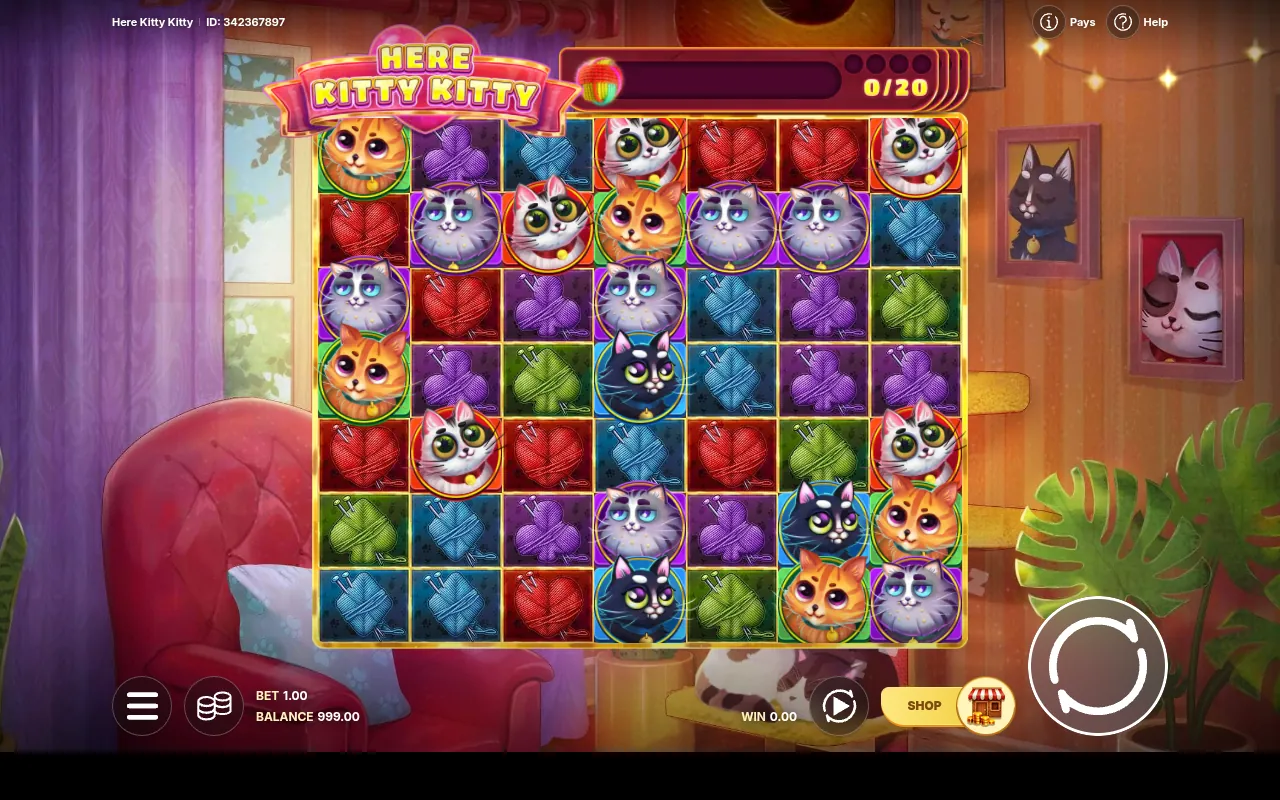
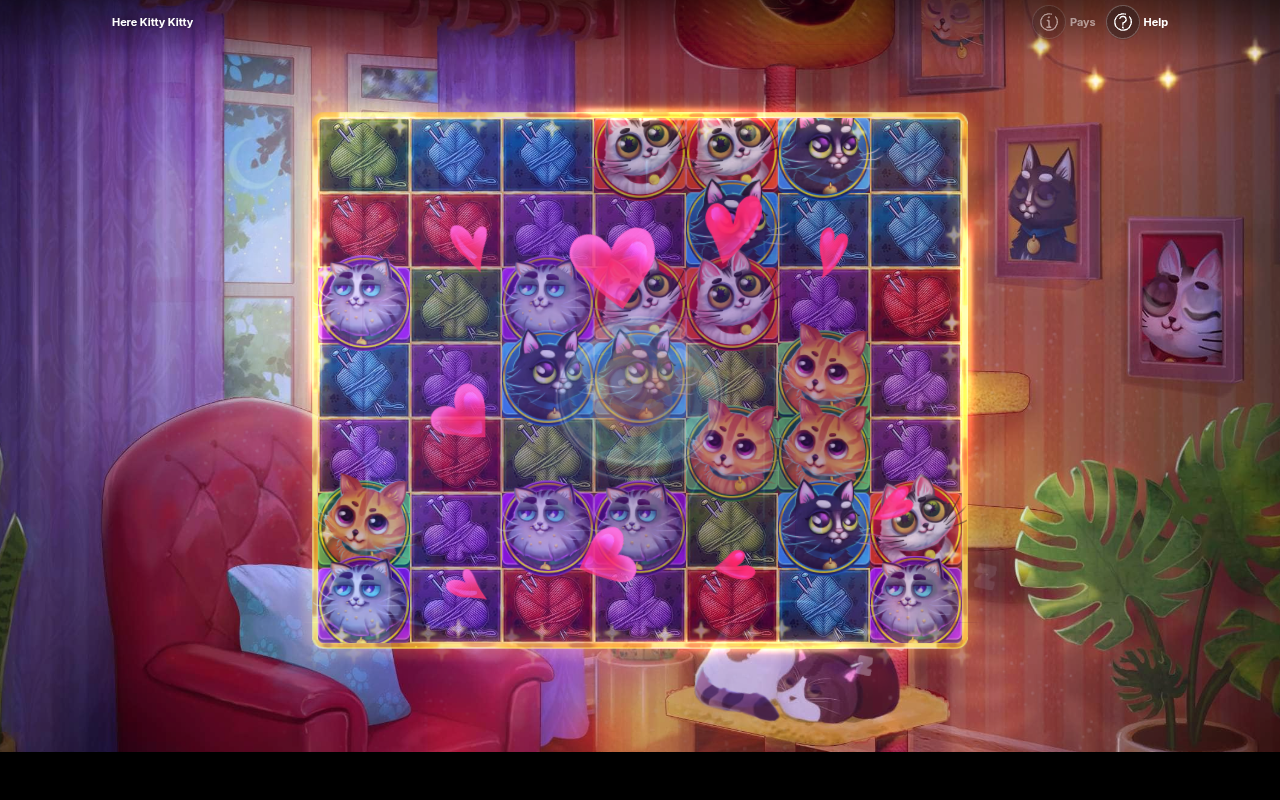
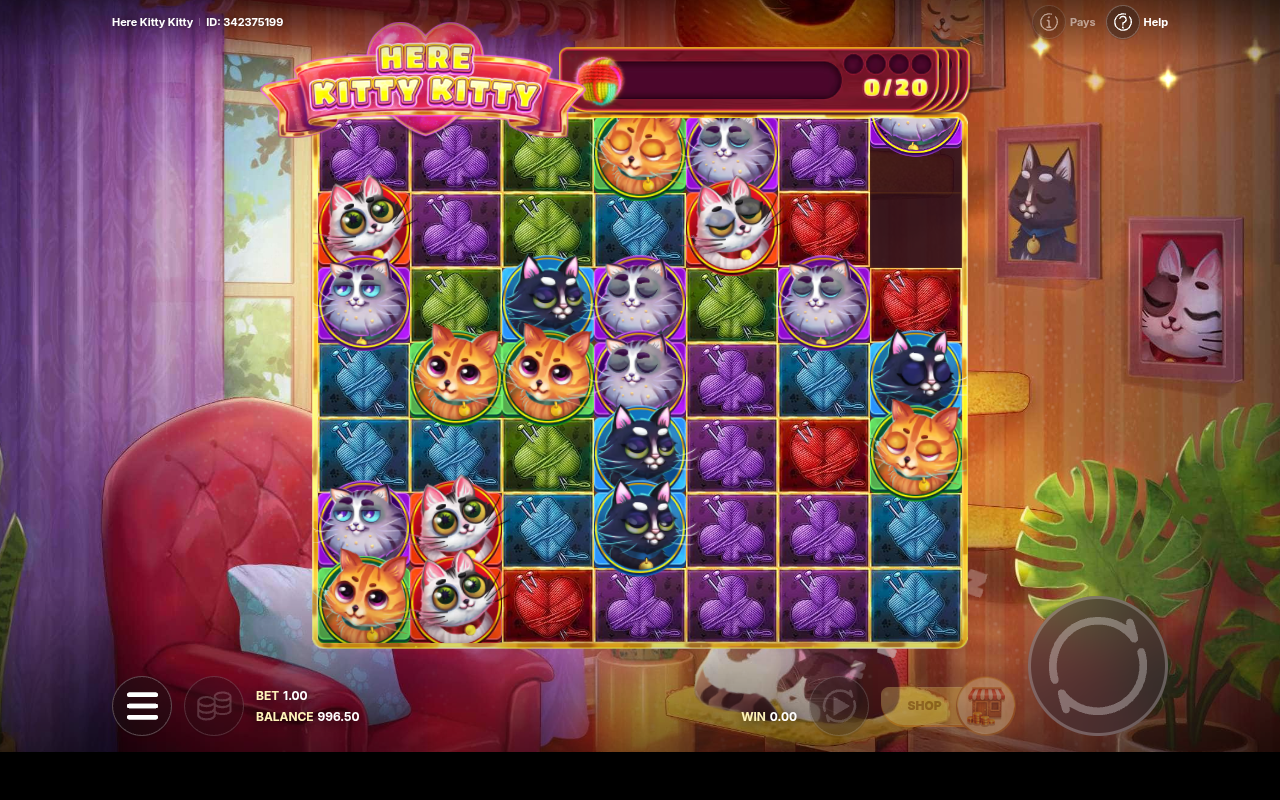
A cat-lover’s living room after dark: framed cat portraits on striped pink-and-amber wallpaper, fairy lights looping over the corner, a grey-and-white cat asleep on a stool beneath the glowing grid. Here Kitty Kitty hides the meanest thing Red Tiger could have put in that room: a 140-symbol progress bar you’ll spend whole sessions trying to fill, for a 2,135x ceiling that pays that patience back modestly.
It’s a cluster game on an 8×7 grid with cascading wins, an RTP of 95.73%, a hit rate of 20.86% and stakes from 0.1 to 50 per spin. There’s no free spins round at all: everything routes through the bar and its random modifiers. Fans of the studio’s gentler work, like Diamond Doggies or Christmas Morning, will recognise the register.
How Here Kitty Kitty Pays
Wins come from clusters of matching symbols anywhere on the 8×7 grid, with twelve of a kind the minimum for a pay. There’s no payline structure and no ways count; a symbol counts wherever it sits, as long as enough of its kind are on the board at once. All pays are multiples of the total bet, not of any line stake.
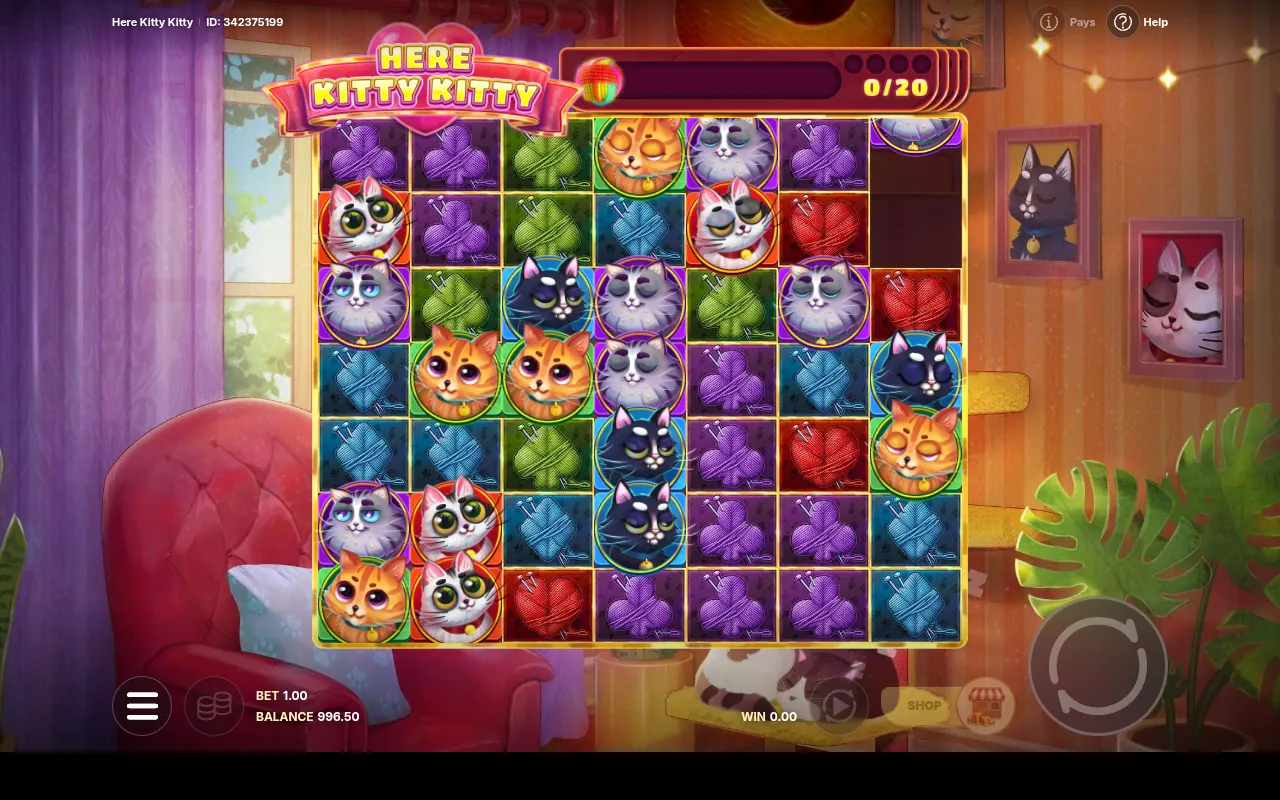
When a cluster lands, those symbols are removed and new ones cascade in from above. If the fresh symbols form new clusters of twelve or more, those clear too, and the chain keeps running until a cascade produces no new combination. It’s at that point, with the board settled, that the progress bar’s features step in.
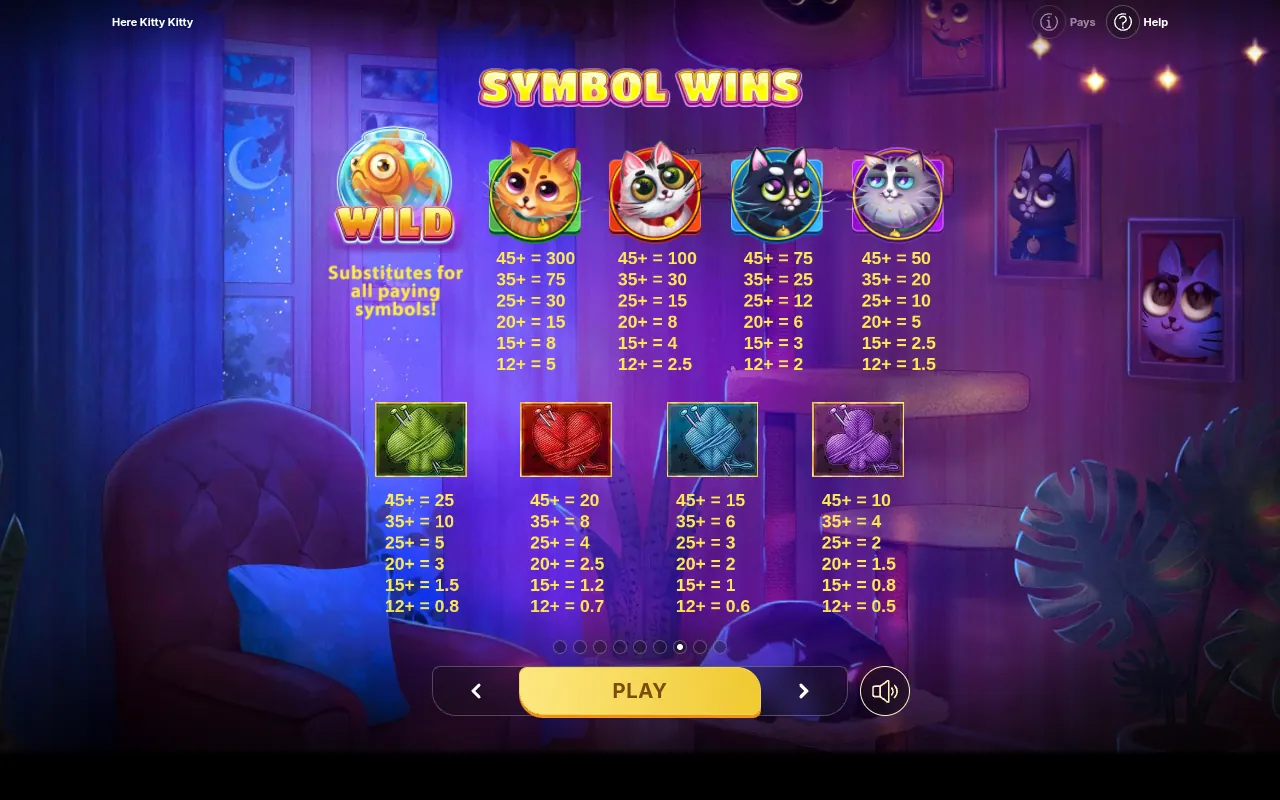
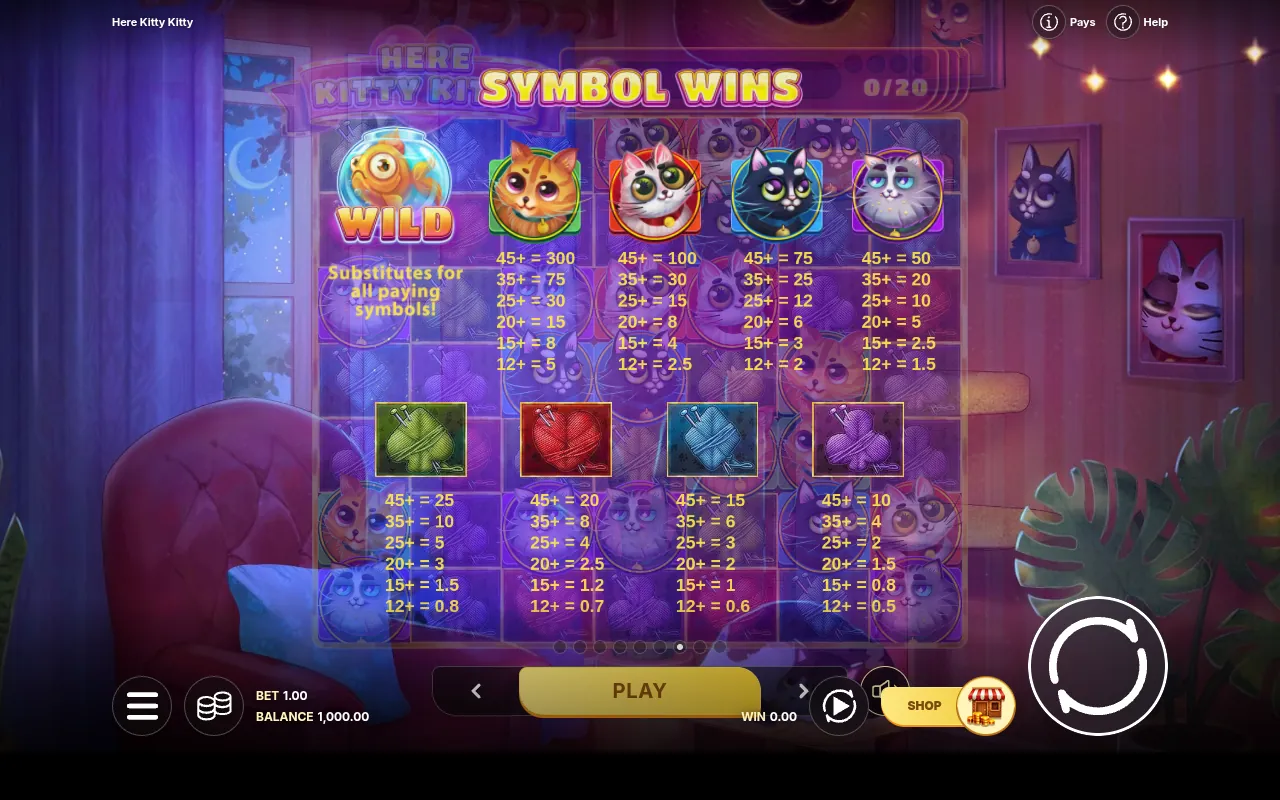
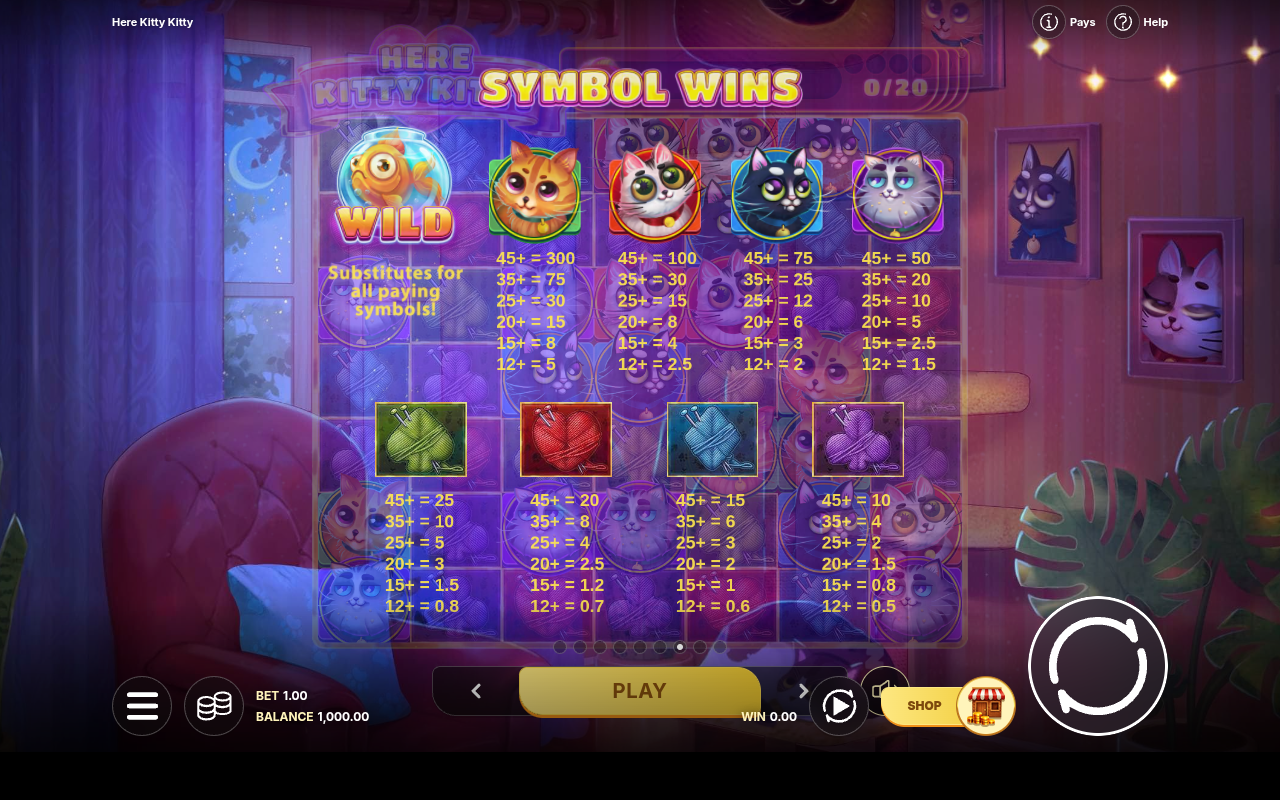
The premium symbols are the cats themselves, four of them, and four yarn balls fill out the lower end of the table. The jump from a minimum cluster to a maximum one is steep, and the yarn pays sit well under the cats at every tier. Every value below is per cluster size:
- Orange cat: 5x for 12+, 8x for 15+, 15x for 20+, 30x for 25+, 75x for 35+, 300x for 45+
- Smiling tabby cat: 2.5x for 12+, 4x for 15+, 8x for 20+, 15x for 25+, 30x for 35+, 100x for 45+
- Dark cat: 2x for 12+, 3x for 15+, 6x for 20+, 12x for 25+, 25x for 35+, 75x for 45+
- Grey cat: 1.5x for 12+, 2.5x for 15+, 5x for 20+, 10x for 25+, 20x for 35+, 50x for 45+
- Green yarn: 0.8x for 12+, 1.5x for 15+, 3x for 20+, 5x for 25+, 10x for 35+, 25x for 45+
- Red yarn/heart: 0.7x for 12+, 1.2x for 15+, 2.5x for 20+, 4x for 25+, 8x for 35+, 20x for 45+
- Teal yarn: 0.6x for 12+, 1x for 15+, 2x for 20+, 3x for 25+, 6x for 35+, 15x for 45+
- Purple yarn: 0.5x for 12+, 0.8x for 15+, 1.5x for 20+, 2x for 25+, 4x for 35+, 10x for 45+
The twelve-symbol floor is the number to hold in your head: it’s the threshold every cluster on that list hangs from, and it’s a demanding one on a grid holding fifty-six cells.
A wild substitutes for all paying symbols, and it’s the only special symbol in the game. There’s no scatter, and no separate bonus round to trigger with one.
The Progress Bar and Its Features
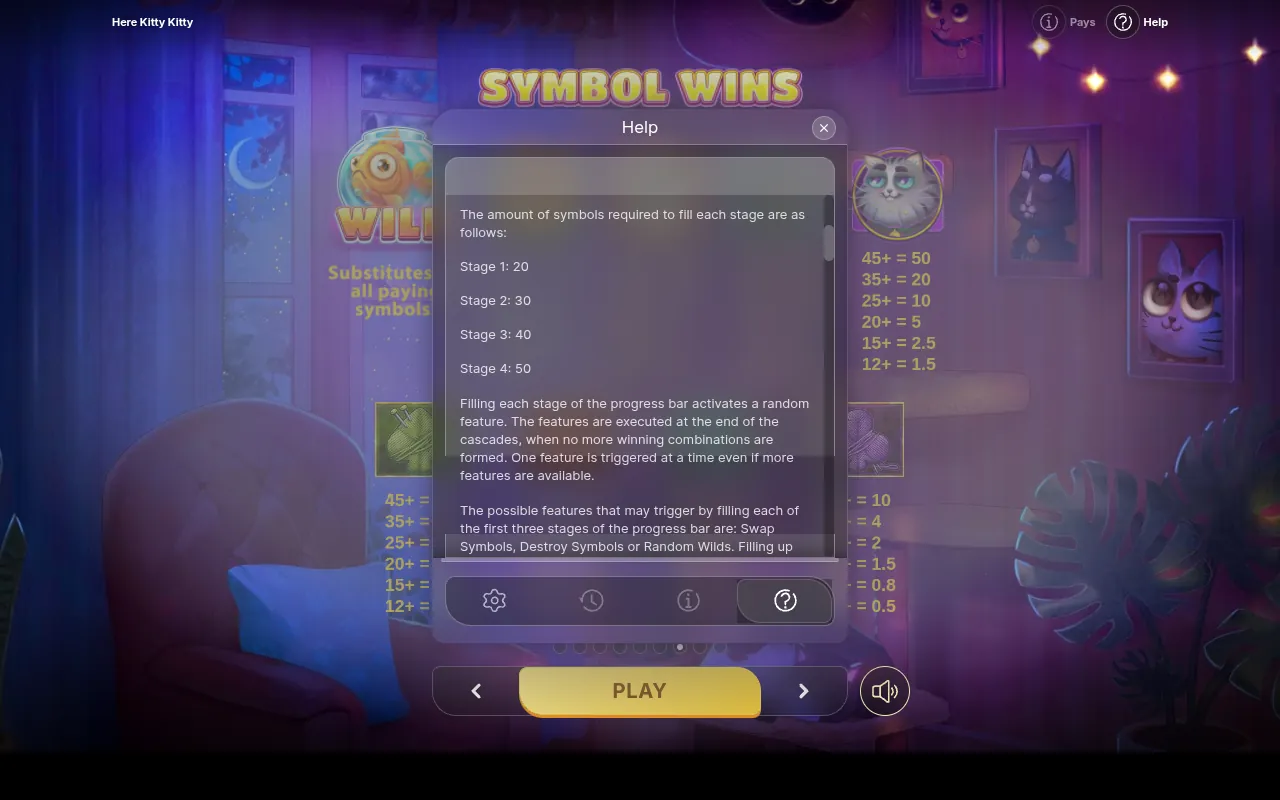
The progress bar is the whole engine of this game. Every symbol that lands feeds it, and each stage needs more than the last: twenty symbols for stage one, thirty for stage two, forty for stage three and fifty for stage four.
Those numbers are worth sitting with for a second. A full bar is 140 symbols in total, and on a grid holding fifty-six cells that’s several spins’ worth of cascades even when the game is paying. The bar doesn’t reset between spins, which is what makes it a persistent thing to watch rather than a per-spin gimmick.
Filling a stage activates a random feature, executed at the end of the cascades once no more winning combinations form. One feature fires at a time, even if several are queued and available. Anything left unfilled carries over rather than being spent, so a stage that fills halfway through a spin is still partway full when the next one starts.
The order of events matters. A cascade chain plays out to its end, the winning symbols clear, the board settles, and only then does the modifier arrive. It never interrupts a running chain, and it never fires mid-spin: the game finishes what it’s doing before it rearranges anything.
Stage One to Three: Swap, Destroy or Random Wilds
The first three stages draw from a pool of three modifiers: Swap Symbols, Destroy Symbols or Random Wilds. Each one rearranges the board after the cascades have stopped, in a different way, to build fresh cluster opportunities out of a settled grid.
Which of the three you get on any given stage is random, so there’s no choosing and no weighting you can plan around. The value comes from the timing: a modifier landing on an already-cleared board has more room to work with than one landing mid-cascade.
Catmageddon
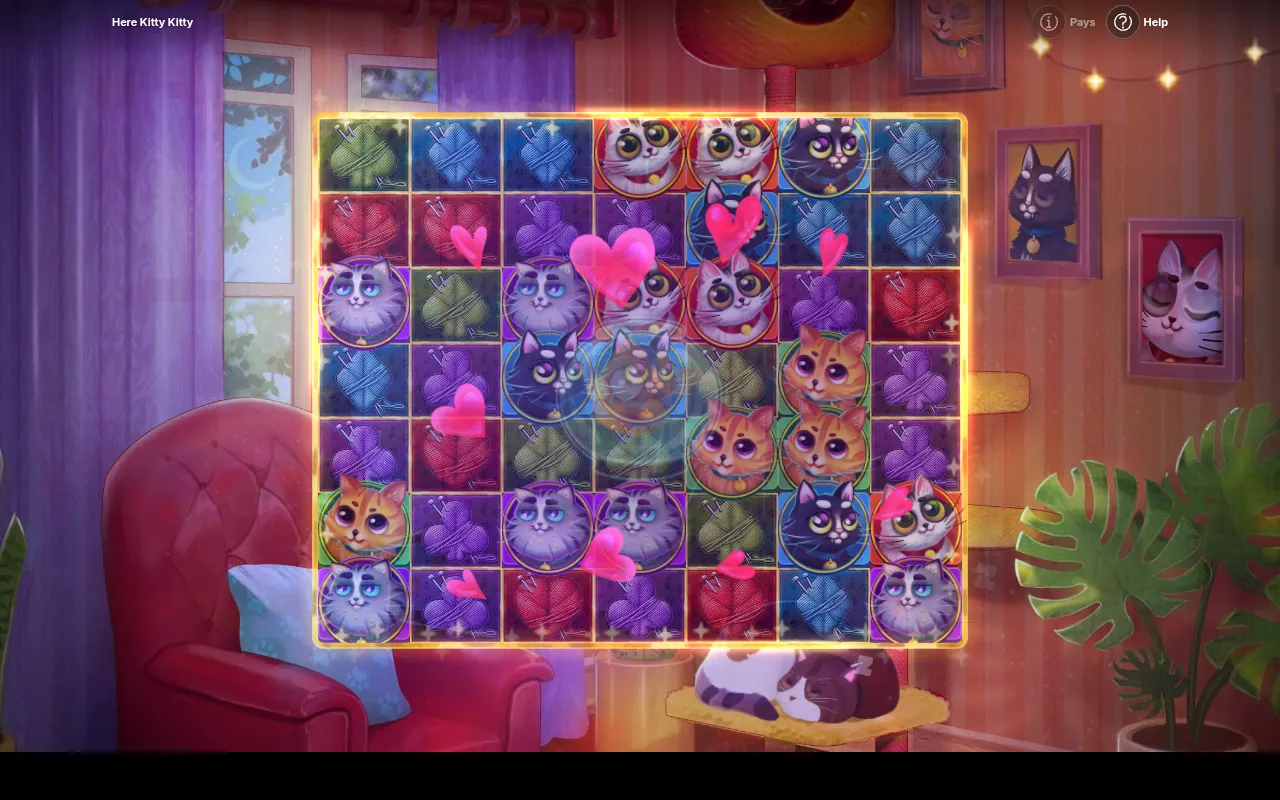
Catmageddon is the destination the bar is building towards, and it promises big multipliers. When it arrives, the grid empties out almost entirely while it plays out, with the 8×7 outline holding shape as symbols cascade through the dark.
It’s the only feature in the game that’s explicitly pitched at multipliers rather than at rearranging symbols, which makes it the one worth grinding the deep stages for. It’s a random feature triggered from the progress bar, so reaching it is a genuinely long build.
Destroy Random Symbols
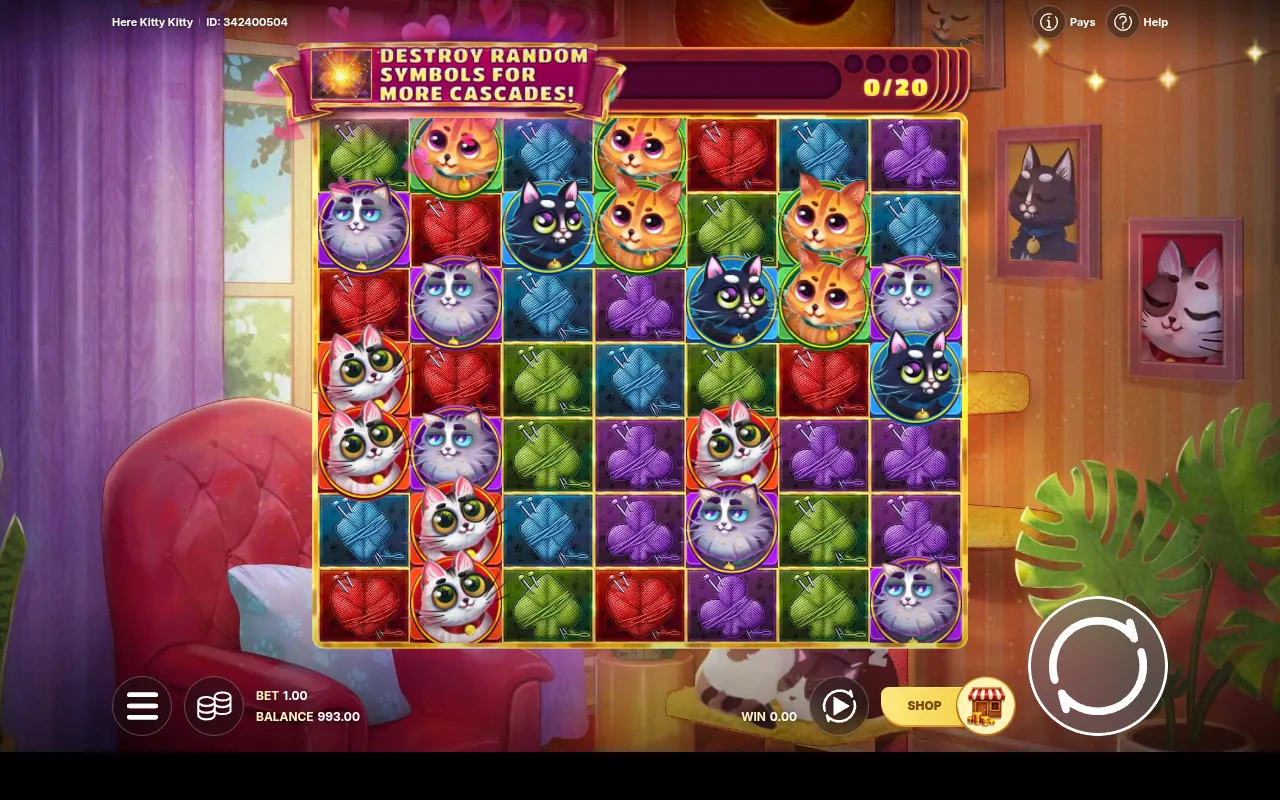
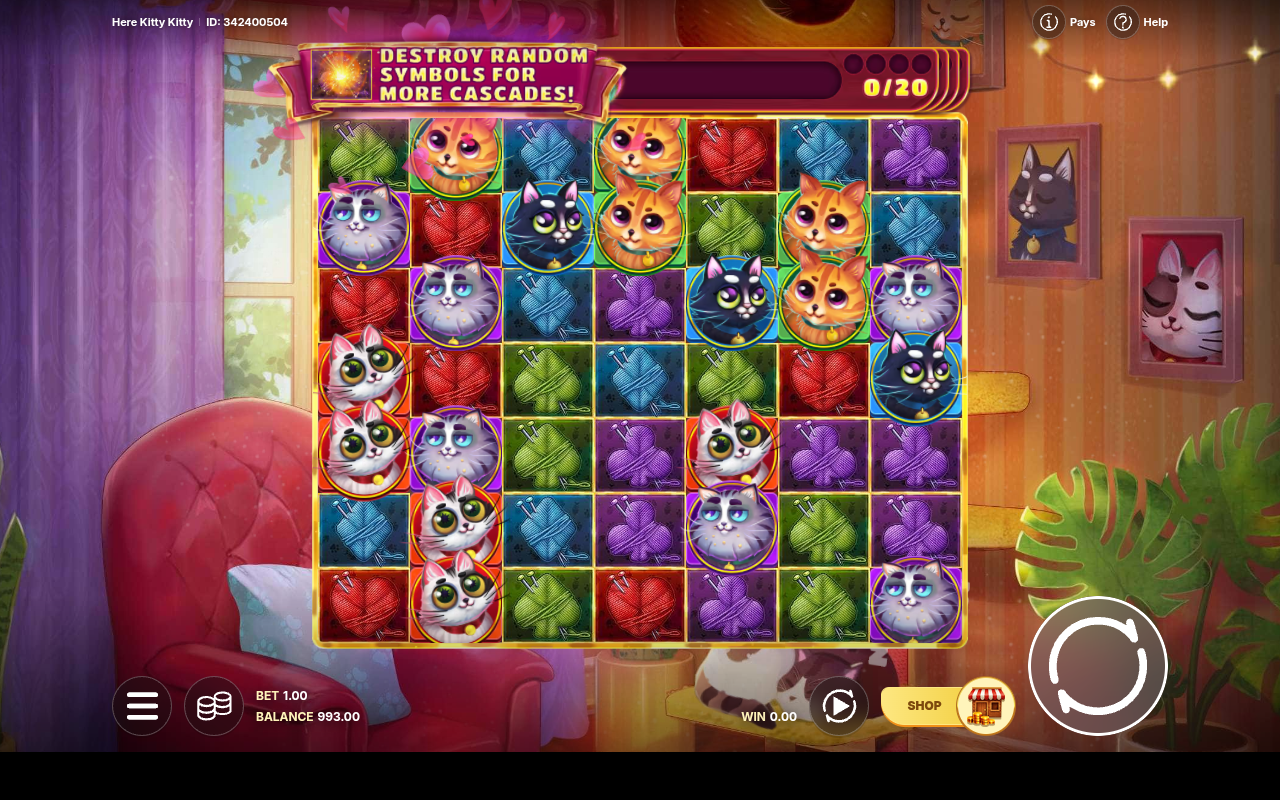
This one removes random symbols from the grid to force more cascades. It’s the bluntest of the modifiers: no transformation, no substitution, just subtraction followed by whatever tumbles into the gaps.
On a board that’s already been stripped by a long cascade chain, a second clear-out can pull clusters together that weren’t adjacent before. Whether it does is down to what falls, and to where the removals land.
Our Honest Verdict
Overall Rating: 7.1/10
This is a game you play for the build, not the hits. Most of a session is watching a bar creep up while the yarn pays trickle, and the one reason to choose it is that the bar never resets, so the long build always feels like it’s going somewhere. The room Red Tiger built around it is genuinely charming, sleeping cat and all.
The strength is the structure itself: a persistent meter that pays out in instalments gives every spin a second stake, and Catmageddon at the bottom of it is a real destination. The weakness is what’s at the top: 2,135x is a small ceiling for a game built entirely on patience, and there’s no free spins round to change the pace when the bar stalls.
If long, incremental builds are your kind of slot, this one does that as well as anything, in prettier wallpaper than most. Chasing four-figure-plus ceilings, you’ll run out of reasons here. Everyone else can settle into the armchair; the cat’s asleep, the fairy lights are on, and the bar is quietly filling.
Here Kitty Kitty FAQs
-
How does the progress bar work in Here Kitty Kitty?
Every symbol that lands fills the progress bar, which needs 20, 30, 40 and 50 symbols for its four stages. Filling a stage triggers a random feature at the end of the cascades, one at a time, from Swap Symbols, Destroy Symbols or Random Wilds on the first three stages. -
What is Catmageddon in Here Kitty Kitty?
Catmageddon is the feature that triggers from the deepest stage of the progress bar, and it may bring big multipliers as the grid empties and symbols cascade through it. -
Can more than one feature trigger at once in Here Kitty Kitty?
No. One feature is triggered at a time, even if more than one is available when the cascades end. -
When do the progress bar features fire in Here Kitty Kitty?
At the end of the cascades, once no more winning combinations form. They never interrupt a running cascade chain. -
What does the wild do in Here Kitty Kitty?
The wild substitutes for all paying symbols. There’s no scatter symbol in the game. -
What is the RTP of Here Kitty Kitty?
The RTP is 95.73%. -
What is the minimum and maximum bet on Here Kitty Kitty?
Stakes run from 0.1 to 50 per spin. -
What is the maximum win on Here Kitty Kitty?
The maximum win is 2,135x the total bet.