








Kart Rush Slot Review
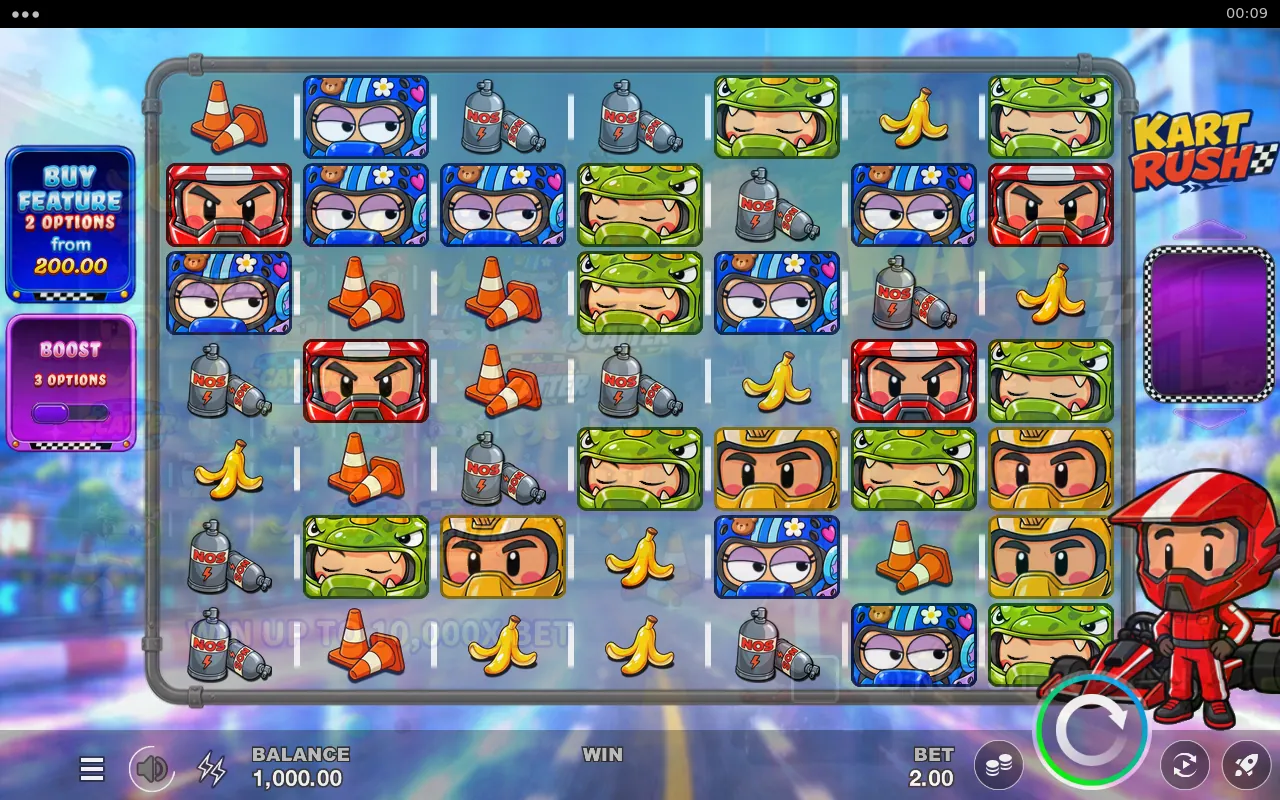
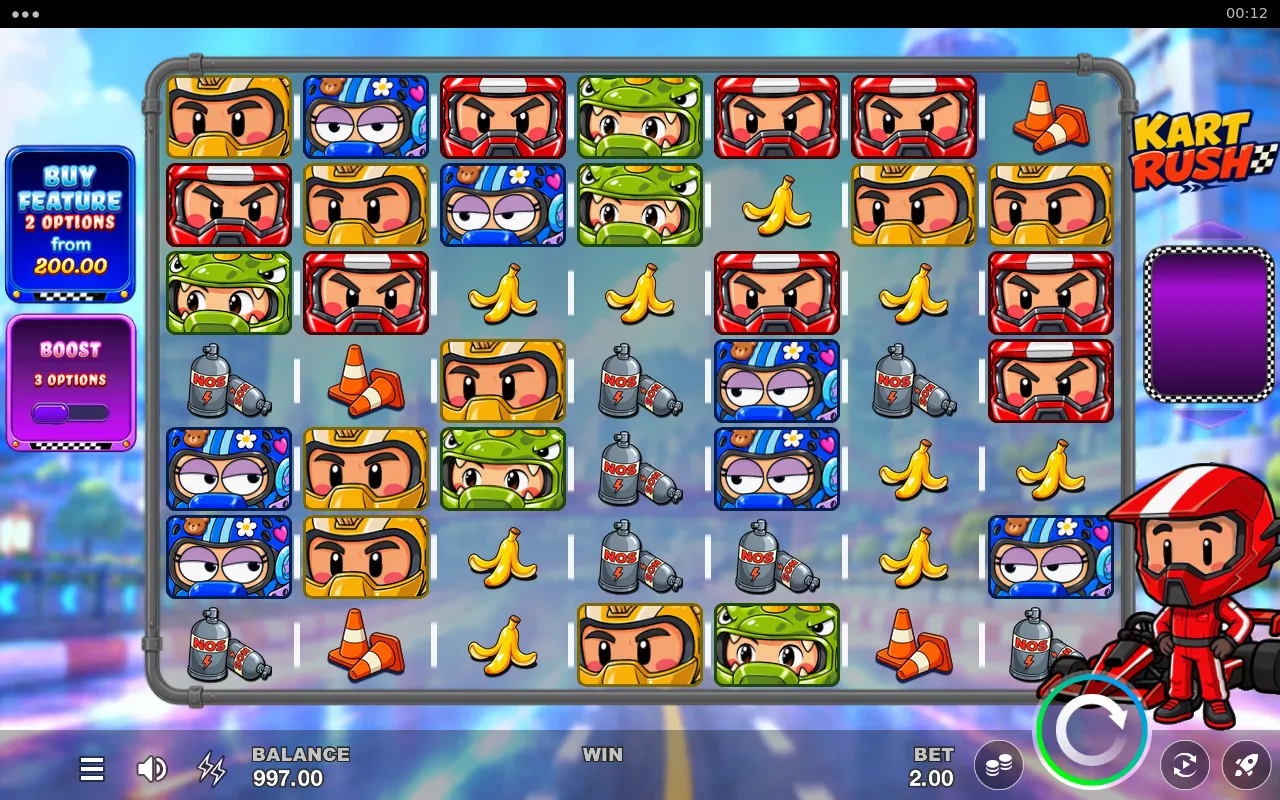
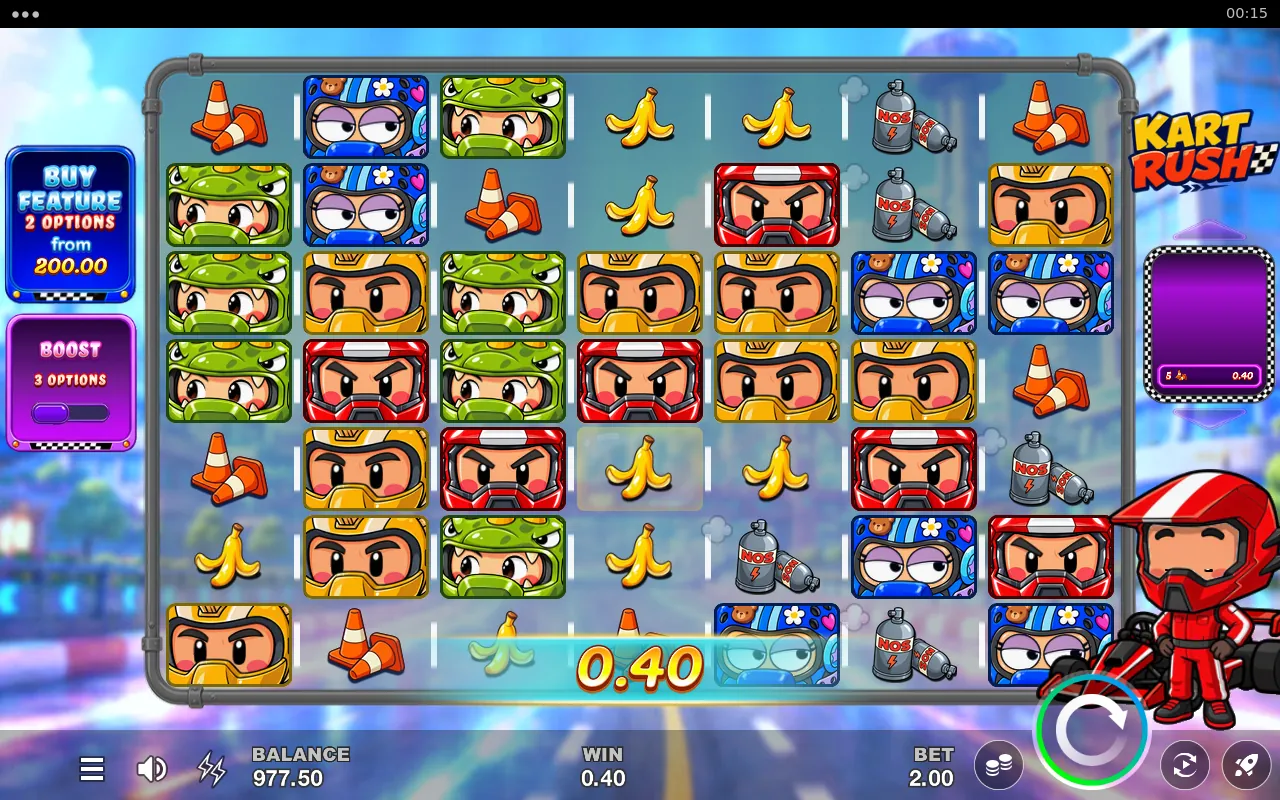
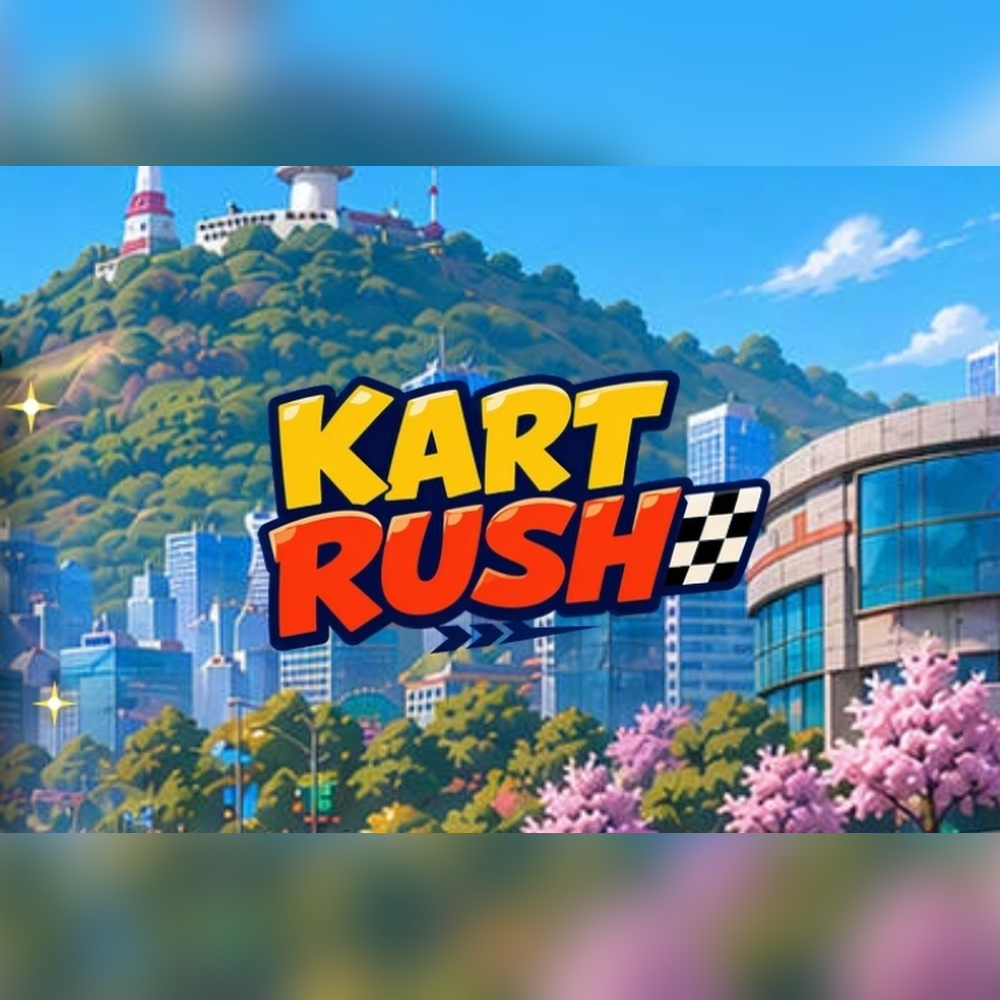
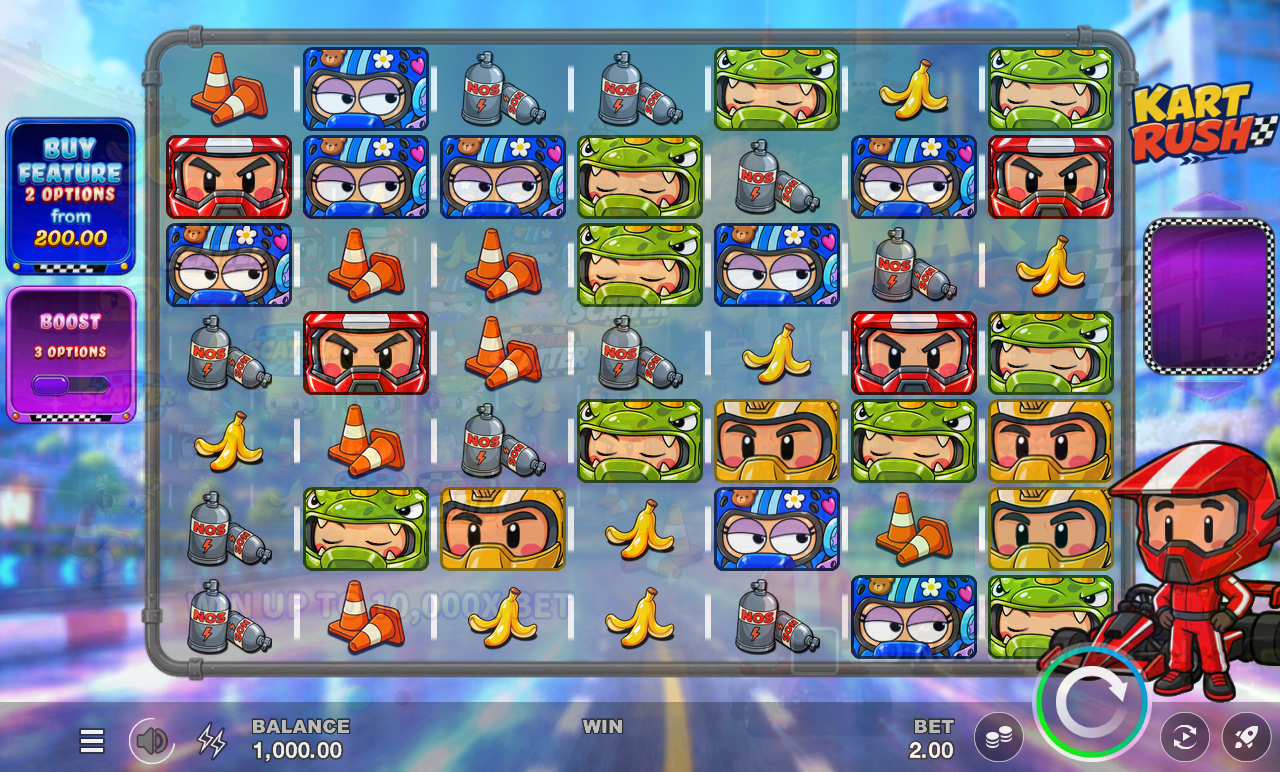
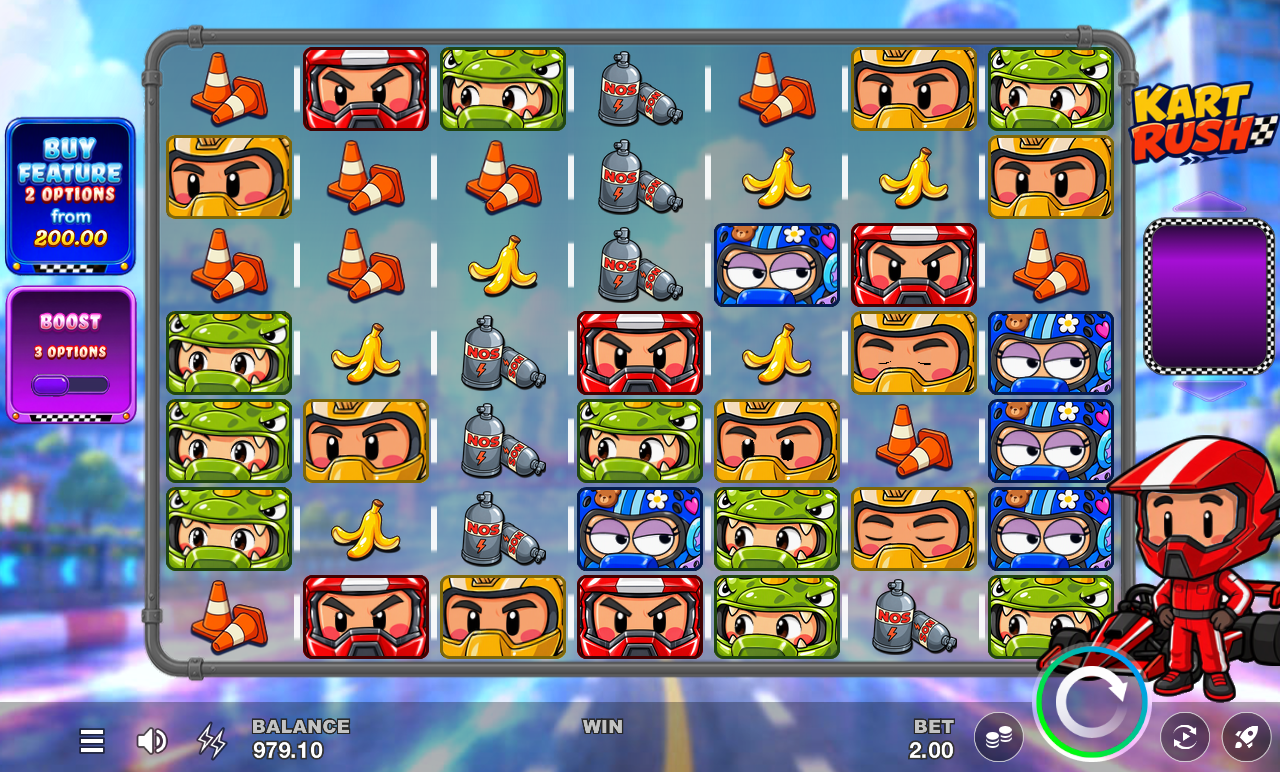
Kart Rush is a slot that remembers where you’ve won. Every cluster that clears on its 7×6 grid leaves a mark behind, and the next win on the same spot is worth more than the last, which means the game’s whole character comes from ground it has already covered. Microgaming has dressed that idea in cartoon racing: a red-suited driver leaning on a kart, high-rises streaking past in soft focus, and the reels bolted into a grey pit-lane panel above a road with a yellow centre line. It looks like a party. The grid underneath it is doing lap times.
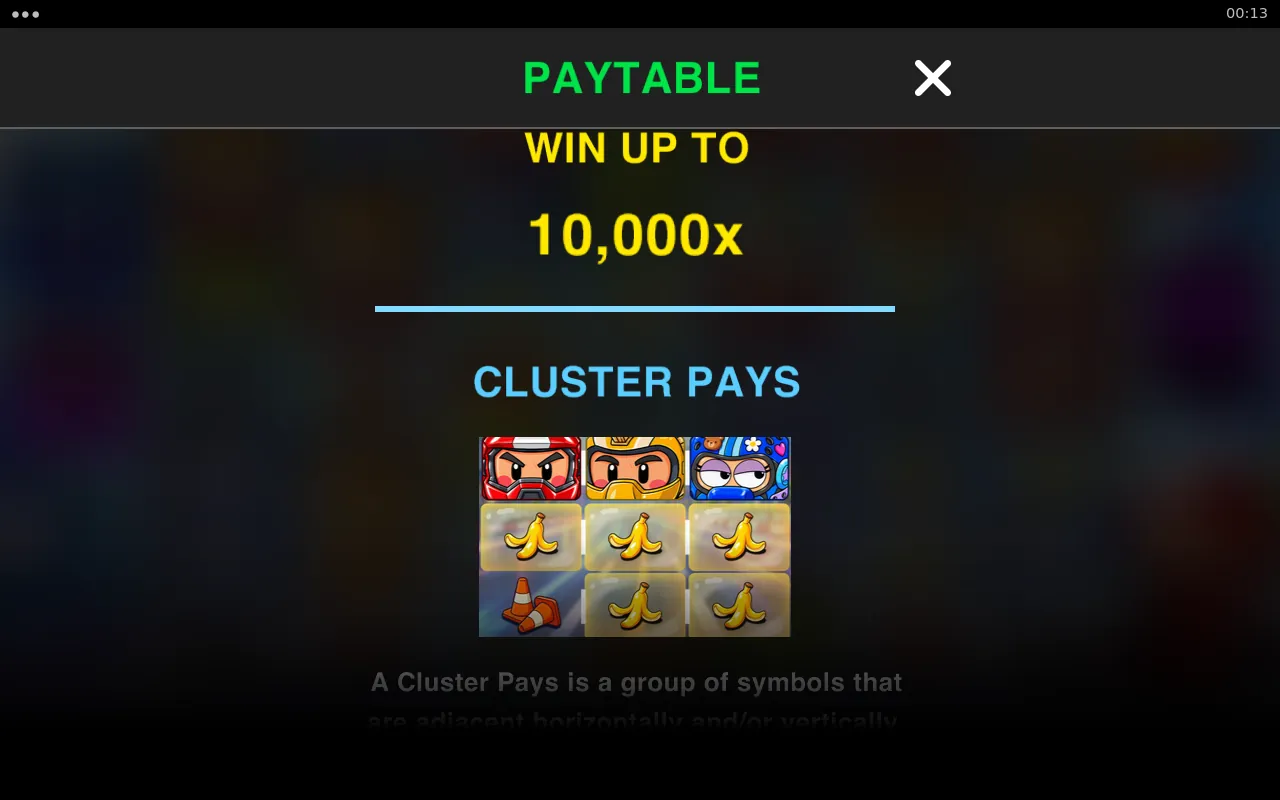
It’s a cheerful machine with serious parts. The 7×6 grid pays in clusters rather than paylines, the multiplier system climbs as high as x1024, and there’s a 10,000x ceiling on what the game will pay out. The cluster-and-multiplier combination is where everything interesting happens.
Cluster Pays
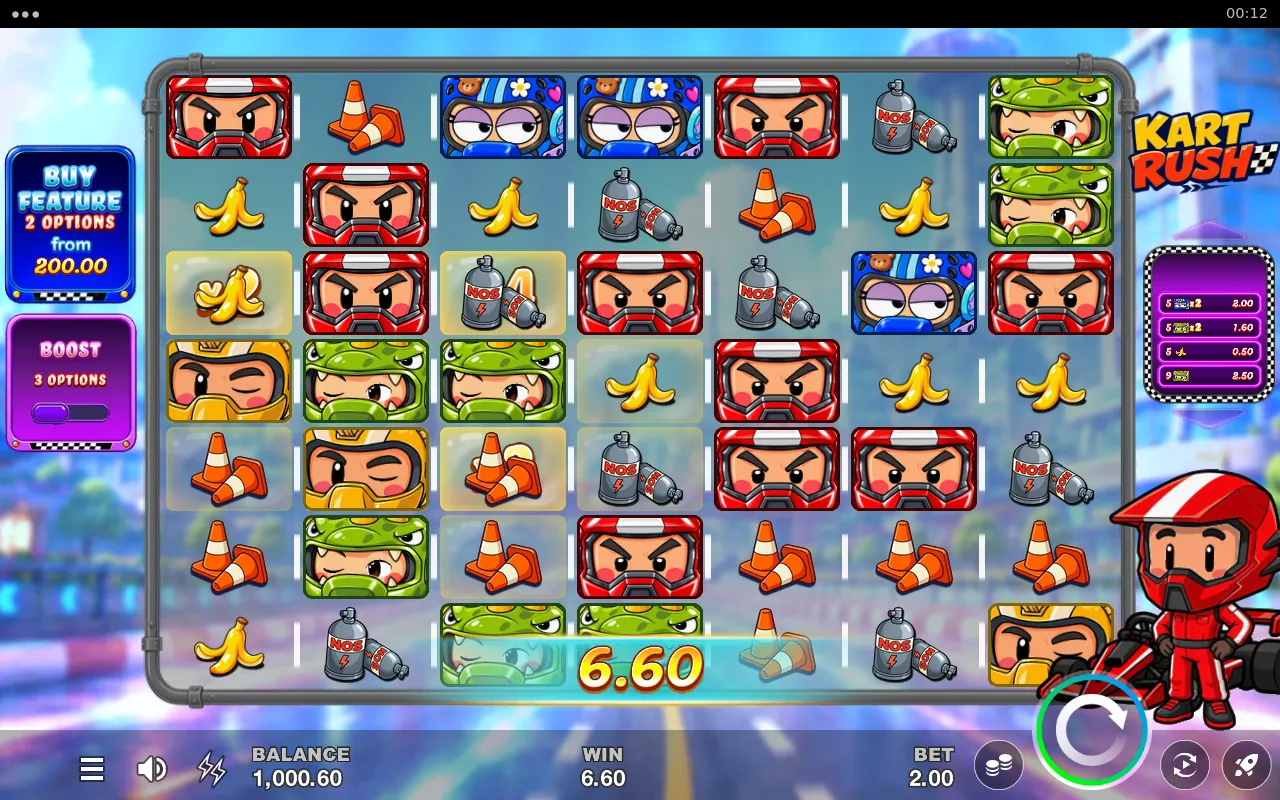
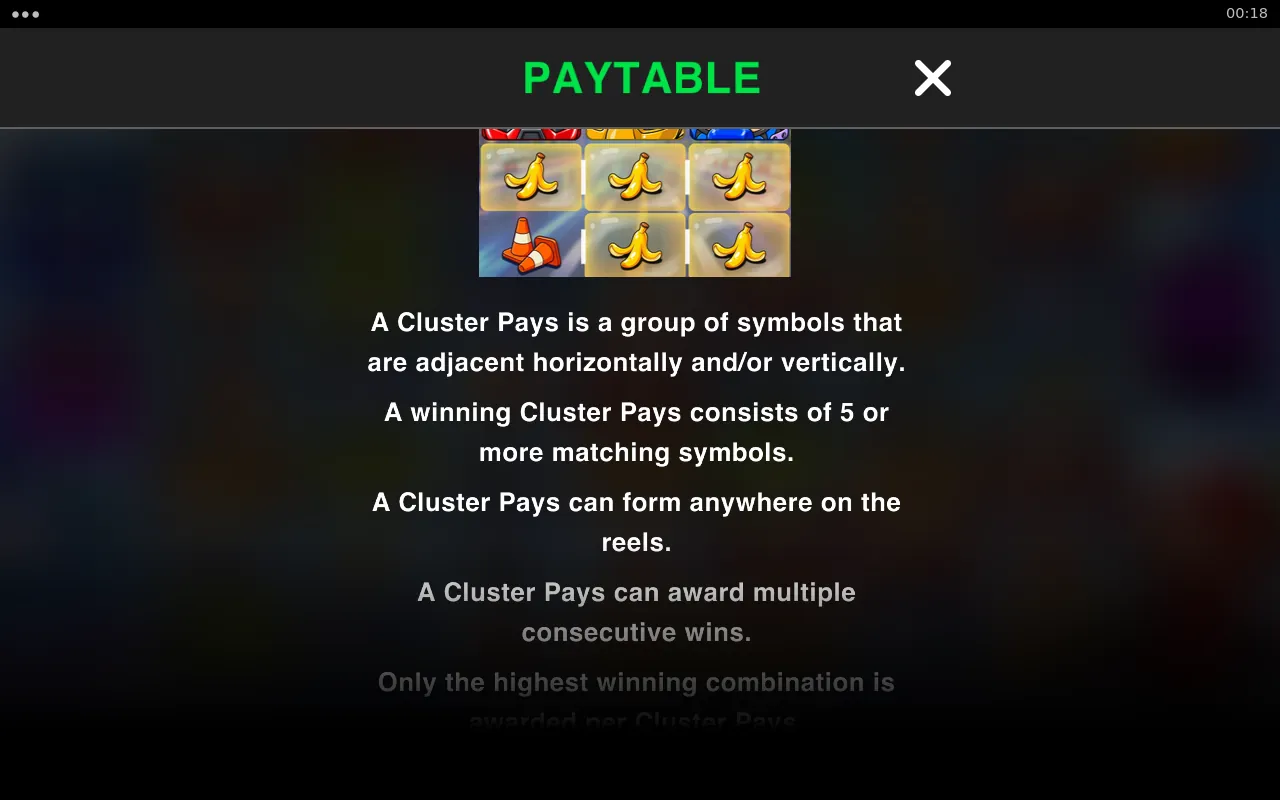
Kart Rush doesn’t use paylines. A win is a cluster: five or more matching symbols sitting next to each other, horizontally or vertically, anywhere on the 7×6 grid. There’s no such thing as a near miss on the leftmost reel here, because position doesn’t matter and only connection does.
A cluster can only contain one symbol type, and a big cluster pays once. If matching symbols form two separate groups on the same spin, each group is judged on its own. Only the highest winning combination is awarded per cluster, so a chain of five never splits into a smaller pay plus a bigger one.
Once a cluster hits, the sequence runs the same way every time:
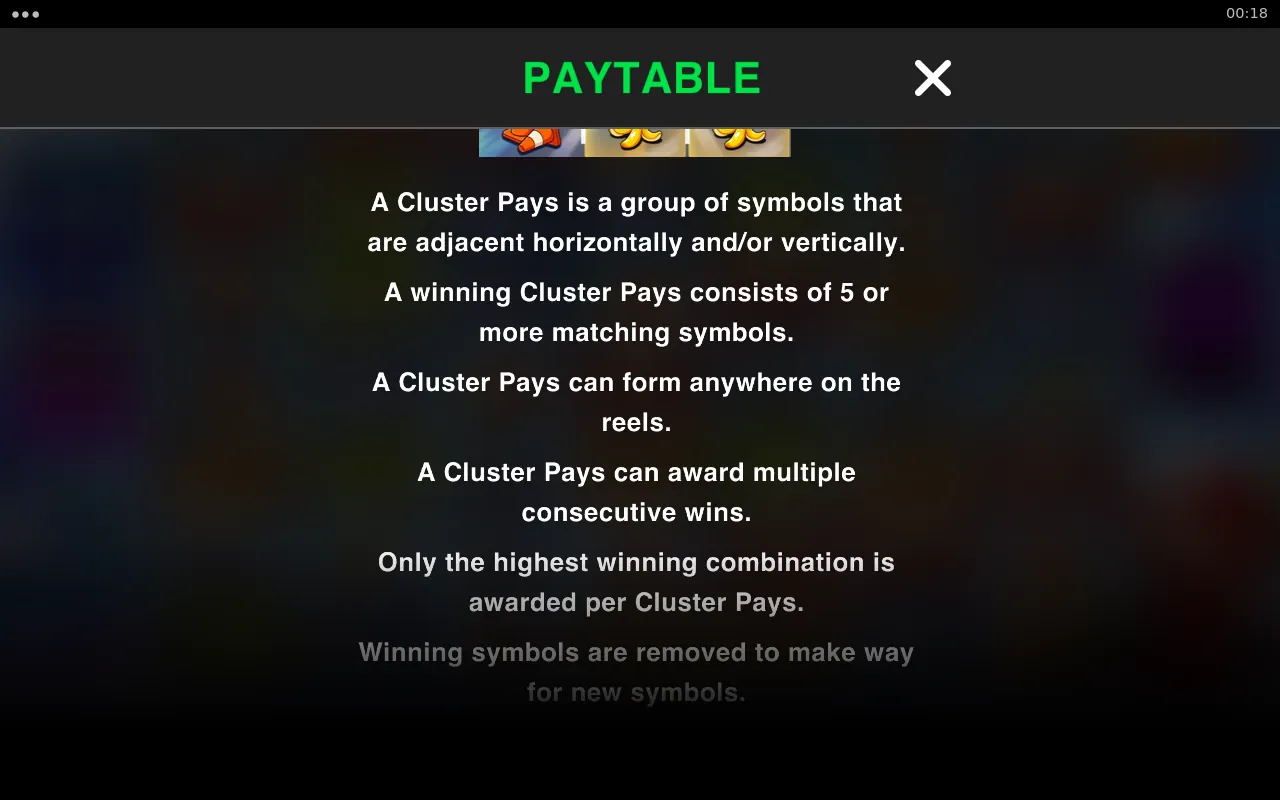
- Five or more matching symbols connect horizontally or vertically, anywhere on the reels
- Only the highest winning combination is paid per cluster
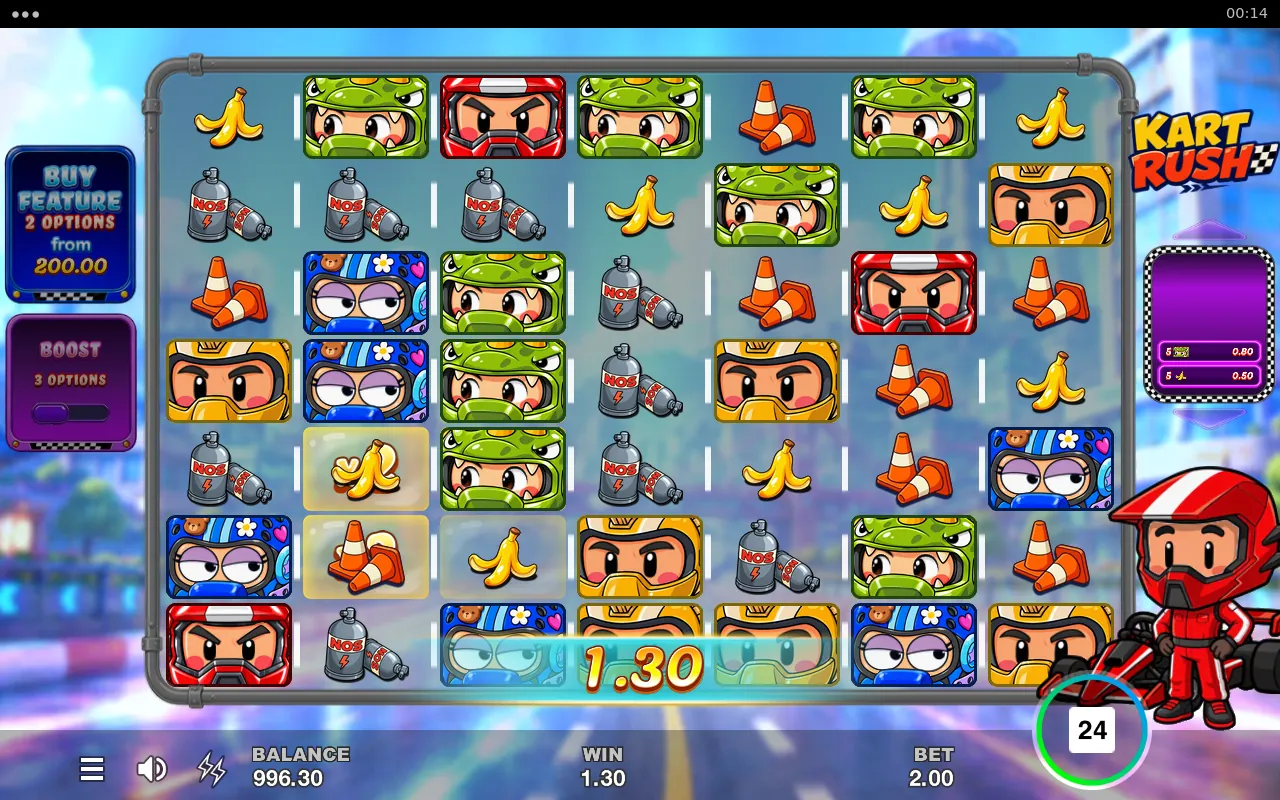
- Winning symbols are removed to make way for new symbols
- New symbols can form fresh clusters, awarding multiple consecutive wins on one spin
- The whole system runs in both the base game and the free spins
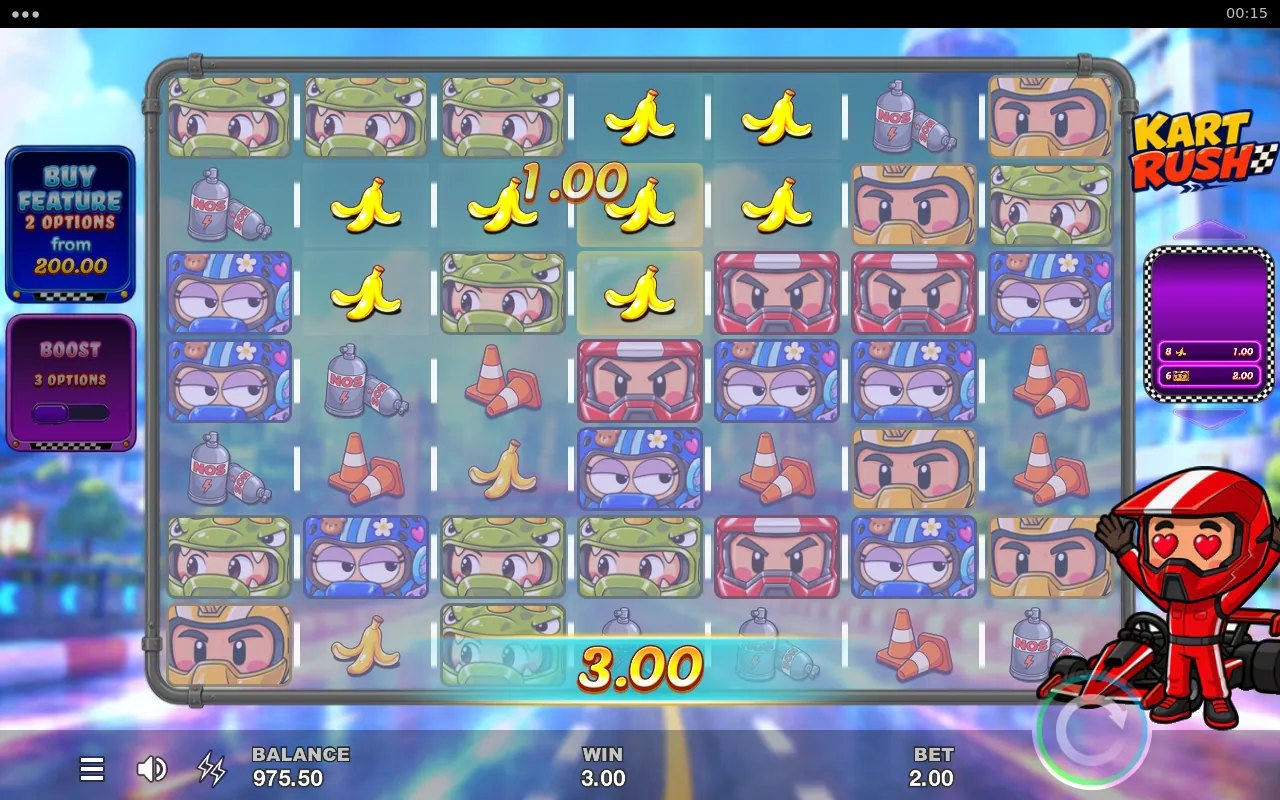
Those consecutive wins matter more here than in most tumbling games. Each removal leaves a mark behind, and the marks are where Kart Rush’s real arithmetic lives. The tumbling also means a single spin isn’t really a single spin: a five-symbol cluster that clears into another five-symbol cluster has already doubled its work, and the grid remembers every position involved.
Multiplier Grids
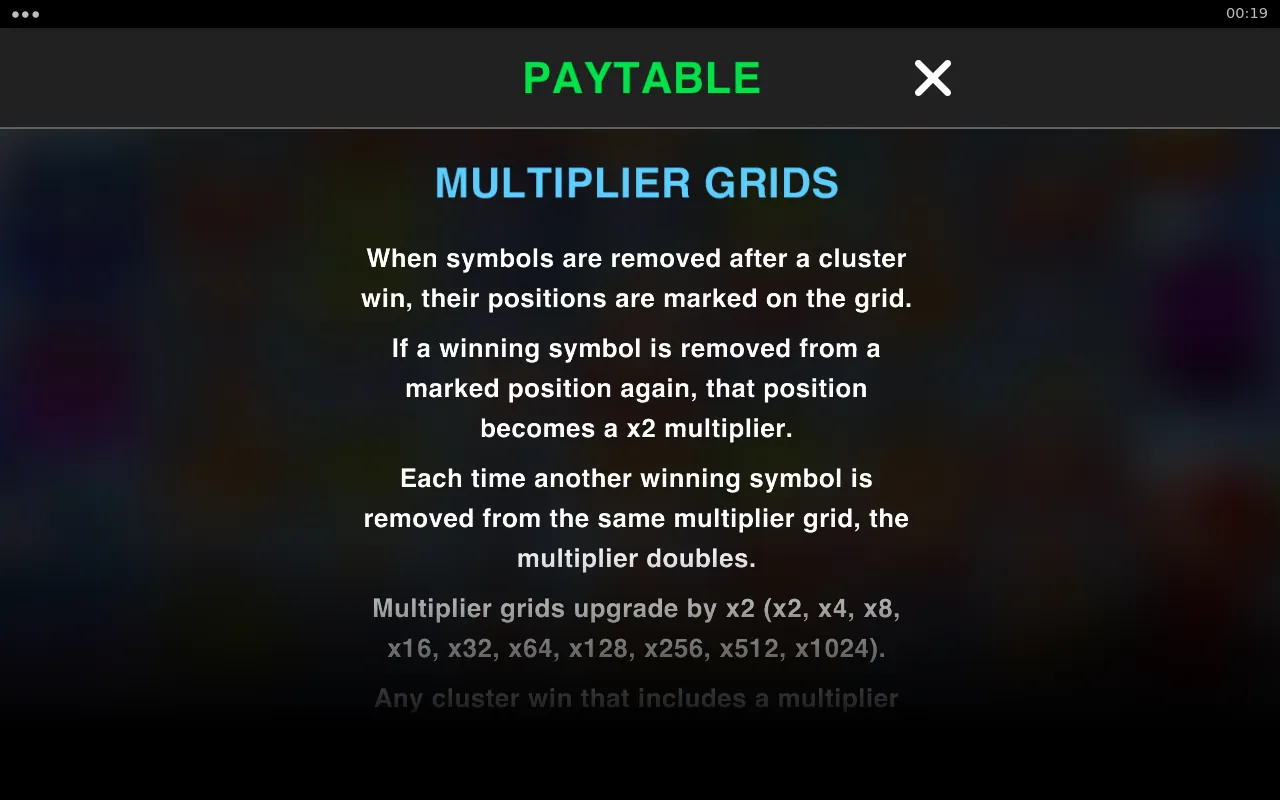
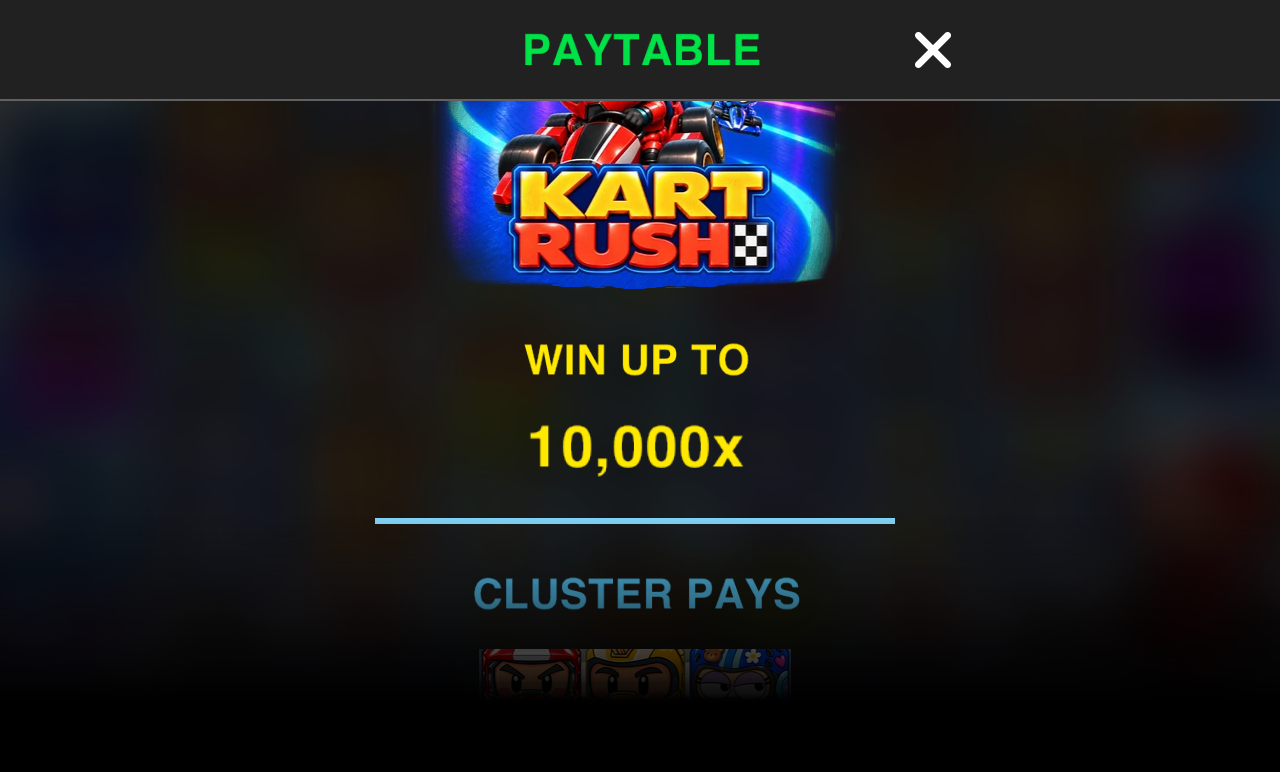
Every time symbols are removed after a cluster win, the positions they left behind get marked on the grid. If a winning symbol is then removed from one of those marked positions again, that position turns into a x2 multiplier. From there, the doubling never stops: each further winning symbol cleared from the same position doubles it again.
The full ladder is long, and every step of it is reachable within a single chain of tumbling wins:
- x2, the starting multiplier when a marked position clears a second time
- x4, on the third clear from the same position
- x8
- x16
- x32
- x64
- x128
- x256
- x512
- x1024, the top of the ladder
Any cluster win that includes a multiplier grid has its win amount multiplied by that multiplier. If a winning cluster includes more than one multiplier grid, the multipliers are added together before being applied to the win.
That adding rule is the quiet star of the mechanic. Two x64 grids feeding a single cluster pay x128, not x64 twice, and the sums grow quickly once a few positions have been through several tumbles in the same chain. Add rather than multiply sounds modest until the chain is long enough for the marks to stack up.
It’s a persistent-within-a-chain system rather than a persistent-per-session one: the marks build while symbols keep clearing, and the payoff arrives when a later cluster lands across the upgraded positions. A chain that keeps feeding the same corner of the grid turns that corner into the most valuable real estate on the reels. The 10,000x ceiling is where the ride ends.
Free Spins
The game runs a free spins round in which the cluster pays system carries over: clusters still form anywhere on the 7×6 grid and tumbles still chain. Beyond that, the rules don’t detail what the round changes.
That makes the round a concentration of the base game’s best moments rather than a separate mode. The clusters and multipliers are doing the same work with the throttle held down, and a long tumble chain in free spins is where the upgraded grids are most likely to pay what they’ve built. There’s no second mechanic to learn and no new rules to read, which is either reassuring or thin depending on what you want from a bonus round.
Buy Feature and Boost
Two selectable options sit alongside the spin button:
- Boost: three options, selectable before a spin
- Buy Feature: two options, priced from 200x the bet
Boost is a player-selectable option with three settings; the rules don’t state what it changes or what it costs. The Buy Feature offers two purchase options, the cheaper of them priced at 200x the bet, though the rules don’t state what a purchase delivers.
The buy price is on the steep side for a 10,000x ceiling, though the multiplier maths is what decides whether that’s fair, not the sticker. Neither option is required to reach the game’s better moments; they’re shortcuts for players who’d rather pay up front than grind for the trigger.
Our Honest Verdict
Overall Rating: 7/10
Playing Kart Rush is mostly watching a long chain build, and the reason to choose it is that the build pays: marks stack, a corner of the grid quietly doubles itself, and a late cluster lands across all of it at once. For a game with a kart on it, it’s a remarkably patient machine.
The strength is that the multiplier grids make every tumble matter, even the small ones, because a cheap cluster in the right place is doing work for a later win. The weakness is the free spins: it’s the same engine again with no new idea, so the round you waited for is the round you were already playing. The buy price from 200x only sharpens that.
It’s for players who enjoy a slow multiplier build and a theme that stays cheerful without asking for attention. Anyone who wants a bonus round with a second act will find one lap enough. That’s a fine lap, though, and the grid earns the trip.
Kart Rush FAQs
-
How do you win in Kart Rush?
Wins are cluster pays. Five or more matching symbols need to sit next to each other, horizontally or vertically, and they can be anywhere on the grid. Only the highest combination is paid per cluster. -
How do Multiplier Grids work?
Positions cleared by a cluster win get marked. If a winning symbol is removed from a marked position again, it becomes a x2 multiplier, and every further clear from the same position doubles it, up to x1024. Cluster wins that include a multiplier grid are multiplied by it, and several grids in one win are added together first. -
What happens when winning symbols are removed?
New symbols drop in to replace them, and those can form fresh clusters. A single cluster can therefore chain into several consecutive wins on one spin, and each removal also marks the grid for the multiplier system. -
What is the highest multiplier grid you can reach?
x1024. A grid position becomes x2 the second time it clears a winning symbol, and it doubles again with every further clear, stepping through x4, x8, x16 and onwards up to x1024. -
If a cluster includes two multiplier grids, are the multipliers multiplied together?
No. The multipliers are added together first, then applied to the win. Two x64 grids in one winning cluster multiply the win by x128. -
Can you buy the bonus on Kart Rush?
Yes. The Buy Feature offers two options, with prices starting from 200x the bet. -
What is the maximum win on Kart Rush?
The maximum win is 10,000x your bet. -
When is Kart Rush released?
Kart Rush’s release date is 25 November 2026.