














Money Plane Slot Review
Relax Gaming have spent years building the Money Train universe into one of the most recognisable brands in iGaming, and with Money Plane they make a calculated move sideways rather than forward. Instead of delivering a fifth instalment of the Money Cart mechanic, they have taken the series’ familiar characters and aesthetic and grafted them onto a crash-style flight format. The result sits in territory between Aviator and a conventional video slot, sharing DNA with both while belonging squarely to neither.
Crash games have attracted a growing audience over the past few years, largely driven by the appeal of a single rising multiplier and the tension of deciding when to bail out. Money Plane’s key departure from that blueprint is the removal of the manual cash-out button entirely. Each round resolves on its own terms: the plane takes off, interacts with objects along the route, and either touches down on a train at the end of the flight or crashes and forfeits everything. It is a different kind of suspense, and one that will divide opinion among crash game regulars.
How Money Plane Works
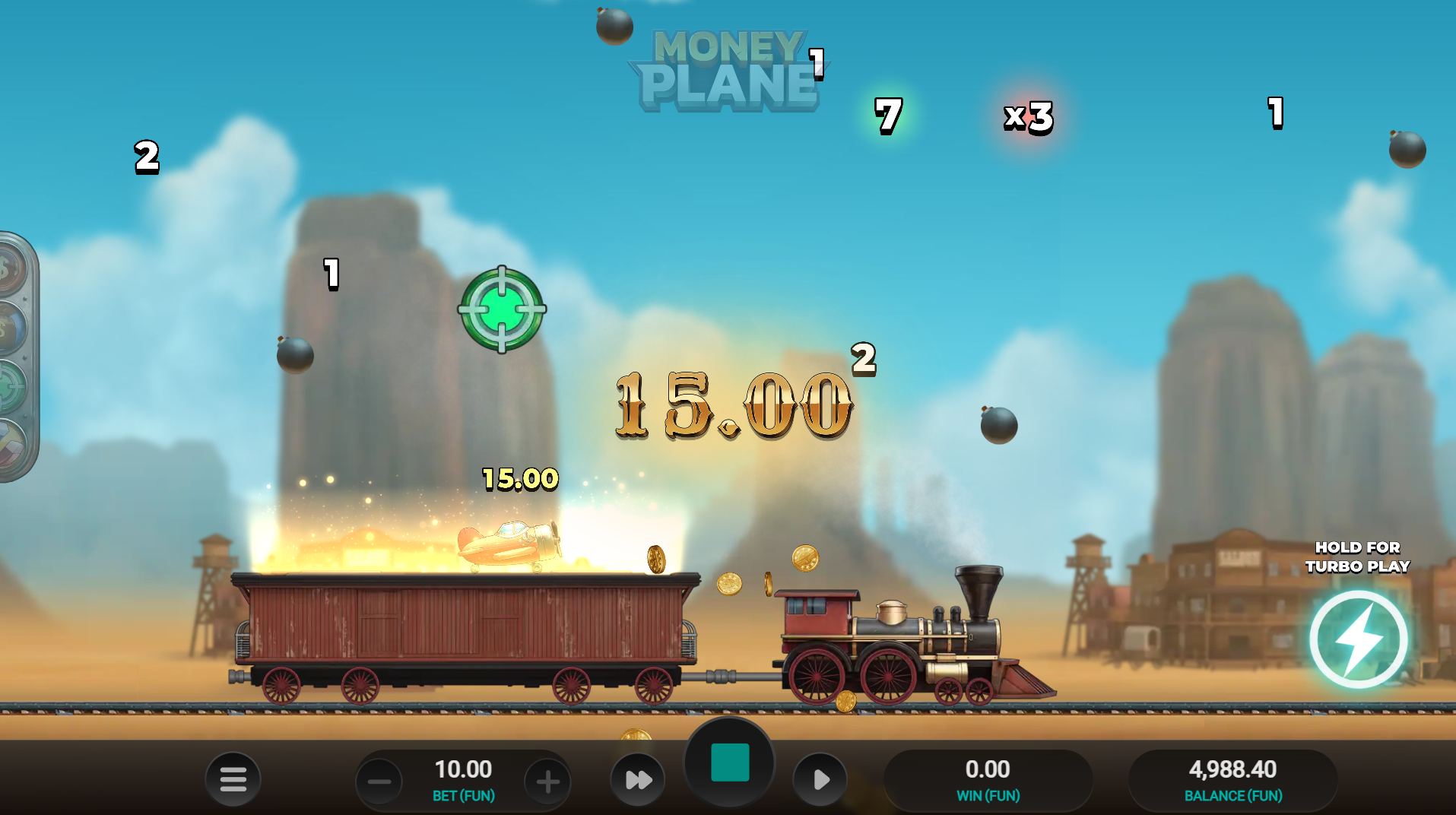
Money Plane is not a traditional slot and does not operate like one. There are no reels, no rows, no paylines, and no grid of symbols to land. Instead, each round unfolds as a single flight sequence: the plane leaves the runway on a 1x multiplier and travels a path populated with three types of objects.
Number tiles add a flat amount to the running multiplier, ranging from +1 to +10. Multiplier tiles scale the total by x2 up to x10, making them the objects most likely to produce dramatic jumps. Bombs cut the running multiplier in half, functioning as the hazard element that keeps each flight uncertain. A round pays out only if the plane successfully touches down on a train at the conclusion; a crash forfeits whatever multiplier had accumulated up to that point.
The pacing is noticeably quick. Unlike traditional slots where sessions involve long periods of unremarkable base game spins punctuated by infrequent bonuses, every Money Plane round is active from the moment the plane takes off. The combination of bombs, number tiles and multiplier tiles means something is always happening, and the relatively brisk resolution of each round makes it easy to settle into a rhythm. The 33% hit frequency means roughly one in three rounds ends with a payout, which keeps things from feeling relentless in either direction.
Volatility Tiers
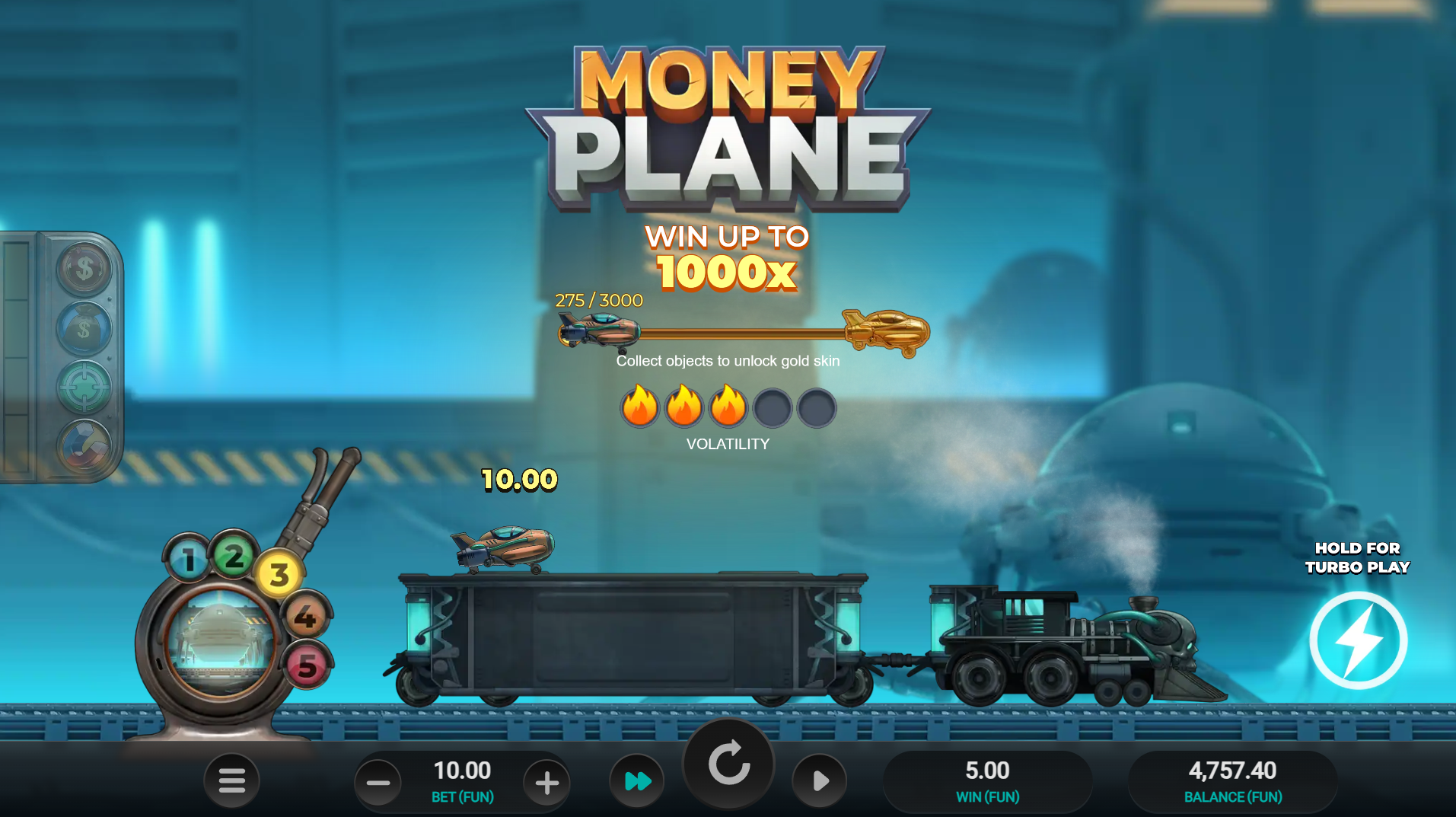
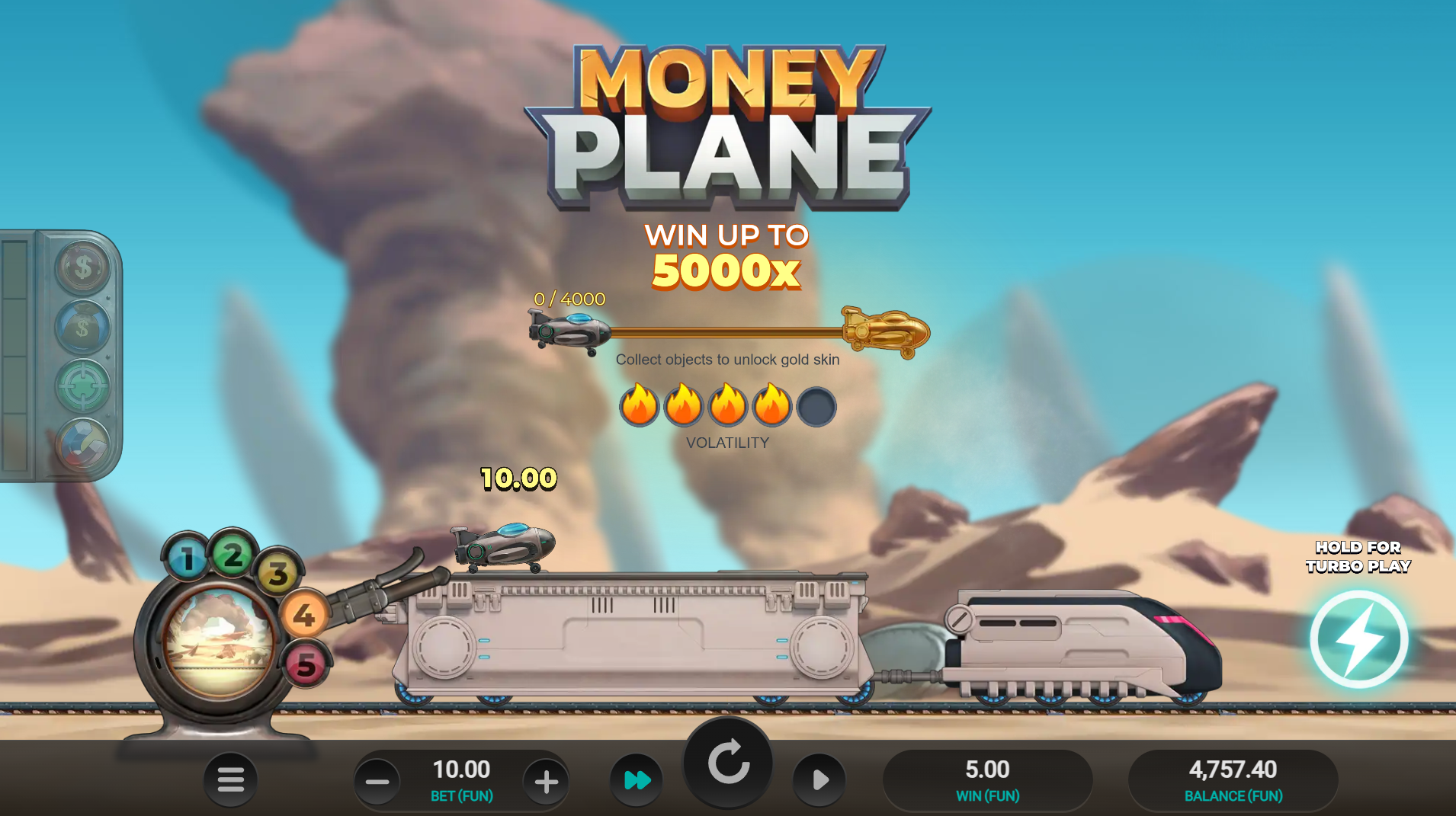
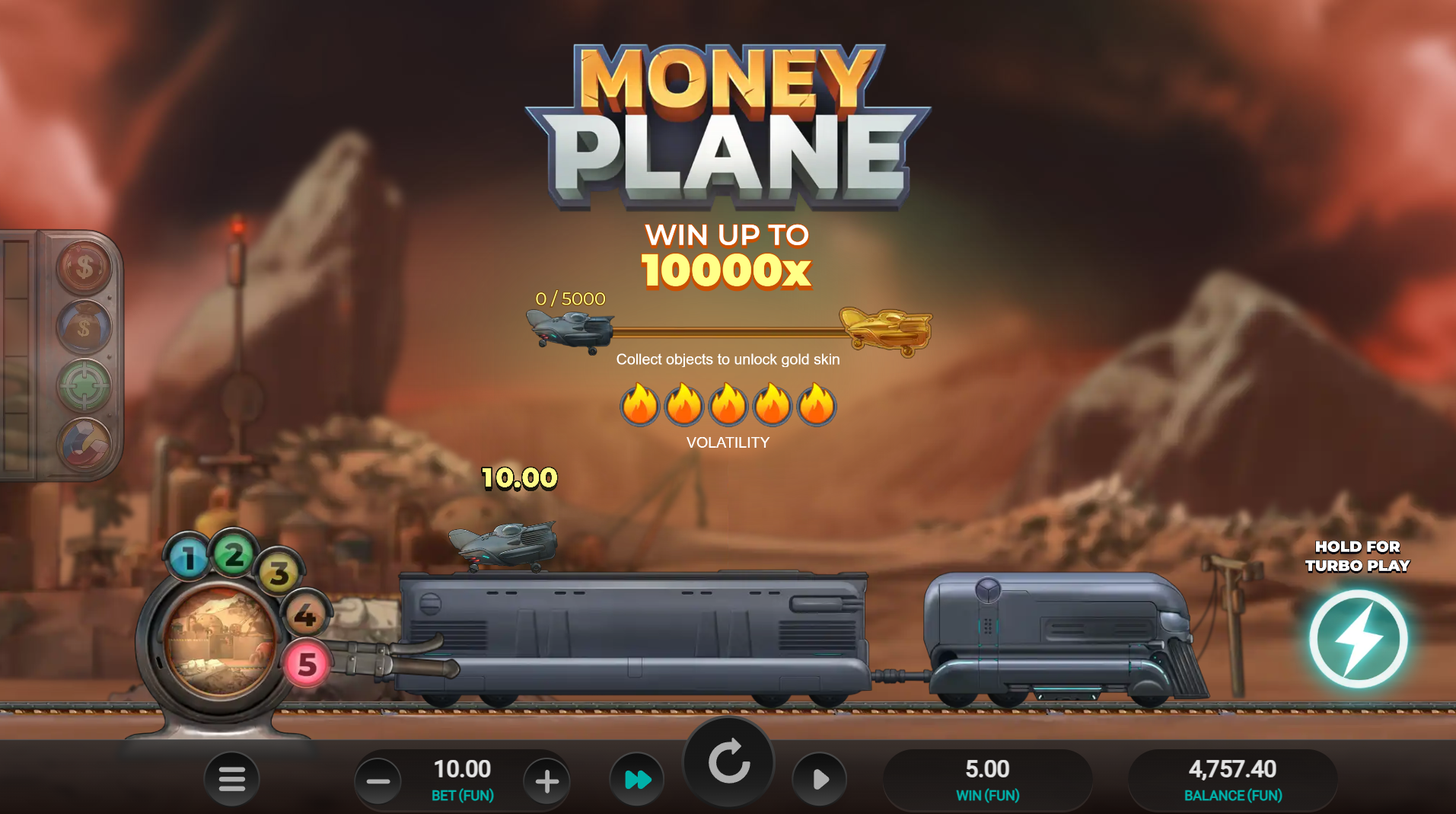
Before each round the player selects one of five volatility tiers, which can be changed between rounds. Each tier carries its own Money Train-inspired backdrop and its own payout ceiling: the lowest tier caps wins at 250x the stake, while the highest tier opens the game up to 10,000x. The maximum bet also varies by tier, with the highest levels accepting stakes up to £1,000 per round and the entry level accessible from £0.10.
Crucially, the RTP holds at 97% across all five tiers. That consistency is meaningful: players moving to higher volatility are not sacrificing long-term return percentage, only accepting a shift in the distribution of outcomes. The tiers genuinely change the character of play rather than simply relabelling the same experience. Low Volatility delivers a more consistent flow of smaller payouts with fewer dramatic swings, while High Volatility produces extended stretches of quieter rounds punctuated by flights where significant multipliers become achievable.
Our testing confirmed the experiential differences between tiers are meaningful. Medium Volatility felt like the practical centre point, offering a reasonable mix of ordinary flights and moments where the power-ups and multiplier tiles combined to produce something more substantial. The jump between Medium-High and High Volatility was perceptible, with High producing longer quiet periods but a noticeably more tense atmosphere when flights did develop well.
Power-ups and the Charge Mechanic
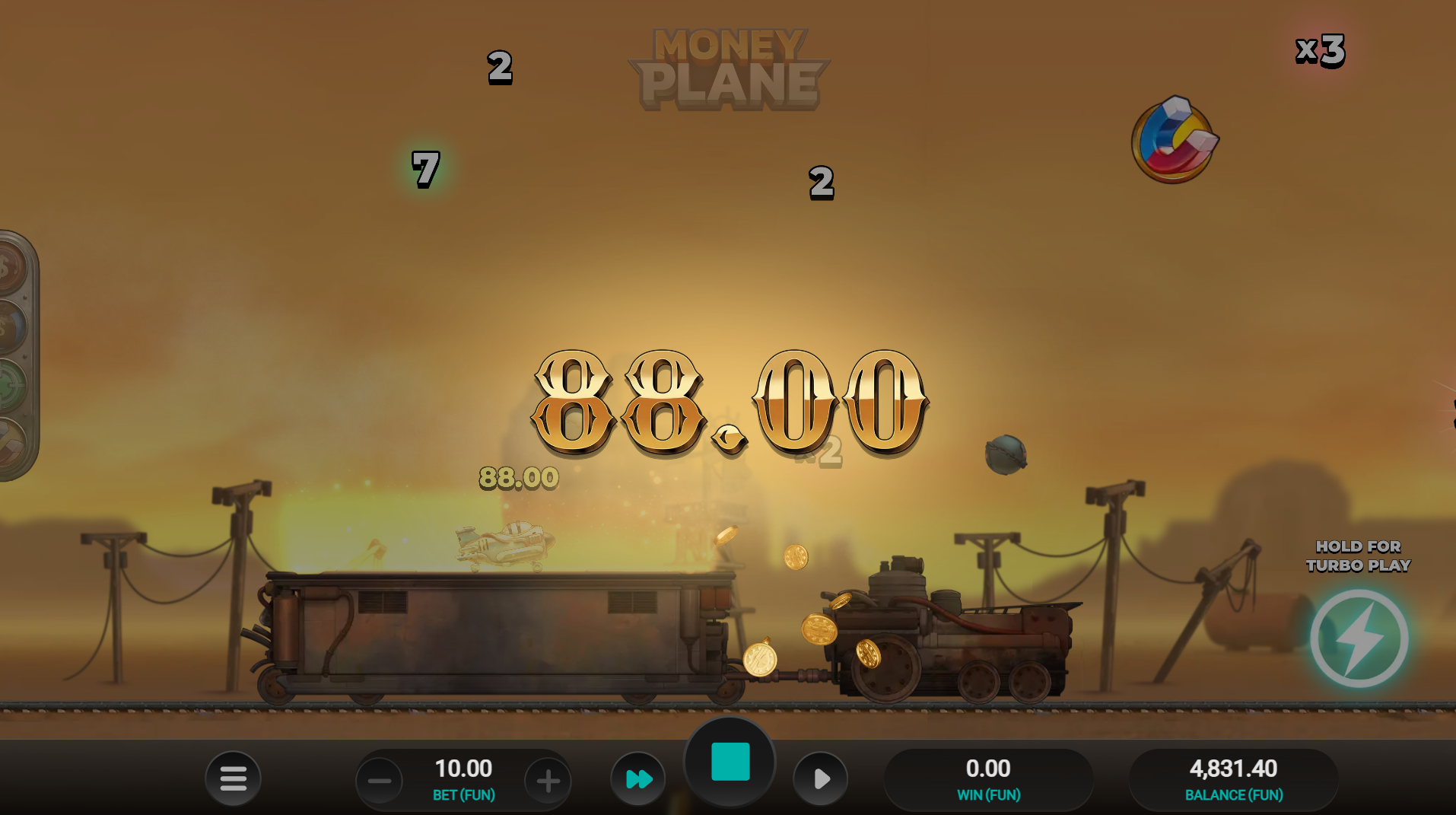
The power-up system is where Money Plane separates itself most clearly from a straightforward crash format. A charge meter builds by one step for every object the plane strikes during a flight. Once the meter fills after four hits, any power-ups collected that round fire in sequence before the meter resets. Four distinct abilities are available, each operating on a different principle.
The Four Power-ups
Necromancer converts a rocket tile into either a value tile or a multiplier tile, effectively turning a potential hazard into a beneficial object. In practice this produced some of the more surprising moments during play, since a rocket that might otherwise complicate the flight suddenly becomes a source of additional multiplier value. It is the power-up with the highest entertainment-to-function ratio, since the transformation feels like a genuine reprieve.
Payer upgrades the nearest value or multiplier tile, boosting its output. The effect is less visually dramatic than Necromancer or Sniper but consistently useful, particularly on flights where the tile distribution is workable rather than spectacular. It reliably adds value without demanding a particularly favourable board state to do so.
Sniper doubles the nearest value or multiplier tile. This is the power-up most likely to produce standout moments, since doubling a meaningful multiplier tile during a flight where several other objects have already been collected can shift the trajectory of a round sharply upward. On higher variance tiers, Sniper firing at the right moment creates the clearest sense of a flight turning from ordinary to potentially significant. During our session, Sniper consistently delivered the most impactful moments and was the standout among the four abilities.
Collector banks the value from the nearest tile, locking it in before the flight concludes. It introduces an element of security into an otherwise automatic process, which suits the format well given that a crash forfeits everything. Collector firing late in a flight that has accumulated a decent multiplier provides a measure of insurance against an untimely crash.
The charge meter fills naturally across a flight rather than requiring specific conditions to be met, so power-ups activate with reasonable regularity during rounds where the plane encounters multiple objects. The staggered firing order, when multiple power-ups have been collected, creates short sequences where one activation feeds into the next, and those sequences account for some of the more substantial rounds the game produces.
Frequent Flyer Progression
Each volatility tier tracks a separate object-collection count across sessions. Reaching the target for a given tier, set at 1,000 objects for Tier 1 through to 5,000 for Tier 5, unlocks a Golden Edition variant of that tier’s plane. This is a cosmetic reward with no bearing on payouts or round outcomes, and Relax Gaming are transparent about that distinction. It functions as a soft progression system for players who return regularly, providing a sense of accumulation that sits outside the individual round stakes.
The Frequent Flyer system will mean different things to different players. For those who play long sessions across multiple tiers it provides a visible measure of engagement; for players who dip in occasionally it is largely invisible. It does not alter the strategic calculus of any individual round, which keeps it appropriately incidental rather than distracting.
Presentation and Platform
Visually, Money Plane borrows heavily from its Money Train heritage. The characters, colour palette and overall aesthetic carry the same energy as the series, though the setting translates the familiar western theme into an aviation context with reasonable coherence. Each volatility tier presents its own backdrop, which gives the different risk levels a visual identity beyond the numbers. Money Train fans will recognise the inspiration immediately; those unfamiliar with the series will find a polished, thematically consistent production that does not feel generic despite the crash-game format.
The audio is functional and well-judged. The soundtrack builds tension during each flight without becoming repetitive across sessions, and the sound effects that accompany tile collection and power-up activation provide clear feedback. Nothing in the presentation feels over-engineered or distracting, which suits a format where the focus is on the flight itself rather than surrounding spectacle.
Performance is consistent across desktop and mobile. The interface adapts cleanly to smaller screens, which is appropriate given the format’s suitability for shorter, more frequent sessions. The simplicity of the core loop, with no manual timing decisions required, translates particularly well to mobile play.
Our Honest Verdict
Overall Rating: 6.5/10
Money Plane is a considered piece of product design from Relax Gaming. Taking a well-established franchise and adapting its visual language for a crash-style format is not the most obvious creative decision, but it produces something that occupies a genuinely distinct position in both categories it touches. It is neither a conventional slot nor a pure crash game, and that hybrid quality is simultaneously its main selling point and the source of its likely polarisation.
The 97% RTP is excellent and applies regardless of which volatility tier is selected, which removes a common concern about games that offer risk-level selection. The five tiers themselves provide genuine variety rather than cosmetic differentiation: Low Volatility produces a different session character from High Volatility in ways that are perceptible from early rounds. The 10,000x maximum win on the highest tier is competitive for the format, and the power-up system gives each flight more texture than a straightforward multiplier climb would provide.
The automatic resolution mechanic, where there is no cash-out button and each round settles on its own, divides opinion. Players who approach crash games primarily for the timing tension will find that element absent. What replaces it is a different kind of engagement: watching the power-ups fire in sequence, tracking how bombs interact with accumulated multipliers, and understanding which tier best suits a given session. It is a more passive format in one sense and a more strategic one in another.
Players looking for traditional reels, paylines and bonus rounds will not find them here. Money Plane is unambiguously aimed at the audience that has grown comfortable with crash-format games and wants something with greater mechanical depth than most of that category offers. For that player, the combination of selectable variance, stacked power-ups and the Money Train presentation makes it a worthwhile addition to the catalogue. For the traditional slot player, this is a significant departure that may not connect despite the familiar branding.
Money Plane FAQs
-
What is the RTP of Money Plane by Relax Gaming?
Money Plane has an RTP of 97% regardless of which volatility level is selected. -
What is the maximum win in Money Plane?
Money Plane offers different maximum wins ranging from 250x to 10,000x the bet, depending on the volatility level selected. -
Is Money Plane a traditional slot game?
No, Money Plane is not a traditional slot game. Reels, rows, and paylines are completely absent. Instead, Money Plane is an offshoot of Aviator crash-style games where a plane rises, interacts with objects, and either crashes or pays. -
Can you change volatility levels in Money Plane?
Yes, volatility can be altered at any time between game rounds. Each level caps the maximum bet and offers different max win from 250x to 10,000x. -
What happens if the plane crashes in Money Plane?
If the plane crashes, players do not collect the reward. However, there is no need to hit a cash-out button; each round resolves automatically. -
What are the power-ups in Money Plane?
Money Plane features four main power-ups: Necromancer (converts a rocket into a value or multiplier tile), Payer (boosts the nearest value or multiplier tile), Sniper (doubles the nearest value or multiplier tile), and Collector (banks the nearest value or multiplier tile). -
What is the minimum bet in Money Plane?
The minimum stake is £0.10 in all cases, regardless of the volatility level selected. -
How is Money Plane different from Money Train?
Money Plane is a crash-style game with no traditional reels or paylines, while Money Train is a 5×4 traditional video slot with 40 fixed paylines. Money Plane offers volatility tier selection, while Money Train focuses on a Money Cart bonus round.