
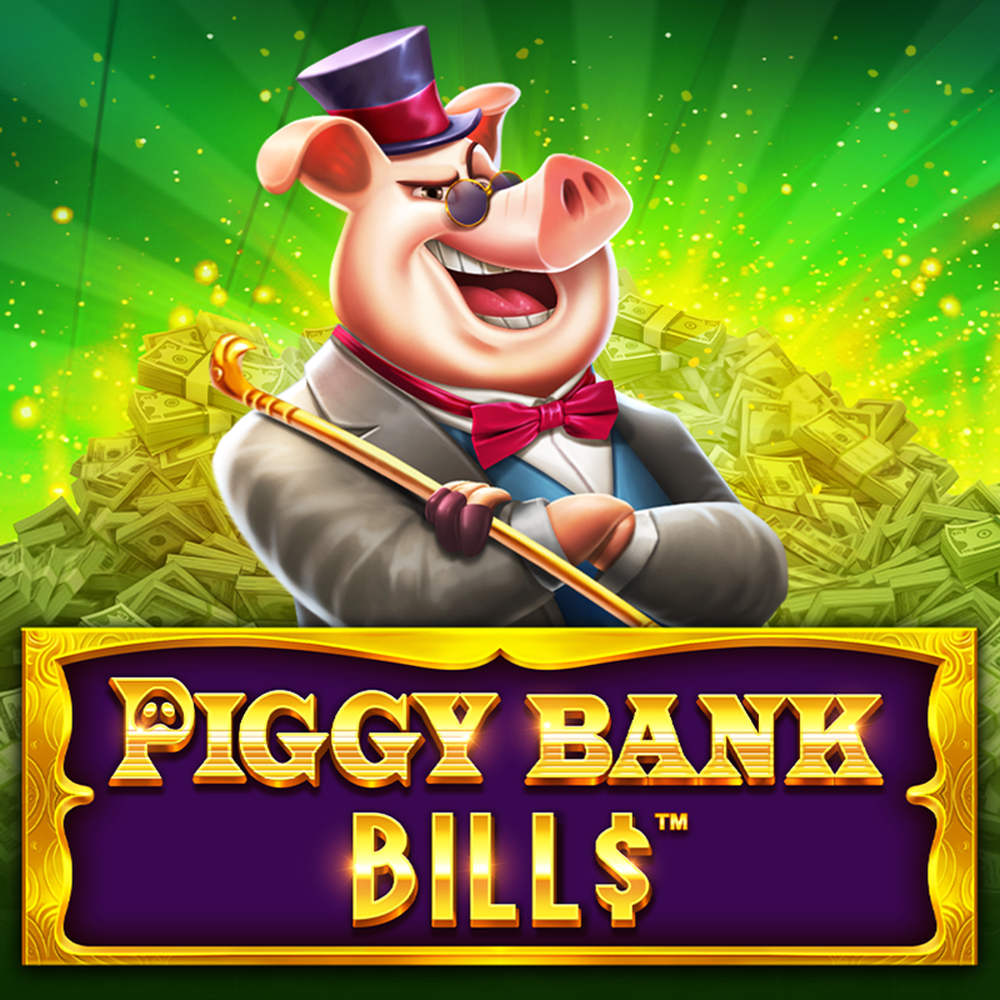











Piggy Bank Bills Slot Review
Every banknote in this game arrives torn in half, and a half-bill on its own pays nothing, which means most spins in Piggy Bank Bills end one symbol away from a win. That’s a braver design than it looks: Pragmatic Play have built a 6×3 grid where near-misses are the entire texture of play, and it works because a wild facing anything completes the bill. The torn-note trick doesn’t just dress up a cartoon banking theme, it decides what every spin is worth.
The slot runs at 96.50% RTP with medium volatility, on a 6×3 grid where symbols pay anywhere in pairs. Wins are capped at 5,000x the bet, and stakes run from 0.20 to 240. It sits alongside Pragmatic’s other porcine outings, Greedy Fortune Pig and Pig Farm, and shares its piggy-bank naming with You Can Piggy Bank On It, which we covered in 2026 with a very different feature set under a similar mascot.
Base Game & Features
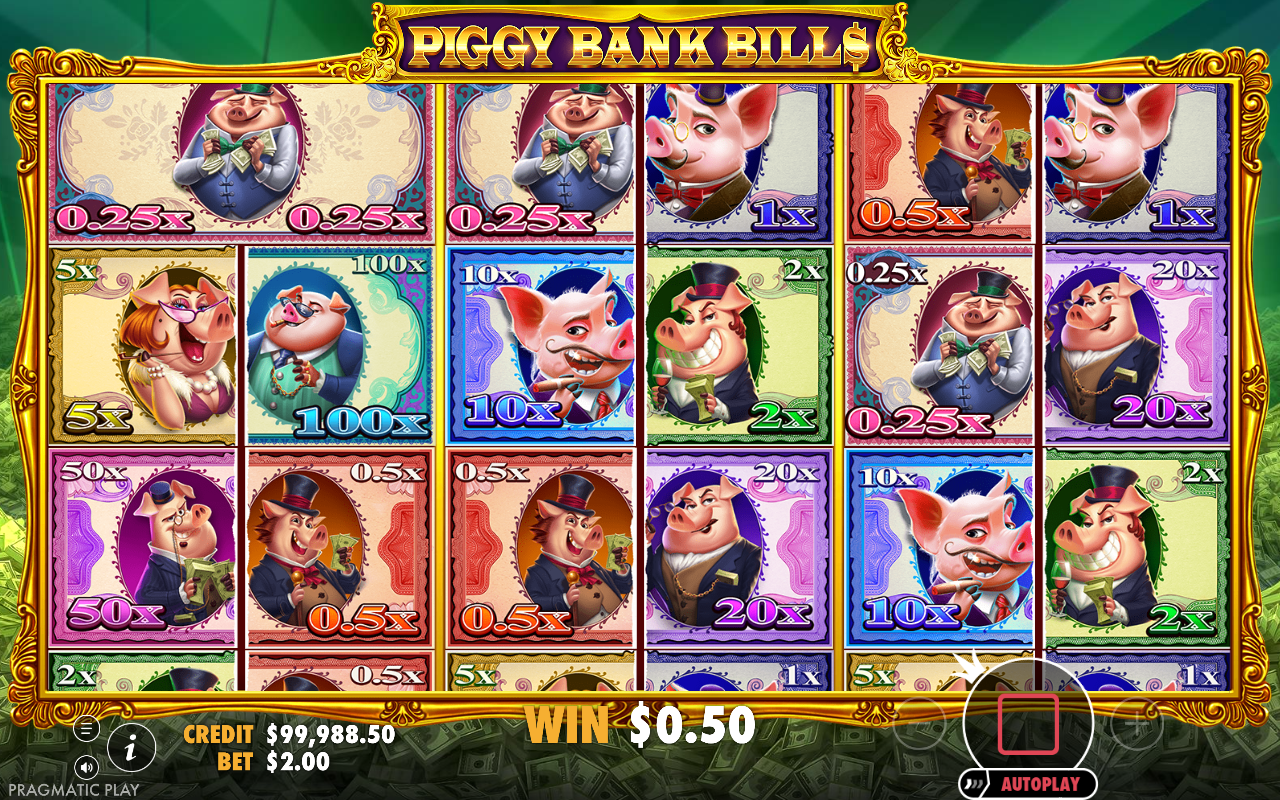
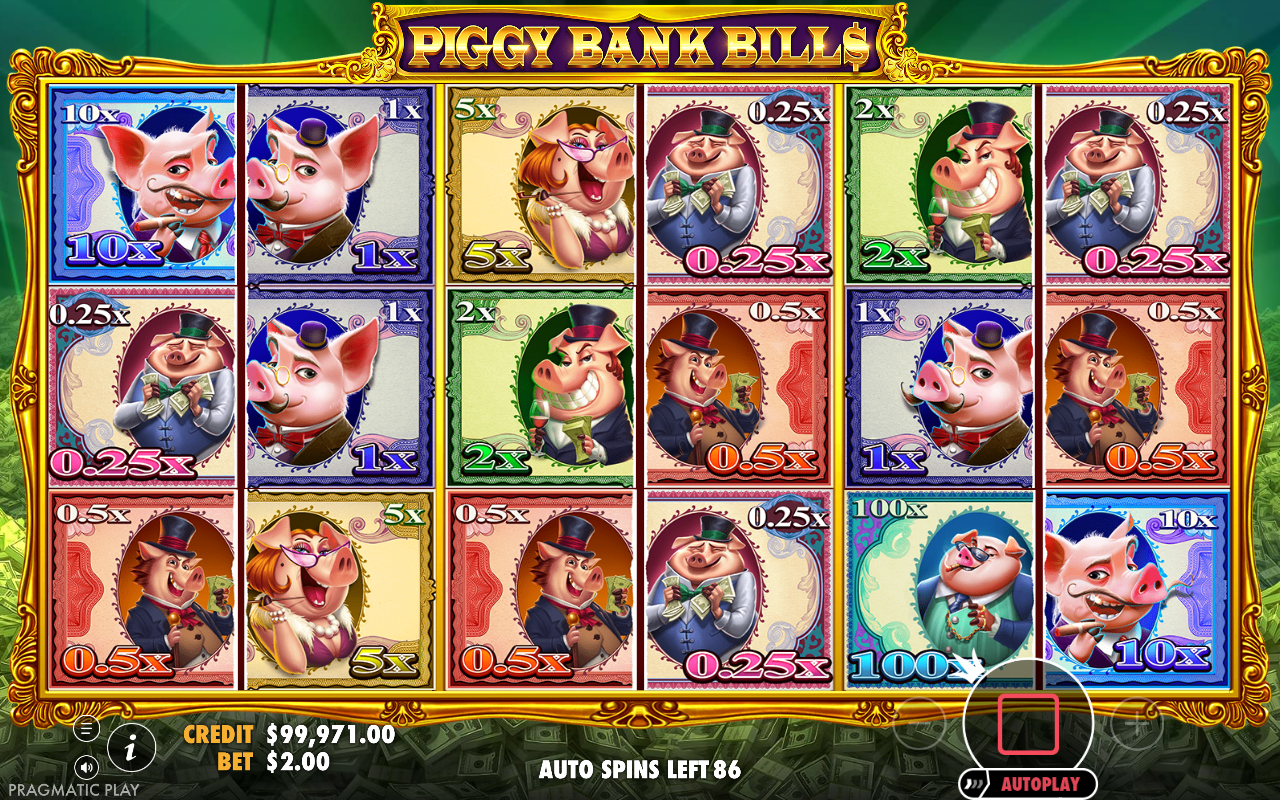
Every paying symbol in Piggy Bank Bills is half a banknote. Symbols pay anywhere on the screen, in pairs of two, and a win only counts when two halves with the same value face each other. When they do, they join into a whole bill and the amount printed on it is paid.
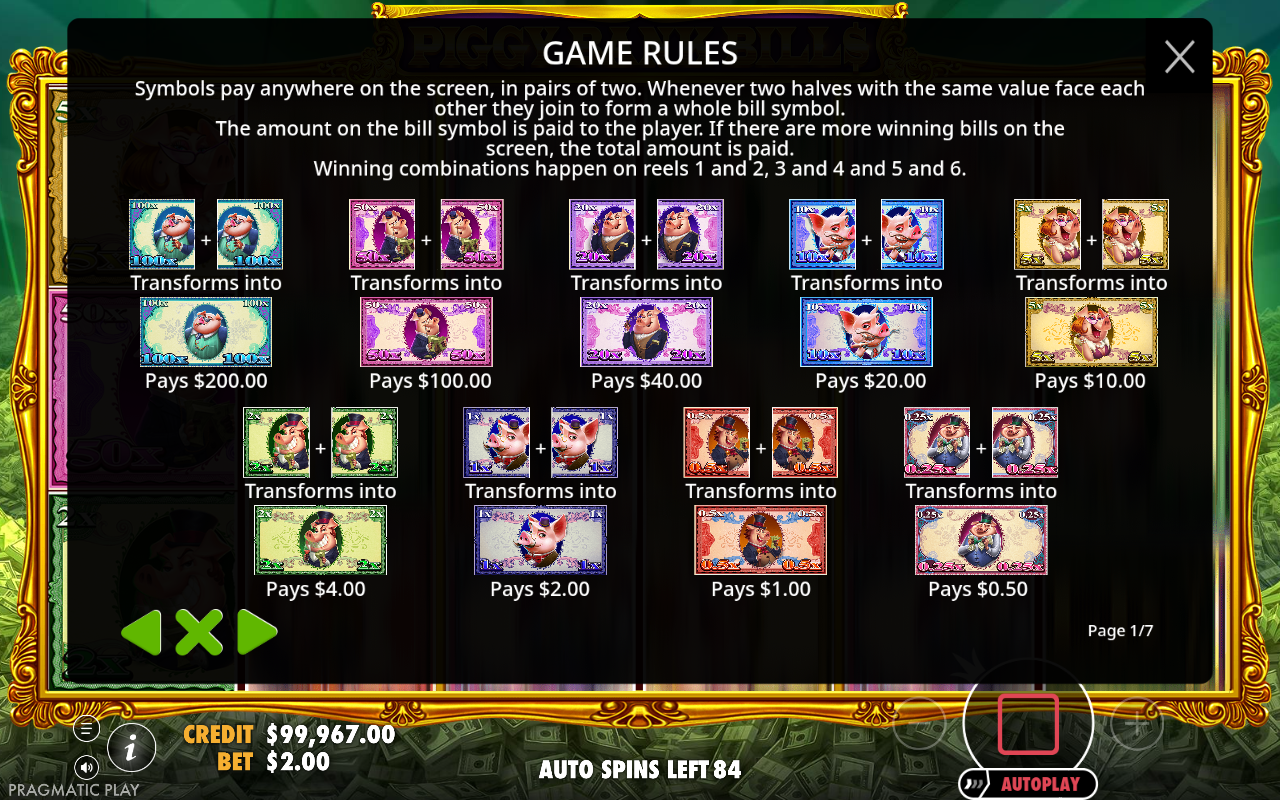
Winning pairs form across reels 1 and 2, 3 and 4, and 5 and 6, so position matters as much as value. A half-bill sitting on reel 2 is useless without its twin on reel 1, and the same goes for every other pair of adjacent reels. If several winning bills land on the same spin, the total is paid. The paytable is a ladder of pig-adorned notes, each pair paying as a multiple of the total bet:
- Green pig pair – 100x total bet
- Pink pig pair – 50x total bet
- Purple pig pair – 20x total bet
- Blue pig pair – 10x total bet
- Gold pig pair – 5x total bet
- Lower green pig pair – 2x total bet
- Lower blue pig pair – 1x total bet
- Red-brown pig pair – 0.5x total bet
- Bottom blue pig pair – 0.25x total bet
Wild Symbols
The wild appears on all reels and substitutes for everything except the scatter. When a wild lands facing a regular half-bill, it transforms to match that symbol’s value, the two halves merge, and the bill pays. The transformation is what makes the wild more than a filler: it doesn’t stand in for a missing symbol the way a traditional wild does, it adopts the exact value of whatever it faces, so a wild opposite the green pig pays the full 100x.
Two wilds facing each other become a single WILD bill with a random value, which is where the base game’s biggest surprises come from. That bill’s worth isn’t tied to the paytable at all, so a wild pair can out-pay every ordinary combination on the screen.
Random Modifiers
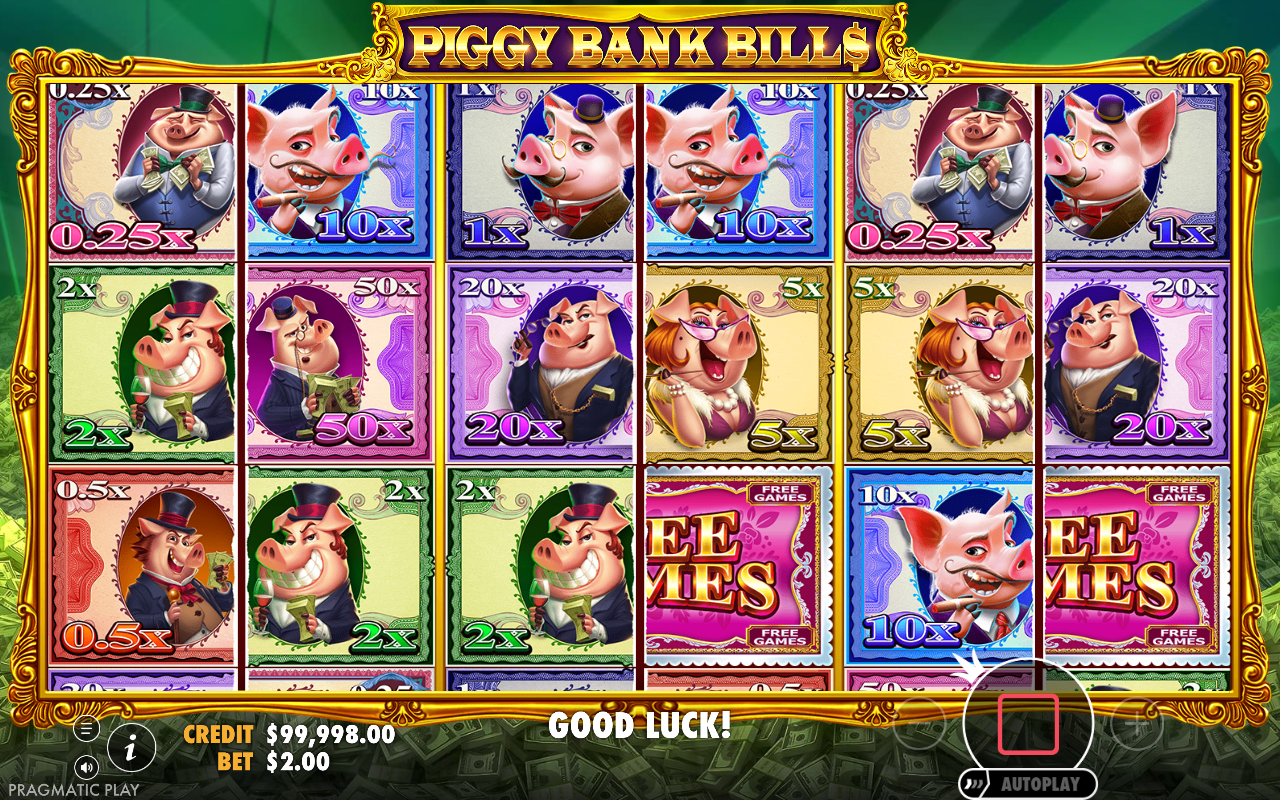
At any spin, one of three random modifiers can hit without warning:
- Free games awarded outright
- Up to 3 symbols replaced with matching halves after the reels stop, forming winning bills
- 2, 3 or 4 wilds scattered across the screen in random positions
There’s no trigger to watch for and no build-up. The modifiers simply arrive, and the wild scatter in particular can turn a dead spin into several completed bills at once. The symbol-swap modifier works the other way round: the reels stop, the swap converts mismatched halves into matching ones, and bills complete that the grid alone wouldn’t have paid.
Piggy Bank Bills Bonus Features & Free Spins
The scatter is a half-bill like everything else, appearing on all reels. 2 facing scatter halves merge into a SCATTER bill, and the count of scatter bills on the triggering spin decides the quality of the round:
- 1 SCATTER bill – 8 free games
- 2 SCATTER bills – 8 free games, with the lowest paying symbols removed from the reel strips during the round
- 3 SCATTER bills – 8 free games, with the lowest two paying symbols removed
Inside the round, a new paying symbol joins the strips, worth 1,000x the total bet as a completed pair. Special reels are in play throughout, and the round cannot be retriggered, so 8 games is always the full count. The free games win is paid in full once the round completes.
Multipliers
Random multipliers of 2x or 3x can appear over the symbols during free games. A multiplier sitting on top of a winning bill applies to that bill’s value. When two multipliers land on the same bill they multiply each other first, so a 2x and a 3x stacked together boost the bill by 6x. Multipliers only pay out when the bill beneath them completes, so a 3x over an unmatched half is worth nothing.
Symbol Removal
The scatter count also sets a schedule for stripping the low end out of the reel strips as the round progresses:
- Triggered by 1 SCATTER bill – the 0.25x symbol goes at free game 2, the 0.5x at game 4, the 1x at game 6 and the 2x at game 8
- Triggered by 2 SCATTER bills – the 0.5x symbol goes at free game 2, the 1x at game 4 and the 2x at game 6
- Triggered by 3 SCATTER bills – the 1x symbol goes at free game 2 and the 2x at game 4
Removals are permanent for the rest of the round, so each one raises the odds of drawing a higher-value half with every subsequent spin. By the back half of a 3-scatter round, the strips carry almost nothing but high-value pig pairs, the 1,000x symbol and the multipliers. The round’s ceiling is the game’s overall cap: the maximum win is limited to 5,000x the bet, and a round that reaches it ends immediately with the win awarded and any remaining features forfeited.
Our Honest Verdict
Overall Rating: 7.9/10
Playing this is a game of almosts. The grid is always full of halves, so nearly every spin lands close enough to a bill to matter, and the wilds complete what the reels can’t. Nobody picks this up for the theme alone; they pick it up because a slot built entirely out of torn notes plays differently to anything with ordinary symbols.
The best thing here is the free games round, and the reason is the removal schedule: a 3-scatter trigger gets visibly richer as it runs, which is rare in a fixed 8-spin round with no retrigger. The weak spot is the base paytable, which tops out at 100x and leaves the ordinary spin feeling small next to the game’s 5,000x ceiling.
It’s a good fit for anyone who enjoys a clever mechanic and medium-volatility pacing, and the wrong one for anyone chasing the biggest numbers in the Pragmatic catalogue. For the rest, the pigs keep their notes honest and the halves worth matching.
Piggy Bank Bills FAQs
-
How do wins form in Piggy Bank Bills?
Every symbol is half a banknote, and two halves with the same value must face each other to merge into a whole bill, which then pays. Winning pairs form across reels 1 and 2, 3 and 4, and 5 and 6, and symbols pay anywhere on the screen rather than across fixed paylines. -
What does the wild do in Piggy Bank Bills?
The wild appears on all reels and substitutes for everything except the scatter. When it faces a regular half-bill it transforms to match that symbol’s value, merges with it and pays the bill. Two wilds facing each other join into a whole WILD bill of random value. -
What do the random modifiers do?
At any spin, one of three modifiers can hit: free games awarded outright, up to 3 symbols replaced with matching halves to form winning bills after the reels stop, or 2 to 4 wilds scattered across the screen in random positions. -
How is the Free Games round triggered?
2 scatter halves facing each other merge into a SCATTER bill. 1 SCATTER bill awards 8 free games, 2 bills award 8 free games with the lowest paying symbols removed during the round, and 3 bills award 8 free games with the lowest two paying symbols removed. -
Can the Free Games round be retriggered?
No. The round cannot be retriggered, so 8 free games is always the total, though special reels and the 1,000x symbol are in play throughout. -
How do the multipliers work in Free Games?
Random 2x or 3x multipliers can appear over the symbols during the round. Each one applies to the value of the winning bill it sits on, and when two land on the same bill they multiply each other first, so a 2x and a 3x together boost the bill by 6x. -
What is the RTP of Piggy Bank Bills?
The RTP is 96.50%. -
What is the maximum win on Piggy Bank Bills?
The maximum win is capped at 5,000x the bet. If a round’s total win reaches that cap, the round ends immediately, the win is awarded up to the cap and any remaining features are forfeited.