










Recycle Riches Slot Review
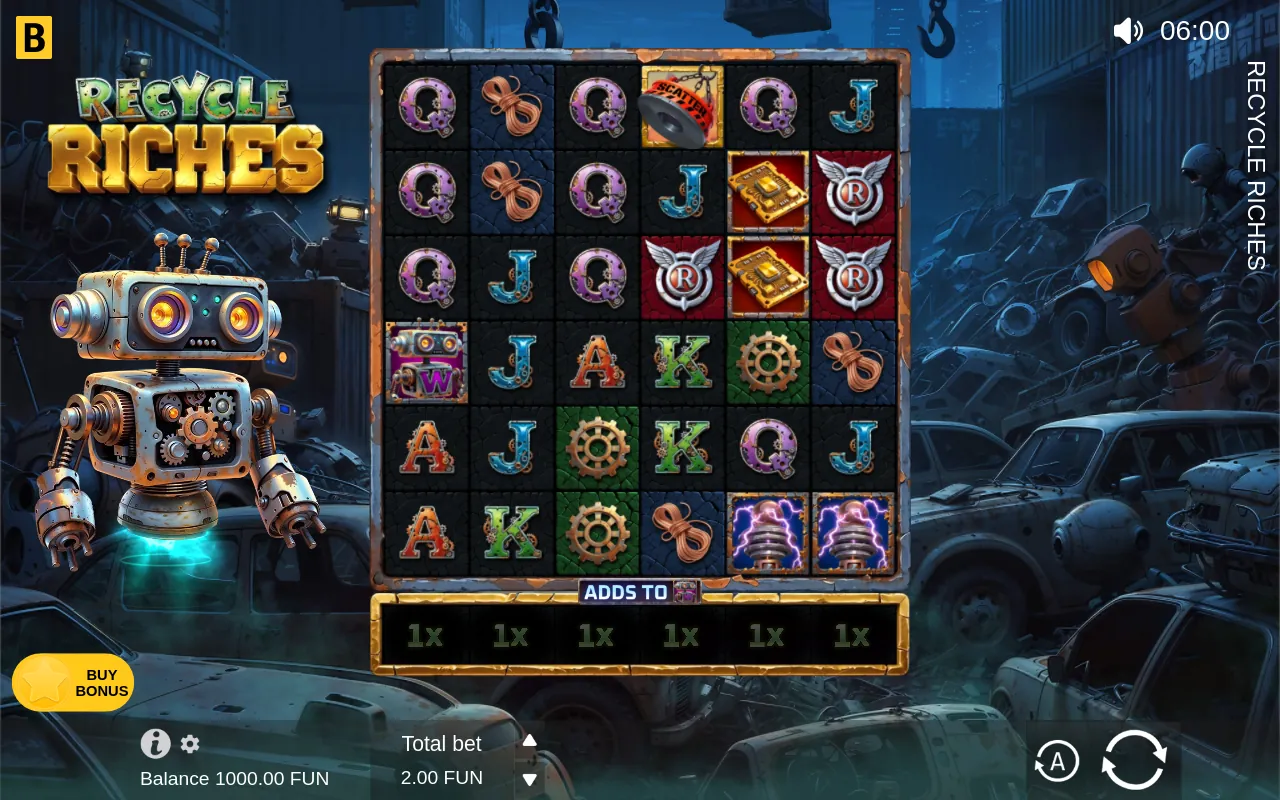
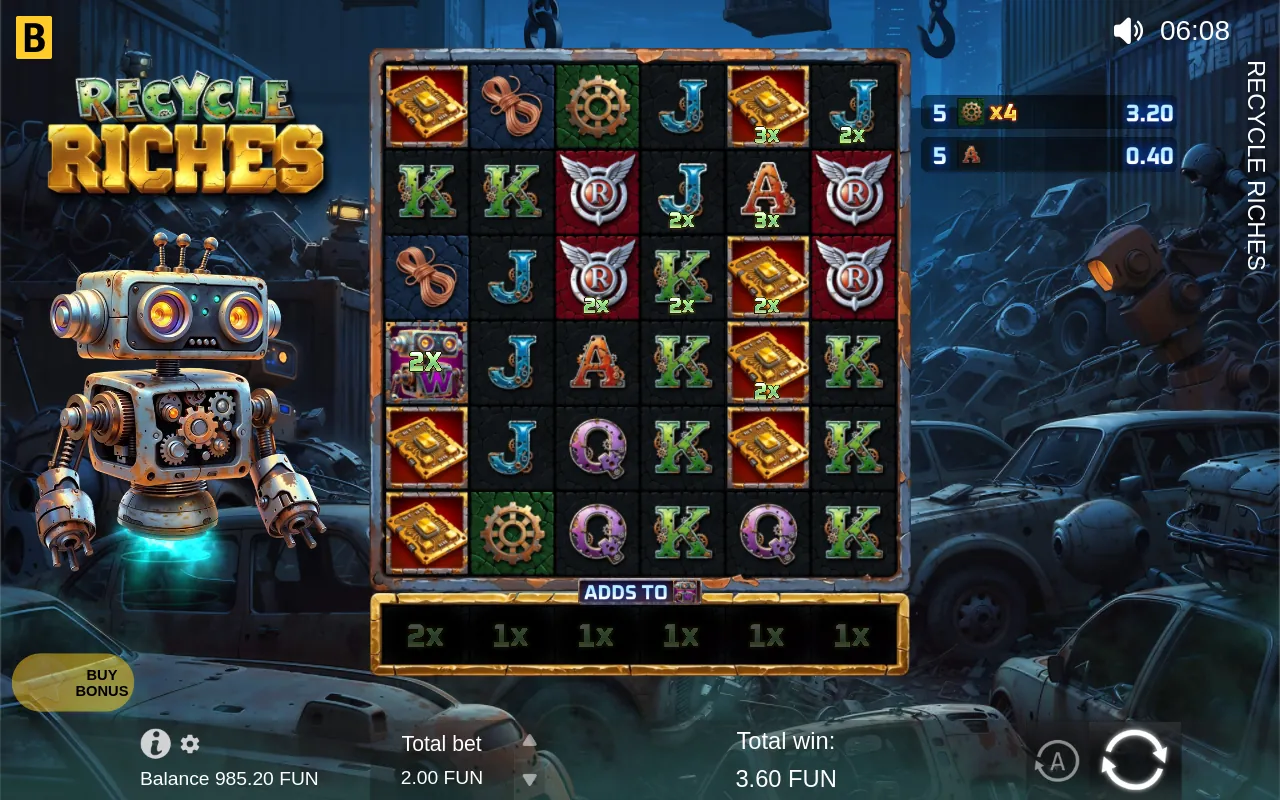
A scrapyard at night, on the edge of a cyber city, with wrecked cars stacked under a dangling crane hook and a rusted robot waiting on a disc of teal light. Recycle Riches, from BGaming, pays almost nothing for its symbols and everything for the charge those symbols leave behind, and whether that’s enough to carry a whole slot is a fair question.
It’s a game built on stacked multipliers, with two systems feeding each other across a 6×6 cluster grid. It runs at 96.14% RTP with high volatility, and up to 10,000x the bet is up for grabs. Cluster games are familiar ground for this studio, from Fruit Million to Snoop Dogg Dollars and Cats Love Yummy, but this one runs on electricity rather than plain symbol matching.
Cluster Pays and Cascades
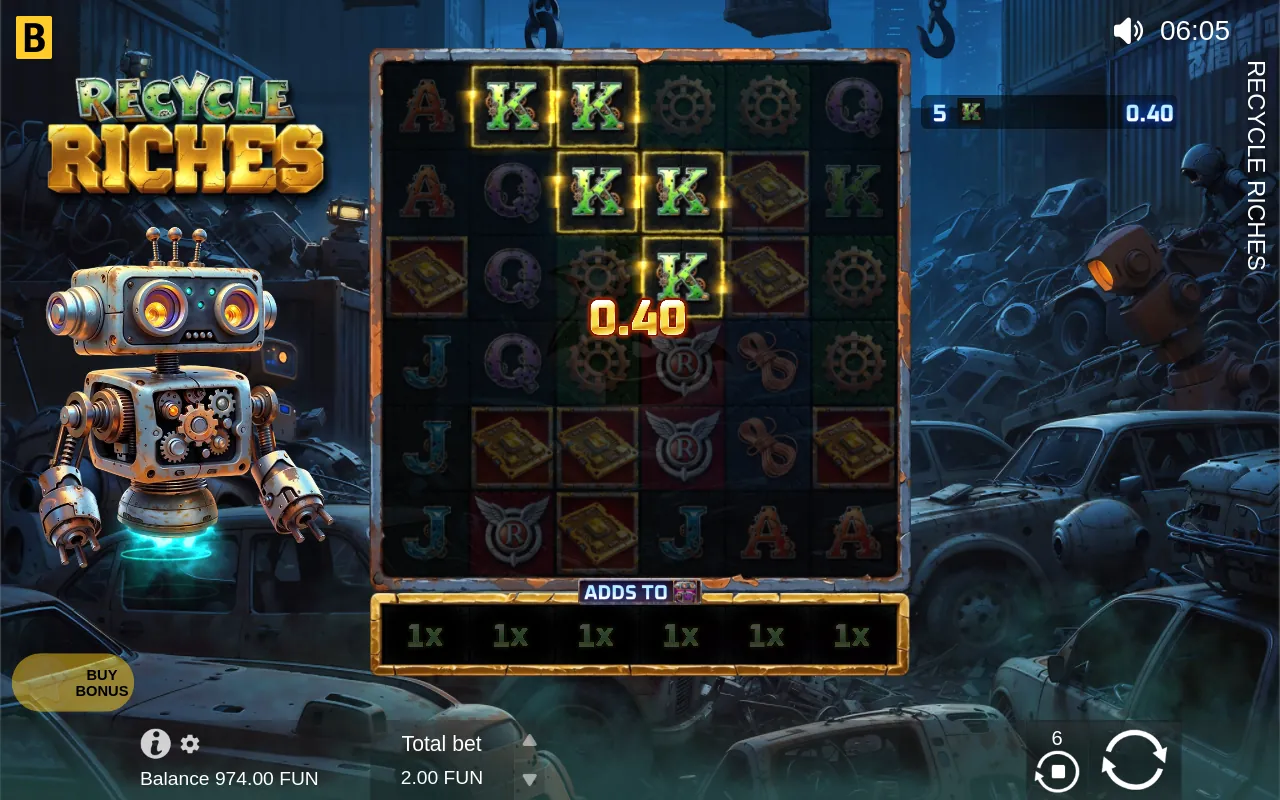
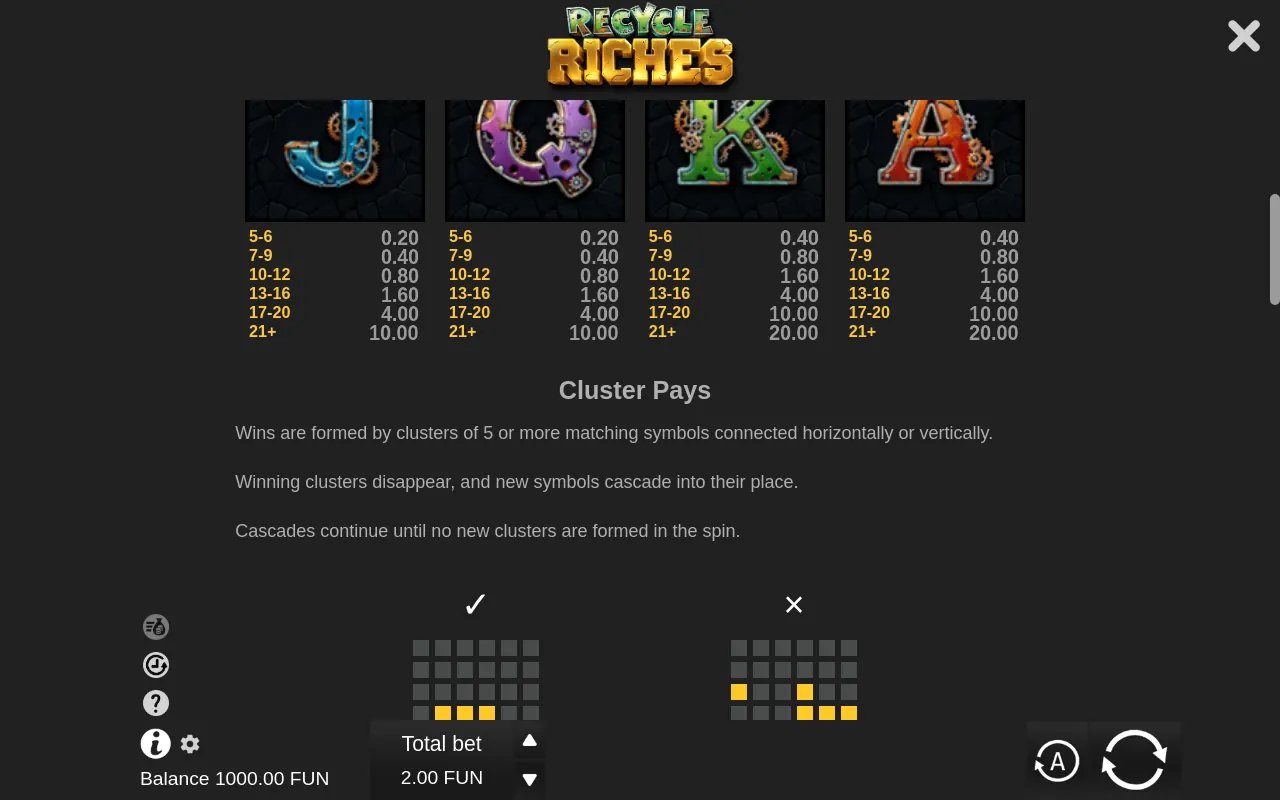
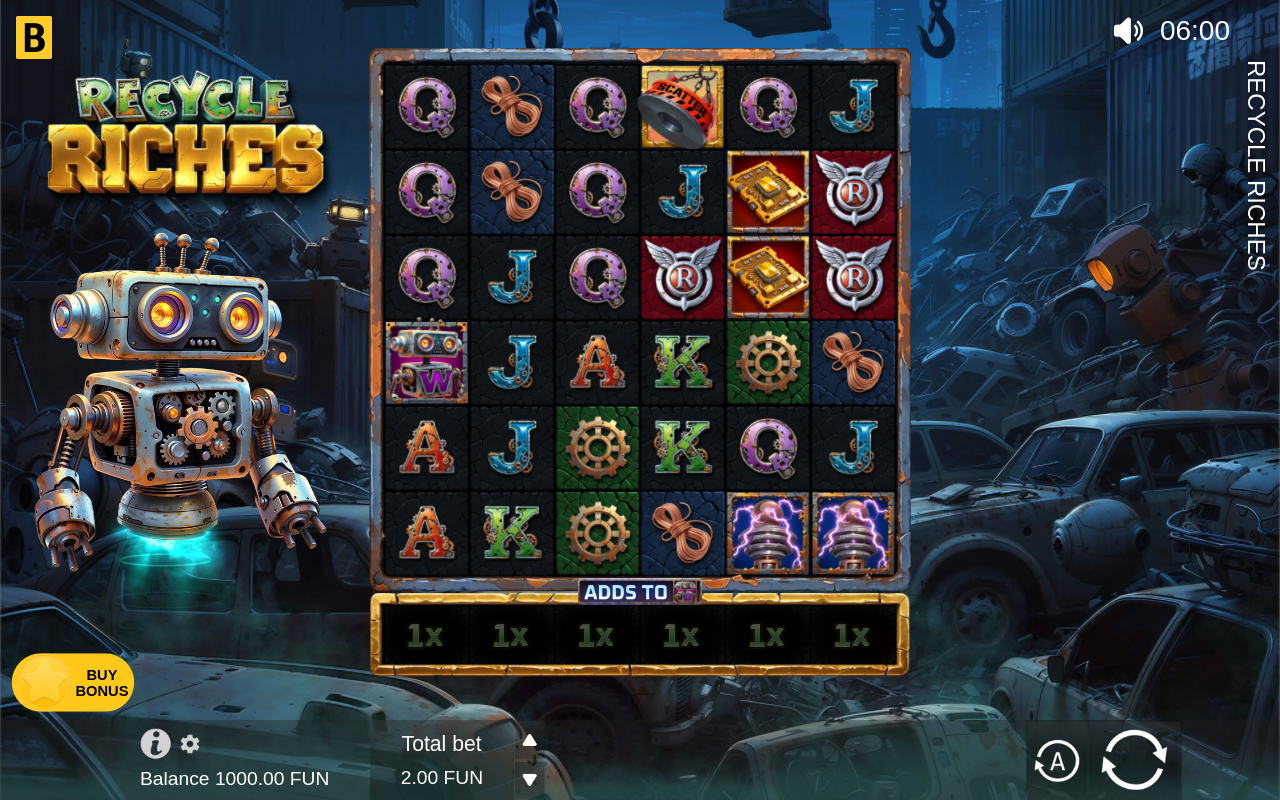
Wins form through clusters of five or more matching symbols connected horizontally or vertically. There’s no payline count to speak of; the grid is the payline. Winning clusters disappear and new symbols cascade into the gaps, with cascades continuing until no new clusters form in the spin.
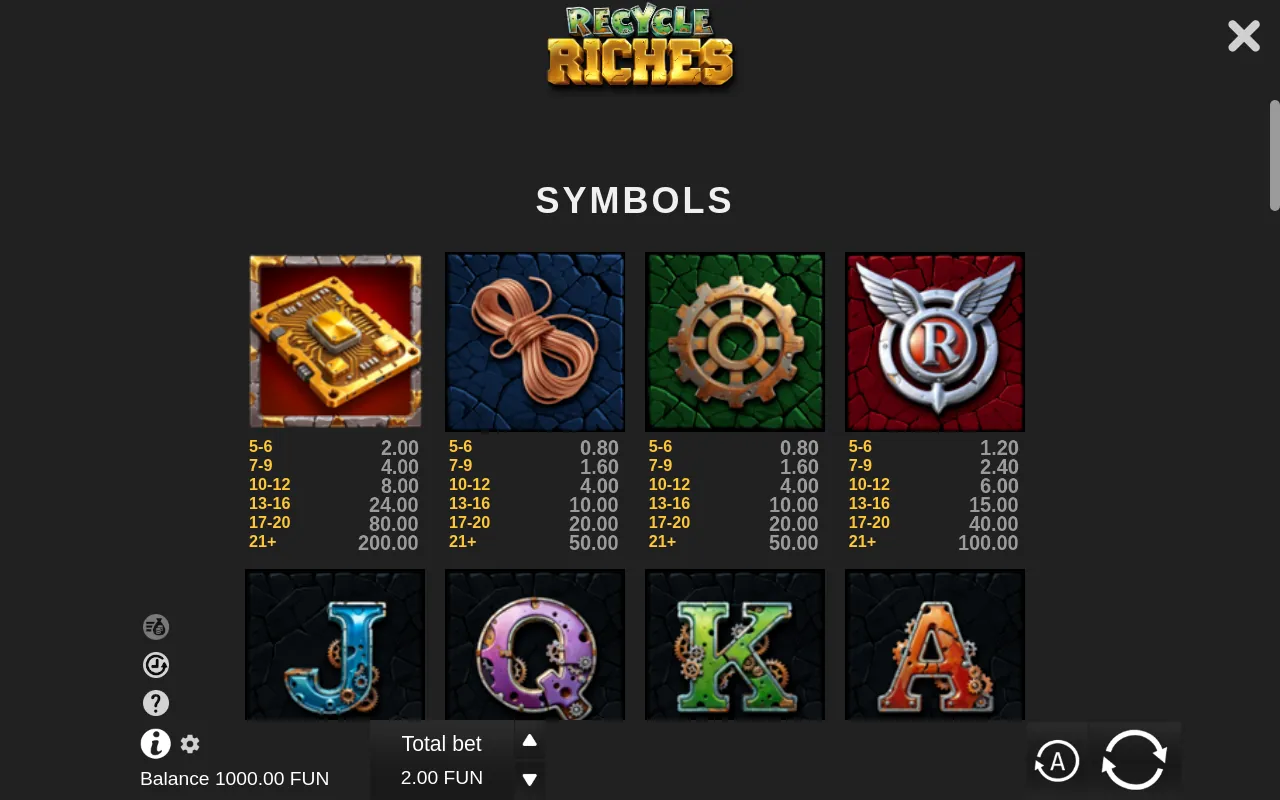
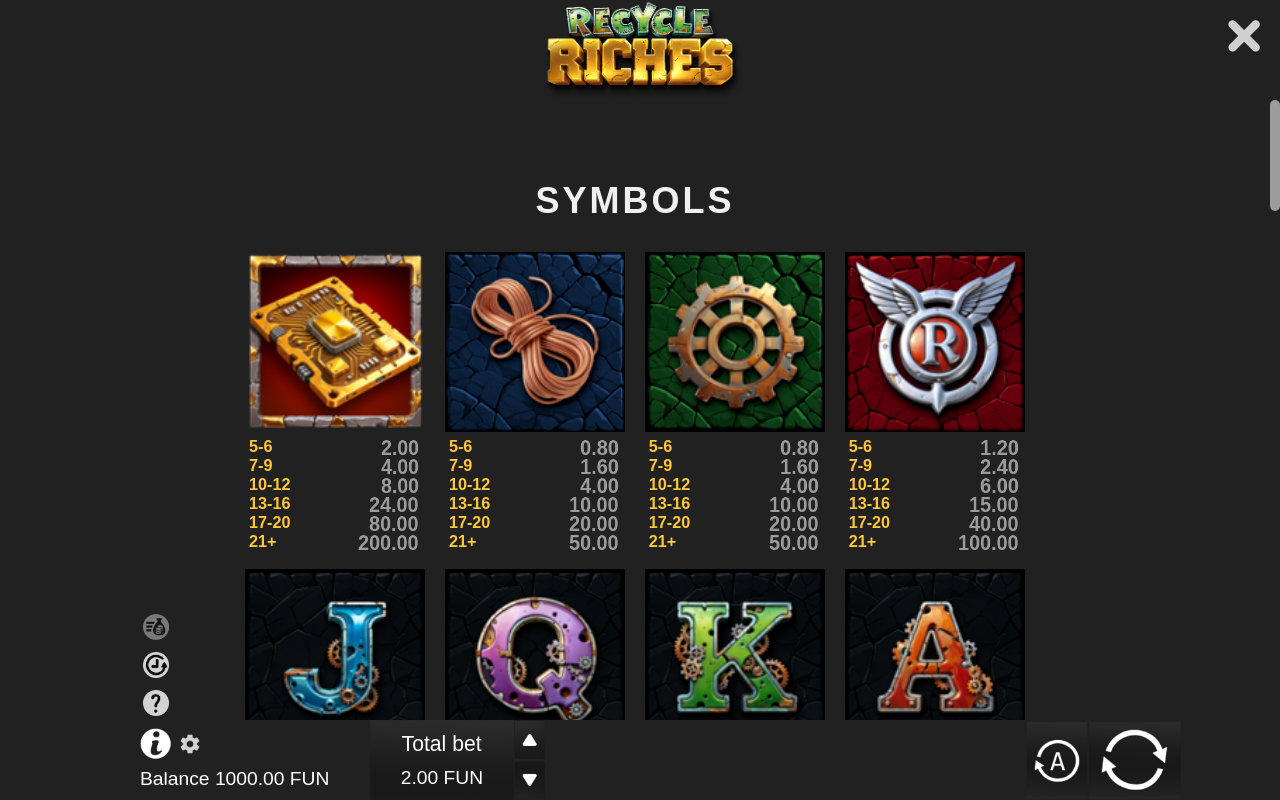
It’s a straightforward engine. The symbols are a scrapyard set, from a gold circuit box at the top down through a winged R shield, copper wire loops and gears to the J, Q, K and A royals. Five-of-a-kind values, as multiples of the total bet:
- Gold circuit box – 1x
- Winged R shield – 0.6x
- Copper wire loop – 0.4x
- Gear – 0.4x
- K – 0.2x
- A – 0.2x
- J – 0.1x
- Q – 0.1x
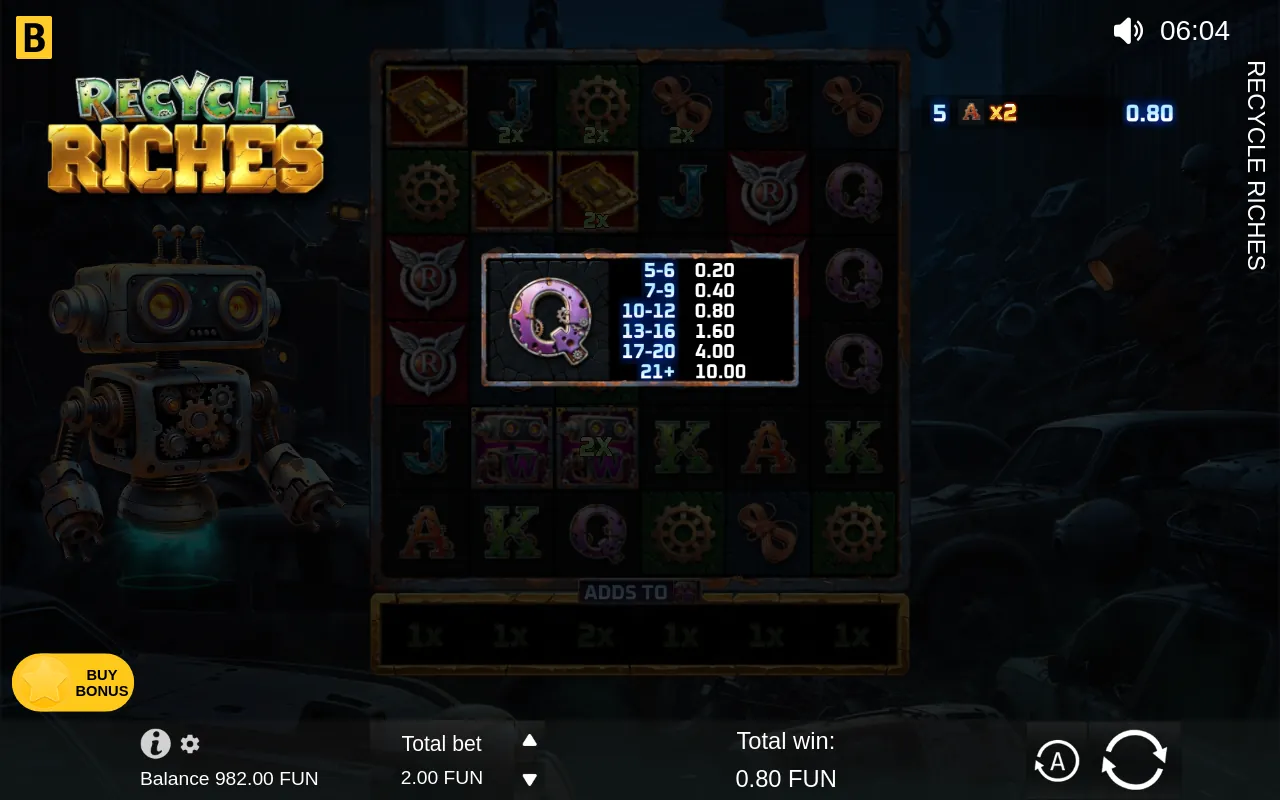
Those are modest numbers on their own, which is normal for a cluster game. Bigger clusters pay the same symbol value at a larger multiple of the bet, so the size of the win scales with the size of the cluster. Even so, the value doesn’t sit in the raw symbol pays.
It sits in what happens to the cells those symbols leave behind. A cascade that clears a patch of the grid opens space for fresh symbols, and every one of those fresh symbols that wins adds another charge to the cells it passes through. The paytable is the floor, not the ceiling.
Cell Multipliers
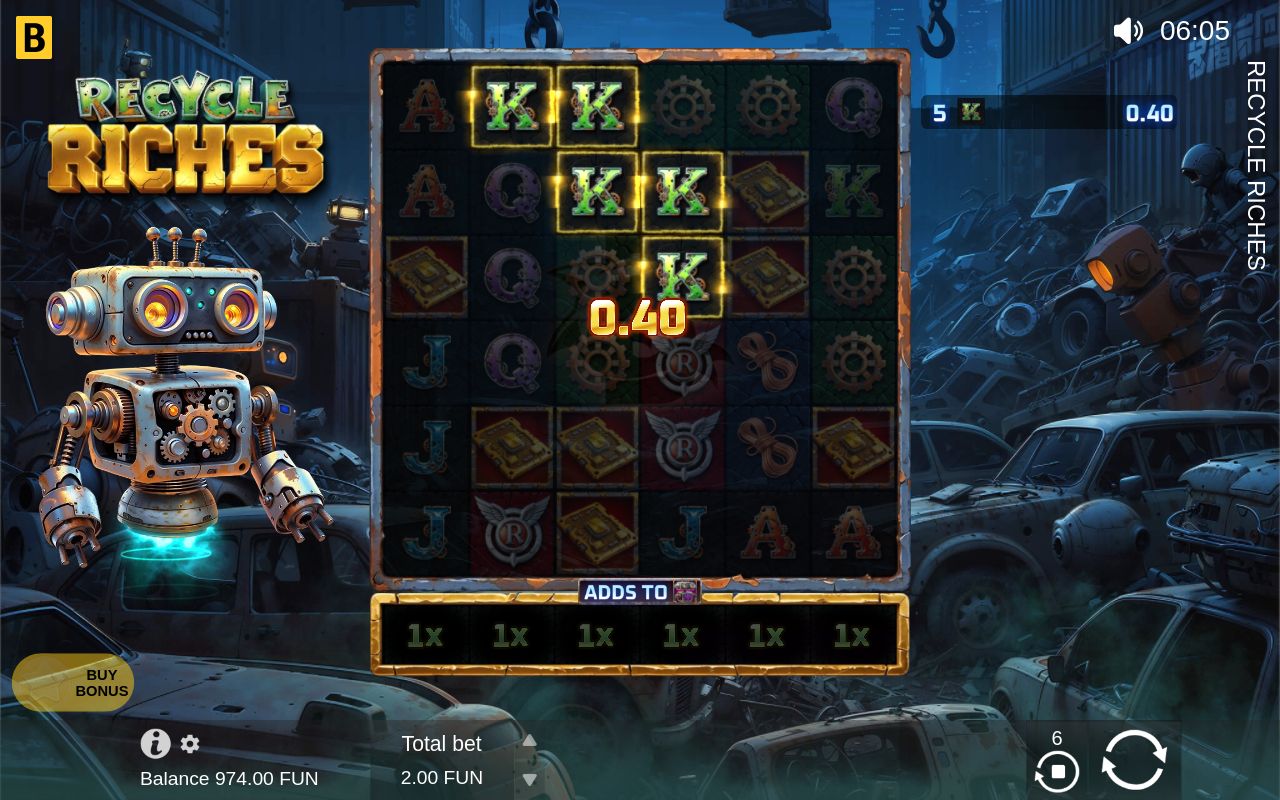
Every cell on the grid carries its own multiplier, and every win charges it up. When a winning symbol appears in a cell, that cell’s multiplier increases by 1x. Cells start empty; the first win in a cell lifts it to 2x. Wins that include a symbol sitting in a charged cell have that multiplier applied.
Where multiple charged cells feed one win, the multipliers are summed before being applied to that single win. A cluster stretched across several charged cells therefore collects every one of those multipliers at once, which is how small symbol values turn into large pays.
In the base game, all cell multipliers reset on every new spin. That’s the hinge of the whole design: cascades within a single spin can stack cells up fast, but the slate wipes clean the moment the run ends. A long cascade chain is where the base game’s money comes from.
It’s over the instant the chain stops producing clusters. Only Free Spins carry the charge across spins, and that single difference is what the whole feature is built on.
Reel Multipliers and the Tesla Coil
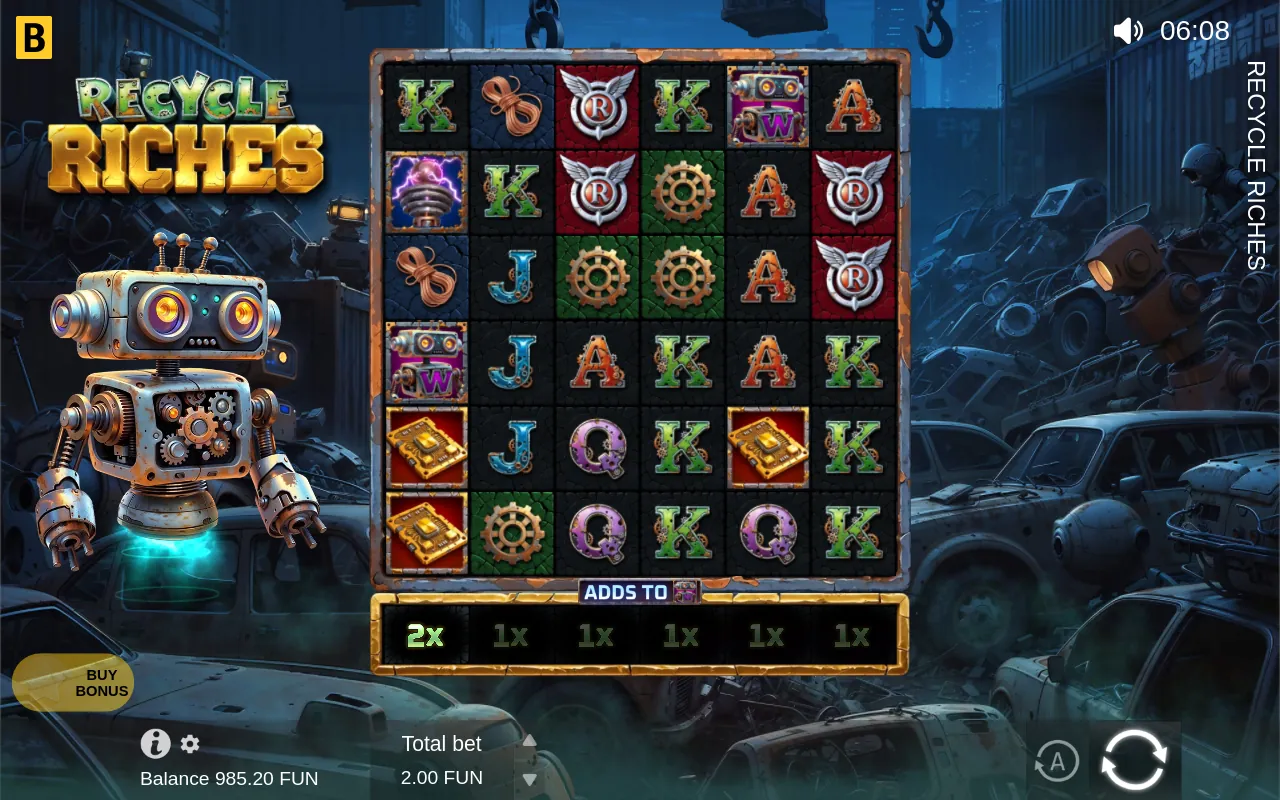
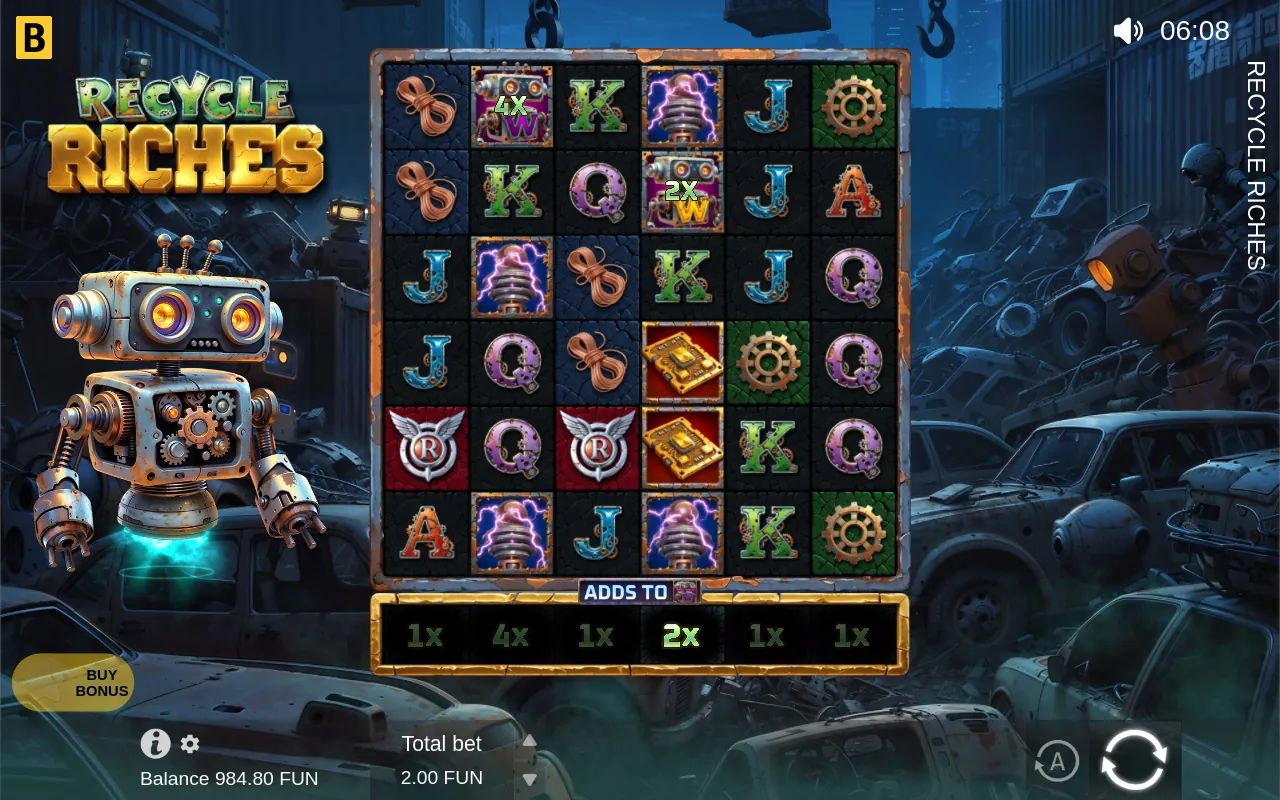
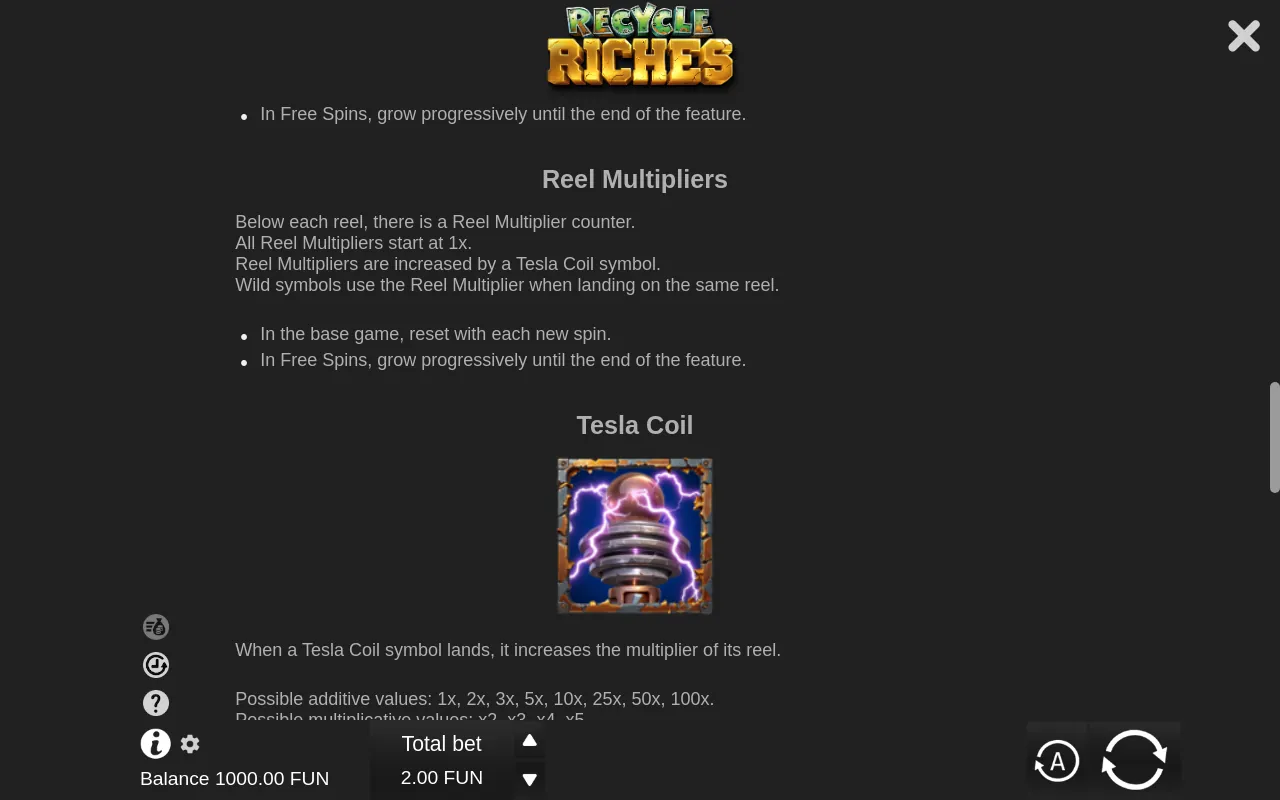
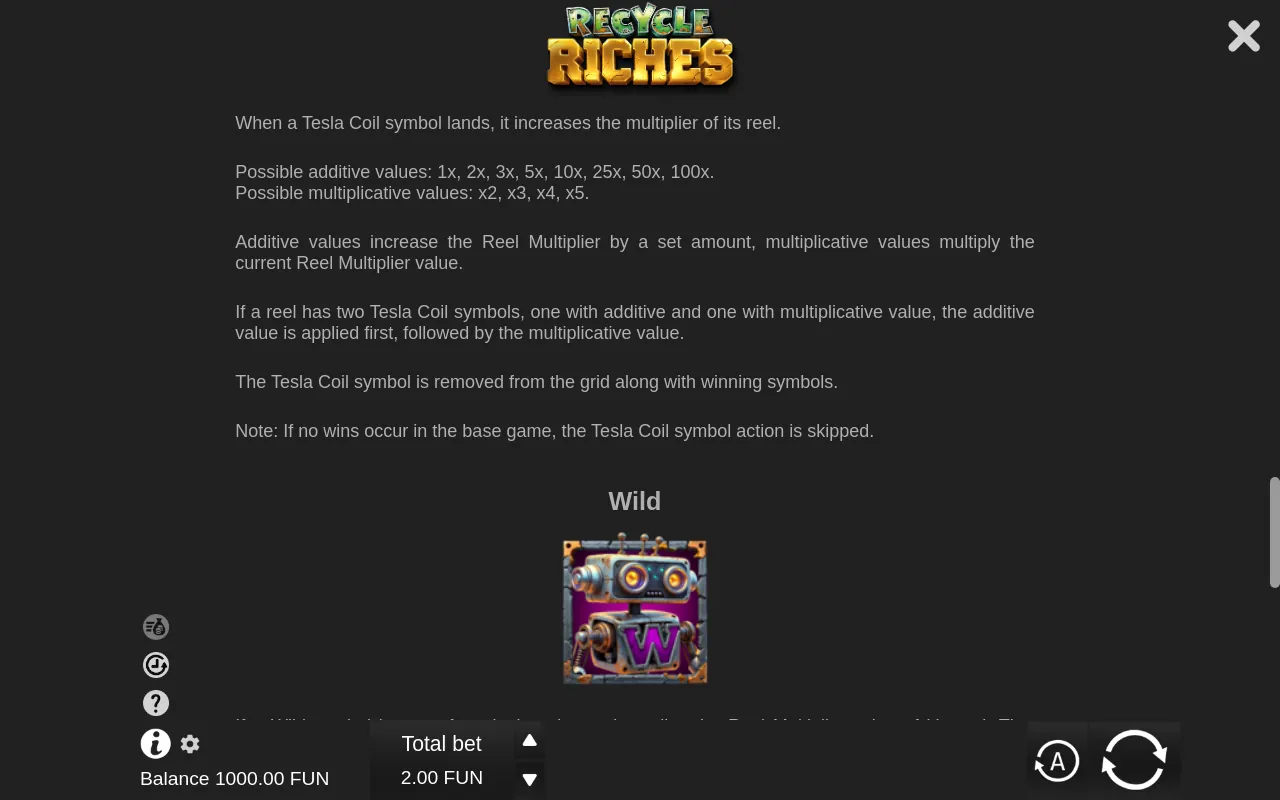
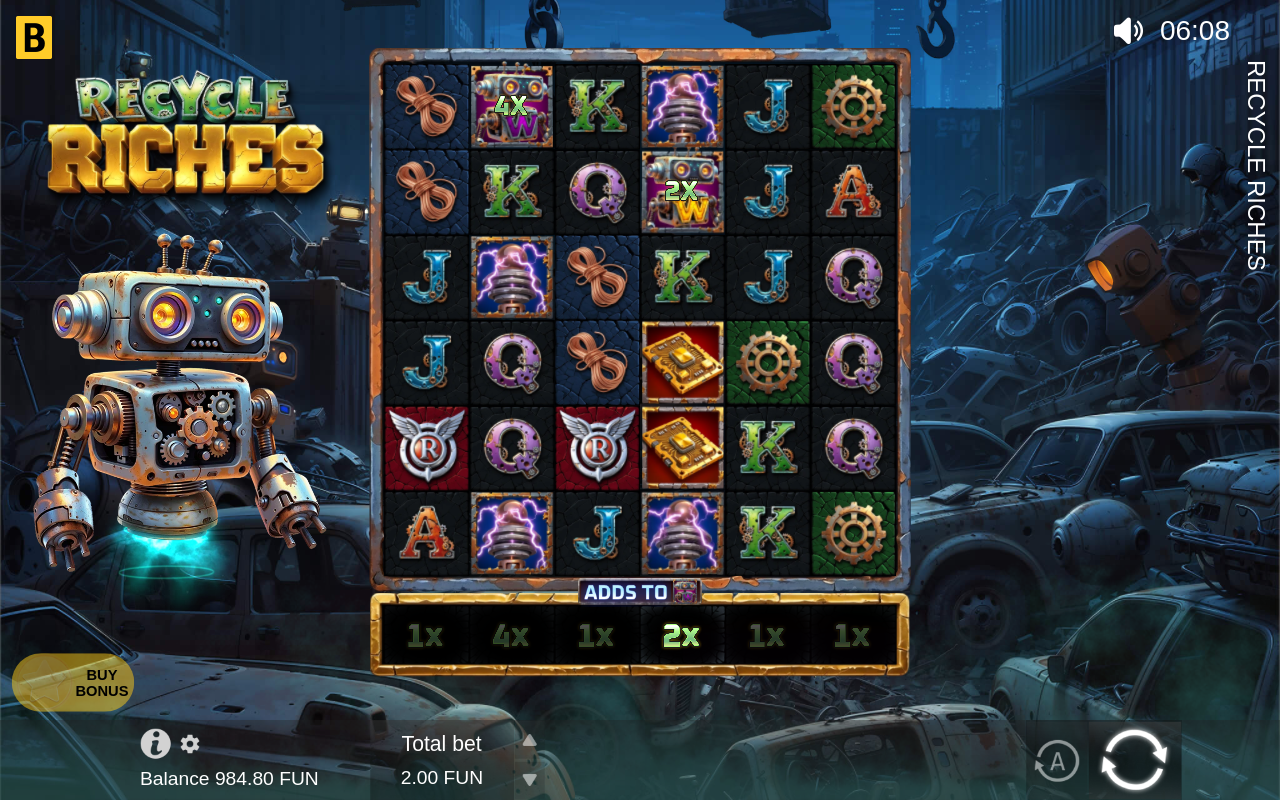
Underneath each reel sits a Reel Multiplier counter, and all of them start at 1x. The Wild uses these: a Wild that forms part of a winning cluster applies its reel’s multiplier to the win. The default 1x doesn’t count, so a Wild is only worth having once its reel has been charged. It substitutes for any paying symbol.
The charging comes from the Tesla Coil symbol. When one lands, it boosts the multiplier of the reel it sits on. Additive values run from 1x, 2x, 3x, 5x, 10x, 25x and 50x up to 100x; multiplicative values run from x2 to x5.
Additive values add a set amount to the counter, and multiplicative values multiply what’s already there. If a reel carries both types at once, the additive value applies first and the multiplicative one then works on the enlarged total, so the order in which coils land matters a great deal to the final number.
Two details shape how this plays. The Tesla Coil clears away with the winning symbols rather than lingering, and in the base game a spin with no wins skips its effect entirely, so a coil landing on a dead spin does nothing. Like the cells, the reel counters reset each base-game spin and only persist through Free Spins.
Free Spins
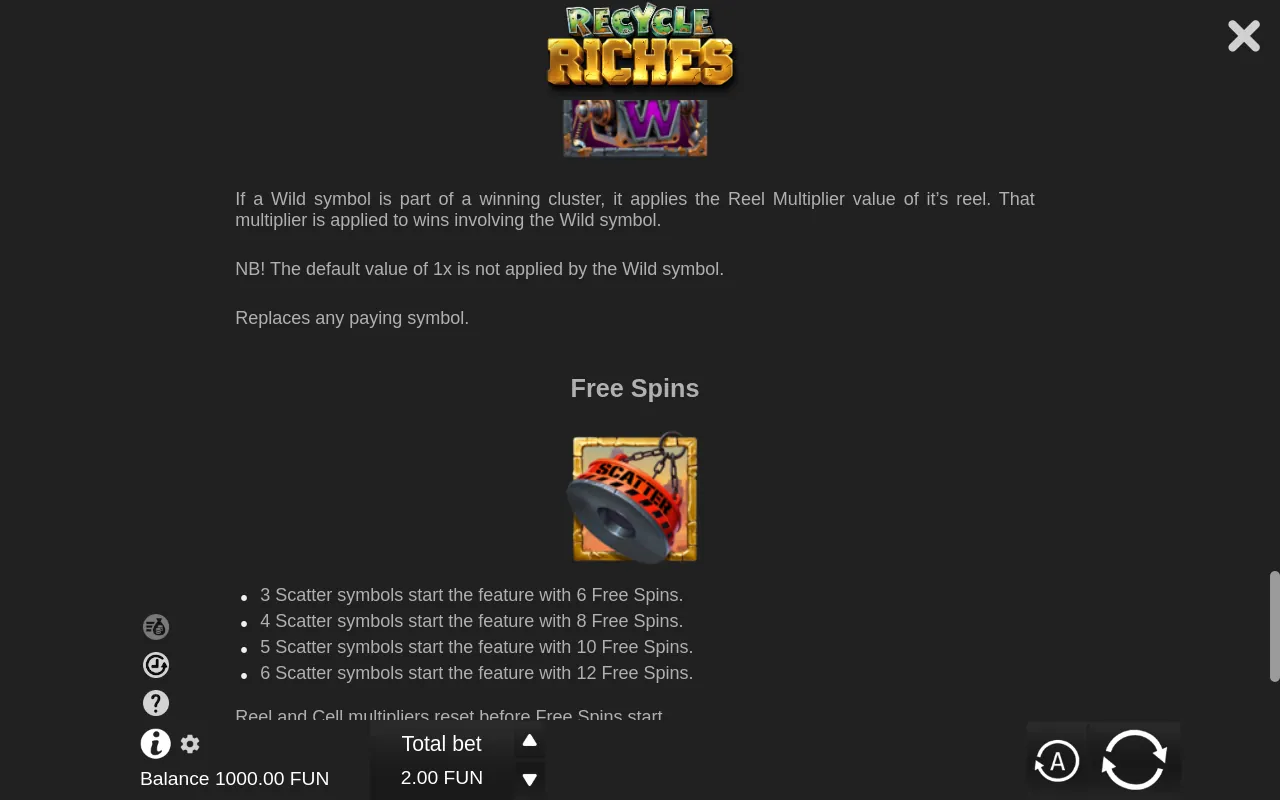
Three or more Scatter symbols start the feature, with the spin count scaling by how many land:
- 3 Scatters – 6 Free Spins
- 4 Scatters – 8 Free Spins
- 5 Scatters – 10 Free Spins
- 6 Scatters – 12 Free Spins
Reel and Cell multipliers reset before the round begins, but the Scatters themselves give the feature a head start. Each Scatter boosts the Cell Multiplier of its own cell by 3x, 4x or 5x at random before the first spin. A six-Scatter trigger opens with six pre-charged cells and twelve spins to build on them.
Inside the round, nothing resets. Every cascade charges cells further, every Tesla Coil lifts a reel permanently, and Wilds start pulling real weight once their reels are loaded. The same reel can be boosted again and again across the round, which is how the counters climb towards the values the multiplicative coils can compound.
The feature retriggers up to two times, awarding additional spins on the same Scatter scale. Each retrigger Scatter again boosts its cell by 3x, 4x or 5x at random. On top of that, every other cell already holding 2x or more gains a further 1x, so a retrigger doesn’t just add spins; it lifts the entire charged grid at the moment it lands.
Our Honest Verdict
Overall Rating: 7.2/10
Playing Recycle Riches is mostly waiting for the one round where nothing wipes clean. That’s the whole reason it exists among BGaming’s cluster games: a scrapyard where everything gets reused, including the multipliers. Outside that round, you’re spinning for small change and the occasional lucky cascade.
Its strength is that both multiplier systems pay into the same win, so a good cluster in Free Spins can compound brutally fast. Its weakness is everything before it: the base game resets on every spin, the symbol pays are token, and long stretches produce almost nothing worth watching.
It’s a game for players who like a slow build towards one big, messy payoff, and it isn’t one for anyone who wants the base game to pay its own way. The junkyard rewards patience here, and for the right player that patience is well spent.
Recycle Riches FAQs
-
How do you trigger Free Spins in Recycle Riches?
Three or more Scatter symbols start the feature. 3 Scatters awards 6 Free Spins, 4 awards 8, 5 awards 10 and 6 awards 12. -
What does the Tesla Coil symbol do?
When a Tesla Coil lands it increases the Reel Multiplier of its reel. Additive values range from 1x up to 100x, while multiplicative values of x2 to x5 multiply the current total. Additive values apply before multiplicative ones on the same reel. -
Can Free Spins retrigger in Recycle Riches?
Yes, up to two times. A retrigger awards additional spins based on the number of Scatter symbols, matching the initial trigger values, and each retrigger Scatter boosts its cell’s multiplier by 3x, 4x or 5x at random. Every other cell holding 2x or more also gains 1x. -
How do Cell Multipliers work?
A cell’s multiplier increases by 1x whenever a winning symbol appears in it, starting at 2x after the first win. Multipliers from several cells in one win are added together. In the base game they reset each spin, but in Free Spins they persist until the feature ends. -
What does the Wild symbol do in Recycle Riches?
The Wild replaces any paying symbol, and if it’s part of a winning cluster it applies its reel’s Reel Multiplier to the win. The default 1x isn’t applied by the Wild, so it only adds value once its reel has been boosted above the starting level. -
What is the RTP of Recycle Riches?
The RTP is 96.14%. -
Is Recycle Riches high volatility?
Yes. Recycle Riches is a high volatility game. -
What is the maximum win on Recycle Riches?
The maximum win is 10,000x your bet. -
Who makes Recycle Riches?
Recycle Riches is made by BGaming, and its release date is 17 March 2026.