










2 Ways Royal Slot Review
Very few games in a casino lobby will ever pay back 99.54%, and 2 Ways Royal manages it by not really being a slot at all. Platipus have dealt five cards on a green felt under a gold crown instead of spinning reels, and the payout you get depends on how well you play them, not on where the reels stop.
At heart it’s Jacks or Better draw poker with one twist: two Royal Flushes count instead of one, the 10-to-Ace version and a second made of 2, 3, 4, 5 and 6 in the same suit. That’s a claim worth arguing about, because it quietly changes which cards deserve to be kept. Between the 99.54% RTP and that two-royal rule, this is a game about decisions rather than luck, played on a five-card poker hand (1×5).
The Cards and What They Pay
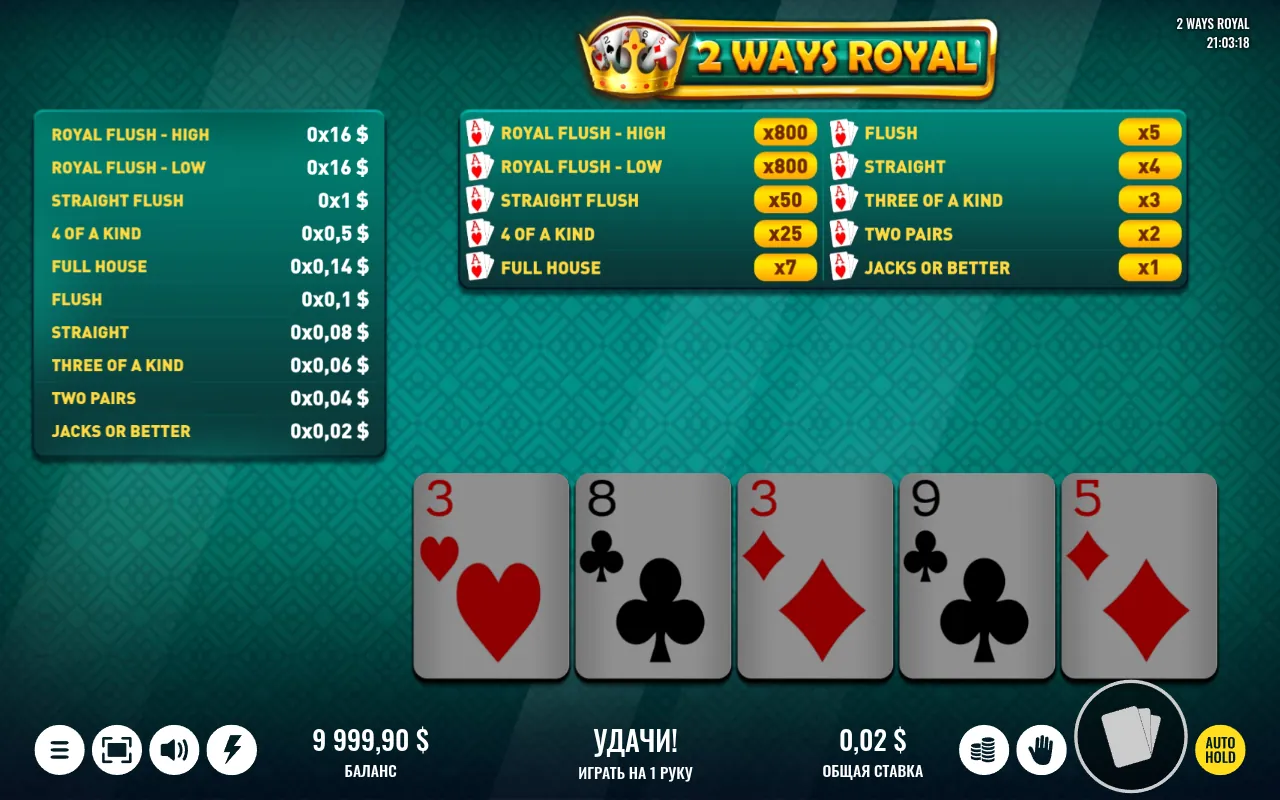
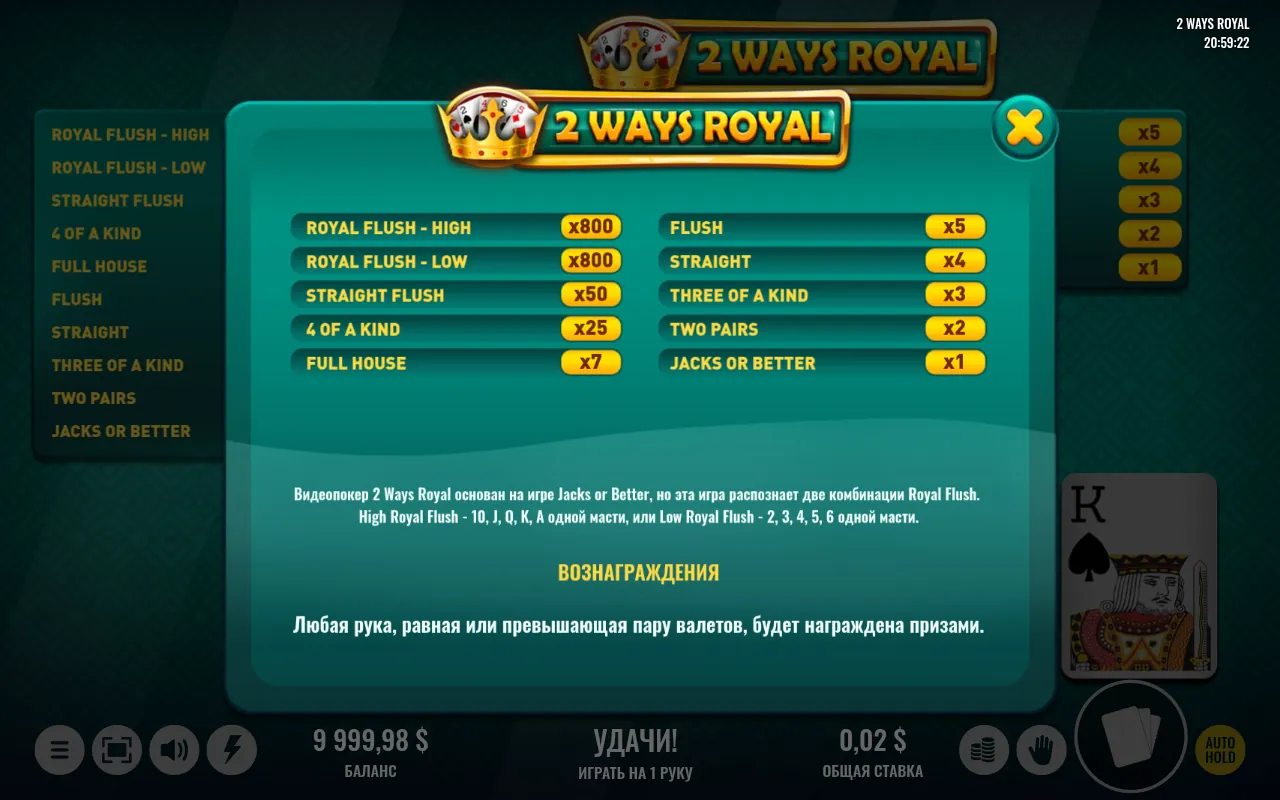
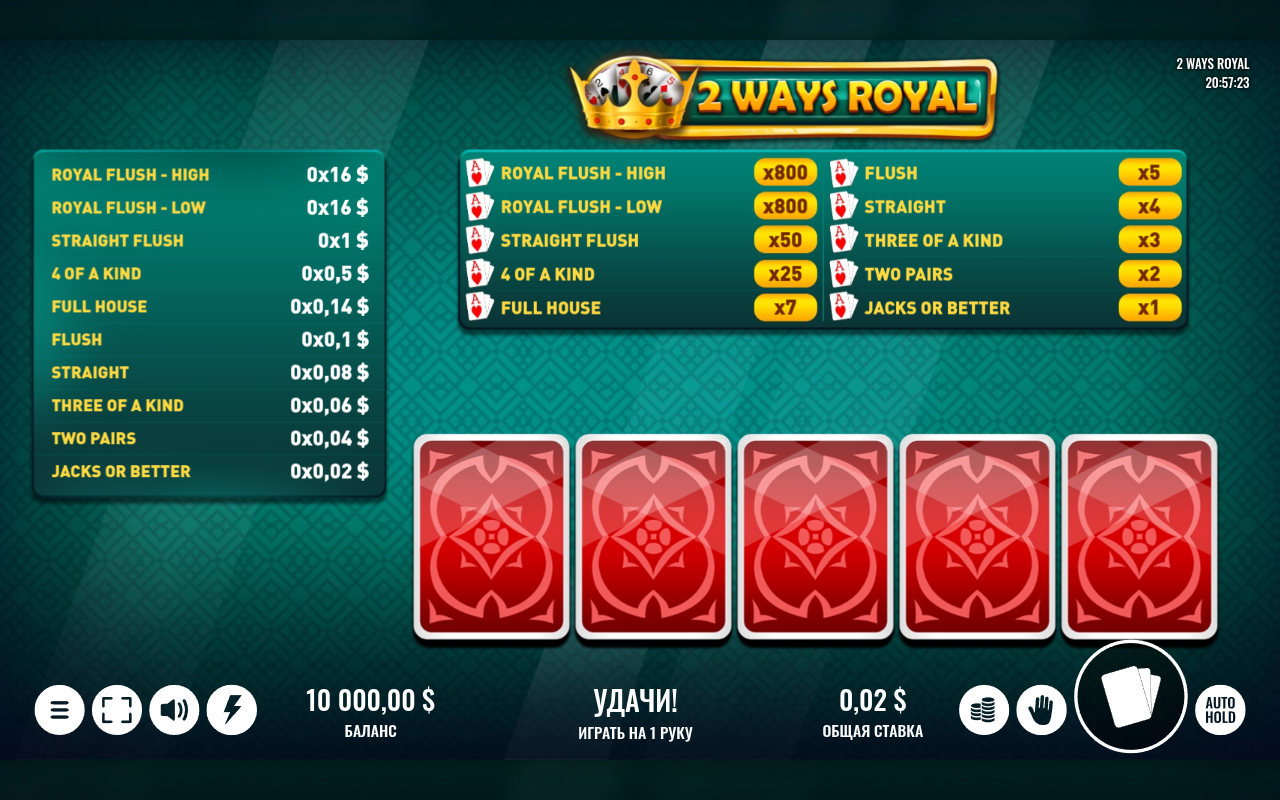
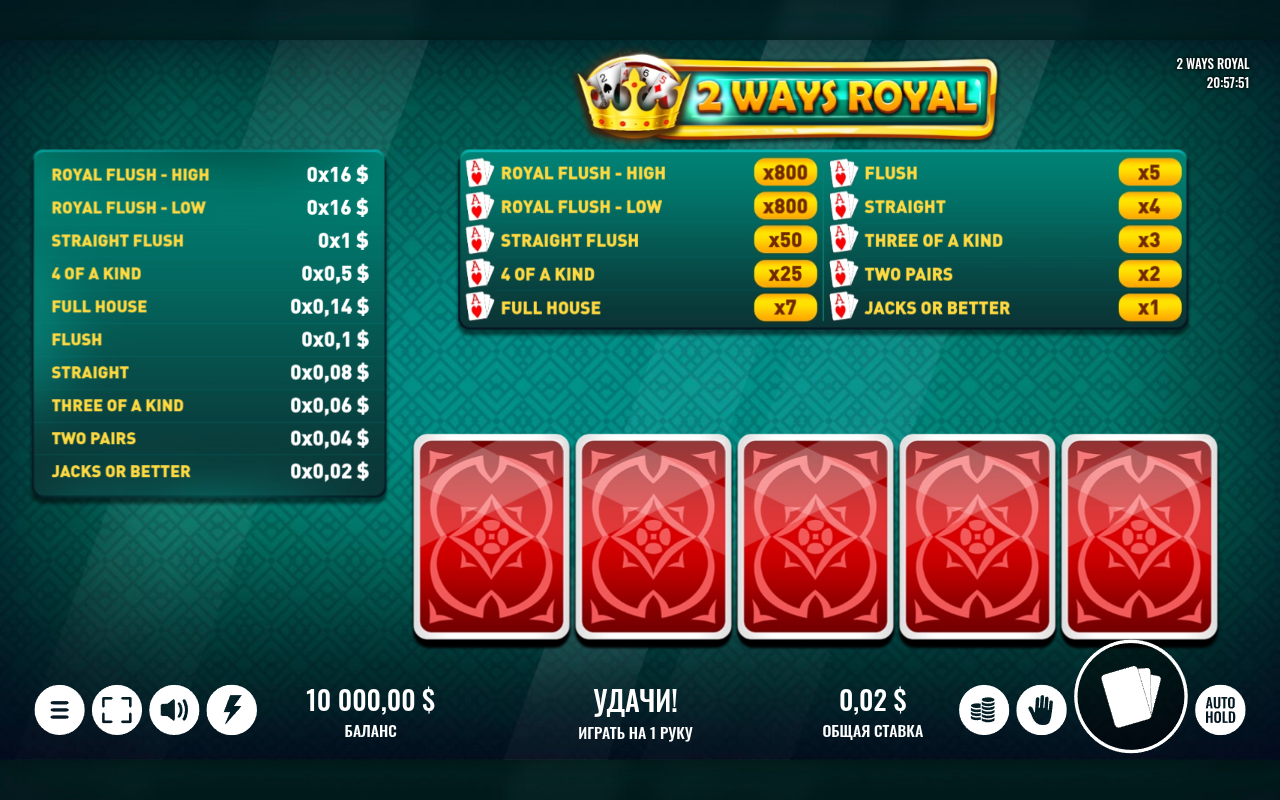
The game deals five cards from a standard deck and pays on any hand of a pair of Jacks or better. There are no wilds, no scatters and no symbols standing in for cards; it’s a straight draw-poker format, and that’s why the return sits so high. Wins are multiples of your total bet, not a line stake, and the ladder reads like this:
- Royal Flush (High or Low): x800 the total bet
- Straight Flush: x50
- 4 of a Kind: x25
- Full House: x7
- Flush: x5
- Straight: x4
- Three of a Kind: x3
- Two Pairs: x2
- Jacks or Better: x1
Notice the shape of that ladder. The gaps between hands are far smaller than a slot’s paytable usually is: Two Pairs returns your stake, Three of a Kind triples it, and even a Full House only reaches x7. Every rung matters, because the strategy is built around which of them you chase.
That flatness is deliberate. In a reel game the mid-tier prizes barely register next to the top symbol; here they’re the hands you’ll actually make, hand after hand, and the paytable is tuned so the correct decision is usually worth taking. The top prize does the attracting, but the middle of the ladder does the paying.
The two Royal Flushes are where the game earns its name. A High Royal is the traditional 10, J, Q, K and A of one suit; the Low Royal is the 2, 3, 4, 5 and 6 of one suit, and it pays the same x800. Doubling the number of royal combinations doesn’t double how often one arrives, but it does mean a suited run of low cards is worth holding rather than breaking up.
Hold and Draw
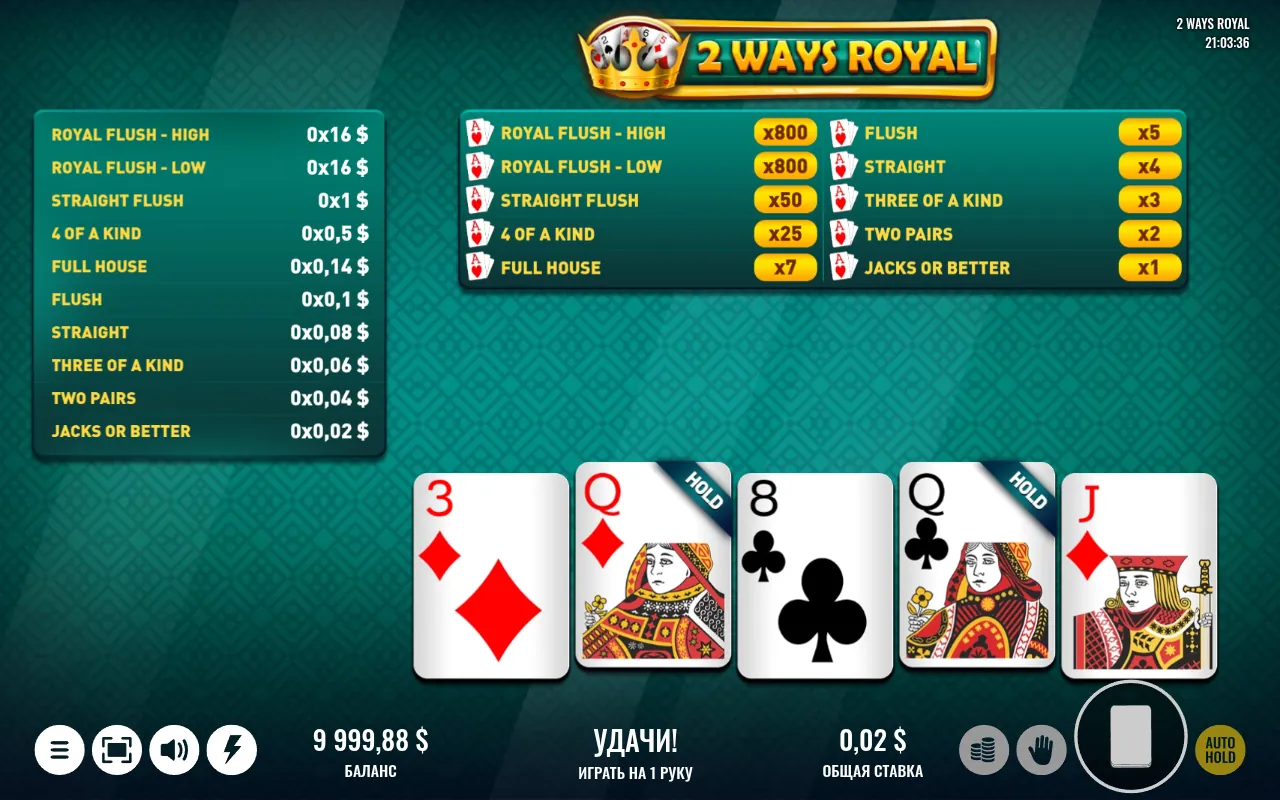
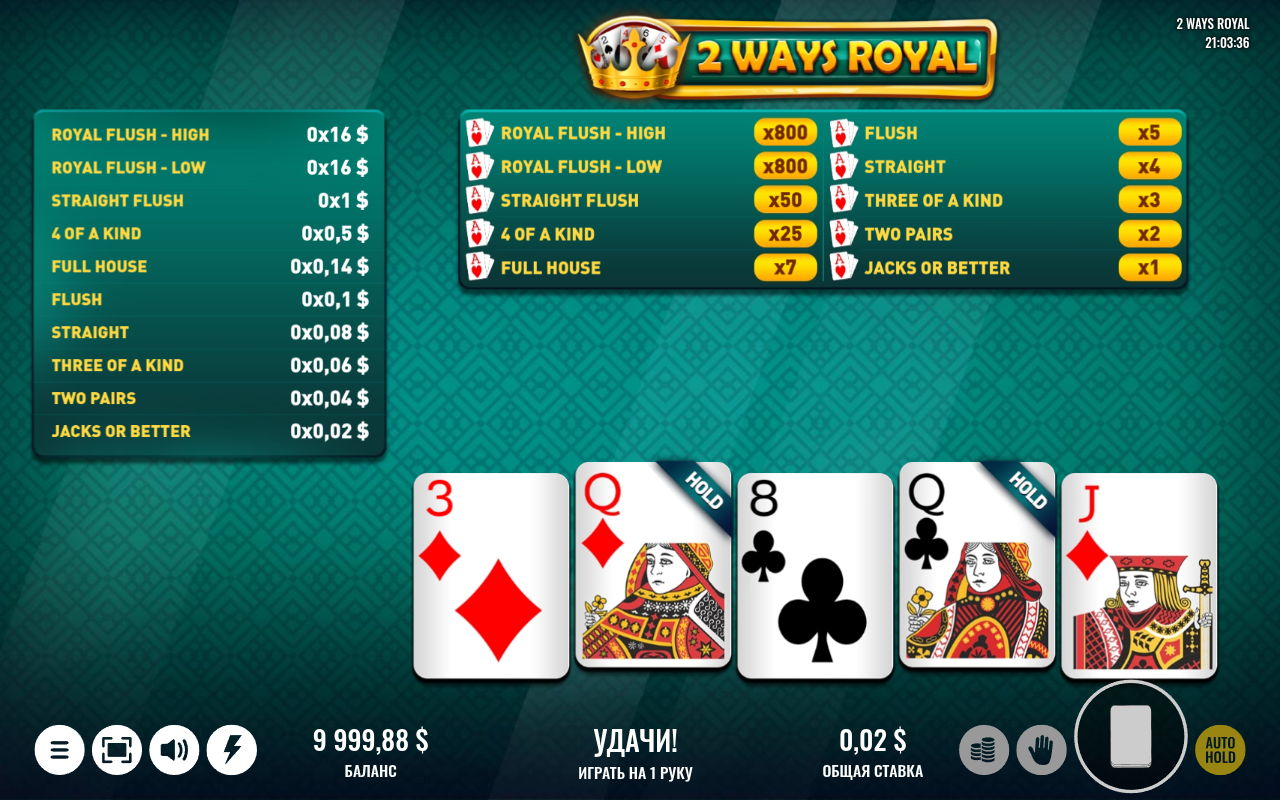
Before the draw, you choose which cards to keep. Selected cards are marked HOLD and carry through while the rest are replaced, so the quality of your decisions shapes the outcome far more than a reel spin does. A dealt pair is the common starting point: hold the pair and take three fresh cards, or chase a four-card Flush or Straight if the dealt shape is better than the pair.
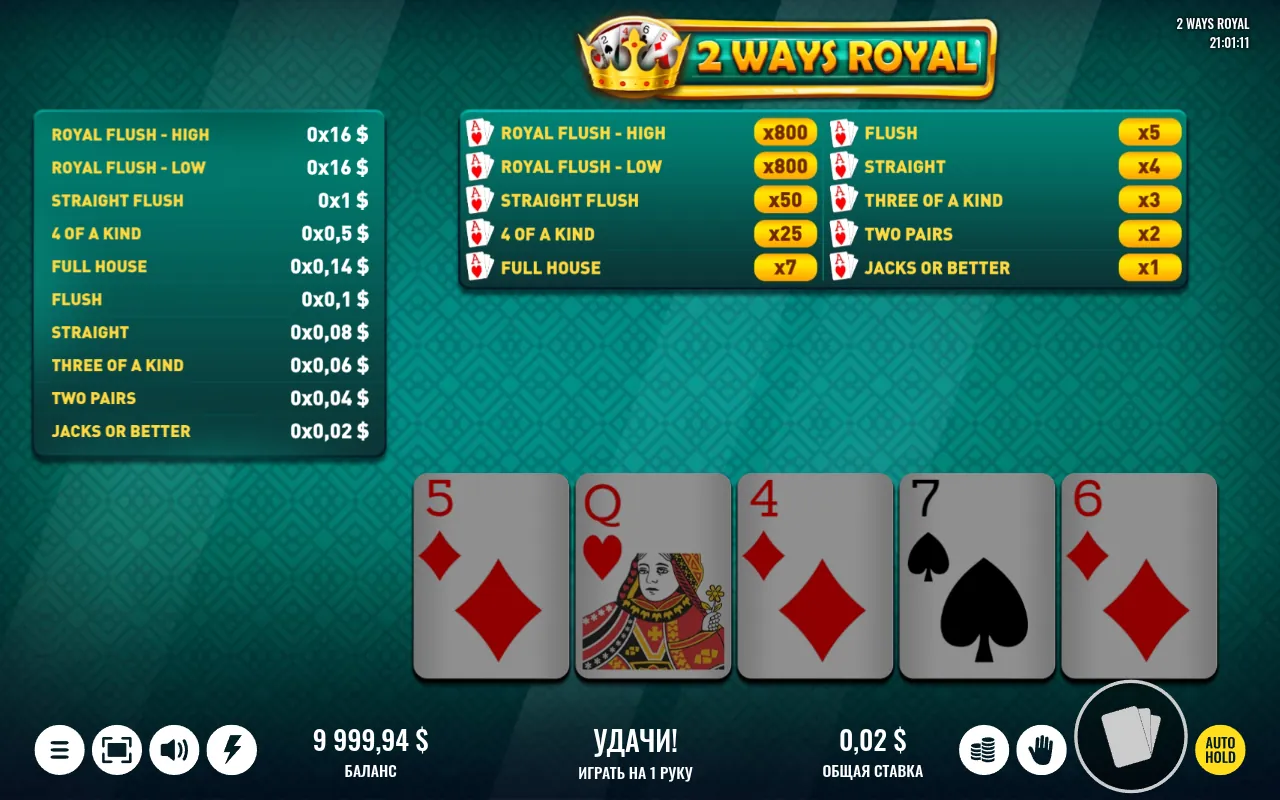
The two Royal Flushes change some of that arithmetic. A suited 2, 3 and 4 in hand isn’t the nothing it would be in standard Jacks or Better; it’s three-fifths of a paying royal, and holding it is a live option. The same goes for a suited 4, 5 and 6, which in the standard game would be three low cards you’d discard without a thought.
There’s no bonus round waiting behind the draw, no meter filling, no second screen. The hand itself is the game. What varies from deal to deal is the shape of the decision: sometimes the correct hold is obvious, a made Flush or a high pair, and sometimes you’re weighing a low three-card royal against a guaranteed small return.
Those marginal calls are where the 99.54% return is won or lost. Hold correctly and the game plays close to even. Hold lazily, breaking up suited low runs or keeping kickers that don’t pay, and the effective return drifts a long way down.
It’s worth being clear about what that figure is and isn’t. The return assumes the hold strategy is played properly, so it’s a ceiling you earn rather than a rate you’re given. The maths is generous only for players who use it.
The Risk Gamble
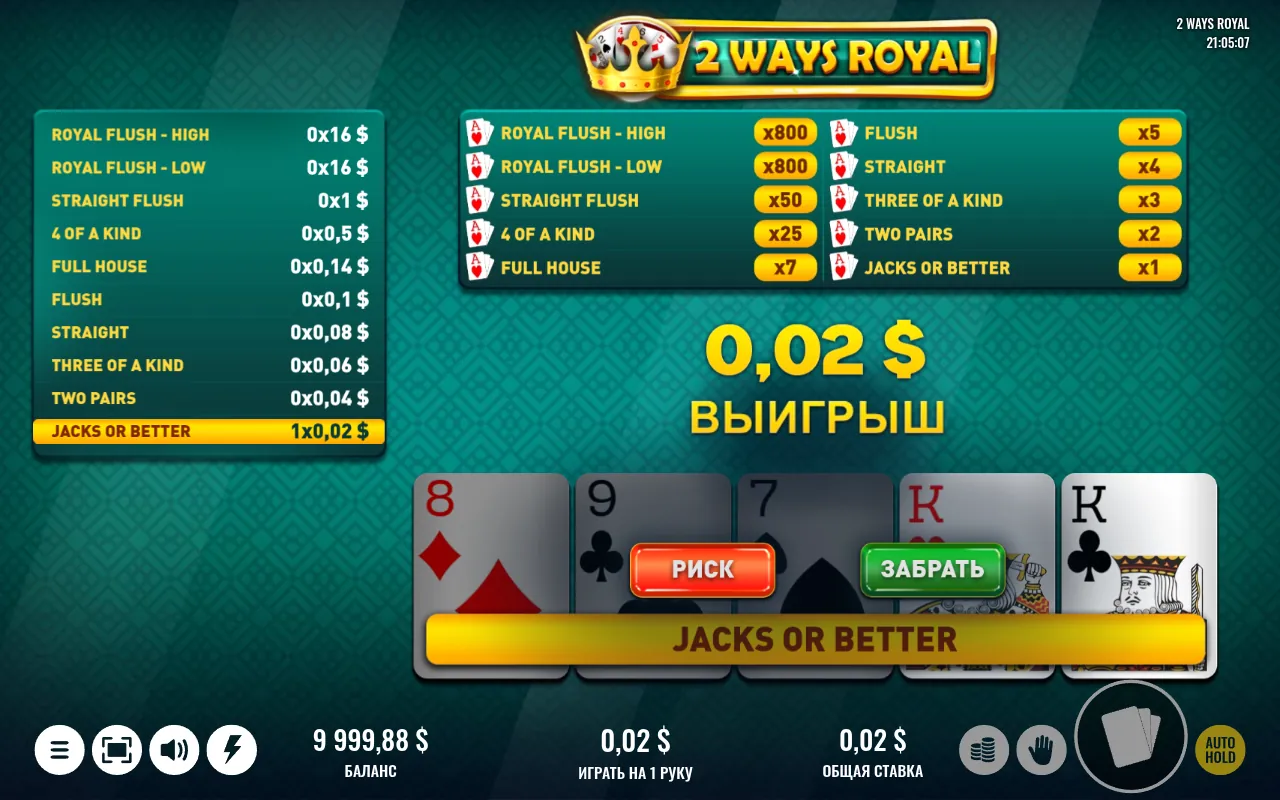
Every winning hand offers a choice: collect the win, or put it on the table with the Risk option. It’s the classic double-or-nothing gamble, and it appears after any pay from Jacks or Better upward, alongside a Collect button that banks the prize and returns you to the deal.
What it doesn’t do is compound indefinitely for free. A gamble that loses takes the win with it, so the question after each winning hand is whether a small return is worth risking for another shot. A x800 royal is an odd thing to gamble and a x1 pair is an easy one, and much of the game’s rhythm sits in exactly that decision.
The gamble also gives the flat mid-section of the paytable a bit of movement. A x2 Two Pairs win can be pushed once or twice and turn into something more interesting, or vanish entirely. It’s the only place in the game where the outcome isn’t a matter of card strategy, just nerve.
Taking that option is never required. Collecting every win and never touching Risk plays the game perfectly well, and for a title whose whole pitch is a near-even return, that restraint is usually the sensible reading of the feature. The gamble is there for the streak-minded, not the strategy-minded.
Our Honest Verdict
Overall Rating: 7.6/10
This is the slowest, quietest table in the building, and that’s exactly why somebody sits at it: deal, think, draw, repeat, with the gold crown watching over a game that never interrupts you. It plays like a card game because it is one, and near enough every result traces back to a decision you made, not a reel that stopped.
Its strength is that the 99.54% return is real money over time, not decoration, and the two-royal rule rewards the effort of learning which low suited cards are worth keeping. Its weakness is the ceiling: x800 is the top of the ladder, and nothing about the presentation or the Risk gamble makes that feel bigger than it is. There’s also no bonus round, no meter, no second screen, and no attempt to hide it.
It suits card players who’d rather think than spin, and who count a session that nearly breaks even as time well spent. Players who want free spins, multipliers and four-figure potential will find none of that at this felt. For the ones who do their arithmetic, the crown is earned.
2 Ways Royal FAQs
-
What is the RTP of 2 Ways Royal?
2 Ways Royal runs at 99.54% RTP, one of the highest returns you’ll find in a casino lobby and well above what most slots offer. The figure assumes you’re holding the correct cards on each hand. -
What is the grid size of 2 Ways Royal?
Rather than a reel grid, the game uses a five-card poker hand (1×5). Five cards are dealt, you hold the ones you want to keep, and the rest are replaced on the draw. -
When is 2 Ways Royal released?
2 Ways Royal’s release date is 10 May 2023. -
Who makes 2 Ways Royal?
2 Ways Royal is made by Platipus. -
What is the difference between a High and Low Royal Flush in 2 Ways Royal?
A High Royal Flush is the traditional 10, J, Q, K and A of one suit. A Low Royal Flush is the 2, 3, 4, 5 and 6 of one suit. Both pay the same x800 the total bet. -
How does the hold feature work in 2 Ways Royal?
After the first deal, you select the cards you want to keep and they’re marked HOLD. Those cards stay in place while the remaining ones are replaced on the draw, so your hold decisions directly shape the final hand. -
What does the Risk button do in 2 Ways Royal?
After any winning hand, the game offers a Risk or Collect choice. Risk gambles your win for a chance to increase it, while Collect banks the prize and returns you to a fresh deal. A lost gamble takes the win with it. -
Are suited low cards worth holding in 2 Ways Royal?
Yes, and that’s what separates it from standard Jacks or Better. A suited 2, 3 and 4, or 4, 5 and 6, is three-fifths of a Low Royal Flush, which pays x800, so they can be a better hold than a low pair depending on the rest of the hand.