













Jacks or Better Slot Review
The best decision in this game is the one to throw away a winning hand. Sitting at a green baize table under palm fronds, with chip stacks crowding the mahogany rail, Urgent Games‘ take on Jacks or Better gives you a full-pay 9/6 paytable – a Full House at 9x per coin, a Flush at 6x – which is the best-paying table in the family and the version serious players look for. The tropical polish is just the setting; the substance is that every draw asks you to weigh a sure small pay against a rare big one.
You choose a coin value, bet one to five coins, get dealt five cards, hold what you like and draw. Just a deck, a paytable and a decision on every hand.
Base Game & Features
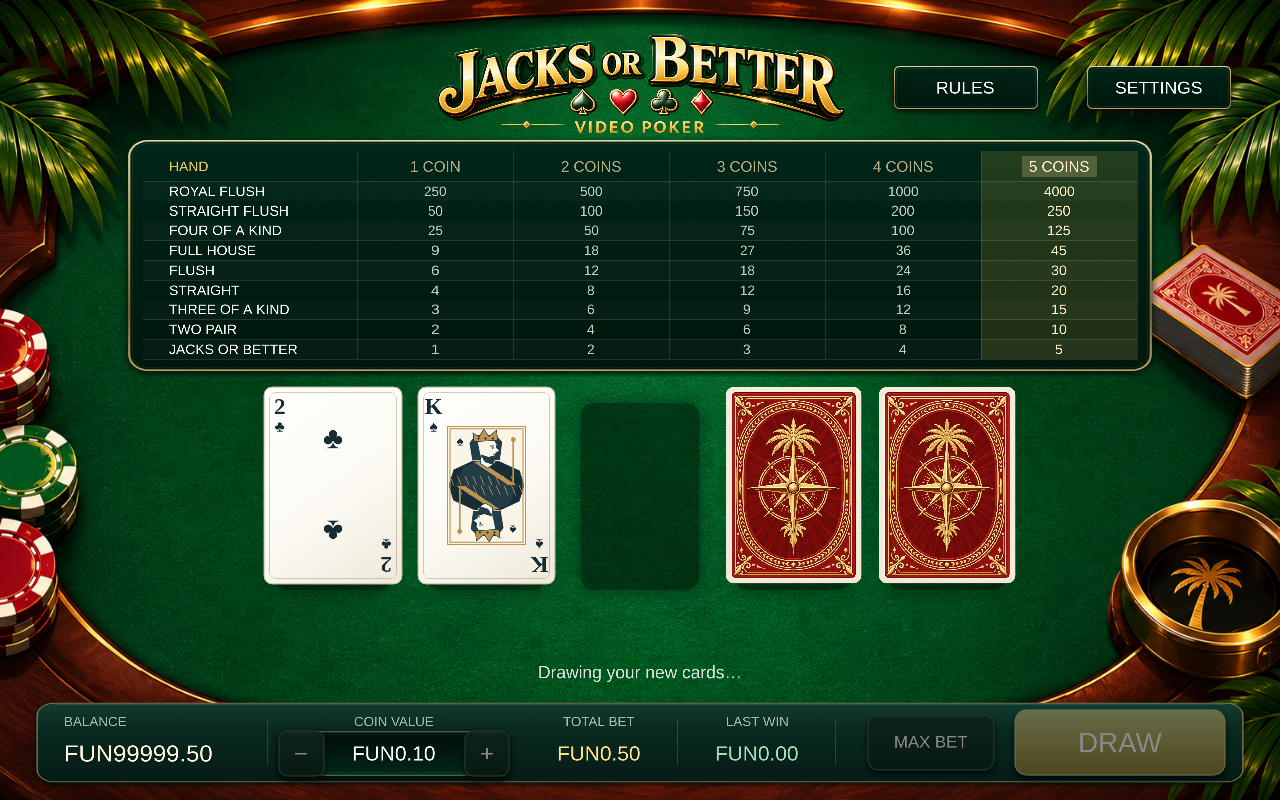
Play runs in four steps. Pick a coin value and a coin count from one to five by tapping a column on the paytable, then deal. Five cards arrive; tapping a card or its hold tag keeps it for the next round.
Press draw, and everything you didn’t hold is replaced with new cards from the deck. Your final five-card hand is compared to the paytable and any win is paid automatically. No second draw, no second chance.
The coin mechanic is worth a second look, because it’s the one place this machine differs from a flat-stake game. Your coin count doesn’t change which hands pay – it changes which column of the paytable you’re playing in.
One coin buys the leftmost column, five coins the rightmost, and the columns don’t all step up at the same rate. Where a slot’s stake simply scales every win together, the coin columns here hide one very steep step at the top.
The qualifying hand gives the game its name. A pair of Jacks, Queens, Kings or Aces is the minimum hand that pays; a lower pair, twos through tens, returns nothing.
That single rule shapes every decision on the draw. A held pair of nines is a hand you’re rebuilding, not banking – you’re drawing to improve it or to replace it, never to be paid for it.
Every card comes from a cryptographically secure shuffle dealt server-side, and the client in front of you only displays what the server returns. It’s the kind of behind-the-scenes detail a poker game should have, and this one does.
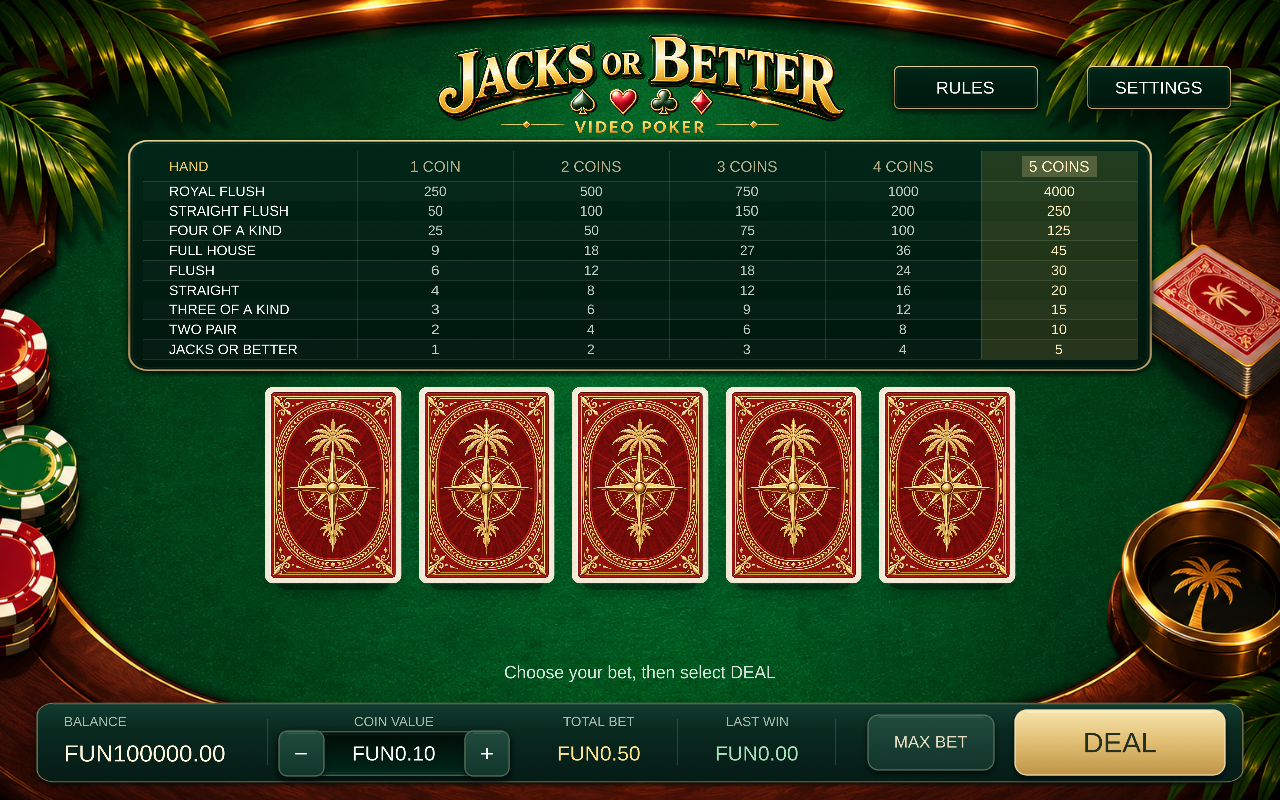
Paytable values below are multiples of the total bet, shown for each coin level from one to five coins:
- Royal Flush: 500x, 1,000x, 1,500x, 2,000x, 8,000x
- Straight Flush: 100x, 200x, 300x, 400x, 500x
- Four of a Kind: 50x, 100x, 150x, 200x, 250x
- Full House: 18x, 36x, 54x, 72x, 90x
- Flush: 12x, 24x, 36x, 48x, 60x
- Straight: 8x, 16x, 24x, 32x, 40x
- Three of a Kind: 6x, 12x, 18x, 24x, 30x
- Two Pair: 4x, 8x, 12x, 16x, 20x
- Jacks or Better: 2x, 4x, 6x, 8x, 10x
Notice the shape of that ladder. Every hand except the Royal Flush scales in even steps from coin to coin, so a bigger stake simply buys a proportionally bigger payout.
The Royal is the one row that breaks the pattern, and that break is the whole reason the max-coin feature below exists. Below the Royal, the gap between adjacent hands is modest – Two Pair to Three of a Kind is a jump from 4x to 6x per coin at any level.
Jacks or Better’s Max Coin Royal Flush Bonus
Betting the maximum of five coins unlocks a Royal Flush jackpot bonus. A Royal at max coins pays 4,000 credits instead of the usual 1,250, which works out to 800x the total bet. It’s the only feature in the game, and it isn’t triggered by scatters or luck – it’s triggered by your stake.
The arithmetic behind it is straightforward. At four coins or fewer, a Royal pays 500x per coin, rising evenly as you add coins. At five coins, that fifth coin alone pays 6,000x.
Nothing else on the paytable rewards max stakes anywhere near that steeply. Every other row climbs by exactly its one-coin value each time you add a coin. So if a Royal is what you’re drawing for, the five-coin column is the only one that makes sense.
It also changes how you play borderline hands. Four to a Royal is a draw worth taking even when it means breaking a made Flush or a low pair, because the hand at the end of it pays so much more at five coins than any alternative. At one coin, that same chase is far less compelling.
There’s no other bonus round, no gamble feature, no side bet. Video poker’s depth has always come from the draw decisions themselves, and this machine doesn’t pad around that.
Whether to break up Two Pair chasing a Full House, whether to hold a low pair over four to a Flush – those choices are where the game lives. Each one is a small calculation the paytable makes for you, once you’ve read it.
Our Honest Verdict
Overall Rating: 7.5/10
Playing this is a quiet hour at a very pretty table: palm leaves, polished rail, and one real decision at a time. The reason to sit down is the full-pay 9/6 table itself, because every correct hold you make is worth more here than on the trimmed versions of the same game.
The strength is that nothing about the game is hidden from you – read the paytable and you know exactly what every hold is worth. The weakness is the Royal. Nearly all the upside sits in one hand that arrives a handful of times in a lifetime of draws, and below five coins the table stops being the one you came for.
It’s for players who enjoy getting decisions right and don’t need a feature ladder to stay interested. Anyone who wants escalating modifiers and bonus rounds will find the felt very quiet. For the rest, the palms make a pleasant place to do some careful arithmetic.
Jacks or Better FAQs
-
When is Jacks or Better released?
Jacks or Better’s release date is 9 November 2026. -
Who makes Jacks or Better?
Jacks or Better is made by Urgent Games. -
What is the minimum winning hand in Jacks or Better?
A pair of Jacks, Queens, Kings or Aces. Any lower pair, from twos through tens, pays nothing. -
What does 9/6 mean in Jacks or Better?
A Full House pays 9x your bet per coin and a Flush pays 6x. That combination is the full-pay version of the game and the best-paying paytable in the Jacks or Better family. -
Why should I bet five coins in Jacks or Better?
Betting the maximum of five coins unlocks a Royal Flush jackpot bonus that pays 800x your total bet, instead of the 500x-per-coin rate that applies at lower coin levels. The jump is steep enough that five coins is the only column that makes sense if you’re drawing for a Royal. -
How does the draw work in Jacks or Better?
You’re dealt five cards, tap any card or its hold tag to keep it, then press draw. Every card you didn’t hold is replaced with new ones from the deck, and your final five-card hand is compared to the paytable and paid automatically. -
Is the dealing in Jacks or Better fair?
Yes. The shuffle is cryptographically secure and runs on the server, not in the game client, which acts purely as a display for what the server deals. -
Are there free spins or bonus rounds in Jacks or Better?
No. The only feature is the max-coin Royal Flush bonus, which pays 4,000 credits instead of the usual 1,250 when you bet five coins. The game’s depth comes from the draw decisions, not from bonus features. -
Does the number of coins I bet change which hands win?
No. Every hand on the paytable pays at every coin level. Your coin count only sets which column of the paytable you play in, and the only column that pays disproportionately is the five-coin column’s Royal Flush. -
Should I break up a made hand to chase a Royal Flush?
At five coins it’s often the right draw. Four to a Royal pays nothing on its own, but the completed hand at max coins is worth 800x your total bet – more than a made Flush or Full House – so breaking either to draw for it can be the better play. At fewer coins the maths changes, because the Royal pays 500x per coin rather than 800x.