













3 Pots of Venice Slot Review
A carnival ball in a Venetian palazzo, all gilt moulding and chandeliers, and the reels themselves are the least important thing in the room. That’s deliberate. 3 Pots of Venice is Betsoft‘s answer to a question most hold and win games dodge: instead of one bonus that plays the same every time, this one lets three pots above the reels decide what the round becomes, and the base game is little more than the mechanism for filling them.
It runs on a 5×3 grid with very high volatility, and the RTP is 96.20%. The studio’s other recent work includes Carnival Rush and Good Girl Bad Girl 2, and this one shares their taste for ornament with a mechanic underneath. The ballroom is the costume. The pots are the plot.

Base Game & Features
The setting is a carnival ball inside a grand ballroom, all cream and gold, with chandeliers receding into an arched hall behind the reels. The grid itself sits in a thin gold filigree frame over deep aubergine, and the logo curls across the top-left corner in Italianate script. Along the left edge, a tall stack of engraved gilt plaques fills the margin, each in its own filigree cartouche. It’s a rich look, and Betsoft have committed to it.
Wins pay left to right across the five reels and three rows. The wild substitutes for the paying symbols and does nothing else, which keeps the base game’s focus exactly where the pots want it. There’s no second wild behaviour and no multiplier hiding in the base game; what you see is what fills the pots.
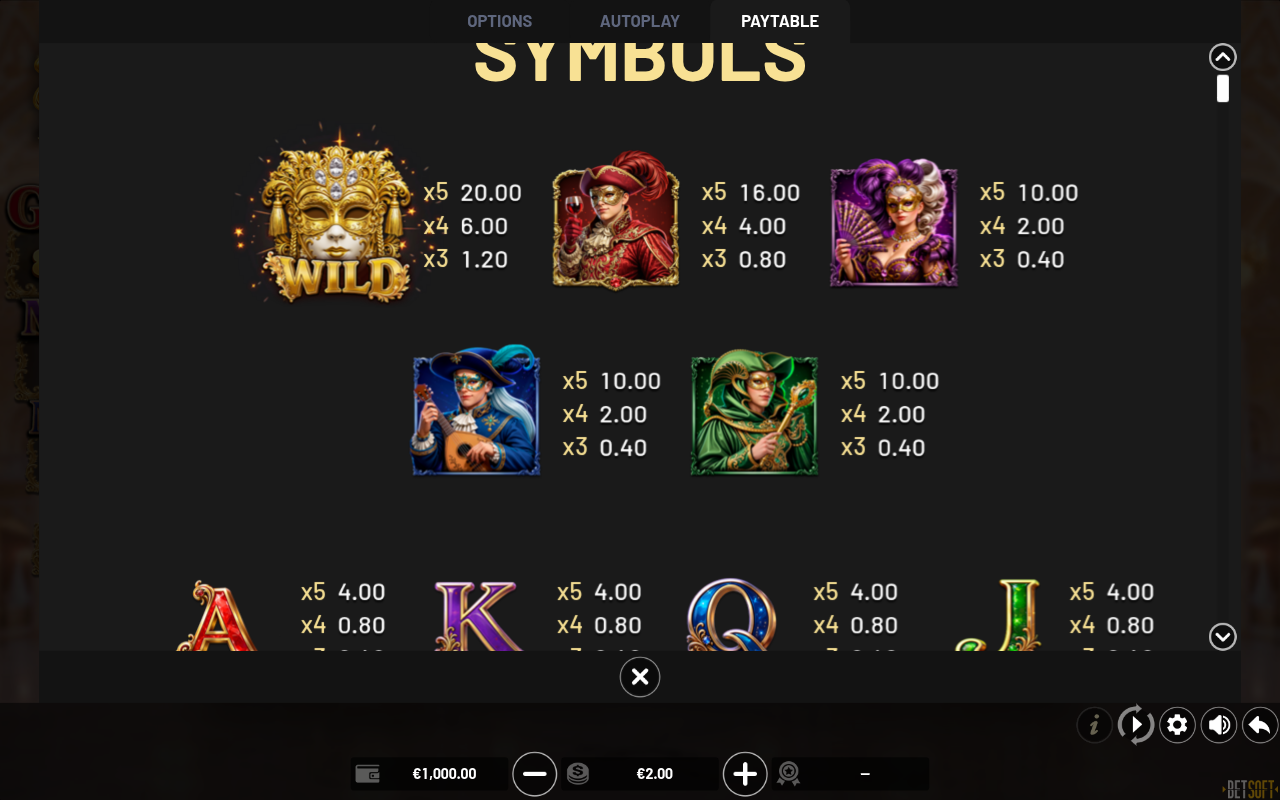
The paytable splits into three tiers, with values as multiples of your stake:
- Red Masked Man – 0.4x for three, 2x for four, 8x for five
- Purple Fan Lady – 0.2x for three, 1x for four, 5x for five
- Blue Masked Musician – 0.2x for three, 1x for four, 5x for five
- Green Masked Figure – 0.2x for three, 1x for four, 5x for five
- A, K, Q, J royals – 0.2x for three, 0.4x for four, 2x for five
The premium tier is thin. A single masked character carries the top pays, and three mid-tier symbols share one value row, so the paytable’s shape pushes attention towards the collection mechanic rather than the line wins. Even a full line of the Red Masked Man returns 8x, and the royals pay a fifth of that at best. Line wins here are pocket money; the pots are the point.
The rose icon is the bonus symbol, and it’s the one to watch. Roses land carrying cash values, and each one collects into the matching pot above the reels. That collection is the whole engine of the game, and the base game is largely a question of which pot is filling fastest.
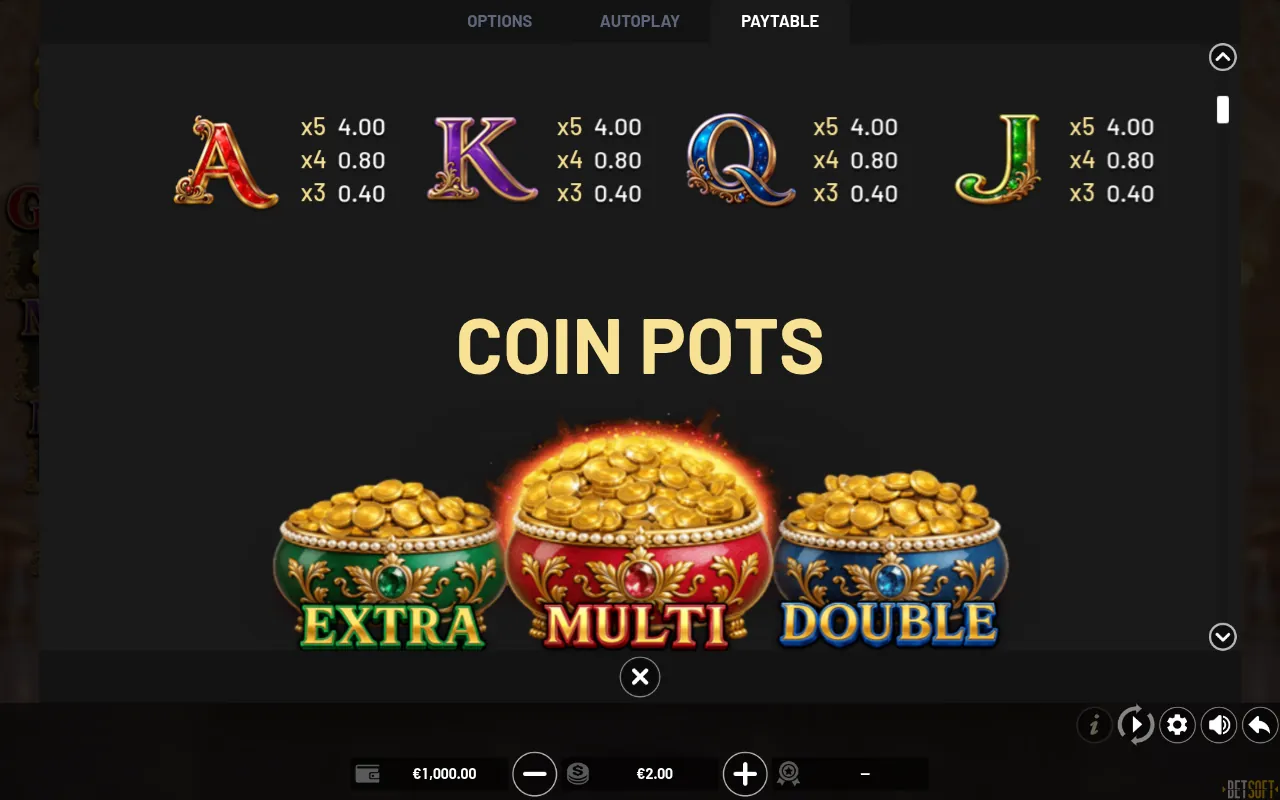
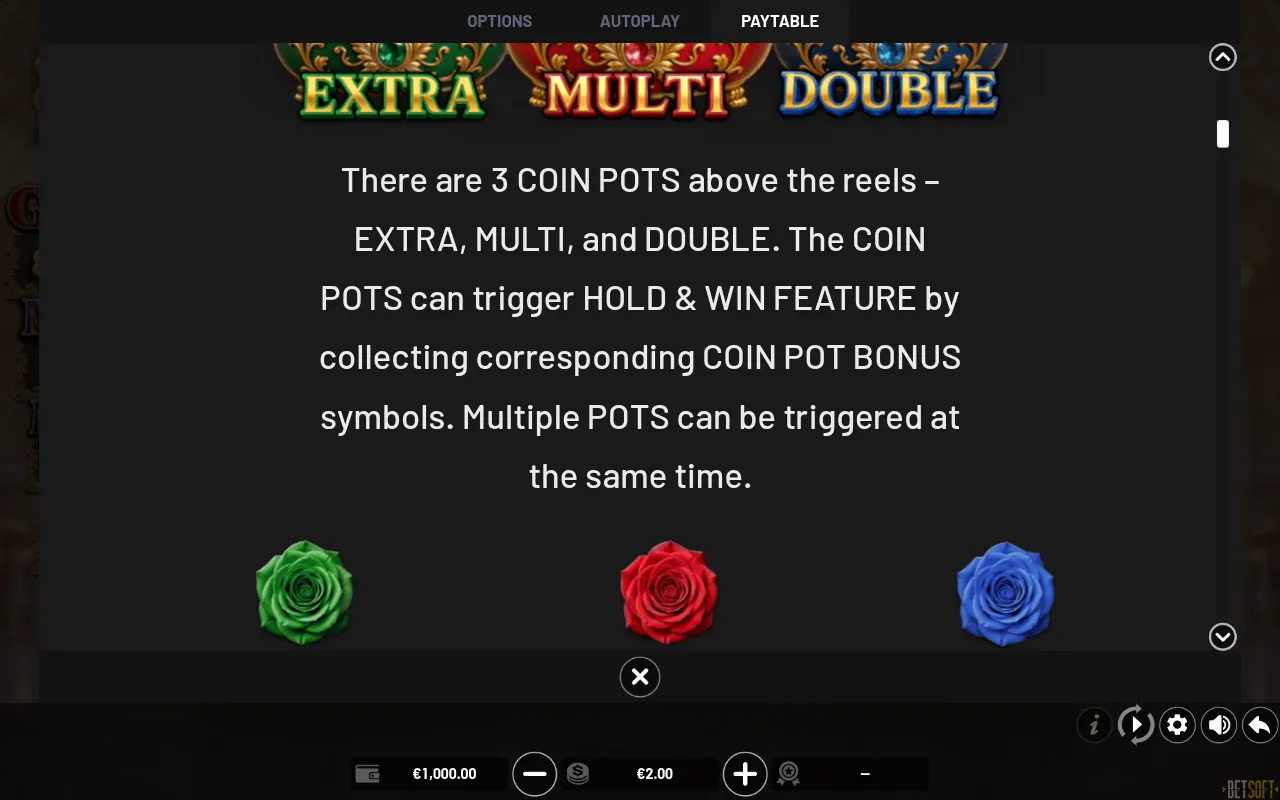
There are three pots, and each one is tied to a different modifier:
- Extra – the green pot, which upgrades the respin count in the bonus
- Multi – the red pot, which adds random multipliers to the bonus
- Double – the blue pot, which duplicates the board in the bonus
Collect enough of the matching bonus symbols and the corresponding pot triggers the Hold & Win Feature, awarding three respins. There’s no separate scatter or free spins round to wait for; the pots are the bonus, and the base game is where you fill them.
3 Pots of Venice Hold & Win Bonus
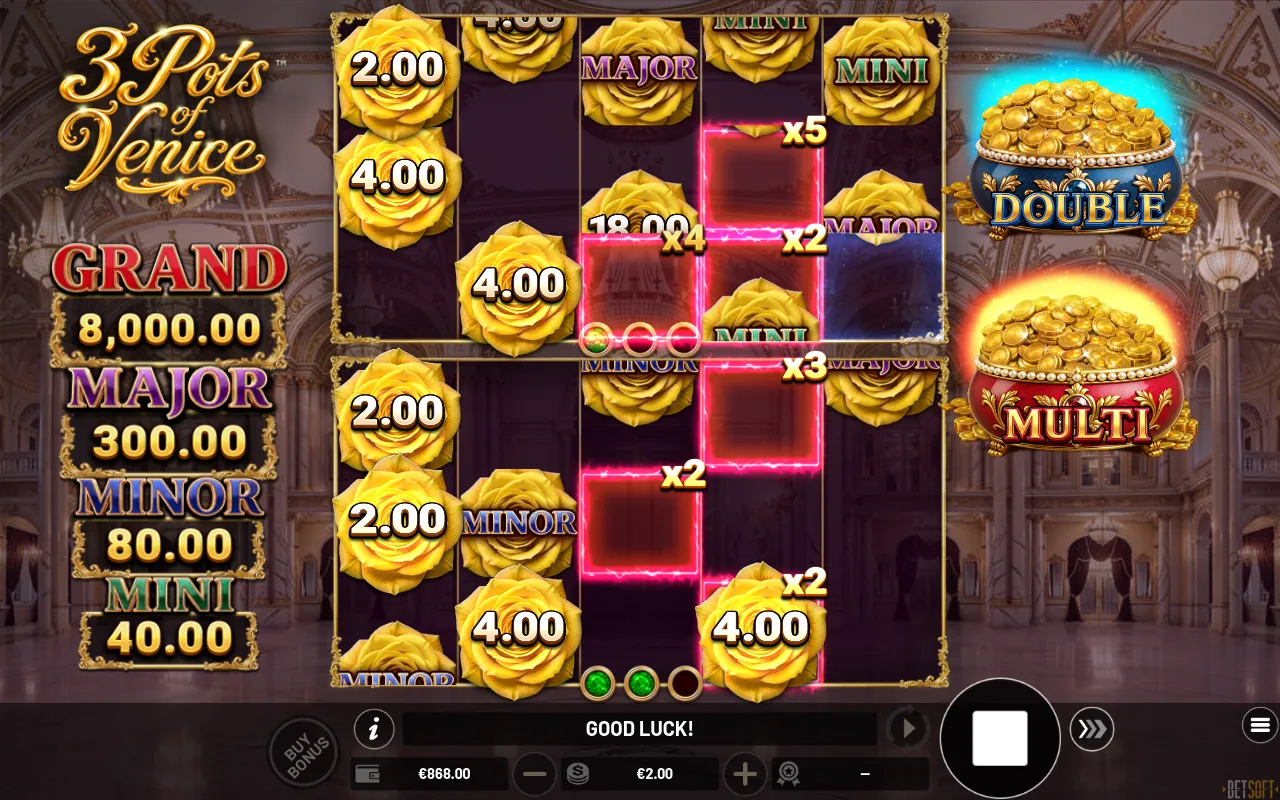
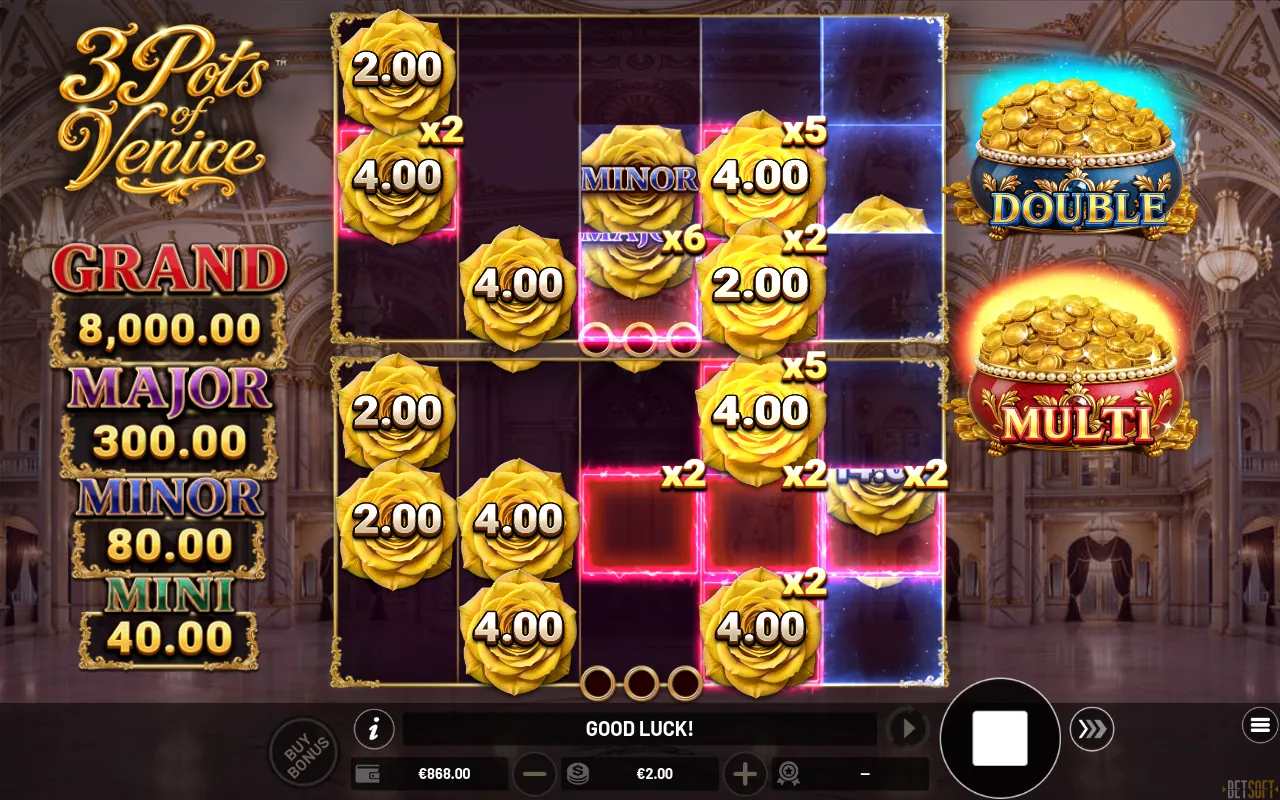
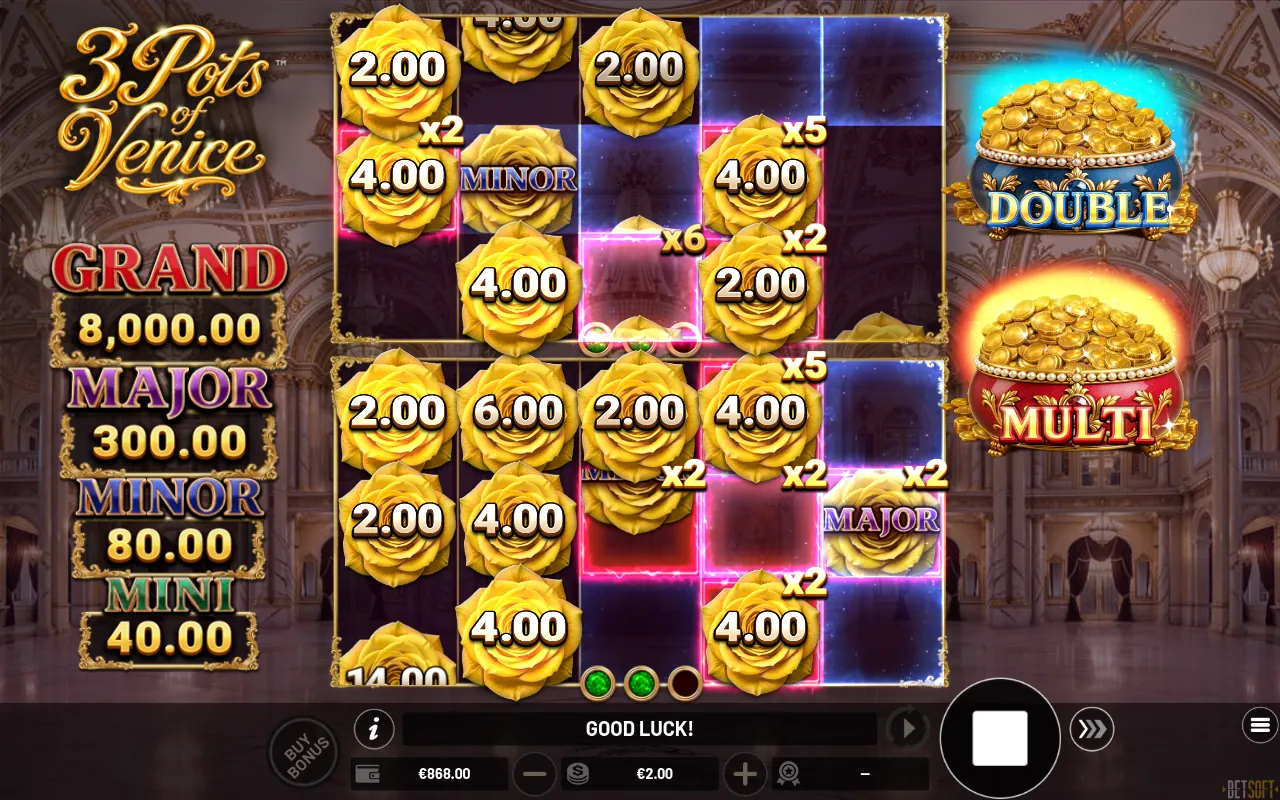
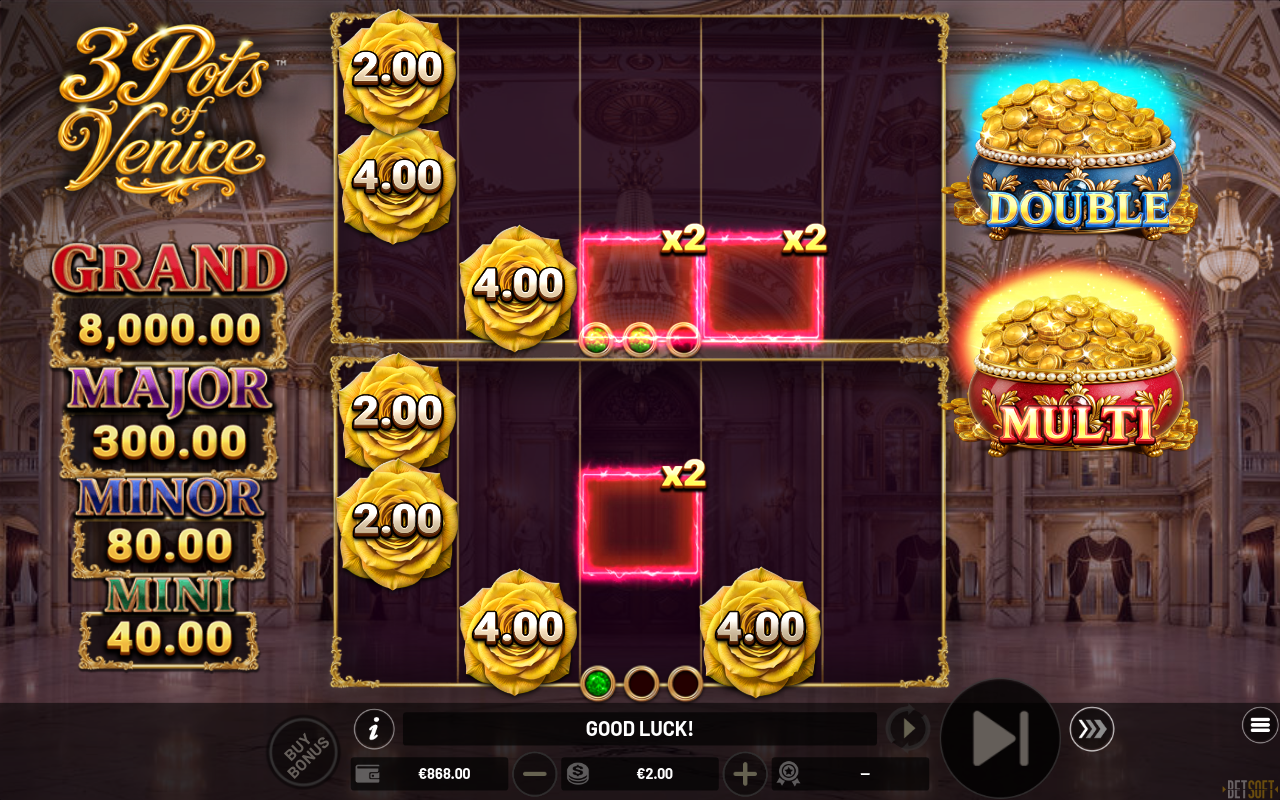
When a pot fills, the reels give way to the Hold & Win Feature and three respins begin. It’s the classic hold and win shape: bonus symbols lock in place, every new one resets the respin counter, and the round ends when the respins run out or the board fills. The twist is that the pots don’t just trigger the round. They change what happens inside it.
The round plays out in a fixed order:
- The triggering pot’s modifier switches on for the whole round
- Three respins start, with locked bonus symbols carrying their cash values
- Each new bonus symbol that lands locks in place and resets the respin count
- The round ends when respins are exhausted, and the locked values pay out
That reset rule is where the tension lives. A board that looks finished with one respin left can rebuild itself twice over if the bonus symbols keep arriving, and a dry streak of three spins ends the round on the spot. Nothing carries over between rounds, so every pot trigger is a fresh start.
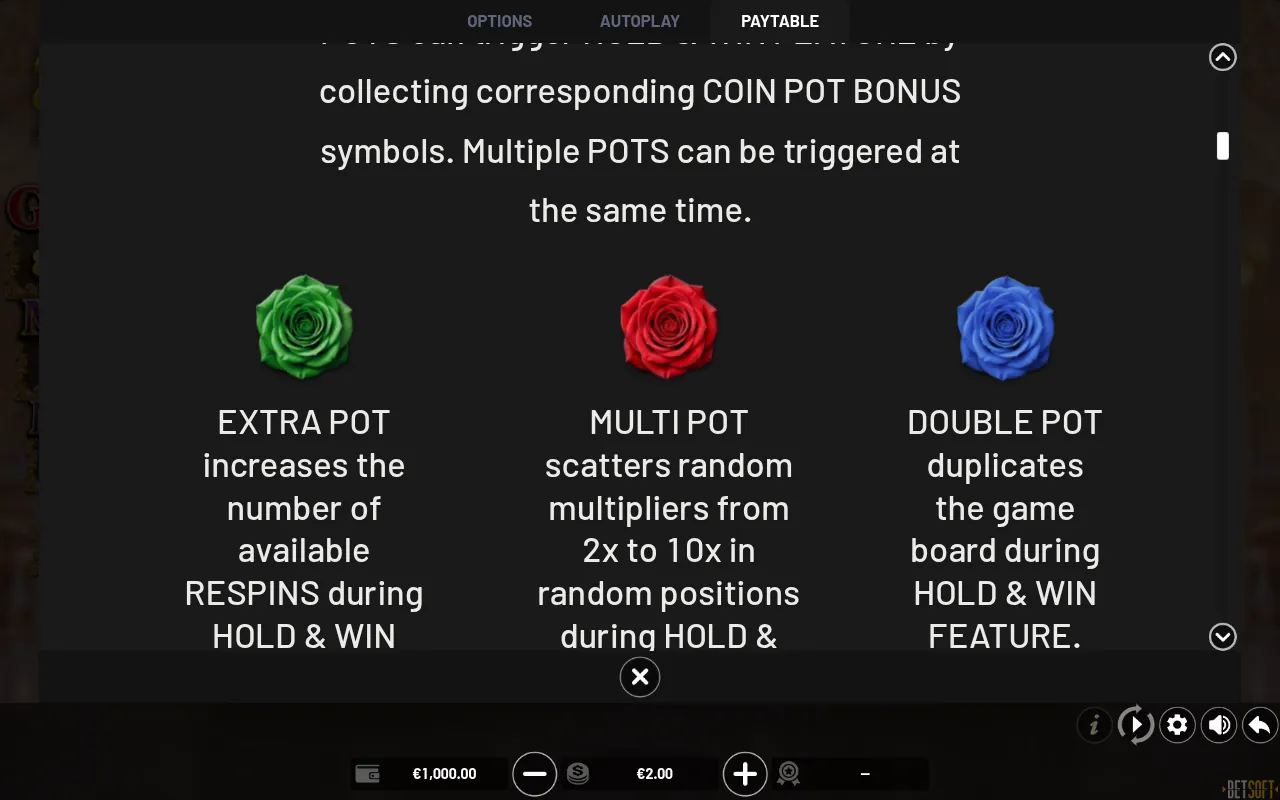
More than one pot can fire at the same time, and the modifiers stack:
- Extra Pot – increases the number of respins from three to four
- Multi Pot – scatters random multipliers from 2x to 10x across random positions
- Double Pot – duplicates the game board
The Double Pot is the loud one. A second board means two sets of locked symbols accumulating at once, and it’s the difference between a tidy round and a proper one. The Multi Pot is quieter but compounds: multipliers landing on populated positions turn a settled board into something better. The Extra Pot is the least glamorous of the three, though a fourth respin is one more chance for the kind of late symbol that resets everything.
Which combination you get depends on which pots you filled, so the base game’s collection choices carry straight into the bonus. Filling the Extra and Multi pots together awards both the fourth respin and the multipliers in one round. There’s no published ceiling on what a round can pay, which is unusual, and the very high volatility rating is the honest signal of how the payouts are distributed.
Bonus Buy
There’s a buy option in the base game for players who’d rather skip the collection phase and go straight to the respins. Very high volatility cuts both ways on a purchase: the stacked-pot rounds are where the money is, but nothing about the buy guarantees you a good board once you’re in.

Our Honest Verdict
Overall Rating: 7.1/10
Playing 3 Pots of Venice is a long waltz around a ballroom floor waiting for one dance: you spin, you collect roses, you watch the pots, and when two of them go together the whole room lights up. That stacking is what you’d choose it for, and when the Double Pot is one of the pair, the round has genuine reach.
The weakness is just as clear. There’s only the one feature, and the paytable is thin enough that the roses are the only symbols doing interesting work, so the stretches between pot triggers are plain. If you need a free spins round or a second mechanic to break up the middle, the ballroom will feel empty.
It’s a good fit for anyone who enjoys a slow collection build with one decisive payoff and doesn’t mind a paytable that exists to feed it. The pots are what this game is, the gilding is what it wears, and for the right player both halves earn their place at the ball.
3 Pots of Venice FAQs
-
What triggers the Hold & Win Feature in 3 Pots of Venice?
Collecting enough COIN POT BONUS symbols fills the matching pot above the reels and triggers the Hold & Win Feature, awarding three respins. -
Can more than one pot trigger at the same time in 3 Pots of Venice?
Yes. Multiple pots can trigger together, and their modifiers stack in the same Hold & Win round. -
What does the Extra Pot do in 3 Pots of Venice?
The Extra Pot increases the number of respins in the Hold & Win Feature from three to four. -
What does the Multi Pot do in 3 Pots of Venice?
The Multi Pot scatters random multipliers from 2x to 10x in random positions during the Hold & Win Feature. -
What does the Double Pot do in 3 Pots of Venice?
The Double Pot duplicates the game board during the Hold & Win Feature, giving two sets of locked symbols in one round. -
Can you buy the bonus on 3 Pots of Venice?
Yes, there’s a buy bonus option in the base game that takes you straight to the Hold & Win Feature. Pricing isn’t fixed in the game itself and can vary by operator. -
What is the grid size of 3 Pots of Venice?
3 Pots of Venice runs on a 5×3 grid, five reels and three rows. -
Is 3 Pots of Venice high volatility?
Yes, it’s rated very high volatility, so wins are designed to be less frequent but potentially larger. -
When is 3 Pots of Venice released?
3 Pots of Venice’s release date is 2 October 2026.