










Bonus Poker Slot Review
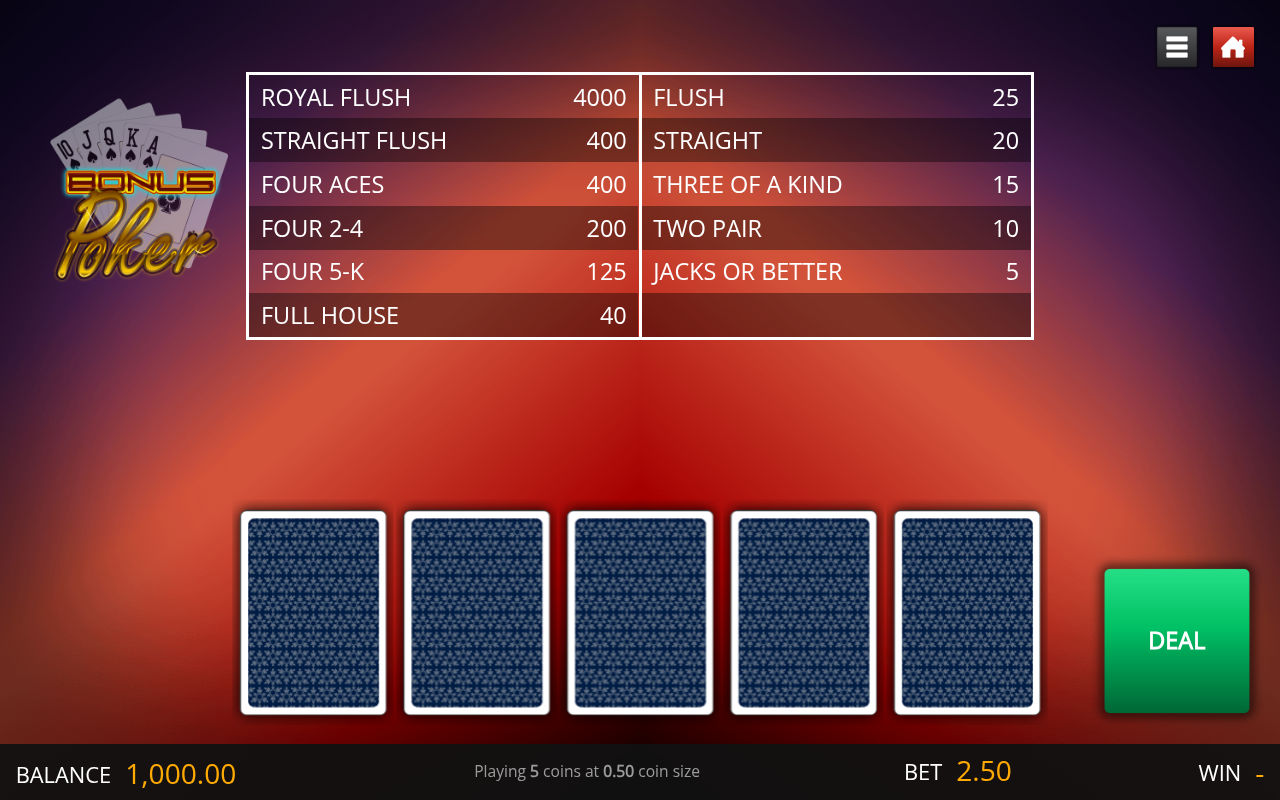
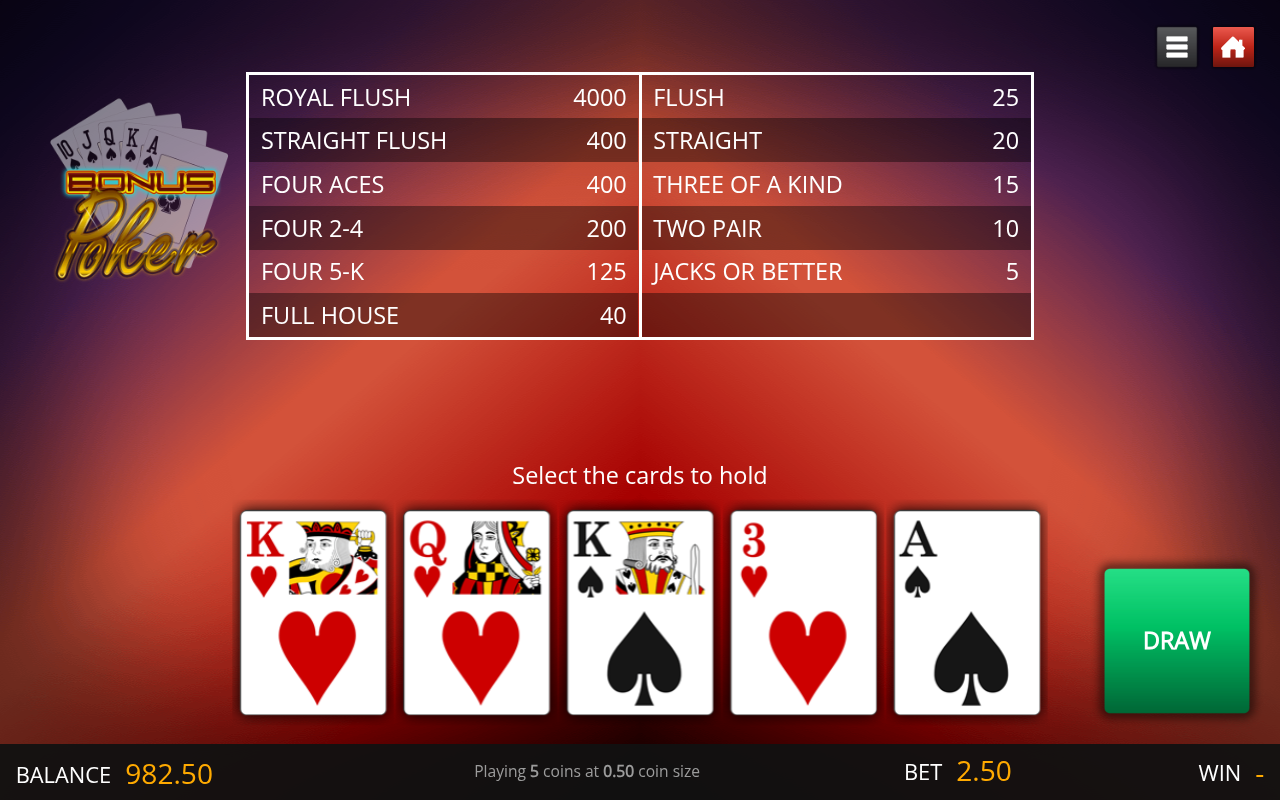
A crimson glow spreads out from the middle of the screen and fades into near-black purple at the corners, with nothing else on the stage: no felt table, no dealer, no venue. Just five cards and a decision. That’s the whole of Bonus Poker, a video poker take from Genii where the outcome depends more on whoever is holding the cards than on anything the machine does.
That’s an arguable thing to say about a game with a fixed paytable, but it’s the truth of draw poker: the deal is luck, and everything after it is judgement. Which cards to hold, whether to gamble a win or bank it, when a certain small pay beats a shot at a big one. Few games hand over that much of the steering, and this one gives nothing else to hide behind.
How a Hand Works
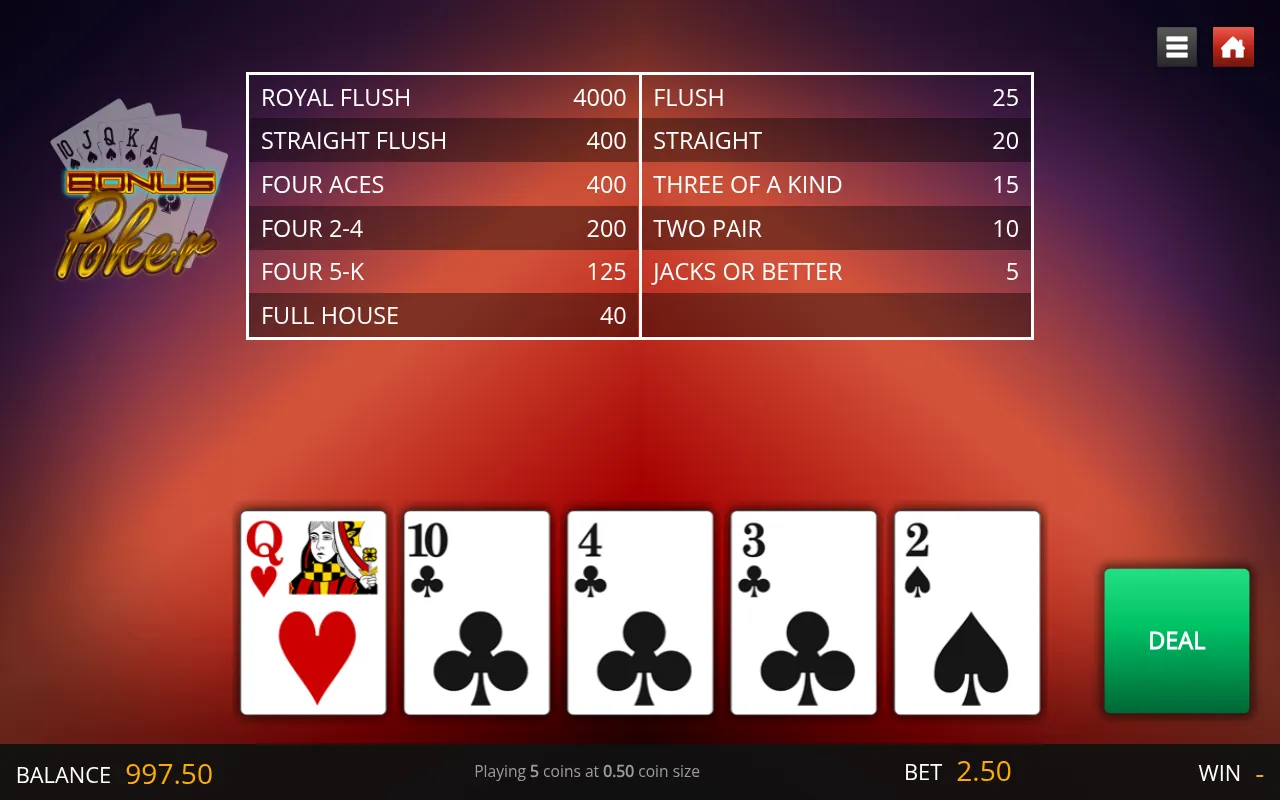
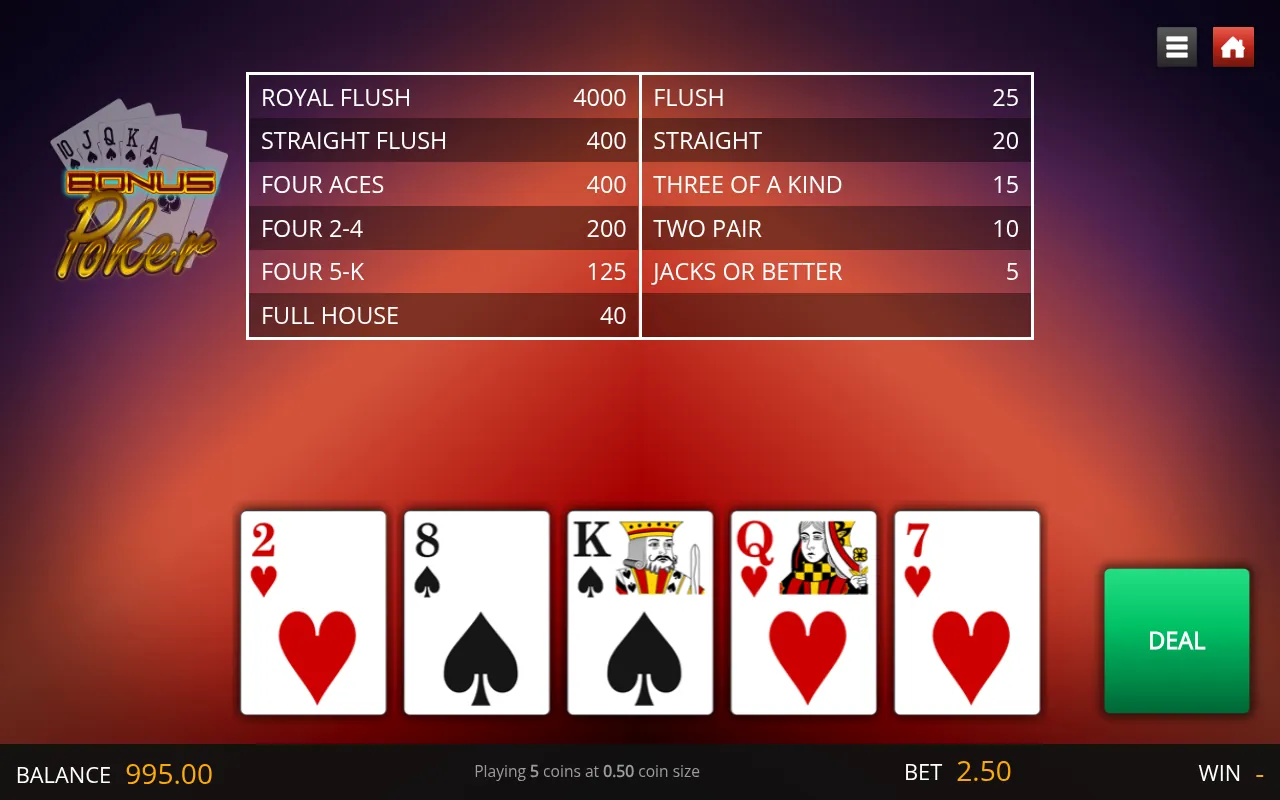
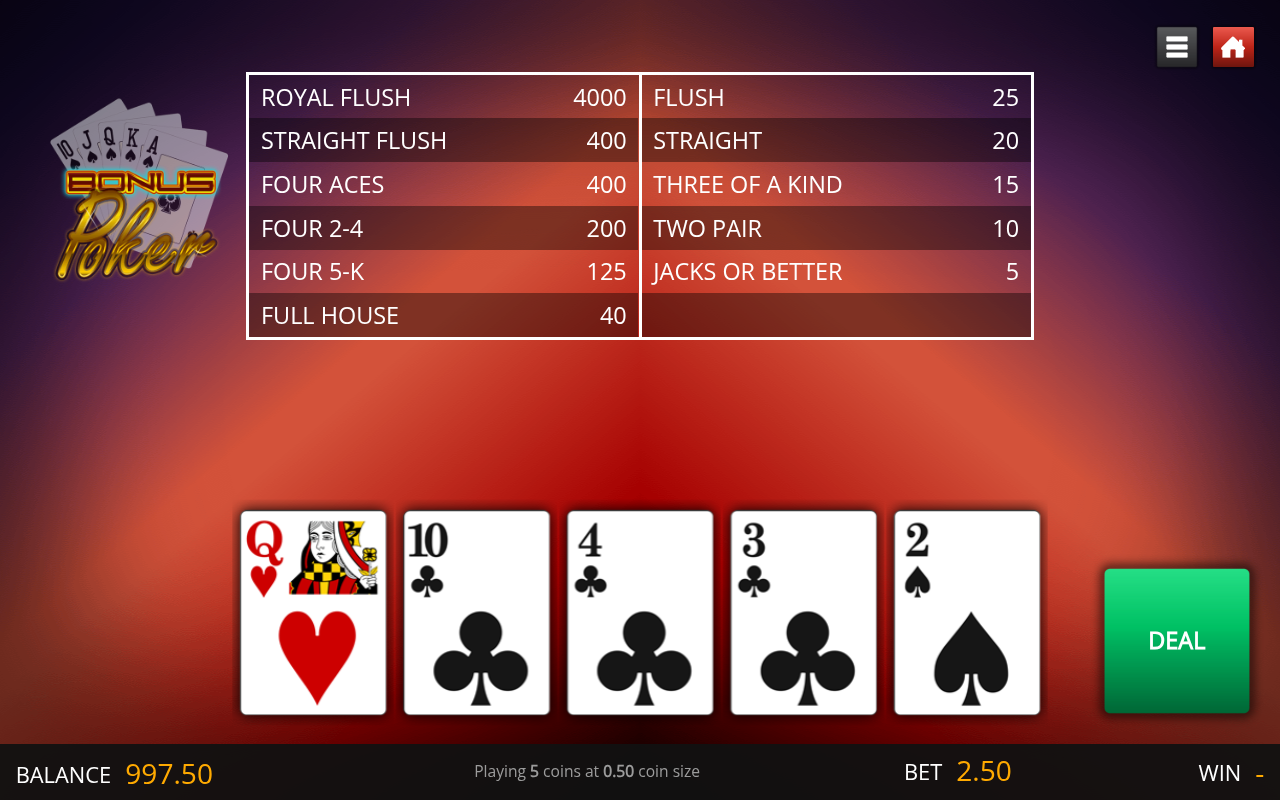
This is draw poker, not a spinning-reel slot. Each round deals five cards from a standard 52-card deck, and you select the cards to hold before drawing replacements for the rest. The final five-card hand is then scored against the paytable, and winning hands are paid as multiples of your total bet.
That hold decision is the whole game. Before the draw you’re weighing what you have against what you could make: a low pair against a four-card flush, three to a royal against a made hand that already pays.
There’s no autopilot here, because every round asks a question and every answer changes the outcome. The choices come in recognisable shapes. A dealt pair is usually worth holding, since two pair already pays 2x and three of a kind pays 3x, but the draw attached to a pair can also improve into a full house or a quad.
A four-card flush or an open-ended straight draw competes with those small certain pays. The tiered quad table adds a third voice to that argument when the pair is deuces or the single high card is an Ace.
Discarded cards are replaced from the same deck, so what you throw away affects what can come back. Holding four hearts means the fifth heart is one fewer card in the remaining deck, a small but real edge to keeping track of when the draws matter.
There’s no wild card and no scatter. Every hand is made from the deck as dealt, which means the odds are the familiar odds of five-card draw, and the only choices that matter are which cards to hold and whether to gamble a win afterwards.
The Paytable
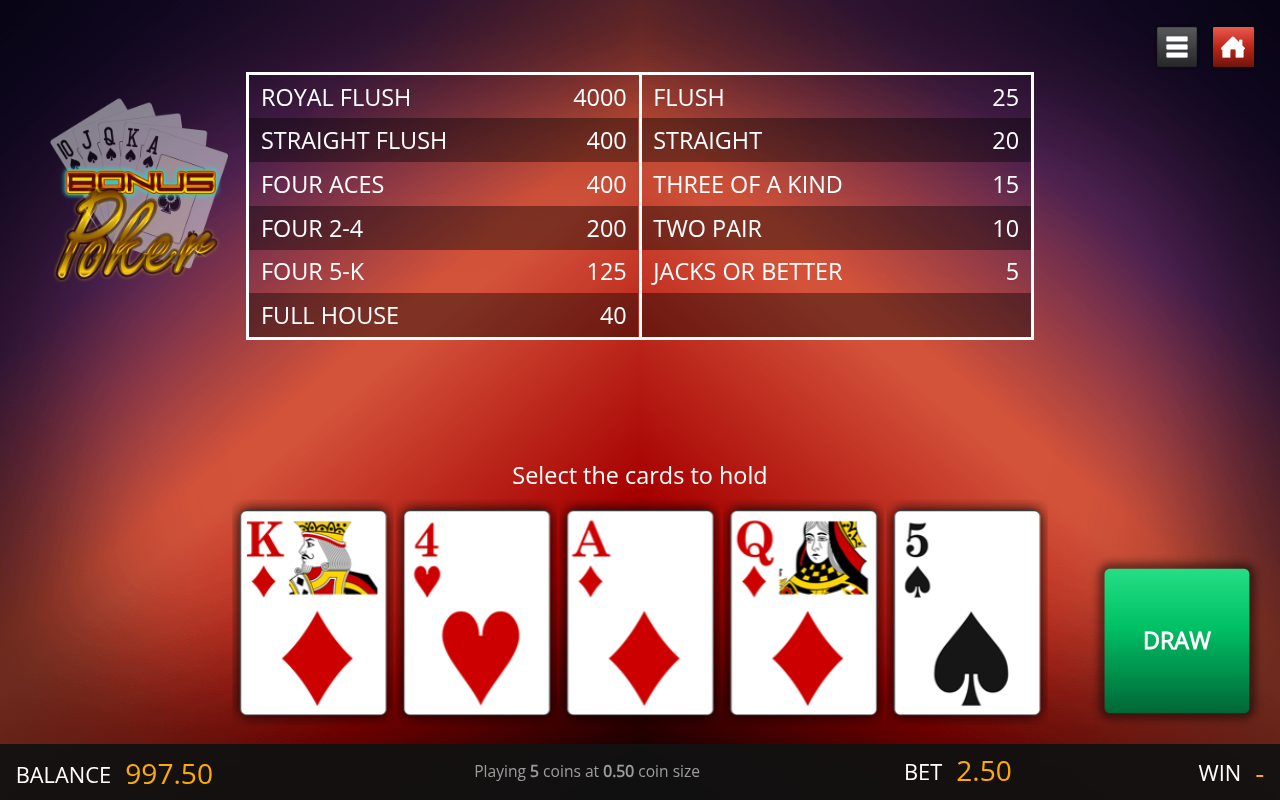
Pays are shown as multiples of the total bet, not per coin, which is worth keeping in mind when comparing against other video poker machines. The full ladder, from the top down:
- Royal Flush – 800x the total bet
- Straight Flush – 80x
- Four Aces – 80x
- Four 2s through 4s – 40x
- Four 5s through Kings – 25x
- Full House – 8x
- Flush – 5x
- Straight – 4x
- Three of a Kind – 3x
- Two Pair – 2x
- Jacks or Better – 1x
The tiered quad structure is the “bonus” of the title. On a plain Jacks or Better machine, all four of a kinds pay the same; here, catching four Aces triples the return of catching four kings, and the low-numbered quads sit comfortably in between.
The effect shows up in the holding decisions. A dealt pair of deuces is a modest start on most machines, but with four 2s through 4s worth 40x, holding that low pair carries a genuinely attractive upside.
The same is true of Aces: a single Ace in the dealt hand is a hold that can grow into an 80x quad, which colours the choice between keeping high cards and chasing a flush draw.
Everything from a full house downwards follows the classic ladder, so the low end of the table will be instantly familiar to anyone who has played video poker before. Jacks or Better returns your stake, which keeps the small hands ticking over while you wait on the big ones. Two pair doubles it, and three of a kind triples it, so the bottom four rungs all pay something back rather than nothing.
Notice the shape of the ladder, too. The jump from quads down to a full house is steep: 25x against 8x. Below the quads, no hand reaches double figures until the flush’s 5x, and the middle of the table is compressed into a narrow band from 1x to 8x. That tells you where the game’s money sits and what the holding strategy is built around.
The gap above that band is just as telling. A straight flush and four Aces both pay 80x, so the second tier is shared between luck and the Ace-heavy holds, and everything above 80x belongs to the royal alone. One hand on the ladder is worth ten times the hands beneath it.
Double or Nothing
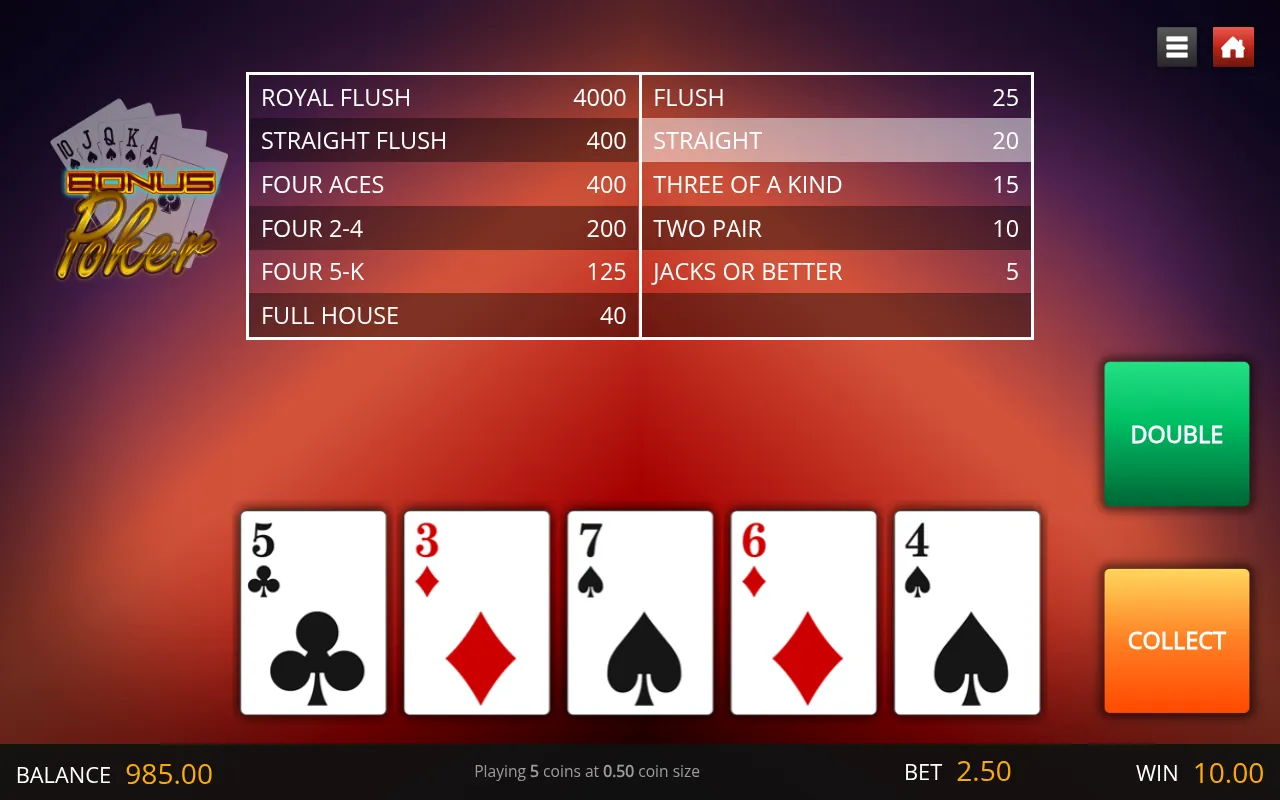
After any winning hand is paid, the game offers a choice: DOUBLE or COLLECT. Collect banks the win and returns you to the deal. Double puts the entire win at risk on a single further outcome, with the straightforward promise in the name: succeed and the win is doubled, fail and it’s gone.
It’s an all-or-nothing structure rather than a partial gamble, so the decision is binary each time. There’s no cashing out half or banking a portion; whatever you’ve won goes into the pot or it doesn’t.
The maths compounds quickly. A modest hand that’s doubled once becomes twice its listed value; doubled twice, four times. A player who keeps doubling is layering risk onto the same original win, and one loss along the way takes the lot, no matter how many successful doubles came before it.
The size of the win changes how the choice reads. Gambling a 1x Jacks or Better payout is a cheap shot at turning it into 2x, and losing it costs very little. Gambling a straight flush’s 80x is a different proposition entirely, because the amount on the table already represents a strong result.
That makes COLLECT the quiet half of the feature. It’s the button that turns a good run into an actual balance change.
Our Honest Verdict
Overall Rating: 6.8/10
Playing Bonus Poker feels less like spinning and more like sitting at a quiet card table that happens to glow red. Every hand deals you a small puzzle, and the one reason to choose it over anything else on a casino floor is that your answers actually matter: nobody’s bonus round is coming to rescue a bad decision.
The tiered quads are the best thing here, because they make otherwise boring hands interesting. A pair of deuces is a genuine hold when four deuces pays 40x, and that reshapes strategy from the bottom of the deck up. The weakness is everything underneath: the middle of the ladder is thin, so long stretches of play hand back your stake in crumbs while you wait on a hand that changes the session.
This suits players who want a game they can play well rather than a game that plays itself, and who don’t mind stretches of quiet between the hands worth remembering. Anyone after reels, free spins and escalating features will find the crimson glow holding nothing but cards. Those cards are the entire point.
Bonus Poker FAQs
-
When is Bonus Poker released?
Bonus Poker was released on 5 June 2023. -
Who makes Bonus Poker?
Bonus Poker is made by Genii. -
How do you play Bonus Poker?
Each round deals five cards from a standard 52-card deck. You select the cards to hold, draw replacements for the rest, and the final hand is paid according to the poker hand rankings. Replacements come from the same deck, so discards influence what the draw can bring. -
What is the highest-paying hand in Bonus Poker?
The Royal Flush is the top hand, paying 800x the total bet. Four Aces and a Straight Flush follow at 80x each, and nothing else on the ladder reaches double figures beyond the quads. -
Why do four of a kinds pay different amounts?
This is the bonus structure. Four Aces pay 80x the bet, four 2s through 4s pay 40x, and four 5s through Kings pay 25x, so higher and lower quads are worth more than mid-range ones. On a plain Jacks or Better machine, all quads pay the same. -
How does the Double or Nothing gamble work?
Every winning hand ends with a choice between two buttons. COLLECT banks the win and deals the next hand, while DOUBLE risks the whole amount on a single outcome that either doubles it or loses it entirely. There’s no partial cash-out, and one failed double takes the full amount no matter how many came before it. -
Is there a wild card in Bonus Poker?
No. The game uses a standard 52-card deck with no wild or scatter symbols, so every hand is made from the cards as dealt. -
Are pays based on the line bet or the total bet?
Pays are multiples of the total bet shown on screen, not the line bet. A Royal Flush, for example, pays 800x the total bet, and Jacks or Better returns exactly your stake.