













Double Double Bonus Poker Slot Review
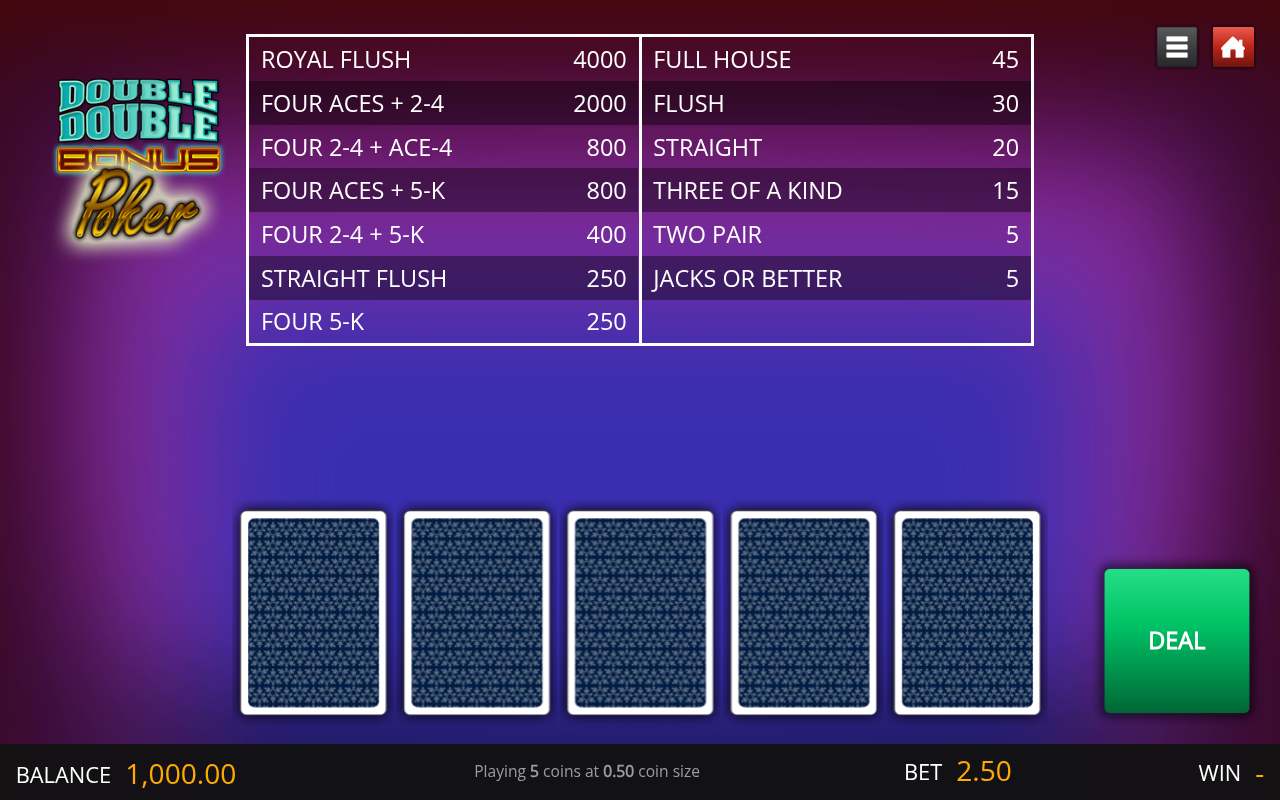
A royal blue glow blooms out of the centre of the screen and fades to violet at the edges, with a dark maroon band along the top that makes the haze look lit from behind. No table, no dealer, no room: just five cards floating in a neon-dark void. Genii have built a clean digital card table, and the restraint suits it.
The claim this game makes is that skill should decide the payout. Where a slot hides its money behind randomly triggered features, Double Double Bonus Poker puts a full 800x on a Royal Flush and 400x on four Aces with a low kicker, then hands you the cards and lets your holds determine whether you ever see any of it. Most of the ladder below those hands barely returns your stake. It’s video poker wearing a slot’s clothes, and it doesn’t care whether you know the difference.
Five Cards, One Decision
Each round deals five cards and asks you to select the cards to hold before the draw. The held cards stay put, the rest are replaced, and the final five-card hand is scored against the paytable. That single decision is the entire game, and it’s the reason video poker has kept its audience for decades: nothing is left to a reel animation or a random modifier.
There’s no wild and no scatter in this game. Every hand is made from a standard deck, and every payout is a function of the five cards you end up holding. That plainness is the point, and it means the paytable is the only document worth learning.
Reading the Table
Two questions decide every hold. First, what does the hand pay if it improves? Second, what are the odds of that improvement? A four-card flush needs one card from thirteen of its suit remaining in the deck, out of forty-seven unseen cards.
A four-card outside straight draw needs one of eight cards. These aren’t hidden numbers; a standard 52-card deck fixes them, and the game’s payouts sit on top of that known arithmetic.
Those two questions produce a short list of standard holds:
- Dealt four to a flush, keep all four and draw one – thirteen outs to a 6x payout.
- Dealt a made straight, hold all five; breaking it to chase a flush or full house costs equity.
- Dealt a low pair with an Ace, keep both – the pair can improve while the Ace waits as a kicker.
- Dealt two pair, hold both pairs and draw one – the 1x floor is locked in, with a full house at 9x live.
The Double Bonus Prize Ladder
“Double Double” refers to the way four-of-a-kind hands are split into tiers, with kickers deciding the size of the prize. The values below are multiples of the total bet on screen, and they step steeply from the top:
- Royal Flush – 800x
- Four Aces with a 2, 3 or 4 kicker – 400x
- Four 2s, 3s or 4s with an Ace to 4 kicker – 160x
- Four Aces with a 5 to King kicker – 160x
- Four 2s, 3s or 4s with a 5 to King kicker – 80x
- Straight Flush – 50x
- Four 5s through Kings – 50x
- Full House – 9x
- Flush – 6x
- Straight – 4x
- Three of a Kind – 3x
- Two Pair – 1x
- Jacks or Better – 1x
The shape of that ladder tells you how to play. A pair of low cards with an Ace is worth more than it looks, because the Ace can serve as the kicker for four 2s through 4s. Similarly, holding a lone Ace is often the right call on a rubbish hand, purely for its kicker potential.
The split runs deepest at the top. Four Aces with a deuce pay 400x; the same Aces with a King beside them pay 160x. The second “Double” is the kicker, and the kicker is money.
Two pair returning just 1x is the line that stings. In Jacks or Better variants, two pair is a steady earner; here it’s been flattened to fund the premium four-of-a-kind tiers. The bottom of the ladder is thin, and the top is where the game lives.
Playing the Hand
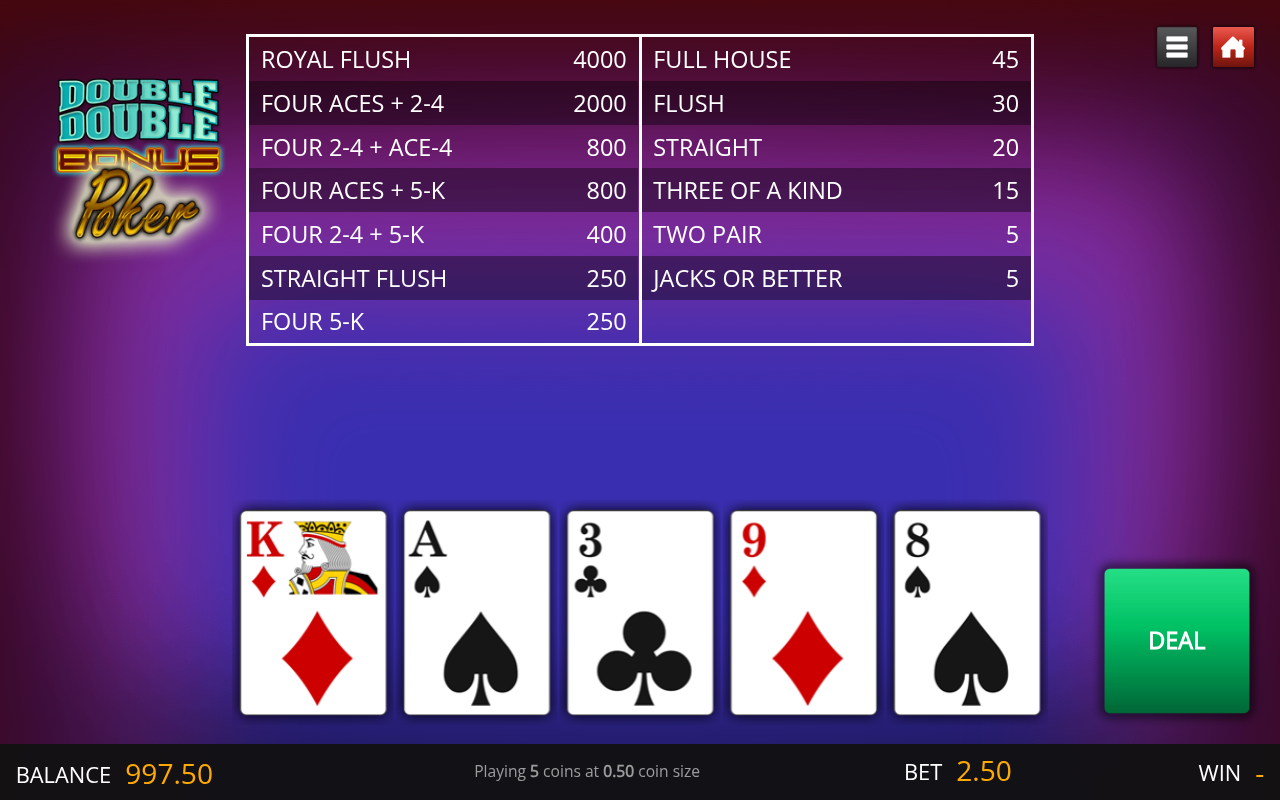
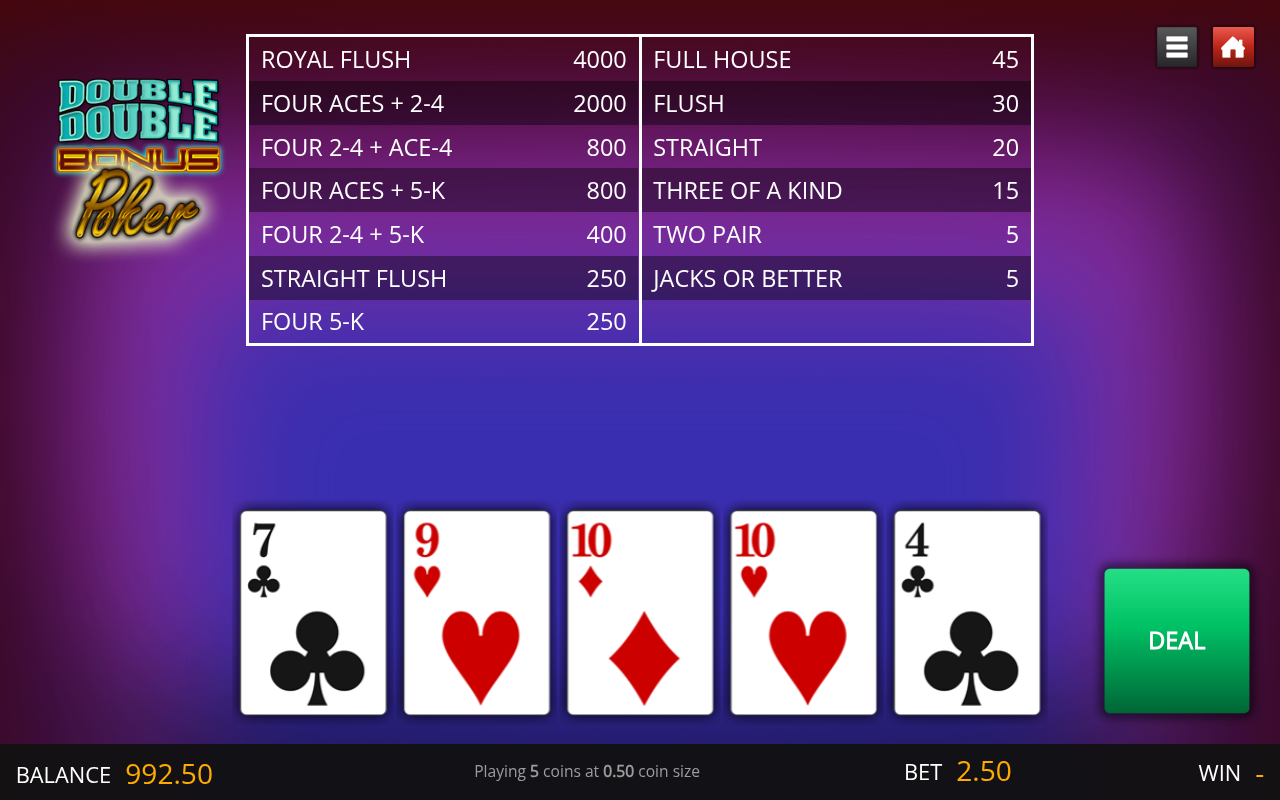
The interface keeps things simple. Cards are dealt with a “select the cards to hold” prompt, held cards lock in place, and the draw completes the hand. A typical round might deal a mixed hand like a ten, a six, a five, an Ace and a Queen, leaving one card worth holding and four to replace.
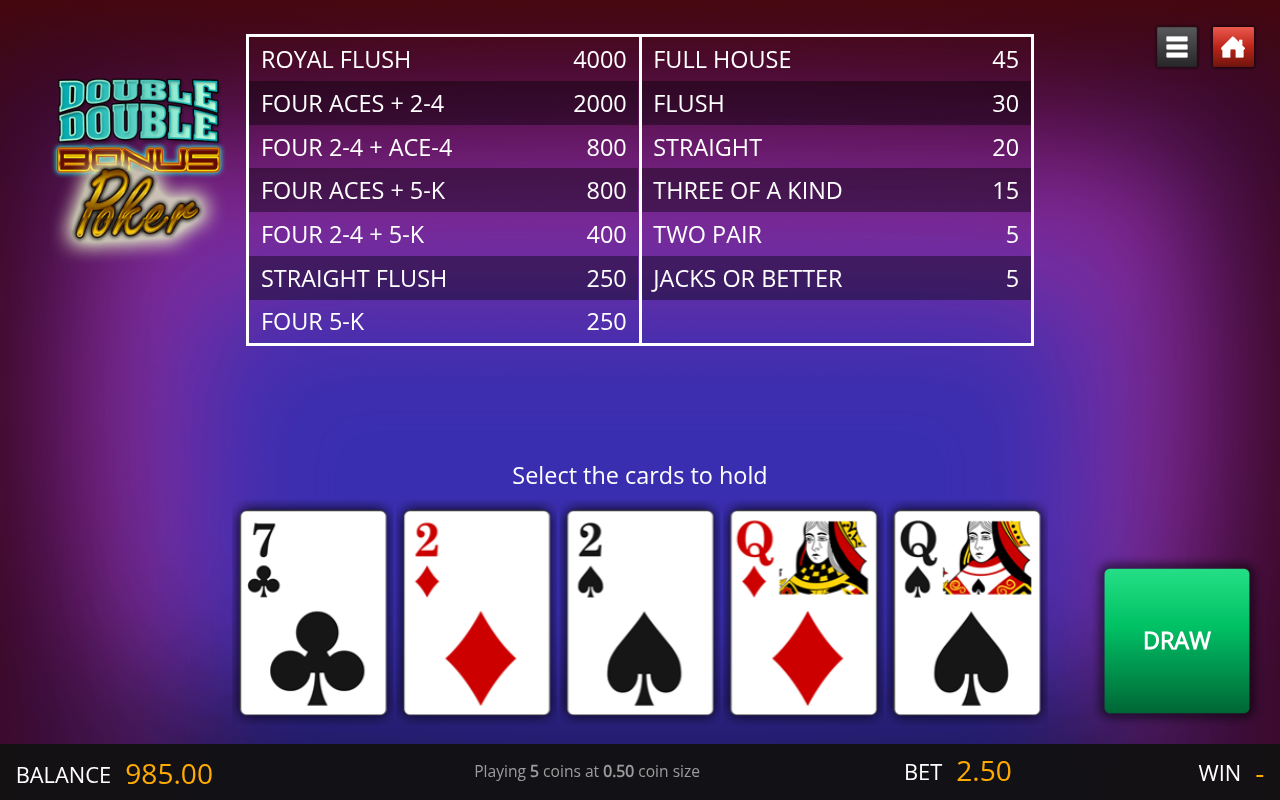
Two-card holdings come up constantly. A dealt pair of Queens with three low singles is an easy hold; a hand like a seven, a two, a two, a Queen and a Queen gives you two pair already made and a decision about whether to chase the full house.
Keep the pair and draw three, and the 1x payout is all but guaranteed. Break it up chasing three of a kind or better, and the ceiling rises sharply while the floor drops out entirely.
The game never nudges you either way. There’s no autoplay strategy hint, no suggested hold flashing on the cards, and no second chance once the draw button is pressed. The decision, and the consequence, are yours alone.
Visually, it’s a glossy digital casino treatment: smooth gradients, a warm glow behind the stacked title lockup in the top-left corner, and a bare floating feel with no horizon or furniture. It won’t be mistaken for a live table, but it doesn’t need to be. The cards do the talking.
Our Honest Verdict
Overall Rating: 7.5/10
Playing this is sitting in the neon glow and making one careful decision after another, and the reason to choose it is exactly that: the outcome genuinely depends on the cards you keep. There’s no feature round waiting behind the next hand, and no animation to paper over a dull stretch. The void is quiet company.
The kicker-split ladder is the best thing here, because it rewards knowledge you can actually acquire. Learn that four Aces with a deuce pay 400x while the same Aces with a King pay 160x, and you’ve found a reason to hold cards you’d otherwise discard. The weakness is the flat floor beneath it: two pair and Jacks or Better both return your stake, so a run of decent-looking hands can leave you exactly where you started.
For players who like poker’s arithmetic and are happy to earn their wins rather than wait for them, it’s a strong take on a proven format. Anyone chasing spectacle will find the blue haze empty. The rest of us know the value sits in the fifth card.
Double Double Bonus Poker FAQs
-
How does Double Double Bonus Poker work?
Each round deals five cards. You choose which cards to hold, the rest are replaced in the draw, and your final hand is paid according to the prize ladder. There are no reels, wilds or scatters. -
What is the top prize in Double Double Bonus Poker?
A Royal Flush pays 800x your total bet, the biggest single-hand prize in the game. Four Aces with a 2, 3 or 4 kicker comes next at 400x. -
Why do kickers matter in Double Double Bonus Poker?
Four-of-a-kind prizes are split into tiers by the fifth card. Four Aces pay 400x with a 2, 3 or 4 kicker but only 160x with a 5 through King kicker, so the side card can be worth more than double the prize. -
Does Double Double Bonus Poker have wild or scatter symbols?
No. It’s a five-card draw poker game with no wilds and no scatters. Every hand is made from a standard deck and paid purely on its poker value. -
What does two pair pay in Double Double Bonus Poker?
Two pair pays 1x your total bet, the same as a single high pair of Jacks or Better. That flattening is what funds the premium four-of-a-kind prizes. -
What is the biggest hand I can make in Double Double Bonus Poker?
The Royal Flush tops the ladder at 800x the total bet, and it’s the practical ceiling on any single paid hand. Below it, only the premium four-of-a-kind tiers reach into triple-digit multiples. -
Who makes Double Double Bonus Poker?
Double Double Bonus Poker is made by Genii. -
When is Double Double Bonus Poker released?
Double Double Bonus Poker’s release date is 25 May 2022.