













Bubble Trouble Slot Review
An airship deck at sunset, brass gears bolted into a purple-pink sky, and a flame-haired orange creature hovering beside the rail. Bubble Trouble, from Yolted, the studio behind Clusterfck, is the softest-looking game you’ll find running a math model this punishing: a hexagonal grid nine columns wide where clusters of up to six connect, pay and dissolve, at 96% RTP and high volatility. Every refill adds a row, up to twelve, so the board you finish a spin on is never the one you started with. That growing board, not the bonus round, is the whole reason to play it.
The Hex Grid
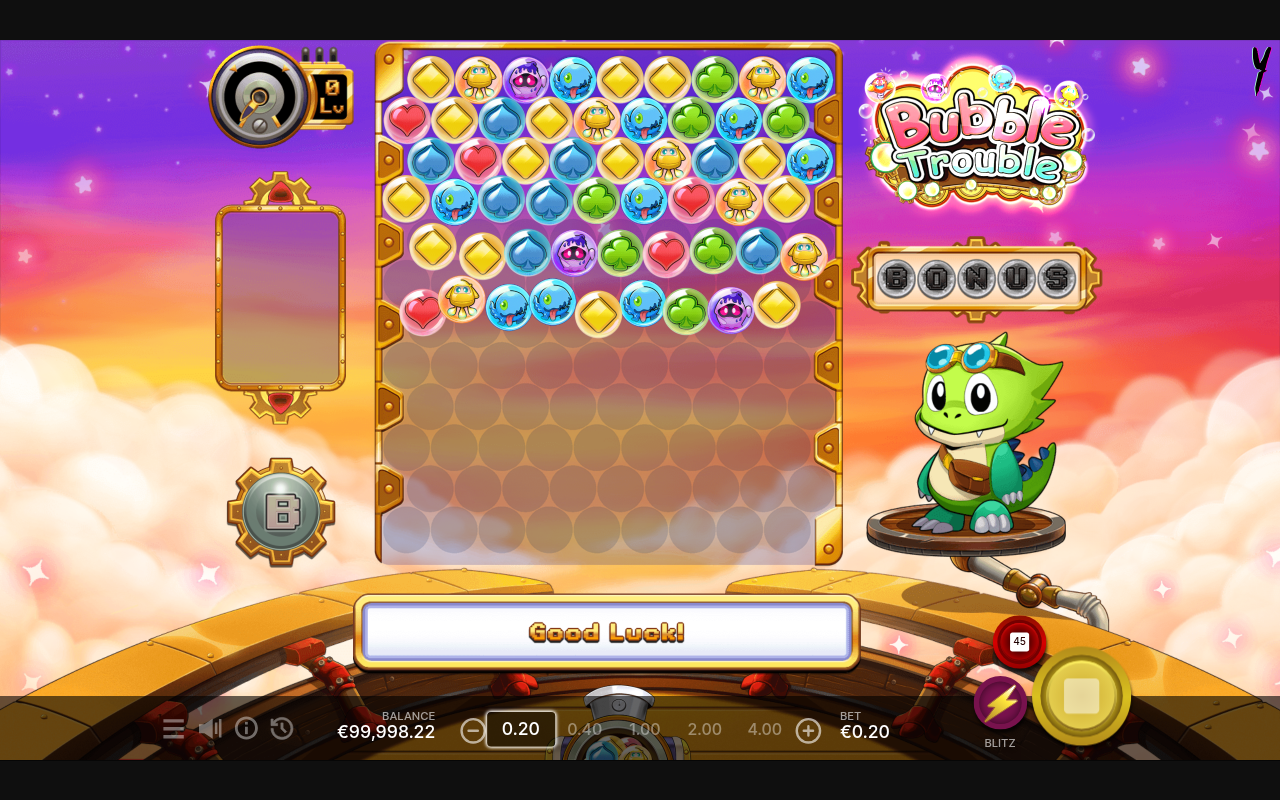
The board is the feature. Symbols sit in a hexagonal layout, nine columns wide, and because each cell has six neighbours rather than four, a matching group can connect in shapes a square grid wouldn’t allow. A cluster of up to six connected identical symbols is a win.
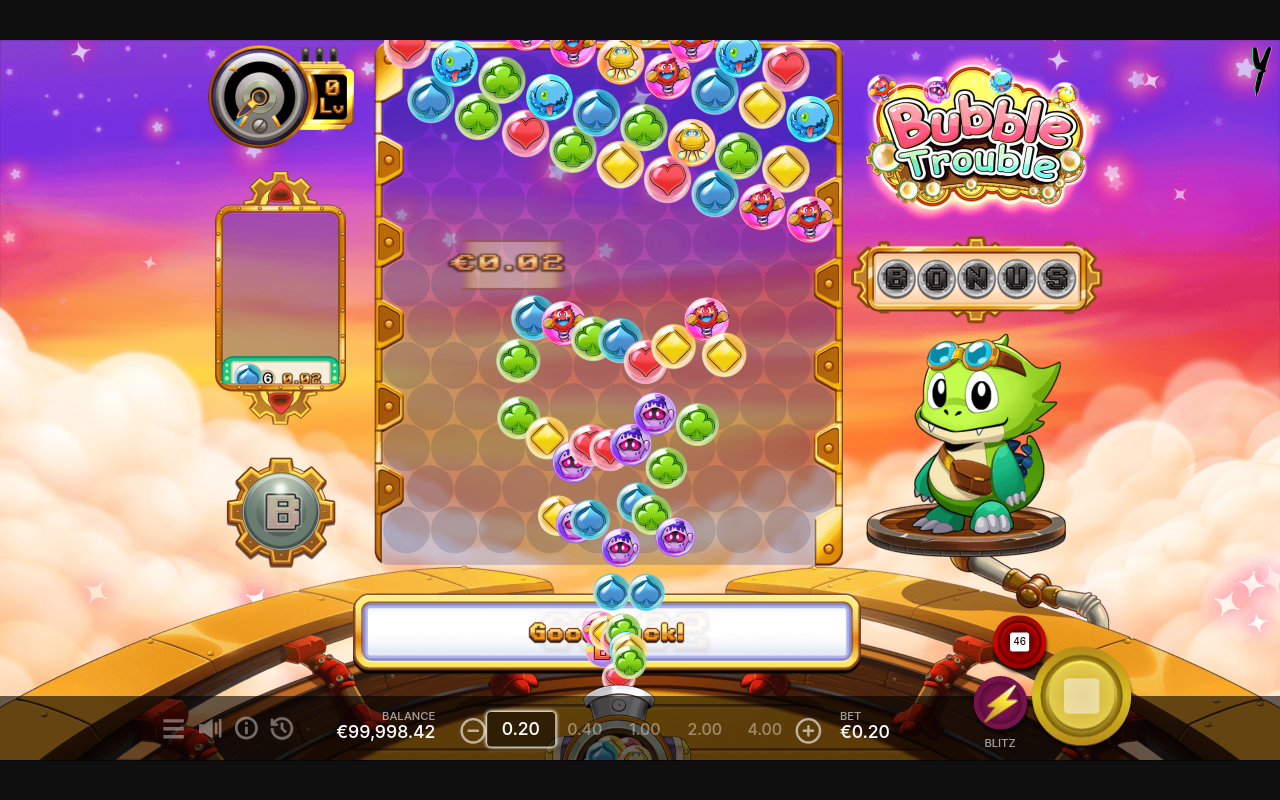
Winning symbols don’t linger. Every winning cluster is destroyed, and new symbols bubble up to fill the gaps. Those refills are the engine of the whole game, and a single spin can run through the same cycle several times over:
- A cluster of up to six connected symbols lands and pays
- The winning cluster is destroyed
- New symbols bubble up into the empty cells
- Every refill adds a row to the grid, up to a maximum of twelve
- Each new arrangement can form fresh clusters and restart the cycle
One spin can therefore chain wins on an increasingly crowded board, with the tension building each time the symbols settle. The grid doesn’t shrink between spins, so the growing rows belong to the sequence that created them, and a long chain is the only way to reach the full twelve-row layout.
What that means in practice is that every stage of a chain has more material to work with than the one before it. An early cluster might connect only three or four symbols across a shallow board; by the fourth or fifth refill, the extra rows give clusters room to spread into shapes the opening grid couldn’t hold. The wins don’t have to be big individually for the total to mount.
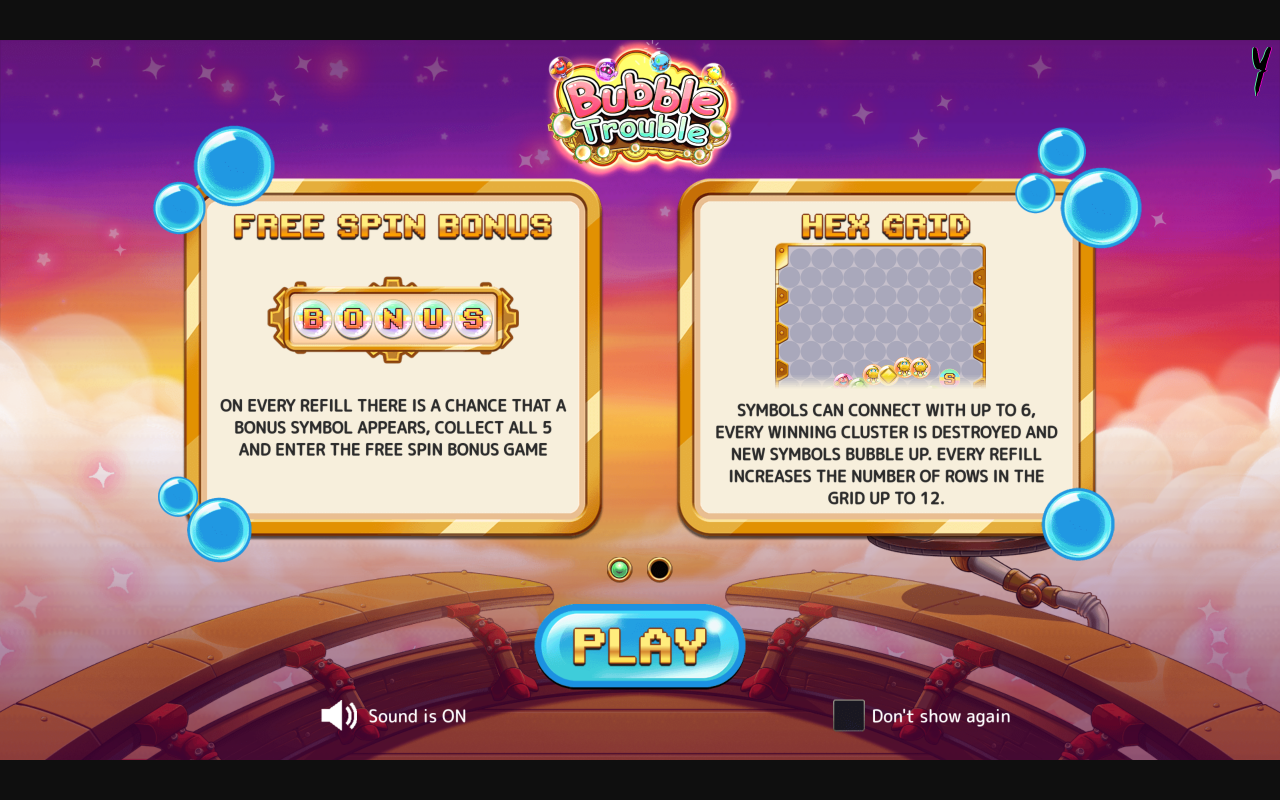
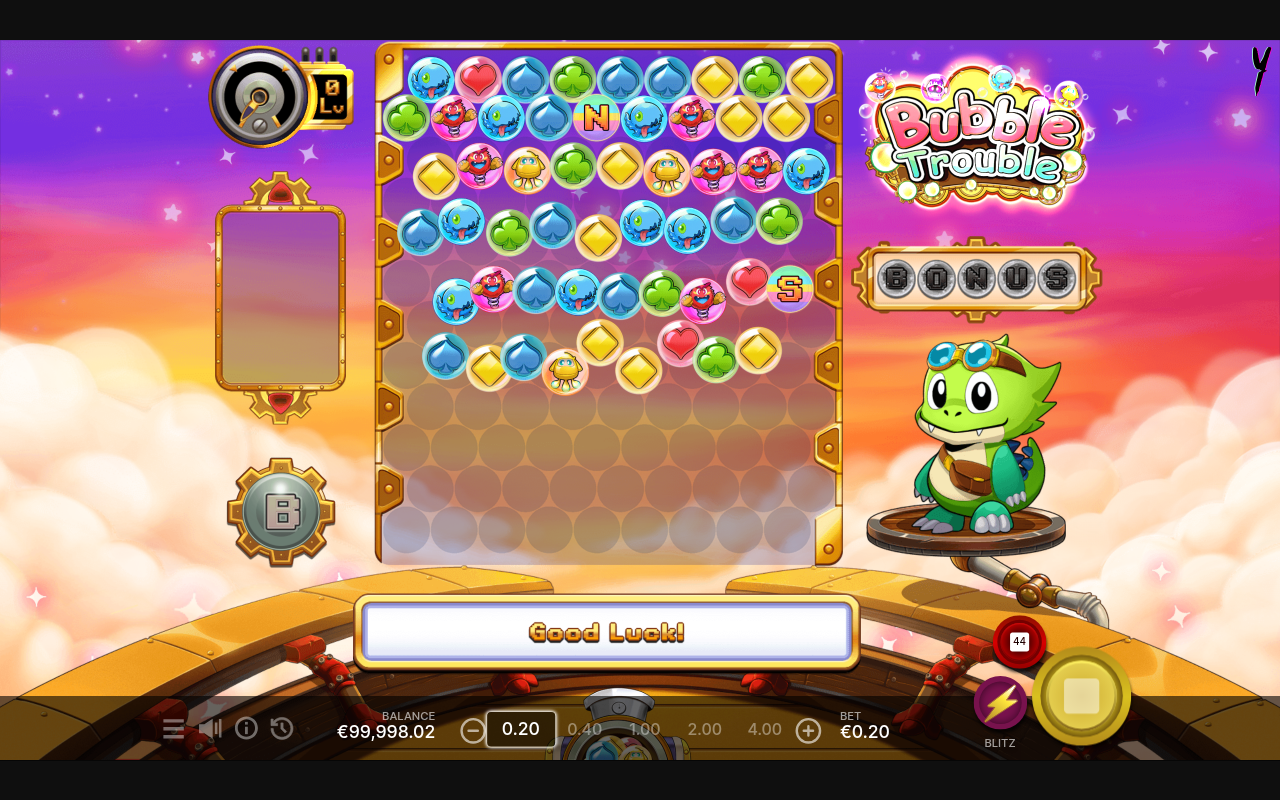
The Bonus symbol appears on refills, with a chance, and collecting five of them across a run of refills enters the Free Spin Bonus. The letters you’re gathering sit on a panel to the right of the grid, so the progress is always visible. A Blitz button sits beside the spin controls, though the game leaves what it does undescribed.
The Combo Meter and Bob’s Features
Every symbol removed from the grid feeds a Combo Meter, and filling it triggers one of three unique features in which Bob, the flame-haired creature from the deck, helps you to more wins. The meter ties the base game together: chains of cluster wins and refills don’t just pay, they also push you towards Bob’s interventions.
It’s a simple loop. Every cascade of destroyed symbols nudges the meter up, every full meter calls Bob in, and every Bob feature clears the way for further clusters. Even a modest chain of small wins is doing double duty, and the meter keeps the refills meaningful when the payouts alone wouldn’t be.
There’s a compounding quality to it. A Bob feature that removes symbols feeds the meter again, which is another step towards the next feature, which removes more symbols still. The loop only breaks when the clusters stop forming, and a board twelve rows deep gives them plenty of room to keep forming.
Exactly what each of the three features does is left to discovery, which is unusual; most games spell out their modifiers. What’s certain is the trigger, and it’s a generous one: anything that removes symbols counts towards it, whether the removal came from a winning cluster or from Bob himself.
The Free Spin Bonus
Triggering the Round
Collect all five Bonus symbols as they appear on refills and the Free Spin Bonus Game begins. Because the Bonus symbols only appear on refills, the base game’s chains and the bonus trigger are the same mechanic wearing two hats. A quiet spin with no clusters pays nothing and collects nothing; a busy one can gather letters, feed the Combo Meter and grow the grid all at once.
The collection therefore rewards exactly the kind of play the grid already wants from you. There’s no shortcut to it, and no way to buy your way in; the letters come when the refills come. A chain long enough to gather all five in a single run is a good chain by definition, and it’s likely to have grown the board considerably along the way.
The game doesn’t state a retrigger rule for the round, so what you collect is what you play.
Travelling Wilds
Inside the bonus, the Bonus symbols you collected become Wilds. They can appear on five of the grid’s nine columns, and they behave like this:
- They’re sticky, holding their positions until the end of the bonus game
- Each carries a stacking multiplier
- The multiplier grows on every win it takes part in
- They only appear on five of the nine columns, so four columns stay wild-free
Sticky, multiplying wilds on a grid that grows to twelve rows is a strong combination. The longer the round runs, the more work those wilds do, and the payouts compound accordingly. A wild that survives several wins in a row ends up carrying a multiplier built from all of them, which is where the round’s biggest results come from.
The column restriction is the counterweight. A wild can’t sit everywhere, so where they land matters as much as that they land at all: five sticky wilds crowded onto neighbouring columns leave four-fifths of the board to fend for itself, while the same five spread wide can carry clusters across the whole grid.
The refills keep running during the bonus too, which is what makes the wilds dangerous. Every winning cluster destroyed drops fresh symbols around the sticky wilds, every refill adds a row, and each new arrangement gets evaluated with the wilds and their grown multipliers still in place.
Our Honest Verdict
Overall Rating: 7.8/10
This is a slow-burn game dressed up as a daydream. You spin, clusters pop, and if the chain holds the board swells and the wins stack, all of it on a floating brass deck that’s drawn with real care. The one reason to pick it over any other cluster slot is that build: nothing here arrives finished, and the spins that earn something are the ones you watched grow.
The Free Spin Bonus is the best of it, because the sticky wilds keep compounding on a grid that keeps expanding, and a round that runs long can leave the one that started it looking small. The worst of it is the wilds’ reach: five columns out of nine is a narrow slice of a twelve-row board, and a bonus that bunches them can feel half-finished through no fault of the way you played.
If long builds and patient math are your idea of a good session, this deck was built for you. Anyone after instant fireworks from a single spin will find the sunset kinder than the payouts. Bob, at least, is in no hurry either.
Bubble Trouble FAQs
-
How do you trigger the Free Spin Bonus in Bubble Trouble?
Bonus symbols can appear on every refill. Collect all five of them and the Free Spin Bonus Game begins. -
What do the Travelling Wilds do in Bubble Trouble?
During Free Spins, the collected Bonus symbols become sticky Wilds that can appear on five of the nine columns. They hold their positions until the bonus ends, and each carries a stacking multiplier that grows on wins. -
What does the Combo Meter do in Bubble Trouble?
Every symbol removed from the grid increases the Combo Meter, which triggers three unique features where Bob helps you to get more wins. -
How big can the grid get in Bubble Trouble?
The hexagonal grid is nine columns wide, and every refill adds a row, growing the grid up to twelve rows. -
How many symbols can connect in a winning cluster?
Symbols can connect with up to six others on the hexagonal grid. Connected groups pay, then vanish so fresh symbols can bubble into the gaps. -
Can the Free Spin Bonus retrigger?
There’s no retrigger rule stated for the round. The Bonus symbols only appear on refills in the base game, so a retrigger would mean collecting all five again. -
What is the RTP of Bubble Trouble?
Bubble Trouble runs at 96% RTP. -
Is Bubble Trouble high volatility?
Yes, Bubble Trouble is a high volatility slot.