














Caramelo Dog: Lucky Run Review
Evoplay have carved out a distinctive corner of the instant-game market with titles that lean into character and personality rather than abstract multiplier graphs. Caramelo Dog: Lucky Run follows that approach by building its crash mechanic around Taco, a colourful street-dog character whose name is a nod to Caramelo, the real-life stray who became a beloved cultural fixture in Brazil. The result is an instant game with genuine warmth underneath its risk-and-reward structure, one that positions itself clearly against the genre’s biggest names through charm rather than novelty of mechanics alone.
As a brand-new release, community feedback is still forming around Caramelo Dog: Lucky Run. What follows draws from hands-on playtesting across all four difficulty modes, giving a thorough picture of how the game actually behaves before broader opinion settles.
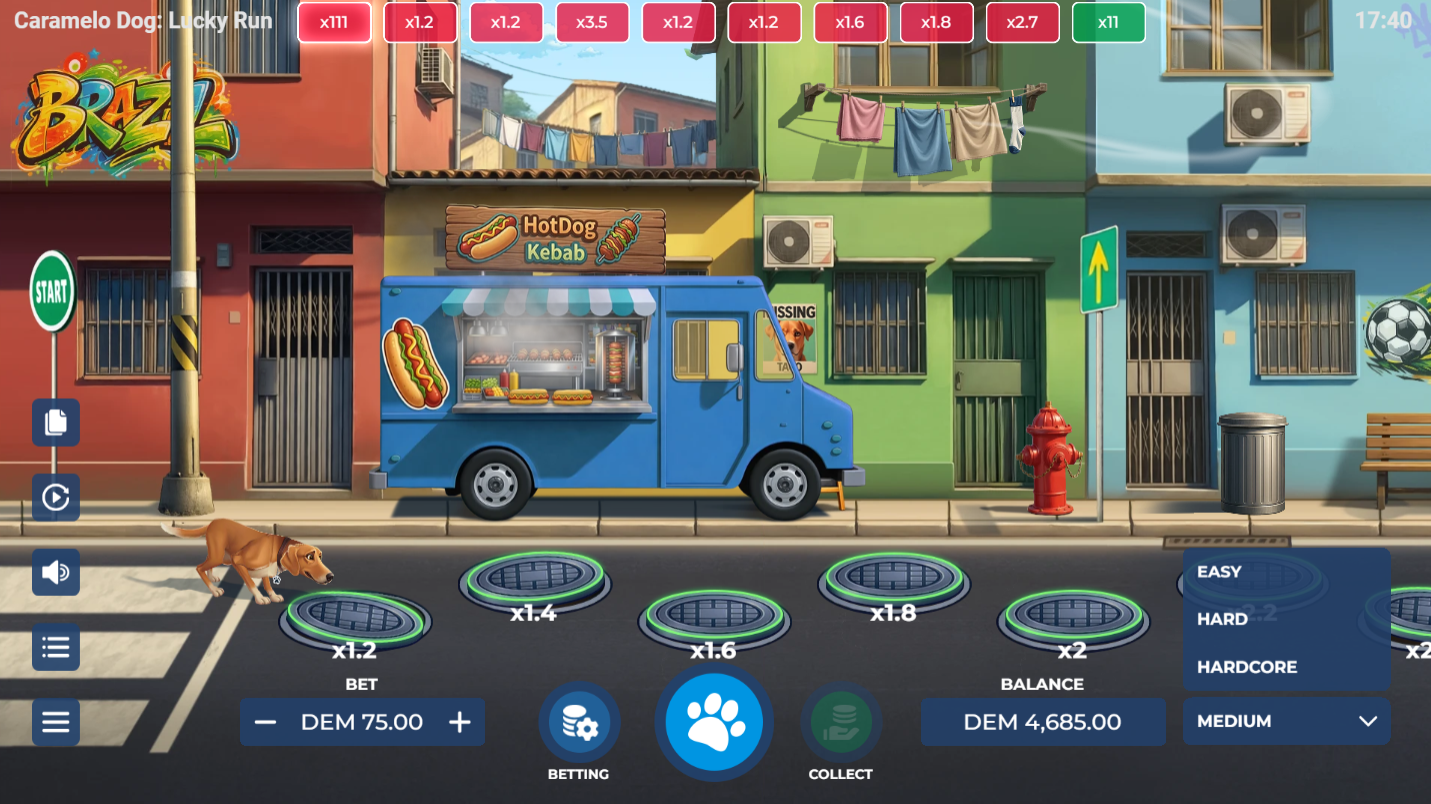
Caramelo Dog: Lucky Run Gameplay and Mechanics
Caramelo Dog: Lucky Run is an instant game, which means there are no reels, no paylines, and no spin button. Each round sees Taco the dog setting off on a run through a colourful neighbourhood setting. The further he gets without crashing, the higher your multiplier climbs. Every successful step forward increases your potential return, and you can collect at any point using the Cash Out feature or let the run continue in search of a bigger multiplier. A crash ends the round instantly and forfeits your bet.
The core loop is simple enough that you understand it within a single round, but the tension it generates is anything but simple. Every extra step feels meaningful because the crash can come at any moment, and the game does not telegraph when that will happen. Near-miss situations are particularly gripping on the harder settings, where the multiplier climbs quickly and the temptation to hold on grows with every successful progression.
Difficulty Levels
The most distinctive structural element in Caramelo Dog: Lucky Run is the four-level difficulty system: Easy, Medium, Hard, and Hardcore. Players select their difficulty before each round, and that choice reshapes the entire experience.
- Easy – Crashes are less aggressive and the rhythm of the game feels relaxed and beginner-friendly. A solid starting point for those new to crash-style instant games, offering time to understand the pacing and build confidence without heavy punishment.
- Medium – The balance point of the game. Risk becomes noticeable but remains manageable, and the tension-to-reward ratio sits at its most satisfying. Medium mode delivers the best blend of fun, pressure, and consistency across sessions.
- Hard – Crashes become substantially more unpredictable and quick. Every extra move feels dangerous, and the game starts genuinely rewarding courageous decisions whilst punishing overconfidence with equal speed. The adrenaline spike here is real.
- Hardcore – Constant pressure from the very first step. Crashes can occur before a natural rhythm develops, and the whole mode is clearly designed for players who want maximum risk in exchange for the highest multiplier potential. Not for the cautious.
The difficulty selection is a genuinely smart design choice because it makes the game’s volatility flexible rather than fixed. On Easy and Medium, the experience sits closer to medium variance play. Push into Hard and Hardcore and the risk profile shifts considerably, effectively allowing players to self-select their preferred intensity level in real time.

Pacing and Session Feel
Rounds complete quickly with minimal downtime between them, which gives the game an unusually strong “just one more” quality for an instant title. The pace adjusts naturally with difficulty: Easy feels relaxed and approachable, whilst Hard and Hardcore push momentum and pressure in equal measure. The game never becomes overwhelming because each round resets cleanly, but the speed of the loop means a session can accumulate quickly without the player noticing the time passing.

Features and Controls
Cash Out
The Cash Out mechanic is the primary decision point of every round. After Taco stops at any point during a run, players can collect their current multiplied stake rather than continuing. This transforms every moment of the game into an active choice rather than passive observation. On easier difficulty levels it functions as a safety valve, locking in modest returns when the risk feels too elevated. On Hard and Hardcore it becomes a genuine strategic instrument, where the timing of your exit can be the difference between a strong session and a costly one.
The cash-out mechanic never feels tacked on or secondary. It is the central tension of the entire game, sitting between every player decision and outcome. The balance between “one more move” and “take it now” is what makes the gameplay compelling rather than passive, and it keeps players mentally involved throughout.
Autoplay
The Autoplay feature lets players configure and run multiple rounds automatically using their selected difficulty and bet settings. On Easy and Medium it works well for a more relaxed, convenient session where you are content with consistent smaller returns. On Hard and Hardcore, most players will find themselves returning to manual control to manage cash-out timing directly, since the stakes of each individual decision are considerably higher at those difficulty levels. Autoplay remains a useful option for the lower modes and for players who prefer a less hands-on approach.

Visuals and Audio
Visually, Caramelo Dog: Lucky Run stands apart from the abstract aesthetic of many crash games. The colourful neighbourhood setting and smooth character animations give Taco’s run a grounded, charming feel that contrasts effectively with the underlying tension of the mechanic. The interface is immediately readable, avoiding the clutter that can accompany instant-game titles with more complex overlay systems. Animations during the running sequences are clean and fluid, and the presentation has a modern mobile-first quality throughout.
Audio design exceeds expectations for this genre. The background music is light and upbeat, matching Taco’s playful character without undermining the tension that builds during longer runs. Sound effects during near-crash moments and successful progressions do meaningful work in amplifying the drama of each decision, without becoming fatiguing across an extended session. The overall audio balance feels controlled and purposeful rather than incidental.

Our Honest Verdict
Overall Rating: 5.8/10
Caramelo Dog: Lucky Run earns its place in the instant-game category through personality and structural flexibility rather than mechanical innovation. The four difficulty levels genuinely change how the game feels in a way that most locked-pace competitors cannot offer, and the cash-out mechanic is executed cleanly without feeling like an afterthought. Evoplay have built something that looks distinctive, plays smoothly across desktop and mobile, and carries genuine charm in its Taco character and neighbourhood presentation.
That said, the core loop will be immediately familiar to anyone who has spent time with Aviator, Chicken Road, or BGaming Chicken Rush. The running format adds a visual personality layer that those titles often lack, but it does not fundamentally alter what the genre asks of players: read the moment, decide to hold or exit, absorb the result. After extended sessions, that repetition becomes noticeable. The 10,000x maximum win is competitive for instant games and feels genuinely reachable within the game’s structure rather than purely theoretical, but chasing it on Hard or Hardcore requires a high tolerance for abrupt crashes.
The 96% RTP sits at the standard threshold for instant titles, and the Medium-High volatility assessment reflects the reality that the game’s risk profile shifts meaningfully depending on difficulty. Players who prefer a controlled, lower-variance session can find it on Easy and Medium. Those who want something more aggressive have Hard and Hardcore available. That flexibility is the strongest case for the game’s replay value.
This is a game worth trying for fans of fast-paced instant titles who value atmosphere alongside mechanics. Players who prefer deep feature systems, extended bonus rounds, or the kind of narrative progression found in traditional slots will find less to hold their interest here. For shorter sessions that want something adrenaline-driven and visually engaging, Caramelo Dog: Lucky Run delivers on what it sets out to do.
Caramelo Dog: Lucky Run FAQs
-
What is Caramelo Dog Lucky Run?
Caramelo Dog Lucky Run is an instant game by Evoplay released in May 2026, featuring a dog-running crash mechanic with four difficulty levels and a maximum win of 10,000x. -
What is the RTP of Caramelo Dog Lucky Run?
The RTP (Return to Player) of Caramelo Dog Lucky Run is 96.00%, as stated in the game documentation. -
What is the maximum win in Caramelo Dog Lucky Run?
The maximum win in Caramelo Dog Lucky Run is 10,000x your bet, with currency caps of EUR 750,000 and USD 1,000,000. -
How many difficulty levels does Caramelo Dog Lucky Run have?
Caramelo Dog Lucky Run features four selectable difficulty levels: Easy, Medium, Hard, and Hardcore. Each level increases obstacle intensity and adjusts the starting bet multiplier. -
Can you cash out manually in Caramelo Dog Lucky Run?
Yes, Caramelo Dog Lucky Run features a Cash Out mechanic that allows players to stop the game and cash out current winnings at any point during a round. -
What is the minimum and maximum bet in Caramelo Dog Lucky Run?
Caramelo Dog Lucky Run offers a minimum bet of EUR 0.10 (USD 0.10) and a maximum bet of EUR 75 (USD 100). -
Does Caramelo Dog Lucky Run have an autoplay feature?
Yes, Caramelo Dog Lucky Run includes an Autoplay feature that allows players to configure and run multiple automated bets with customizable settings. -
When was Caramelo Dog Lucky Run released?
Caramelo Dog Lucky Run was launched on May 19, 2026, as announced by Evoplay in an official release statement.