













Diamond Jackpots Slot Review
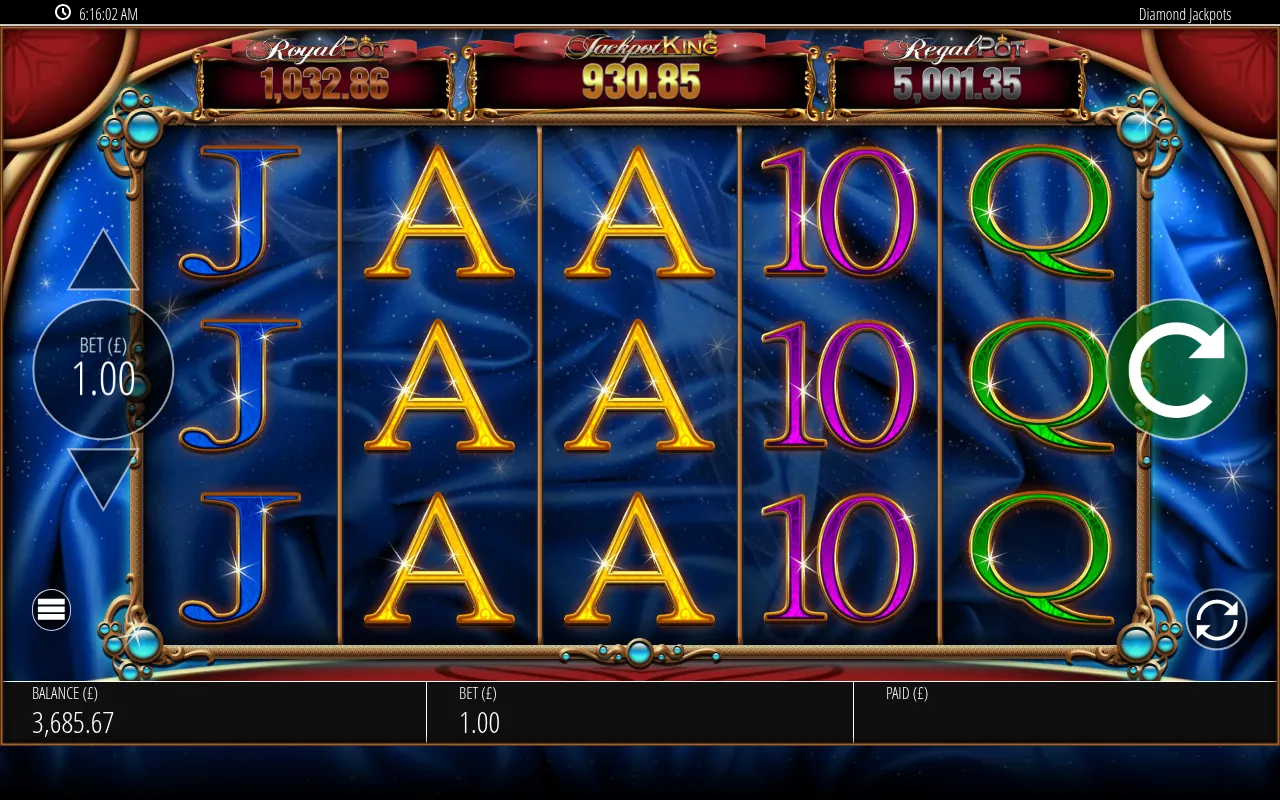
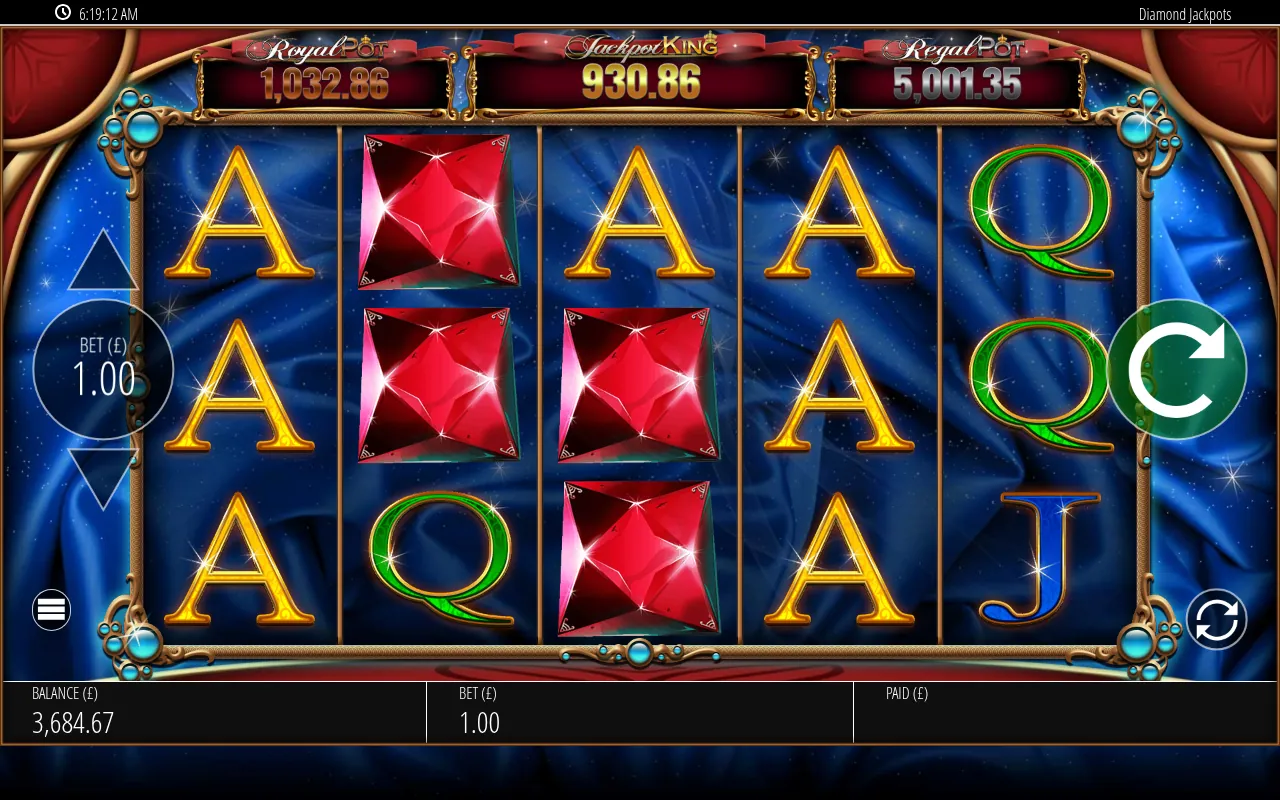
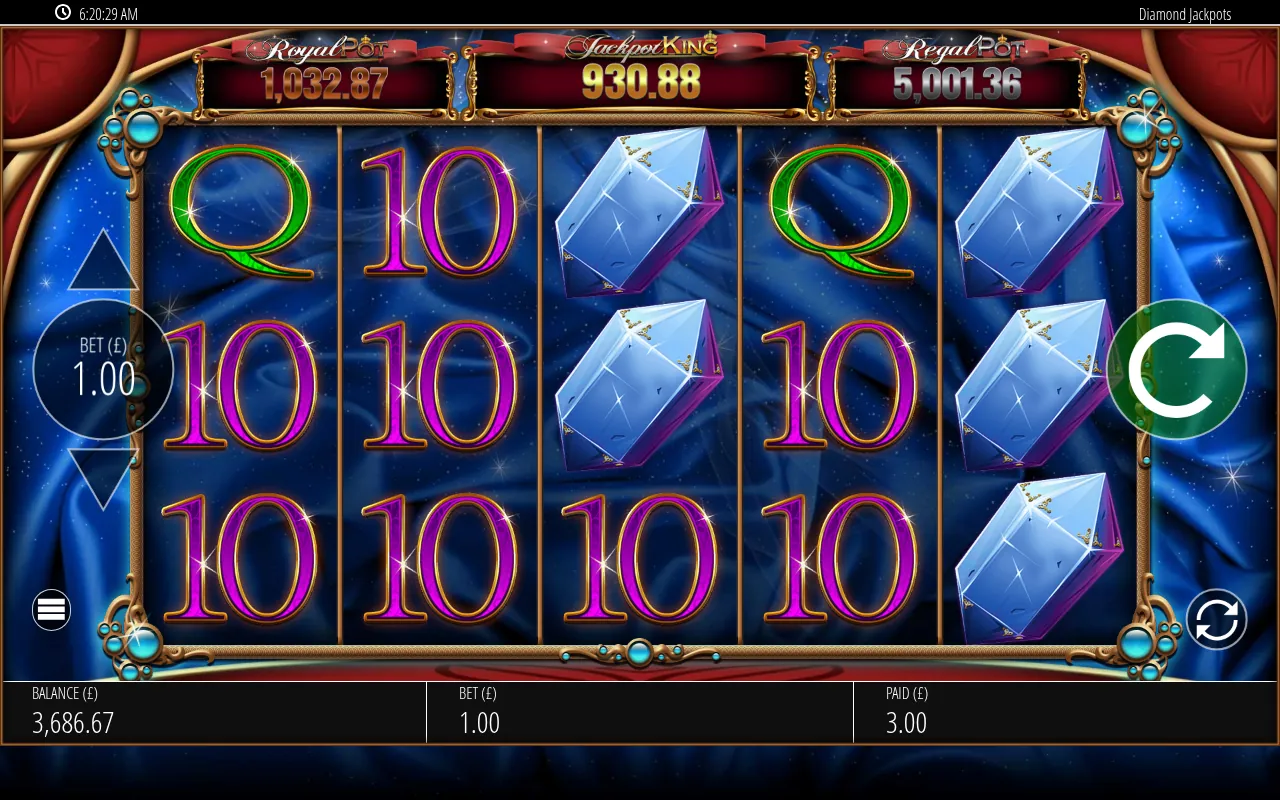
Rippling blue satin sits behind a gilded frame, scarlet drapes swagged across the top, and three ribboned jackpot plaques hanging from a bronze bar beneath them. Strip the curtains away and Diamond Jackpots is barely a slot at all: six symbols, adjacent pays, and a paytable so steep that five J/10 royals pay no more than three diamonds. The jewels are the wrapping; the crown chase is the product.
Blueprint Gaming built it that way, and the numbers are straightforward. It’s a 5×3 grid with a 94.12% RTP and a 50,000x maximum win, and it belongs to the same Jackpot King family as Fishin’ Frenzy Jackpot King and Ted Jackpot King. The crown chase is the whole reason this one exists.
How the Base Game Pays
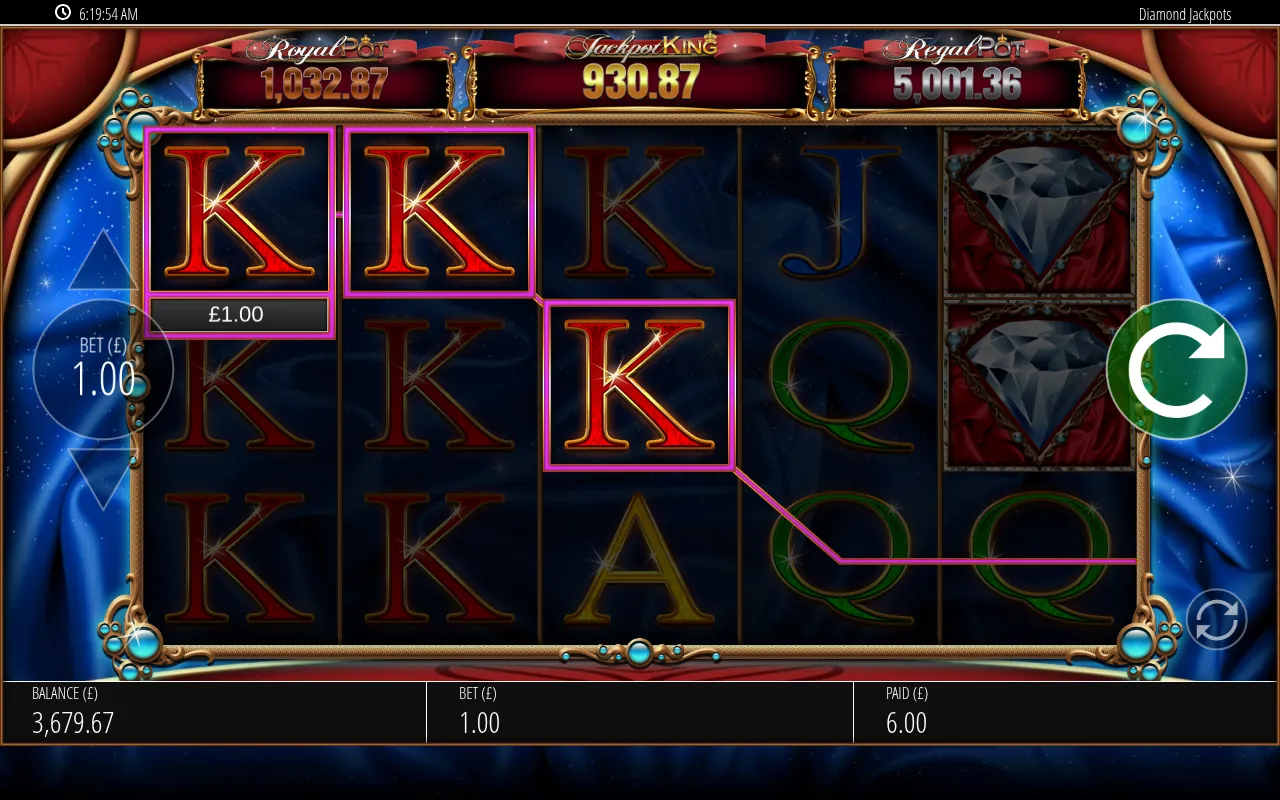
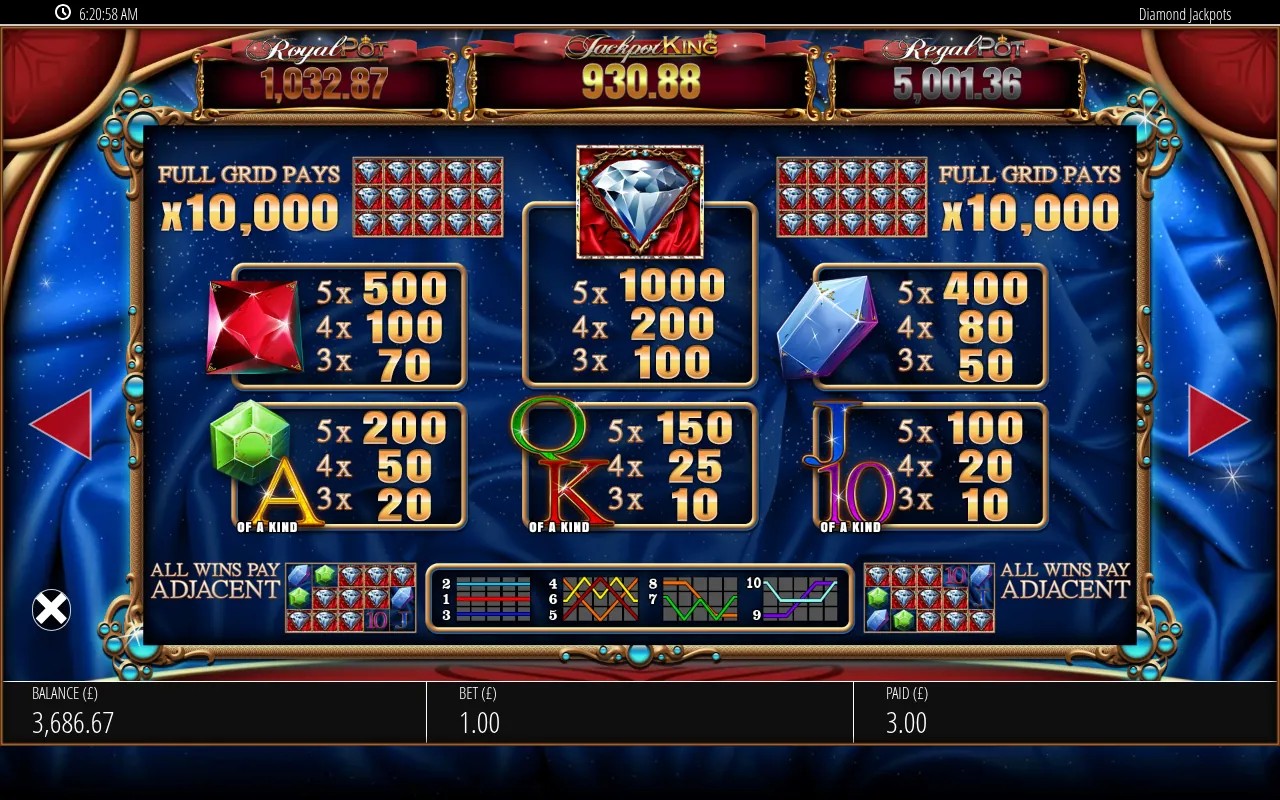
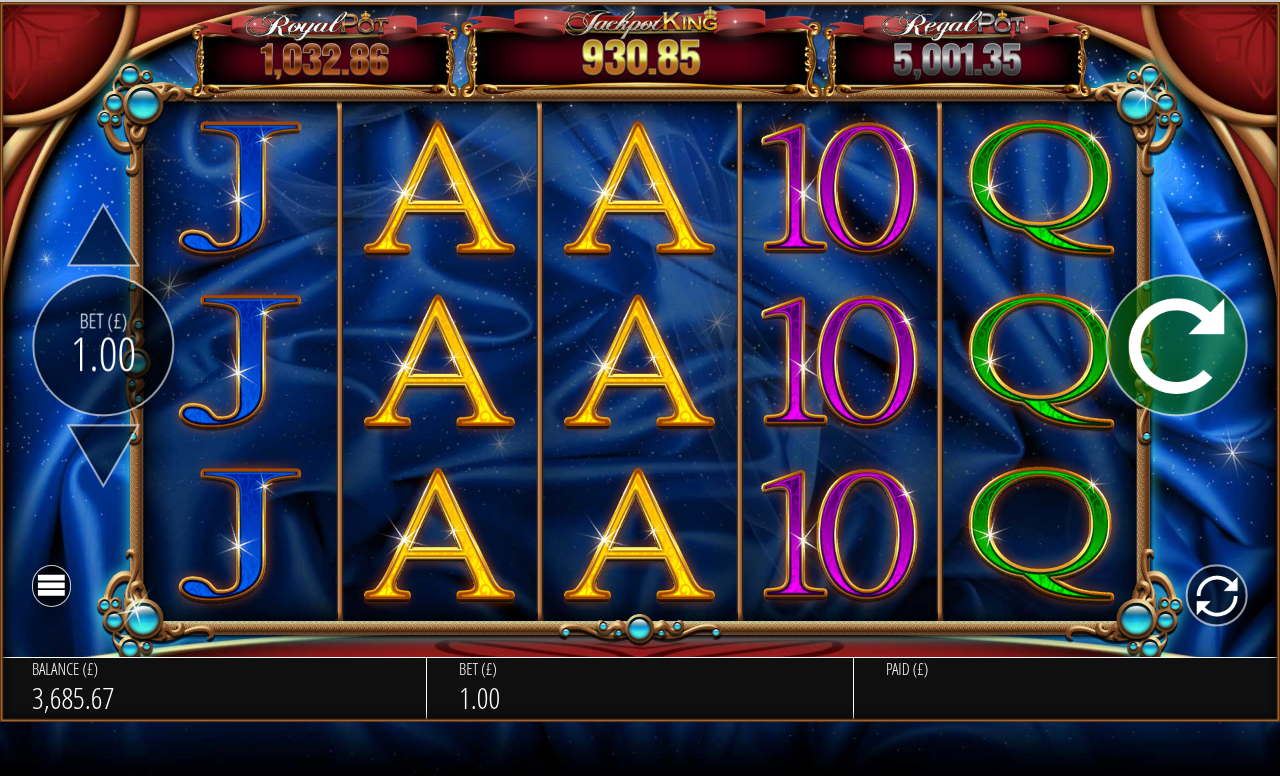
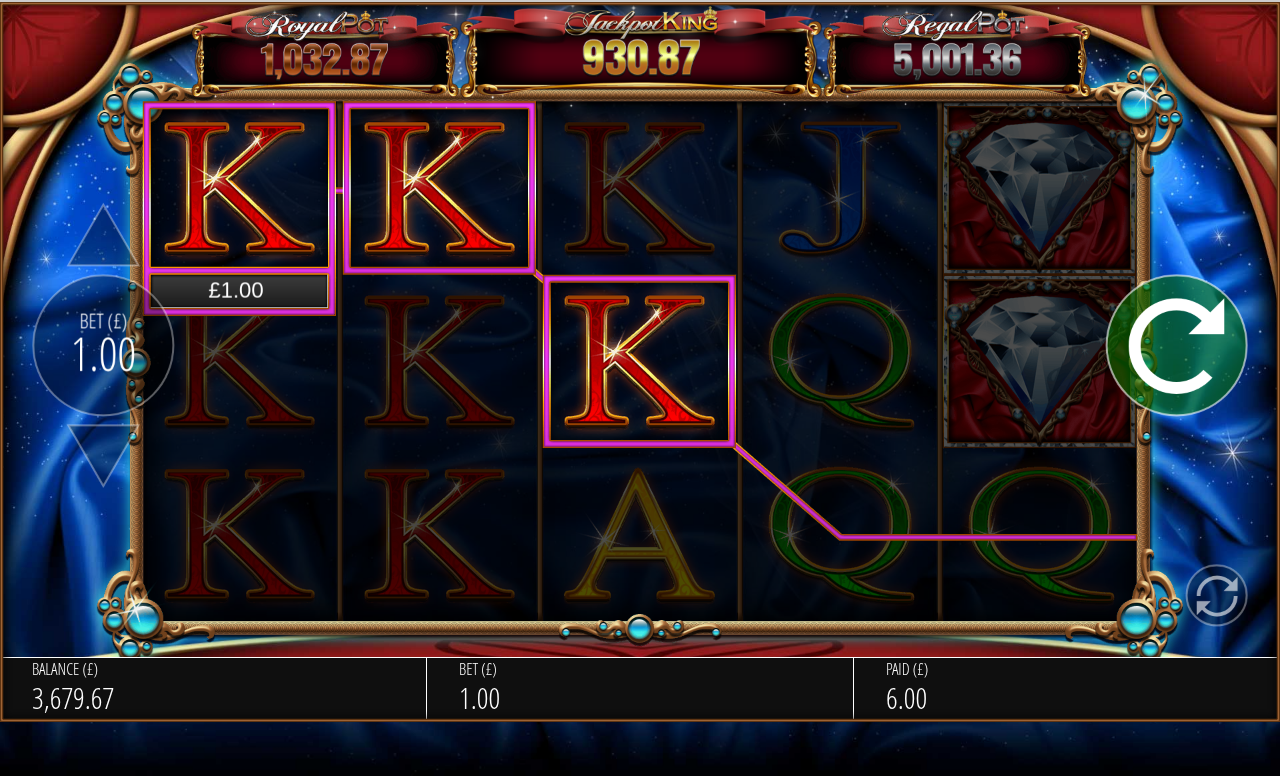
Wins pay adjacent rather than on fixed lines, so matching symbols need to land next to each other from the leftmost reel. A cluster of the same symbol touching horizontally or vertically is what counts; a matching symbol stranded a reel away from its twin contributes nothing. Every value below is a multiple of the total bet, not the line bet. There’s no separate wild described in the paytable; the gems and royals carry everything on their own.
Six symbols do all the paying, and the gaps between them are wide:
- Diamond: 100x, 200x, 1,000x for three, four, five
- Red Gem: 70x, 100x, 500x
- Blue/White Gem: 50x, 80x, 400x
- A: 20x, 50x, 200x
- Q / K: 10x, 25x, 150x
- J / 10: 10x, 20x, 100x
The structure is a steep one. The three gems pay in a league of their own at the top, and even a five-of-a-kind J/10 royal pays no more than three diamonds. What that means in practice is a base game of small royal wins and rare gem clusters, with the diamonds doing the heavy lifting whenever they show up on more than one reel.
The gaps inside each symbol’s row matter as much as the gaps between symbols. A four-diamond cluster doubles the three-diamond pay; a five-diamond cluster pays five times the four. The Red Gem follows the same shape, so the step from a good cluster to a great one is where the base game’s money sits.
The one genuine twist is the Full Grid rule. Fill all fifteen positions with diamonds and the game pays a flat 10,000x the total bet on top of everything else. It’s a long shot in the purest sense, but it gives the base game a jackpot-shaped target of its own.
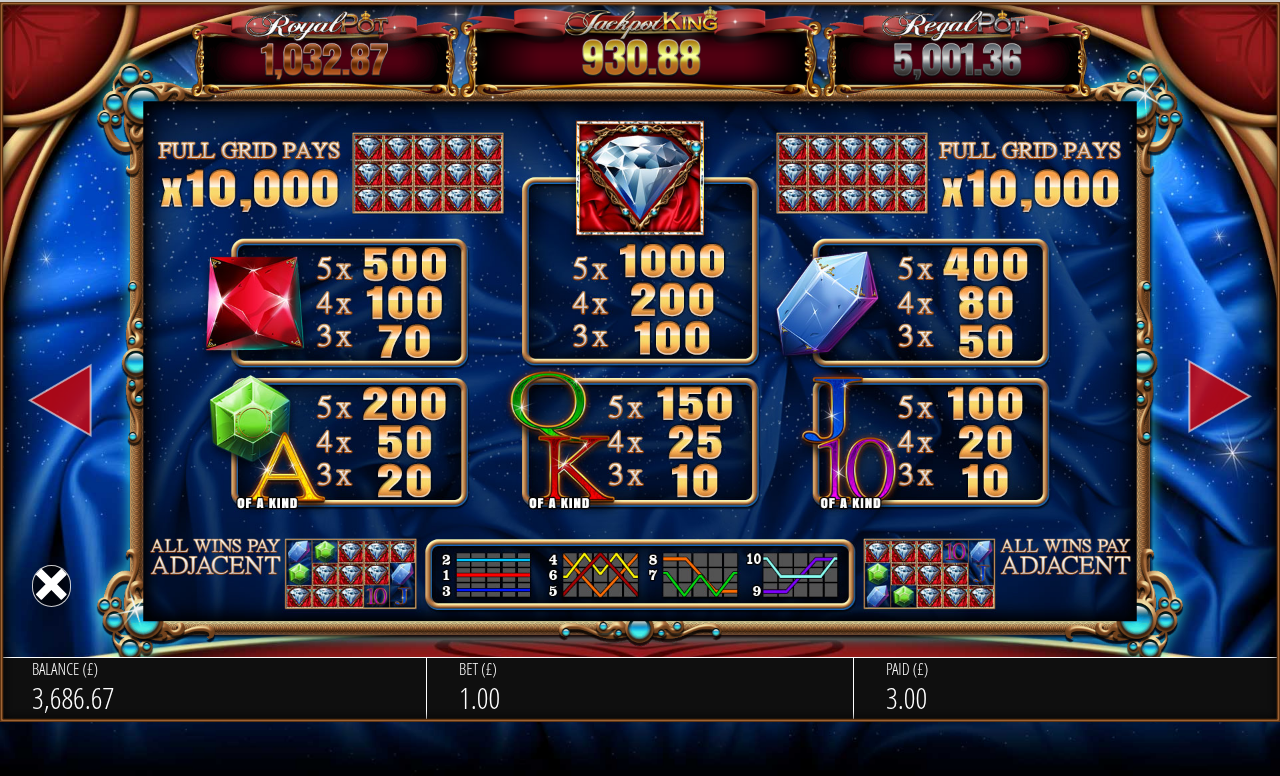
One quirk of the adjacent-pays setup: because there are no fixed lines to count, a full screen of mixed gems can pay several clusters at once. The paytable’s diagrams show the accepted adjacent patterns, and they’re worth a look before settling in, because the shapes aren’t always the ones you’d guess.
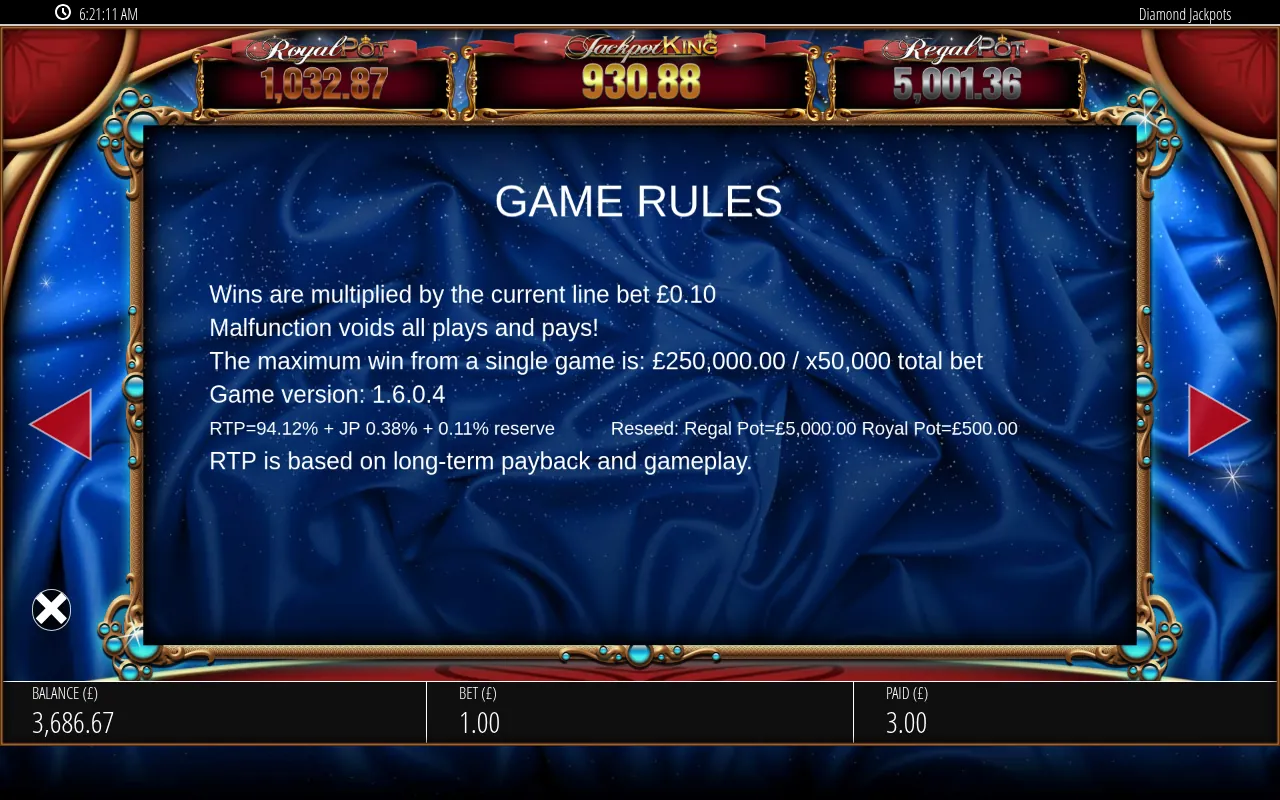
That 94.12% return is the total figure, and it’s built from parts: 0.38% of it comes from the jackpot contribution and a further 0.11% from a reserve that refills the pots after they drop. It’s a below-average number by modern standards, and the crown chase is what you’re paying for with the difference.
Jackpot King and the Progressive Pots
There’s no symbol combination to land and nothing to line up; the round arrives unannounced on any spin. When it does, it runs as a three-stage climb, and each stage can end the round or push you up to the next one:
- Crown Collection – respin the reels and stack up crowns, with more crowns awarding a bigger total bet multiplier
- King’s Treasure – pick from the treasure to increase the prize built from the crowns
- Wheel King – spin the wheel for the bigger multiples and a chance at the progressive pot
Crown Collection
The reels respin and crowns stack up. More crowns means a bigger multiple of the total bet, so the collection phase sets the floor for whatever comes next. Land enough of them and you move on to the King’s Treasure.
King’s Treasure
A pick round. Choose from the King’s Treasure to increase the prize you’ve built from the crowns. It’s a straight booster stage, and a good pick here is what turns a modest round into a memorable one.
Wheel King
The final stage is a spin of the Wheel King, which awards the bigger multiples and carries the shot at the progressive pot. The wheel is where the round’s ceiling lives, and it’s the only route to the top prize on the board.
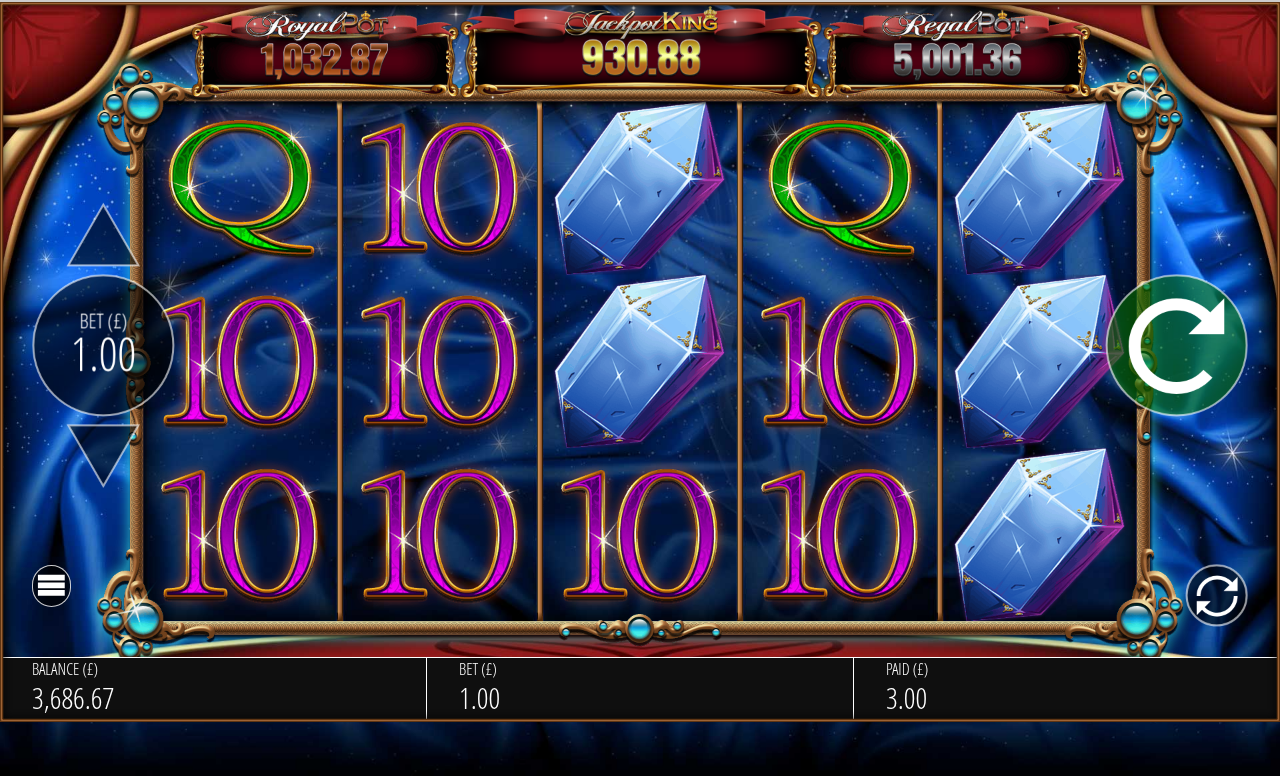
Three plaques sit above the reels the whole time, and their counters tick with every spin:
- Royal Pot – the smaller of the two side pots, reseeded at 500.00 after every drop
- Jackpot King – the central plaque and the biggest prize on the ladder
- Regal Pot – the larger side pot, reseeded at 5,000.00 after every drop
The two side pots sit either side of the central Jackpot King plaque, which is the one worth the wait. Because every dropped pot reseeds rather than emptying, there’s always something on the board to chase, and the counters move on every spin regardless of what the reels are doing. The reseed values are fixed, so the Royal Pot restarts its climb from a modest base while the Regal Pot starts ten times higher.
One practical note worth knowing: autoplay switches itself off if a jackpot lands. If you’re running long sessions at the crown chase, the game makes you press spin again after a big one, which is no bad thing. Autoplay itself comes with the usual guardrails – play counts of 10, 25, 50, 75 or 100 spins, with session loss and win limits you set before you start.
Our Honest Verdict
Overall Rating: 7/10
Most of your time here is spent watching small royal clusters land while three counters tick above the reels, and that’s the honest shape of a session. Nobody sits down at this game for the gems; they sit down because the next spin can open the crown round on a whim.
What the game does properly is escalation. The bonus round climbs through three stages that each build on the last, and the Full Grid rule gives even an ordinary spin a prize worth imagining, which is more than most classic-styled slots manage. Against that, the reels themselves are thin: six symbols, one steep paytable, and long stretches where nothing of consequence lands.
This one suits the patient jackpot chaser who enjoys a slow game and doesn’t need modifiers or free spins to stay interested; anyone who wants a busy reel set will find it sparse. For what it sets out to be, a velvet-draped jewel box with a crown on top, it delivers without fuss.
Diamond Jackpots FAQs
-
How does the Jackpot King feature trigger in Diamond Jackpots?
The round arrives at random on any spin. There is no symbol combination to land and no bet level to reach; the game simply awards it when it chooses to. -
What does collecting crowns do in the Jackpot King round?
The round respins the reels and collects crowns, and the more crowns you gather, the bigger the total bet multiplier you win. Enough crowns takes you through to the King’s Treasure pick round, where prizes can be increased further. -
What is the Wheel King in Diamond Jackpots?
The Wheel King is the final stage of the Jackpot King round. Spinning it awards the larger total bet multiples and gives you the chance to win the progressive pot. -
How does the Full Grid pays rule work?
If diamond symbols fill all fifteen positions on the 5×3 grid, the game pays a flat 10,000x the total bet. All wins in Diamond Jackpots pay adjacently rather than on fixed paylines. -
Does autoplay stop after a jackpot win?
Yes. Autoplay is disabled when a jackpot is won, so the game returns to manual spins after a progressive drop. Autoplay options run from 10 to 100 spins and can be capped with session loss and win limits. -
What is the RTP of Diamond Jackpots?
The total RTP is 94.12%. That figure includes a 0.38% jackpot contribution and a 0.11% reserve that reseeds the progressive pots after they are won. -
What is the maximum win on Diamond Jackpots?
The maximum win from a single game is 50,000x the total bet. -
Who makes Diamond Jackpots?
Diamond Jackpots is made by Blueprint Gaming and forms part of their Jackpot King series of progressive slots, alongside games like Fishin’ Frenzy Jackpot King and Ted Jackpot King.