












Dragon’s Crash Slot Review
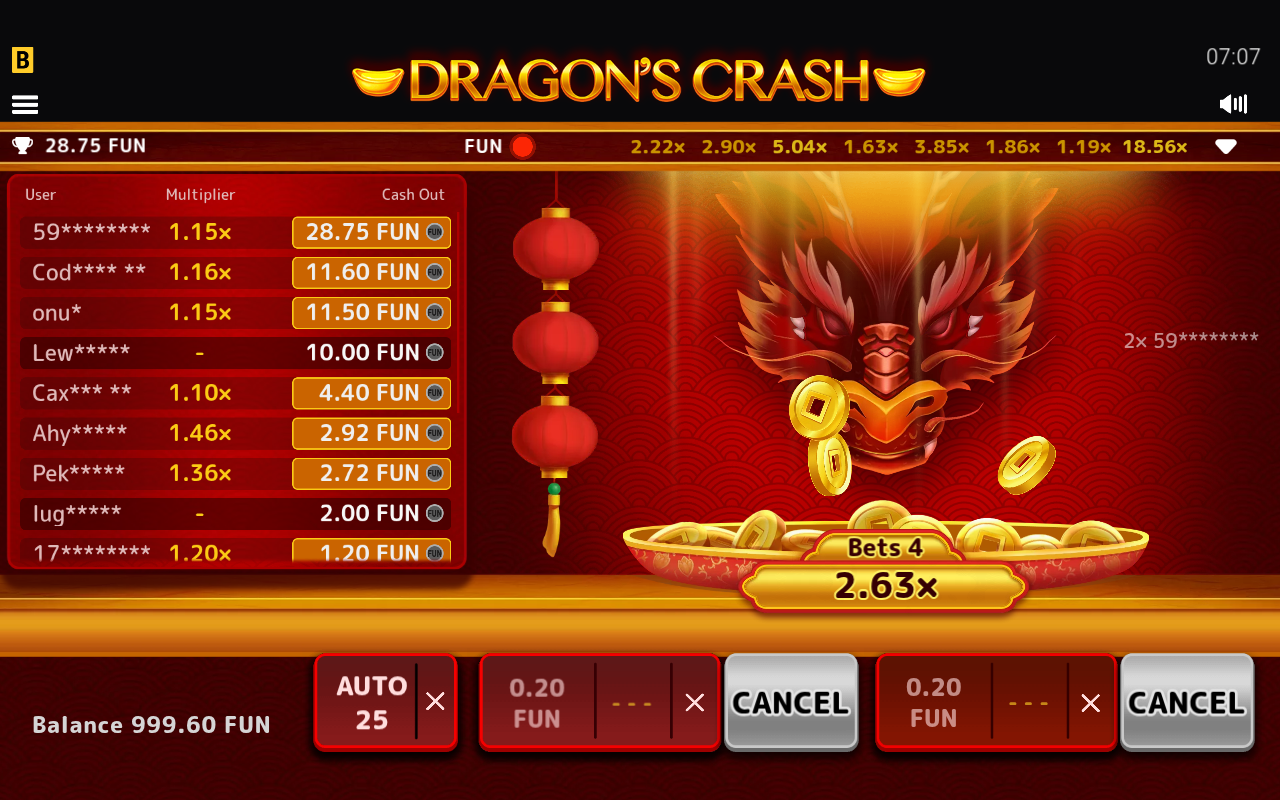
A red-and-gold dragon head fills the upper right of the screen, eyes narrowed and glowing, with a wide bowl of gold coins heaped below him and three paper lanterns hanging to his left. He is the lord of Dragon’s Crash: powerful, capricious, generous until he isn’t. BGaming have built the whole game around his moods, backed by a 97% RTP on high volatility – the most generous number in the game and the reason it earns a second look.
There are no reels here at all. A single multiplier climbs above the dragon, and your entire job is to grab the gold before he changes his mind. BGaming’s catalogue covers a lot of ground, from Snoop Dogg Dollars to Chicken Shot, and Dragon’s Crash sits on the stripped-back end of it, with nothing between you and the dragon but a cash-out button.
Grabbing the Dragon’s Gold
A round begins with your bets placed, and then a multiplier starts climbing above the dragon’s head. Every tick upward is more gold in the bowl. The round ends when the dragon decides it ends, and anything you haven’t taken by then goes back to him.
That is the entire game, and it’s a tense one. The multiplier doesn’t pause and doesn’t warn you. Cash out at 2x and it may sail on to 45.38x; hold on for the big number and it can stop at 1.04x with nothing in your hands.
The range of stopping points in a single stretch of rounds tells the story on its own. Climbs end at 1.04x and 1.28x. They end at 2.24x and 2.85x. And they run on past 23.59x and 45.38x, which is where the discipline of the game gets tested: a round that ends at 1.04x was never going to pay, and a round that runs to 45.38x was never going to be caught by a nervous cash-out at 2x.
Both outcomes are the game working exactly as designed. The dragon decides when the gold stops, and the only power you have is the cash-out button. Nothing you do changes when the round ends; it only changes whether you’re holding anything when it does.
The dragon himself fills the upper right of the screen, crest flared, eyes narrowed and glowing, snout trimmed in gold. Soft golden light falls from the top of the frame behind him, and the deep-red backdrop carries a repeating gold scale pattern.
He is lord of the game: powerful, capricious, generous until he isn’t. It’s a rare case of a theme doing genuine work, because the artwork and the maths are telling the same story.
Bets, Auto Play and the Cash-Out
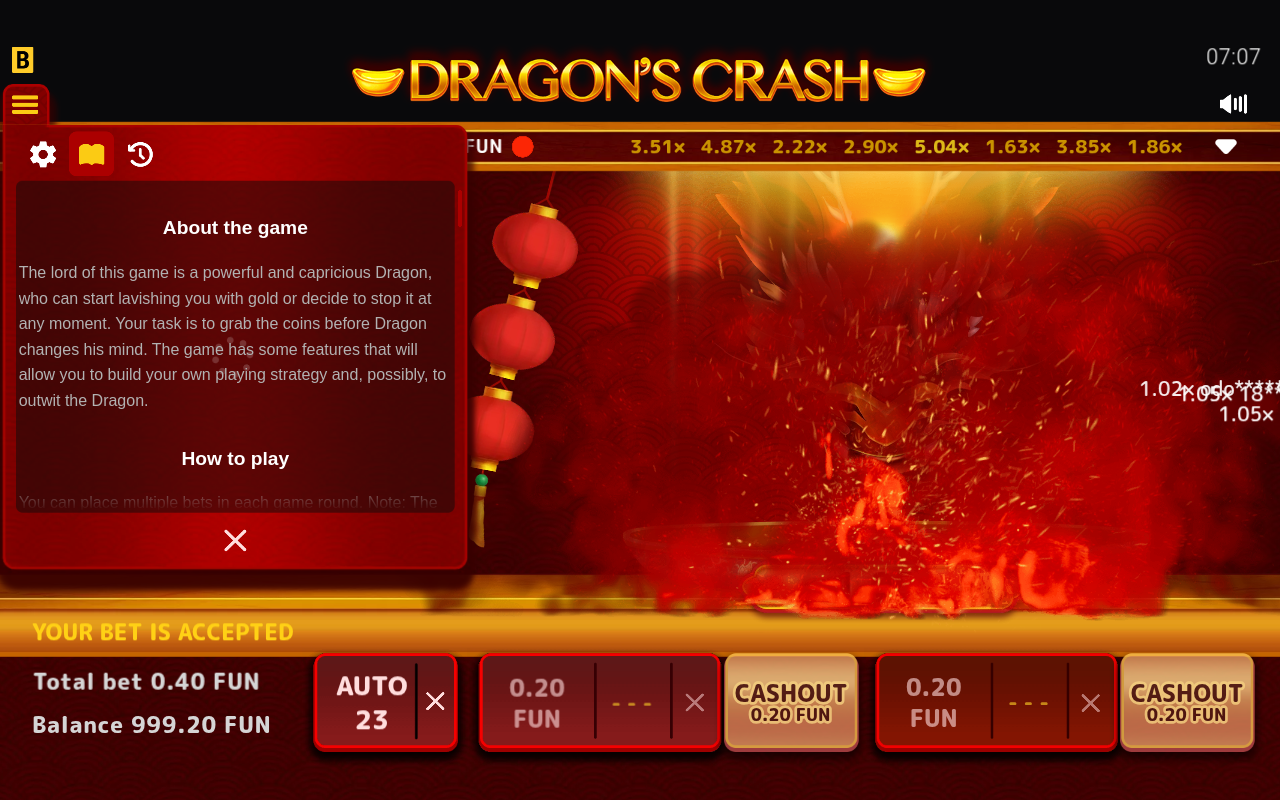
You can place multiple bets in each round, and that’s where the game’s strategy lives. The game exists to let you build your own approach and, possibly, to outwit the dragon. Everything on screen serves that one job.
- Multiple bets can be placed in a single round
- Each bet cashes out independently at the multiplier it locks in
- Splitting a stake lets one bet bank an early cash-out while another rides the climb
- Several cash-outs can be staggered across a single multiplier
- Auto play runs a set number of rounds without input
- A counter ticks down the auto rounds remaining
- A bets counter tracks how many wagers are live in the current round
- Cash-out buttons show your accumulated amount as the multiplier climbs
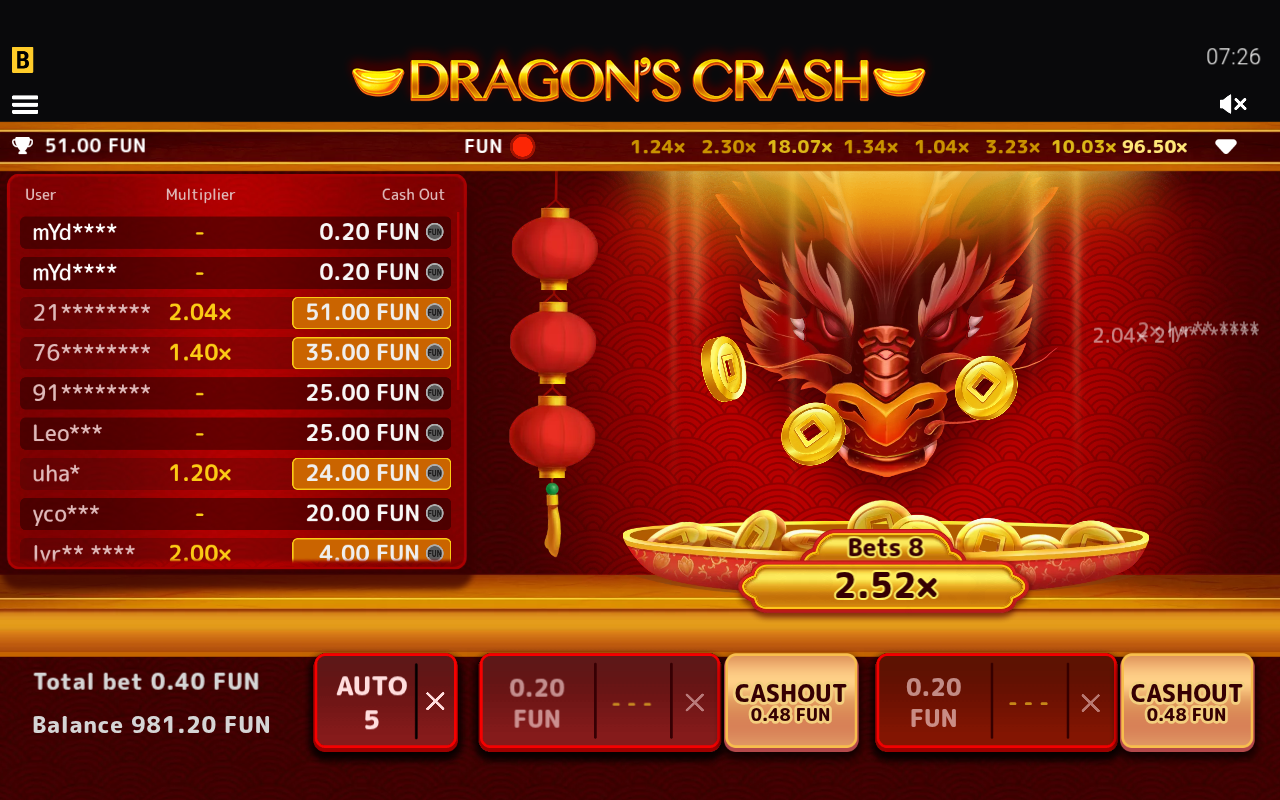
The cash-out buttons carry a running figure that grows with every tick of the multiplier, so the decision is always in front of you with a number attached. A cash-out that read 0.20 early in a climb reads 0.97 a few seconds later on the same round. That number is the whole argument for acting now rather than waiting.
The climb never stops to let you think, either. Everything the game shows you is a prompt to act or lose the chance. Between the running cash-out figures, the live bets counter and the ticking multiplier, every piece of information on screen is aimed at the same decision.
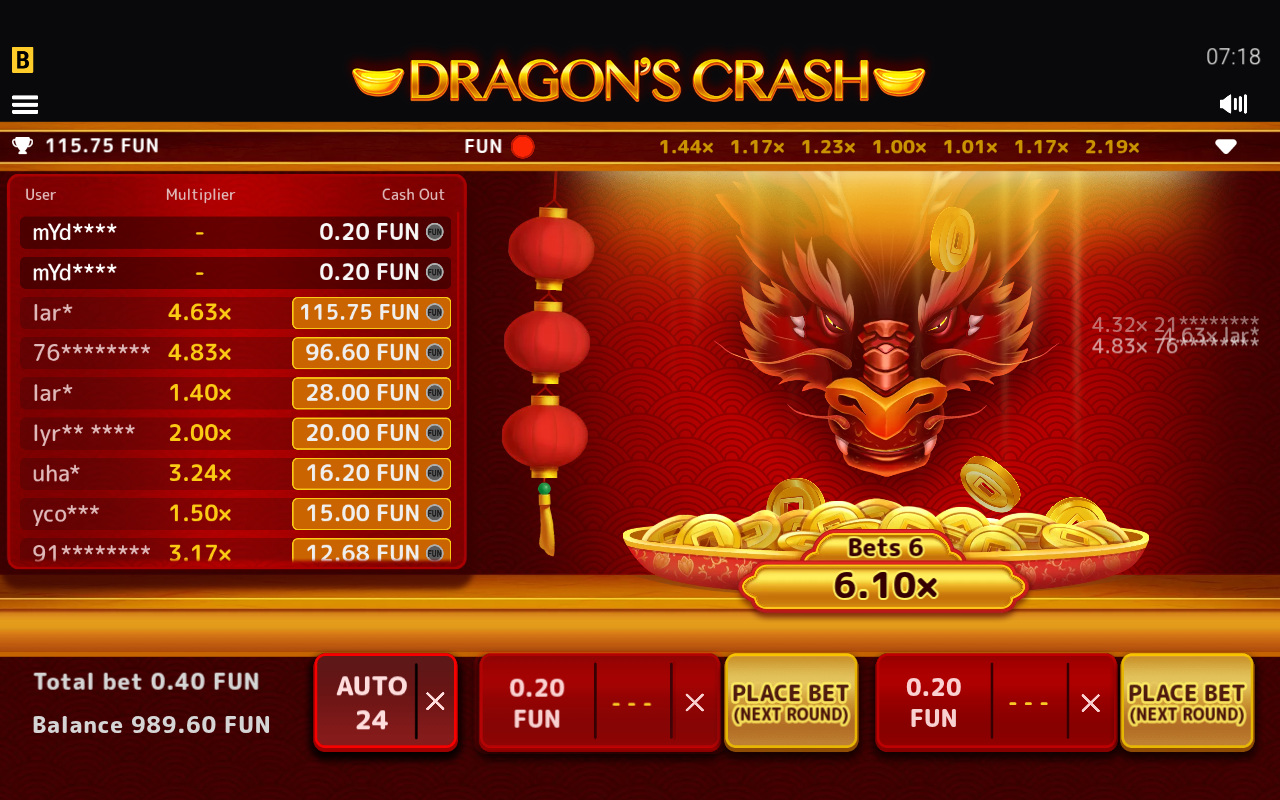
The multiplayer overlay gives the game its atmosphere. Small multiplier tags sit on the dragon graphic showing where other players got out, at values like 1.4x, 1.5x, 1.6x and 2x. One tag reads 2.63x. Others sit higher.
The user list runs alongside with usernames, multipliers and cashed amounts, each entry a decision somebody else already made. A line showing 1.15x next to a cashed amount is a player who took the safe exit. A line showing a bigger multiplier is a player who held their nerve, or lost it at exactly the right moment.
You’re watching other people face the same choice you’re facing, at the same moment. Seeing somebody take 2.63x just before the dragon stops is its own small drama, and the next round brings a fresh set of names and a fresh set of exits. That social layer changes how the game feels without changing anything about the maths.
A One-Mechanic Game
There’s no feature round, no wild symbol, no scatter and no bonus buy anywhere in Dragon’s Crash. Every round plays out the same way: bets down, multiplier up, cash out or don’t. The dragon doesn’t do extras.
What you get instead of features is depth in the one mechanic. The multiple-bets system is the closest thing to a decision tree this format offers: with two or more wagers live, you can set one to exit early and keep another running for a bigger number, and adjust the split round by round as the results come in.
The counter tracking live bets matters here. If you’re running three or four wagers in a round, knowing exactly how many are still unresolved – and which ones already banked – is the difference between a structured round and four separate guesses. A bet that’s already cashed out is safe no matter what the dragon does next, so the running count is also a running tally of how exposed you still are.
Our Honest Verdict
Overall Rating: 7.6/10
Playing this is a few seconds of greed management, over and over, while a dragon decides whether you’ve had enough. The reason to choose it over a conventional slot is that every outcome is your own call – nobody else pressed the cash-out button for you.
The best thing here is the maths: 97% RTP on high volatility is rare for the format, and it rewards the unglamorous habit of taking the small cash-out. The worst thing is that one idea is all there is – after ten minutes you’ve seen the entire game, and after an hour you’ve seen it a hundred times.
If you like your gambling pure, fast and self-directed, this is one of the better rooms to do it in, and the hall looks terrific while you lose your nerve. Reel players chasing free spins and feature rounds will find nothing here. The dragon doesn’t do extras; he does gold, and only while he’s in the mood.
Dragon’s Crash FAQs
-
What is the RTP of Dragon’s Crash?
Dragon’s Crash runs at an RTP of 97%, which is well above the typical slot average and a strong setting for a high-volatility game. -
Is Dragon’s Crash high volatility?
Yes. Dragon’s Crash is a high-volatility game, so rounds can end quickly and outcomes swing hard between cash-outs and losses. -
Can you place more than one bet in a round of Dragon’s Crash?
Yes. You can place multiple bets in each game round, and each one cashes out independently. This lets you lock in an early cash-out on one bet while letting another ride the multiplier. -
How do you win in Dragon’s Crash?
A multiplier climbs above the dragon during each round and you cash out before he stops the gold. Whatever you’ve taken by then is yours, and anything still riding goes back to him. -
Does Dragon’s Crash have a bonus buy?
No. There are no bonus rounds or feature buys in Dragon’s Crash; every round plays the same way, with bets placed and a multiplier to cash out on. -
Can you use auto play in Dragon’s Crash?
Yes. Auto play runs a set number of rounds without input, and a counter shows how many rounds remain. It handles the betting, but the cash-out timing is still down to you. -
Who makes Dragon’s Crash?
Dragon’s Crash is made by BGaming, whose slot catalogue on this site includes Snoop Dogg Dollars and Chicken Shot. -
When is Dragon’s Crash released?
Dragon’s Crash’s release date is 7 March 2024.