













Druid’s Drop Slot Review
Deep in a moss-choked forest, a druid with a staff watches skulls, mushrooms, moths and seed pods tumble across a 7×7 grid, and almost none of them pay. That’s the honest heart of Druid’s Drop: it’s a game that spends its base game counting shards for a stone rune meter rather than handing out wins, and the studio behind it, Black Cat, were right to build it that way.
The maths is blunt about what that patience costs. Druid’s Drop runs at 96% RTP with Super High volatility, a hit frequency of 21.8%, and a ceiling of 10,000x the stake. Stakes sit between 0.20 and 100 per spin. It shares its shelf with Captain’s Curse, Island Ices and Lucky Lizard Oasis, though it’s the darker corner of it.
Base Game & Features
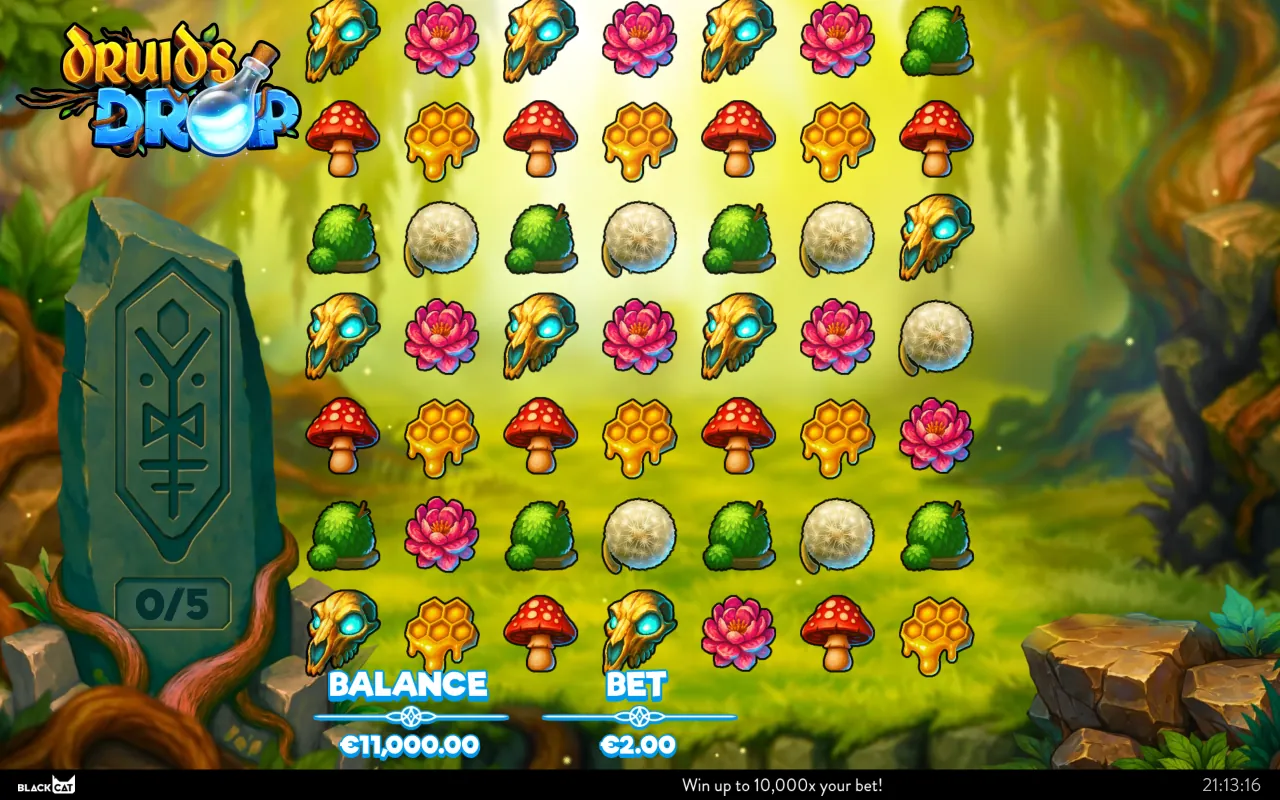
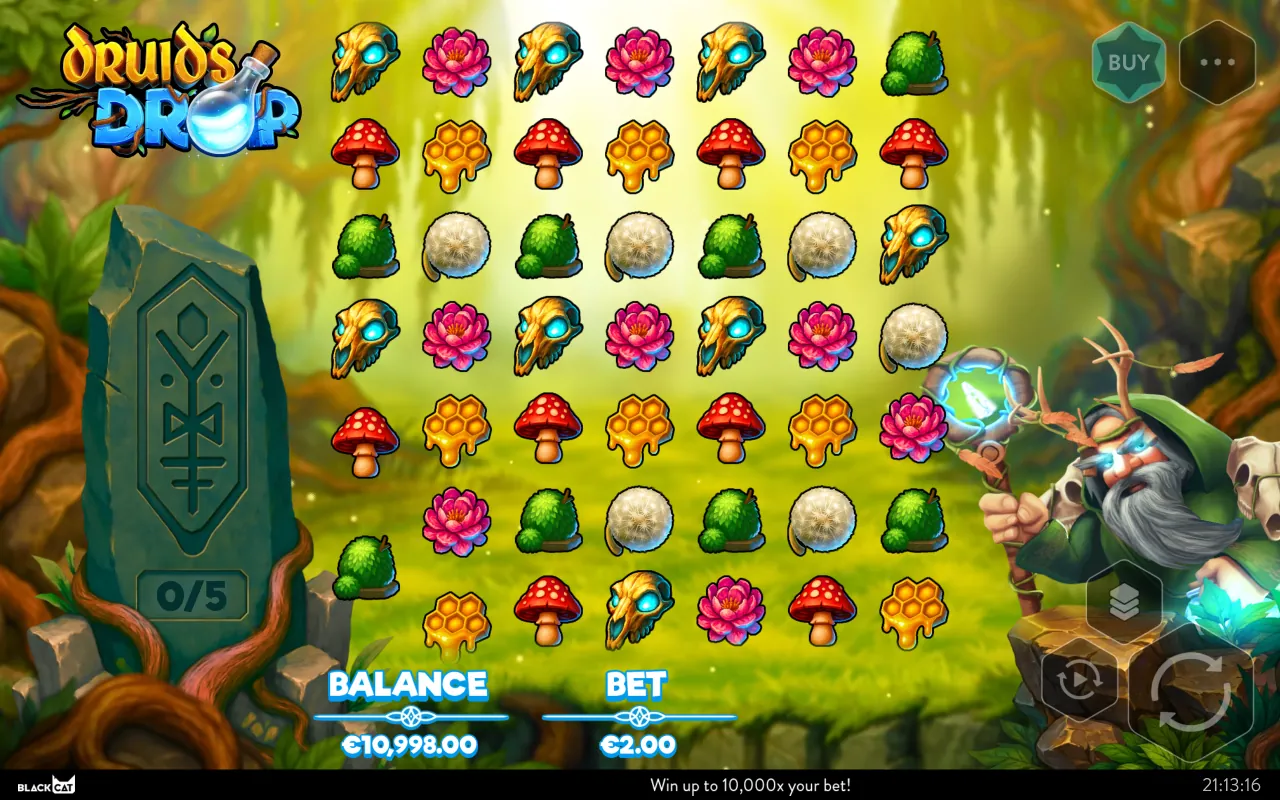
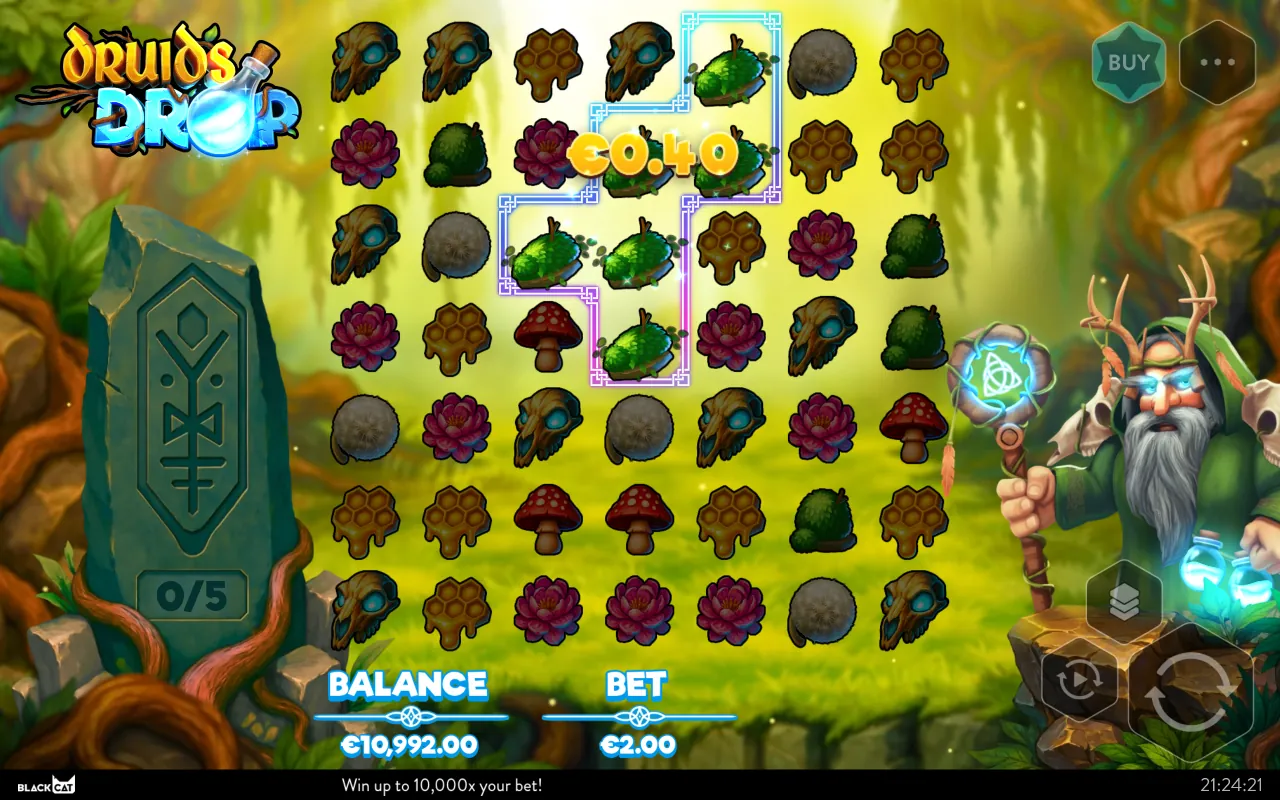
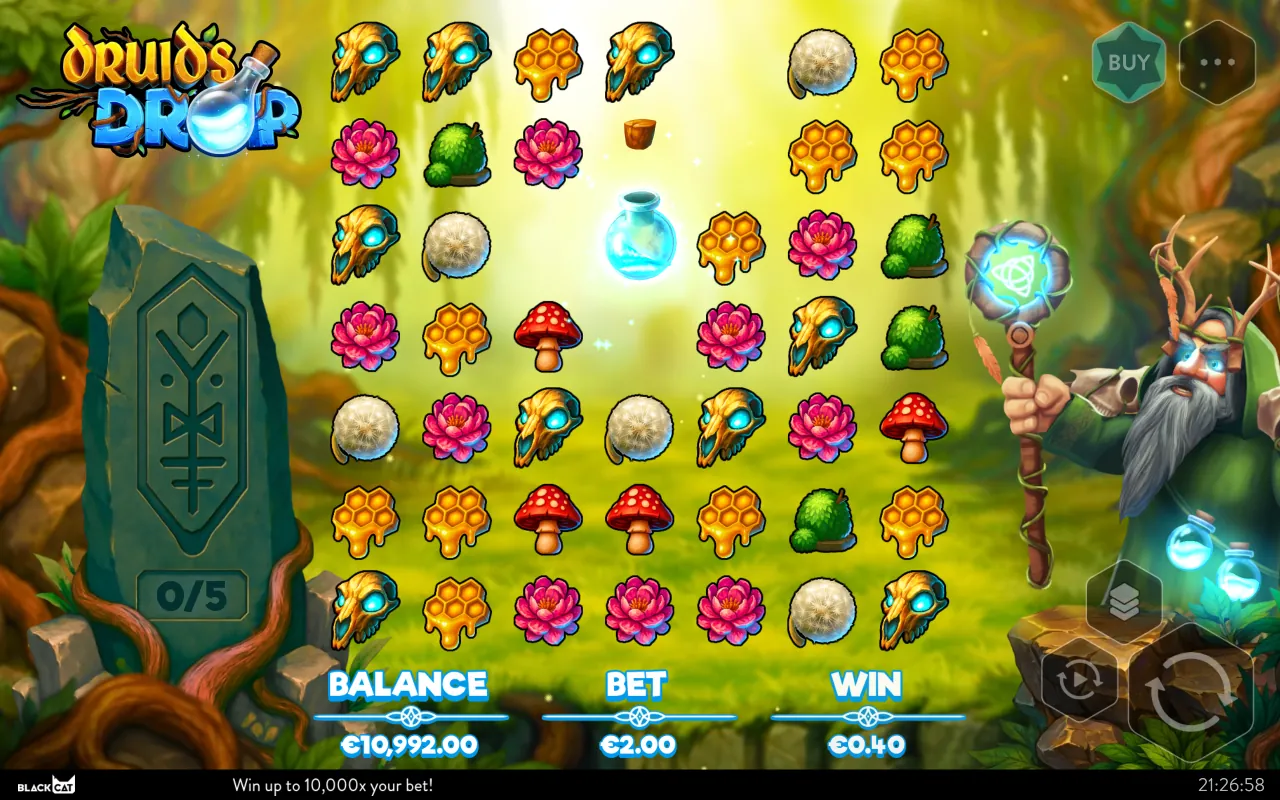
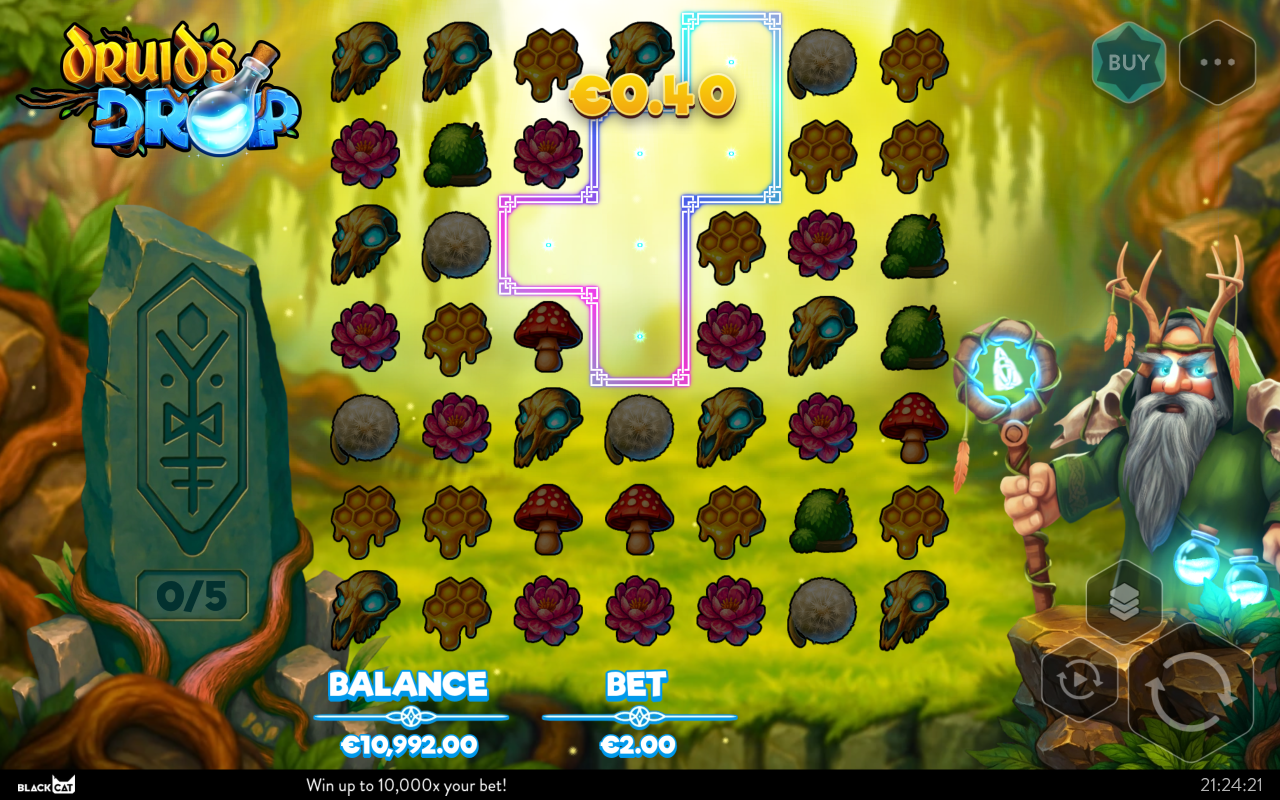
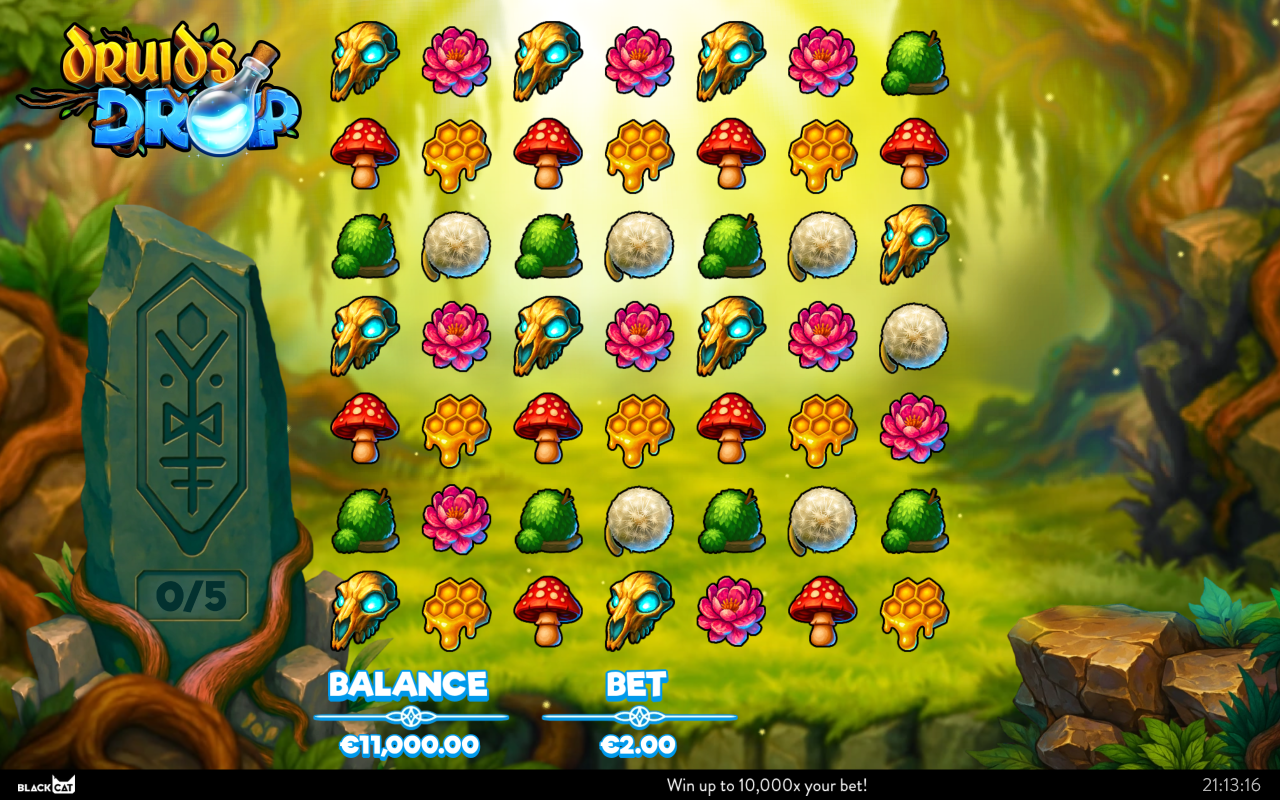
Druid’s Drop plays on a 7×7 grid rather than conventional reels. Symbols drop in, and winning clusters clear the board so new symbols can fall into the gaps. It’s the cascade format, and the game leans on it heavily: one spin can chain several wins as the grid keeps refilling.
Each cascade runs through the same sequence:
- Symbols drop onto the 7×7 grid
- Matching symbols form a connected cluster and pay
- The winning symbols clear from the board
- New symbols fall into the empty positions
- If a new cluster forms, the chain continues
The paytable is drawn straight from the forest. There are six symbol types in total, and every one of them is something you’d find under a fallen log:
- Skulls, bleached and mossy
- Mushrooms
- Honeycomb
- Flowers
- Moths
- Seed pods
Wins form when matching symbols land in connected groups. With a hit rate of 21.8%, roughly one spin in five returns something, which is sparse by any standard and very much in keeping with the Super High volatility rating. Base wins are typically small: a cluster of moth and seed symbols returning a fraction of the stake is representative of the scale.
Because the grid is square and clusters can form in any direction, the shape of a win matters as much as its size. A cluster that clears from the middle of the board drops far more fresh symbols than one hugging a corner, and the chains that follow a central clear are where the base game produces its better moments.
Exploding Wilds
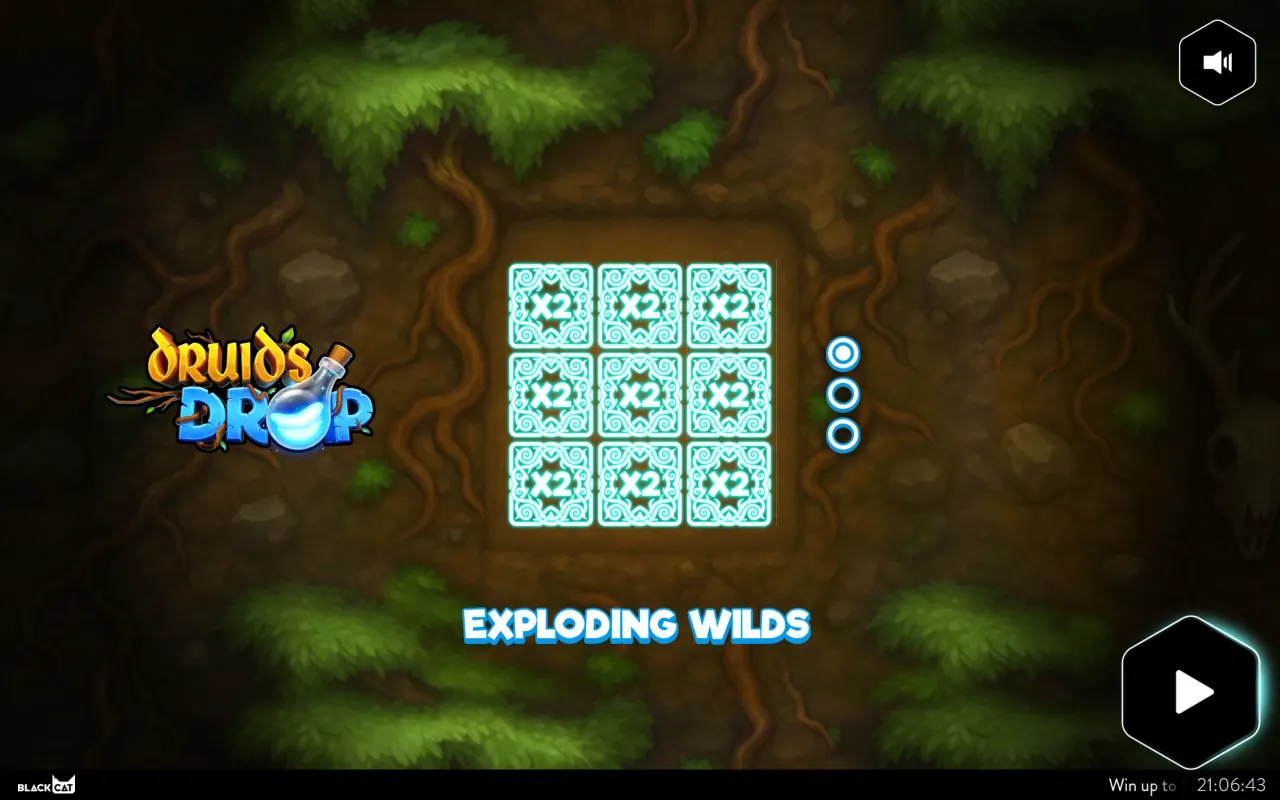
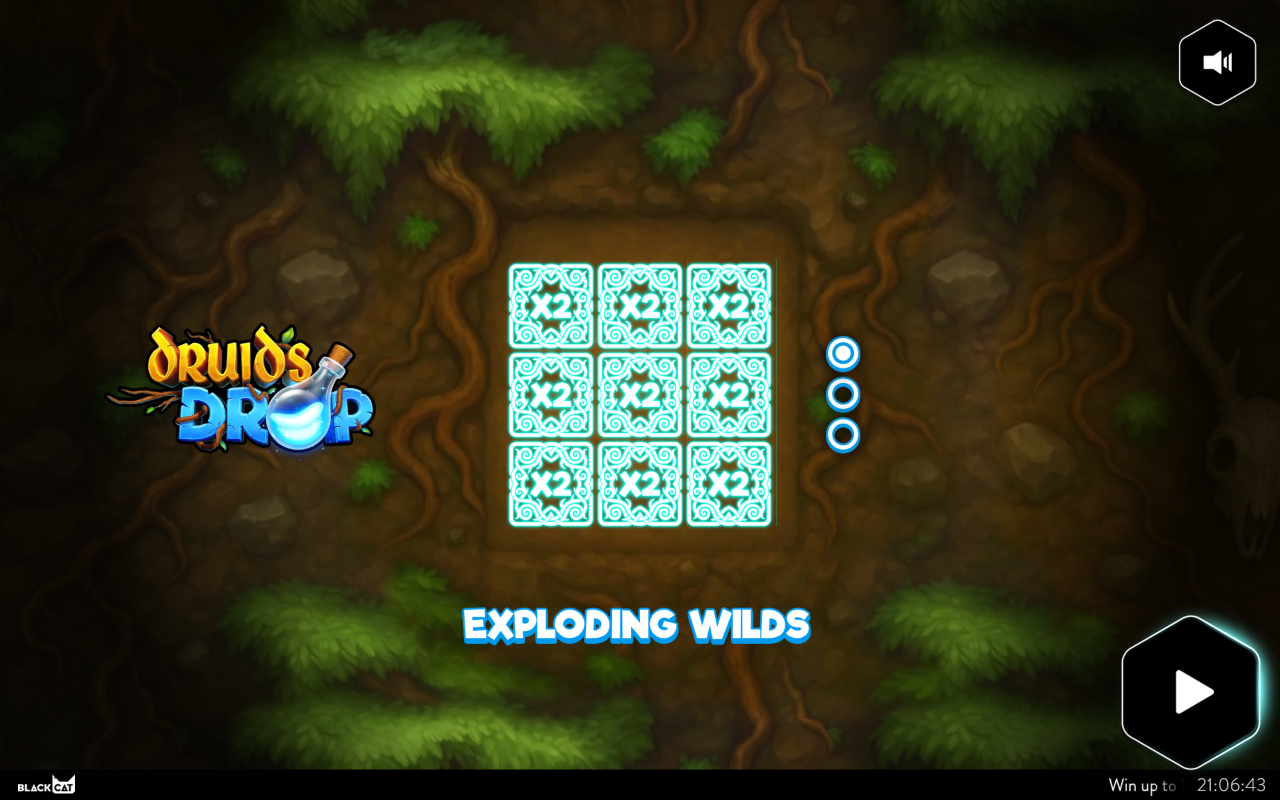
The wild in Druid’s Drop doesn’t just substitute. When it lands, it bursts into a 3×3 block of multiplier tiles, each carrying its own value. The wild does the substituting job, and the tiles it leaves behind do the paying.
It plays out in three steps:
- The wild lands on the grid and pays as part of any cluster it completes
- It bursts into a 3×3 footprint of multiplier tiles
- Each tile applies its multiplier to clusters that form across it
A single explosion can fill that 3×3 area with X2 tiles, and the same grid format carries larger multipliers elsewhere in the game:
- X2
- X4
- X8
- X16
When those values stack up under a cascade, the arithmetic escalates quickly. A clearing cluster drops fresh symbols directly onto multiplier tiles, so the second and third win of a chain can pay far more than the first. The tiles themselves clear away once the chain ends, which is what makes the base game and the bonus round feel so different.
The Rune Meter
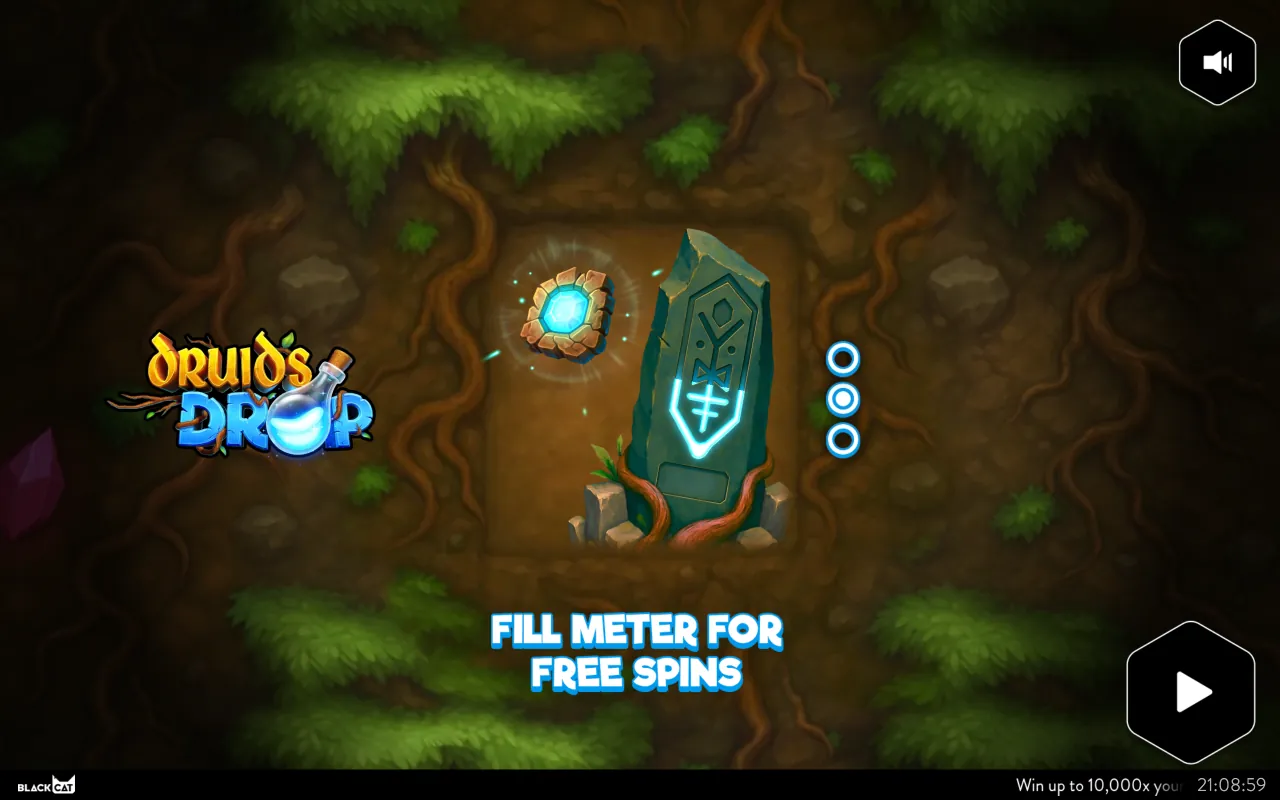
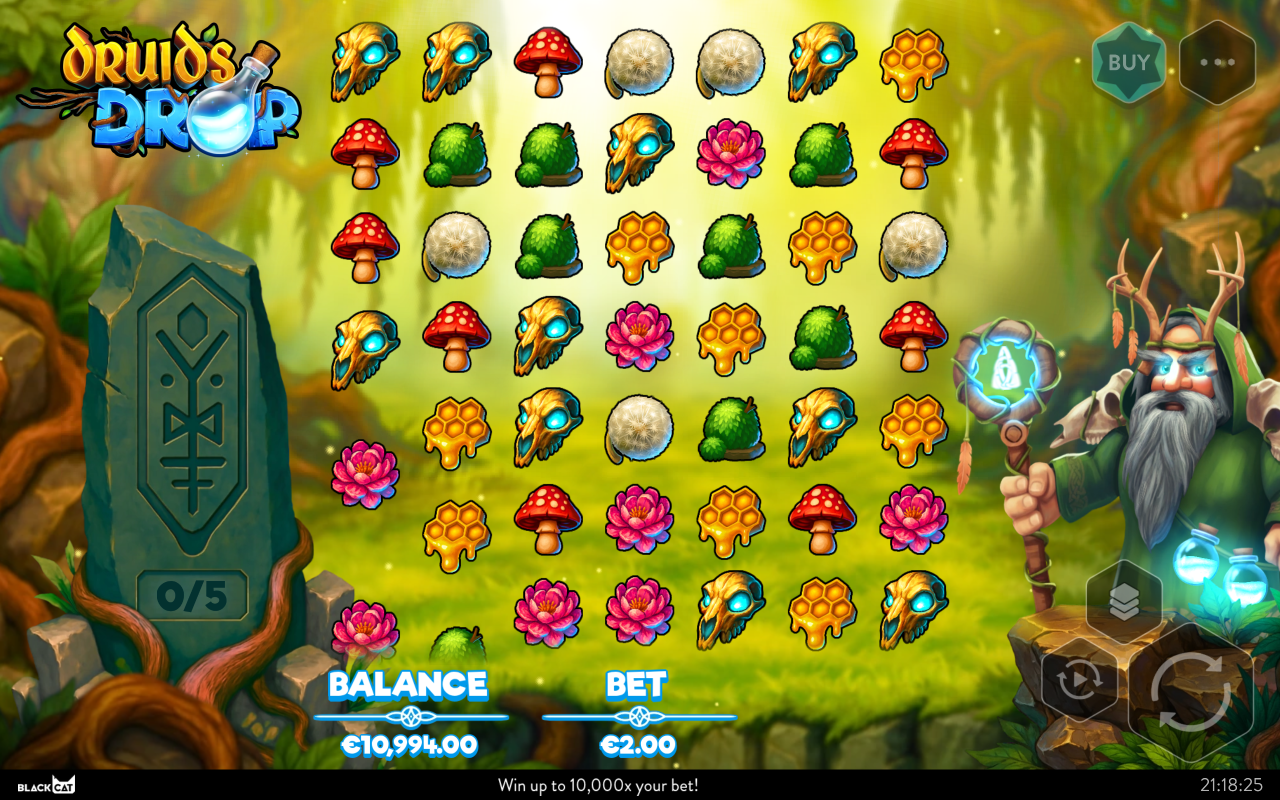
Beside the reels sits a stone counter, shown as 0/5. Rune shards fill it as play goes on, and the fifth shard is what opens the Free Spins round. Five shards, one meter, and the free games behind it.
It’s a build mechanic, and it changes the rhythm of the base game. Every cascade is doing two jobs: paying what it pays, and nudging the meter one shard closer to the round the whole game is built around. A meter at 3/5 makes the next two shards matter more than the wins themselves.
Druid’s Drop Free Spins
Fill the rune meter and the Free Spins round begins. This is where Druid’s Drop stops holding back, because the multiplier tiles that burst and vanish in the base game behave differently here.
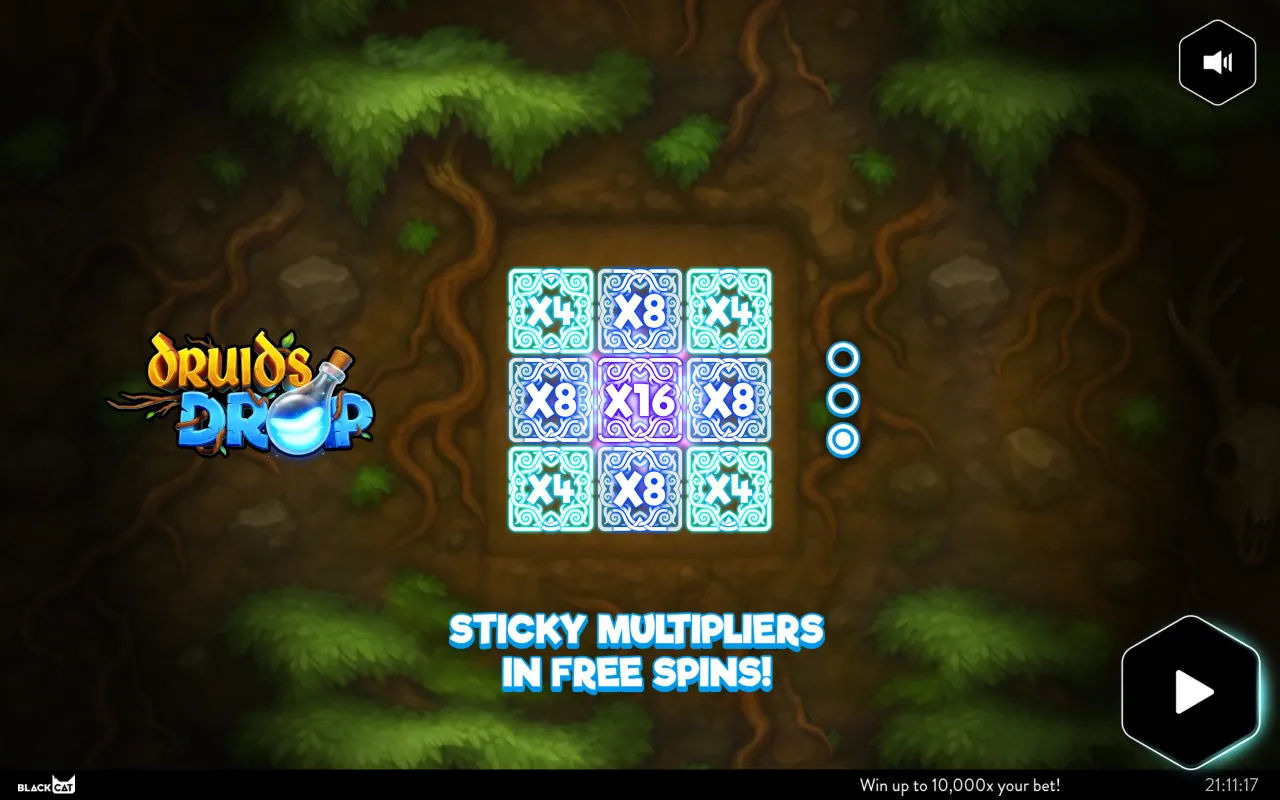
During Free Spins the multiplier tiles stick in place. They don’t clear with the cascade, and they can combine with one another, building towards higher multiplier values, with X16 the highest observed. The round works like this:
- Multiplier tiles land and lock in position
- Each cascade that clears over a tile leaves it standing
- Adjacent or stacked tiles combine their values
- Clusters forming across combined tiles pay the combined multiplier
A board that starts with a few X2 tiles can end the round carrying a scatter of high-value sticky multipliers, with every cluster that forms on top of them multiplied accordingly. That compounding is the whole engine of the round. A run of cascades in quick succession can leave half the grid covered in standing tiles, at which point even modest clusters pay serious money.
The druid himself takes a more active role as the round builds, appearing on the right side of the screen with his staff. The 10,000x ceiling is reachable through this round, and it’s the sticky-multiplier combining that gets a session anywhere near it.
There’s also a BUY button in the top right corner of the play screen for jumping straight past the meter. On a Super High volatility build it’s the quick route to the only round that really pays, at the price of the meter’s slow build being skipped entirely.
Our Honest Verdict
Overall Rating: 7.7/10
Playing Druid’s Drop is mostly waiting in a forest, and the reason to wait is the rune meter: every shard lands with real weight because the round behind it is the only place this game truly pays. The base game gives you small clusters, a slowly filling stone counter and a druid watching from the side, and the strange thing is that it works.
The free spins round is the strength, and for a concrete reason: the multipliers that vanish in the base game stick there and combine, so a good run snowballs instead of resetting. The weakness is the price of admission. One win in five, and the smallest ones, means the meter can take a very long walk to fill, and the buy button is a toll booth on that path.
This is a game for players who enjoy the build itself, cluster grids and the nerve to sit through a cold spell. Anyone after steady returns will hate it within ten minutes. For the patient type, the forest is worth the walk.
Druid’s Drop FAQs
-
What is the RTP of Druid’s Drop?
The RTP is 96%. -
Is Druid’s Drop high volatility?
Yes, and then some. Druid’s Drop is rated Super High volatility, so wins are infrequent and the game is built around the bonus round rather than steady base game returns. -
What is the minimum and maximum bet on Druid’s Drop?
Stakes run from 0.20 to 100 per spin. -
Can you buy the bonus on Druid’s Drop?
Yes. A BUY button sits in the top right corner of the play screen, letting you skip the rune meter and go straight to the Free Spins round. -
How do the Exploding Wilds work in Druid’s Drop?
A landing wild bursts into a 3×3 block of multiplier tiles, each with its own value. Any cluster that then forms across those tiles gets multiplied. -
How do you trigger Free Spins in Druid’s Drop?
Land five rune shards in the stone counter beside the reels. The counter fills as you play, and the fifth shard opens the Free Spins round. -
What do sticky multipliers do in Druid’s Drop Free Spins?
During Free Spins, multiplier tiles stay locked in place instead of clearing with the cascade. They can combine with one another, building values up to X16 and multiplying every cluster that forms across them. -
What is the maximum win on Druid’s Drop?
The maximum win is 10,000x the stake.