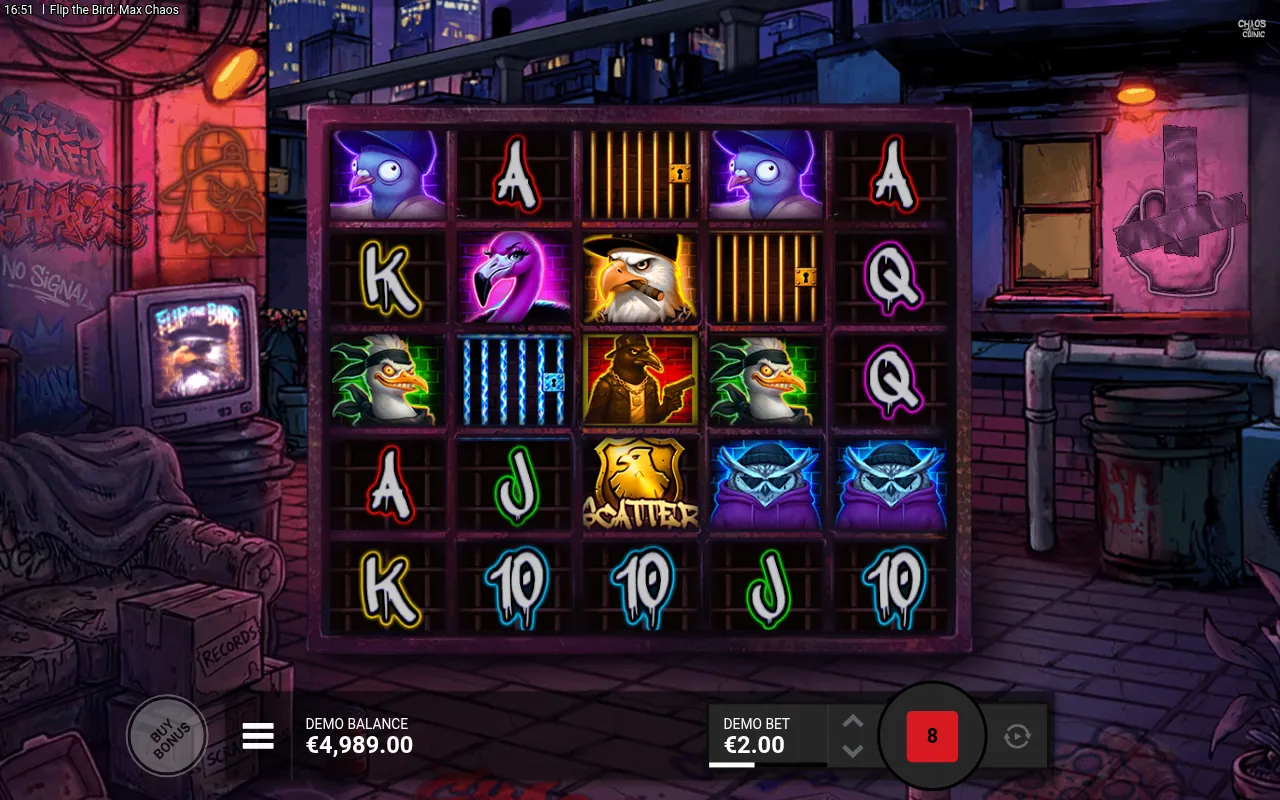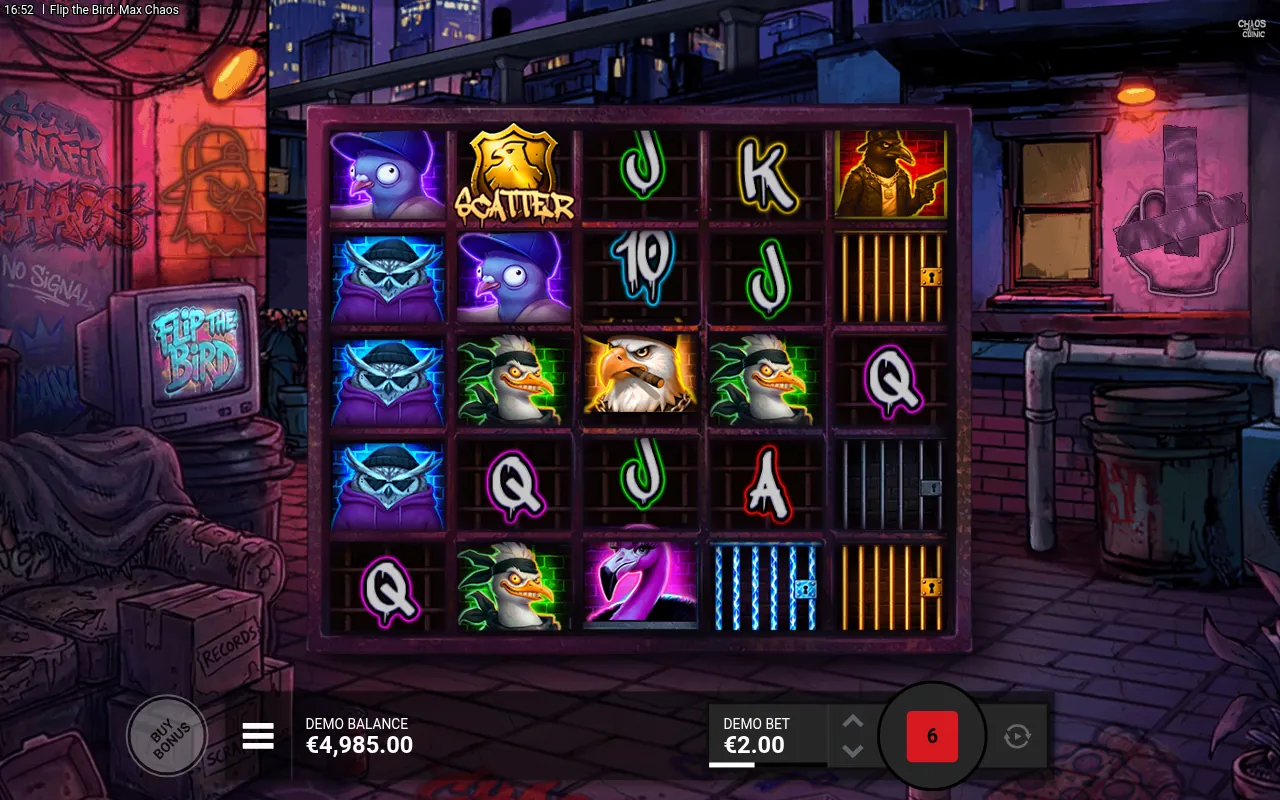














Flip The Bird Slot Review
Down a neon-lit back alley, past the graffiti and a television that still works despite everything, some very serious birds are running a multiplier racket. Flip The Bird is at its best read as arithmetic with feathers: a game where a single reel can stack three different values into one number, and where losing eight spins in a row is the jackpot condition rather than the reason to walk away.
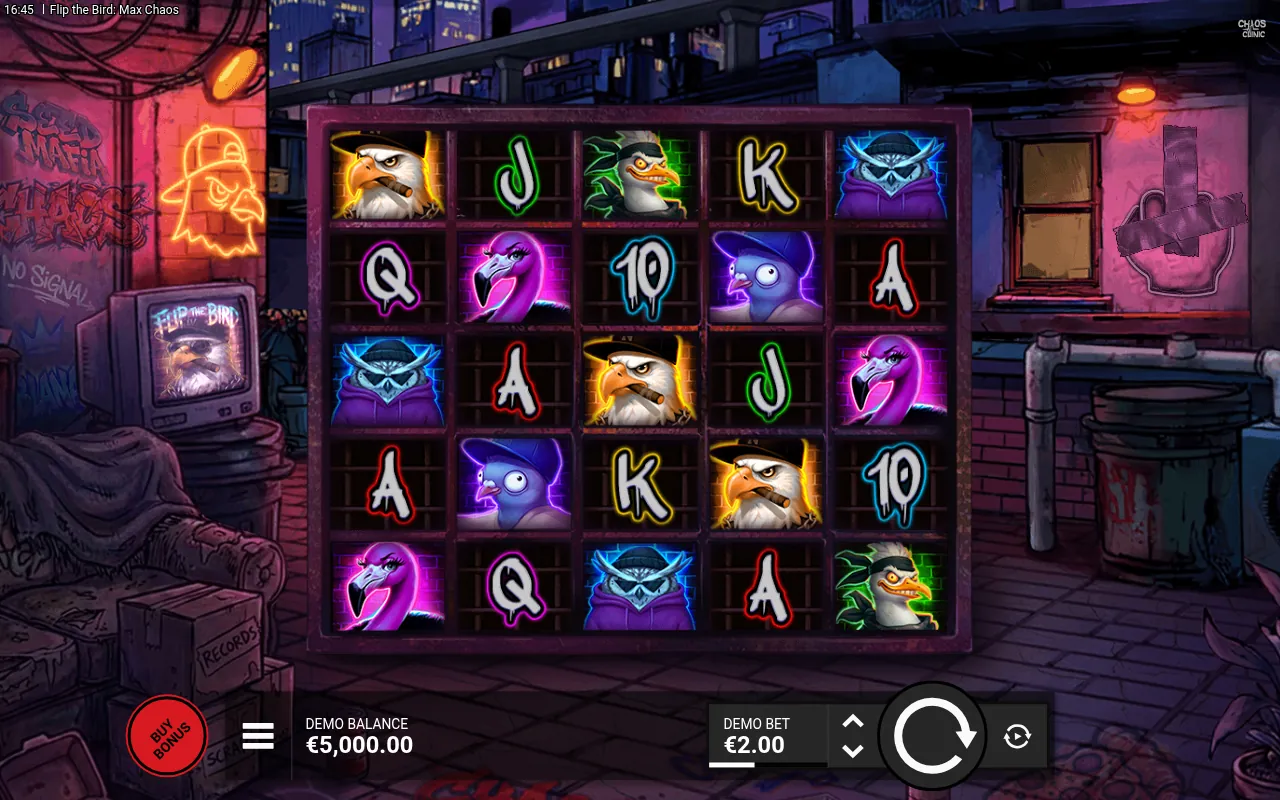
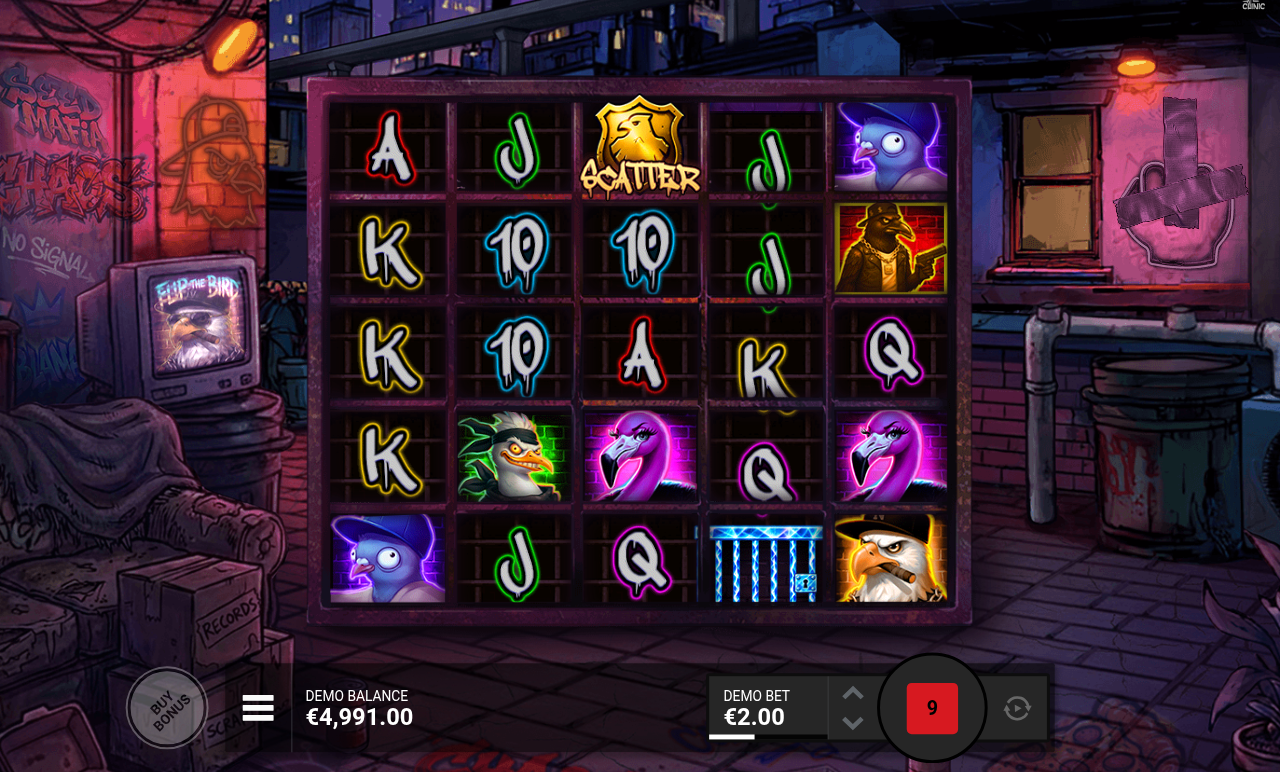
Not every slot would dare build both of those ideas into the same 19 paylines. This one does, and mostly holds together. It’s a 5×5 grid with 19 fixed paylines, a 96.33% RTP and a 15,000x max win, from Chaos Clinic, the studio behind Deadline: Max Chaos. The alley is grimy, the birds are up to no good, and the cages are where the money hides.
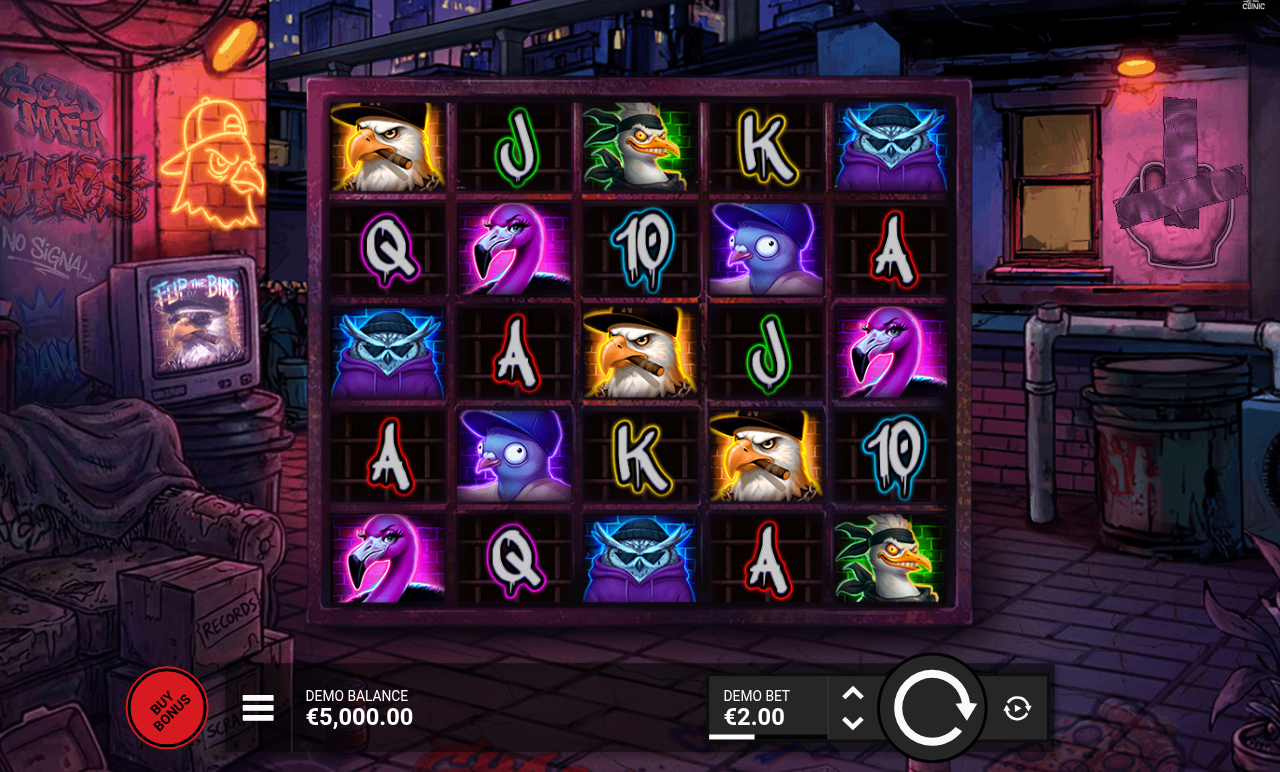
Rooftop Reels and Paylines
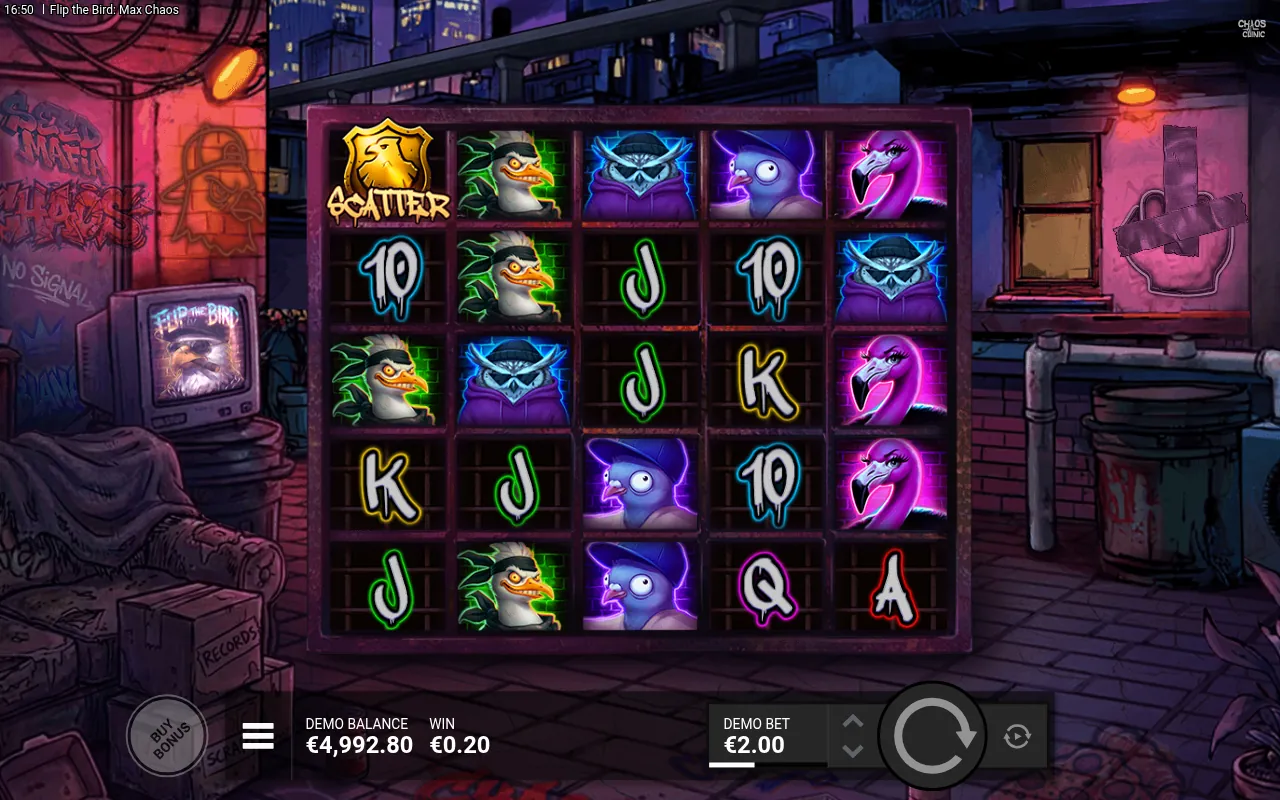
Flip The Bird is a 5-reel, 5-row game with 19 fixed paylines, and the gangster birds that run these rooftops pay across all of them. Wins pay left to right on adjacent reels, and only the highest combination on each line counts. Three or more matching symbols from the left reel is the standard ask.
The wilds here are the Bird Cages, which stand in for regular symbols in winning combinations but never for the FS Scatter or the Crow. Every other system in the game is built around what those cages do next.
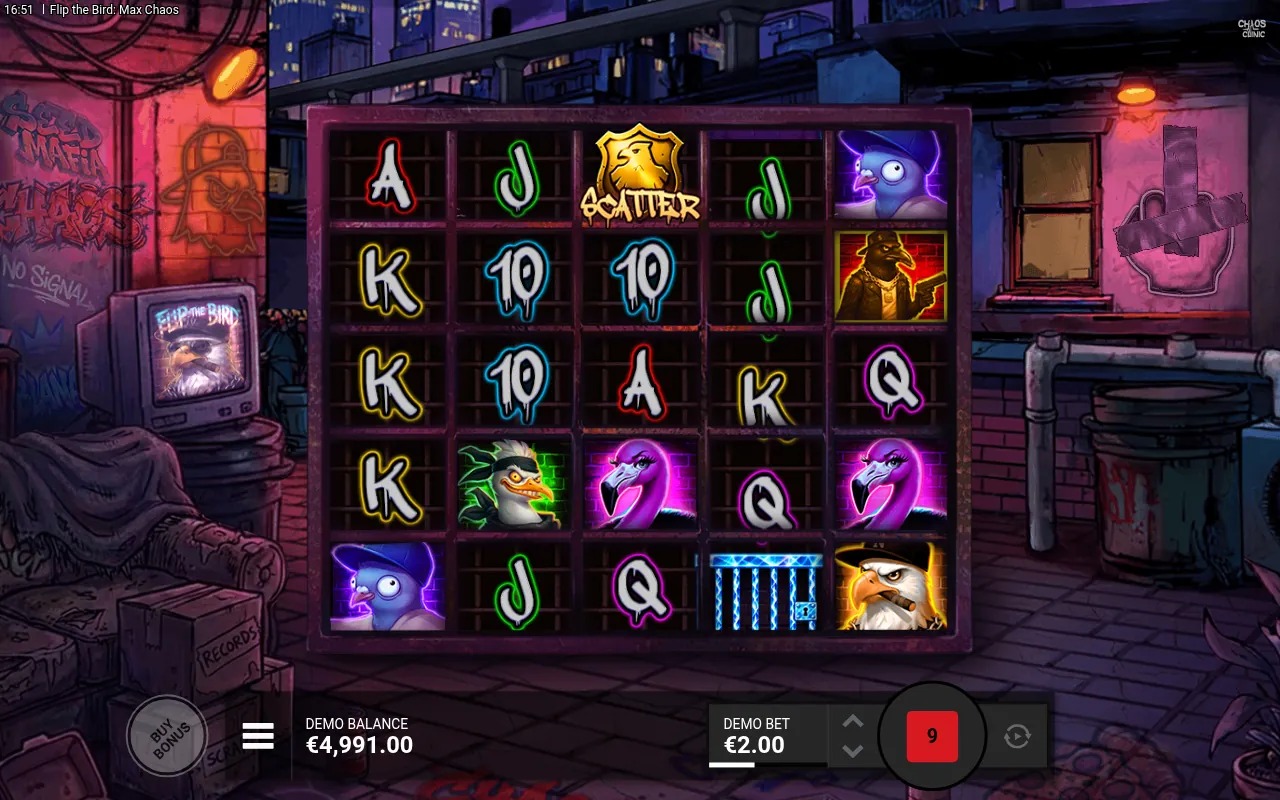
The Scatter is a gold shield, and FS Scatter symbols feed the game’s three bonus games alongside the Crow Respin. All of those matter more further down, so they’ll keep. For now, the alley looks calm.
Bird Cages
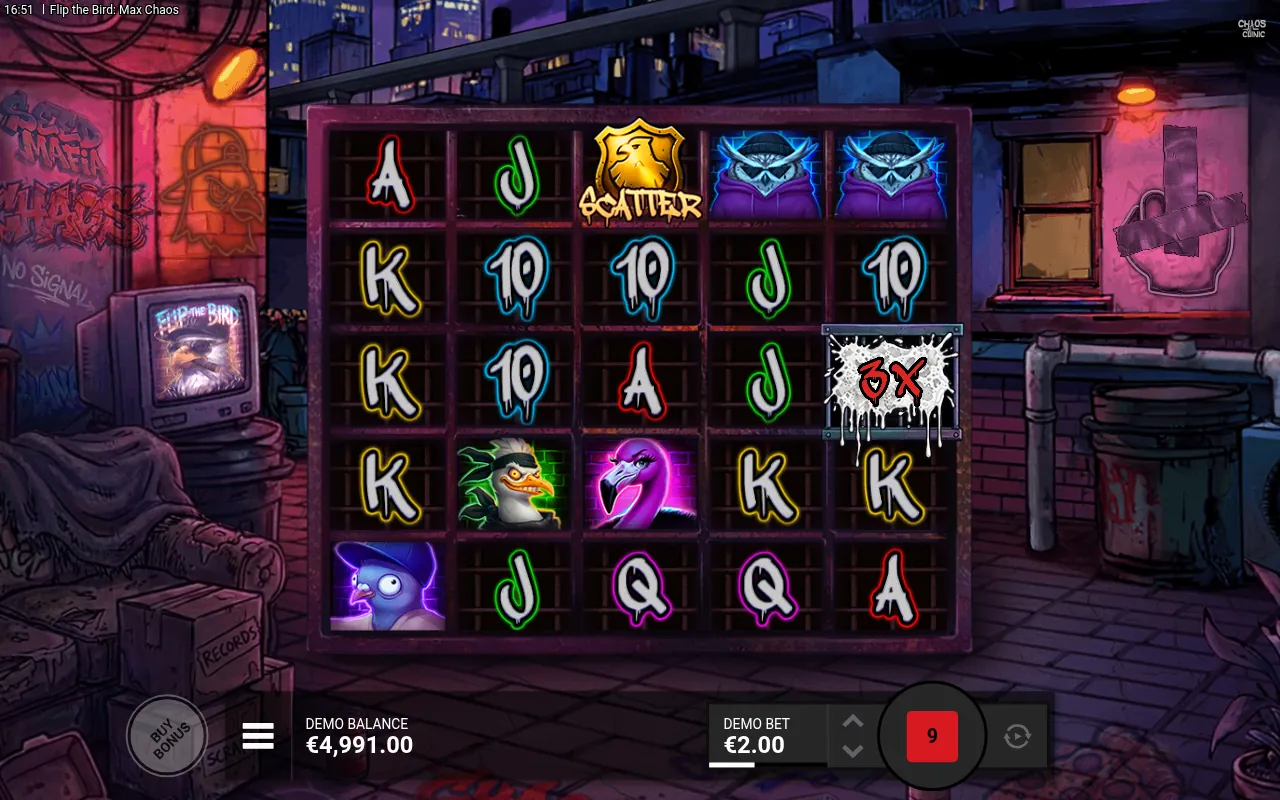
Cages are the whole show. They land in two shapes, and the difference between them decides how much of the reel they control:
- Closed cage: covers a single position, and several can stack on the same reel
- Open cage: extends down to the bottom of the reel, covering 2 to 5 positions
- An open cage’s multiplier applies to every position it covers
- Open cages can’t land in the bottom position, and only one can land per reel
That last pair of limits keeps the grid honest. Without them, a reel full of stretched Gold cages would pay for itself on every spin, and the 15,000x ceiling would be a formality rather than a chase.

Regular and Gold Cages
The multiplier ladder is the part worth memorising:
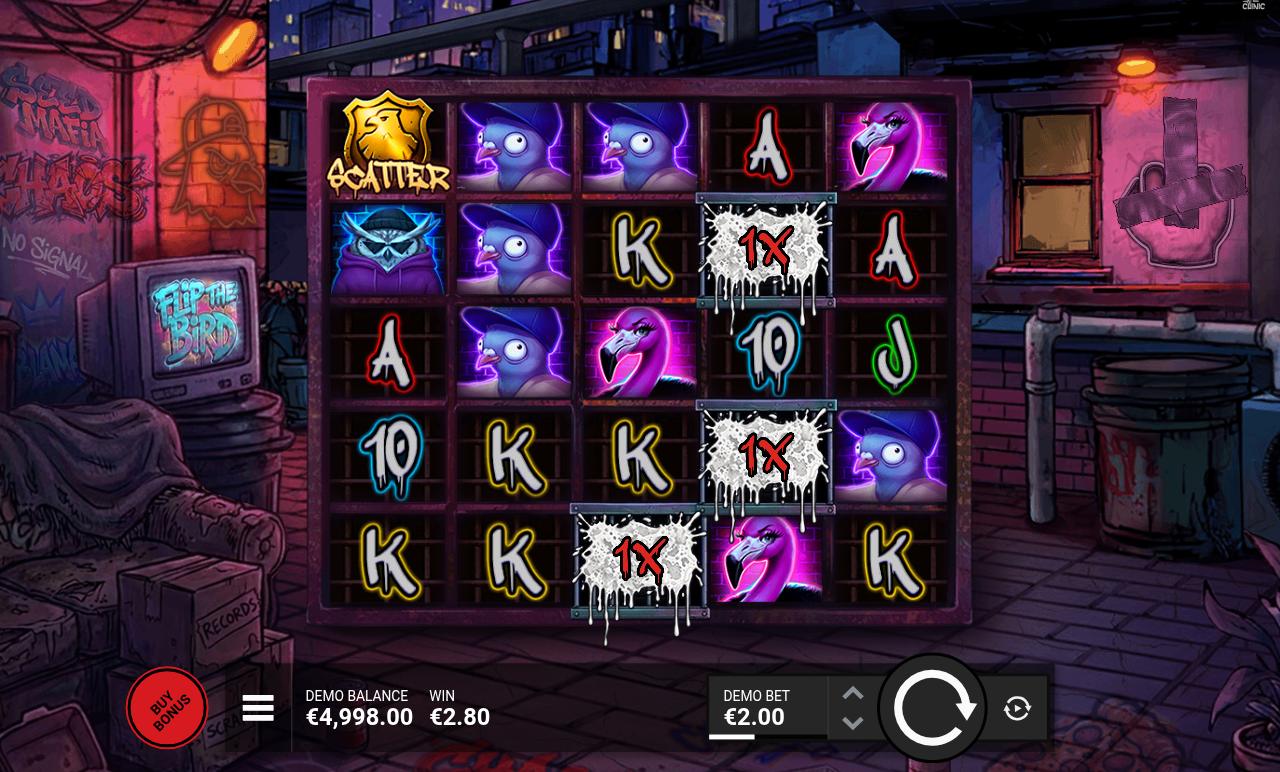
- Regular cages award multipliers from 1x to 10x
- Gold cages award 15x, 20x, 25x, 50x, 75x or 100x
- Diamond cages multiply every other active cage by x2 to x10
- Each cage’s final multiplier is capped at 2000x
Diamond Cages
Diamonds don’t carry a value of their own in the usual sense. They boost every other active cage, and they’re applied first, before anything is added up. The notation even tracks it: while a Diamond is busy boosting another cage, it’s written with the x in front, as in x2. Once all the boosting is done, the cage’s final multiplier is written with the x behind it, as in 2x.
When several Diamonds are active at once, their boosts land in a fixed order:
- Open Diamond cages first, then closed ones
- Within each group, from the bottom row to the top row
- Within the same row, from right to left
Once every Diamond boost has landed, each cage carries a final multiplier. The final multipliers of the cages in a winning combination are added together and multiply that win. A cage sitting at 1x never adds to the total, so a win covered only by 1x cages pays flat.
The worked sums make it concrete. Combine a 36x cage with a 216x cage on the same win and the payout is multiplied by 252x, while a lone 2x cage simply doubles it. That’s the arithmetic that makes the 15,000x ceiling believable: stacked Gold cages, a Diamond or two multiplying them, and merges on top.
Cage Merges
When an open cage reaches a closed cage below it on the same reel, the two merge, and their values combine before the win is calculated. The outcomes depend on what’s meeting:
- Two multiplier cages, Regular or Gold, add their values together
- A multiplier cage merged with a Diamond adds their values and becomes a Diamond cage
- Two Diamond cages multiply, so a x3 and a x4 merge into a x12 Diamond
Two Diamonds merging is the endgame. With the 2000x per-cage cap waiting, a good merge chain is how a base-game spin turns into something worth writing home about. Merges also explain why a closed cage low on a reel isn’t dead weight: it’s fuel for whatever opens above it.
That fuel logic changes how you read the grid. A closed 25x cage parked above the bottom row looks modest on its own, but the moment a Gold cage opens above it, the two become one symbol carrying the combined value. Reading reels as merge opportunities, rather than as a scatter of separate multipliers, is the skill this game quietly teaches.
Crow Respin
Landing a Crow in the base game starts the Crow Respin. Only one Crow can ever land on the grid, and it never appears outside the base game, so this is a base-game event rather than a bonus-round one.
It’s a short, sharp interruption: the Crow arrives, the respin plays out, and the cages carry on as before. Think of it as the alley’s way of keeping you watching between the big merges.
Max Chaos
Max Chaos is the feature with the nastiest sense of humour. Eight dead spins in a row equals the max win, and every dead spin raises the multiplier stage. A winning spin ends the feature.
Losing is the point. Every spin that pays nothing pushes the stage higher, and a single win banks the progress and resets the board. The 15,000x top prize can land in any game mode, and this is the mode built to chase it.
It’s a design that rewards the opposite instinct to every other slot you’ve played this month. Eight misses in a row is normally a reason to wince; here it’s the jackpot condition. Whether that’s genius or provocation is a matter of taste, but it’s certainly Chaos Clinic.
Our Honest Verdict
Overall Rating: 7.9/10
This is a game of waiting, then suddenly not. Most spins are a quiet rooftop with a handful of small multipliers; then one reel opens a Gold cage into a closed neighbour, a Diamond turns up behind it, and a modest win comes out multiplied by 252x. That switchback is the reason to choose it over a dozen glossier games. Nobody does the quiet-to-violent swing quite this well, because the merge maths means a single spin can compound three times before it pays.
Patience is the entry fee. Between the good reels, there’s very little happening: no streak mechanics worth the name in the base game, and the Crow’s respin is a moment, not a rescue. The alley is atmospheric, but atmosphere doesn’t spin the reels for you.
It suits players who enjoy doing arithmetic in their heads while they wait, and who’d take one enormous spin over twenty modest ones. Anyone who wants constant action should look elsewhere on the rooftop. For the rest, the birds are worth the wait.
Flip The Bird FAQs
-
What is the RTP of Flip The Bird?
The RTP is 96.33%, which is the total expected return for the game. -
What is the maximum win on Flip The Bird?
The maximum win is 15,000x your bet, and it can be achieved in all game modes. -
Who makes Flip The Bird?
Flip The Bird is made by Chaos Clinic, the studio behind Deadline: Max Chaos. -
How do Diamond Bird Cages work?
Diamond Cages don’t carry a value of their own. They multiply every other active cage by x2 to x10, and their boosts are applied before any win is calculated. Each cage’s final multiplier is capped at 2000x. -
What happens when cages merge in Flip The Bird?
When an open cage reaches a closed cage below it on the same reel, they merge. Two multiplier cages add their values, a multiplier merged with a Diamond becomes a Diamond, and two Diamonds multiply together. -
What does the Crow do in Flip The Bird?
The Crow only lands in the base game, only one can ever appear on the grid, and its arrival starts a respin. -
What happens after eight dead spins in Max Chaos?
Eight dead spins in a row equals the max win. Every dead spin raises the multiplier stage, and a winning spin ends the feature. -
When is Flip The Bird released?
Flip The Bird’s release date is 25 November 2026. -
What is the difference between an open and a closed Bird Cage?
A closed cage covers a single position. An open cage extends down to the bottom of the reel, covering 2 to 5 positions, and its multiplier applies to every position it covers. Open cages can’t land in the bottom position, and only one open cage can land per reel.