











Joker’s Triple Play Slot Review
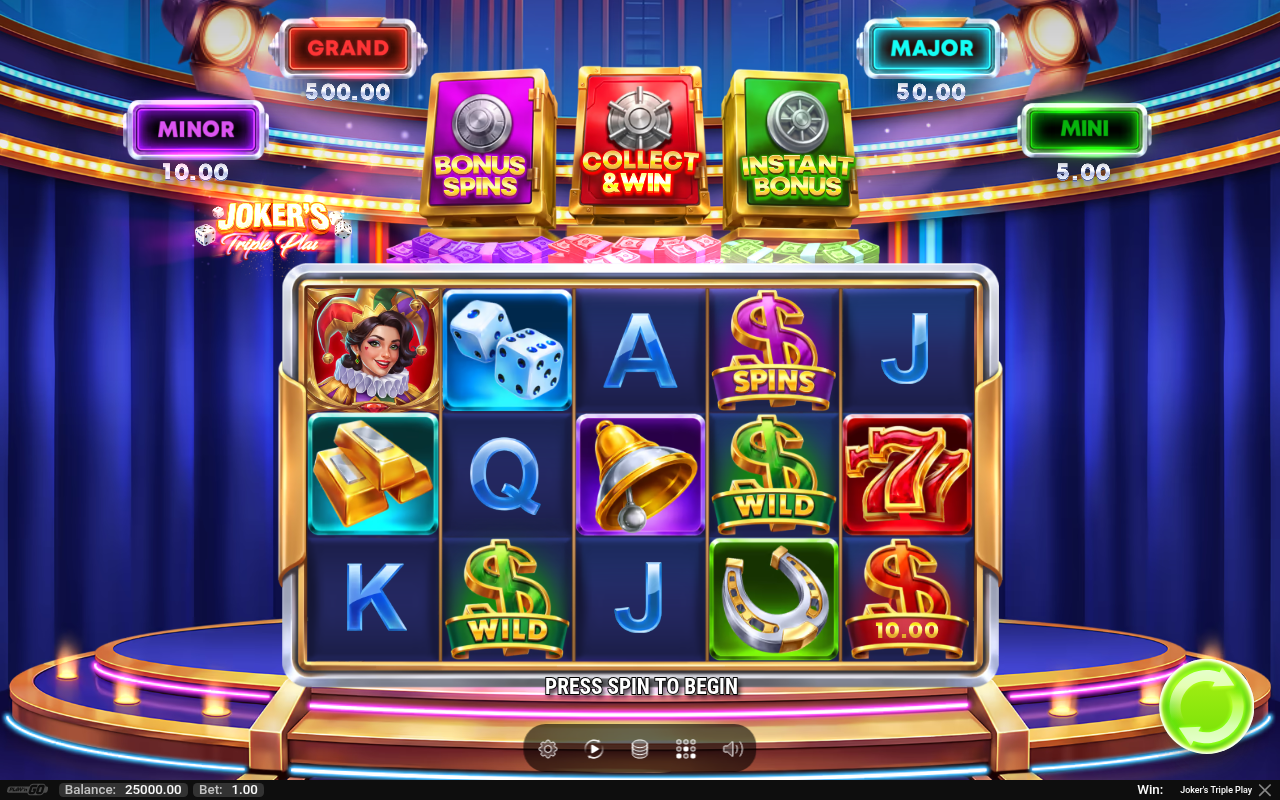
A Vegas revue stage, three squat vaults on gold plinths, chase-light bulbs arcing over blue velvet curtains – and then Joker’s Triple Play hands almost everything it pays to a single symbol. One family of scatter icons carries three different features here, which is a bold bet on one image doing the work an entire paytable usually shares. Most of the line wins from the bells and 7s will feel like change found in the seats.
Play’n GO build it on a 5×4 grid, with three separate features hanging off that single scatter family. It sits in the studio’s joker line alongside 3 Clown Monty II, Free Reelin’ Joker and Fire Joker Freeze, though those older titles never handed one symbol this much to do.
Base Game & Features
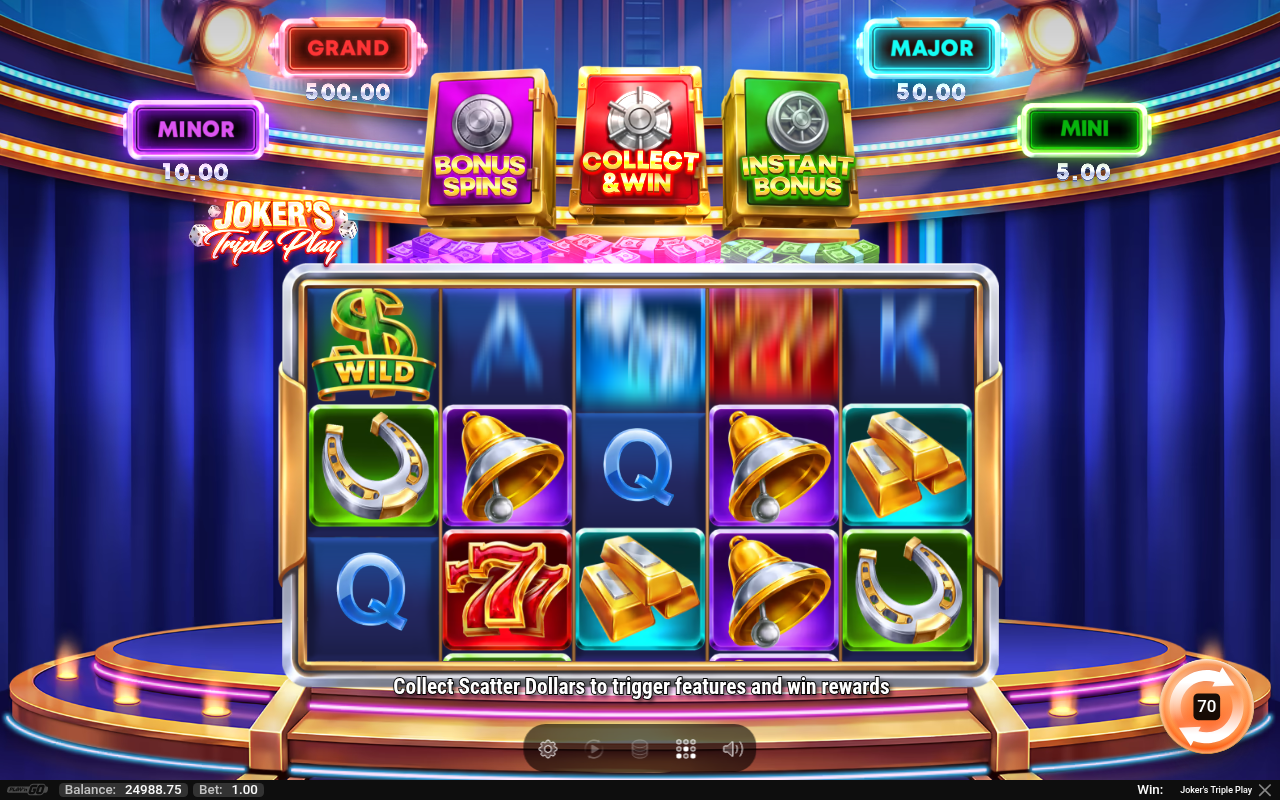
The reels sit centre stage under two tilted theatre spotlights, and the base game is a straightforward affair: spin, line up symbols, hope a Scatter Dollar drops in. Bells and 7s carry the standard line wins, with a Scatter Dollar 2.00 also appearing among the regular symbols. Between spins, the on-screen prompts make the game’s priorities plain – collect Scatter Dollars to trigger features, and landing three or more Bonus Spins Scatter Dollars starts the free round.
The autoplay menu offers five fixed options for anyone who’d rather let the show run itself:
- 10 spins
- 20 spins
- 50 spins
- 75 spins
- 100 spins
The Wild Scatter Dollar substitutes for all symbols except the Scatter Dollars and the Joker Symbol. When it lands, it can also trigger the Instant Bonus at random. That’s its whole job, and it does it from any reel.
The Scatter Dollar Family
Three different Scatter Dollars can appear on all reels, and each one is a key to a different feature:
- The Wild Scatter Dollar, the family’s substitute, and a possible doorway to the Instant Bonus
- The Collect & Win Scatter Dollar, carrying an x20 marker, which can randomly trigger the Collect & Win feature
- The Bonus Spins Scatter Dollar, which can randomly trigger the Bonus Spins feature
The random triggers are the interesting part. A single Scatter Dollar landing anywhere might fire its feature on the spot, which keeps even non-winning spins carrying a little tension. Collect enough of the right kind, and the feature fires regardless.
That dual-route design shapes the whole base game. There’s a slow path – count the scatters as they build – and a fast one, where any stray dollar lights the fuse early. It means every scatter landing matters, even the ones that don’t complete a set.
Because all three scatter variants can appear on all five reels, no reel is ever dead weight. The reels you watch change depending on which feature you’re chasing: reel 1 matters most when the Joker Symbol is due, while the Bonus Spins count builds wherever the dollars happen to fall. The Wild and the Scatter Dollar 2.00 can share a spin with them too, so a single screen can carry three different possibilities at once.
Joker’s Triple Play Bonus Features & Free Spins
Three features sit behind the scatter family, and the vault icons above the reels – Bonus Spins, Collect & Win and Instant Bonus – track which prizes are in play. Each has its own trigger and its own shape:
- Bonus Spins: three or more Bonus Spins Scatter Dollars, or a random trigger from one
- Collect & Win: a Joker Symbol on reel 1 plus at least one Collect & Win Scatter Dollar, or a random trigger
- Instant Bonus: a random trigger from a landing Wild Scatter Dollar
Bonus Spins
This is the round the count-up is for. Stack three or more of the right scatter and the free round begins outright, no random roll required. A single scatter of that type can also set it off early, so patience isn’t the only route in.
It’s the most conventional of the three features – a free round on the familiar reels, entered from the base game’s most countable symbol. The scatter family keeps it connected to the other two features, since the same spins that build towards it can also fire either of the others early.
What the round itself awards is tied to the same scatter family that opens it, so the feature is best understood as the game’s default destination – the one you reach by simple counting rather than by a lucky random trigger or a reel 1 Joker.
Collect & Win
This is the feature the game is built around. It triggers when a Joker Symbol lands on reel 1 alongside at least one Collect & Win Scatter Dollar, or at random whenever any Collect & Win Scatter Dollar appears. The reels expand to a 5×5 grid and you start with five spins, with a 2×2 Joker Symbol taking up position on the board.
Every coin that lands inside the Joker’s footprint goes into your total; coins outside it don’t. The Joker’s position on the expanded grid therefore decides whether a coin is worth anything, so each drop arrives with a question attached – five spins of that is a compact, positional round rather than a watch-and-wait one.
It works step by step like this. First the trigger resolves and the grid grows by a column. Then the 2×2 Joker takes its place, four cells wide in a 25-cell grid. Then the five spins run, each one dropping coins that either fall inside that footprint or beside it, and the collected total pays out when the counter reaches zero.
The x20 marker on the Collect & Win Scatter Dollar signals what the feature is chasing: multipliers of the stake rather than line pays. Between the marker, the expanded grid and the 2×2 Joker, the round has a different geometry from everything else in the game, which is exactly why it sits at the centre of the design.
Instant Bonus
The quietest of the three. The Instant Bonus fires at random from a landing Wild Scatter Dollar, paying out on the spot without a round of its own.
It’s the drumroll the game hands you between the bigger numbers. No spin counter, no expanded grid – just a wild lands, and sometimes the vault opens straight away. Because the wild is also the substitute, the same symbol that completes a line win can simultaneously be the one that opens the prize, which is a neat doubling-up of a single icon.
Our Honest Verdict
Overall Rating: 7.1/10
Playing Joker’s Triple Play mostly means watching for dollars under the spotlights. The line wins are small beer; the show is the Scatter Dollar, and the random triggers mean a single one can open the vault at any moment. That’s the pull – the reels rarely feel settled while a scatter is still resolving.
Collect & Win is the best thing here by some distance. Positioning a 2×2 Joker and hoping the coins fall inside it is a genuinely involving five spins, and it’s the one round with real personality. The weakness sits either side of it: the base game is thin, and Bonus Spins and the Instant Bonus are filler by comparison.
This one’s for players who like a slot that can tip over at any spin, and who don’t mind a plain stretch between vaults. Anyone who wants a rich paytable to chew on between features won’t find it under these curtains. For scatter-hunters, though, the stage is well lit.
Joker’s Triple Play FAQs
-
What is the grid size of Joker’s Triple Play?
The base game runs on a 5×4 grid. In the Collect & Win feature the reels expand to 5×5. -
How do you trigger Collect & Win in Joker’s Triple Play?
Collect & Win triggers when a Joker Symbol lands on reel 1 alongside at least one Collect & Win Scatter Dollar. It can also fire at random when any Collect & Win Scatter Dollar lands on the reels. -
How does the Collect & Win feature work?
You start with five spins on a 5×5 reel set with a 2×2 Joker Symbol on the grid. Every coin that lands inside the Joker’s footprint is added to your total. -
How do you trigger Bonus Spins in Joker’s Triple Play?
Landing three or more Bonus Spins Scatter Dollars starts the feature. A single Bonus Spins Scatter Dollar can also trigger it at random. -
What does the Wild Scatter Dollar do in Joker’s Triple Play?
It stands in for every symbol except the Scatter Dollars and the Joker Symbol. Landing one can also set off the Instant Bonus feature at random. -
Who makes Joker’s Triple Play?
Joker’s Triple Play is made by Play’n GO. -
When is Joker’s Triple Play released?
Joker’s Triple Play’s release date is 17 September 2026.