













Pai Gow Poker Slot Review
Green felt, gold fretwork carved along the rail, a dragon watermark ghosted into each corner of the betting areas. Pai Gow Poker is that rare casino card game you cannot play badly, and that’s exactly why it’s hard to beat: every hand is split perfectly for you, the dealer still takes the ties, and the gap between those two facts is where your money goes.
Urgent Games have built a decision-free card table: seven cards, two hands, and a dealer who’s tougher to beat than he first looks. Winning means beating him twice in the same round, and the game won’t let you get there by half measures.
The card table is the quieter corner of a catalogue that also runs to Celestial Blessings, Golden Hoard and their Jacks or Better table, so this one sits among familiar company.
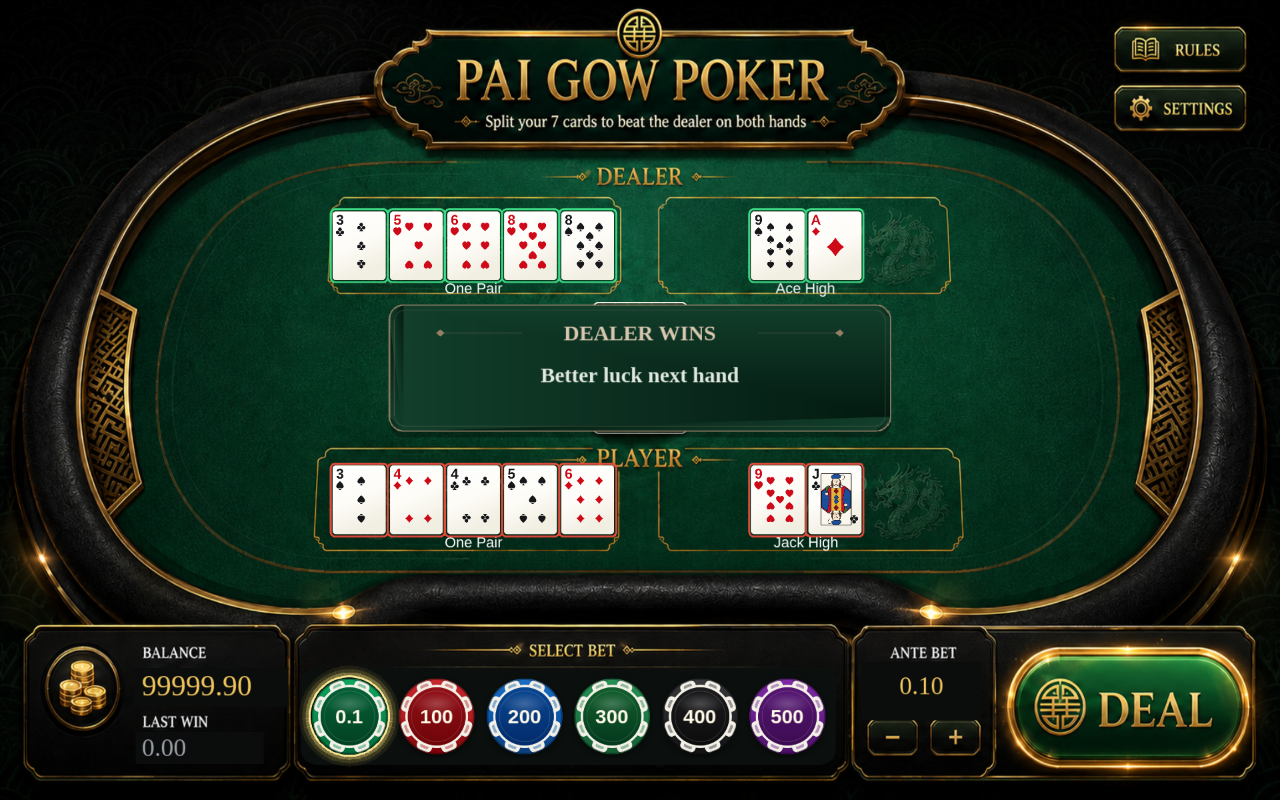
Seven Cards, Two Hands, One Rule
Each round deals seven cards to you and seven to the dealer, from a 53-card deck that includes a single joker. Your seven cards are split into a five-card high hand and a two-card low hand. That split isn’t yours to make, and that’s the most unusual thing about this game: the arrangement is done for you.
The game uses standard house way rules to set both hands, and the high hand always ranks at or above the low hand. Because the split is automatic, a hand can never be fouled, which is the classic way to lose at pai gow in a live setting. Here, that mistake simply can’t happen.
The dealer’s seven cards are arranged the same way, under the same house rules. Neither side has any say in how the cards are sorted. From there, the round resolves as two independent comparisons:
- Win both hands and you win the round, with a 5% commission deducted from the win
- Win one hand and lose the other and the round is a push, returning your bet
- Lose both hands and you lose your bet
- The dealer, as banker, wins all ties, on both the high and low hand
That tie rule is where the house edge lives. A round that splits one-and-one returns your stake, so the worst common outcome is a slow drift of pushes rather than sudden losses. Beating the dealer twice is the only way to get paid.
The two comparisons are genuinely independent, which is what gives the format its character. A monster high hand counts for nothing if the low hand can’t hold up, and a strong low hand is wasted behind a weak five-card set. You need both at once, from the same seven cards.
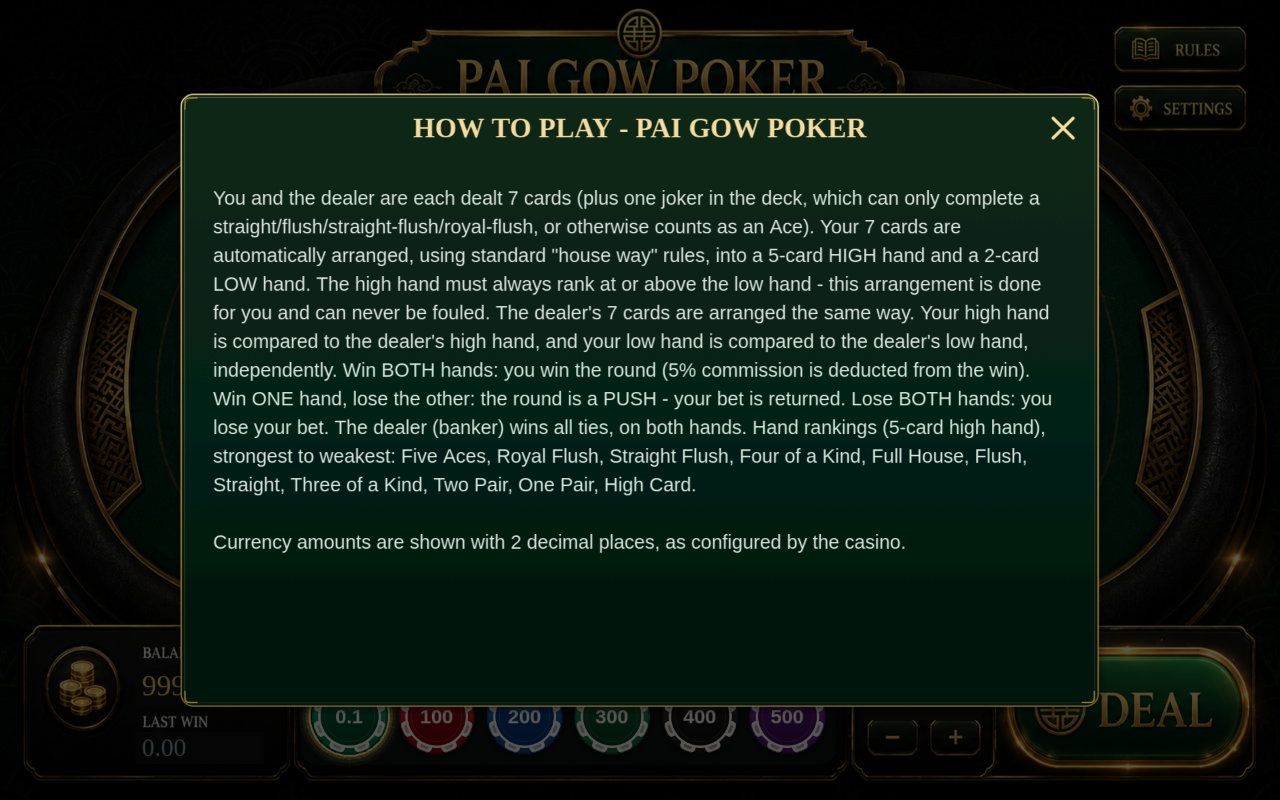
Hand Rankings and the Joker
The five-card high hand uses conventional poker rankings, with one addition at the very top. From strongest to weakest:
- Five Aces
- Royal Flush
- Straight Flush
- Four of a Kind
- Full House
- Flush
- Straight
- Three of a Kind
- Two Pair
- One Pair
- High Card
Five Aces sit above the royal because of the joker, and the joker’s role is tightly defined. It can only complete a straight, a flush, a straight flush or a royal flush; in any other situation it counts as an Ace. There’s no free substitution here, no wild-card flexibility – the joker is either finishing a made hand or it’s the highest card in the deck.
Holding the joker alongside four cards to a flush gives you a completed hand; holding it with scattered ranks gives you nothing more than an extra Ace. It’s the only card in the deck that changes identity depending on its company.
The two-card low hand has no rankings to speak of: it’s simply the higher pair, or the higher card. Since the house way handles the split, what matters is understanding what the game has done with your seven cards, not what you’d have done yourself.
Wins, Pushes and the Commission
Wins pay even money minus a 5% commission, which is the traditional pai gow charge and the reason the game’s economics tilt gently against you over time. The commission is taken from the win before it’s paid. A push returns your stake untouched.
The push is the signature of this format. A strong high hand paired with a low hand that can’t beat the dealer’s doesn’t win or cost anything – it simply moves the round along. Even a straight on the five-card side counts for nothing if the two-card side folds.
Over a session, that means plenty of rounds end exactly where they started. The game neither punishes nor rewards those rounds; it just declines to settle them. It’s a format built for long stretches of small movements rather than sudden swings.
Ties go to the dealer on both hands, which turns a dead heat into a loss with real teeth. A tied high hand that would be a stand-off at most poker tables is a small defeat here, and a tied low hand is often the difference between a push and a paid win.
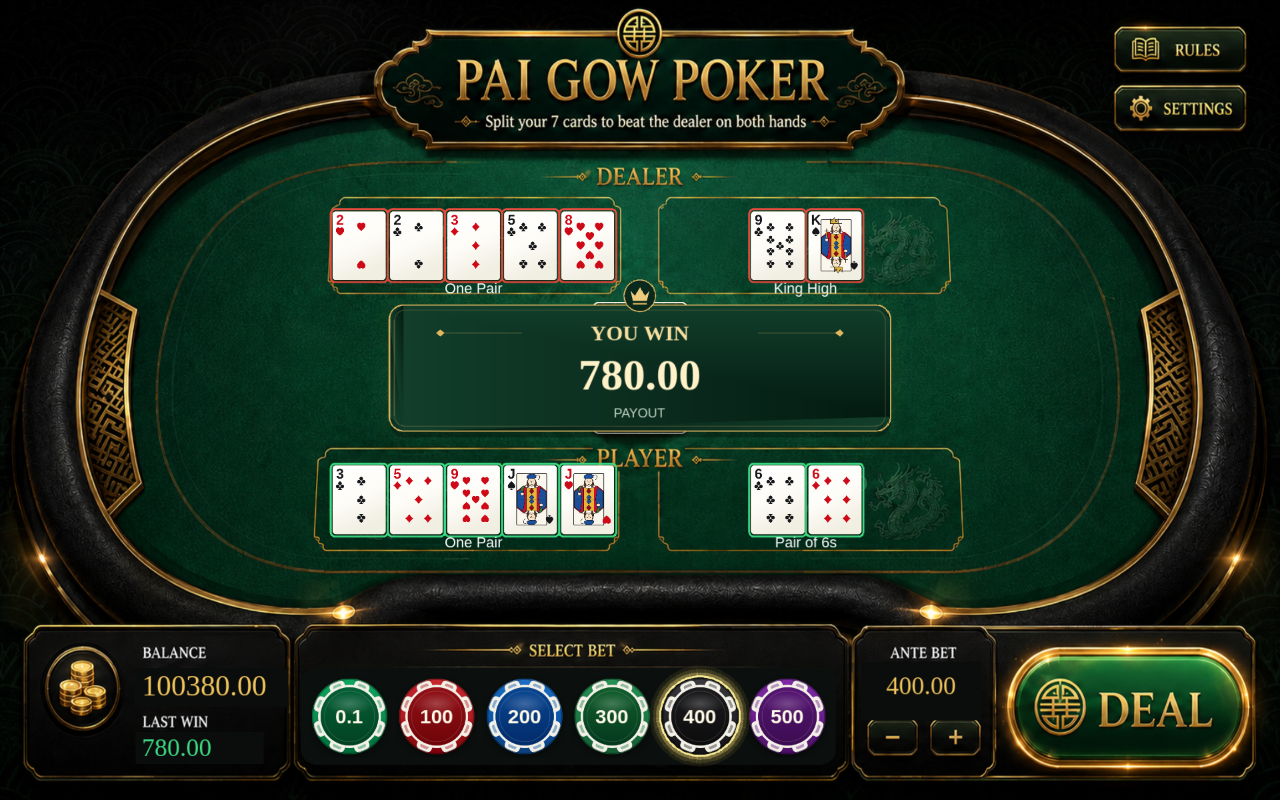
Currency amounts are displayed to two decimal places, as configured by the casino, so payouts read cleanly whatever the stake. Bets are set before the deal, and there’s no side bet, bonus round or decision point once the cards are out.
What you see in the first deal is the entire game. The only variable from round to round is what the 53 cards bring, and every arrangement of them is made for you under the same fixed rules.
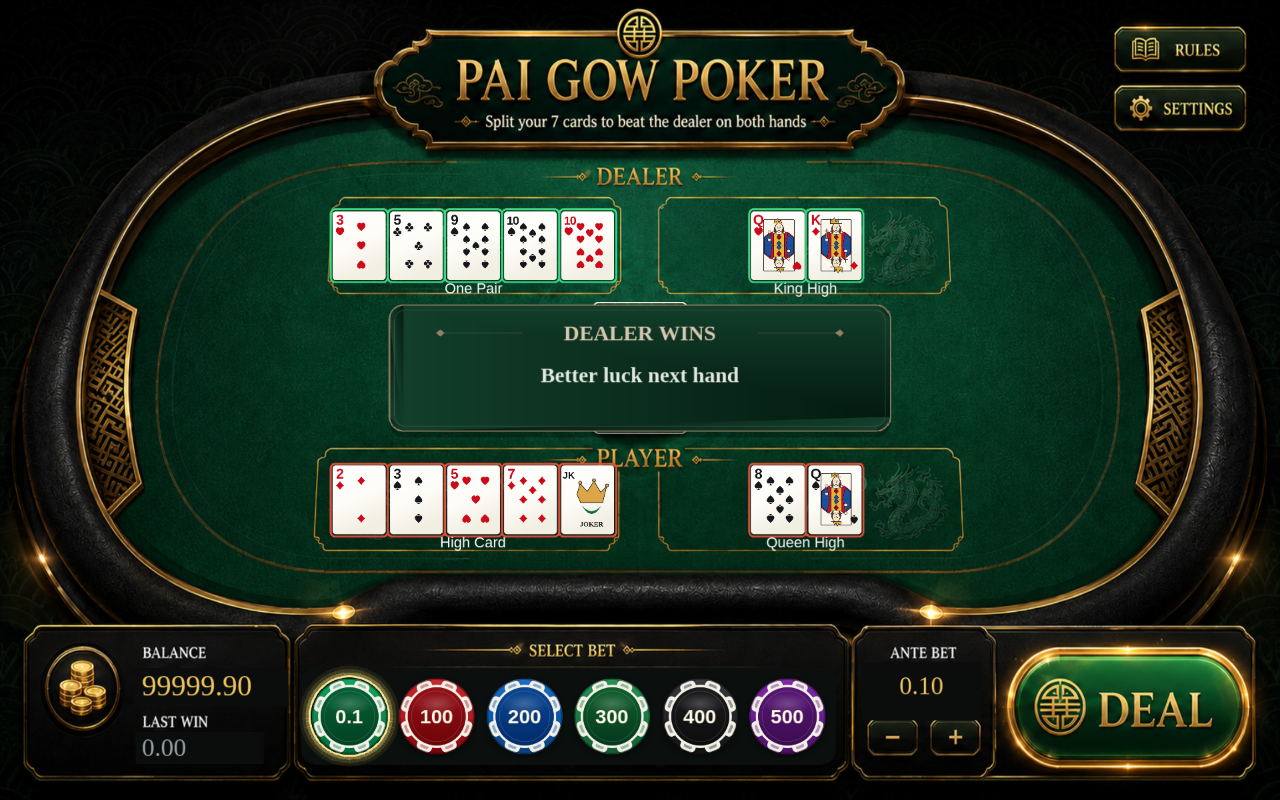
Our Honest Verdict
Overall Rating: 6.2/10
Playing this is more like sitting at a calm table than spinning anything: you set a stake, the cards come out, and most rounds drift rather than swing. The reason to choose it is that drift – the push-heavy pacing keeps a bankroll alive a long time, and the green felt and gold fretwork make it a pleasant place to sit still.
The automatic house-way split is its best feature. You can’t foul a hand, so every round is played as well as it can be, and no loss is ever your own doing. The cost of that is a game with nothing to learn: no decisions, no improving, no lever to pull. Wins pay even money less commission, so there’s no ceiling to chase either.
It suits players who want table-game pacing without table-game homework – something steady to sit with, not something to master. Anyone after volatility or a headline to chase should look elsewhere. For a quiet evening on the felt, this table will keep dealing all night.
Pai Gow Poker FAQs
-
When is Pai Gow Poker released?
Pai Gow Poker’s release date is 14 January 2027. -
Who makes Pai Gow Poker?
Pai Gow Poker is made by Urgent Games. -
How do you win a round of Pai Gow Poker?
You need to beat the dealer with both your five-card high hand and your two-card low hand in the same round. Winning only one of the two hands results in a push, and your bet is returned. -
What happens if I win one hand and lose the other?
The round is a push and your bet is returned in full. You only lose your stake when the dealer wins both hands. -
Who wins ties in Pai Gow Poker?
Ties go to the dealer, who acts as banker, on both hands. A tied hand is never a stand-off in this game. -
What does the joker do in Pai Gow Poker?
The joker can only complete a straight, flush, straight flush or royal flush. In any other situation it counts as an Ace. -
What is the 5% commission on wins?
Every winning round has a 5% commission deducted from the win before it’s paid. This is the traditional pai gow charge and is the game’s built-in house edge. -
Can my hand be fouled by a bad split?
No. Your seven cards are always arranged automatically using standard house way rules into the five-card high and two-card low hands, so an illegal split is impossible.