













Plinko Blast Slot Review
Plinko Blast hands you more control over your own volatility than almost any five-reel slot does, and it does it with two settings and a falling ball. Evoplay‘s take on the arcade-drop format has no reels, no symbols and no paylines to learn. Just a bet, a drop and wherever the ball takes it.
That restraint is the whole appeal, and the two dials it keeps, difficulty and field size, give it more to configure than plenty of five-reel games. The RTP runs at 96.01-96.08% with mid volatility, the pyramid stands 8 to 16 rows tall, and the top basket pays up to 500x the bet.
How Plinko Blast Pays
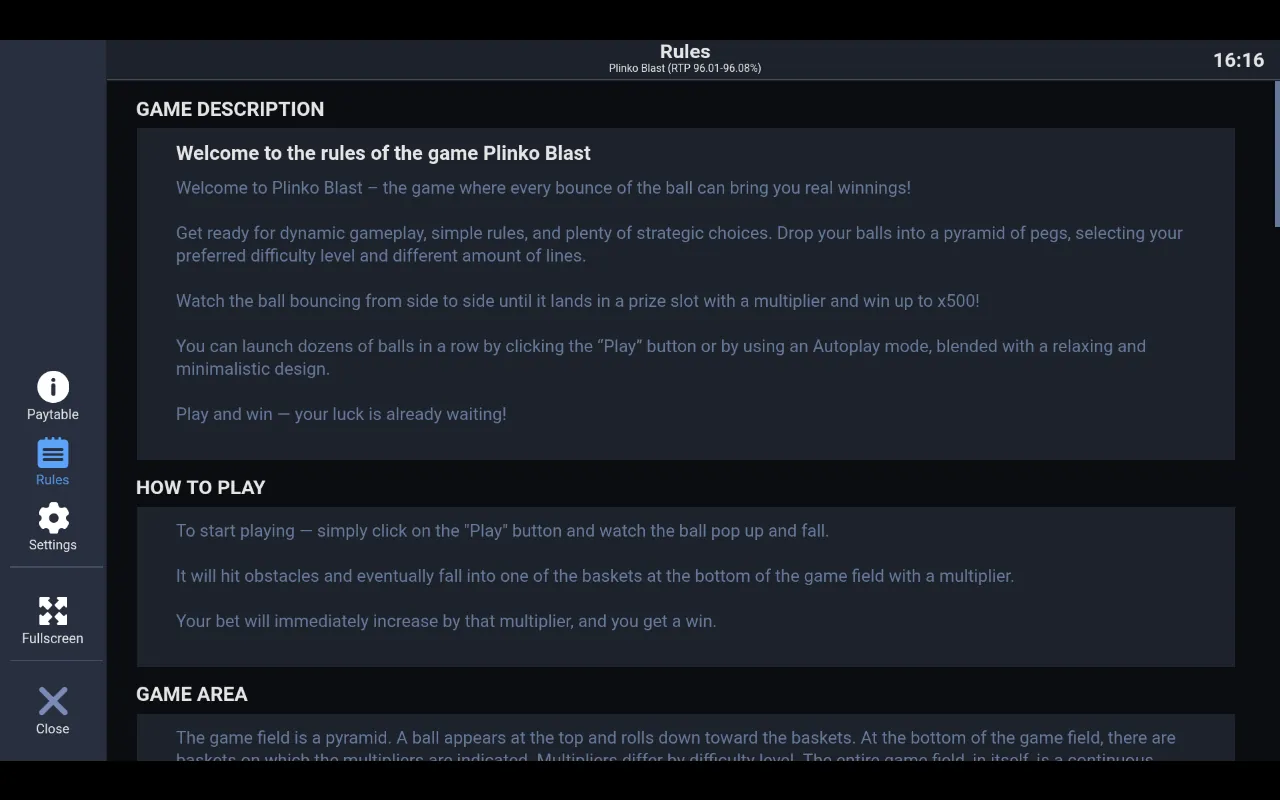
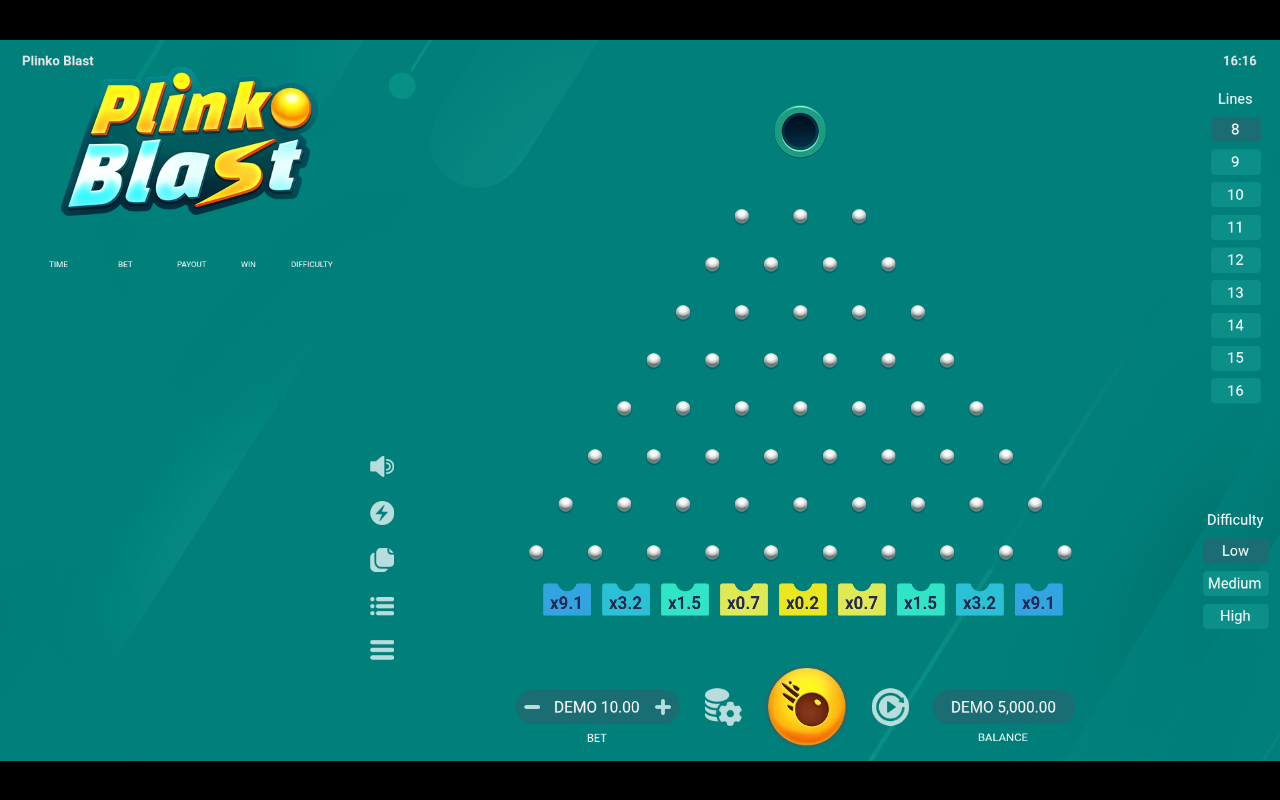
Each round starts with a bet and one click of Play. The bet is deducted from the balance, a ball pops up from the top of the pyramid, and it rolls down through the pegs until it lands in one of the baskets at the bottom. Whatever multiplier sits in that basket is applied to the bet, and that’s the round settled. No second stage, no coin flips, no ladders.
The multiplier row is the paytable, and it changes shape with two settings: the number of rows and the difficulty. On the smallest field, 8 rows with Low difficulty, the edge baskets pay 9.1x and the centre basket pays 0.2x, so a ball finishing mid-row returns a fraction of the stake. Raising the difficulty stretches the edges further while keeping the middle lean.
The values below are multipliers of the bet, listed from the leftmost basket to the rightmost. The row is symmetrical, so the outer values are the rare, loud ones and the centre values are where the physics tends to finish.
Field size 8
- Low: 9.1, 3.2, 1.5, 0.7, 0.2, 0.7, 1.5, 3.2, 9.1
- Medium: 20.3, 5.3, 1.1, 0.4, 0.2, 0.4, 1.1, 5.3, 20.3
- High: 23.9, 5.9, 1, 0.3, 0.2, 0.3, 1, 5.9, 23.9
Field size 9
- Low: 8.8, 2.8, 1.8, 1.3, 0.3, 0.3, 1.3, 1.8, 2.8, 8.8
- Medium: 17.8, 5.4, 1.6, 1, 0.3, 0.3, 1, 1.6, 5.4, 17.8
- High: 21.4, 6.6, 1.9, 0.7, 0.3, 0.3, 0.7, 1.9, 6.6, 21.4
Field size 10
- Low: 8, 2.9, 1.8, 1.4, 0.8, 0.3, 0.8, 1.4, 1.8, 2.9, 8
- Medium: 17, 5.3, 1.8, 1.3, 0.7, 0.3, 0.7, 1.3, 1.8, 5.3, 17
- High: 25, 7.2, 2, 1, 0.7, 0.3, 0.7, 1, 2, 7.2, 25
Larger fields keep the same pattern with more baskets. At 11 rows, the Low row runs 8.4, 3.3, 2.6, 1.7, 1, 0.4, 0.4, 1, 1.7, 2.6, 3.3, 8.4 across the middle of its row, with the outermost values extending the same spread. The biggest single win the game advertises is 500x the bet.
Read the rows side by side and the shape of each setting shows clearly. The centre basket pays 0.2x on almost every field, so the middle of the pyramid is always a losing drop. The step from the edge inward is steep. On field size 10 High, the row runs 25, 7.2, 2, 1, 0.7, 0.3 on its way to the centre, which means the value collapses from 25x to 2x within two baskets of the edge.
Betting is set through a bet menu before the drop, and Autoplay runs dozens of balls in a row for anyone who’d rather watch than click. The interface keeps a running history of recent results alongside the balance, bet and win readouts. The last few multipliers are always on screen.
Difficulty Levels
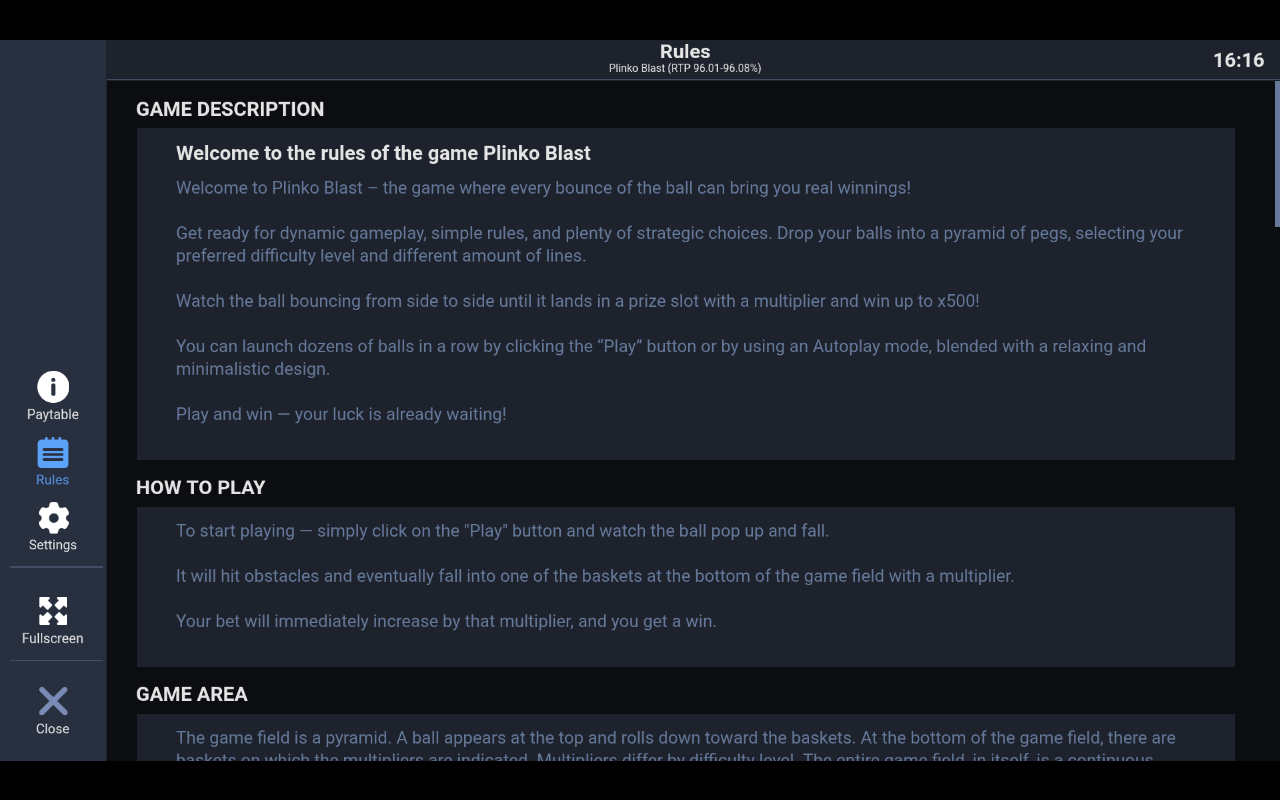
Difficulty is chosen before the ball drops, and there are three settings: Low, Medium and High. The row of multipliers changes with the choice, and on High the maximum multiplier is higher than on Medium or Low. The cost of that bigger edge is a leaner middle; the values either side of centre drop as the outer numbers climb.
It’s the game’s main strategic decision, and it’s a real one. Low keeps the gentler profile, with more baskets at or above 1x on the smaller fields, while High concentrates the return into the outer slots that a bouncing ball reaches far less often. The overall volatility stays mid, but the setting nudges each session towards either end of that feel.
Comparing the 8-row field makes the difference concrete. On Low, six of the nine baskets pay more than the stake back. On High, only the two edge baskets at 23.9x and the 5.9x pair clear it, and the other five centre baskets pay the stake or less. Same pyramid, same pegs, a completely different risk profile.
Field Size and Lines
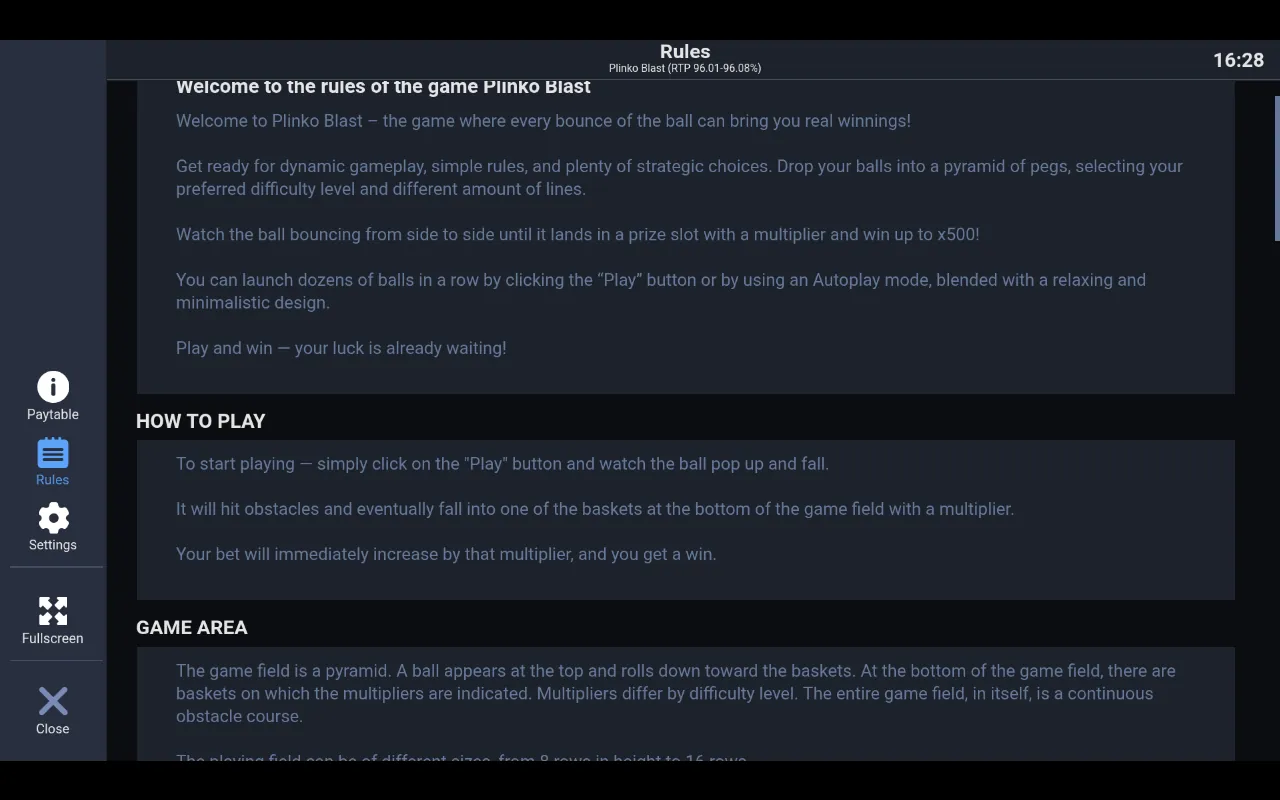
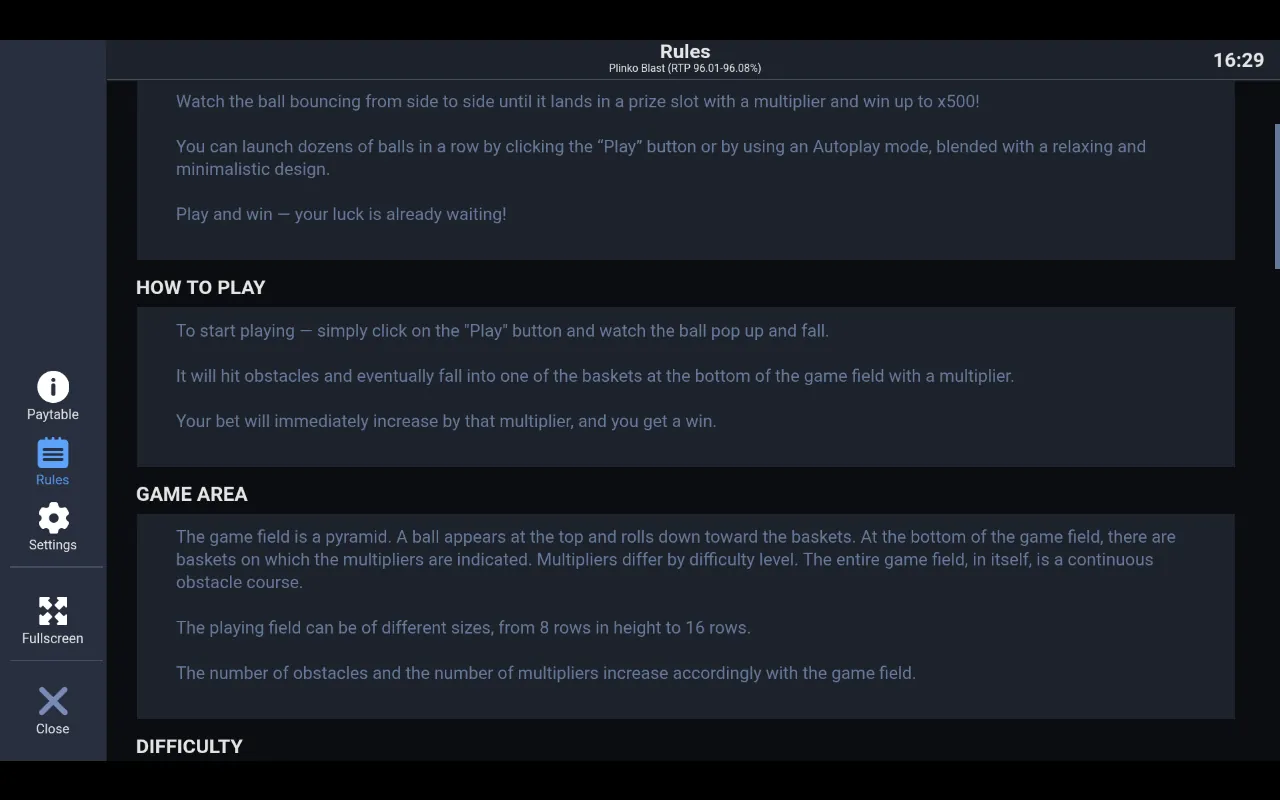
The second setting is the size of the pyramid itself, from 8 rows up to 16. Rows are labelled as Lines, and the number of pegs and the number of baskets both grow with the field. A short pyramid settles quickly with a tight row of multipliers; a tall one gives the ball more bounces, more spread and a wider row at the bottom.
Combined with the difficulty setting, that’s the whole decision space. 8 rows on Low is the quiet corner of the game; 16 rows on High is the other extreme, at the end of the longest possible fall. Between those sits every combination a player wants to tune.
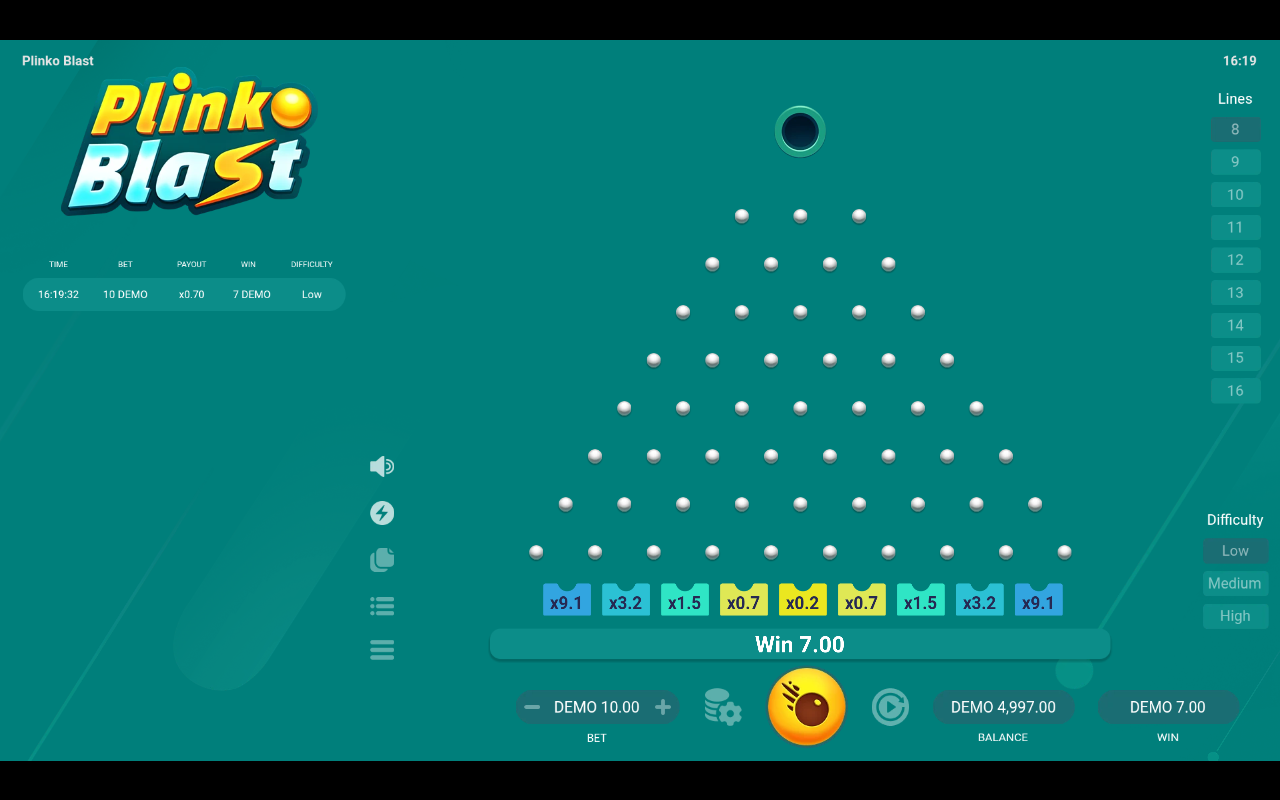
Field size also changes how a round reads. On an 8-row pyramid the ball is in a basket within a second or two of leaving the chute, so sessions on small fields move at a fast clip even without Autoplay. Sixteen rows give each drop a longer journey and a wider spread of possible landings. That suits players who want the outcome to feel earned rather than instant.
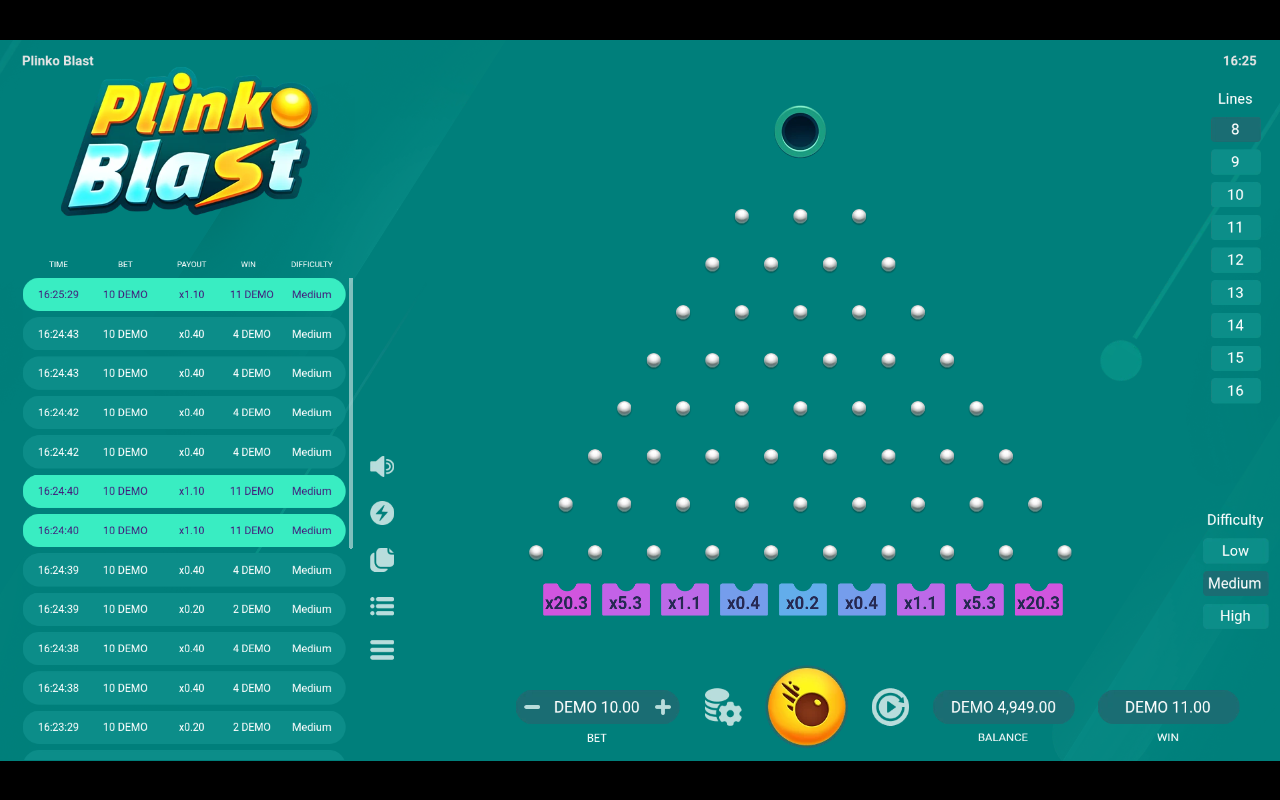
The history panel tracks each result, which matters more here than in a five-reel slot. Watching which baskets have been paying is half of what there is to do between drops, and the win readout carries the current or last payout forward.
Our Honest Verdict
Overall Rating: 7/10
Playing Plinko Blast is a quiet, rhythmic loop: pick your settings, drop the ball, watch it rattle down the pegs, do it again. The reason to choose it over anything with reels is that you’re the one setting the risk, and the pyramid makes every outcome visible before you commit a penny.
The multiplier rows are its best feature, honest to the point of bluntness. That same plainness is the weakness too: after the first hour you’ve seen the whole game, and there’s nothing left to unlock.
This is one for players who enjoy tuning numbers and watching physics do the rest, not for anyone who wants features, themes or momentum. The ball drops where it likes, and if that’s enough, it’s enough.
Plinko Blast FAQs
-
What is the RTP of Plinko Blast?
Plinko Blast runs at an RTP of 96.01-96.08%, depending on the configuration. -
Is Plinko Blast high volatility?
No. Plinko Blast is a mid volatility game, though the difficulty setting shifts the feel of a session towards either end. -
When is Plinko Blast released?
Plinko Blast’s release date is 26 August 2025. -
Who makes Plinko Blast?
Plinko Blast is made by Evoplay. -
What is the maximum win on Plinko Blast?
The maximum win is 500x the bet. -
How does Plinko Blast pay out wins?
A ball drops through the pyramid of pegs and lands in one of the multiplier baskets at the bottom. Your bet is multiplied by the value of that basket, and that’s the win for the round. -
What do the difficulty levels do in Plinko Blast?
There are three difficulty levels: Low, Medium and High. Changing the difficulty changes the row of multipliers at the bottom, with High offering a bigger maximum multiplier but leaner values in the middle of the row. -
Can you change the field size in Plinko Blast?
Yes. The pyramid can be set from 8 rows up to 16, and both the number of pegs and the number of multiplier baskets increase with the field size.