











Plinko Clusters Slot Review
Plinko Clusters gets more out of one dropped ball than most slots get out of five reels. A single wager can split into nine bonus balls, the board reshapes itself around your appetite for risk, and the pay ladder runs from a tenth of your stake to forty times it. All of that happens without a single symbol landing on a payline, which is exactly the point.
Coin Machine Gaming trades in short-form arcade games rather than five-reel tradition, and this one sits alongside Cash Court – Tap n Cash and Cash Hog – Turbo Tap in that catalogue. It runs at 96.20% RTP across all modes, carries Very High volatility, and takes stakes from 0.10 to 300.00. No maximum win figure is published. The neon pin board floating in magenta space does the rest.
Base Game & Features
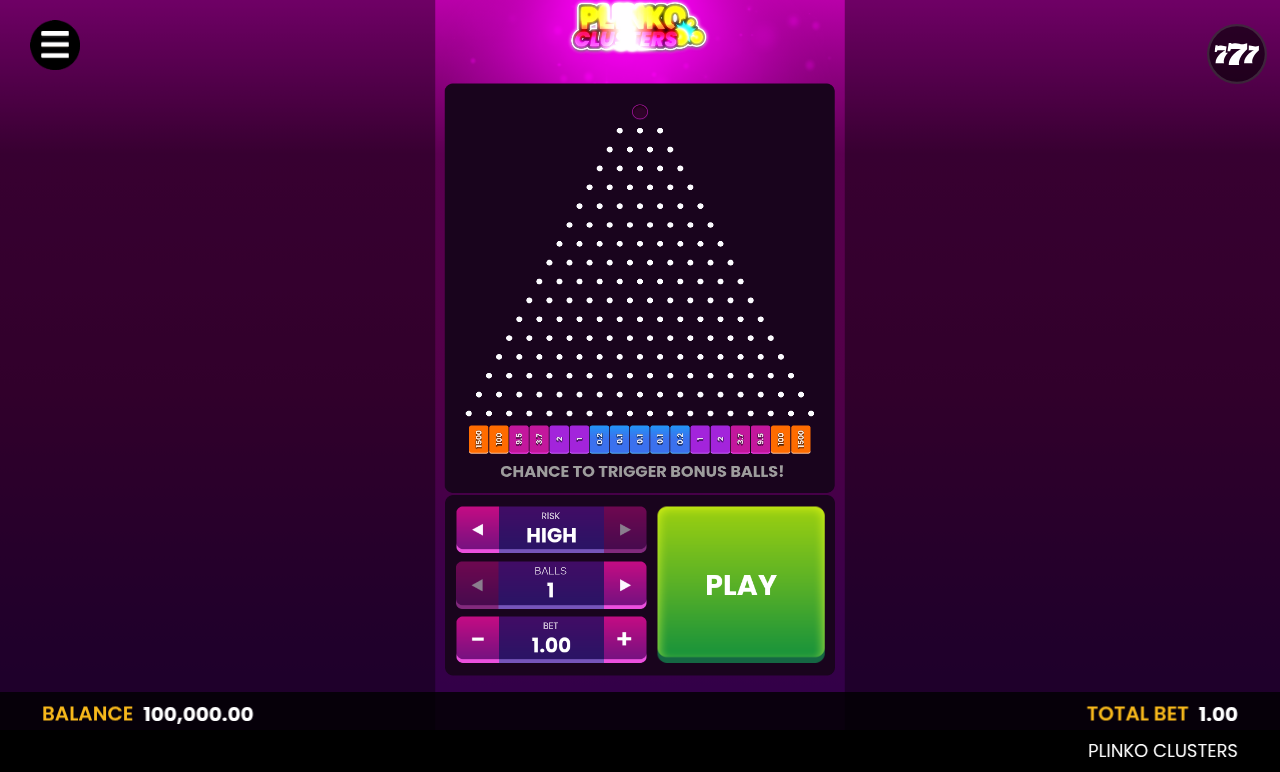
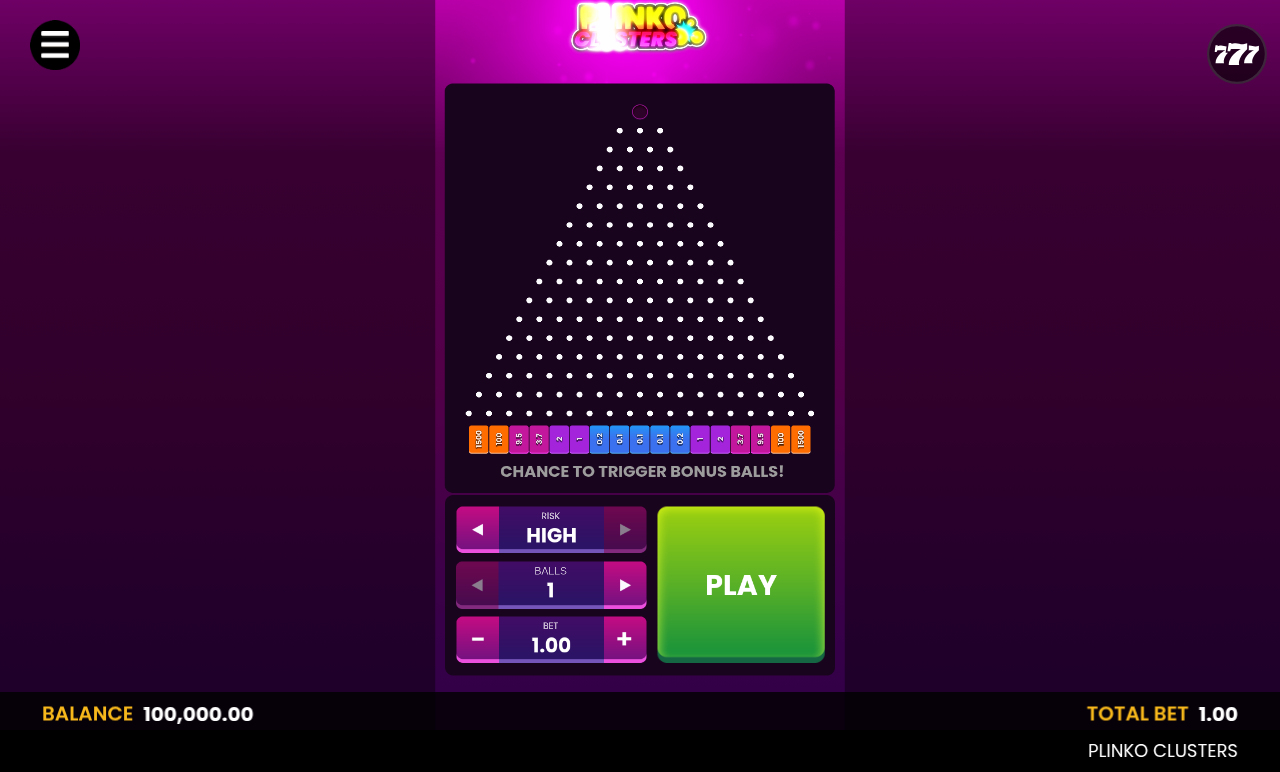
There are no reels and no paylines. You drop a ball from the top of a triangular pin board, it bounces through the rows, and wherever it lands in the multiplier pockets at the bottom, the pocket’s multiplier is applied to your bet. Landing a pocket awards a cash prize based on your bet value and the multiplier, so a 0.10 ball in the 15x pocket returns 1.50. One ball, one outcome, no second chances mid-drop.
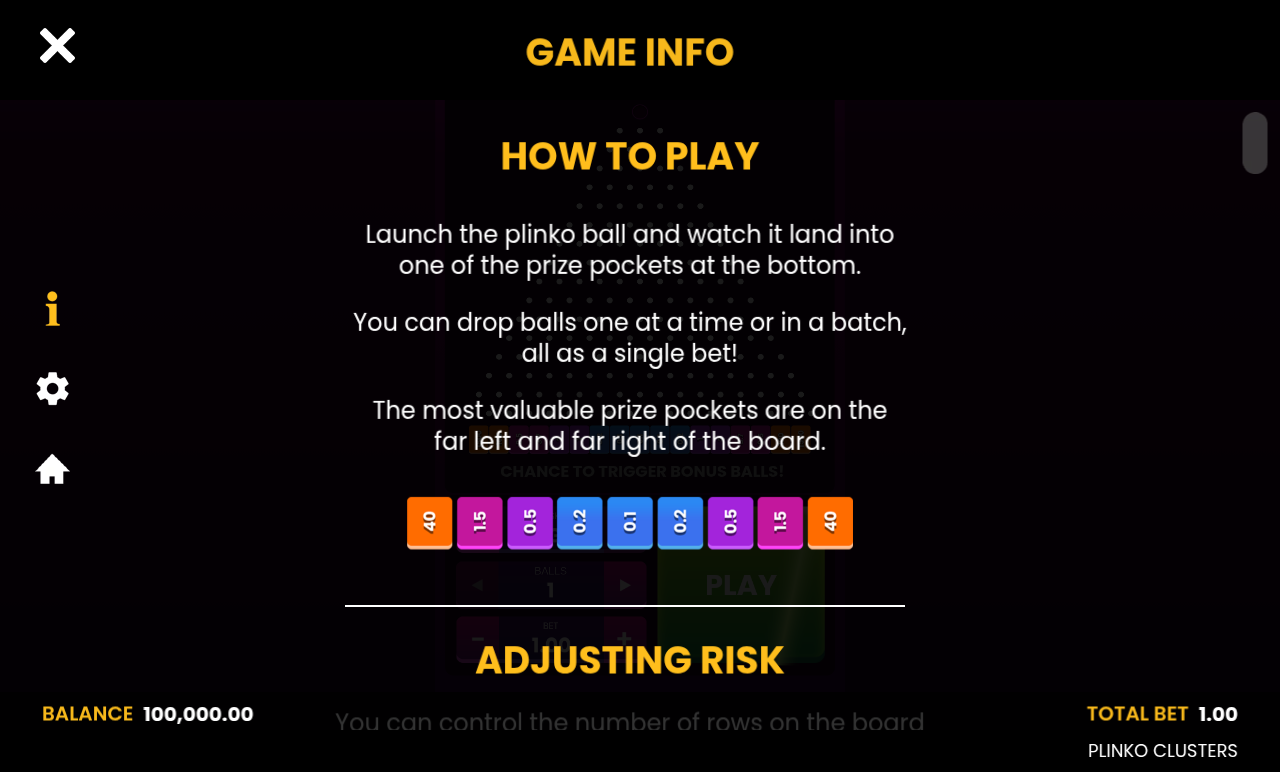
The pocket values sit on a fixed ladder, and the spread between the middle and the edges is where this game lives:
- 40x your bet
- 15x
- 0.5x
- 0.2x
- 0.1x
The shape of that ladder tells the story before a single ball falls. The centre of the board pays back a tenth of your stake, the edges pay forty times it, and the pins decide which one you get.
Adjustable Risk
Before you drop, you choose a risk level: LOW, MEDIUM or HIGH. The setting changes the number of rows on the board, and the number of rows changes the maths. More rows means more bounces and more spread, which pushes the multipliers on the outer pockets higher while leaving the centre as cheap as ever.
It’s the same bet, three different games. Low risk keeps the balls congregating near the middle of the ladder. High risk stretches it, giving the middle pockets less room and the 40x edge pocket more reason to matter. Switching between levels mid-session costs nothing, so the risk setting is something you can tune round by round rather than commit to up front.
Ball Batch
You don’t have to drop one ball at a time. The Ball Batch controls let you send up to 100 balls down in a single bet, and the batch counts as one wager rather than a hundred.
Three rules govern the batch:
- A batch drop counts as a single bet
- A batch can’t be stopped once the bet has been placed
- The ball count is limited if the batch total would exceed the game’s maximum bet
The arithmetic works per ball. A 100-ball batch at 0.10 each is a 10.00 wager in total, and at the 300.00 maximum bet the ball count scales down until the batch fits. At higher stakes, the batch shrinks accordingly. Stake sizing and ball count are the two dials that decide how a round unfolds, and the game leaves both of them to you.
Game Controls
The board keeps its controls to a handful, and most of them feed the two decisions that matter. The relevant ones:
- (+) and (-) Bet buttons: change the bet value per ball
- Balls buttons: change the number of balls dropped in a single bet
- Risk buttons: change the level of risk
- History: displays a tally of the multiplier pockets you’ve landed in
- Win / Bet / Balance: display the latest win, current bet and current balance
The History tally is worth a word. Because every ball’s landing pocket is logged, it doubles as a read on how the ladder is treating you: a run of centre pockets shows up as plainly as a lucky edge, which is useful on a board where the spread between the two runs from 0.1x to 40x.
Plinko Clusters Bonus Features
Cluster Drop is the one proper feature, and it’s simple in the telling: every ball you drop can produce 1 to 9 bonus balls. There’s no scatter to land and no meter to fill. The split can happen on any drop, and the bonus balls travel the board like any other, each one finding its own pocket and its own multiplier.
What that does to a round is easy to picture. A single 0.10 ball becomes a cluster of five or six, each one paying independently, and a batch of dozens becomes a board full of them. Every bonus ball resolves the same way a bought ball does: its pocket multiplier applied to the per-ball bet, no more, no less.
The feature is where the game’s name comes from, and it’s also where the Very High volatility does its work. A nine-ball split that lands favourably across the ladder pays a lot more than the stake that triggered it. Most splits won’t, and the centre pockets are always there to absorb the ones that scatter badly.
Combined with the batch controls, it makes stake sizing the main decision you make. One ball is a coin flip on the ladder. A hundred-ball batch with splits in play is a sustained burst across the whole board, and the History tally keeps count of which pockets have been catching.
Our Honest Verdict
Overall Rating: 7.2/10
This is betting at its most stripped back: choose a risk level, release the balls, and watch the pins argue over your money. There’s something quietly hypnotic in a full batch clattering down a neon board, and the Cluster Drop split means any drop can turn into a small shower of payouts. That unpredictability is the reason to pick it up.
The risk dial is the best thing here – three genuinely different boards from one game, adjustable on every round, which is more say over your own variance than most instant-win titles ever hand you. Against that, the middle of the ladder is bleak, so low-risk play bleeds slowly and only the brave edges pay.
It suits a certain mood: short rounds, no features to track, all of the drama packed into a few seconds of bouncing. Players who want persistent mechanics, free spins and a long build won’t find them on this board. For everyone else, the magenta void and its pins make a lean, honest little time-waster.
Plinko Clusters FAQs
-
What is the RTP of Plinko Clusters?
The RTP is 96.20%, and it’s the same for all modes in the game. -
Is Plinko Clusters high volatility?
Yes, it’s rated Very High volatility. The centre pockets pay well under your stake, so returns lean heavily on the outer multipliers. -
What is the grid size of Plinko Clusters?
There’s no fixed grid. The game uses a triangular pin board, and the number of rows changes depending on the risk level you select. -
What is the minimum and maximum bet on Plinko Clusters?
Stakes run from 0.10 to 300.00. Ball batches count as a single bet, and the number of balls in a batch is limited if the total would exceed the maximum bet. -
How does the Cluster Drop Feature work?
Every ball you drop can produce 1 to 9 bonus balls, with no scatter or trigger condition. Each bonus ball travels the board independently and pays into its own multiplier pocket. -
How many balls can you drop at once in Plinko Clusters?
Up to 100 balls in a single Ball Batch. A batch counts as one bet, can’t be stopped once placed, and is capped if the total would exceed the game’s maximum bet. -
What do the risk levels do in Plinko Clusters?
The LOW, MEDIUM and HIGH risk settings change the number of rows on the board. More rows increases the multipliers on the outer prize pockets. -
When is Plinko Clusters released?
Plinko Clusters’ release date is 22 June 2026.