













Plinko Pop: Meltdown Slot Review
A nuclear control room at dusk, cooling towers breathing steam outside the window, every surface washed in reactor green. Plinko Pop: Meltdown is a Plinko game that gives you more control over its odds than any reel slot ever does – and then refuses to publish a single figure proving what those odds are worth.
It’s from Mascot Gaming, arriving as the successor to Plinko Pop 2, which the site covered in 2026. The physics are the point: a ball falls, bounces off pins, and settles wherever gravity takes it. The pyramid stretches from 8 to 16 lines and the outer multipliers reach x1000, but there’s no published RTP or volatility figure, so the board is the whole offer.
Betting, Balls and the Board
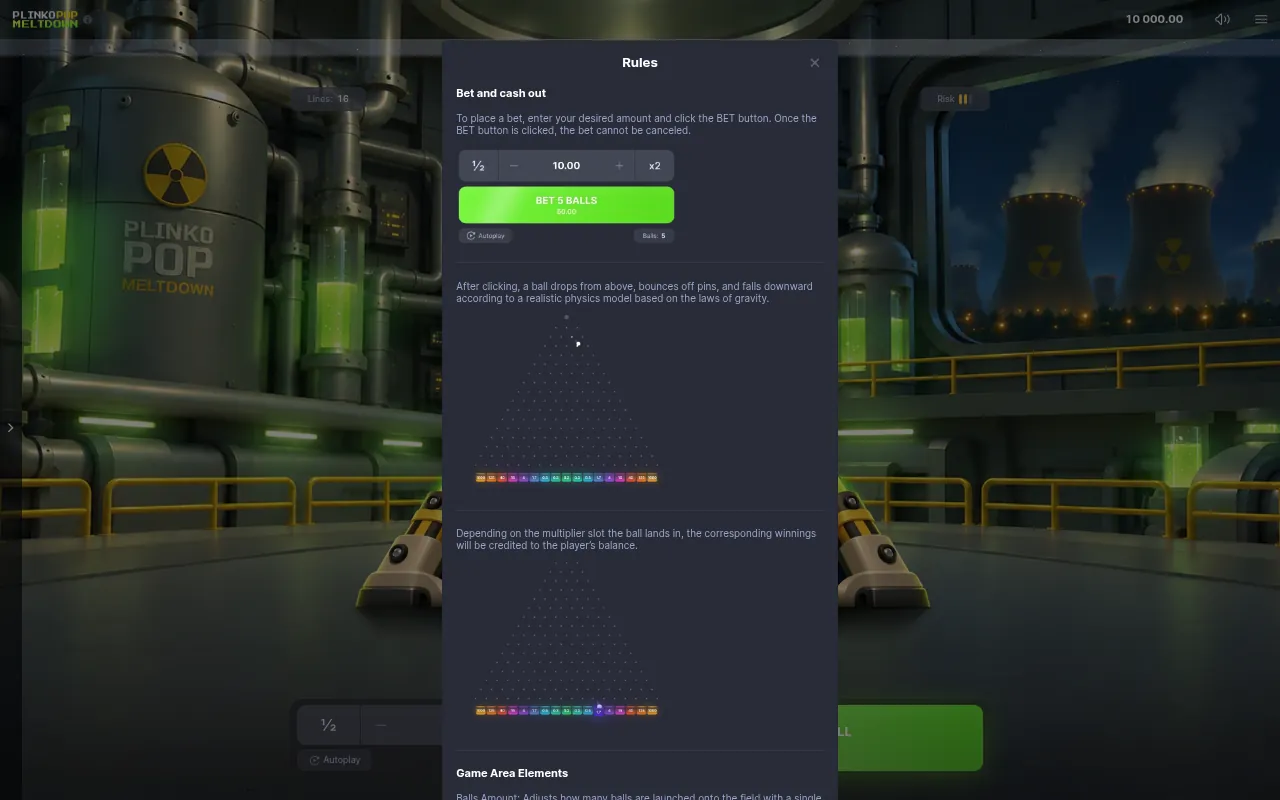
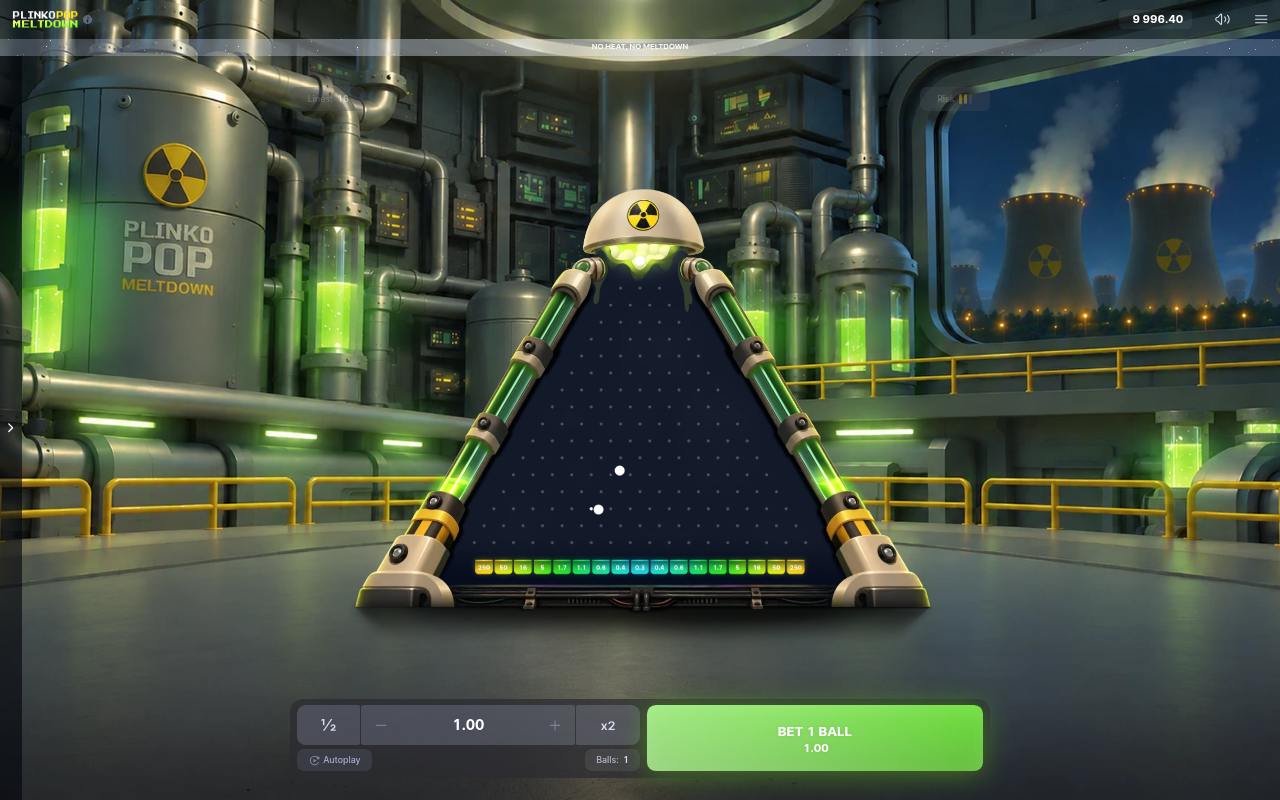
A round starts the moment you enter an amount and press BET. Once pressed, the bet can’t be cancelled, and a ball falls from the top of the pyramid, bouncing off pins on a physics model built on the laws of gravity. Wherever it lands, the multiplier slot it settles in pays straight to your balance.
Because the drop is physical rather than a random reel stop, no two balls take the same route. A ball clipped by an early pin can drift wide and find an edge slot; one that threads the centre will cluster with everything else in the middle. That’s the whole tension of the format – you’re watching a bounce, not reading a result.
Four settings shape every round, and all of them change the shape of the game rather than the game underneath:
- Balls Amount – how many balls launch with a single click
- Risk – the game’s risk level
- Lines – the height of the Plinko pyramid, from 8 to 16 lines
- Autoplay – automatic play for a set number of rounds
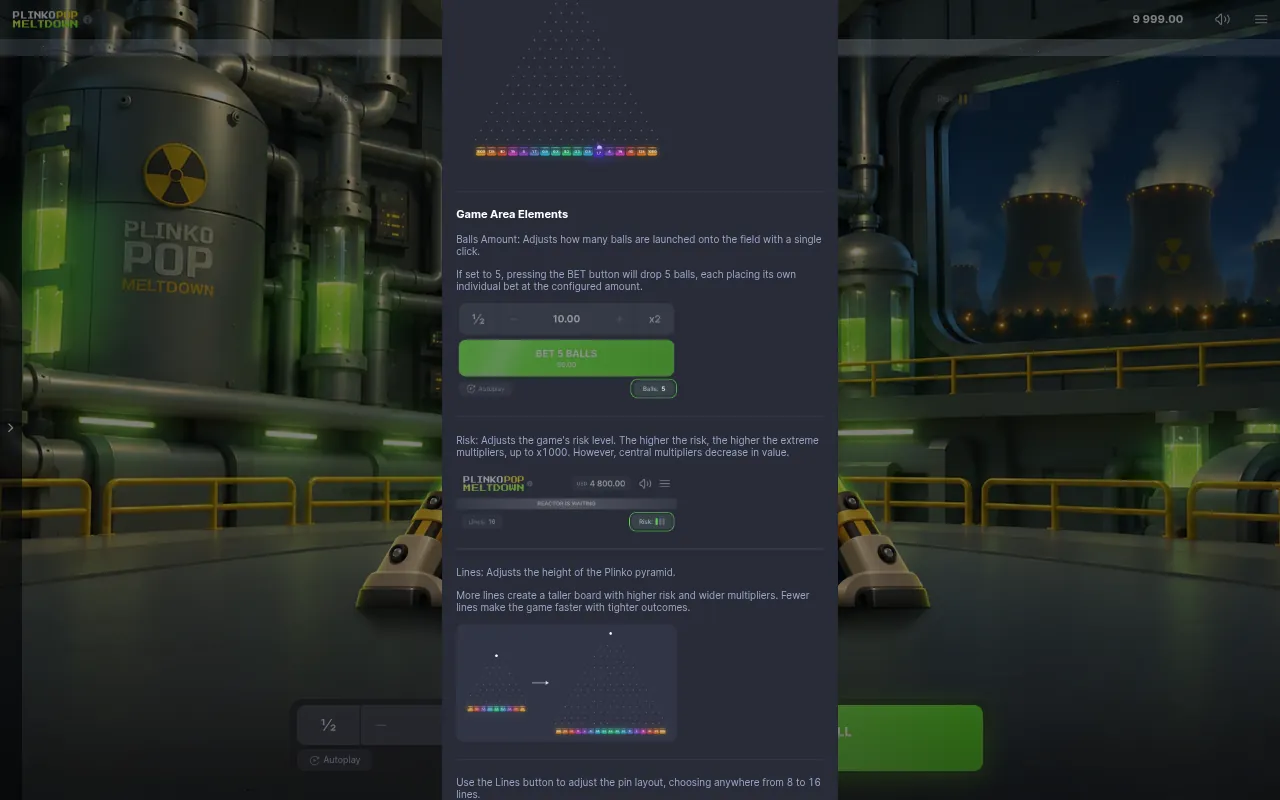
Balls Amount is the simplest of the four. Set it to five and one press of BET drops five balls in sequence, each staking the configured amount individually, so a single click can scatter the whole pyramid at once. The cost scales with it: five balls means five stakes, not one split five ways.
That distinction matters when the reactor meter is in play, because the meter counts balls, not clicks. A player dropping five at a time fills it five times faster than a player dropping one, and pays for the privilege at the same rate. It’s the setting that turns a patient one-ball game into a shower.
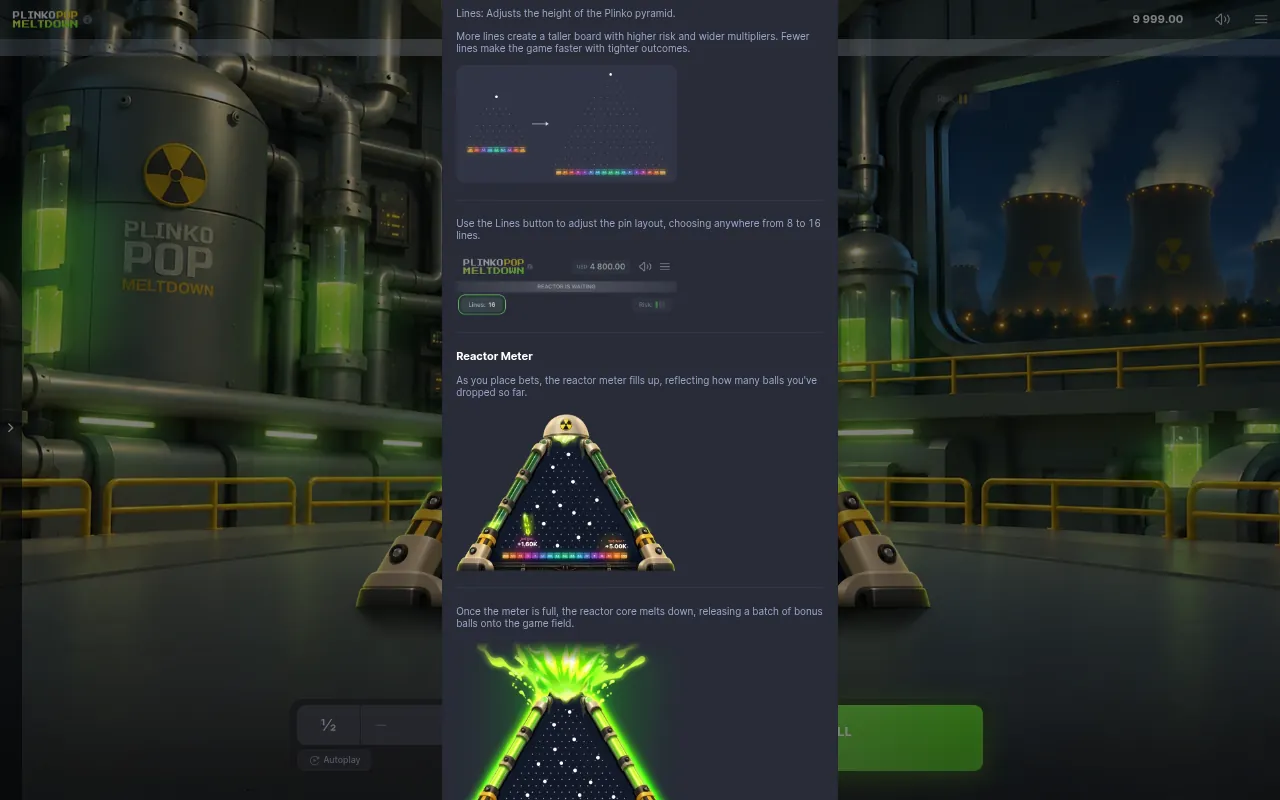
Lines changes the game most. More lines build a taller board with higher risk and wider multipliers at the edges; fewer lines make each round faster and the outcomes tighter. It’s the closest thing this game has to a difficulty dial, and it’s worth settling before you stake anything, because the two extremes play like different games entirely.
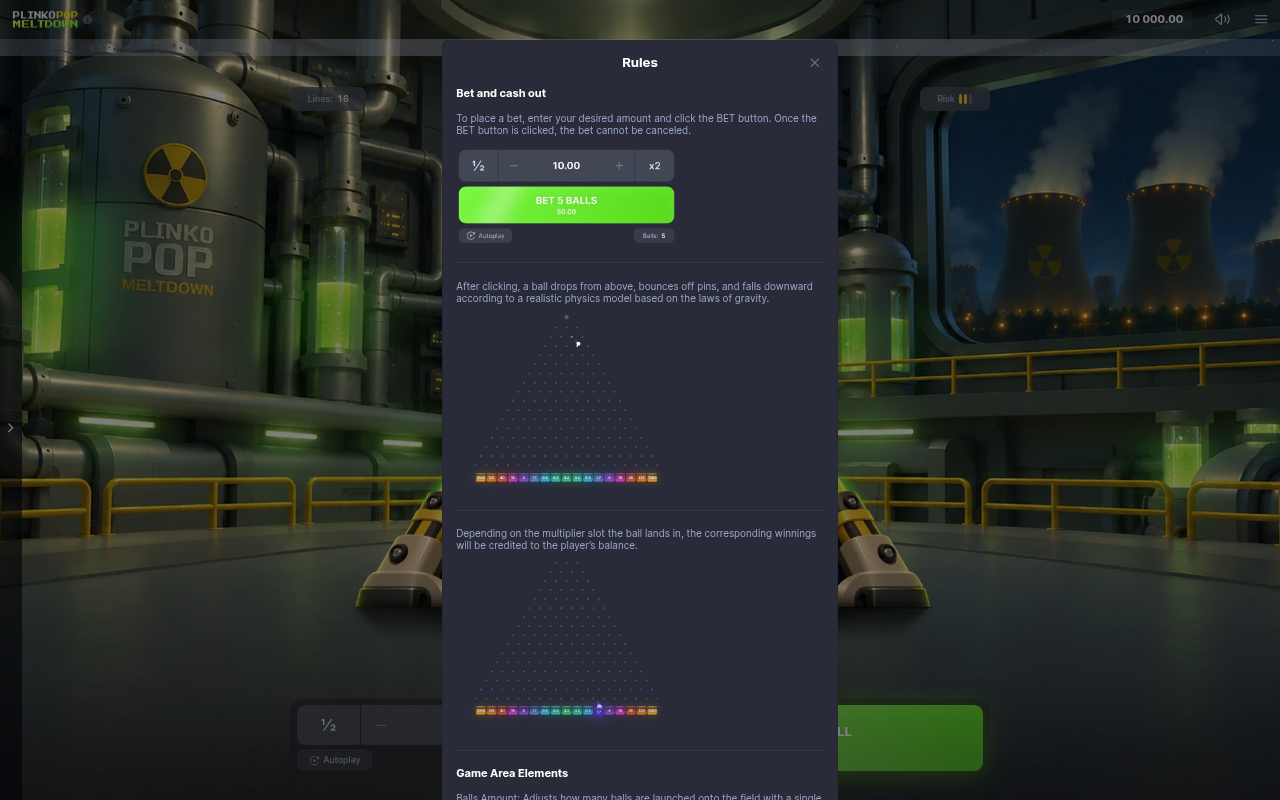
Autoplay
Autoplay hands the clicking over to the machine. The button layout shifts as you go, and each stage is labelled plainly:
- Press Autoplay to enable automatic play.
- BET is replaced by START; press it to launch rounds for the set number.
- While running, STOP appears in place of BET and START; press it to end the sequence.
On a game where rounds last seconds, that’s the difference between a session and a screensaver. A tall board, a big Balls Amount and Autoplay together will keep the pyramid busy without a single click.
The Reactor Meter and the Meltdown
Every bet you place feeds the reactor meter, which fills in proportion to how many balls you’ve dropped. It’s the game’s only persistent progress, and it runs on a simple cycle:
- Place bets; the meter fills with each ball.
- When it’s full, the reactor core melts down and releases a batch of bonus balls onto the field.
- Each bonus ball pays into your balance exactly like a regular one.
- The meter empties and begins filling again from your next bet.
There’s no separate bonus screen and no picking round. A meltdown is a wave of free drops on the same game field, and the winnings from these bonus balls are credited to your balance the same way as regular balls.
That’s the quiet strength of the design: the meter rewards the game you’re already playing rather than interrupting it. Nobody is pulled out of the game they set up.
The cycle repeats without limit in a session, which makes the meter a loyalty loop: the longer you sit at the controls, the more often the core gives a batch back. Short sessions still see it fill, because the count is balls placed, not rounds waited out.
Risk, Lines and What the Board Pays
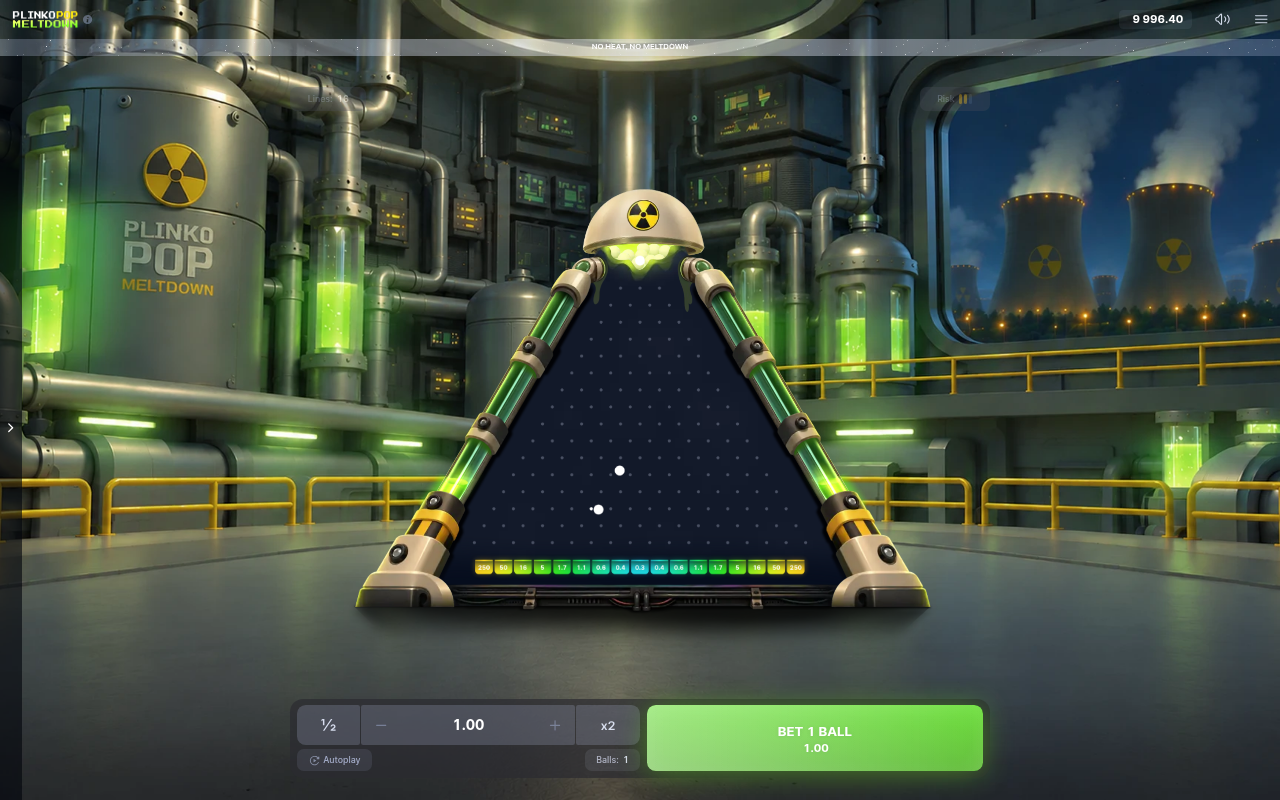
Risk is where the maths lives. Push it up and the outer multipliers climb, x1000 at the top end, while the centre slots shrink. Wind it down and the opposite happens: the middle of the board pays more, the edges pay less, and the spread of outcomes narrows.
The shape of that spread follows the pyramid. Centre slots catch most balls, so their multipliers are the small, steady numbers; the edges catch almost none, so they carry the big figures. Risk simply decides how steep the gradient between them is.
Lines works alongside it. At 8 lines the pyramid is short and quick, with a tight cluster of outcomes. At 16 it’s tall enough that a ball’s path matters, and the edge multipliers stretch wider to reward the lucky bounces that find them. The two settings together give you genuine control over the shape of the game – more than most pegboards offer.
Stack them and the extremes compound: a 16-line board at maximum risk is a long fall to a very narrow x1000 slot, while an 8-line low-risk board is a quick shuffle towards safe, modest payouts. Everything in between is yours to tune.
Our Honest Verdict
Overall Rating: 7/10
This is a game of small repeated moments at a control desk: press BET, watch a ball rattle through the pins, bank whatever slot catches it, do it again. The reactor meter is why you’d stay at the desk, because every ball brings the core closer to giving a batch back, and that countdown sits under everything you do.
The strength is that the meltdown lands on your board, not a stock bonus screen – the bonus balls’ winnings are credited to your balance the same way as regular balls, a far better reward than a fixed mini-round. The weakness is the numbers: with no RTP and no volatility figure, you’re tuning the machine without being told what it returns.
It suits drop-game players who enjoy building their own board and don’t need the maths spelled out first, and it’s a good fit for short casual sessions where the meter fills fast. Players who want the terms before they sit down won’t find them here. For everyone else, the core is warm and the lights are green.
Plinko Pop: Meltdown FAQs
-
When is Plinko Pop: Meltdown released?
Plinko Pop: Meltdown’s release date is 29 October 2026. -
Who makes Plinko Pop: Meltdown?
Plinko Pop: Meltdown is made by Mascot Gaming. -
What does the Reactor Meter do in Plinko Pop: Meltdown?
Every ball you drop feeds the meter. Fill it and the core melts down, sending a batch of bonus balls across the pins; their winnings credit to your balance like any other ball’s. The meter then empties and refills as you keep playing. -
How does the Risk setting work?
Risk raises or lowers the stakes of the board. At the top setting the outer slots reach x1000 while the centre slots shrink in value; lower settings flatten that spread, paying more in the middle and less at the edges. -
What does the Lines setting do?
Lines sets the height of the Plinko pyramid, anywhere from 8 to 16 lines. More lines mean a taller board, higher risk and wider multipliers; fewer lines mean faster rounds and tighter outcomes. -
What is the Balls Amount setting?
It sets how many balls launch per click. At five, one press of BET drops five balls, each staking the configured amount individually. -
Can a bet be cancelled in Plinko Pop: Meltdown?
No. Once the BET button is pressed, the bet can’t be cancelled. -
How does Autoplay work in Plinko Pop: Meltdown?
Press Autoplay, then press START (which replaces BET) to launch automatic play for the set number of rounds. While it runs, press STOP to end the sequence.