










Rune Beasts! Deep Trenches Slot Review
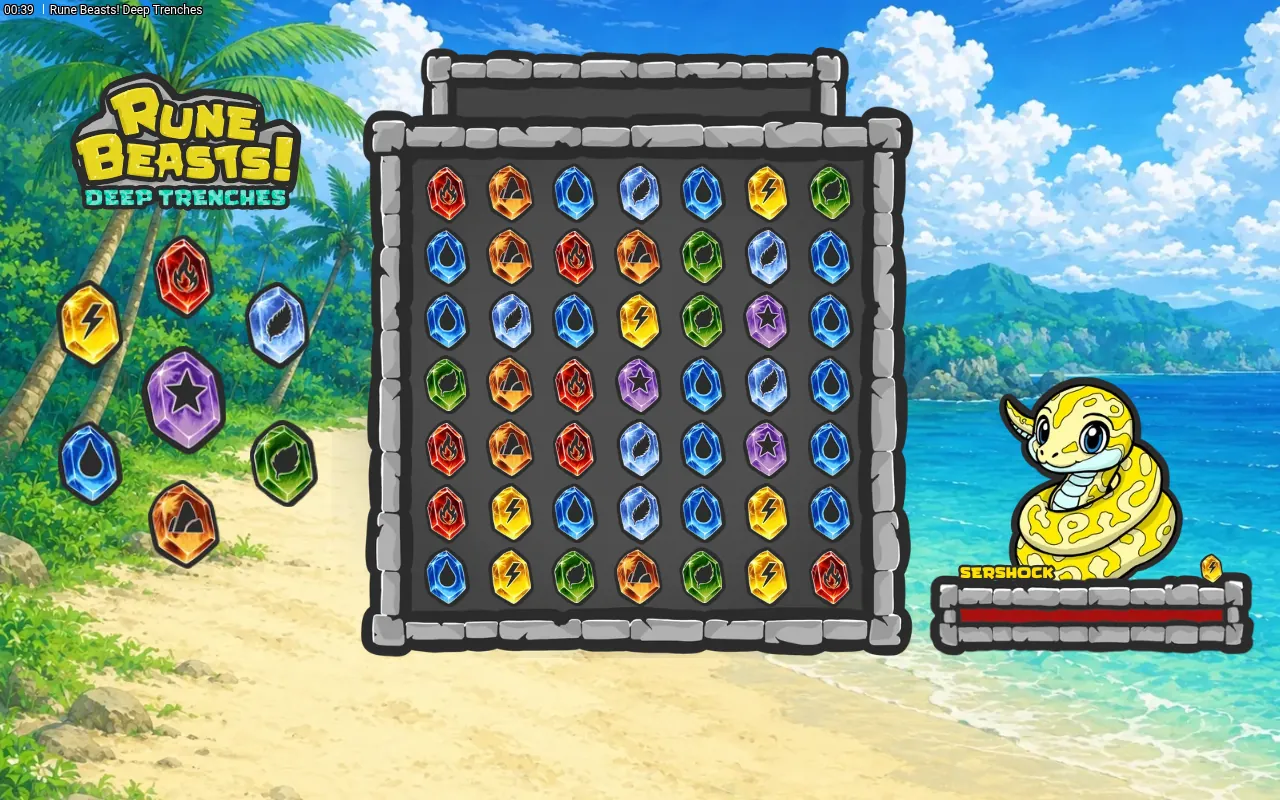
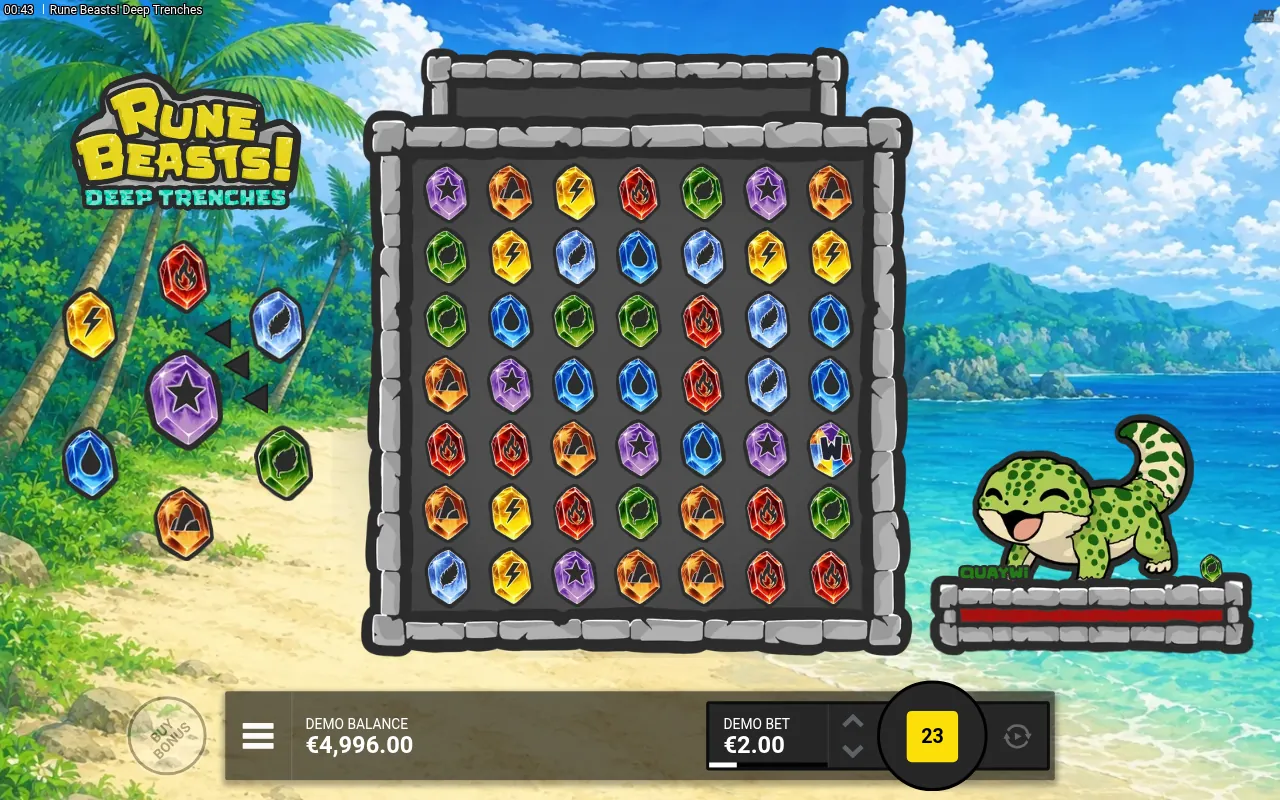
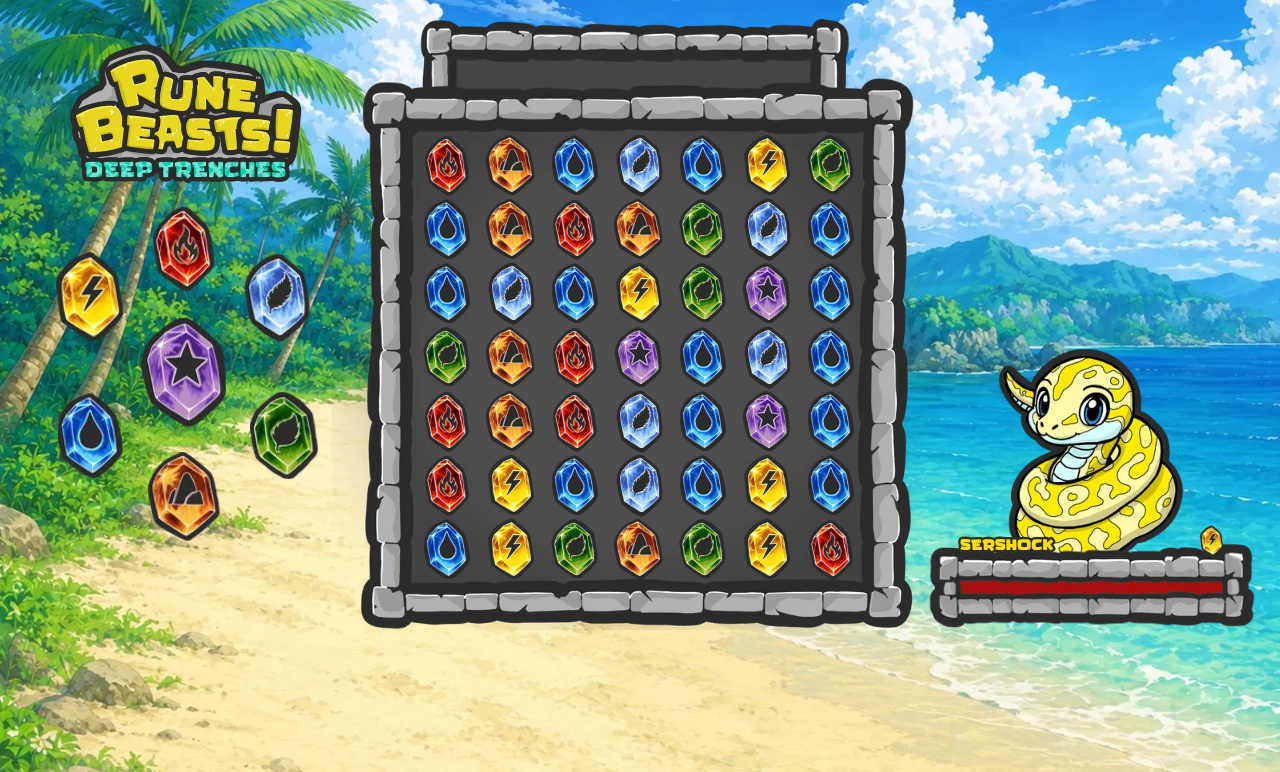
A blue-eyed cartoon snake coils around a rough-cut stone frame at the edge of a tropical beach, palms leaning over the sand, turquoise surf rolling in behind it. Rune Beasts! Deep Trenches looks like the laziest holiday in the catalogue, but it’s the most combative thing on it: nearly every spin of this 7×7 grid is a quiet build towards a beast fight, and the fights are the reason to pick it over a straight cluster game.
This is the second Rune Beasts outing from Jinx Gaming, following Rune Beasts! Sharp Peaks. It runs on the same chassis: a 7×7 grid where clusters of seven or more matching symbols pay, a 96.29% RTP, and a 5,000x cap that holds across all four game modes. The trench is deeper water for the battles.
Clusters and Cascades on a 7×7 Grid
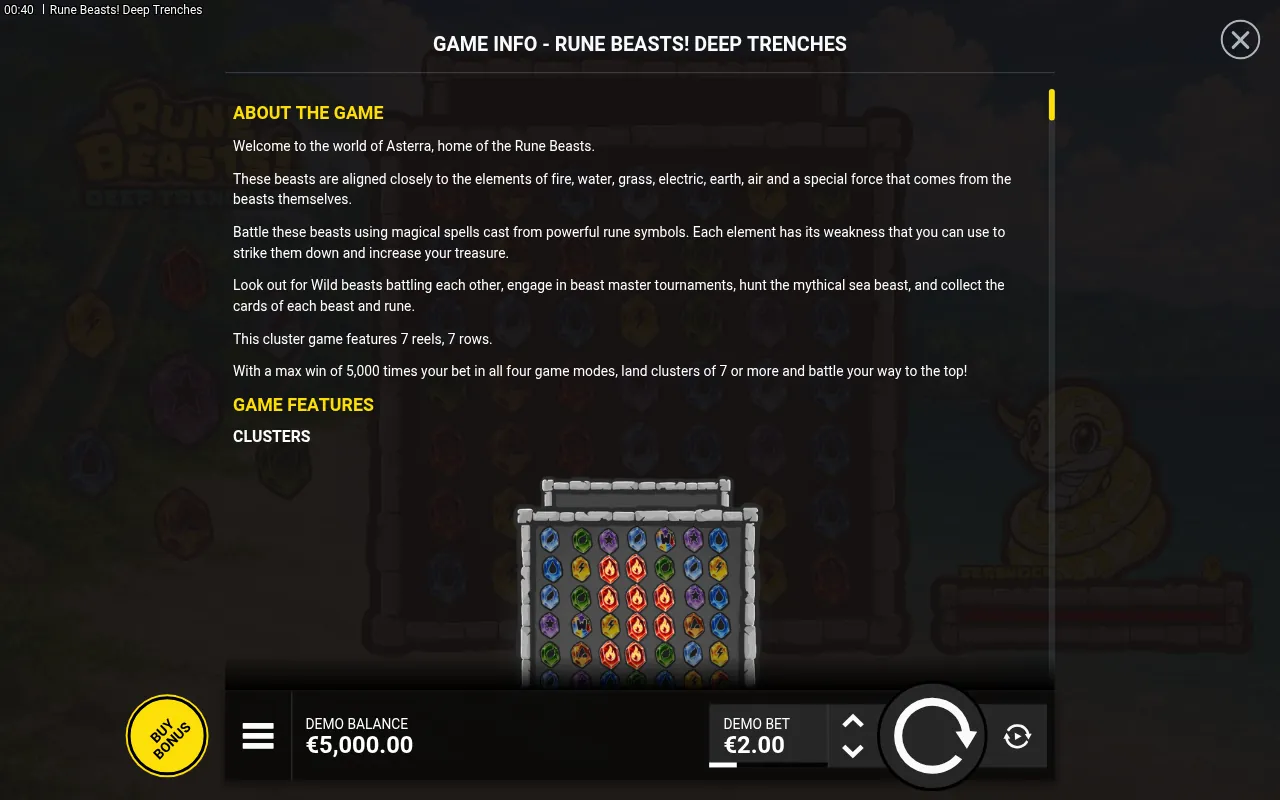
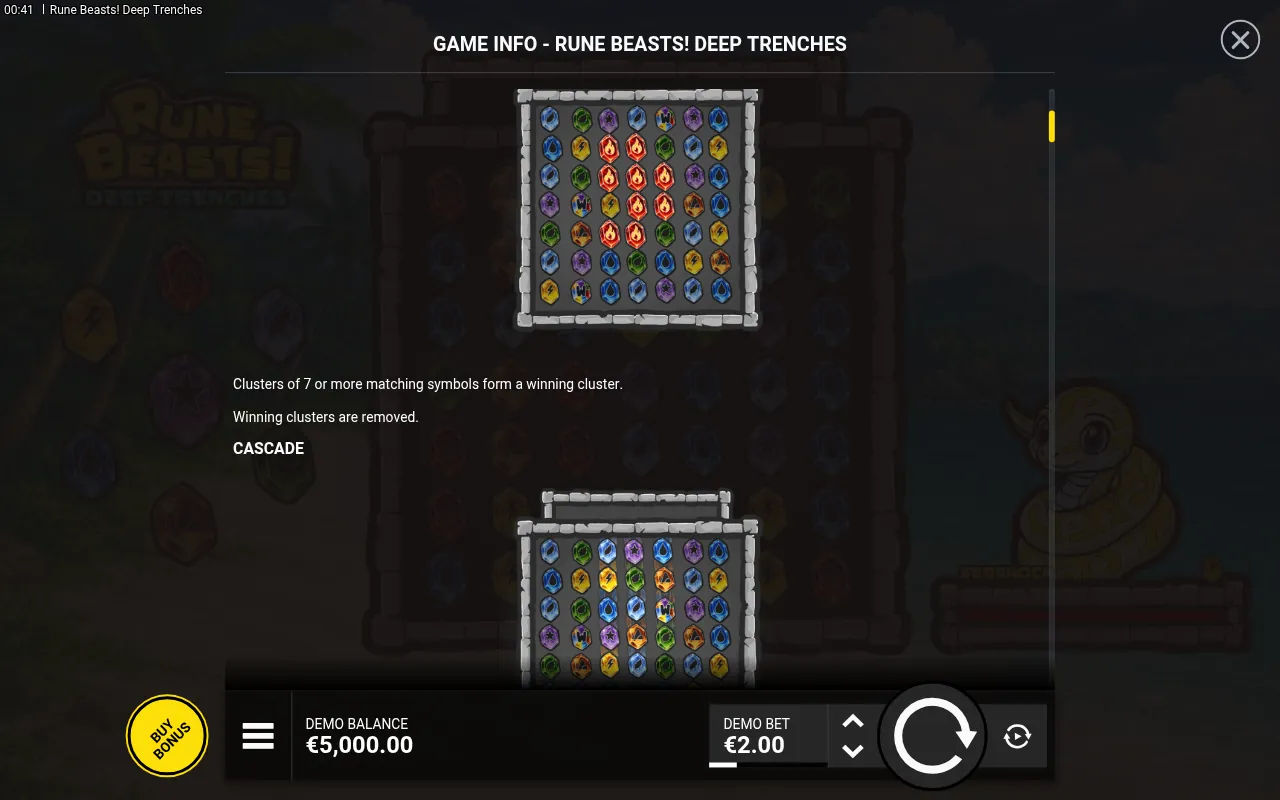
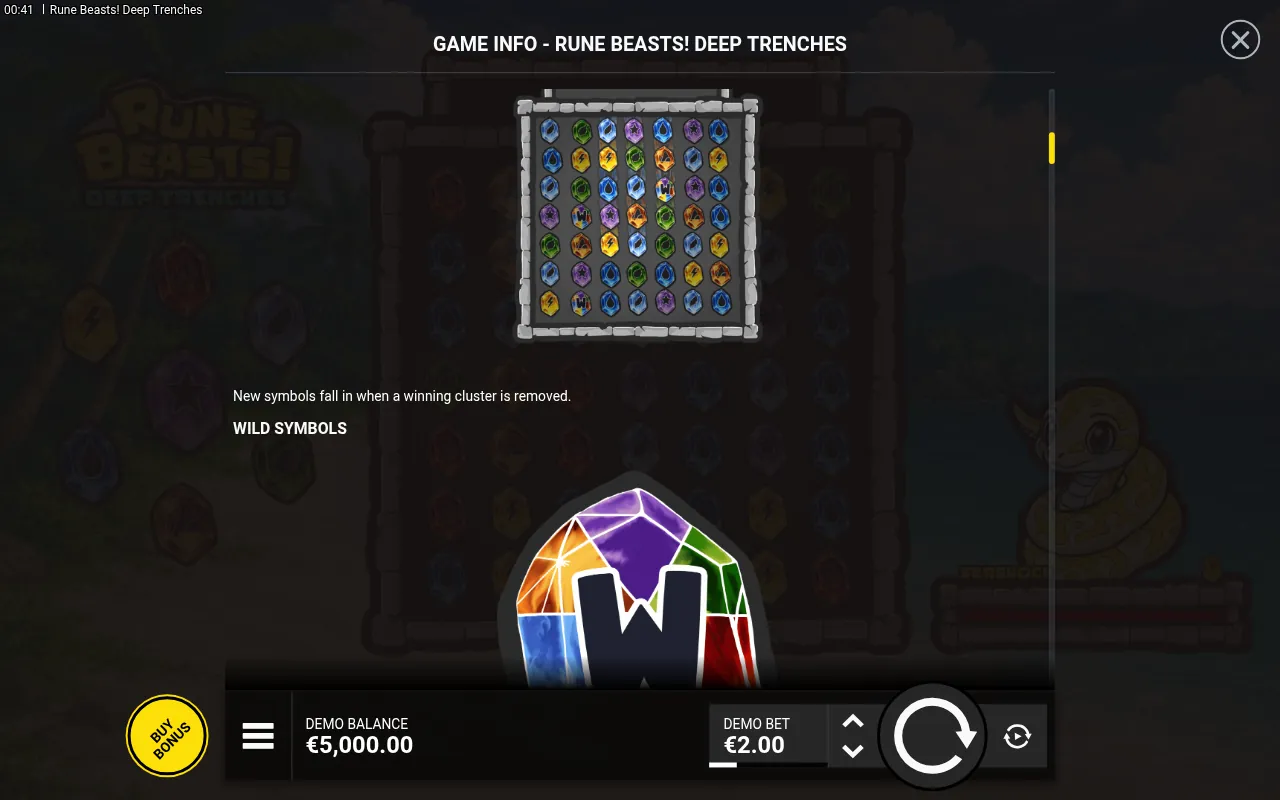
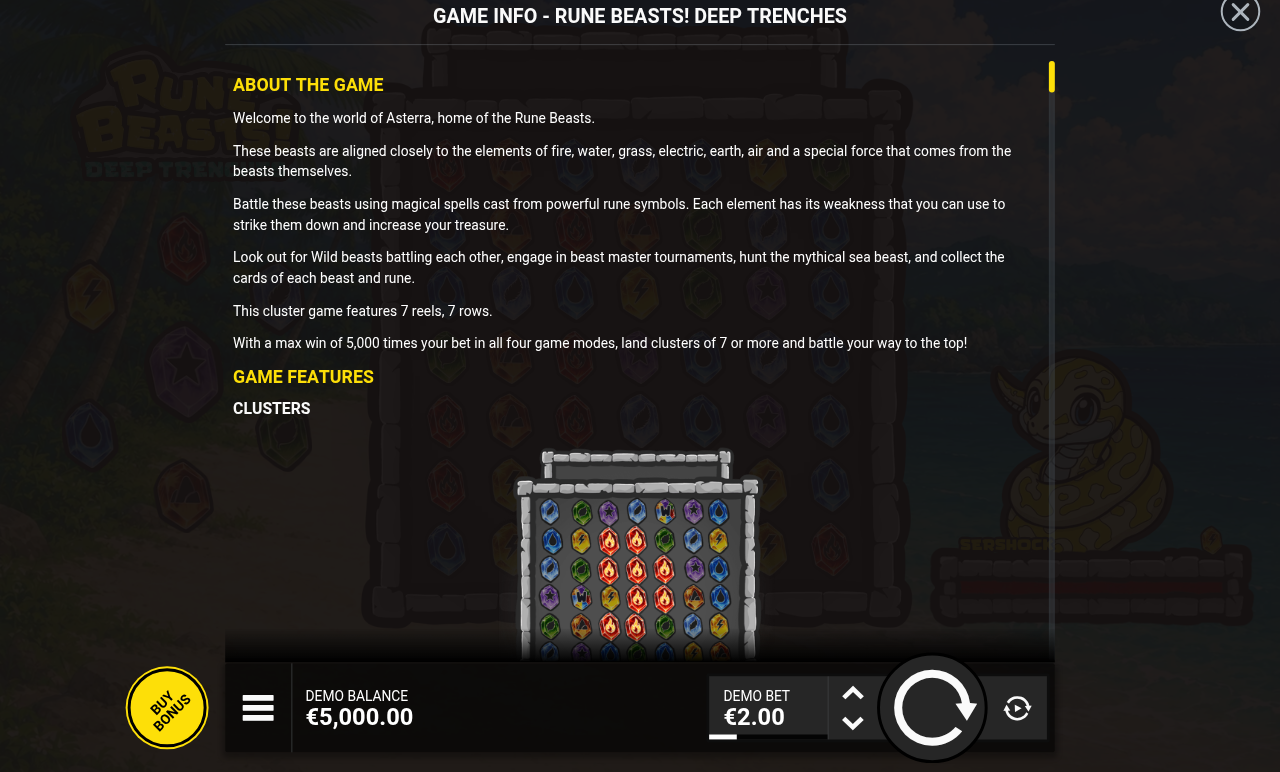
This is a cluster game, not a payline one. Seven or more matching symbols touching anywhere on the 7×7 grid form a winning cluster, and that’s the only way anything pays. There’s no line to trace and no left-to-right requirement, so a win can start in the middle of the board and spread outward.
Winning clusters are removed, and new symbols fall into the gaps. Cascades continue as long as new clusters keep forming, so one spin can chain several payouts together. The fall animation is quick and clean, and the stone-framed grid keeps everything readable even when a long cascade is running.
Wild Symbols
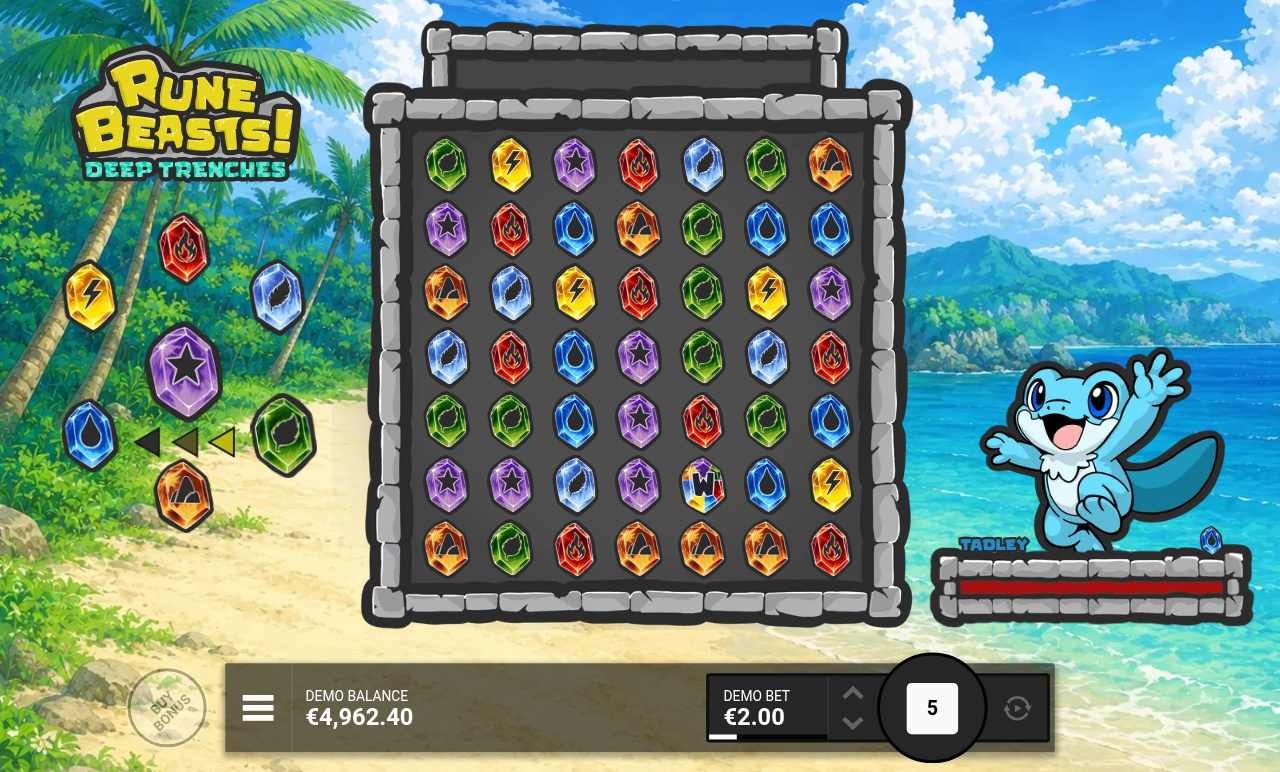
Wild symbols substitute for all symbols in the paytable and appear on all reels, with new wilds able to fall on any reel during a cascade. That’s their whole job. A wild landing mid-chain can turn a seven-symbol cluster into something considerably bigger.
Because fresh wilds keep arriving with each wave of falling symbols, a long cascade can grow in more than one place at once. Scatters have their own separate role and the wild doesn’t touch it. Three or more scatters anywhere on the grid is the bonus trigger, and scatters can appear on all reels alongside everything else. The two symbols share space with the VS symbol, which does something no other symbol in the game does.
VS Symbols and Beast Battles
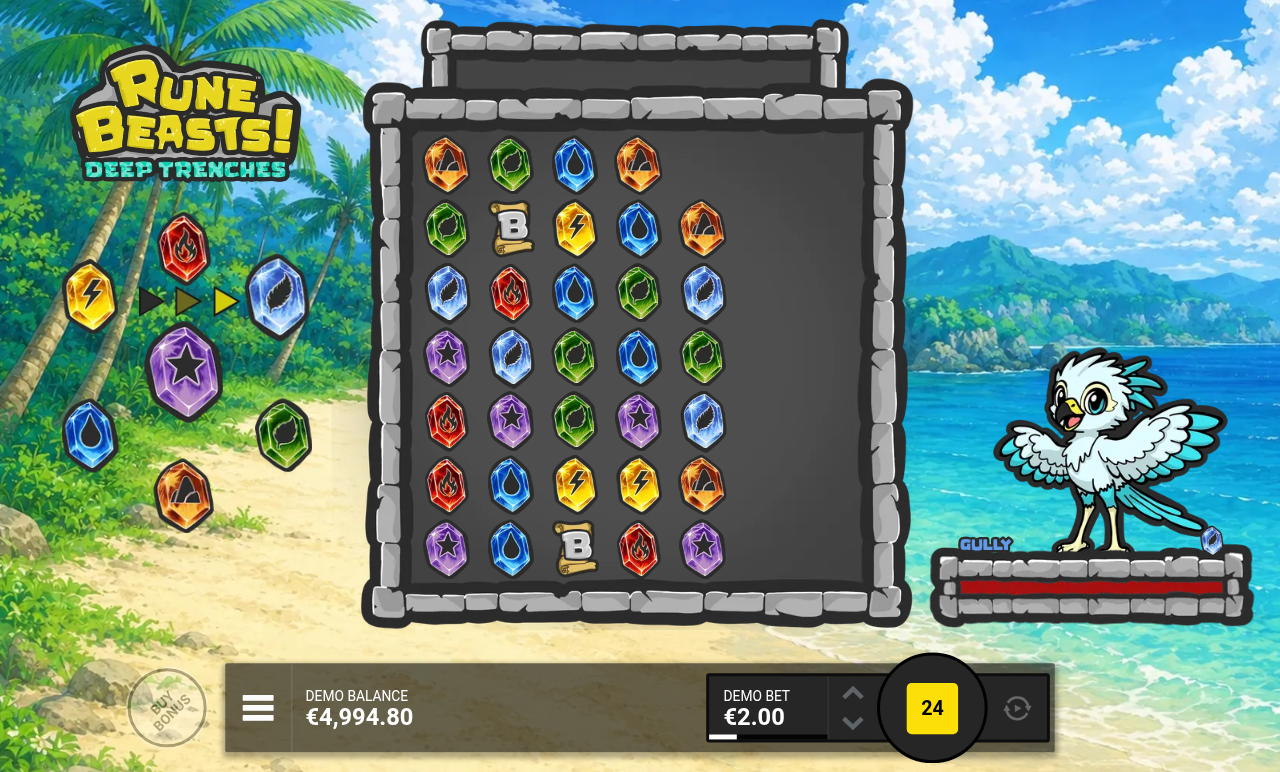
The VS symbol is the piece of this game that isn’t standard. It can appear on reels two to six and rows two to six, and it works in three steps:
- It lands as a standard one-space symbol
- It stays on the grid, sticky in its original position, until it expands
- It expands to fill a 3×3 space, and other symbols cascade through it in the meantime
That stickiness is the interesting part. A VS symbol sitting on the grid changes what every cascade after it is worth, because it’s holding space that clusters can’t use while it waits to trigger. When it finally opens up, it does so over a board that has already been reshaped several times.
The outer band of the grid is off-limits to it by design. Reels one and seven, plus the top and bottom rows, never carry a VS symbol, which means every expansion happens somewhere near the middle of the board where clusters are densest.
An expanded VS symbol covers nine spaces at once on a 49-space grid. That’s a fifth of the board held by a single symbol.
The Elements and the Beasts
The setting is Asterra, home of the Rune Beasts, and the beasts themselves are aligned to the elements. Each element has a weakness, and you battle the beasts using magical spells cast from powerful rune symbols, exploiting those weaknesses to strike them down and increase your treasure. The elements in play are:
- Fire
- Water
- Grass
- Electric
- Earth
- Air
- A special force that comes from the beasts themselves
Six elements plus a beast-force wildcard gives the battles a rock-paper-scissors structure: what beats a fire beast won’t beat a water one, so the rune symbols you’re landing matter to more than their face value. Around the battles sit a few other things to look out for:
- Wild beasts battling each other
- Beast master tournaments
- The hunt for the mythical sea beast
- Collectable cards for each beast and rune
It’s a lot of framing for one 7×7 grid, and the card-collecting angle in particular gives the game somewhere to go beyond the spin button. The hand-drawn, cartoonish art style carries it well; everything on screen is bright, lush and deliberately silly.
Bonus Rounds and the Buy Bonus
Scatter symbols exist on all reels, and landing three or more awards entry to one of the bonus rounds. How the round is chosen isn’t spelled out, so the four game modes and their contents are something you discover by getting there. What is fixed is the ceiling: whichever mode you land in, the top prize is the same 5,000 times your bet.
There’s also a buy bonus button in the bottom-left corner of the play screen, for players who’d rather skip the scatter wait entirely. It’s a shortcut to the same bonus rounds the scatters award. No price tiers or per-mode costs are published, so the buy menu is worth a look before you commit to anything.
The rest of the control panel is conventional. Autoplay runs 10, 25, 50, 75, 100, 500 or 1,000 rounds at a time, with the full range of round counts selectable from the menu. It sits alongside the buy button at the foot of the stone frame.
Our Honest Verdict
Overall Rating: 7.6/10
A session here is long stretches of clusters forming and collapsing on that stone frame, punctuated by the moments a VS symbol finally opens up and the beasts go at each other over a board the chains have already rebuilt. Those escalations, not the cluster pays themselves, are the reason to choose this over a sharper cascade game.
The battle layer is the strength: a sticky tile waiting to expand turns ordinary cascades into a run-up, and every fight lands on a board the previous chains shaped. The weakness is the ceiling. Deep Trenches stops at 5,000x in all four modes, so no bonus round you reach is the big one.
The elements-and-weaknesses framing promises a depth the cluster maths underneath never has to deliver on. Still, this is for players who liked the first game’s battles and don’t mind a tighter cap, and for anyone who enjoys watching a board build towards one big payoff. Anyone chasing pure chain action will find leaner engines elsewhere. The snake on the ledge, still grinning over its warm shallow water, seems content with the arrangement.
Rune Beasts! Deep Trenches FAQs
-
What is the RTP of Rune Beasts! Deep Trenches?
The RTP is 96.29%. That’s the total expected return for the game, so it’s the figure to compare against other slots. -
How do wins work in Rune Beasts! Deep Trenches?
There are no paylines. Clusters of seven or more matching symbols anywhere on the 7×7 grid form a winning cluster, which is then removed so new symbols can cascade in. -
What does the VS symbol do in Rune Beasts! Deep Trenches?
The VS symbol lands as a single space on reels two to six and rows two to six, then expands to a 3×3 area. It stays sticky in its original position until it expands, and other symbols cascade through it. -
How do you trigger the bonus rounds in Rune Beasts! Deep Trenches?
Landing three or more scatter symbols awards entry to one of the bonus rounds. Scatters can appear on all reels. -
Can you buy the bonus on Rune Beasts! Deep Trenches?
Yes, there’s a buy bonus button in the bottom-left corner of the play screen. It takes you straight to the bonus rounds rather than waiting for scatters to land. -
What is the maximum win on Rune Beasts! Deep Trenches?
The maximum win is 5,000 times your bet, and it’s available in all four game modes. -
How big is the playing area in Rune Beasts! Deep Trenches?
Seven reels by seven rows, using cluster pays rather than paylines. Wins need seven or more matching symbols touching. -
Does the wild substitute for everything in Rune Beasts! Deep Trenches?
Yes, the wild covers every paying symbol on all reels, and extra wilds can drop onto any reel while a cascade is still running. It has no effect on scatters or VS symbols, which work on their own rules.