










Ramses Legacy Slot Review
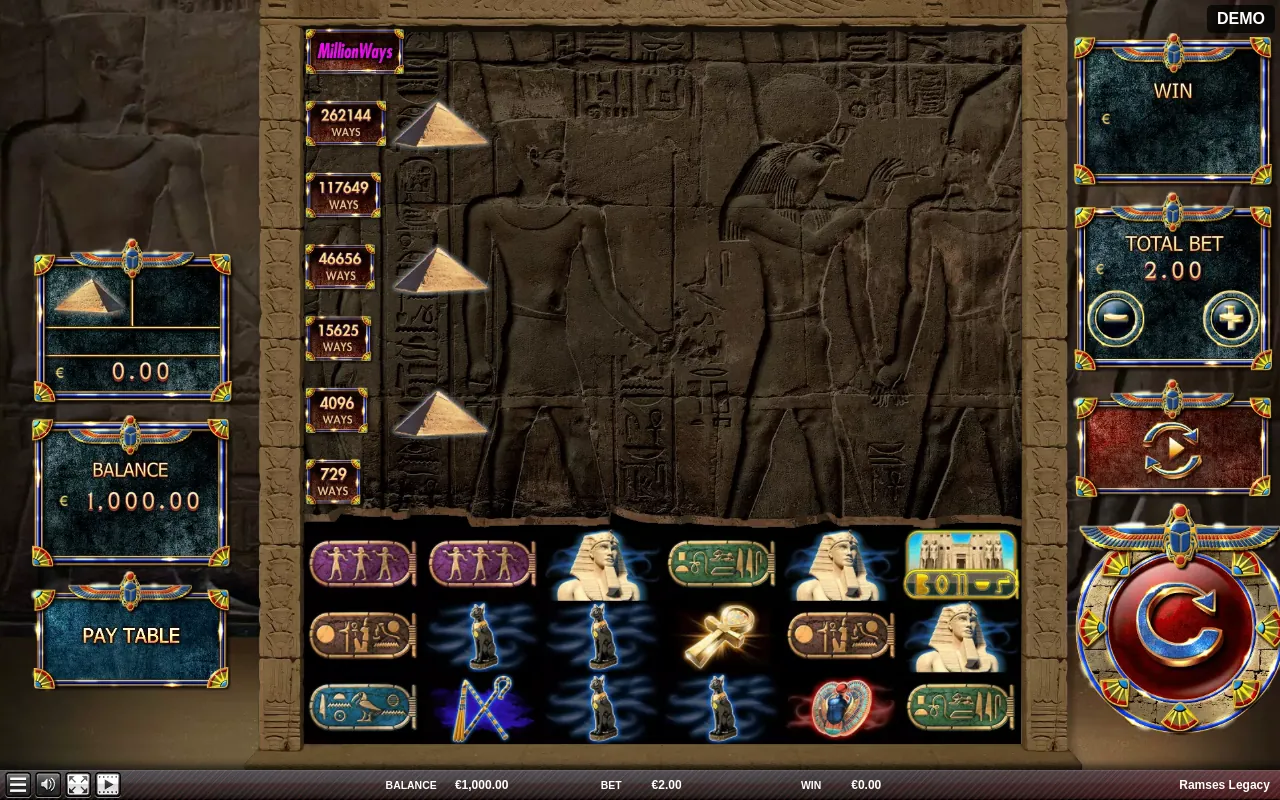
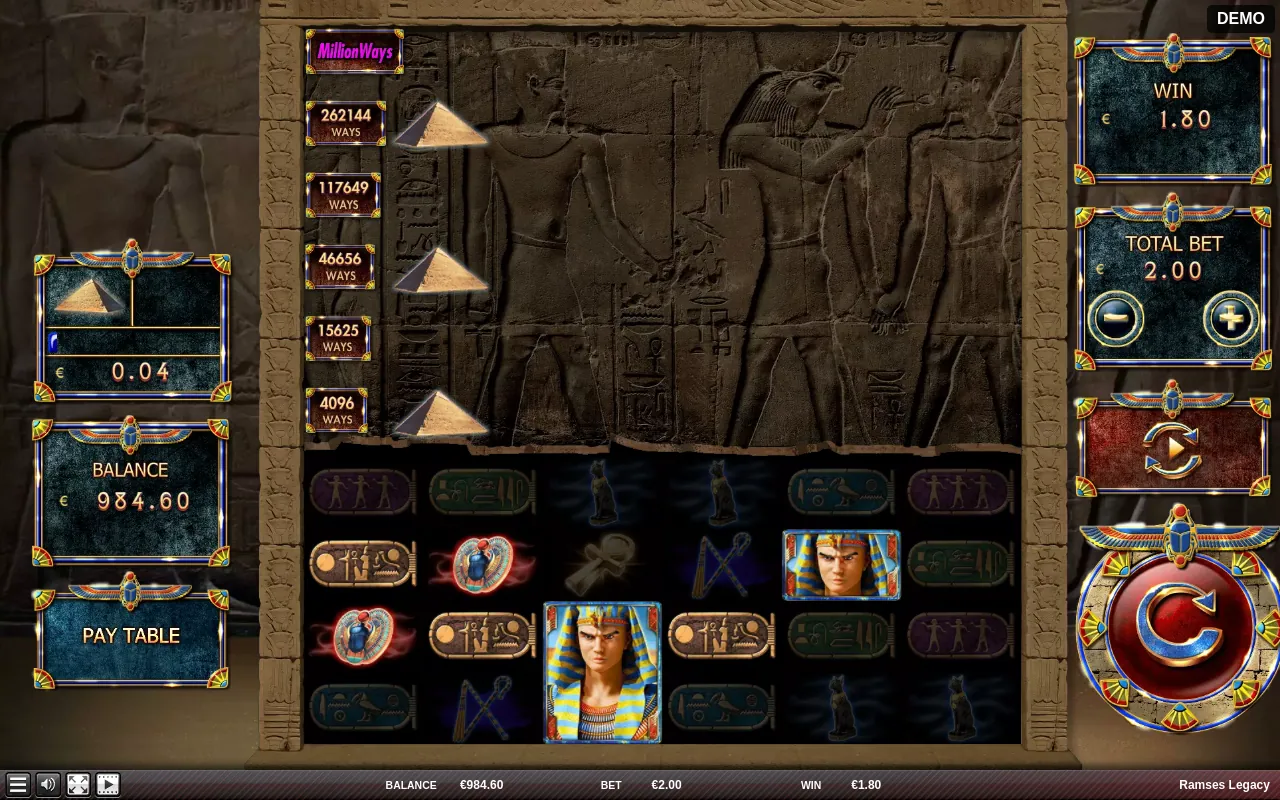
A falcon-headed god stands in shallow relief on a sandstone wall, one arm raised towards a pharaoh carved into the same rock, columns of hieroglyphs running down the stone beside the reels. This is a slot that hides most of its own board from you: three rows on show, seven hidden behind the stonework, and no way to reach them but to keep winning. It’s an unusual arrangement for an ancient Egypt game, where the habit is to drape the same old five reels in gold and call it a tomb. Ramses Legacy, by contrast, is sober and dim – all muted browns and greys, closer to a museum wall than a treasure chamber – and it puts its ambition into the structure rather than the paintwork.
It comes from Red Rake Gaming, built on their MillionWays engine: a 6×3 grid that grows to 6×10 and up to 262,144 ways, mid to high volatility, an RTP of 95.3%. It’s a cousin of Pots of Tut Rake It In and Secrets Of The Temple 2, and like Triple Jewel Of Egypt it digs in the same Egyptian soil. The tomb here doesn’t give up its gold on the first spin.
MillionWays and the Growing Grid
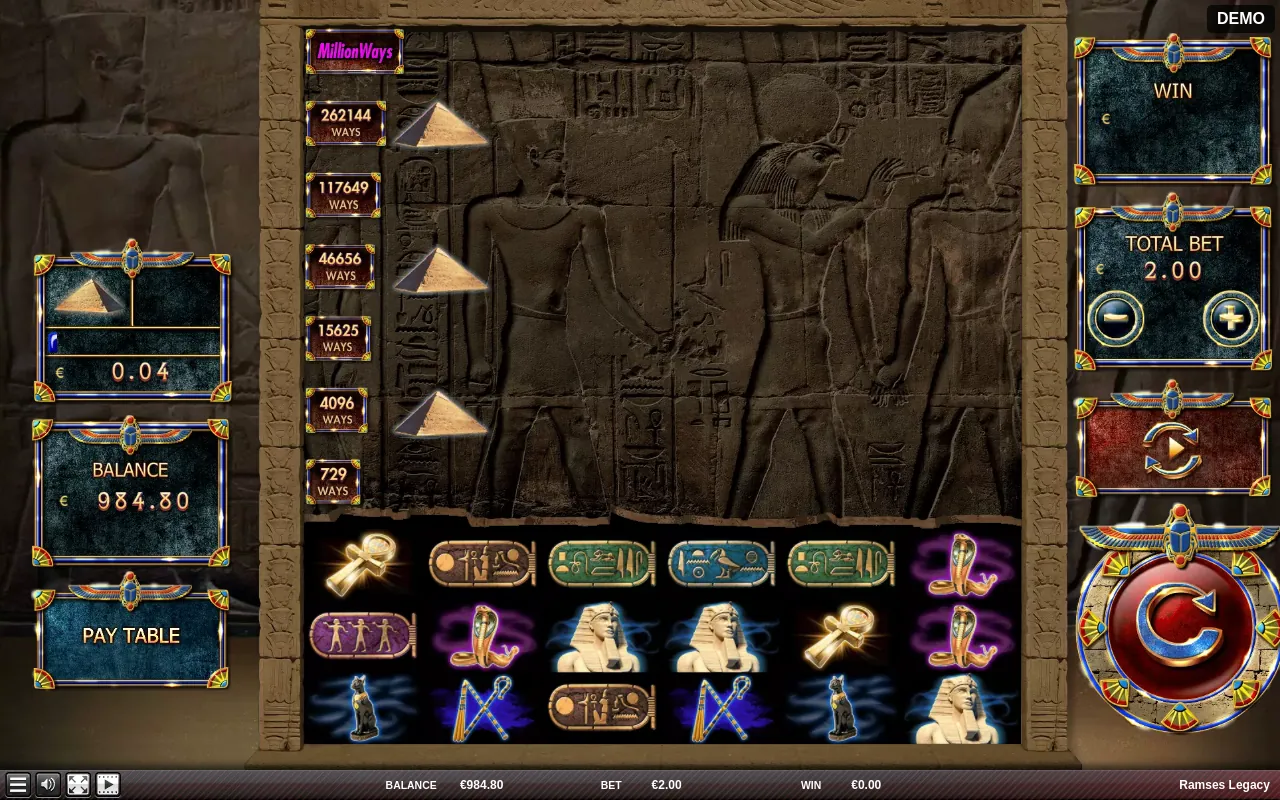
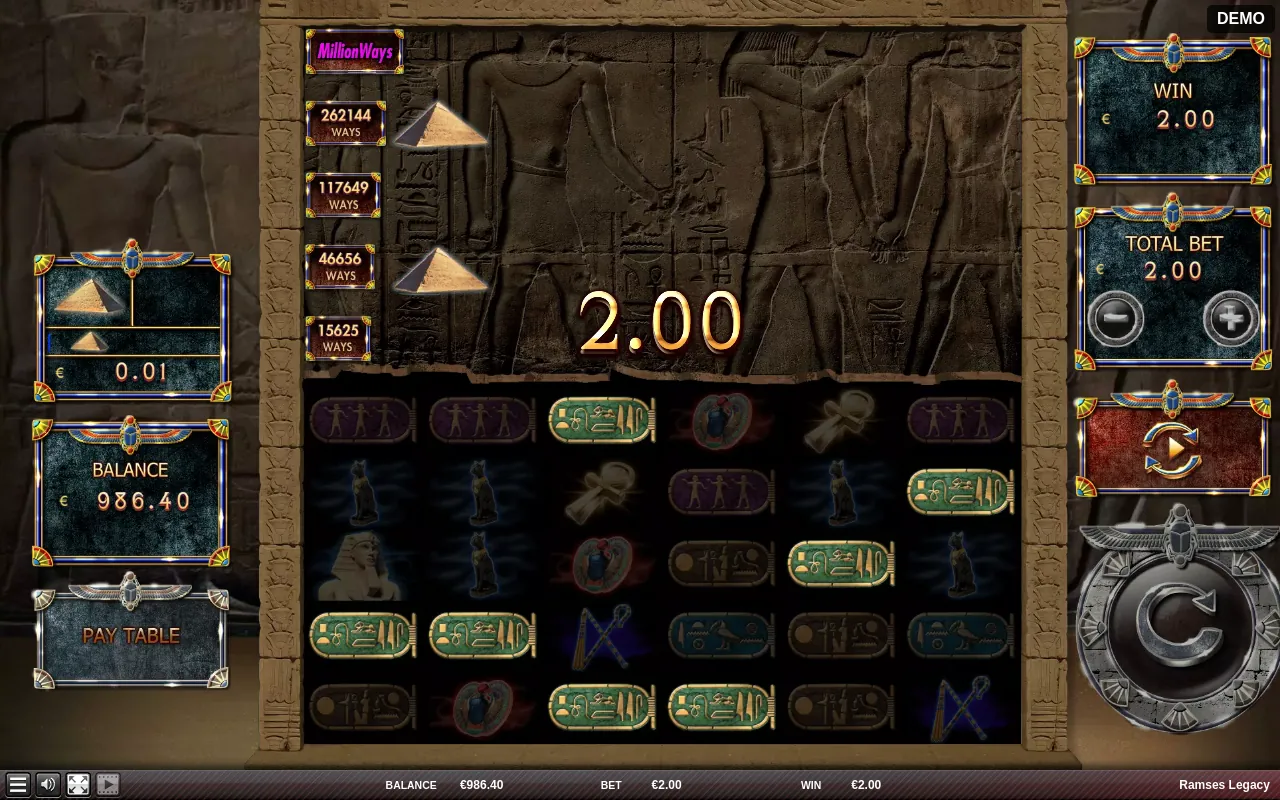
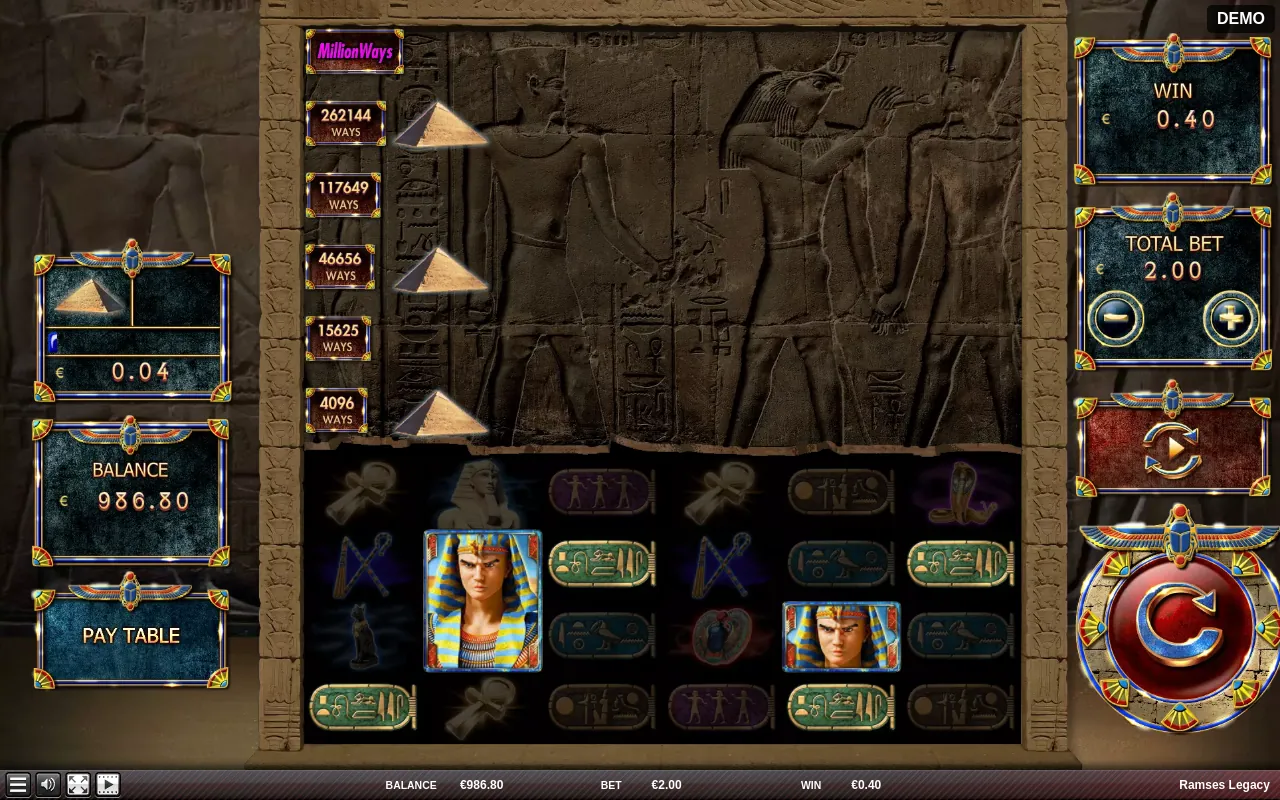
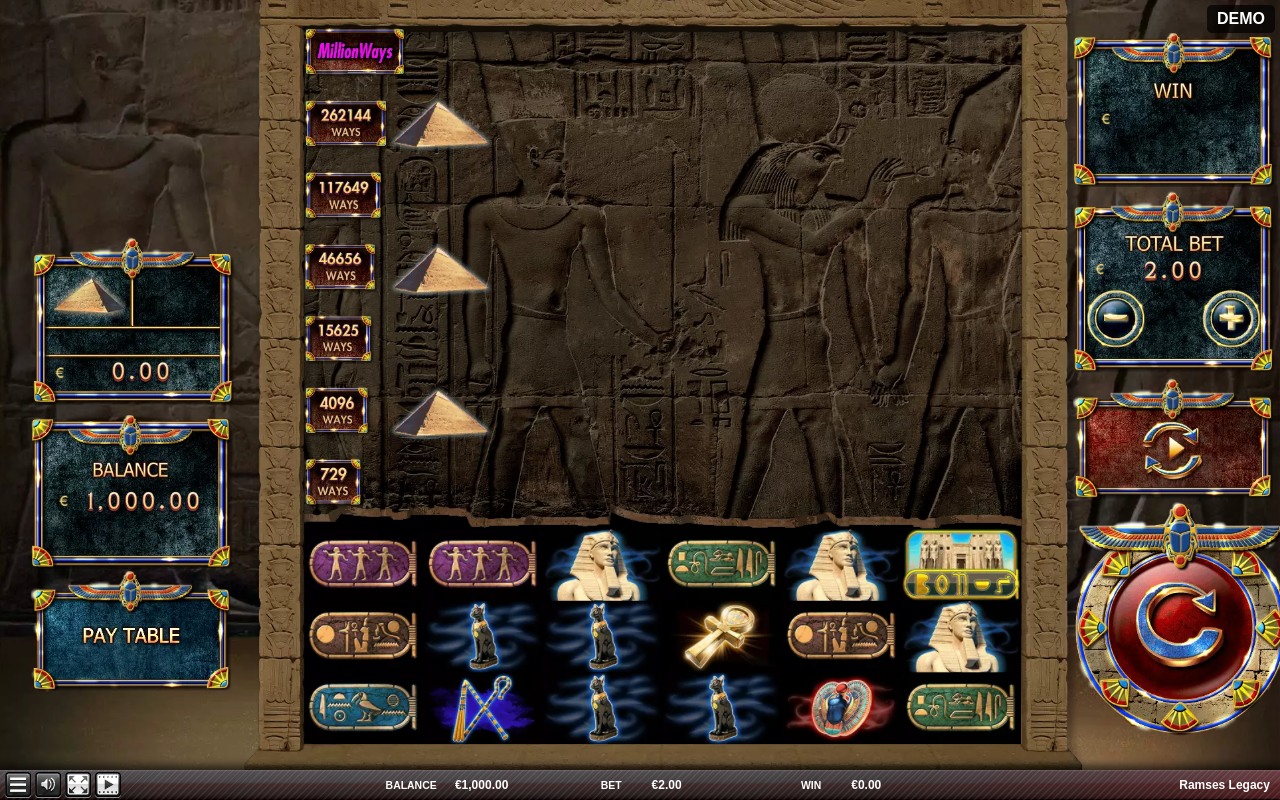
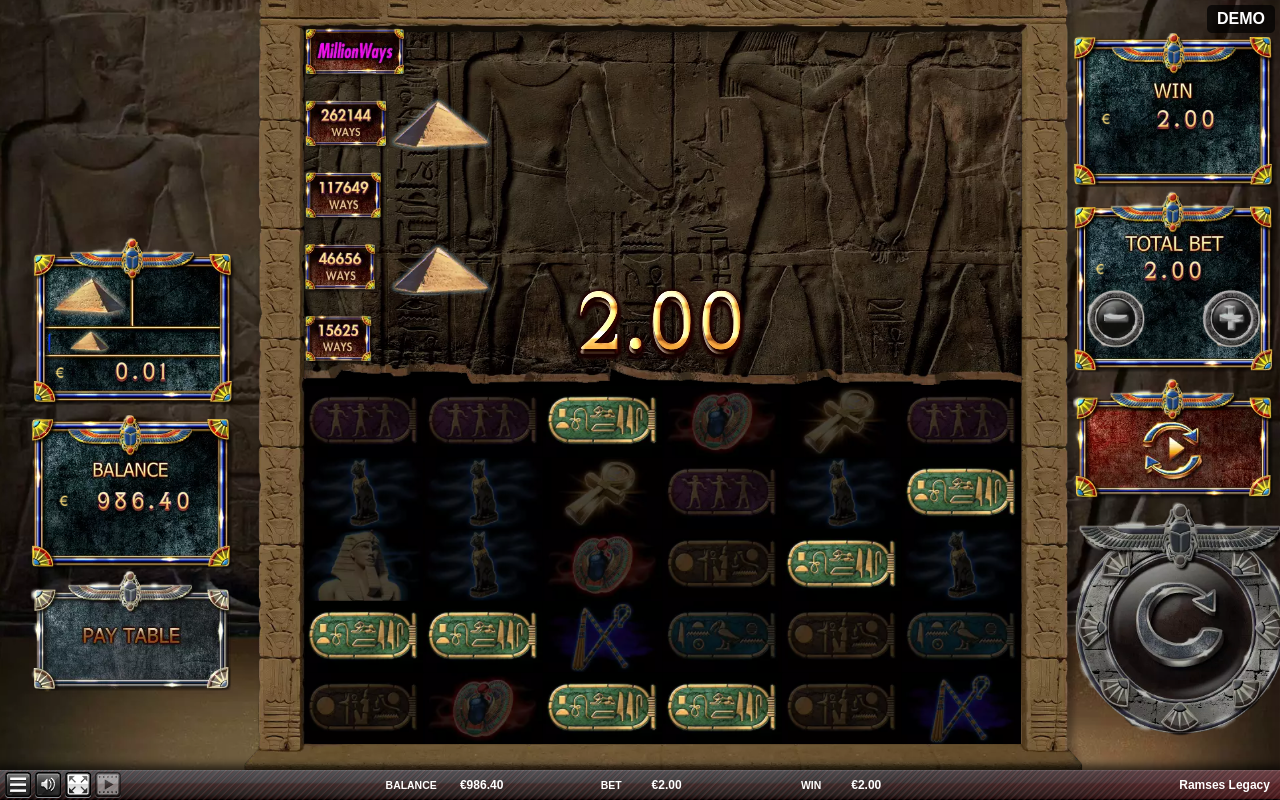
The game starts as a 6×3 grid, and on its own that board is unremarkable. Land a win and a new row is revealed above it. If the expanded grid produces new wins with symbols that have already paid, more rows keep opening one at a time, each win buying another layer of the wall away.
The full board is six reels by ten rows. Each row that appears grows the ways to win, and the ladder sits on the left panel: 729 ways on the opening three rows, then 4,096, 15,625, 46,656, 117,649 and finally 262,144 ways at full height. That top step is a long way up, and the base game only ever climbs it one rung at a time.
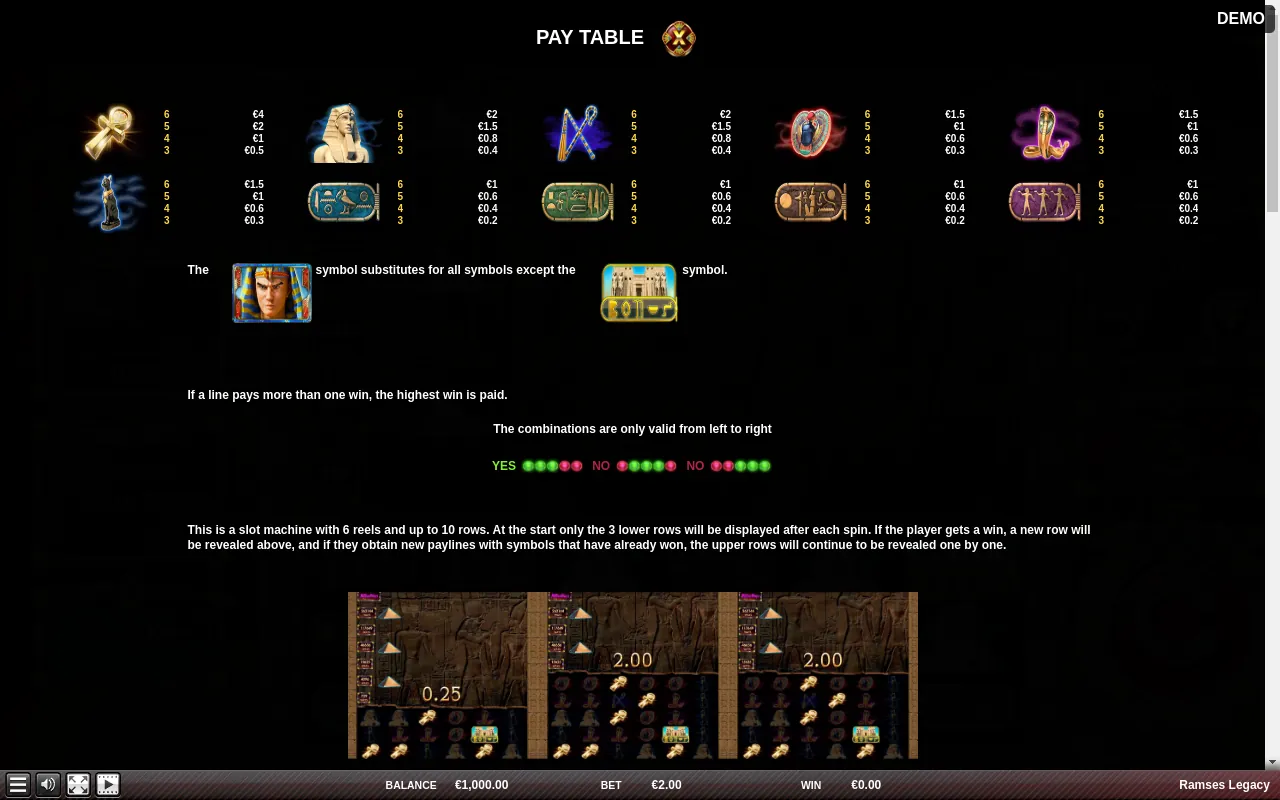
Wins pay left to right only. Where a line carries more than one winning combination, only the highest counts. Both rules matter more as the board widens, because a ten-row grid produces far more candidate lines than a three-row one, and most of them will fail the left-to-right test.
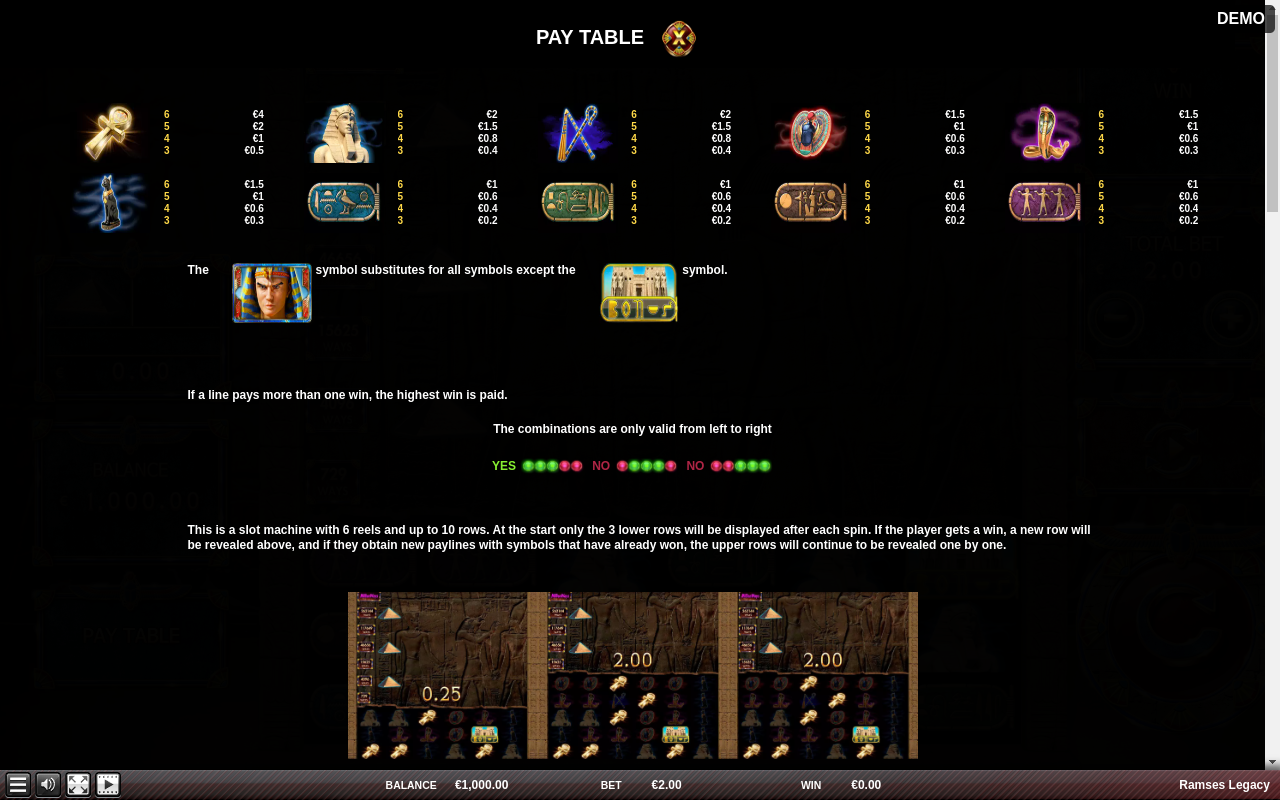
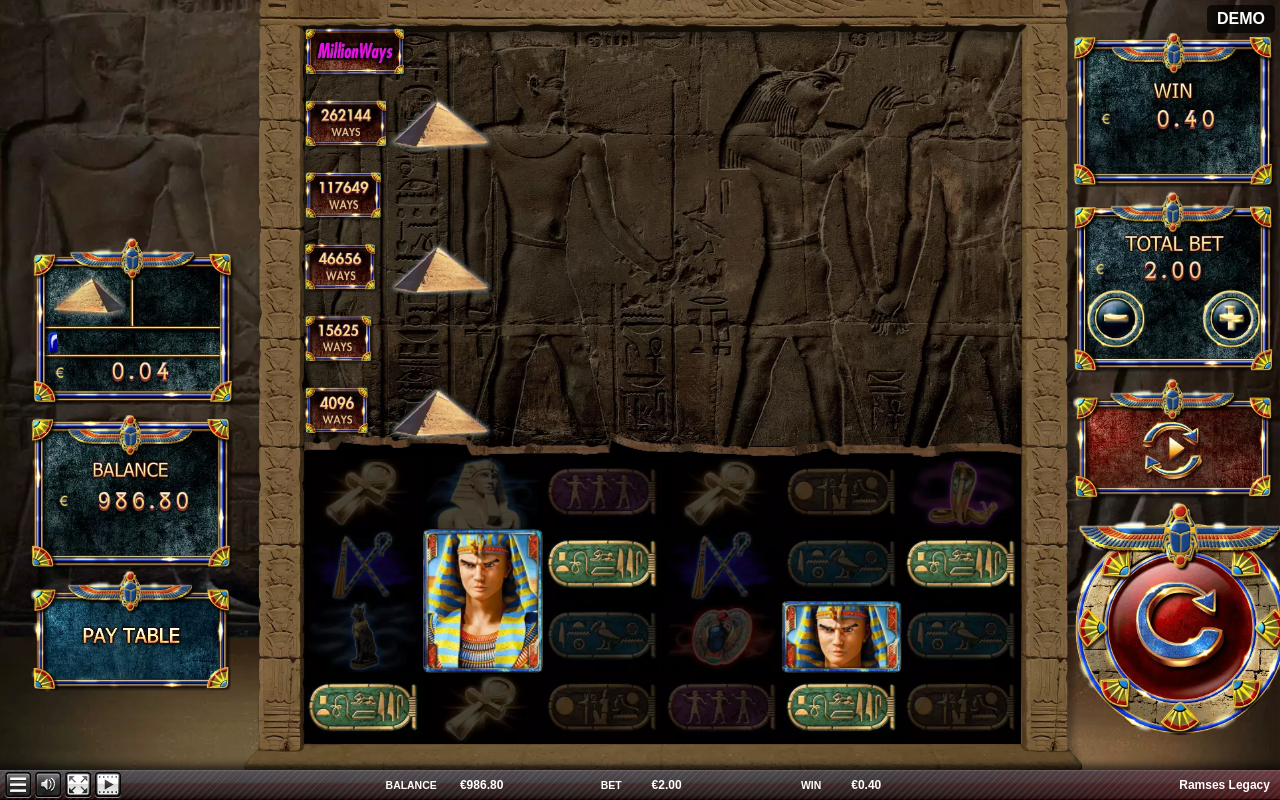
The Ramses portrait is the wild and substitutes for every symbol except the temple scatter. That’s the whole of its job, and it’s a useful one on a board this wide, where a single substitute can be the difference between a chain continuing and the grid resetting.
Symbol Values
Wins are multiples of the total bet, and the values climb as the grid does:
- Ankh (gold) – 0.25x for three, 1x for five, 2x for six
- Pharaoh / Compass – 0.2x for three, 0.4x for four, 0.75x for five, 1x for six
- Amulet / Scarab – 0.15x for three, 0.3x for four, 0.5x for five, 1x for six
- Cat figure (blue) / Hieroglyph Scroll (gold) – 0.15x for three, 0.3x for four, 0.5x for five, 0.75x for six
- Hieroglyph Scroll (blue) / Cartouche / Dancers (pink) / Dancers (blue) – 0.1x for three, 0.2x for four, 0.3x for five, 0.5x for six
The ceiling on offer here is modest: the gold ankh tops out at 2x the total bet for six of a kind, and the bottom tier pays half that. What the list doesn’t show is frequency. A six-of-a-kind needs six reels, and three-row boards can’t produce one at all, so the bigger values only become reachable once the grid has grown.
That’s the design in a sentence: the paytable doesn’t change, but the board it pays on does. Every value in that list pays more often once the rows are open.
Ramses’ Treasure and the Minigame
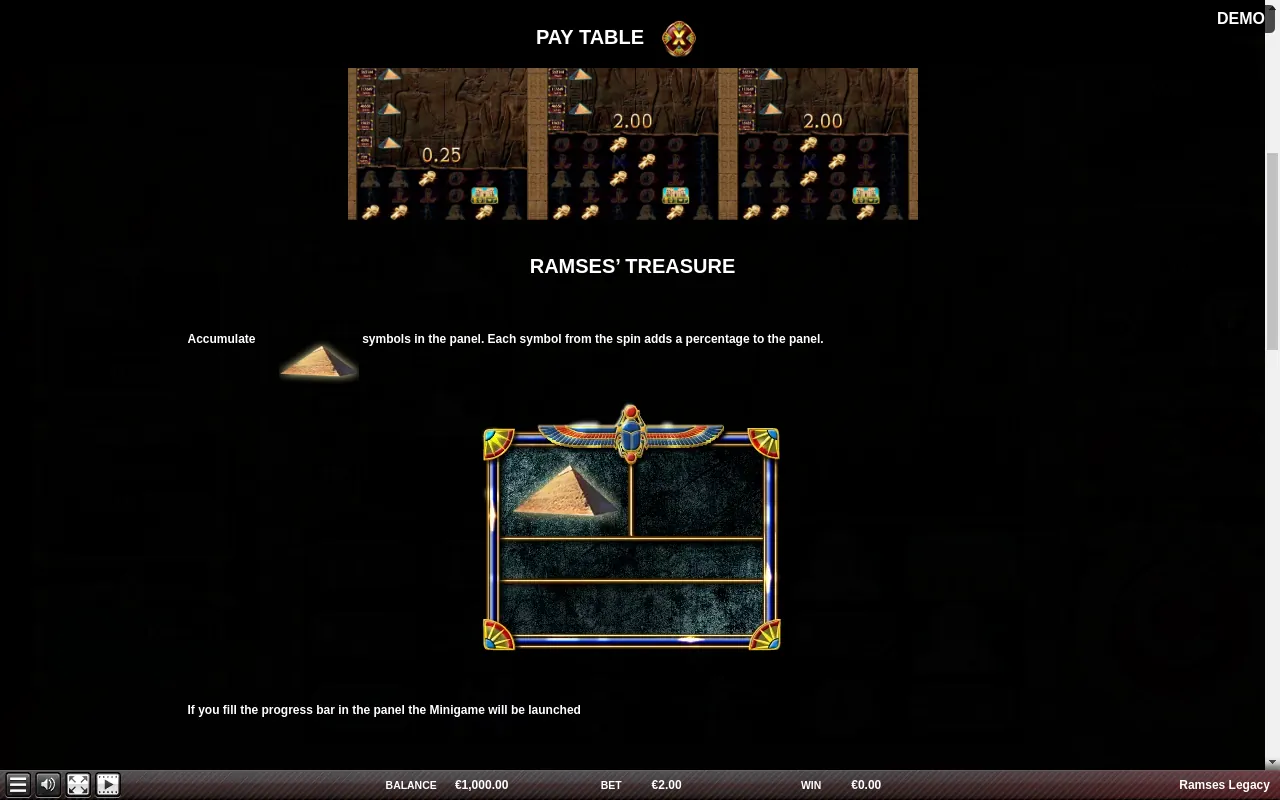
Pyramid symbols accumulate in a side panel throughout play, and each one that lands adds a percentage to the bar. Fill it and the Minigame launches. It’s a slow build by design, and it’s the second of the game’s two bonus routes.
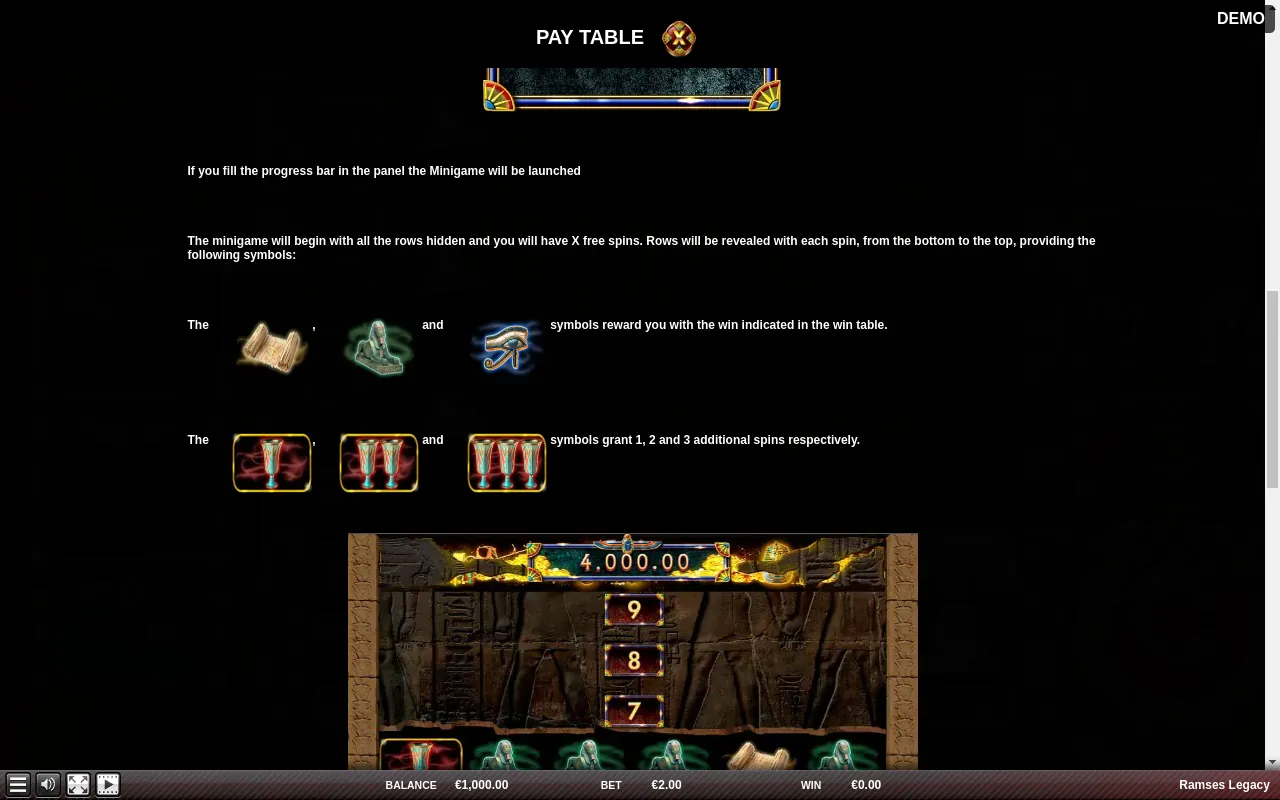
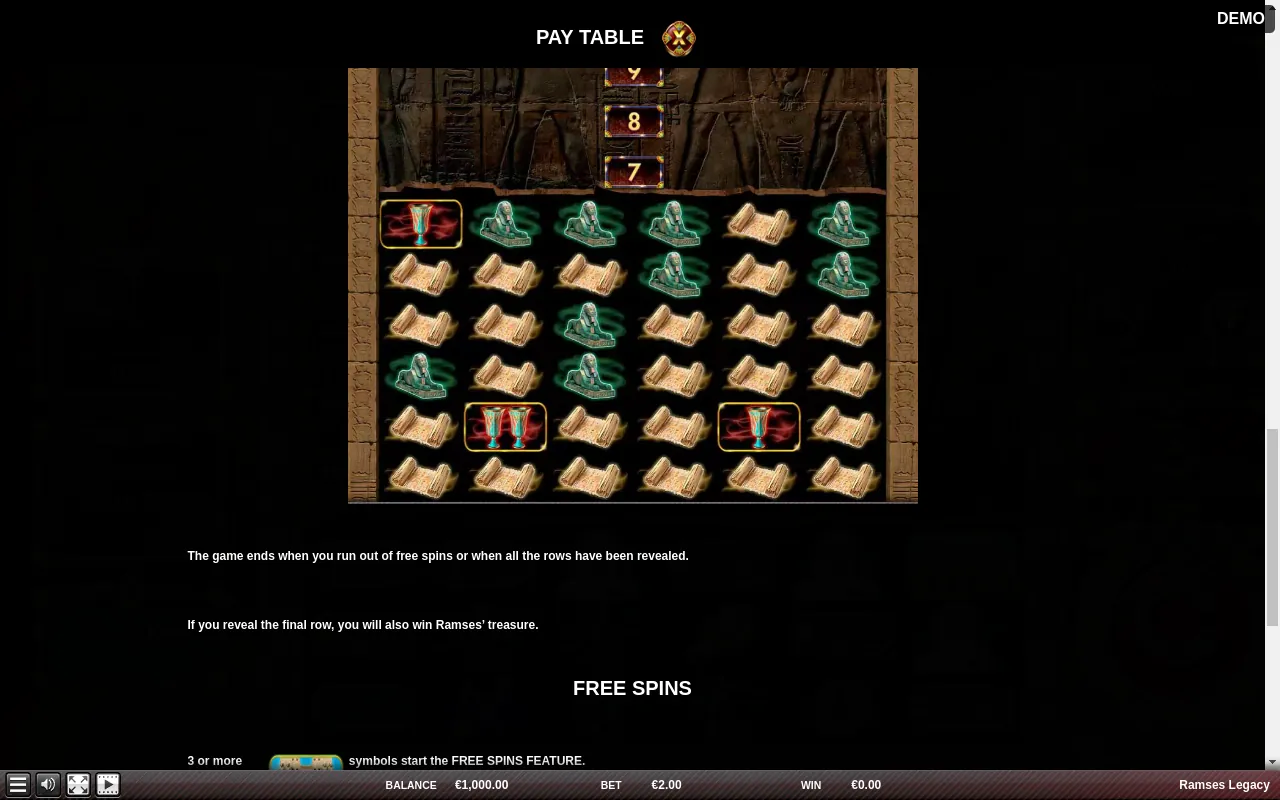
The Minigame starts with every row hidden and a set number of free spins on the clock. Each spin reveals a row from the bottom upwards, and the symbols on it pay what they’re worth: the scroll and Eye of Horus symbols carry the rewards, and the win table sets out what each is worth.
Three chalice symbols extend the round, granting one, two and three additional spins respectively. Landing them in the middle of a run matters more than at the start – a chalice early gives the reveal more spins to work with, while one late can be the difference between reaching the top and stopping short.
The round ends when the spins run out or every row has been revealed. Reveal the final row and you also win Ramses’ Treasure itself – the prize sitting at the top of the whole structure. It’s a neat piece of design: the feature’s ceiling and its finish line are the same thing.
Free Spins
Temple symbols are the scatter, and three or more of them start the Free Spins feature. The awards step up with the count:
- 3 temples – 8 free spins
- 4 temples – 12 free spins
- 5 or more temples – 16 free spins
The difference from regular play is the pace of the expansion. Four rows are revealed straight away at the start of each spin, and further rows then open two at a time rather than one. A free spin therefore starts life at 4,096 ways before anything has paid, and each step up the ladder is a double jump rather than a single one.
The feature lives far closer to the top of the ways ladder than the base game manages, which is where the bigger combinations sit. A 16-spin round that keeps winning can spend most of its life above 46,656 ways, territory the base game barely visits.
Our Honest Verdict
Overall Rating: 7.2/10
Playing Ramses Legacy is mostly waiting for the wall to crack open. You grind along on three rows, wins are small, and then a chain catches and the temple starts giving up its storeys one at a time – that climb, not the theme, is the reason to choose it.
Its best idea is the Minigame, where the bonus and the finish line are the same thing: the chalices buy the spins, the rows climb, and the final one pays Ramses’ Treasure. The weakness is that the paytable never grows with the board – 2x for a six-of-a-kind is thin reward for reaching the top of a 262,144-way grid, so the expansion has to do all the work on its own.
It suits players who enjoy a long build and don’t need a fixed jackpot at the end of it. Anyone chasing the biggest prizes the genre offers will find this tomb too quiet. For everyone else, there’s a genuine engine under the sandstone, and it rewards patience the way an excavation should.
Ramses Legacy FAQs
-
What is the RTP of Ramses Legacy?
Ramses Legacy runs at an RTP of 95.3%. -
Is Ramses Legacy high volatility?
It sits at mid to high volatility, so wins can be spaced out but have room to build as the grid expands. -
How many paylines does Ramses Legacy have?
It uses Red Rake’s MillionWays system. The ways ladder runs from 729 on the opening three rows up to 262,144 ways at the full ten-row height, with 4,096, 15,625, 46,656 and 117,649 in between. -
What is the grid size of Ramses Legacy?
It starts as a 6×3 grid. Landing wins reveals extra rows above, up to a maximum of six reels by ten rows. -
How do you trigger the Free Spins in Ramses Legacy?
Three or more temple symbols start the feature. Three temples award 8 free spins, four award 12, and five or more award 16. -
How does the Ramses’ Treasure Minigame work?
Pyramid symbols fill a progress panel, and each one that lands adds a percentage. Filling the bar launches the Minigame, which starts with all rows hidden and reveals one row per spin from the bottom up. The round ends when your spins run out or all rows are revealed, and revealing the final row also wins Ramses’ Treasure. -
What do the chalice symbols do in Ramses Legacy?
In the Minigame, the three chalice symbols award one, two and three additional spins respectively, extending the round and giving you more chances to reach the final row. -
How do rows open during the Free Spins round?
Differently from the base game. Four rows are revealed straight away at the start of each free spin, and any further rows open two at a time rather than one, so the round reaches the higher steps of the ways ladder much faster.