










Sequential Royal Slot Review
A dark teal table, a fine diagonal lattice, a soft glow at the centre: Sequential Royal is five cards and one decision, and that decision matters more than any feature ever could. Most casino games let you press a button and hope. This one asks you to think, and pays 99.77% RTP to those who do it well, a return no reel slot gets close to.
Red Rake Gaming built it as a single-hand five-card variation of Jacks or Better, one twist on a classic: a royal flush dealt in sequence pays far more than the ordinary kind. Red Rake’s reels, from Million 7 to 777 Heist 2 and Super 25 Stars, are a much louder world. This is the studio at its quietest, and whether that quiet is a virtue or a vacancy is the question.
Five Cards, One Hand, One Draw
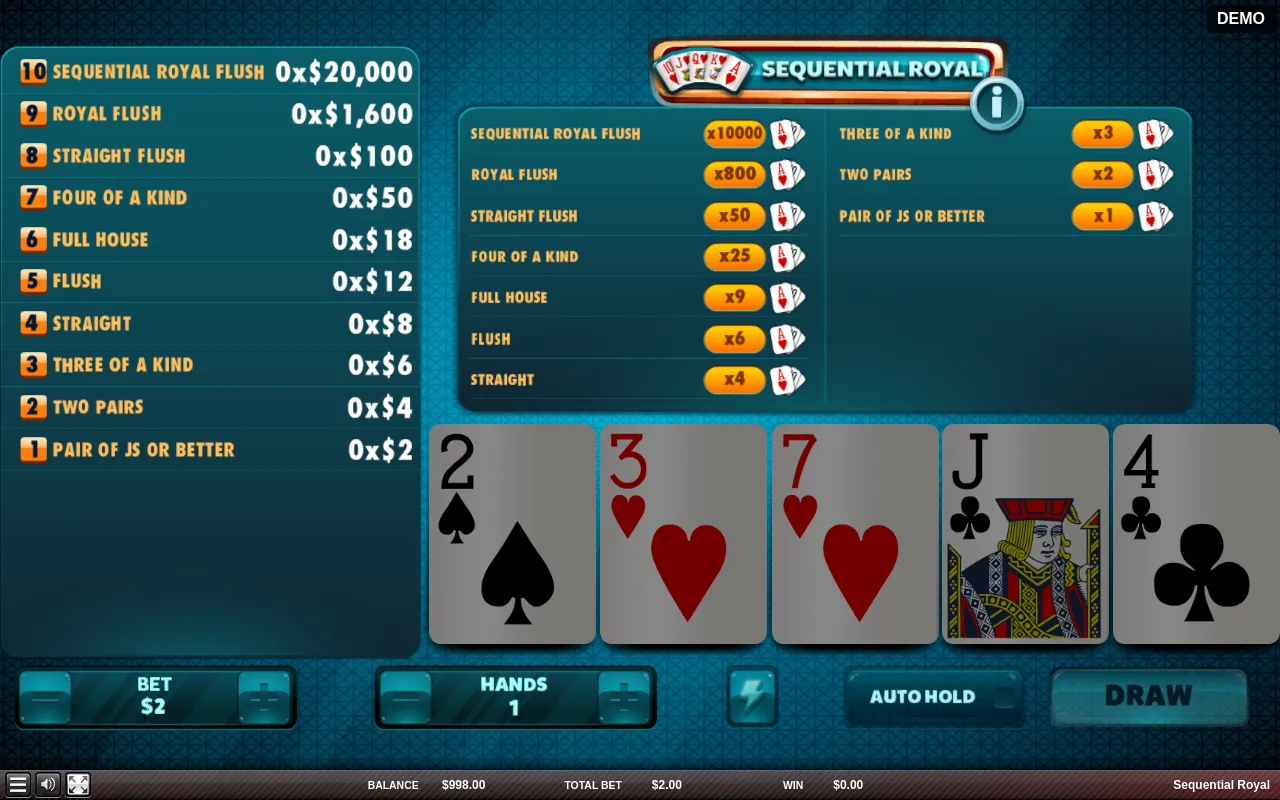
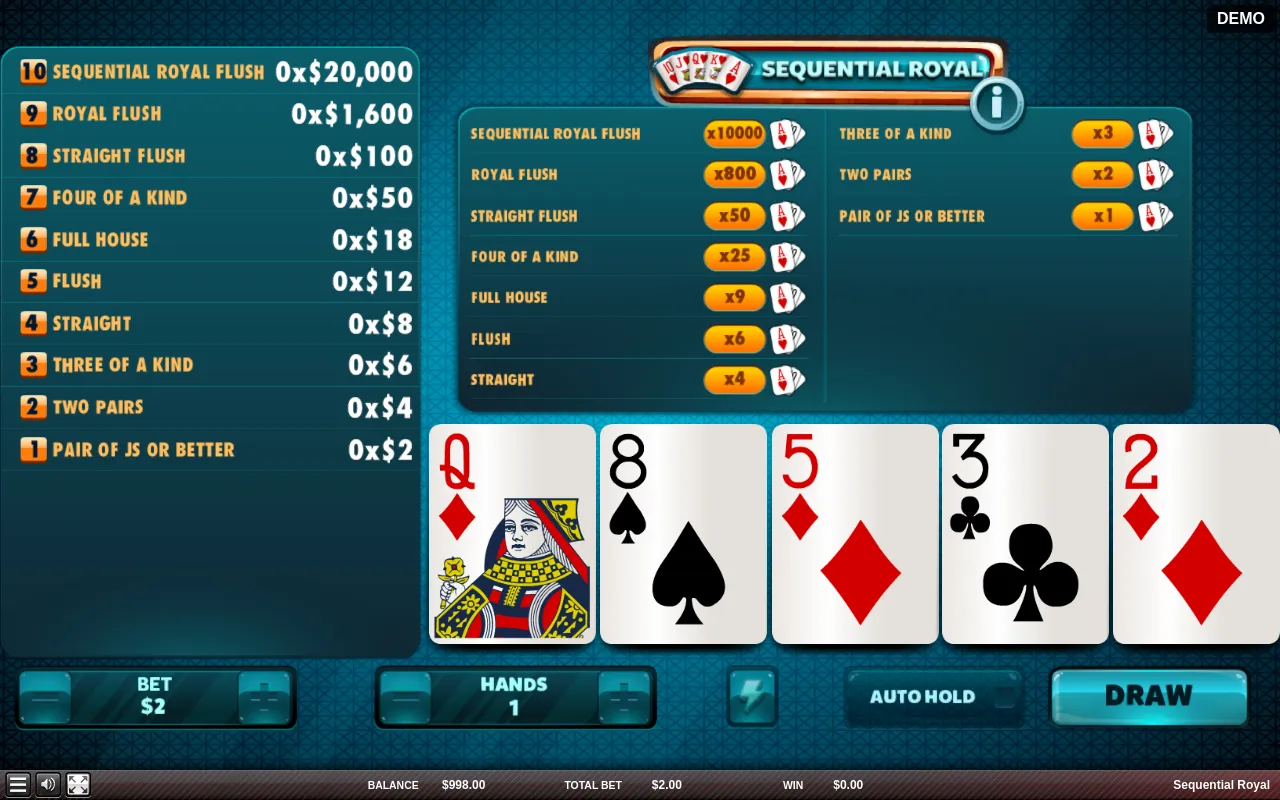
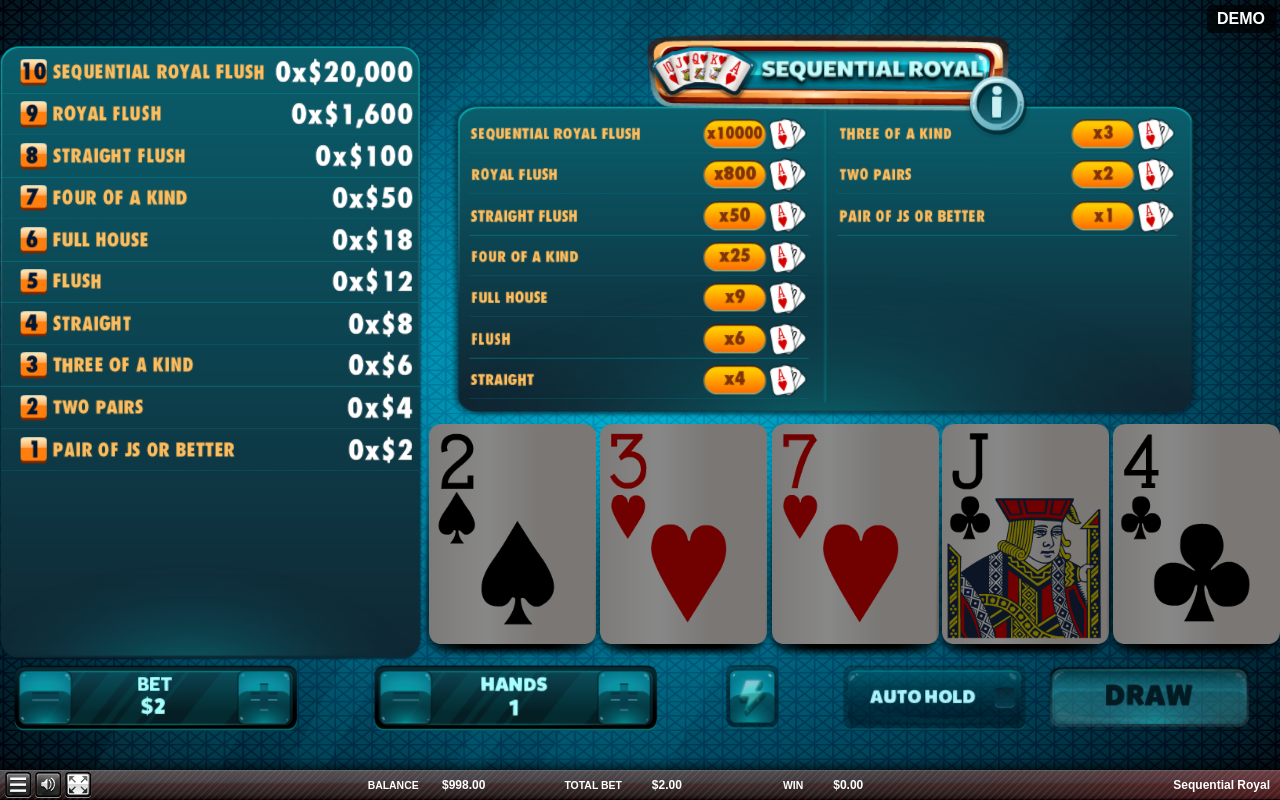
Each round deals five cards. You choose which to hold, discard the rest, and the draw replaces them. That’s the entire loop, and it hasn’t changed since video poker left the casino floor: no reels spinning underneath, no meters filling, no second screen waiting for a trigger.
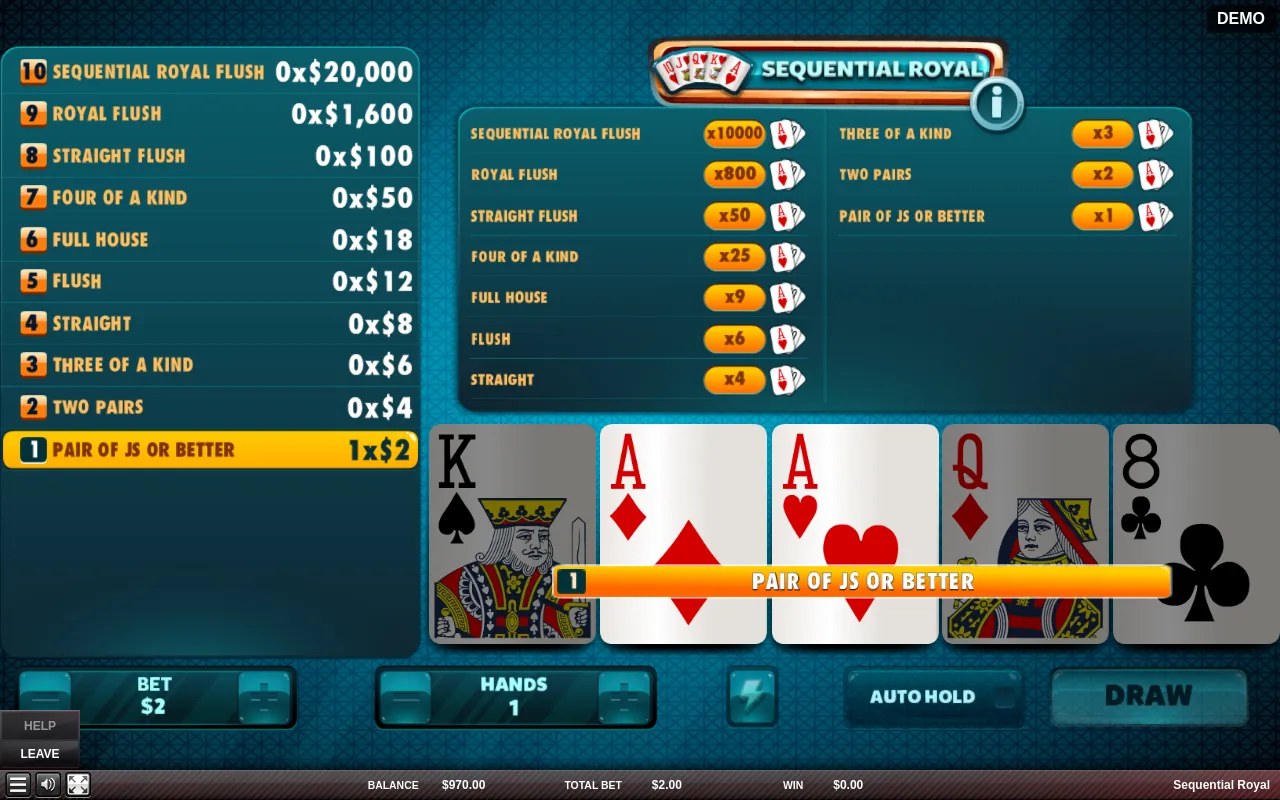
Wins start low on the ladder. Any hand of a Pair of Jacks or better collects a prize, and everything below that simply loses the bet. Nothing substitutes and nothing scatters here; the deck is a standard 52 cards and every result comes from the deal and the draw, nothing else.
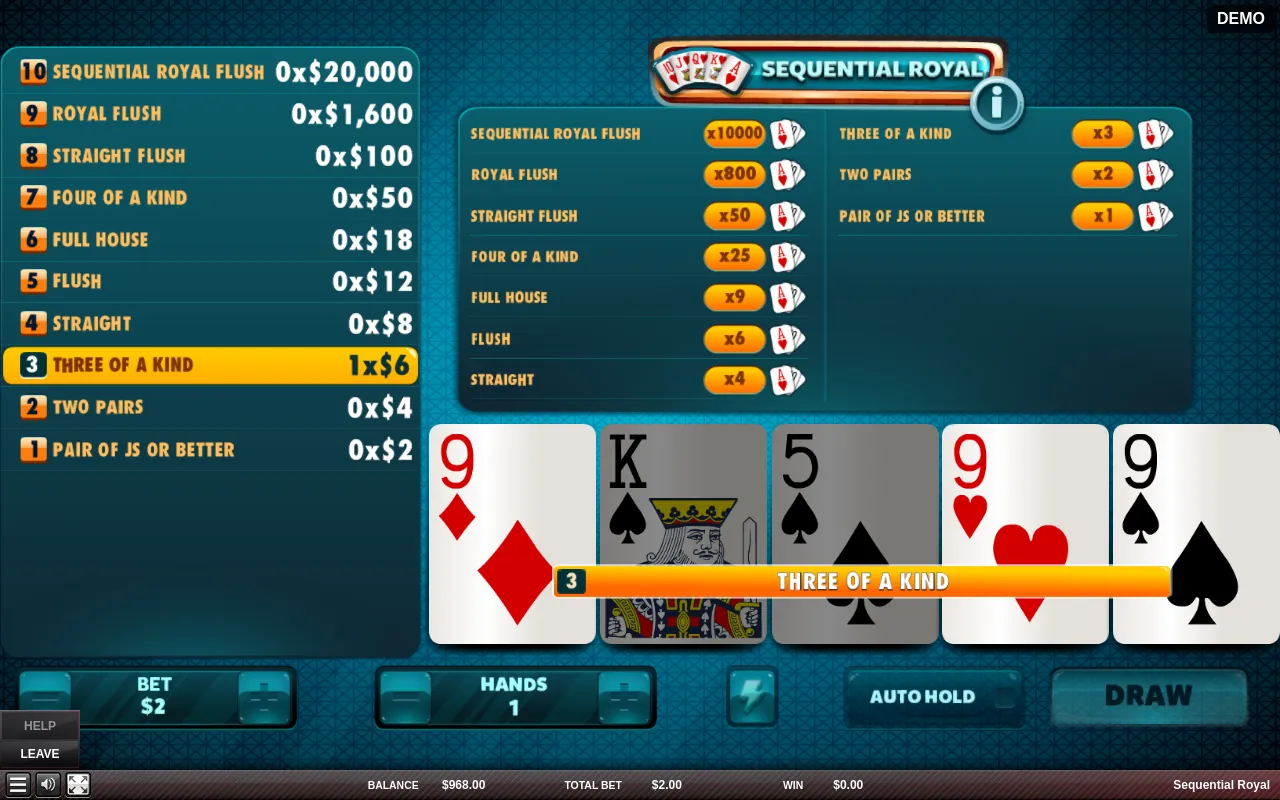
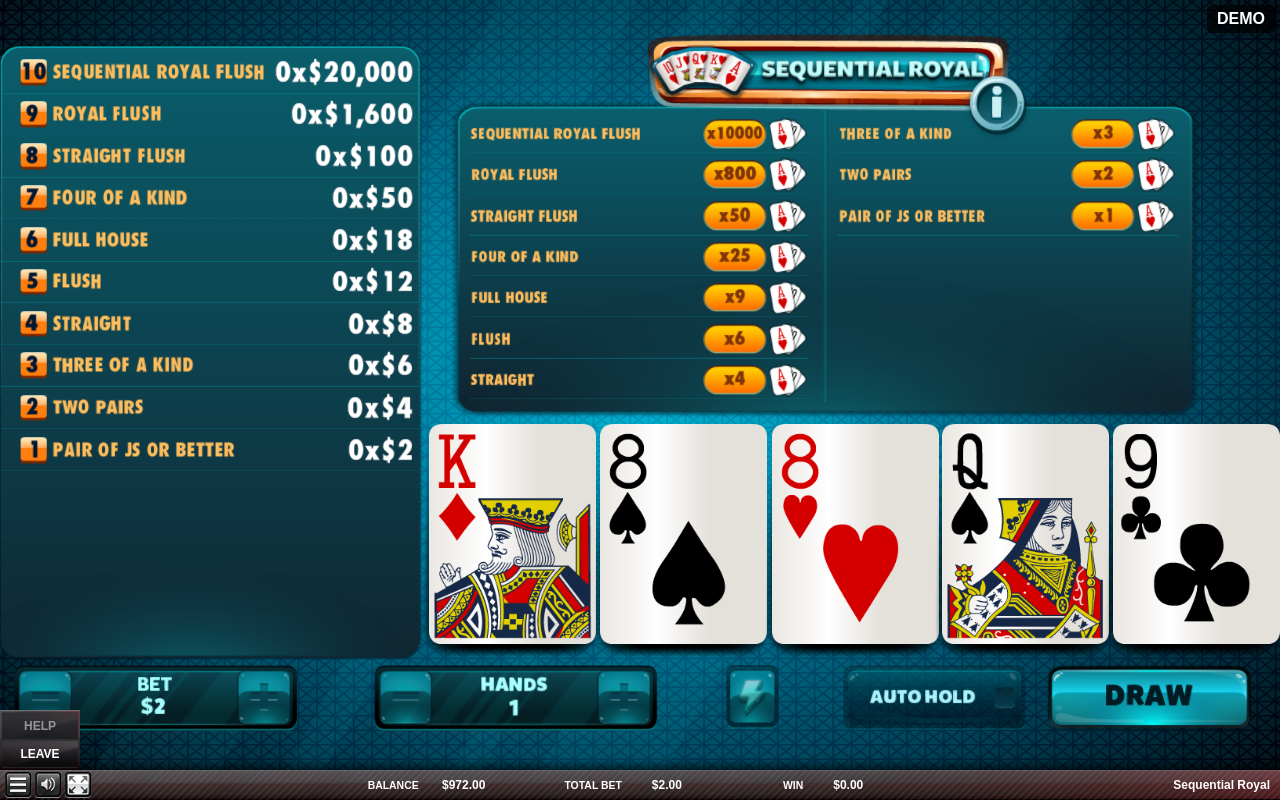
That puts the whole game in your hands. Holding the right pair over a four-card flush is the difference between a paying hand and a dead one, and the game gives you the information to make that call on every single deal. A hand like three nines is already a paying hand before you’ve decided what to do with it.
The hold decision is where the 99.77% lives or dies. Chasing a sequential royal by holding four suited high cards means throwing away a certain pair, and the paytable charges you for that chase. Playing the percentages, hand after hand, is what the return figure rewards.
Most deals present exactly one defensible answer. A dealt flush with no royal potential is a hold-all; a low pair with three suited cards is a hold-the-pair. The interesting hands are the ones where two lines point in different directions, and they’re rarer than the game’s calm surface suggests.
There’s no stated ceiling on what a single hand can return beyond the paytable itself, and no jackpot meter climbing anywhere. What the ladder pays is what you get, and the ladder is the whole of the game’s ambition.
The Paytable, Card by Card
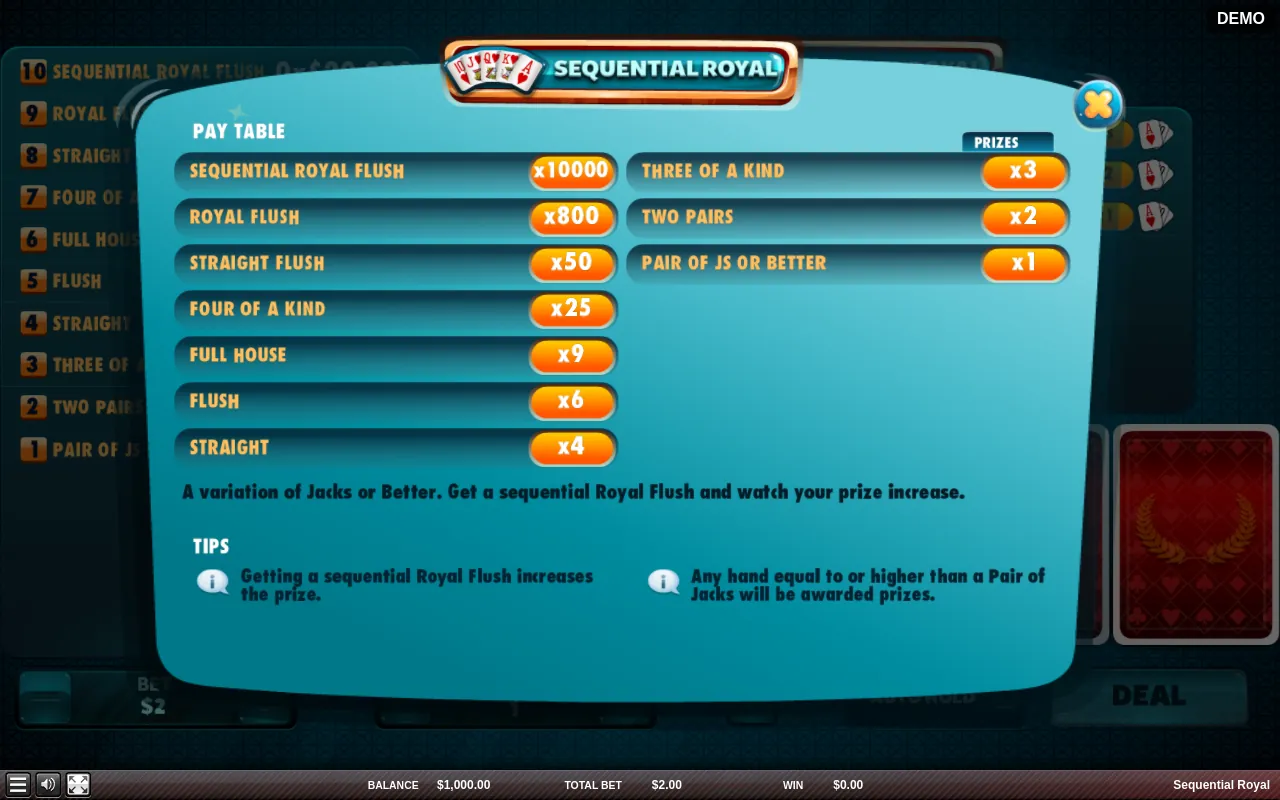
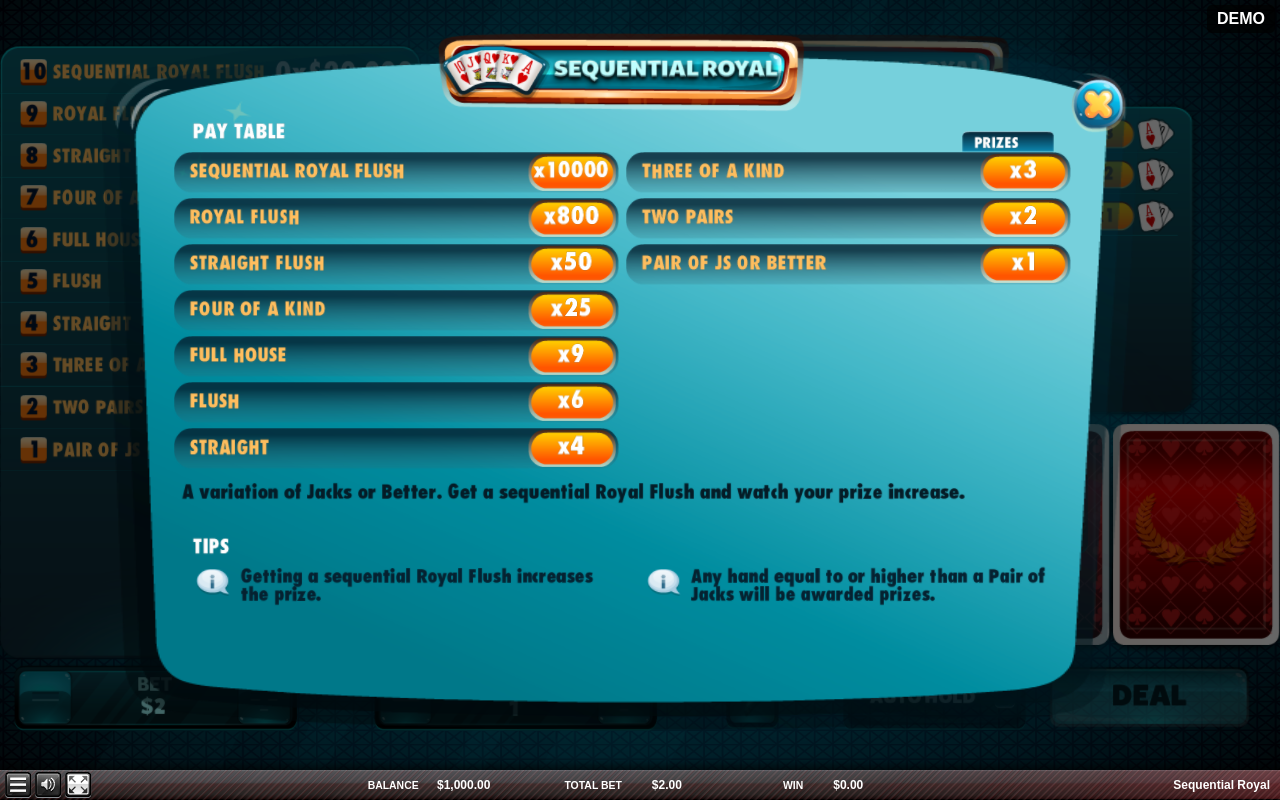
The prize ladder is classic Jacks or Better with one embellishment at the top. Every value below is shown as a multiple of the Pair of Jacks or Better prize, the smallest paying hand:
- Sequential Royal Flush – 10,000x the base prize
- Royal Flush – 800x the base prize
- Straight Flush – 50x the base prize
- Four of a Kind – 25x the base prize
- Full House – 9x the base prize
- Flush – 6x the base prize
- Straight – 4x the base prize
- Three of a Kind – 3x the base prize
- Two Pairs – 2x the base prize
- Pair of Jacks or Better – 1x the base prize
The shape of that ladder tells you how the game plays. Six of the ten paying hands return less than five times the entry prize, so the money sits a long way up, and the step from a Straight Flush to a Royal Flush is sixteen times the step from nothing to a pair.
Four of a Kind is the hinge of the whole table. At 25x the base prize it’s the last rung that arrives with any regularity, and everything above it, straight flushes, royals and the sequential royal itself, is a long-odds event that most sessions never touch.
The bottom half of the ladder is what keeps the balance ticking. Two Pairs and Trips return two and three times the entry prize respectively, which is why the correct play on most ambiguous hands is to protect the made hand rather than chase the card that would complete something grander. The Full House and the Flush, at 9x and 6x, reward exactly that patience.
Read together, the ladder is a lesson in what video poker actually is: a game where the rare hands are priced so far above the common ones that the correct strategy almost never involves chasing them, and where the steady drip of pairs and two pairs does the real accounting.
The Sequential Royal Flush
The game’s namesake is its one flourish. Land a royal flush with the cards in sequential order, ascending from ten to ace or descending the other way, and the prize steps up to twelve and a half times the standard royal, the biggest multiple on the board by a distance.
The order of the cards doesn’t change the poker hand at all; it only matters to the paytable, which is exactly why the premium exists. An ordinary royal is already the second-best result in the game, and the sequential version simply rewards the rarest possible arrangement of it.
It also changes how you play certain hands. Four suited cards in sequence, ten, jack, queen, king, are normally an easy hold for a royal draw. Here that same hold carries a second prize on top, and the temptation to break up a made flush for it is part of the game’s design.
The arithmetic of that temptation is brutal. A four-card royal hold discards a sure thing on the hope of one specific card arriving, and then further hopes that the five arrive in order. The paytable pays 10,000x for the perfect arrangement, but it pays nothing at all for the near miss.
In practice, the two prizes do different jobs. The ordinary royal is the dream that occasionally lands; the sequential royal is the dream with a rider attached, and a player who rearranges sound strategy to chase it pays for the privilege every time the draw misses.
Our Honest Verdict
Overall Rating: 7.5/10
Sequential Royal is a game of small, careful decisions under a calm teal surface. You sit down for it because it hands you the outcome: no meter, no trigger, just five cards and a choice, repeated until the session ends.
Its strength is that 99.77% RTP, honest money backed by a paytable you can hold in your head after one look. Its weakness is that the ladder’s top half barely exists in play. Most sessions run on pairs and two pairs, and the sequential royal the game is named for is a hand you’ll wait years to see.
It’s built for the table-game temperament: someone who’d rather weigh a hold than watch reels spin. Anyone chasing features will find it bare. For the card player, the quiet is the point, and the price of admission is one of the fairest in the building.
Sequential Royal FAQs
-
What is the RTP of Sequential Royal?
Sequential Royal runs at a 99.77% RTP, one of the highest return figures you’ll find in any casino game. -
What kind of game is Sequential Royal?
It’s a single-hand video poker game built as a variation of Jacks or Better, played with five cards and one draw on a single hand. -
How do you win in Sequential Royal?
Any hand equal to or higher than a Pair of Jacks wins a prize. You’re dealt five cards, hold the ones you want to keep, and draw replacements for the rest. -
What is a sequential Royal Flush in Sequential Royal?
A sequential Royal Flush is a royal flush with the cards in sequential order, either ten up to ace or ace down to ten. It pays twelve and a half times the standard royal flush, making it the game’s top prize. -
Who makes Sequential Royal?
Sequential Royal is made by Red Rake Gaming, a studio better known for its reel slots such as Million 7 and Super 25 Stars. -
Are there wild symbols in Sequential Royal?
No. Sequential Royal uses a standard 52-card deck with no wild or scatter symbols, and every hand is settled purely on the five cards you hold and draw. -
What is the biggest prize in Sequential Royal?
The top prize is the sequential Royal Flush, a royal flush dealt in sequential order. It pays twelve and a half times the standard royal flush, the second-best hand on the paytable. -
When is Sequential Royal released?
Sequential Royal’s release date is 29 November 2017.