











Six Feet Under Slot Review
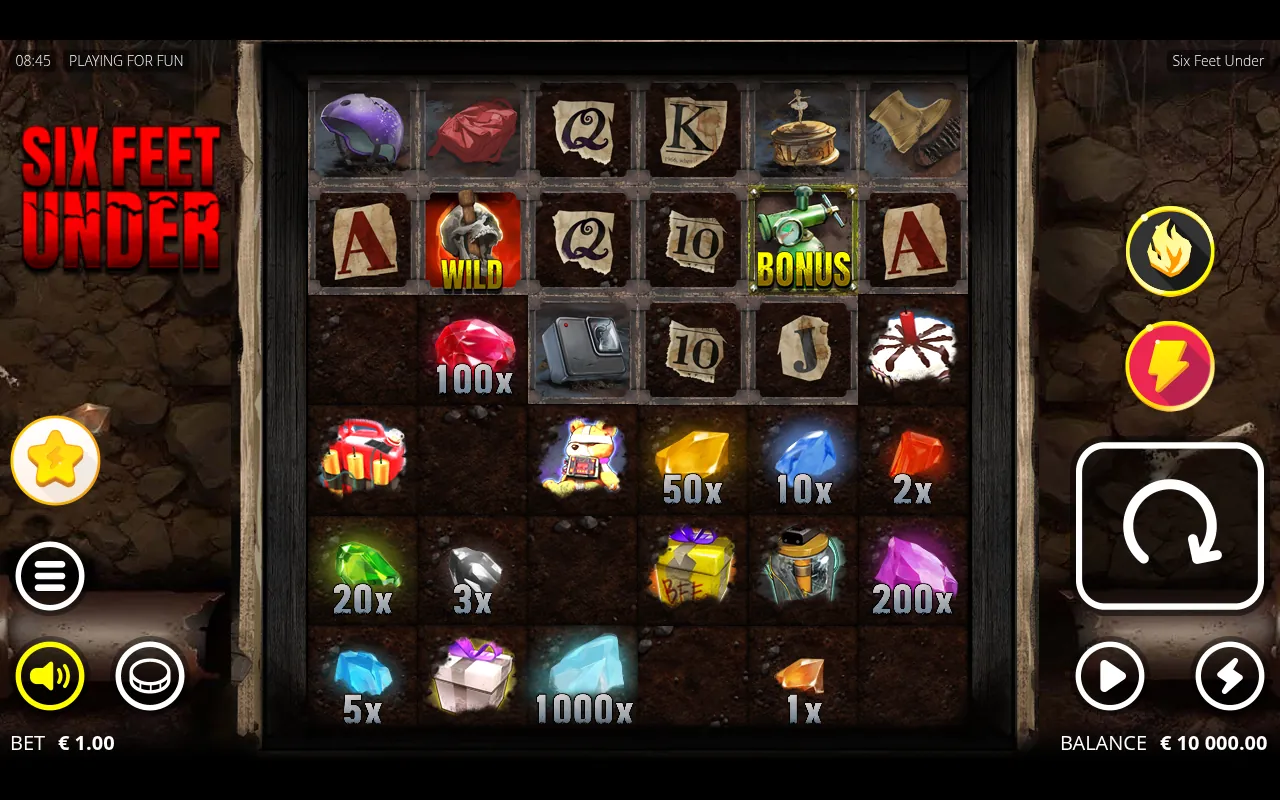
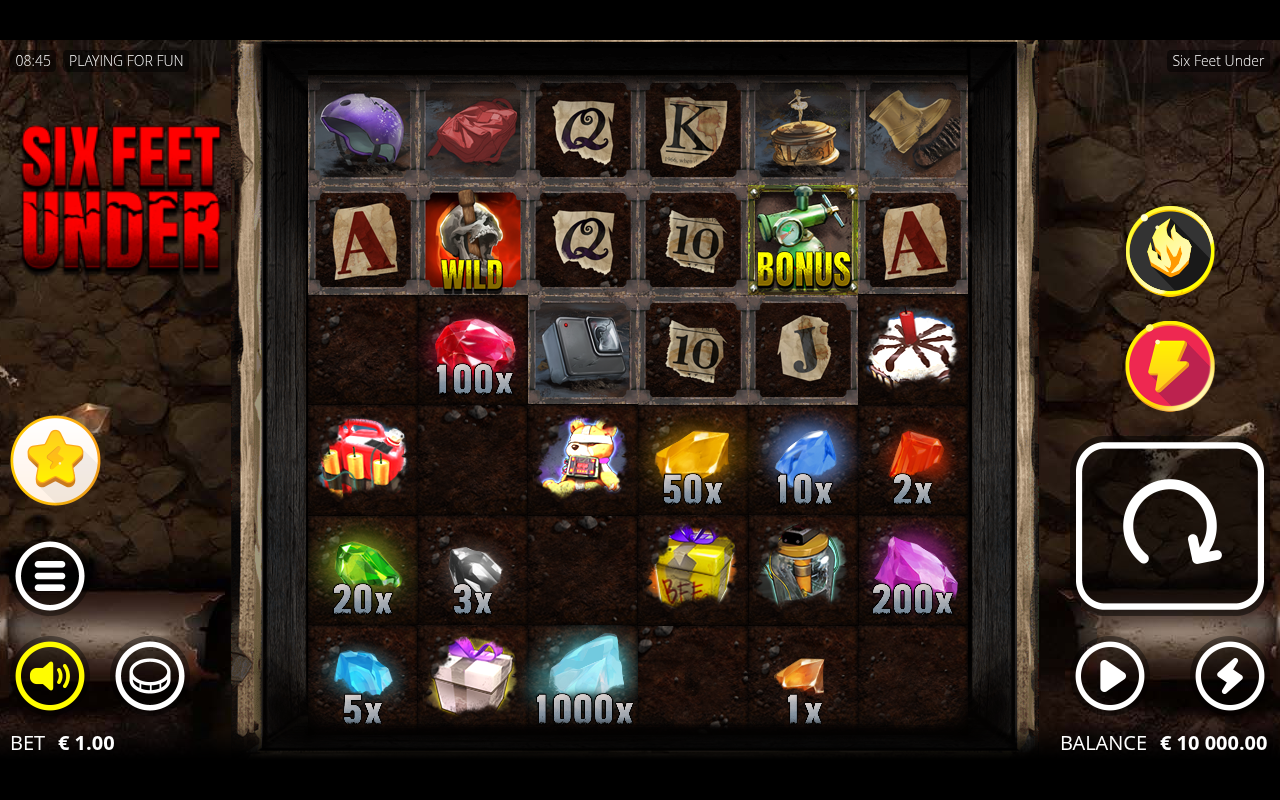
Somewhere beneath the earth, framed by rough rock walls and timber planking, a rusted pipe juts from the stone and nobody’s coming back for it. In Nolimit City‘s Six Feet Under, that buried world is the whole argument: the paytable you can see is close to irrelevant, and every spin is really a bet on what the dirt is hiding. The bottom rows fill with soil each time, and the game’s real rewards sit locked underneath it, waiting for something to blow the ground open.
It’s a bold way to build a slot, and it places this one in the same underground territory as Fire in the Hole xBomb and Misery Mining, though the buried ground here works on its own terms. It runs on a 6×6 grid with cascading reels and an RTP of 96.08%. The studio has always liked its themes grim and gritty, and this one digs deeper than most.
Dirt, Digging and the 6×6 Grid
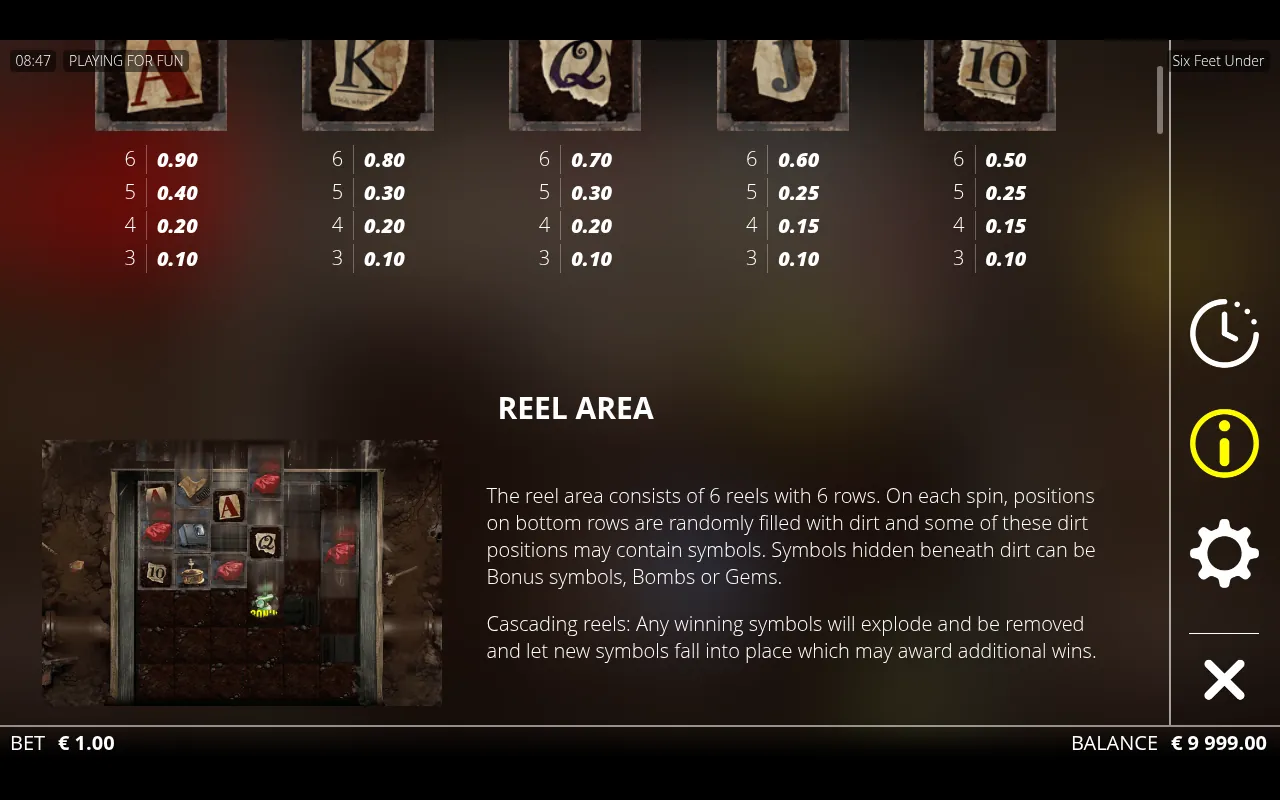
The reel area is six reels by six rows, and every spin works the same way. Positions in the bottom rows are randomly filled with dirt, and some of those dirt positions conceal symbols underneath. A dirt tile isn’t dead ground; it’s a locked box. Until something clears the soil, you can’t know whether a position holds nothing or something that changes the spin entirely.
The rest of the grid behaves conventionally. Symbols pay for three to six of a kind, and the wild stands in where needed. It’s the buried bottom rows that give each spin its tension, because the most valuable effects in the game arrive through the dirt rather than around it.
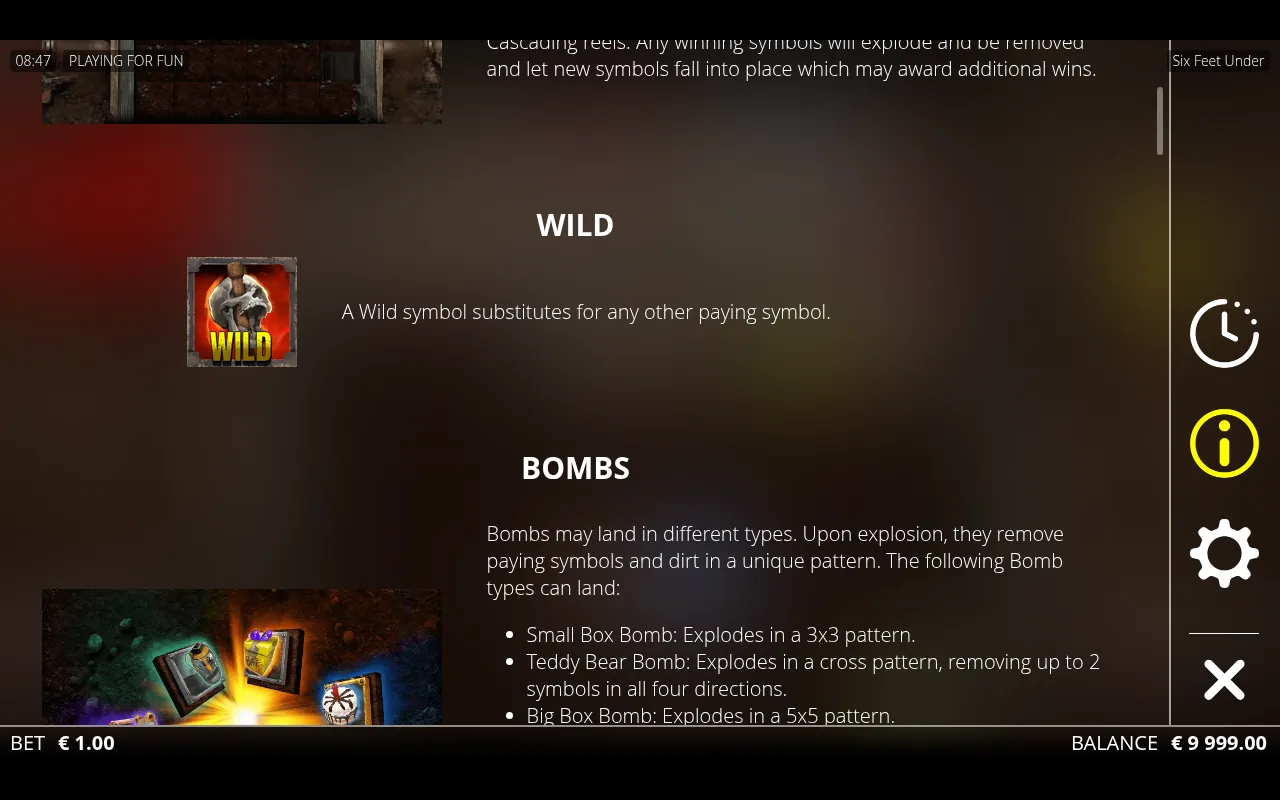
A Wild symbol substitutes for any other paying symbol. That’s its whole job, and it’s a useful one when six-of-a-kind wins are the target on a grid this wide.
Cascading Reels
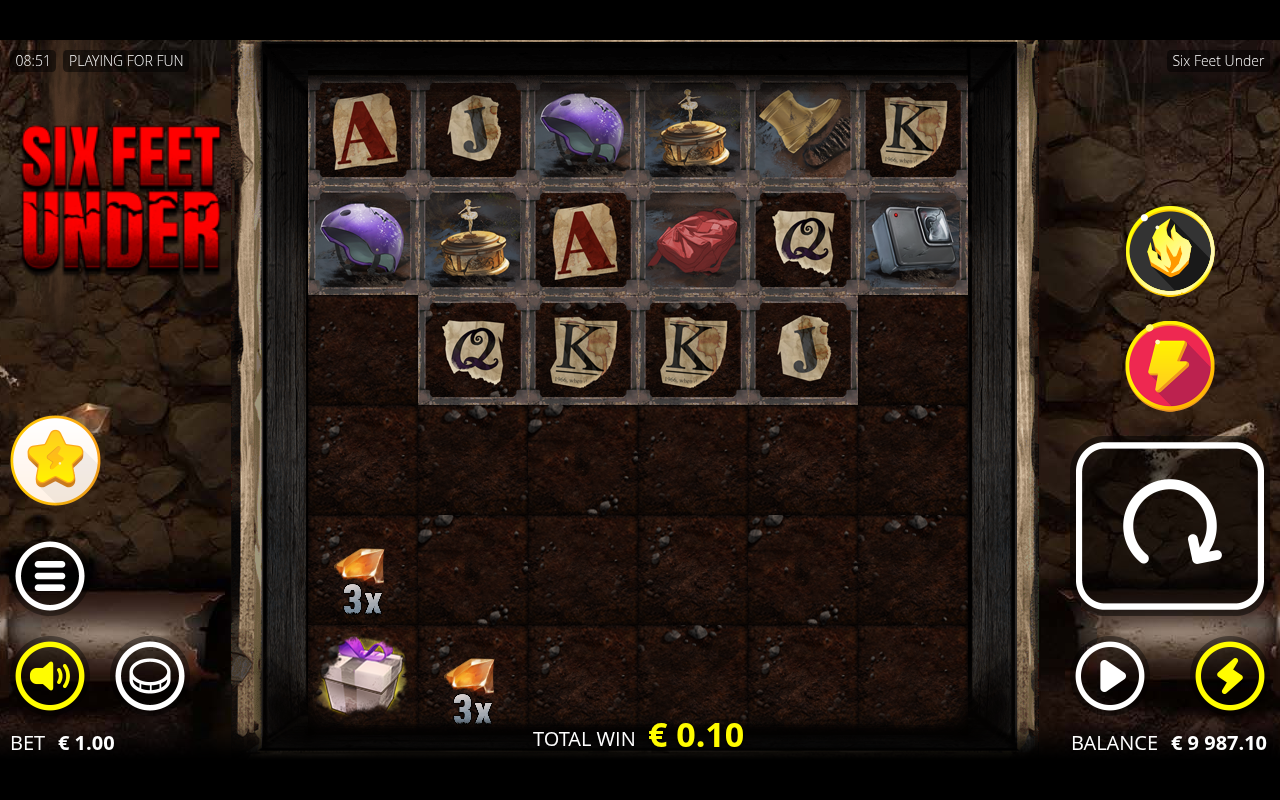
Any winning combination sets off a cascade. The winning symbols explode and are removed, new symbols fall into the gaps, and those fresh drops can form further wins of their own. A single spin can therefore chain several payouts together, one collapse feeding the next.
Each step of the chain is also fresh ground for the buried rows: symbols that fall into dirt positions settle on top of them, and what the dirt holds stays where it was, still waiting. The cascade is the game’s heartbeat, and it’s what turns a modest hit into a run.
What the Symbols Pay
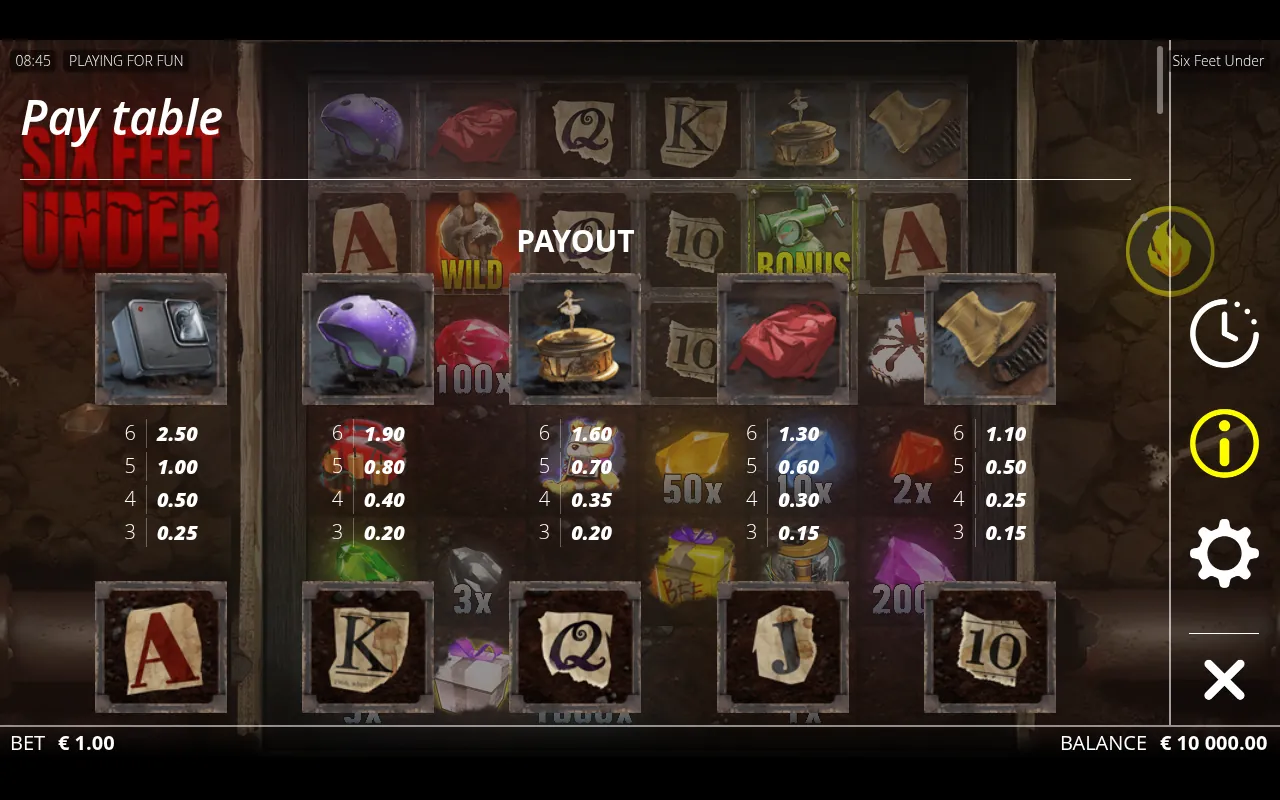
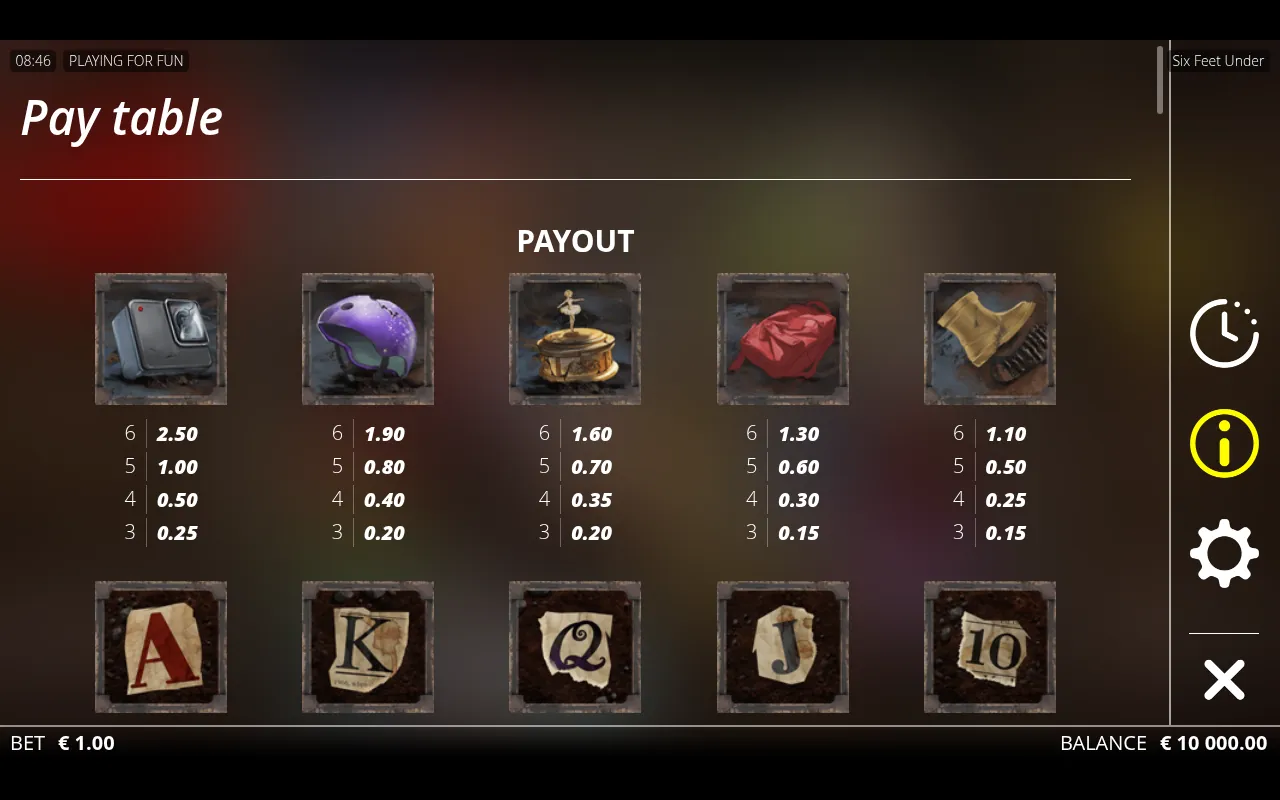
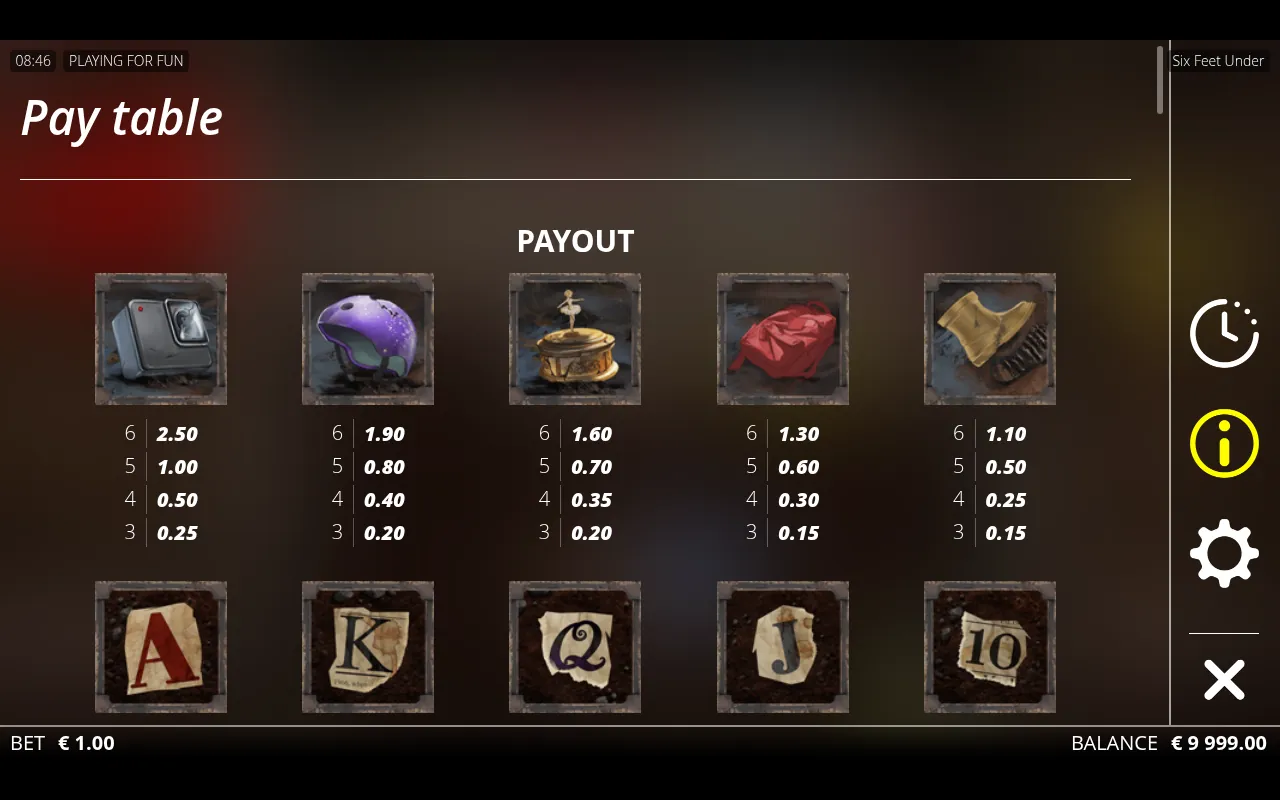
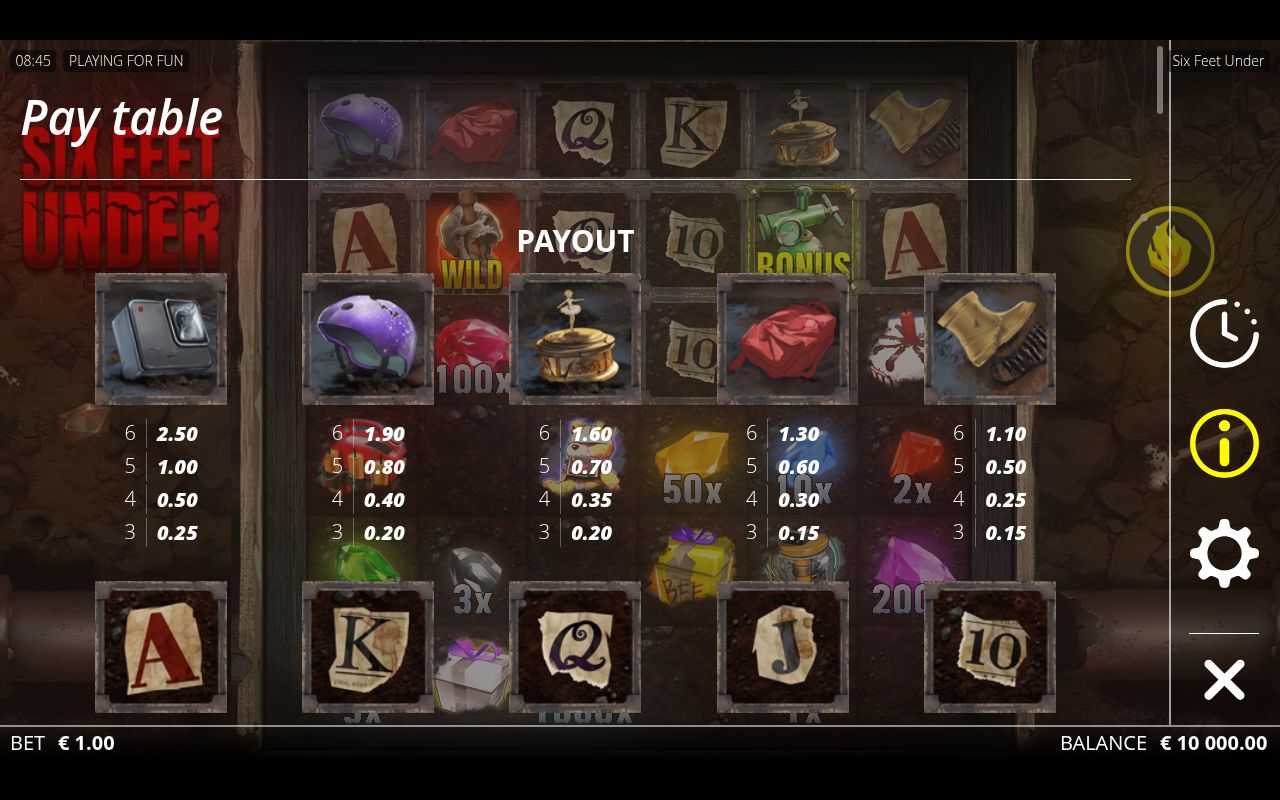
All pays are multiples of the total bet, for three to six matching symbols:
- Camera device: 0.25x, 0.5x, 1x, 2.5x
- Purple helmet: 0.2x, 0.4x, 0.8x, 1.9x
- Gold urn: 0.2x, 0.35x, 0.7x, 1.6x
- Red cloth: 0.15x, 0.3x, 0.6x, 1.3x
- Glove and sock: 0.15x, 0.25x, 0.5x, 1.1x
- A: 0.1x, 0.2x, 0.4x, 0.9x
- K: 0.1x, 0.2x, 0.3x, 0.8x
- Q: 0.1x, 0.2x, 0.3x, 0.7x
- J: 0.1x, 0.15x, 0.25x, 0.6x
- 10: 0.1x, 0.15x, 0.25x, 0.5x
It’s a flat ladder. Even the top symbol returns 2.5x for a full line of six, so the base pays alone won’t move the needle. The picture symbols, a camera, a helmet, an urn, do a little better than the royals, but the gap between the best and worst pay is barely two and a half times at any tier.
The steps between tiers are small and even. Going from three matching symbols to six multiplies the camera’s pay tenfold, from 0.25x to 2.5x, but every other symbol climbs by a similar factor, and no single jump changes a symbol’s standing. Six of a kind is the target on a grid this wide, and the wild helps assemble it, but the symbol values themselves are the floor of the game, not its ceiling.
What the symbols pay, then, is the entry ticket. The bigger money has to come from chains of cascades and from what the explosions turn up, which is where the rest of the game’s design points.
Bombs
Bombs are the digging tools of the game. They may land in different types, and when one explodes it removes paying symbols and dirt in a pattern unique to that type. Because dirt can conceal a Bomb, a tile that looks inert can suddenly go up and rewrite the board.
The patterns are what separate the types:
- Small Box Bomb: explodes in a 3×3 pattern
- Teddy Bear Bomb: explodes in a cross pattern, removing up to two symbols in all four directions
- Big Box Bomb: explodes in a 5×5 pattern
The Teddy Bear is the odd one out, trading raw coverage for reach along the rows and columns. The Small Box is the workhorse, clearing a tidy block wherever it sits. The Big Box takes a 5×5 bite out of a 6×6 grid, which on the right position clears nearly half the visible board at once.
What an explosion removes matters as much as how much. Paying symbols that are cleared simply vanish, letting new ones fall in. Dirt that is cleared is gone for good, and whatever it was hiding, a Bonus symbol, a Gem or another Bomb, is uncovered and comes into play. A single explosion can therefore reveal a second one.
Bombs work with the cascades rather than separately. Clearing paying symbols drops new ones in, so a well-placed explosion can start a chain that keeps paying as the grid refills, and each refill is another chance at a fresh win. Dirt hiding the tools that clear the dirt is the engine of the game.
Position decides everything. A Small Box sitting in a corner wastes most of its 3×3 blast on rock, while the same bomb dead centre takes nine positions at once. The Teddy Bear is the cheapest to waste and the cheapest to benefit from: in the middle of a full board it reaches two positions in each of the four directions, hugging the edges it barely touches anything.
Our Honest Verdict
Overall Rating: 7.2/10
Playing this is a waiting game, and the waiting is the point. Every spin covers the bottom of the grid in soil, and you’re not really spinning for the symbols you can see; you’re spinning for the moment a Bomb uncovers what the ground was holding all along. That’s the one reason to pick it: no other format makes the empty space beneath the reels feel this loaded.
The strength is how completely the buried ground and the cascades feed each other, since one well-placed explosion can start a chain that keeps clearing, refilling and paying. The weakness is everything above ground: the paytable tops out at 2.5x, so a run of quiet spins pays almost nothing and the soil has to deliver or nothing does.
This is one for players who enjoy the slow reveal, the chain reaction and Nolimit City’s grim sense of humour, and it’ll leave anyone hunting big headline multiples cold. If your favourite part of a mine is the moment it collapses, this one was dug for you.
Six Feet Under FAQs
-
What is the RTP of Six Feet Under?
Six Feet Under runs at an RTP of 96.08%. -
What is the grid size of Six Feet Under?
The game uses a 6×6 grid, with the bottom rows randomly filled with dirt on each spin. Some dirt positions can conceal Bonus symbols, Bombs or Gems. -
How do cascading reels work in Six Feet Under?
Any winning symbols explode and are removed from the grid, and new symbols then fall into the empty positions. These fresh symbols can form additional wins, so a single spin can chain several payouts together. -
What do Bombs do in Six Feet Under?
Bombs explode to remove paying symbols and dirt in a pattern unique to their type. The Small Box Bomb clears a 3×3 area, the Teddy Bear Bomb clears a cross pattern of up to two symbols in each direction, and the Big Box Bomb clears a 5×5 area. -
What can be hidden under the dirt in Six Feet Under?
Symbols hidden beneath dirt can be Bonus symbols, Bombs or Gems. A Bomb sitting under a dirt tile means a seemingly empty position can explode and clear the board. -
What does the Wild symbol do in Six Feet Under?
The Wild substitutes for any other paying symbol, helping to complete winning combinations on the 6×6 grid. -
What happens when a Bomb clears dirt in Six Feet Under?
The dirt is removed and whatever was hidden beneath it is uncovered and comes into play. Because hidden symbols can include another Bomb, a single explosion can reveal a second one and extend the clear. -
When is Six Feet Under released?
Six Feet Under’s release date is 20 October 2026. -
Who makes Six Feet Under?
Six Feet Under is made by Nolimit City.